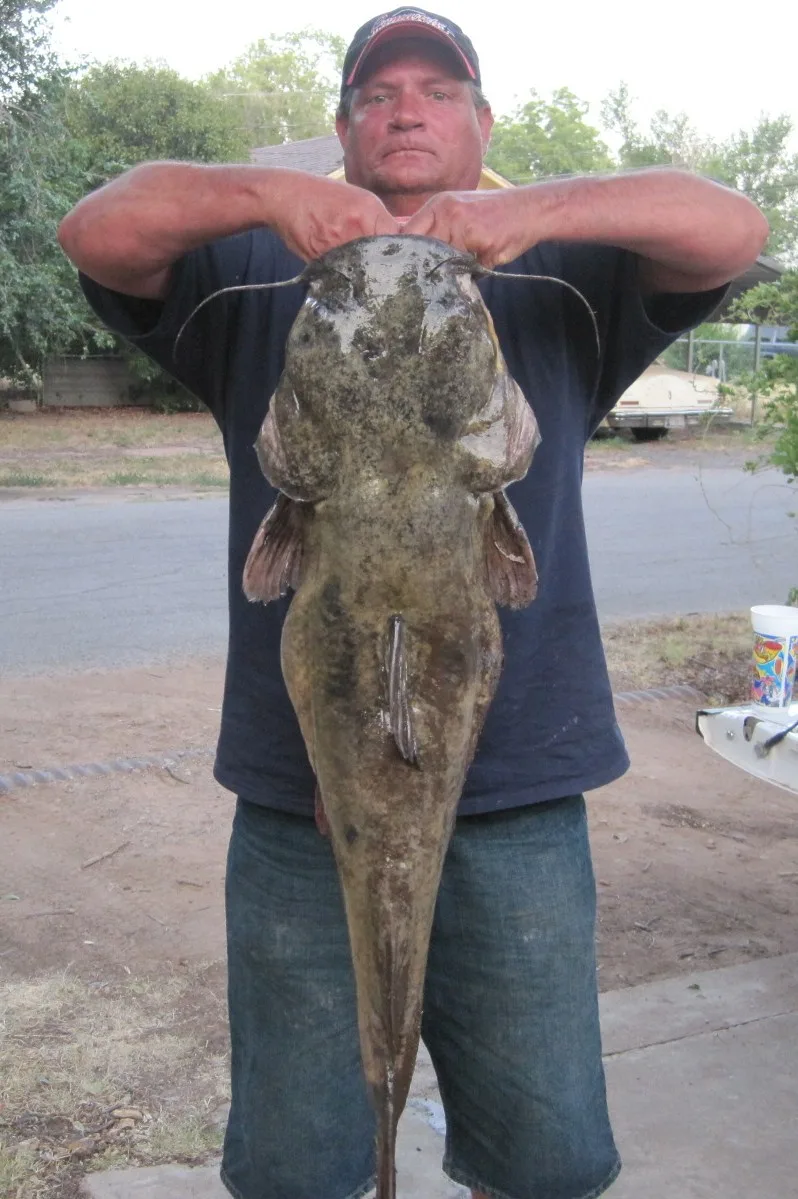
Noodling catfish is legal in seventeen states and a crime in the other thirty-three, and it works for one reason. From late May into July, a male flathead picks a cavity in a bank, a hollow log or a rock pile, fans the eggs, guards the fry and does not leave. A fish that will not abandon the hole bites whatever comes into it, and a noodler’s hand is what comes in.
The whole trick is a father that will not abandon his nest. Everything else about noodling is knowing where the holes are and having the nerve to put your hand in one.
How does noodling work?
- Find the holes. Undercut banks, hollow logs, root wads, rock ledges, culverts, and boat ramps where the sand has washed out from under the slab. Add the man-made junk of a reservoir in 2–10 ft (0.6–3 m) of slow water. Holes cannot be seen from the surface or on a fish finder. Noodlers find them by wading shorelines and probing, and they keep them secret for years.
- Check the hole. Probe it with a foot or a stick first. Oklahoma tournament noodler Nathan Williams describes the tell: something softer than the bottom is usually a flathead. A snapping turtle, a beaver or a snake answers differently, and that check is what keeps hands attached.
- Block the exits. Noodling is a team sport. Partners block the other openings of the cavity with legs or bodies, so the fish has one way out, and that way is the noodler’s arm.
- Go in. Reach in with the palm open, and the fish clamps on the hand or wrist. The jaw has no real teeth, only pads of fine cardiform teeth that rasp skin like sandpaper. A flathead bites and holds without much pressure; a big blue or channel cat, in Will Brantley’s words, bites like a rat trap.
- Get the grip. Slide the hand under the gill plate, bring the other hand in and lock them together. Pull the head to your chest, and wrap your legs around the tail if the fish is big. Holding the lower jaw with finger strength alone is the mistake. That is how Brantley broke his middle finger, and how a friend’s 90 lb (41 kg) fish tore the tendons in his wrist. Out of the water, the how to hold a catfish page has the safe grip.
- Bring it out. The fish rolls and pulls; the noodler stands and pulls back, and the partners lift once it is clear of the hole. Williams says four out of five fish are landed quickly with a buddy’s help. The first minutes out of the hole are when the fish goes wild.
- Never alone, never tethered. Two or more people every time, a life jacket for anyone who is not a strong swimmer, and no stringer rope from fish to body. Williams’s four-year-old son was dragged across a cove by a stringered flathead. An 80 lb (36 kg) fish once broke Williams’s own stringer rope and nearly took him with it.
Some noodlers dive to holes 3–10 ft (1–3 m) down and hold their breath for the fight; most work with their faces above water. Brantley’s rule is that a diver has about two minutes of breath, and most people about one, before panic sets in. The deep holes belong to the experienced.
What do you need?
Gloves are the one essential, and the surprise is which ones. Tacky gardening gloves or cotton shop gloves grip a wet fish; vinyl and Kevlar gloves slide off it. Then:
- a Kevlar sleeve for the forearm, against rock and rasp;
- a snug swimsuit or old jeans that nothing can snag, and old shoes;
- goggles, only in clear water;
- a stick for probing, where the state allows one;
- a stringer that stays on the bank.
No hooks, no ropes with hooks, no scuba. They are illegal in every noodling state and dangerous besides.
Water temperature is the only electronics you need. The flathead spawn runs at 75–80 °F (24–27 °C); in Texas that is late May through August. The catfish water temperature page has the thresholds.
Where is noodling legal?
Seventeen states allow some form of hand fishing. The rows below were checked against each state’s own regulation in October 2026. They change, so read the current booklet before you go, and a fishing license is required in every one of them.
| State | Season | The rules that matter |
|---|---|---|
| Alabama | Year-round | Nongame method with a sport license; only a single barbless hook may be used, never barbed or treble; one catfish over 34 in (86 cm) a day |
| Arkansas | Most waters Jul 15–Oct 31; Mississippi River May 1–Jul 15 | Called “hogging” in the code; catfish, buffalo, carp and drum; half the daily catfish limit; the Ouachita below the Little Missouri is closed |
| Georgia | Mar 1–Jul 15 | Flathead, channel and blue only; no scuba; no altering a hole and no lifting a box out of the water |
| Illinois | No season in the statute | Taking fish by hand is a listed sport-fishing method with a license; confirm site rules with IDNR |
| Kansas | Jun 15–Aug 31, sunrise to sunset | Flathead only; a $27.50 hand-fishing permit on top of the license; the Arkansas and Kansas rivers and federal reservoirs beyond 150 yd (137 m) of the dam; a stringer only once the fish is at the surface |
| Kentucky | Jun 1–Aug 31, half an hour either side of daylight | “Tickling and noodling”; a handled hook is allowed; 15 rough fish a day, 5 of them catfish; not in department lakes under 500 acres (200 ha); hand-caught fish never count as state records |
| Louisiana | Year-round | Legal since August 1, 2022; catfish only; the LDWF booklet restricts grabbing fish out of logs, buckets, barrels, drums and nesting areas, so read that line first |
| Maryland | No season in the rule | “Hand” and “noodling” are listed hand gear for nontidal waters since 2013, no special rules; blue and flathead are invasive there, and DNR asks that they are not released |
| Mississippi | May 1–Jul 15 | Hands or a bare rope; wooden boxes only, never barrels, tires, pipe or water heaters; no cavity boxes at all on the Tenn-Tom; no lifting a box out of the water |
| North Carolina | Year-round | “Grabbling”; catfish are nongame, so no size or creel limit by this method; blue and flathead are invasive in the coastal rivers |
| Oklahoma | Year-round, daylight only | Hands only; carrying a hook, gaff, spear or hooked rope while noodling is proof of a violation; no sunk drums, tubs or boxes; flathead limit five, no size limit; blue and channel 15 combined, one over 30 in (76 cm) |
| South Carolina | No closed season | A stick, pole, rod or PVC pipe must be used to dislodge the fish; no scuba; all freshwater except SCDNR state lakes |
| Tennessee | Year-round except listed waters | “Grabbling”; not within 100 yd (91 m) below a dam; parts of Dale Hollow, Norris and Watauga closed Jan 1–Apr 30; catfish by the local limits, one over 34 in (86 cm) a day |
| Texas | Year-round | Legal since June 17, 2011; channel, blue and flathead in fresh water; hands only, not even a stick; no placed boxes, barrels or pipes; license with freshwater endorsement |
| Virginia | Year-round in 17 Southside counties; west of the Blue Ridge only Apr 1–May 15 and Oct 1–Nov 30, daytime | “Grabbing” of nongame fish, banned in public impoundments, the Roanoke and Dan, the James in Goochland and stocked waters; unlawful elsewhere in the state |
| West Virginia | Jun 15–Aug 31, sunrise to sunset | Legal since 2018; four catfish a day, one over 35 in (89 cm), at most two blues; natural cavities only; no scuba; state impoundments closed except Cheat, Stonecoal, Hawks Nest, Mount Storm and the Corps lakes |
| Wisconsin | Jun 1–Aug 31 | Emergency rule 2018, permanent 2020; one flathead and five channel cats a day; no scuba, hooks or spawning boxes; boundary waters only on the Wisconsin side |
| Missouri | Never | Banned since 1919; a 2005–2006 trial season on three rivers was ended in 2007 after study data suggested hand fishing might reduce catfish numbers; MDC: “if they’re harvested off the nest, the eggs are gonna die” |
| Every other state | No | Including Florida, Iowa, Nebraska, Indiana, Ohio and every western and northeastern state |
Two patterns stand out. Four states (Kansas, Kentucky, West Virginia, Wisconsin) open the season in June and close it at the end of August, which is the spawn and nothing else. Arkansas does the opposite and keeps most waters shut until July 15, when the nests are empty.
The gear rule is nearly universal: hands, maybe a bare rope or a stick to feel with, and never a hook on a pole except in Kentucky and Alabama. A sunk barrel or box to make a hole is illegal in every state that mentions it. A placed cavity concentrates the spawning males of a whole cove into one spot.
What actually hurts people?
Outdoor Life found no safety statistics for noodling, so the record is the injuries noodlers report themselves. The table is built from those reports.
| Hazard | What the record says | What prevents it |
|---|---|---|
| Drowning | Snagged clothing underwater, a stringer tied to the body, a big fish pinning an arm, current below a dam | A partner in the water every time, a life jacket for weak swimmers, the stringer on the bank, never below a dam |
| The fish | Broken fingers from jaw grips, torn wrist tendons from a 90 lb fish, the wind knocked out, broken noses | The gill-plate grip with hands locked, head to the chest; big fish are two-person fish |
| Spines | A channel cat’s dorsal spine through a forearm, an emergency-room bill | Gloves and a sleeve; know whether the hole holds a channel cat before you commit the arm |
| Debris | Rebar, broken concrete, glass and rock cutting arms and hands | A cut-resistant sleeve, old shoes, and a hole you have probed |
| Other animals | Snapping turtles, beavers, muskrats, cottonmouths, alligators in the Deep South | A fully submerged hole checked with a stick; Oklahoma’s Cliff Sager knows of no turtle or beaver bite in 21 years |
The one hazard that kills is the first row. Everything in it is prevented by the same three habits: a partner, nothing tied to your body, and slack water.
Why does the male stay, and does noodling hurt the fish?
All three big catfish are cavity nesters. The male picks and cleans the site, and the female lays a golden mass of 100,000 eggs or more. The male fans it with his fins for oxygen, eats little or nothing, and guards the fry for about a week after they hatch, four to six days later.
That is why a spawning male is nearly impossible to catch on a catfish rig and easy to catch by hand. The rest of the year, a flathead wants a live bluegill, as the best catfish bait page explains. Oklahoma biologist Austin Griffin adds a detail noodlers confirm: flatheads are less aggressive before the eggs are laid, so the early-season fish bites softer than the one over fry.
The argument against noodling is that it takes the father at the exact moment the year’s eggs depend on him. Missouri ran an experimental season on the Fabius, Mississippi and St. Francis rivers, planned for five years. It was ended in April 2007, after two seasons. In the words of the fisheries chief at the time, study data “suggested legal hand-fishing might reduce catfish numbers”. The department’s line since is that a nest left unguarded loses its eggs.
The argument for it is that the harvest is small. A Texas study on Lake Palestine found total annual flathead harvest, by all methods, under five percent. A 2017 Texas survey had hand fishers catching about eight catfish a day and keeping two or three. Oklahoma looked at its own data and found nothing showing that spawning-season harvest hurt the population. It then set one flathead limit of five a day for every method; noodlers had been held to three while rod-and-reel anglers could keep 15.
How big do noodled flatheads get?
What both sides agree on is that a big flathead is old. The 123 lb (56 kg) world record was at least 22 years old, and West Virginia’s rivers hold fish aged at 30 to 40 years. A 40 lb (18 kg) noodled fish has been guarding nests for a decade or more.
The world record catfish page has the certified fish. The hand-caught benchmarks are their own list:
- an 85 lb 2 oz (38.6 kg) flathead from Lake Tawakoni, Texas, in 2017;
- a 98.7 lb (44.8 kg) Texas fish in 2023, caught with a dive air supply;
- a 106 lb (48 kg) East Texas fish in 2021 that never saw a certified scale.
The IGFA does not recognize the method, and Kentucky’s guide says a hand-caught fish cannot be a state record. The 2025 Okie Noodling Tournament in Pauls Valley was won by a 14-year-old with a 53.5 lb (24.3 kg) flathead.
Take the photo and put the big ones back. Catch and release matters more for a 20-year-old fish than for any other catch of the year. Noodling is one technique among several that catch flatheads; the catfish hub covers the rest.
Related
Section guide
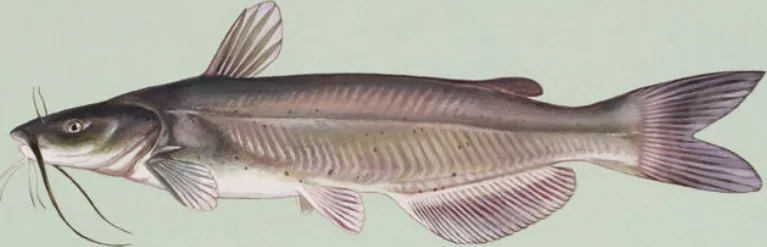
Catfish: Species Identification, Baits, Seasons and RecordsThe catfish species anglers catch most, channel, blue and flathead first: how to tell them apart by the anal fin, when they spawn, what bait each wants.
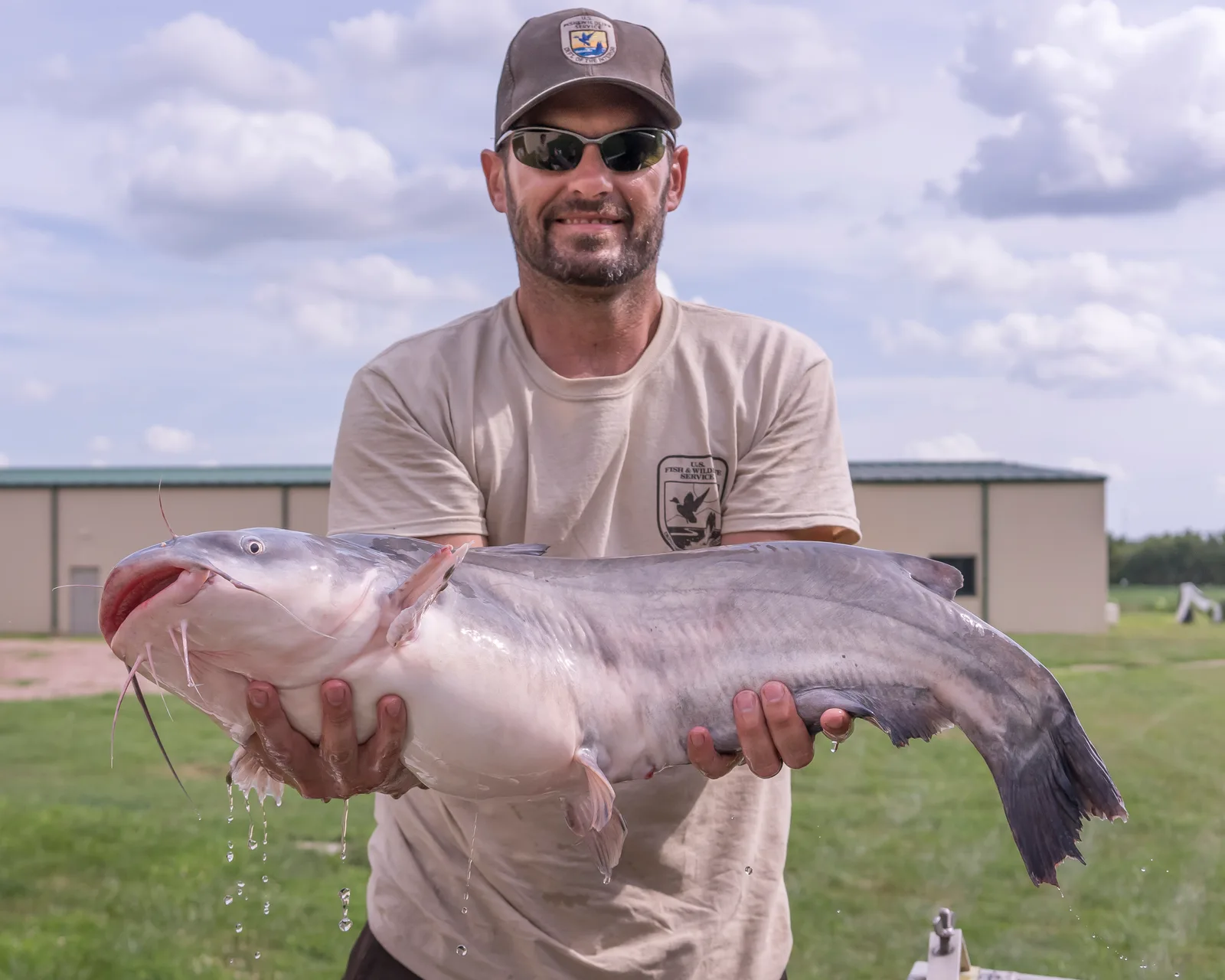 World Record Catfish: Blue, Flathead, Channel, Wels, Mekong Giant
Every world record catfish: the 143 lb blue, 123 lb flathead, 58 lb channel of 1964, 297 lb wels and 646 lb Mekong giant, and how a record is certified.
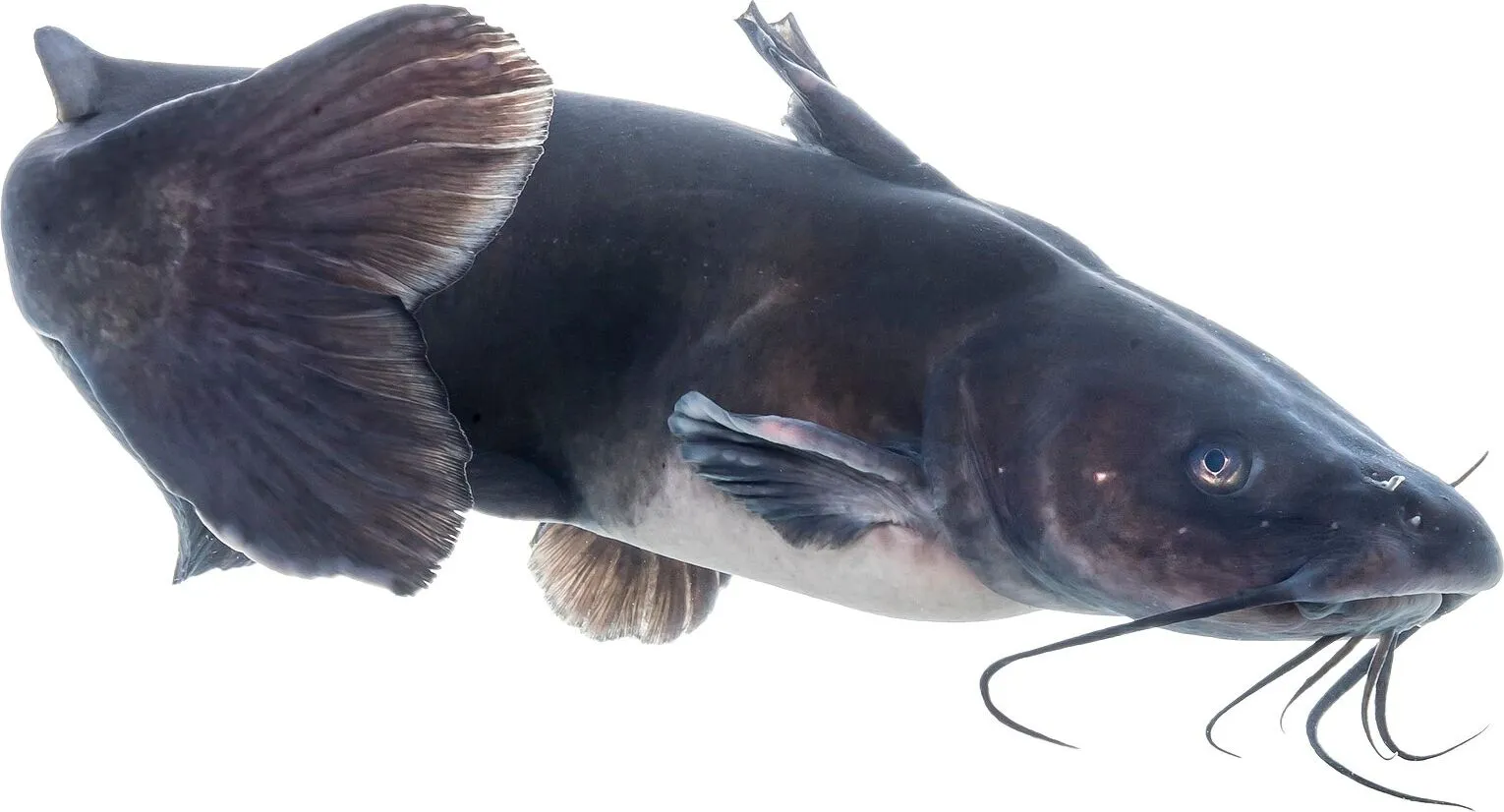 How to Hold a Catfish Without Getting Stung, Small to Big
How to hold a catfish safely: where the three spines are, the grip behind the pectoral fins for small fish, the lip grip for big ones, and first aid for stings.
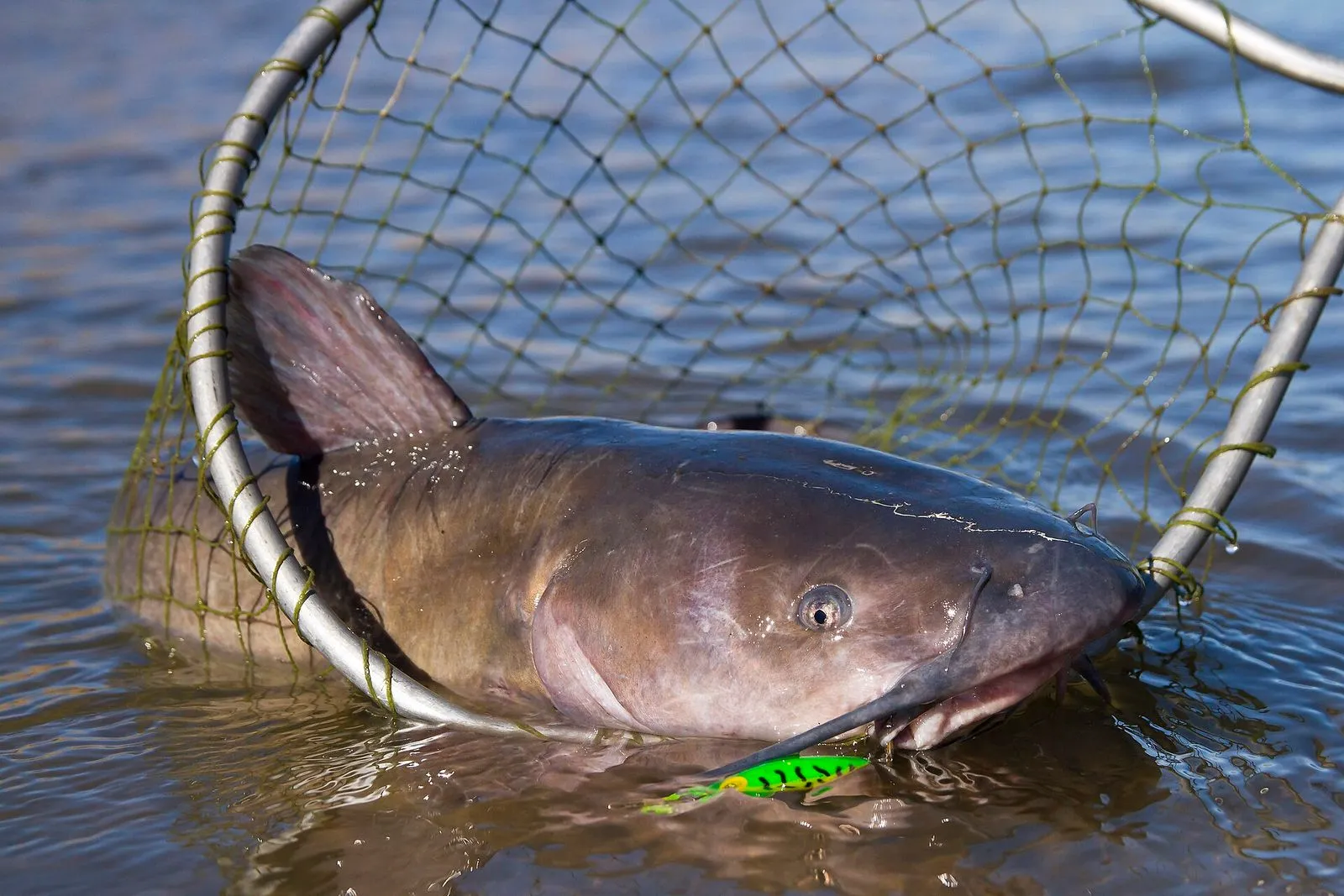 Catfish Rigs: The Five That Matter and When to Use Each
The five catfish rigs the guides use, slip sinker, Santee Cooper, three-way, slip float and bottom rig, with sinker weights, hook sizes and when to use each.
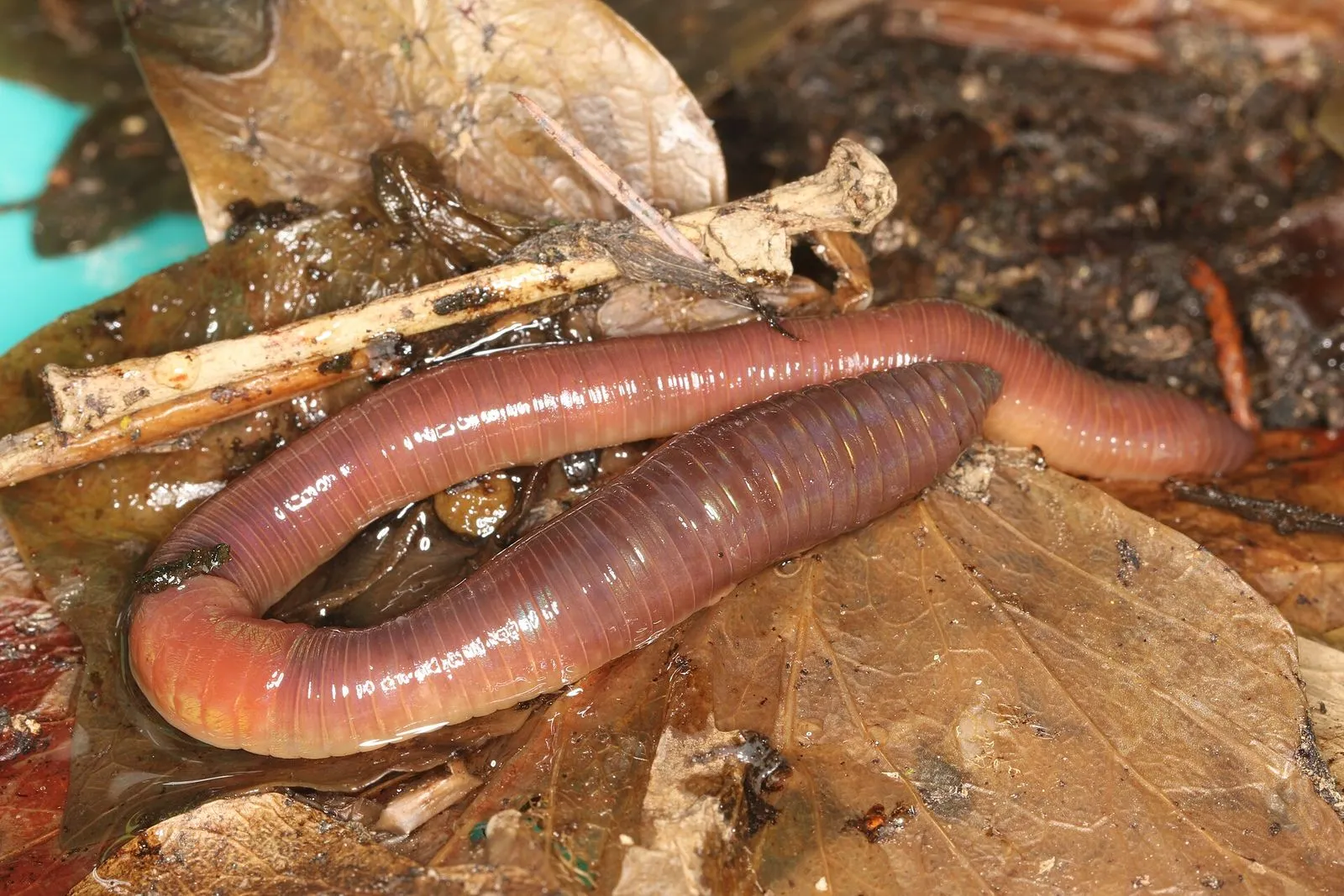 Best Catfish Bait: What Channel, Blue and Flathead Catfish Eat
The best catfish bait by species: cut shad for blues, punch and dip baits for channels, live bluegill for flatheads, and which prepared baits to buy.
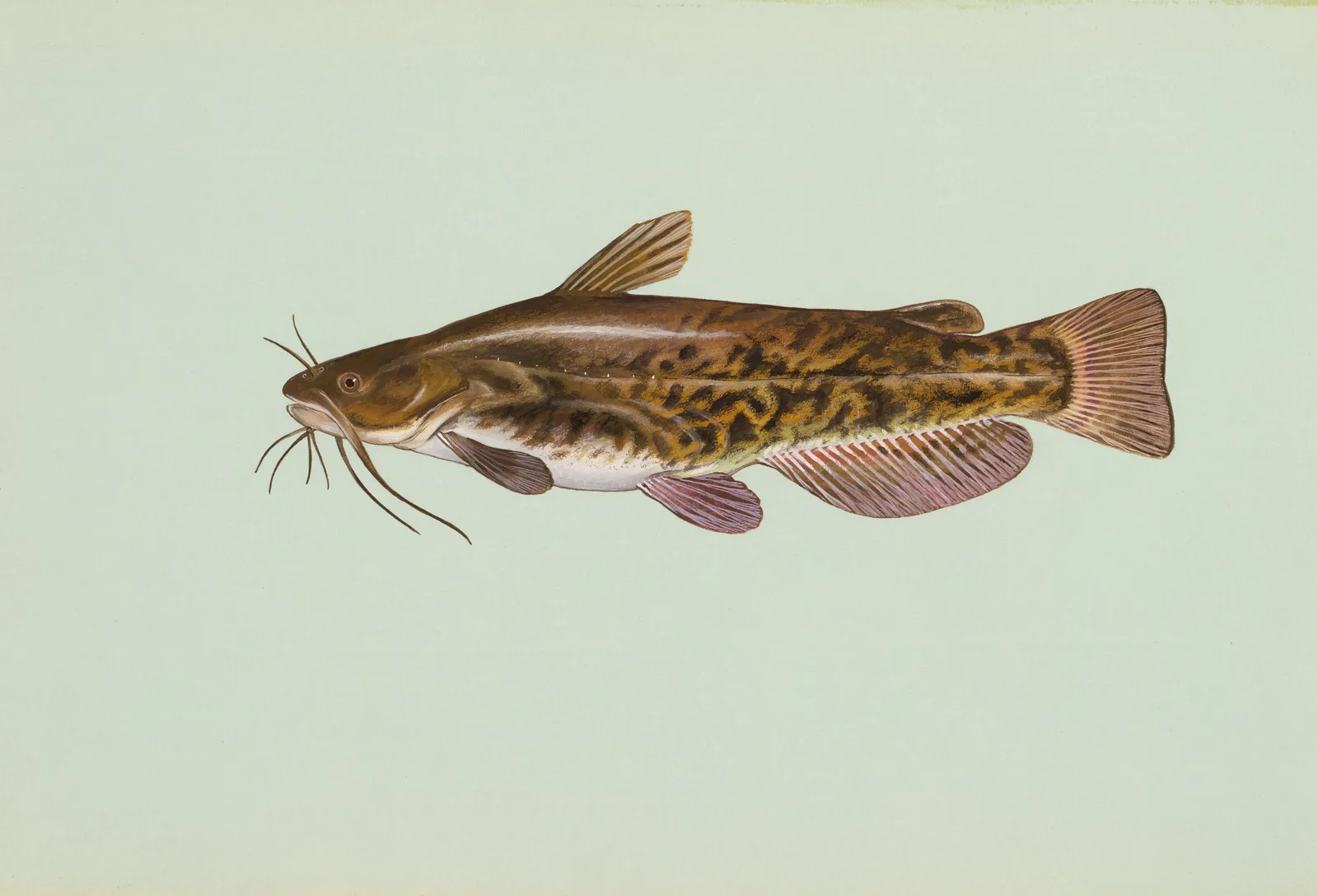 Bullhead Catfish: Black, Brown and Yellow Bullheads Compared
Black, brown and yellow bullheads told apart, a season table on water temperature, the worm rig, the sting, skinning in three cuts, and the state records.
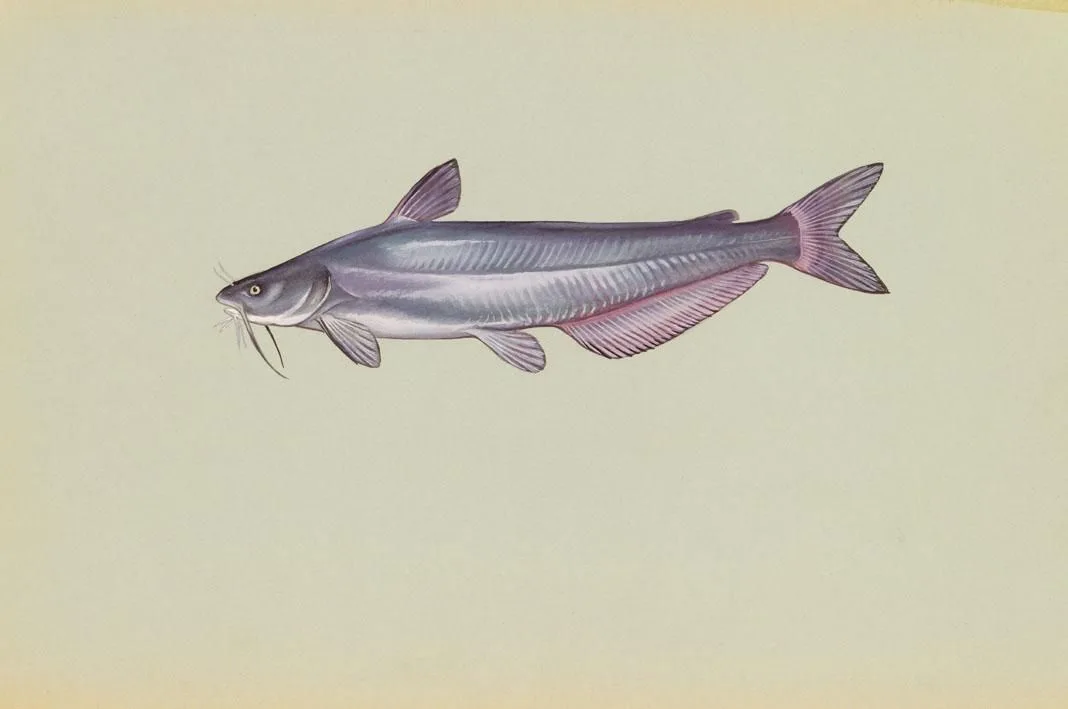 Blue Catfish: Identification, Size, Season and the Chesapeake Invasion
Blue catfish from the agency data: the 30-ray anal fin, how big and old they get, a month-by-month season from a river guide, and the Chesapeake invasion.
Sources
- Oklahoma Department of Wildlife Conservation, methods of take (noodling)
- Kansas Department of Wildlife and Parks, hand fishing
- Texas Parks and Wildlife Code §66.115, handfishing (2011)
- Arkansas Game and Fish Commission code 26.05, hogging and noodling restricted
- Georgia DNR fishing regulations, fishing methods (noodling)
- Mississippi freshwater fishing regulations, grabbling
- South Carolina DNR, nongame device: hand grabbing (noodling)
- North Carolina Wildlife Resources Commission, nongame possession and collection
- Tennessee fishing regulations, methods other than rod and reel
- Alabama fishing regulations, gigs or grabbling
- Kentucky Fishing and Boating Guide (tickling and noodling)
- West Virginia DNR, fishing regulations summary 2025 (hand-fishing)
- Wisconsin DNR, catfish hand fishing regulations
- Louisiana RS 56:320, methods of taking freshwater fish
- Virginia 4VAC15-350, fish: gigs, grab hooks, trotlines, snares
- Maryland COMAR 08.02.25.02, recreational gear, nontidal waters
- KY3, two arrested for noodling at Lake of the Ozarks (Missouri Department of Conservation quoted)
- Columbia Missourian, No hook, no line, no sinker (Missouri's 1919 ban and the 2005–2007 experimental season)
- University of Missouri Extension, The noodler and the damage done (Mark Morgan's study; the trial ended in 2007)
- Outdoor Life, the complete beginner's guide to noodling catfish
- Field & Stream, Will Brantley on catfish noodling
- Game & Fish, catfish noodling will test your resolve (Nathan Williams)
- Texas Parks and Wildlife, flathead catfish
- Missouri Department of Conservation, flathead catfish
- News On 6, 2025 Okie Noodling champion