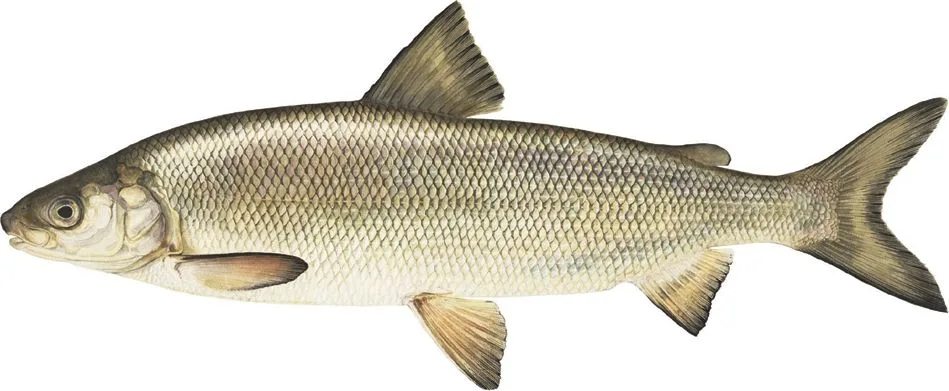
To a Great Lakes angler, whitefish means the lake whitefish: a silver, small-headed cousin of the trout that lives near the bottom of cold, deep lakes. Most run 17 to 22 in (43–56 cm) and 1.5 to 4 lb (0.7–1.8 kg). It spawns at night in November and December, and anglers catch it mostly through the ice, on small baits fished near bottom. It is the fish in the Door County fish boil and the main commercial catch of the upper Great Lakes.
Maine biologists aged an 11 in whitefish at 43 to 45 years old. And the biggest whitefish on record never saw a hook: 42 lb, from a Lake Superior net around 1918.
What is a whitefish?
Three different things carry the name. On the Great Lakes it is the lake whitefish. In a Rocky Mountain trout river it is the mountain whitefish. At the seafood counter it is any lean, white-fleshed sea fish, cod or haddock or pollock, and no relation at all.
Which one is most common depends on where you fish. On the Great Lakes it is the lake whitefish, whose native range runs from Alaska across most of Canada to northern New England. In Alaska the whole group dominates: the state’s Department of Fish and Game calls whitefish the most abundant group of fish north of the Alaska Range.
The freshwater whitefishes all belong to the trout and salmon family. All of them carry the small adipose fin on the back, near the tail.
| Fish | Typical size | Where | The mark |
|---|---|---|---|
| Lake whitefish | 17–22 in (43–56 cm) | Great Lakes, Canada, Alaska, New England | Snout overhangs the mouth; deep, flat-sided body |
| Cisco (lake herring, tullibee) | About 13 in (34 cm) | Great Lakes and northern lakes | Lower jaw reaches or passes the snout |
| Round whitefish (menominee) | 8–12 in (20–30 cm) | All Great Lakes but Erie | Cigar-shaped; one flap between the nostrils |
| Mountain whitefish | 10–16 in (25–41 cm) | Cold rivers of the Rockies and Northwest | Round body, pointed snout, small round mouth |
| Sheefish (inconnu) | To about 42 in (1 m) | Alaska, northwest Canada | The giant of the group; a toothed predator |
The sheefish is the outlier: its mouth is full of small teeth, and Alaska’s biologists say adults feed almost entirely on other fish. Burbot, sturgeon, gar and bowfin, the other odd ones out, are on the other freshwater fish page.
Whitefish or cisco? Look at the mouth
Minnesota DNR’s key settles it: the lake whitefish has a snout that overhangs the lower jaw, and the lower jaw of the cisco extends up to or beyond the tip of the snout. A whitefish feeds down, off the bottom. A cisco feeds forward, on plankton.
Two more checks. A lake whitefish has two small flaps of skin between its nostril openings, and a round whitefish has one. A sucker has thick lips, a mouth built for suction and no adipose fin. Big whitefish grow a fleshy hump behind the head that makes the small head look smaller still. Minnesota DNR notes the old name humpback, given because the head is small for the length of the body.
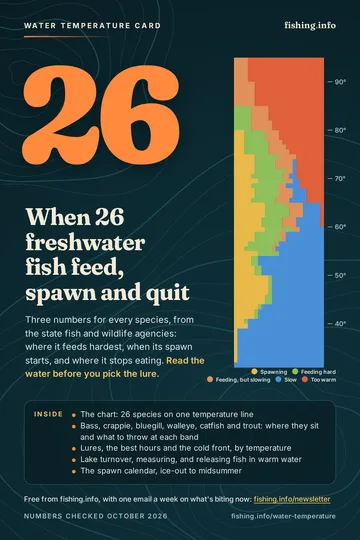
Free card: what 26 species do at your water temperature
Plus one email a week on what's biting now. No sales pitches. Privacy.
Where do whitefish live?
The native range runs from Alaska across most of Canada, south to the Great Lakes and east through northern New England. In the West the fish is an import. It was stocked into Lake Pend Oreille in Idaho and Flathead Lake in Montana, probably in the late 1800s, spread down the Columbia and now supports a winter fishery on Washington’s Banks Lake.
Whitefish want cold water and stay close to the bottom. New York’s assessment puts them at 40 to 130 ft (12–40 m) in the warm months; Michigan says 200 ft and deeper as summer heat climbs. They feed there too. The Great Lakes Fishery Commission names a small bottom-living amphipod, Diporeia, as a major diet item. It has fallen to near absence in the four lower Great Lakes, and its loss is blamed for slower growth and thinner whitefish in Lakes Michigan, Huron and Ontario. They share those cold depths with the lake trout. They come shallow twice: in spring, and again in late fall to spawn.
How do you catch whitefish?
Ice is the main season, from December to March, and the method is small and near bottom. Maine’s fisheries department puts it plainly: small baited jigs in the lowest two to three feet of the water column, in 30 to 60 ft (9–18 m) of water.
- Green Bay, Wisconsin. A winter fishery big enough to keep more than 20 guides busy. The rig Dale Bowman described for the Chicago Sun-Times is typical: a small jigging lure on the bottom of the line, with a No. 6 hook baited with a waxworm sliding above the swivel. Fish shallower on cloudy days and deeper on sunny ones.
- Off the bottom, not on it. Gord Pyzer of In-Fisherman, writing about Lake Superior and Lake Huron, uses jigging lures such as the Jigging Rap and a small spoon tipped with a shiner head. His warning: whitefish are bottom fish, but he never starts on the bottom, because they will hit a bright lure as much as 10 ft (3 m) above it.
- Light line, soft hands. Michigan DNR describes a small, exceedingly delicate mouth. Washington’s biologists fish 4 to 8 lb line and a size 8 or 10 hook and call the fish hook-sensitive.
- Lake Michigan piers in November. Whitefish come to the pierheads to spawn, and anglers take them on a small hook with a single fish egg. At Grand Haven, Muskegon and Whitehall, Michigan allows only one unweighted single-point hook from November 1 to 30, because too many fish were being snagged.
In a western river in January the fish on the line is the mountain whitefish. Idaho Fish and Game’s advice for it: a single salmon egg, a piece of worm or a small weighted nymph, drifted through slow to medium current in the warmest part of the day. On the same ice as the whitefish, the burbot is the other deep, cold-water fish that bites best in winter.
How big do whitefish get?
Great Lakes commercial fish run 17 to 22 in and 1.5 to 4 lb. Maine’s inland whitefish are normally 14 to 20 in and 1 to 3 lb. Michigan DNR notes that fish of more than 20 lb were once taken, more often fifty years ago than now.
They can be far older than they look. Michigan gives a lifespan of over 25 years and New York up to 30 or more. The Maine fish in the quote above was 11 in long and four decades old.
| Record | Weight | Where and when |
|---|---|---|
| IGFA all-tackle | 14 lb 6 oz (6.52 kg) | Dennis Laycock, Meaford, Ontario, May 21, 1984 |
| Ontario registry | 14.77 lb (6.70 kg) | Georgian Bay near Wiarton, 1996 |
| Michigan | 14.28 lb (6.48 kg) | Lake Superior, 1993 |
| Minnesota | 13 lb 9 oz (6.15 kg) | Lake of the Woods, April 6, 2019 |
| Montana | 10.46 lb (4.74 kg) | Flathead Lake, 2006 |
| Washington | 7.86 lb (3.57 kg) | Lake Roosevelt, 2023 |
Minnesota’s record went to a man from Oklahoma who was ice fishing for walleyes at sunset.
How many can you keep, and are they good to eat?
Wisconsin allows 10 a day in total of whitefish, cisco and their hybrids, Green Bay included. Michigan allows 10 on the Great Lakes, counted together with cisco and round whitefish. Minnesota set its first limit ever, 15 fish, on March 1, 2025. Check the current rules for your water; all three have been under review.
On the plate it has been praised for three centuries. Cadillac, at Mackinac around 1695, wrote that a better fish cannot be eaten. Wisconsin Sea Grant describes a delicate, mild flavor and medium-firm flesh with a large flake, firmer and fattier in cold weather, with more omega-3 fat than Atlantic cod. The Door County fish boil is still made with Lake Michigan whitefish, and smoked whitefish is the other classic. State advisories for PCBs and other contaminants differ by lake, so read your state’s guide before making it a weekly meal.
When do whitefish spawn?
In November and into December on the Great Lakes, once the shallows cool to about 43 to 46 °F (6–8 °C). Five agencies give the timing like this:
| Source | When | Water | Where |
|---|---|---|---|
| Great Lakes Fishery Commission | Late October to mid-December | Not given | Rock and gravel, 3–30 ft (1–9 m) |
| New York DEC | Mid-October to early December | 43–46 °F (6–8 °C) | Shoals of rock, gravel or sand |
| Minnesota DNR | Mid-October to early December | Below 45 °F (7 °C) | Gravel and rubble, at night |
| Michigan DNR | Early winter | Not given | Rock or sand, under 25 ft (8 m) |
| Montana Field Guide | October to January | Not given | Shallow shoals near shore, at night |
There is no nest. The fish rise toward the surface in twos and threes at night and scatter the eggs, 10,000 to 130,000 from one female depending on her size. The eggs settle into the rocks and lie there all winter. Wisconsin DNR biologist Scott Hansen puts the hatch around March and April.
That long winter on the bottom is the weak point. Ice cover shields the eggs from storm waves, and the Great Lakes have had less of it since the late 1990s.
Why is the Great Lakes catch falling?
The whitefish is the most valuable commercial fish in the Great Lakes, and in two of them it is in trouble. The Great Lakes Fishery Commission’s 2021 review counted a 54% fall in the catch from the 1998 peak to 2019. Measured from each lake’s own peak to 2019, the fall was 68% in Lake Michigan and 57% in Lake Huron, against 24% in Lake Superior.
The young are not surviving. The number of new fish produced per kilogram of spawners fell 76 to 80% in Lakes Michigan and Huron, and doubled in Lake Superior. The review ties it to the invasive zebra and quagga mussels, established in the early 1990s; by the late 1990s whitefish growth was falling as the mussels stripped the food web the larvae and adults depended on. Lake Superior has been largely spared because its water lacks the calcium the mussels need for their shells.
Green Bay was the bright spot. Whitefish all but vanished from the bay for much of the 1900s, returned in the 1990s and were booming by 2006. Wisconsin DNR’s creel clerks counted 117,000 to 158,000 whitefish taken through the bay’s ice each winter from 2014 to 2018. In 2024, a winter with poor ice, the count was 5,750, and the bay’s stock is reported to have shrunk by half since the mid-2010s.
Free download
The water temperature card
Read your water temperature and the card tells you who is spawning, who is feeding and what to throw. 26 species, 16 pages, for your phone and the tackle box.
Plus one email a week on what's biting now. No sales pitches. Privacy.
Related
Section guide
Freshwater Fish Species Outside the Big Families: Sturgeon, Gar, Bowfin, BurbotThe freshwater fish species outside the bass, trout, catfish and pike families: sturgeon, gar, bowfin, burbot, drum, eel and paddlefish, with records.
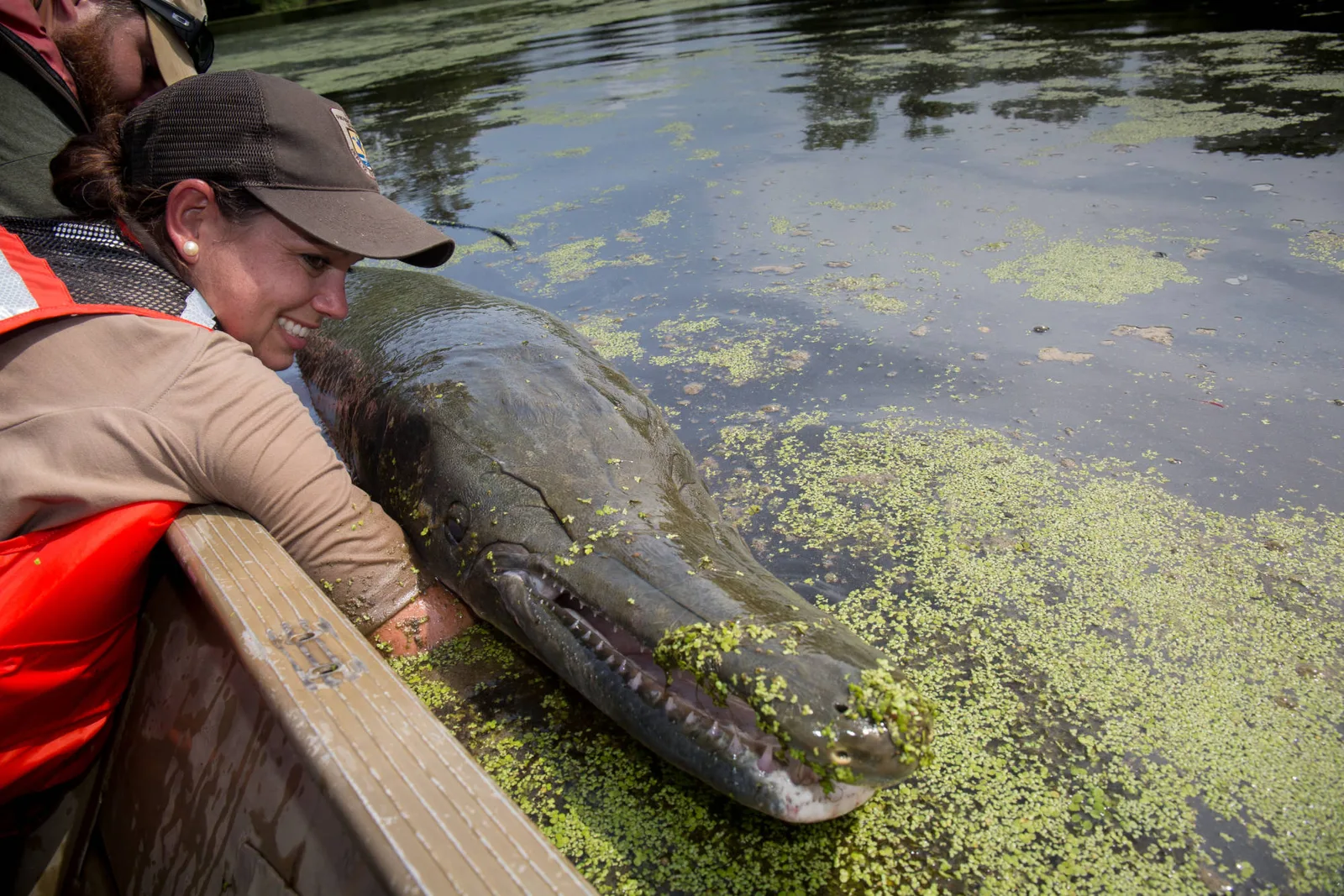
- Alligator Gar: Size, Teeth, Records, and How to Catch One
Alligator gar reach 8 ft and 300 lb and can live past 90 years. How to tell them from other gars, how to catch one, the records and the rules by state.
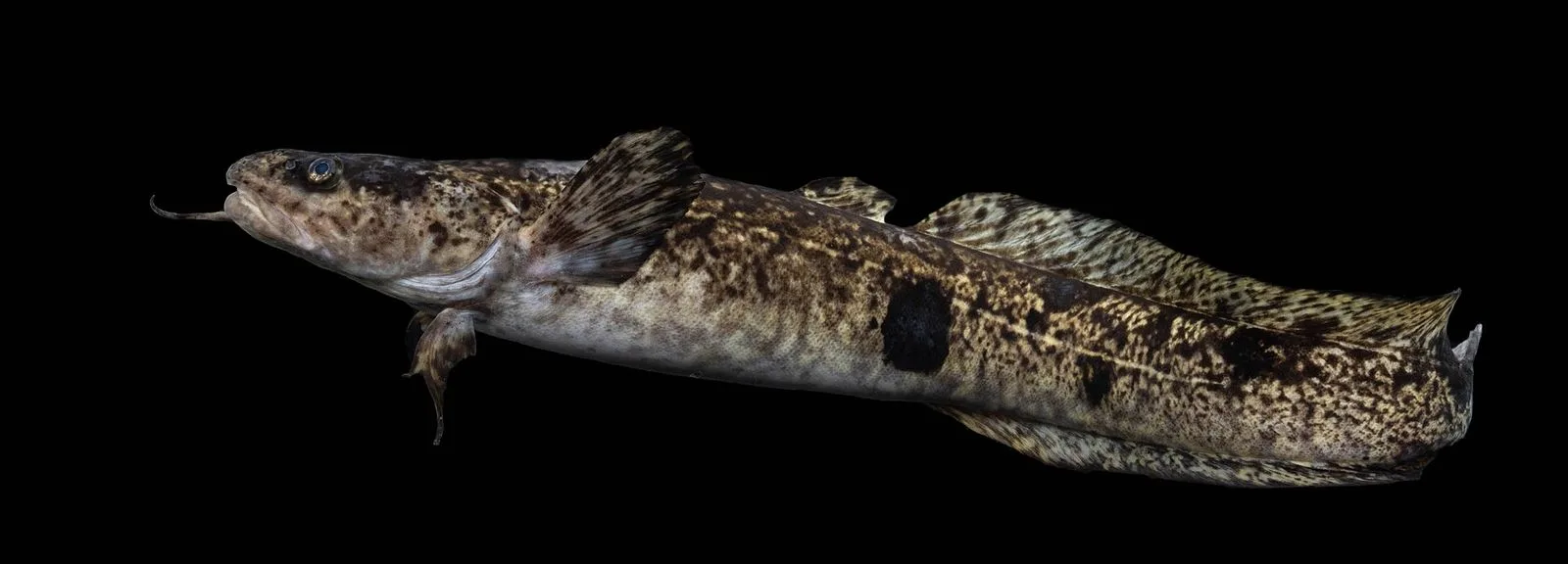 Burbot: The Freshwater Cod That Spawns Under the Ice
Burbot, the only freshwater cod: one chin barbel, 15–28 in, 1.5–5 lb. Where to find them, the glow jig and bait that work after dark, and the lobster test.
Sources
- Michigan DNR, Lake whitefish: identification, depth, diet, spawning
- Michigan DNR, Round whitefish (menominee): the single nostril flap
- Michigan DNR, State record fish
- Michigan DNR (2025), Single-pointed hook regulations, November 1–30, at three Lake Michigan piers
- Michigan Sea Grant, Lake whitefish: size, the shoulder hump, commercial importance
- Minnesota DNR, MinnAqua species profile: lake whitefish
- Minnesota DNR, Baudette area: cisco, lake whitefish and mooneye told apart
- Minnesota DNR, Inland waters rule rationale: the first whitefish limit
- Maine Department of Inland Fisheries and Wildlife, Lake whitefish: size, age, ice fishing
- Government of Ontario, Lake whitefish
- New York State DEC, Lake whitefish species assessment (2023): range, spawning temperature, depth
- Montana Field Guide, Lake whitefish
- Montana Field Guide, Mountain whitefish
- Montana Fish, Wildlife and Parks, Montana state record fish (2022)
- Chalupnicki et al. (2026), Whitefishes: Coregonus spp., in Fish Hatchery Management (USGS)
- Alaska Department of Fish and Game, Whitefish Species: Wildlife Notebook Series
- Alaska Department of Fish and Game, Sheefish Species Profile
- Ebener, Dunlop and Muir (2021), Declining Recruitment of Lake Whitefish to Fisheries in the Laurentian Great Lakes: Management Considerations and Research Priorities, Great Lakes Fishery Commission
- Wisconsin DNR, Green Bay ice creel harvest tables 2014–2024
- Wisconsin DNR, Daily bag and total daily bag limits
- Wisconsin Sea Grant, Lake Whitefish – Eat Wisconsin Fish
- eRegulations, Michigan general fishing regulations: cisco, lake whitefish and round whitefish limits
- Washington Department of Fish and Wildlife, Bank on Banks Lake: the lake whitefish fishery
- Washington Department of Fish and Wildlife (2023), Davenport angler reels in a new state record lake whitefish
- Bridge Michigan via Wisconsin Watch (2026), Green Bay as the whitefish refuge
- Bridge Michigan (2025), Iconic whitefish on the edge of collapse
- Susan Bence and Graham Thomas, WUWM (2025), Wisconsin's warming winters impact iconic lake whitefish and anglers who icefish for them
- Patrick Durkin (2020), Whitefish rejuvenate Green Bay ice fishing
- Destination Door County, The tradition of the fish boil
- Idaho Fish and Game, mountain whitefish in winter
- Dale Bowman, Whitefish on ice: a Green Bay encounter, Chicago Sun-Times (2016)
- Gord Pyzer (2014), Chasing Phantoms: Hook Whitefish This Ice Fishing Season, In-Fisherman
- In-Fisherman, Whitefish: catch more
- Grand Forks Herald (2019), DNR certifies Lake of the Woods whitefish as a Minnesota state record
- Ontario Record Fish Registry, reprint (lake whitefish, 14.77 lb, Georgian Bay, 1996)
- IGFA freshwater all-tackle records, reprint (lake whitefish, 14 lb 6 oz)