 By
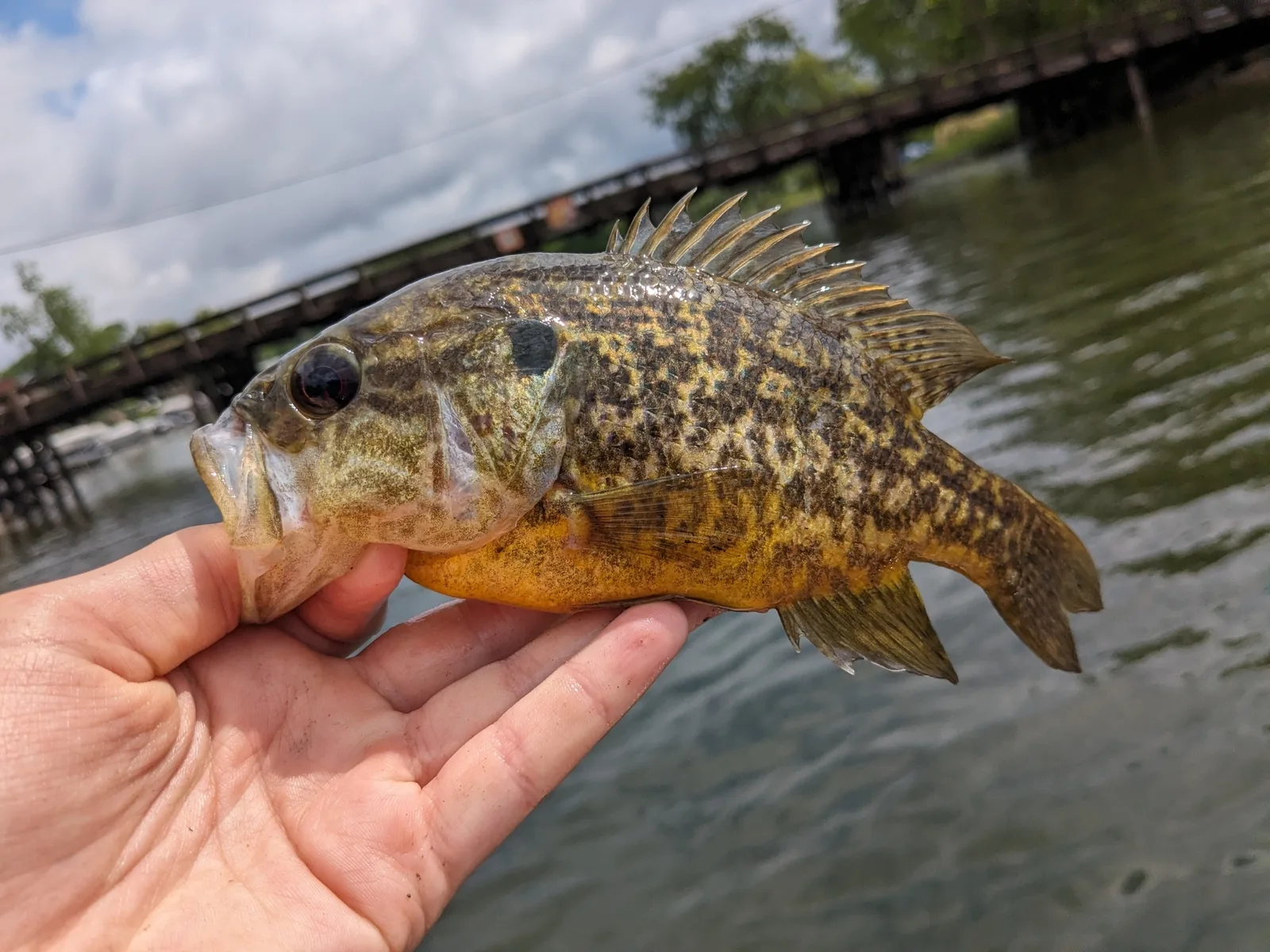
A warmouth is a thick-bodied sunfish with a mouth like a bass’s, a red eye and dark streaks fanning back across its cheek, and most are 4 to 10 in (10 to 25 cm) long. It lives in the warm, weedy, muddy-bottomed backwaters other sunfish avoid: swamps, sloughs, ditches and the slow stretches of Southern rivers. It hides tight to stumps and snags and hits hard. Any bait that catches a bluegill will catch one.
Run a fingertip over its tongue. Connecticut’s fisheries guide says the raspy patch of small teeth there tells the warmouth from the other sunfish.
How do you tell a warmouth from a rock bass?
Count the spines at the front of the anal fin, the fin on the belly just ahead of the tail. A warmouth has three. A rock bass has six. Texas Parks and Wildlife calls that fin “the difference between the two”, and Missouri’s field guide uses the same count.
The count matters because the two fish share a name as well as a look. Both are heavy-bodied, big-mouthed and red-eyed, and both get called “goggle-eye”. Texas even lists “rock bass” among the warmouth’s local names. So a fish someone calls a rock bass may well have three anal spines.
Two more marks help. A rock bass carries its dark spots in neat horizontal rows along the sides. A warmouth is mottled instead, olive-brown with irregular dark blotches. And the warmouth’s face has three to five reddish-brown streaks running back from the eye across the cheek and gill cover. Florida’s FWC compares them to war paint.
How is a warmouth different from a green sunfish or a bluegill?
The green sunfish is the harder one. It has the same thick body, big mouth and three anal spines, and the two even hybridize. Check the cheek and the tongue. A green sunfish has blue-green streaks on the cheek, and Connecticut describes a lighter, usually reddish or yellowish, edge on its black ear flap. A warmouth has red-brown streaks, a red eye and the tooth patch on its tongue.
A bluegill is easy by comparison. Its mouth is small: the upper jaw stops short of the front of the eye. Fold the pectoral fin forward, the paired fin behind the gill cover. On a bluegill it is long and pointed. On a warmouth it is short and rounded.
| Mark | Warmouth | Rock bass | Green sunfish | Bluegill |
|---|---|---|---|---|
| Anal fin spines | 3 | 6 | 3 | 3 |
| Tongue | Patch of small teeth | — | No teeth | No teeth |
| Mouth | Jaw to or past the middle of the eye | Jaw past the middle of the eye | Jaw to about the middle of the eye | Small; jaw short of the eye |
| Pectoral fin | Short, rounded | — | Short, rounded | Long, pointed |
| Eye and cheek | Red eye; 3–5 dark streaks across the cheek | Large red eye | Blue-green cheek streaks | Blue wash on chin and gill cover |
| Sides | Mottled olive-brown | Dark spots in horizontal rows | Turquoise spots on some scales; faint bars | Vertical bars, faint in adults |
| Typical size | 4–10 in (10–25 cm) | To 11 in (28 cm) | 6–8 in (15–20 cm) | To about 9.5 in (24 cm) |
Every row comes from the Missouri, Texas, Connecticut, Illinois and North Carolina agency descriptions of the four species in the sources. A dash means the sources give no comparison for that mark. The “no teeth” entries follow Connecticut’s statement that the tongue teeth tell the warmouth from all other sunfish. The full nine-species key is on the panfish hub.
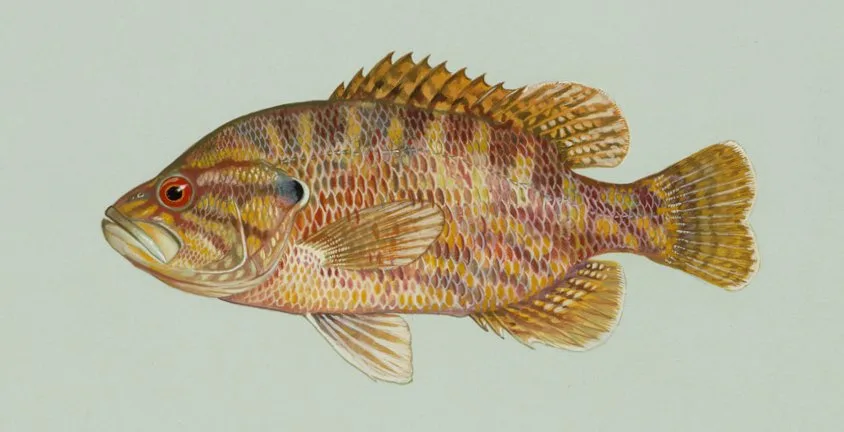
The red eye, the streaks across the cheek and the bass-like mouth. Illustration: Duane Raver, U.S. Fish and Wildlife Service (public domain).
Free PDF · Water temperature chart When do panfish bite?
One water temperature reading, and the 16-page chart tells you who's spawning, who's feeding hard, where they sit and what to throw. 26 fish, every number sourced.
Enter your email, confirm it with one click, and the PDF is in your inbox. Plus one email a week on what's biting. Unsubscribe anytime. Privacy.
Where do warmouth live?
Across the eastern half of the country. Texas Parks and Wildlife gives the native range as the Great Lakes and Mississippi basins from western Pennsylvania to Minnesota, south to the Gulf, plus the Atlantic and Gulf drainages from the Rappahannock River in Virginia to the Rio Grande. Stocking has taken it farther. Connecticut’s only known population, in one small private pond, was first reported by an angler who caught a 6-in fish through the ice in the winter of 2007–2008.
What it needs is cover over a soft bottom. North Carolina and Florida describe the same water: swamps, marshes, shallow lakes, slow-moving streams and canals with soft, muddy bottoms. The fish stay around aquatic weeds, stumps and snags, and under the banks of streams and ponds. In Missouri’s Bootheel they are most common in weedy ditches with little current, and in swamps, sloughs and borrow pits.
They also put up with water that would kill other sunfish. Texas says they “can survive in polluted, low oxygenated waters where other sunfish cannot”. Muddy water bothers them less than most species, in North Carolina’s words.
In North Carolina they are commonest from the middle of the state eastward, in the Cape Fear, Neuse, Roanoke and other coastal basins. On the Northeast Cape Fear River, Carolina Sportsman reports anglers catching plenty of them by late May.
When do warmouth spawn and bite?
Warmouth spawn once the water reaches 71 °F (21.5 °C), Texas Parks and Wildlife says, and carry on through summer. Missouri gives mid-May through August, with a peak in early June. Florida’s FWC says they often spawn more than once a year, usually between April and August.
Bluegill nest in tightly packed colonies, Connecticut’s guide says. The warmouth is a solitary nester, in Florida’s words. Texas Parks and Wildlife says the male fans a disc-shaped nest in 1.5 to 4 ft (0.45 to 1.2 m) of water beside a stump, a clump of weeds or another big submerged object. Missouri finds them over silt-dusted rubble by preference. A female produces 4,000 to 63,000 eggs in a season, and they hatch after three days, Texas says. The male guards them hard. Missouri describes him spreading his gill covers at intruders while his eyes turn blood red and his body bright yellow.
Larger fish, water snakes, turtles and herons all eat warmouth, and Texas notes that their life span is not known.
That makes a submerged stump in early summer the classic spot. Outside the spawn, the fish keep the same habits. Missouri calls the warmouth “sedentary and secretive”, a fish that hides in cover and avoids bright light. Florida and North Carolina both say it does most of its feeding in the morning, and Florida adds that it appears to sleep at night. So a shaded snag at first light is a better bet than open water at noon.
How do you catch warmouth?
Put a bait right against the cover and let it sit. Texas notes that warmouth are sight feeders that wait in cover for food to come past, and that they “hit hard and are easily caught”. North Carolina suggests worms, small crayfish, minnows and a variety of small artificial baits. Florida’s advice is the simplest: any bait or lure that works for bluegill and redear sunfish will catch warmouth.
The big mouth gives you room. Adults eat crayfish, aquatic insects and small fish, so a minnow or a small crayfish that a bluegill could not swallow suits a warmouth well. A worm under a small bobber, set beside a stump or a snag, puts North Carolina’s first suggestion where Missouri says the fish hide.
Lures work as well. Connecticut says the fish is “readily taken on a variety of small lures and baits”. A small inline spinner such as a Rooster Tail worked past a snag, or a small jig, fits that description. On North Carolina’s blackwater rivers, Carolina Sportsman describes warmouth guarding cypress trunks and knees, pouncing on insects, crawfish and minnows. They “readily strike any artificial lure or fly that resembles prey”.
How big do warmouth get?
Small, mostly. Texas Parks and Wildlife gives 4 to 10 in (10 to 25 cm) as the usual range, with fish of more than 12 in (31 cm) and up to 2.25 lb (1 kg) at the top. Missouri’s field guide is more modest: up to 8 in and 7 oz, with about 1 lb 4 oz as the maximum. Connecticut’s guide puts them commonly at 3 to 6 in. Texas says warmouth mature at only 3 to 4 in (7.5 to 10 cm), so a hand-sized fish can already be an adult.
Biologists judge a fish’s condition against a standard weight, the weight of a well-fed fish of that length. For warmouth the equation is Bister and colleagues’ from 2000. The weights below are computed from it.
| Length | Standard weight | What it means |
|---|---|---|
| 6 in (15 cm) | 2.8 oz (79 g) | The top of Connecticut’s common size |
| 8 in (20 cm) | 7.0 oz (200 g) | Missouri’s typical maximum |
| 9 in (23 cm) | 10.3 oz (292 g) | Michigan’s Master Angler minimum |
| 10 in (25 cm) | 14.5 oz (411 g) | The top of the usual range |
| 13.25 in (34 cm) | 2 lb 4 oz (1.02 kg) | The world record’s length |
The all-tackle world record is 2 lb 7 oz (1.1 kg). Tony Dempsey caught it on October 19, 1985, in Guess Lake on the Yellow River near Holt, Florida, the IGFA records. Outdoor Life gives its length as 13.25 in and the bait as a wiggler. At that length the standard weight is 2 lb 4 oz, so the record fish was only about 8 percent heavier than a well-fed warmouth of its size.
State records run smaller. Florida’s stands at 2.44 lb. North Carolina’s, caught by Emma Sears at McLeod’s Pond in Richmond County on May 7, 1976, weighed 1 lb 13 oz. Michigan’s is 1.38 lb. Florida’s Big Catch program recognizes a warmouth of 9 in or half a pound. Limits differ by state and often lump warmouth with the other sunfish, so check your state’s regulations before you keep a bucketful.
Are warmouth good to eat?
Yes, from clean water. Texas Parks and Wildlife says they “are good to eat when caught in clean water”. It adds a warning: because they feed near the bottom like catfish, “the flesh can have a strong flavor”. So a warmouth from a clear, weedy lake is a better keeper than one from a stagnant ditch. Most are small, so the fillets are small, like those of the bream anglers keep for the same pan. Check your state’s fish consumption advisory for the water you fish before you keep any.
What else is a warmouth called?
Plenty. Texas lists redeye, goggle-eye, red-eyed bream, stump knocker, mudgapper, mo-mouth, morgan, molly, open mouth, weed bass, wood bass, mud bass and warmouth bass, among others. Carolina Sportsman adds “more-mouth”, because the fish seems to be more mouth than anything else. Despite “warmouth bass”, it is a sunfish, not one of the black bass; Texas notes only that it belongs to the same family as the largemouth bass.
The scientific name is Lepomis gulosus. Missouri translates it as the “large-mouthed” sunfish. It shares the genus with the bluegill, the green sunfish and the redear, and like them it crosses with its relatives: Texas notes hybrids with bluegill and green sunfish. A mottled sunfish with a middling mouth may be one of those crosses. If its tongue has no teeth, it is not a pure warmouth.
Free PDF · 16 pages
Know what's biting before your first cast
The Water Temperature Fishing Chart. Take one water temperature reading, find it on the chart, and you know which of 26 freshwater fish are feeding today, where they are and what to throw. For your phone and the tackle box.
- Where they sit and what to throw at every band: bass, crappie, bluegill and walleye; catfish by species; trout: when to stop and where they hide
- The best hours at your reading, the cold front day by day, and the spawn calendar from ice-out to midsummer
- The three thermometer mistakes that make a reading lie (the first one is the surface)
- The 26-fish chart: who's spawning, feeding hard or shut down at your reading
Every number from state fish and wildlife agencies and fisheries research: 61 sources, all on the site.
Enter your email, confirm it with one click, and the PDF is in your inbox. Plus one email a week on what's biting. Unsubscribe anytime. Privacy.
Related
Section guide
Panfish: Which Fish Count and How to Tell Them ApartPanfish are bluegill, the sunfish, crappie and yellow perch. Tell 9 sunfish apart by the ear flap, plus records and limits from 50 a day to none in Texas.
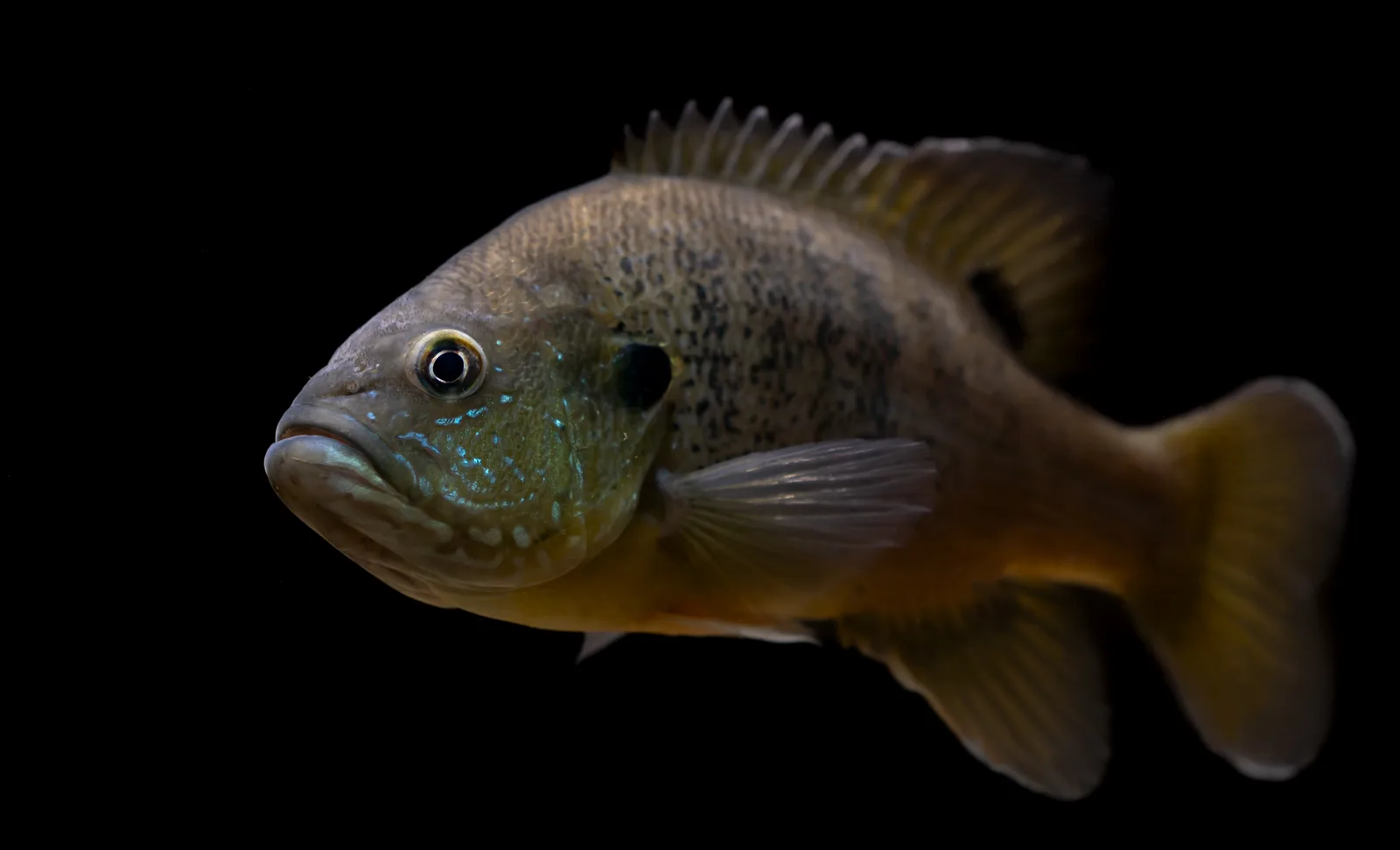 Green Sunfish: How to Identify It, and Why Ponds Fill With It
How to tell a green sunfish from a bluegill or a warmouth, why it takes over small ponds, how to catch one, how big it gets and the 1971 record.
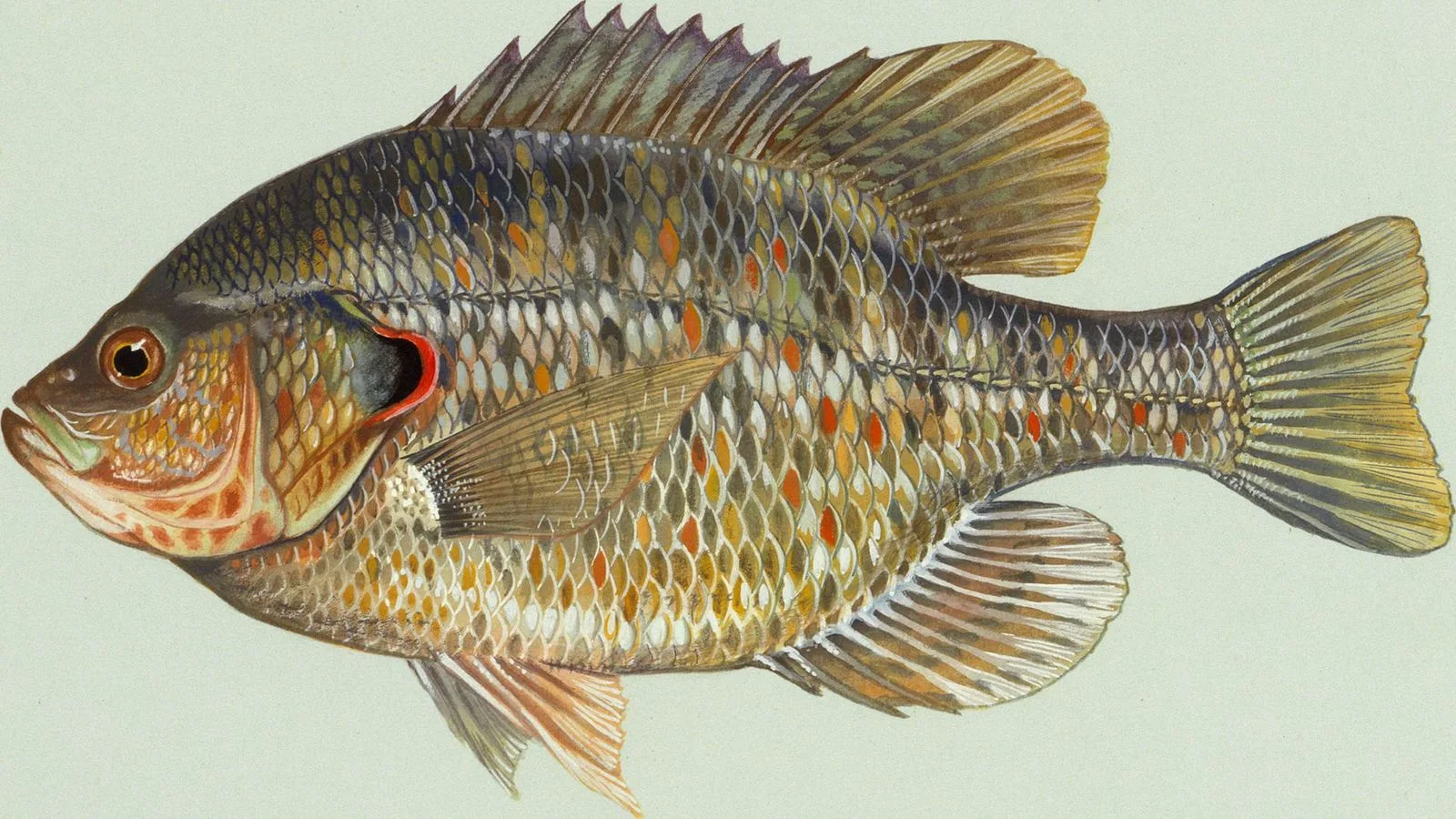 Bream Fish: What Southern Anglers Mean, and Which Bream You Have
In the South a bream is any sunfish, the bluegill first. In Europe it is a carp relative, on a menu a sea bream. How to tell which bream you have.
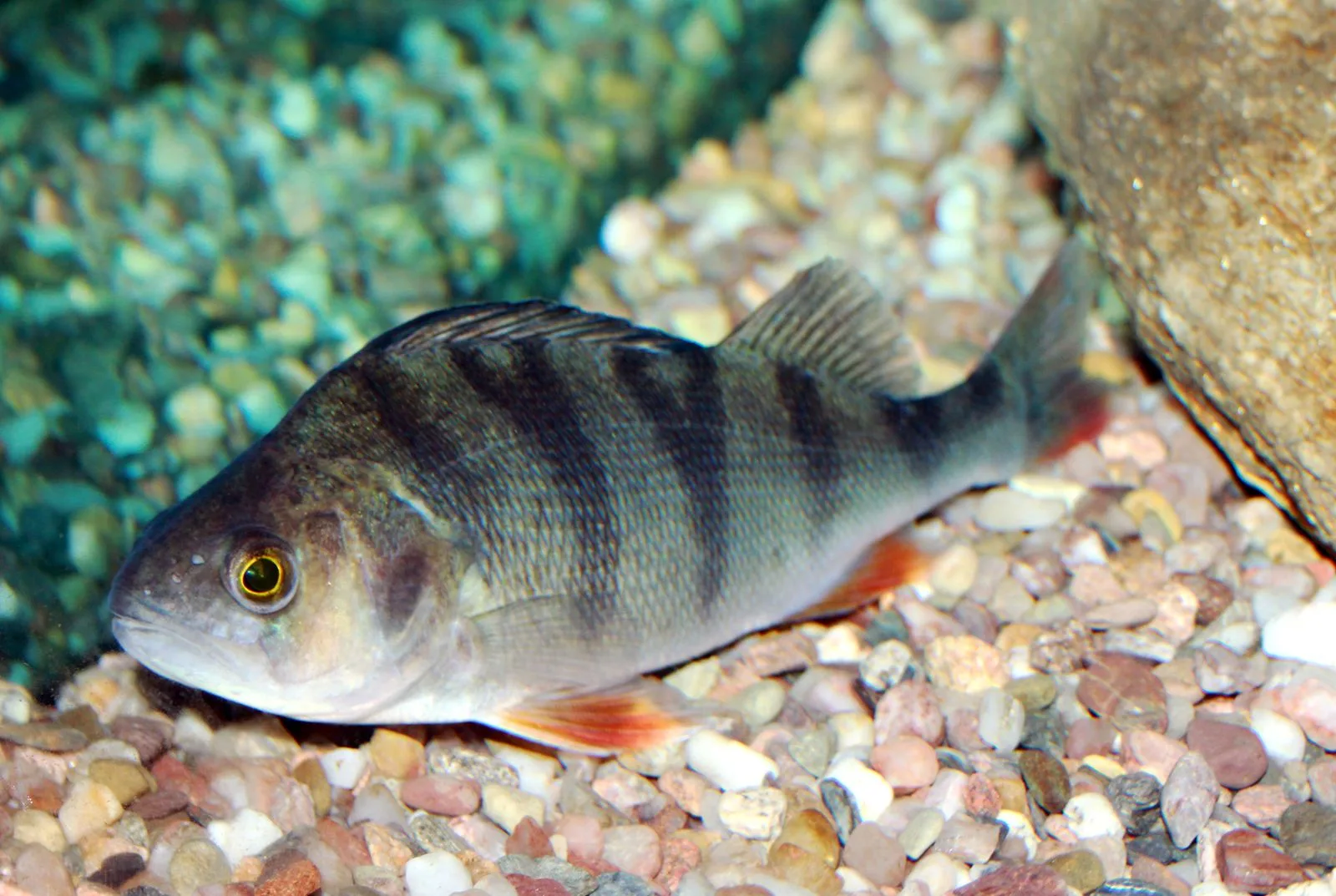 Perch Fish: What a True Perch Is, and Which Perch Are Not
A true perch is one of three Perca species. White perch, ocean perch, Nile perch and surfperch borrow the name: what each really is, and the records.
 Perch Fishing: Where to Find Them, the Rigs That Work, and When They Bite
How to catch yellow perch: where the schools sit each season, the spreader and jig rigs, how far off the bottom to fish, the bait, and the ice.
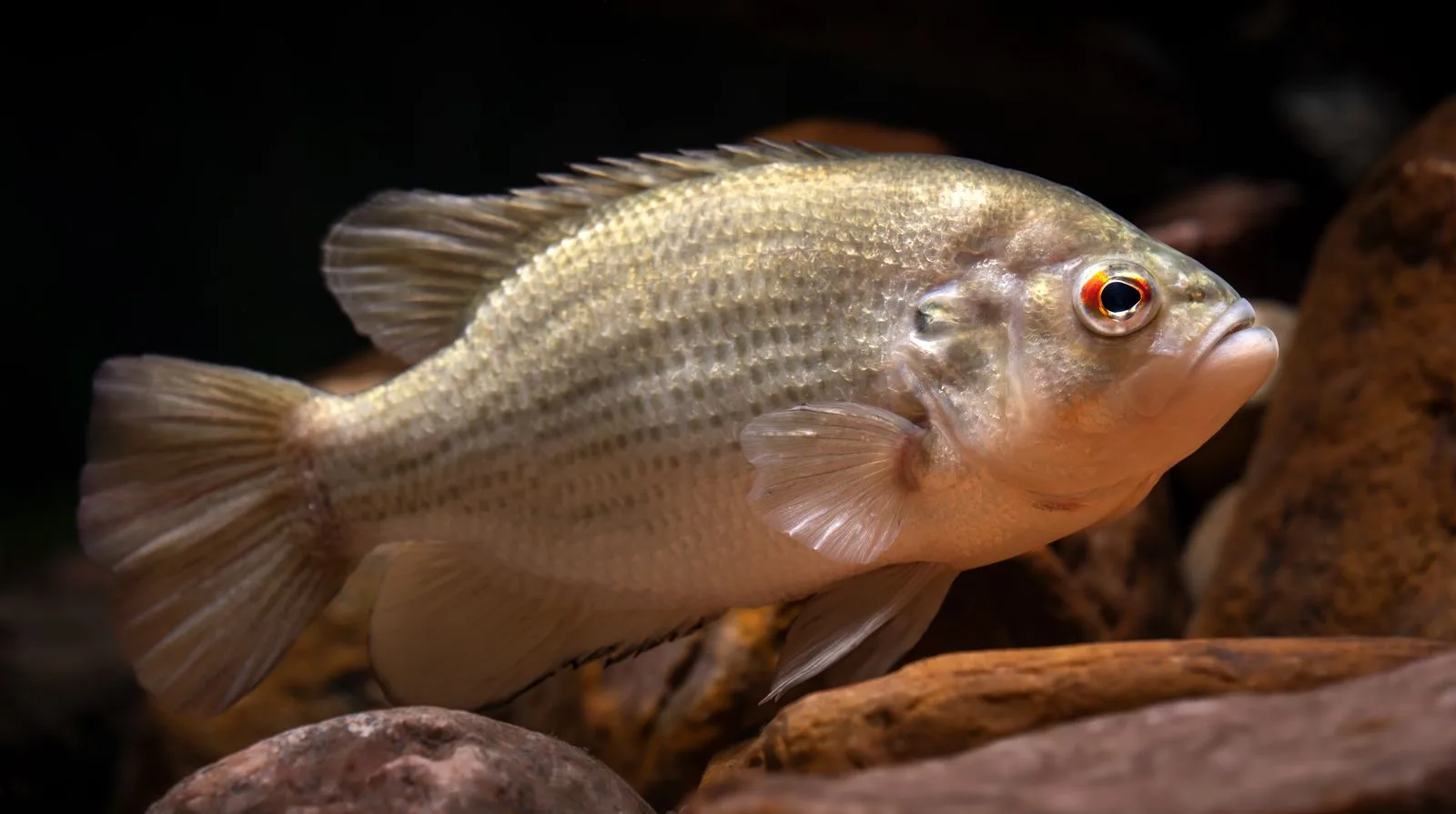 Rock Bass: How to Identify, Find and Catch the Goggle-Eye
How to tell a rock bass from a warmouth or a smallmouth, where it lives, what it bites, how big it gets and the 3 lb world record that is a tie.
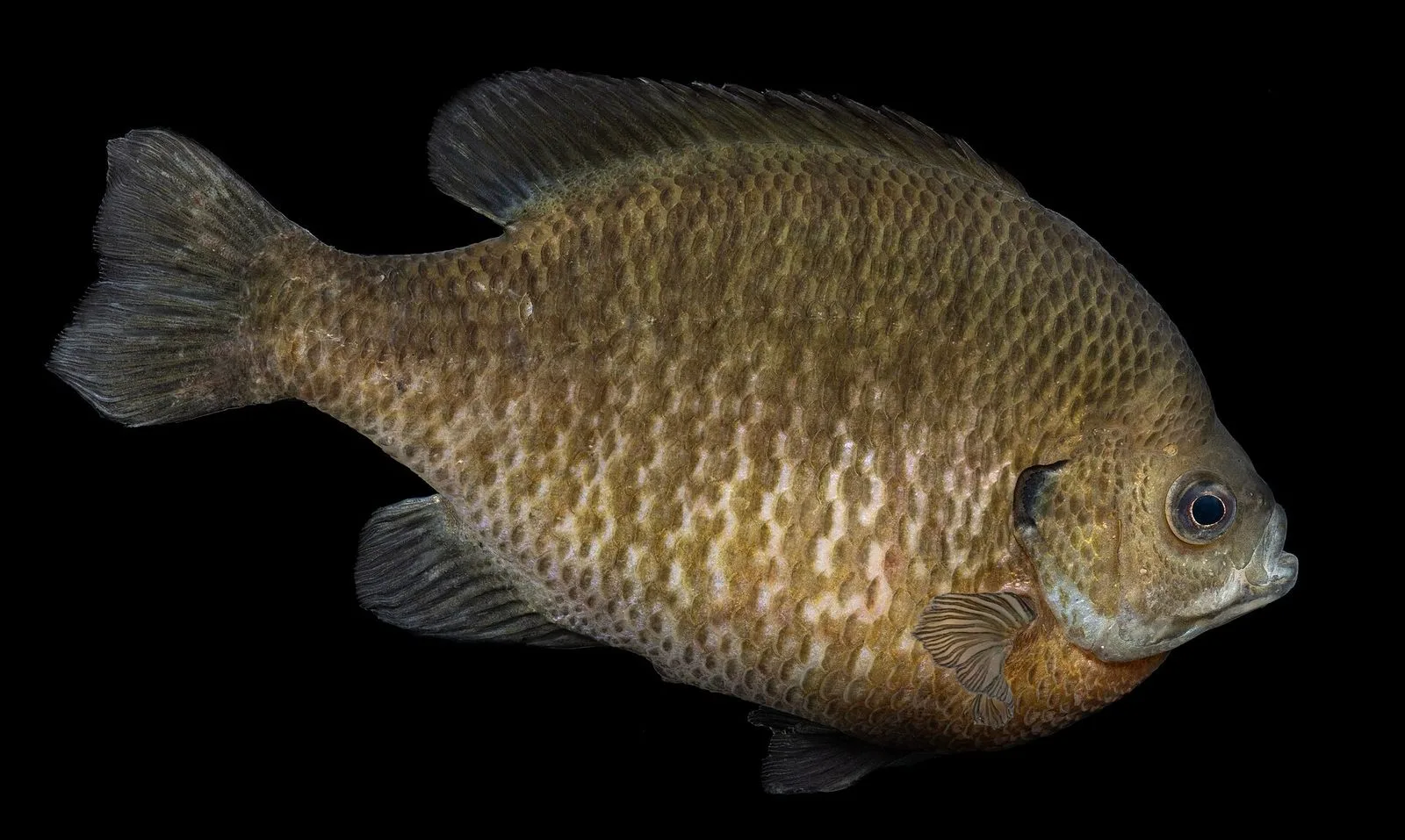 Bluegill: How to Identify It, How Big It Gets and How It Spawns
How to identify a bluegill, how old an 8- or 10-inch fish is, why a pound is a trophy, the 4 lb 12 oz record and the sneaker males on the beds.
Sources
- Missouri Department of Conservation, warmouth (description, size, habitat, food, nesting)
- Texas Parks and Wildlife, warmouth (other names, size, spawning, habitat, food value)
- Connecticut DEEP, warmouth (identification, tongue teeth, size, introduced range)
- NC Wildlife Resources Commission, warmouth (identification, habitat, feeding, fishing tips)
- Florida Fish and Wildlife Conservation Commission, warmouth (habitat, nesting, state record, Big Catch)
- Carolina Sportsman, Warmouth: more mouth than anything (Mike Marsh)
- IGFA world record search, warmouth
- Outdoor Life, the biggest panfish of all time (IGFA all-tackle records with lengths and tackle)
- Missouri Department of Conservation, northern rock bass
- Illinois DNR, rock bass
- Missouri Department of Conservation, green sunfish
- Texas Parks and Wildlife, green sunfish (turquoise spots, faint bars)
- Connecticut DEEP, green sunfish (anal spines, ear-flap edge)
- Connecticut DEEP, bluegill (anal spines, vertical bars, nesting colonies)
- Missouri Department of Conservation, bluegill
- Michigan DNR, Master Angler minimum entry lengths and state records
- FSA WSlit standard-weight table (Bister et al. 2000 warmouth equation)