 By
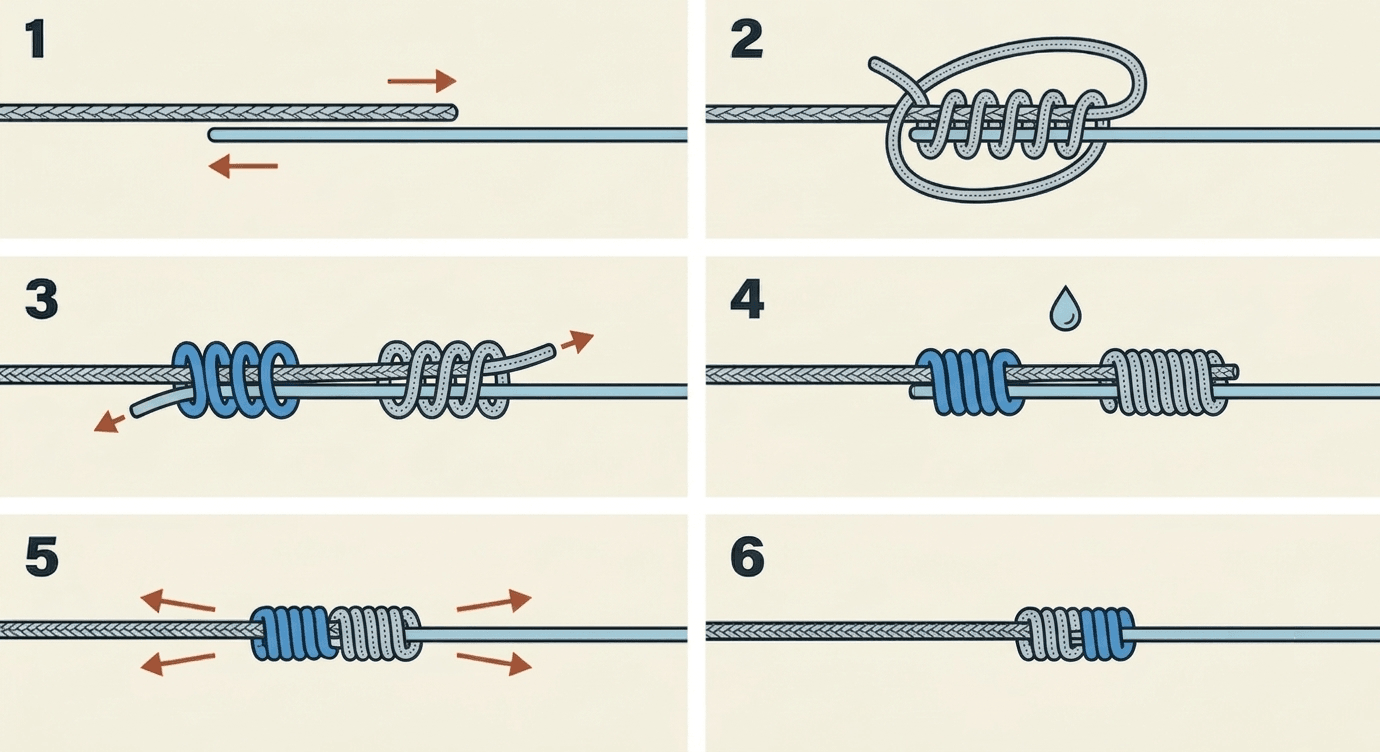
Tie the double uni knot as two uni knots, one in each line around the other, then slide them together until the two barrels jam. A barrel is the neat coil of wraps a uni pulls into. It’s one of the easiest ways to join braid, the thin woven line on your reel, to a leader. That’s a short piece of heavier line ahead of your hook. Bear Essentials keeps it for the dark and the cold. How well it holds comes down to one thing: the wraps. Sport Fishing pulled knots on 15 lb braid, where lb is the pull a line is sold to take. They used the test machine of the IGFA, the people who keep fishing’s world records. With five wraps a side the double uni beat the surgeon’s knot, both Albrights and both Albertos. With four wraps a side it fell into the bottom third. So on braid, never go under five, and seven to ten is the usual count.
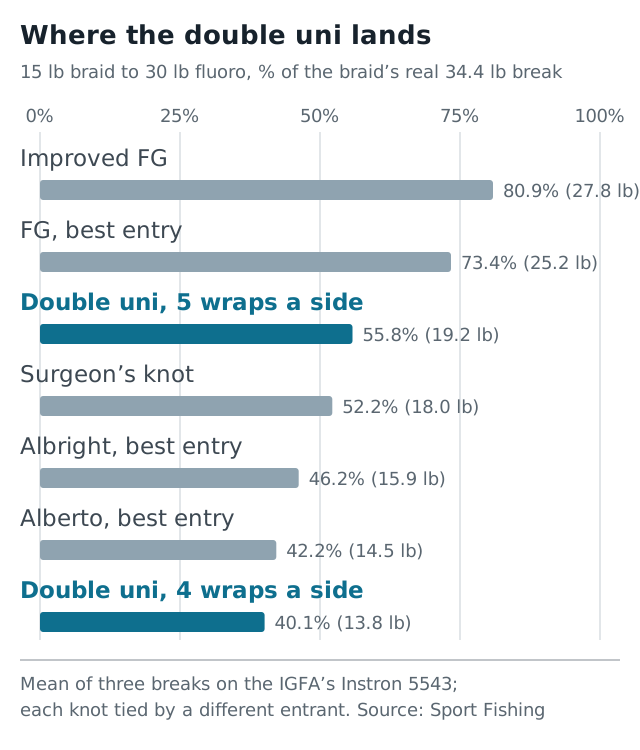
On the IGFA’s tester a double uni with five wraps a side held 55.8 percent of the braid’s real breaking strength. One with four wraps a side, tied by another angler, held 40.1. One wrap apart, sixteen points apart.
What do you need?
- Your two lines. Usually that’s braid on the reel and a leader of fluorocarbon, which is harder for fish to see, or mono, plain single-strand nylon. Two nylon lines work too. Most tests below used a leader heavier than the braid’s label. How long and how heavy your fishing leader should be depends on what you’re fishing for.
- 6–8 in (15–20 cm) of overlap, where the two lines lie side by side. Two uni knots use more line than a surgeon’s knot, so don’t skimp. FishTrack says at least 6 in.
- Water or spit to wet the knots, and clippers to trim them.
You already know half of this if you tie a uni knot. The double uni is two of them, and the single uni ties your line to a hook or lure with the same moves. Looking for a double uni to a hook or swivel? That’s just a uni knot, and the uni page shows you how.
How do you tie the double uni knot?
-
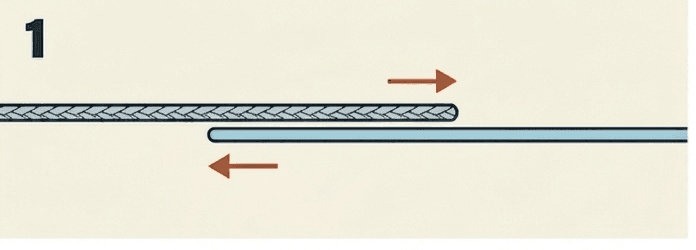
Overlap the lines by 6–8 in (15–20 cm). The tag ends, the loose ends you tie with, point in opposite directions.
-
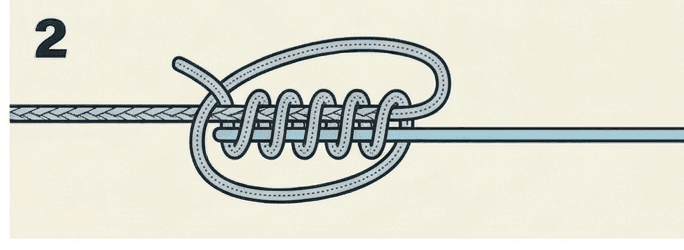
Tie the first uni, in the braid. Bring the braid’s tag back over both lines to make a loop. Then wrap the tag through that loop and around both lines, as many times as the table below says. Pull the tag to snug the barrel. Don’t slide it yet.
-
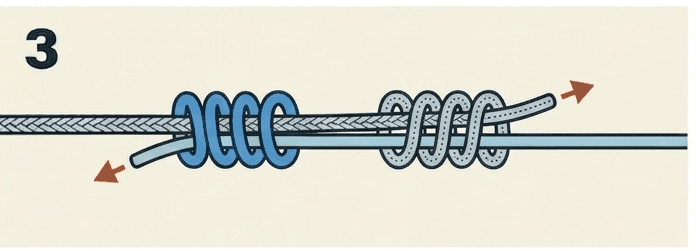
Tie the second uni with the leader’s tag the same way, pointing the other direction, with its own wrap count. Snug it on its own, so each uni sits tight before you pull them together.
-
Wet both barrels. Wet both knots with water or spit before you slide them, as the how-to guides say. One small test questions that for this knot. You’ll find it in the mistakes below.
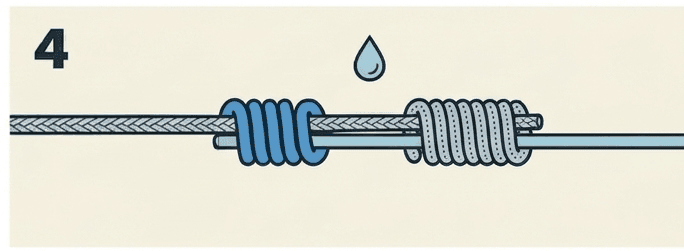
-
Slide them together. Pull the two main lines, the long ends, away from each other. The barrels slide along and jam. Then give each tag one last firm pull, and each main line another. The two knots have to sit hard against each other or you lose strength, FishTrack says.
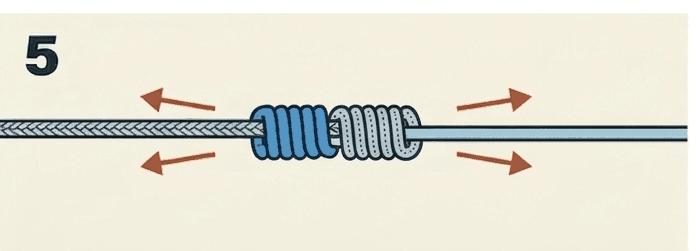
-
Trim both tags. Cut them close, as FishTrack and Bear Essentials both do. A long, sharp tag snags grass and nicks the thread wraps on your rod’s guides, the rings your line runs through.
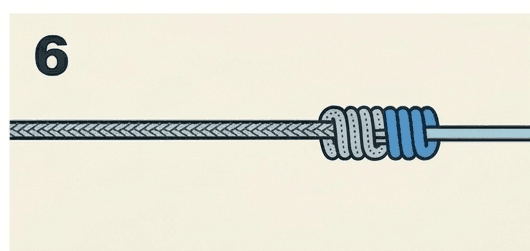
Drawings: fishing.info, generated with Gemini and checked step by step against the text. They show three to seven wraps a side to keep the coils readable. Take your count from the table below.
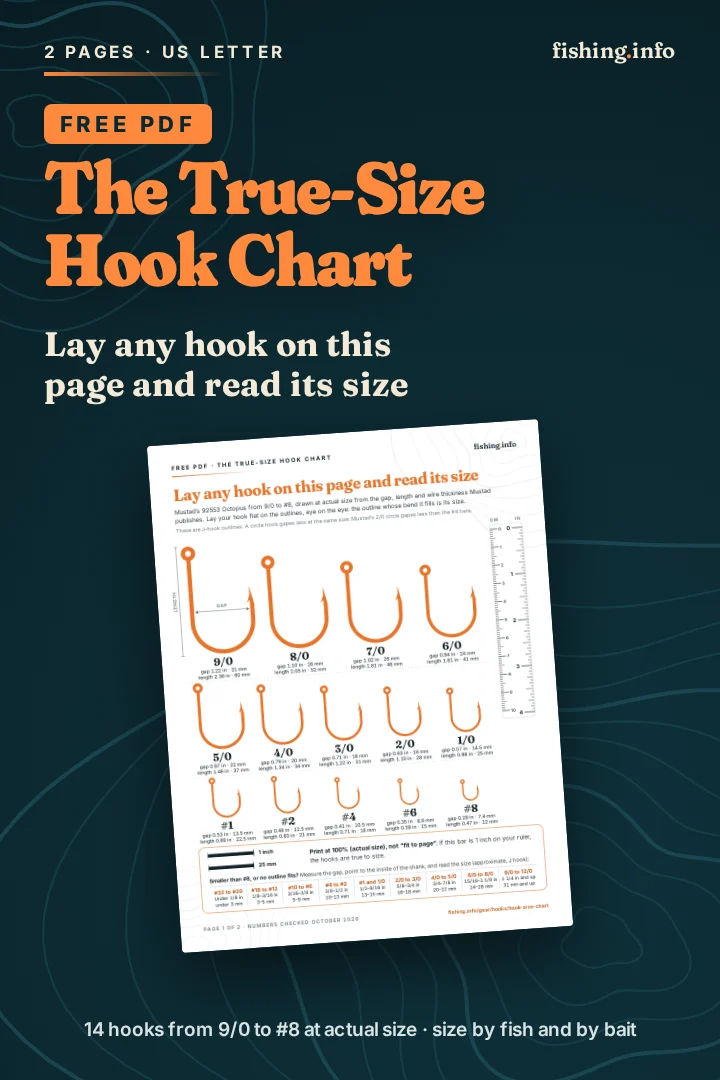
Free PDF · Hook size chart What size is that hook? Lay it on the chart.
Print the free chart, lay any hook on it and read its size: 14 hooks from 9/0 to #8 at actual size, a gap ladder from #32 to 12/0, and the size for 17 fish and 16 baits on the back.
No card, nothing to buy, and the PDF is yours to keep. Confirm with one click and it's on its way. Then a few short emails and one a week on what's biting. Unsubscribe anytime. Privacy.
How many wraps per side?
Put more wraps on thinner, slicker line. Every guide agrees on that. They just don’t agree on the numbers.
| Line on that side | Wraps | Who says so |
|---|---|---|
| Light mono or fluorocarbon, 20 lb (9 kg) and under | 5 | Salt Strong tied 5 on 20 lb mono |
| Heavy mono or fluorocarbon, 30 lb (14 kg) and up | 3–4 | Wired2Fish: “Often 3 will do” on larger lines; Salt Strong tied 4 on 30 lb |
| Braid | 7–10; our floor is 5 | Bear Essentials 7–10; FishTrack 12 or more; the one measured test: 5 a side held 55.8%, 4 a side 40.1%, on 15 lb braid (Sport Fishing) |
| Any small line, Wired2Fish’s floor | 4 | Wired2Fish: 4 “should be the minimum” |
The spread is wide. Jason Sealock ties four a side for braid to fluorocarbon. FishTrack goes highest: six turns on ordinary line and twelve or more on braid. Bear Essentials sits in between, at 7–10 on braid and 4–6 on the leader. Is your braid much thinner than the leader? Then double the braid and at least double the turns on that side, FishTrack says. Want it stronger still? Double over the tag ends of both lines before you tie, for “closer to 100% reliability,” FishTrack says.
Only one test put numbers on the wraps: the IGFA machine. Five wraps a side held 55.8 percent, four wraps held 40.1. Two different anglers tied them, with three breaks each, so the wrap count isn’t the whole gap. Still, it points the same way as every guide: on light braid, go high. That one test backs five a side as your floor. The guides say seven to ten. Field & Stream’s John Merwin went further. Braid doesn’t work well in a uni splice, his name for this knot, he wrote. Slick, skinny braid tends to over-tighten and slip through instead of jamming. Still, his own five-turn double uni on FireLine braid held three quarters of the leader’s strength (see the table below). Take it as a warning, not a ban.
How strong is the double uni knot?
In the tests, the double uni kept 40 to 75 percent of the line’s strength, where a percentage was given. That’s four tests by three publications, on five pairs of line. FishTrack says it holds “about 90%” on lines up to at least 30 lb test, but names no test behind it. The lb number is the pull a line is sold to take. Each test used different lines and a different way of pulling, so read each row across. Don’t compare down the column.
| Test | Lines | Double uni | Same test, other knots |
|---|---|---|---|
| Sport Fishing, IGFA Instron 5543, average of 3 breaks | 15 lb Spiderwire braid (breaks at 34.4 lb) to 30 lb fluoro | 5 wraps: 55.8%, about 19.2 lb (8.7 kg). 4 wraps: 40.1%, about 13.8 lb (6.3 kg) | FG 49.1–73.4%; surgeon’s 52.2%; Albright 38.3–46.2%; Alberto 36.0–42.2% |
| Sport Fishing, same machine | 50 lb Spiderwire (breaks at 62.8 lb) to 80 lb fluoro | 46.6%, about 29.3 lb (13.3 kg); wraps not stated | FG 54.8–76.4%; surgeon’s 64.6%; Albright 48.1–59.4%; Alberto 43.6% |
| Salt Strong 2015, best 3 of 4 head-to-head pulls | 10 lb Trilene XL to 30 lb Trilene Big Game mono | 7–12 lb (3.2–5.4 kg), “the most inconsistent” | Three-turn surgeon’s 13–15 lb; Albright 6–8 lb |
| Salt Strong 2021, 3 dry and 3 wet trials | 20 lb to 30 lb mono, 5 and 4 wraps | Lost to the blood knot by 13% | Blood knot |
| Field & Stream, John Merwin, % of the unknotted leader | 30 lb FireLine braid to 10 lb InvizX fluoro (matched for diameter) | 5 turns: 75% | J knot 83%; 4-turn surgeon’s 80% |
What that table tells you:
- Braid is rated far below its true break. The “15 lb” Spiderwire broke at 34.4 lb on average. So the five-wrap double uni, at 55.8 percent, still held about 19 lb: well above the label, well below the line.
- It’s mid-pack, not last. Albright and uni knots “scored pretty low” for braid to leader, Sport Fishing’s editors wrote. A small change in how a knot was tied could make a real difference, they added. The five-wrap entry placed 12th of 26 in the light class, the four-wrap one 22nd. The heavy-class entry, wraps unknown, placed 22nd of 27.
- Salt Strong ranks it near the top for mono. It’s second of five mono-to-mono knots in its 2018 list, behind the blood knot. For braid to leader it puts a doubled-over double uni fourth of seven, “up to 30% weaker than the FG knot” in Luke Simonds’ own tests.
So here’s the honest read. A well-tied five-wrap double uni beats a slower knot tied badly. A well-tied FG beats the double uni.
Double uni, FG, Alberto or blood knot?
Here’s when to tie the double uni, and when to tie something else. The knots hub matches every knot to its line, braid-to-mono joins included.
- A long leader that casts through the guides: the FG knot. The double uni is the fattest of the four. Bear Essentials ranks them “FG > Alberto > Albright > Double Uni (biggest)”, and Wired2Fish calls it a bit bulkier than the FG or the Alberto. It tested weaker too. In Sport Fishing’s light class the best plain FG held 73.4 percent, about 25 lb, the improved FG 80.9, the double uni 55.8.
- Tying a leader on the water, in the dark, with cold hands: the double uni. Put seven to ten wraps on the braid side, and never go under five. Bear Essentials keeps it as the “in-the-dark backup” for exactly that.
- A short, heavy leader on heavy braid for topwater or swimbaits: the double uni. Topwater lures work on the surface, and swimbaits look like a small fish. That’s the job Wired2Fish gives the double uni, since a slightly bigger knot doesn’t matter there.
- Mono to mono of similar size: the blood knot. It was 13 percent stronger than the double uni in Salt Strong’s 2021 trials.
- Two nylon lines, fast: the surgeon’s knot. In Salt Strong’s 2015 mono contest the three-turn version broke at 13–15 lb, where the double uni ranged from 7 to 12.
- Something slimmer than the double uni, without the FG’s fuss: the Alberto. Just know it tested weaker. In Sport Fishing’s 15 lb class both Alberto entries came in below the five-wrap double uni, at 42.2 and 36.0 percent.
- The Albright? It’s slimmer than the double uni, by Bear Essentials’ ranking, and the two swap places on strength. In Sport Fishing’s test both Albrights fell below the five-wrap double uni on 15 lb braid. Both beat the double uni entry on 50 lb. So on light braid, tie the double uni. On 50 lb, the Albright tested stronger.
What do charter captains tie?
Twelve of the 25 charter captains and guides Sport Fishing asked tie the double uni from braid to leader. Their tip: double the braid first. Paul Hobby and Mike Roy just double it. Rick Murphy and Tom Van Horn tie a Bimini twist, a long twisted loop, and Mark Bennett ties a spider hitch, a quicker loop. Richard Andrews in North Carolina uses it for light braid. Jason Stock, out of Holmes Beach, Florida, ties a double uni or “three surgeons” for lighter braid. And here’s a habit worth copying from Mike Roy, out of Old Saybrook, Connecticut: tie the FG at home and the double uni on the water.
Venice, Louisiana, captain Damon McKnight has used it on everything from 3-pound redfish to 500-pound blue marlin. His case for it: “I can tie it quickly, and it works every time. Also, I like it because if you don’t tie it correctly, it’s obvious.”
That last point is the double uni’s quiet strength. You can see a bad one before you cast: a barrel with crossed turns, or a gap between the two knots after the slide. Retie it then, not after the fish.
Wet or dry, and what else goes wrong?
- Thinking wet is always better. Salt Strong pulled 20 lb to 30 lb mono six times in 2021, three dry and three wet. The double uni did better dry, the blood knot did better wet. It’s one small test on nylon, and FishTrack and most guides still say to wet it. So don’t sweat a dry knot on a cold morning, but don’t make dry your rule either.
- Too few wraps on the braid side. In Sport Fishing’s test the four-wrap entry held 40.1 percent, the five-wrap one 55.8. So never go under five on braid, even though Wired2Fish allows four. Seven to ten is the usual count.
- Sliding before both barrels are snug. Pull each uni tight on its own first. A barrel that’s still loose when the two meet won’t seat evenly.
- Skipping the final pulls. After the slide, pull each tag, then each main line, the way Wired2Fish does. A double uni you haven’t pulled hard, you haven’t tested.
- Uneven overlap. Tie the first uni about midway along the overlap, as FishTrack does, so each tag has the same length to work with. Start off center and one tag runs short, and that uni forms on too little line.
Once your leader has to fly through the guides on every cast, the FG knot is the next join to learn.

Free PDF · 2 pages
Stop guessing hook sizes. Lay any hook on this page and read it
A jar of loose hooks and no packet in sight. Guess wrong and you find out with a fish on.
The True-Size Hook Chart. Print it at actual size, lay a hook on the outlines, and the one its bend fills is its size. One sheet, front and back, for the tackle box.
- 14 hooks from 9/0 to #8 at true size, plus a ladder from #32 to 12/0
- The size for 17 fish and 16 baits, from bluegill to tuna
- A 2/0 circle that gapes less than a #4: why a 2/0 is not always a 2/0
Every outline drawn from Mustad's published dimensions; every size from the 25 sources on the page, Maryland DNR and Idaho Fish and Game among them.
No card, nothing to buy. Confirm with one click and the PDF is on its way, one version for your phone and one to print, yours to keep. Then a few short emails and one a week on what's biting, with an unsubscribe link in every one. Privacy.
Related
Section guide
Fishing Knots: Which Knot for Which Line and JobFishing knots by job and line: the five to learn first (Palomar, uni, FG, surgeon's, loop), the knot for braid, and what three pull tests measured.
 Alberto Knot: How to Tie It, and What the Pull Tests Show
The Alberto knot is an Albright with seven braid wraps up the leader loop and seven back. How to tie it, and how it did in two pull tests against the FG.
 Loop Knot: How to Tie the Non-Slip Loop and the Rapala Knot
A loop knot leaves a small fixed loop so the lure swings free. How to tie Kreh's non-slip loop (83% in a pull test) and the Rapala knot, and which wins.
 Arbor Knot: How to Tie Line to a Reel Spool (and Why Braid Slips)
How to tie the arbor knot on a spinning, baitcast, spincast or fly reel, why it slips on braid, and the backing or tape that stops it.
 FG Knot: How to Tie It, and What the Pull Tests Show
The FG knot step by step: 12–15 pairs of wraps on a tight braid, the hitches, the setting pull, and what four named pull tests measured.
 Surgeon's Knot for Fishing: How to Tie It, and How Strong It Is
The fishing surgeon's knot in five steps, from 4–6 in of overlap to all four ends pulled, and what three pull tests measured: up to 64.6% of 50 lb braid.
 Uni Knot: One Knot for Hooks, Leaders, Snells and Loops
How to tie the uni knot in six steps, the turns for mono, fluorocarbon and braid, its six uses from hook to reel spool, and the pull tests.
Sources (8)
- Doug Olander, Strongest fishing knots connecting braid to leader (53 knots on the IGFA's Instron 5543, plus a survey of 25 captains and guides), Sport Fishing
- Luke Simonds, The strongest line-to-line fishing knot (10 lb to 30 lb Trilene contest), Salt Strong (2015)
- Sean Person, Blood knot vs double uni knot (six trials, dry and wet), Salt Strong (2021)
- Luke Simonds, The best fishing knots of all time, ranked, Salt Strong (2018)
- John Merwin, The strongest fishing knots for each type of line, tested, Field & Stream