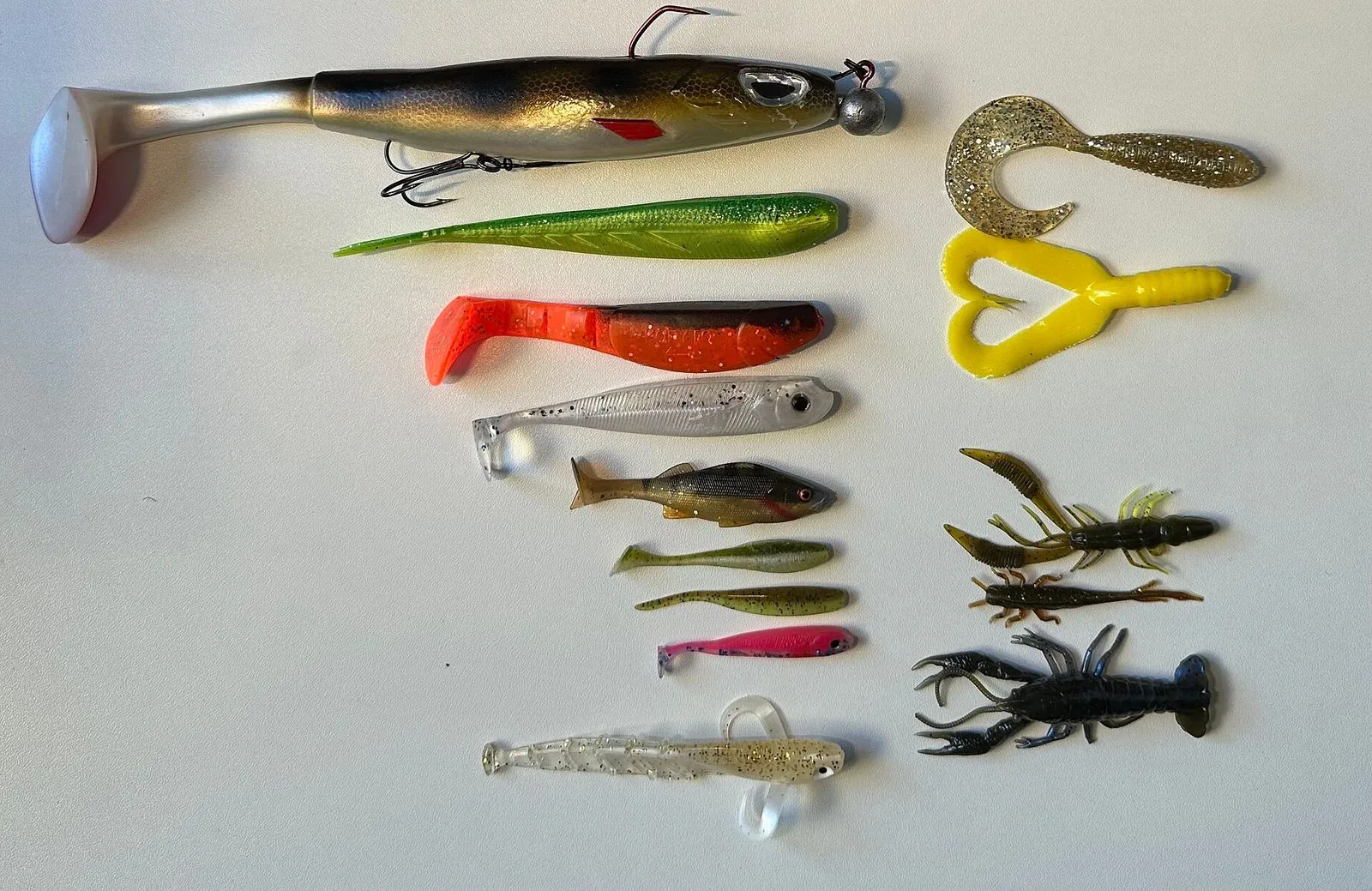
Soft plastic lures are the worms, craws, creature baits, stick baits, flukes, tubes, grubs and swimbaits that fill more tackle-box trays than every hard bait put together. They are the cheapest lures to make and the most adaptable to fish, because the same bait can be rigged weedless on a Texas rig, hooked through the middle on a wacky rig, nose-hooked on a drop shot or threaded on a jig head, and each rig gives it a different fall and a different job. Below: the history, the material, the families and the rig each was made for. The families below are the bass angler’s, which is where soft plastics were developed and where the data comes from; the paddle-tails, grubs and jerkbaits are also the inshore and walleye standards in other sizes, and the species pages say which.
Nick and Cosma Creme cooked the first plastic worm in an Akron basement in 1949 and sold them by mail, five for a dollar. The tackle trays have never recovered.
Start here
- Fishing lures — the section hub.
- Jigs and rigs — the Texas, Carolina, Ned, drop-shot, wacky and shaky-head rigs that put these baits to work.
- Chatterbaits — where a fluke or a swimbait goes on as the trailer.
- Bass fishing — the species the whole category was invented for.
Where it started
Nick and Cosma Creme cooked vinyl, oils and pigments in their Akron, Ohio, basement until they had a worm that stayed soft in air, and in 1949 the plastic worm was born. The six-inch Wiggle Worm, later renamed the Scoundrel, was sold by mail through Sports Afield from 1951 at five for a dollar, and nearly ten thousand packs went in days at a Cleveland sportsman’s show. Texas anglers learned to rig it weedless through brush, demand there exploded in 1959, and Creme opened a plant in Tyler, Texas, within the year. Tom Mann’s Jelly Worm of 1967 brought the softer, translucent, colored worm. Ed Chambers founded Zoom in Georgia in 1977 by mixing plastic with a trolling motor in a 55-gallon drum; the company now runs a 40,000 square foot plant and more than 400 colors, and its Super Fluke and Brush Hog defined two of the families below.
The material
Soft baits are plastisol: PVC resin suspended in a liquid plasticiser that fuses into a flexible solid at about 320–350 °F. What the maker adds sets the bait’s behavior. Salt, at 5–10%, makes the bait denser so it sinks and gives it a taste fish hold; Gary Yamamoto’s Senko is the extreme case, a salt-loaded stick bait designed to fall horizontally with, in his words, “a continual vibration” on a weightless hook. Scent is added after curing because heat burns it off. Z-Man’s ElaZtech is a different chemistry, a buoyant, tear-resistant elastomer that stands a Ned-rig bait on its tail. Hardness is a choice too: a softer bait has more action and a shorter life.
The families and their rigs
| Family | Typical size | Made for | Reference baits |
|---|---|---|---|
| Straight and ribbon-tail worms | 6–10 in (15–25 cm) | Texas rig, Carolina rig, shaky head | Zoom Trick Worm, Creme Scoundrel |
| Stick baits | 4–5 in (10–13 cm) | Weightless Texas rig, wacky rig, Neko | Yamamoto Senko, Zoom Zlinky |
| Finesse worms | 4–6 in (10–15 cm) | Drop shot, shaky head, Ned rig | Roboworm Straight Tail, Z-Man Finesse TRD |
| Craws and creature baits | 3–6 in (8–15 cm) | Jig trailer, flipping, Texas rig | Zoom Brush Hog, Z-Craw |
| Soft jerkbaits (flukes) | 4–5 in (10–13 cm) | Weightless on a 4/0–5/0 EWG, twitched; chatterbait trailer | Zoom Super Fluke |
| Tubes | 3–4 in (8–10 cm) | Tube jig head, smallmouth on rock | Strike King Coffee Tube |
| Grubs | 2–5 in (5–13 cm) | Jig head, swim jig trailer | Kalin’s, Yamamoto grub |
| Paddle-tail swimbaits | 3–8 in (8–20 cm) | Jig head, weighted swimbait hook, weedless | Keitech Swing Impact FAT, Basstrix |
| Big swimbaits and glide baits | 6–12 in (15–30 cm) | Own rods and line; trophy fishing | Huddleston Deluxe, Deps Slide Swimmer, River2Sea S-Waver |
| Frogs and toads | 3–4 in (8–10 cm) | Weedless over grass, buzzed on the surface | Zoom Horny Toad, Strike King Rage Toad |
Tackle
Most soft plastics are fished on the rigs in the jigs hub and take that tackle: a 7 ft medium-heavy baitcaster and 15–20 lb fluorocarbon for Texas rigs and creature baits, a 7 ft medium-light spinning rod and 10–15 lb braid to a 6–8 lb fluorocarbon leader for the finesse baits. Yamamoto himself fishes the Senko on a 7 ft light spinning rod with 10–15 lb braid and a 6–14 lb fluorocarbon leader, snelled to a 3/0 wide-gap hook. The big swimbaits are a separate discipline: 7 ft 9 in to 9 ft rods rated heavy to extra-extra-heavy, so that a 4 oz bait sits in the middle of a 2–6 oz rating, 15–17 lb fluorocarbon for 4–6 in baits and 20–25 lb above that, 200–400 size reels, and the expectation of one or two fish in a day.
Where to go next
The jigs and rigs hub is the working half of this one; the crankbait and topwater hubs cover the hard baits. The hooks hub explains the worm hook, EWG and drop-shot hook sizes that every rig on this page assumes.
All articles
- Swimbaits: Soft Paddle Tails, Glides and Segmented Baits Explained — Swimbaits explained by type: soft paddle tails on a jig head, rigged soft baits like the Huddleston, glide baits and segmented baits. Sizes, rods, seasons.
- Yamamoto Senko: Why It Works and the Six Ways to Rig It — The Yamamoto Senko explained: the salt-loaded stick bait designed to fall flat and quiver, the six rigs from wacky to drop shot, the tackle and the retrieve.