 By
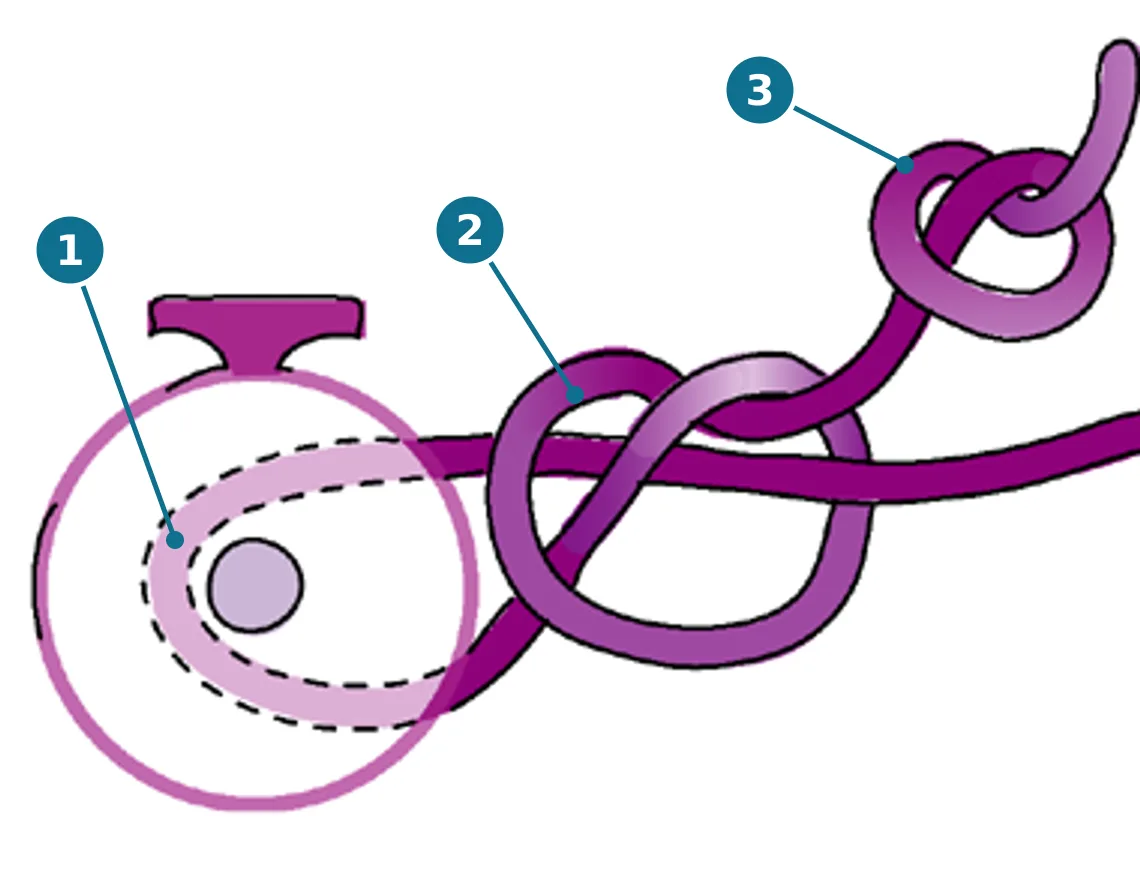
The arbor knot is two overhand knots: one tied with the tag end around the standing line, and a second in the tag alone. When you pull the line tight, the second knot jams against the first on the center of the reel spool. It is the knot that starts every spool of line, on spinning, baitcast, spincast and fly reels alike. On mono and fluorocarbon it holds; on braid it slips, however well it is tied.
The arbor knot is a noose: pulling the line tightens it on the spool. If it pulls straight off instead, you tied a slip knot by mistake.
What does the arbor knot do, and what does it not do?
The knot has one job: to grip the arbor, the center of the spool, so the first turns of line do not slide round while you wind on the rest. It is a simple jam. Once the spool is full, the turns of line on top hold it in place by friction, and the knot itself carries almost nothing.
It is not a strength knot, and we found no published break test for it. That is fine. If a fish ever takes you down to the arbor knot, it has taken every yard on the reel, and the knot that matters then is the one at the hook. The knots hub has those by job.
Its structure explains its one weakness. The noose holds the arbor by friction, so it holds only as well as the line grips. Monofilament and fluorocarbon grip. Braid is slick and does not, and that is the whole braid problem below.
How to tie the arbor knot, step by step
The numbers in brackets match the diagram at the top of the page.
- Pass the line around the arbor (1). On a spinning reel, open the bail first. On a baitcaster, thread the line through the rod guides and the level-wind guide before you go near the spool. Leave a tag end of several inches to work with.
- Tie an overhand knot with the tag around the standing line (2). The standing line runs through this knot without being tied into it. You tie the knot with the tag itself; the main line just happens to pass through it.
- Tie a second overhand knot in the tag alone (3), near the very end, and snug it. This stopper is essential: it is what jams against the first knot when you pull.
- Wet the knot and pull the standing line. The first knot slides down onto the arbor and closes, and the stopper snugs against it.
- Pull it hard, then check the seat. The stopper should sit tight against the first knot, and the knot should not slide round the arbor when you tug the line.
- Trim the tag close to the stopper, and start winding under tension.
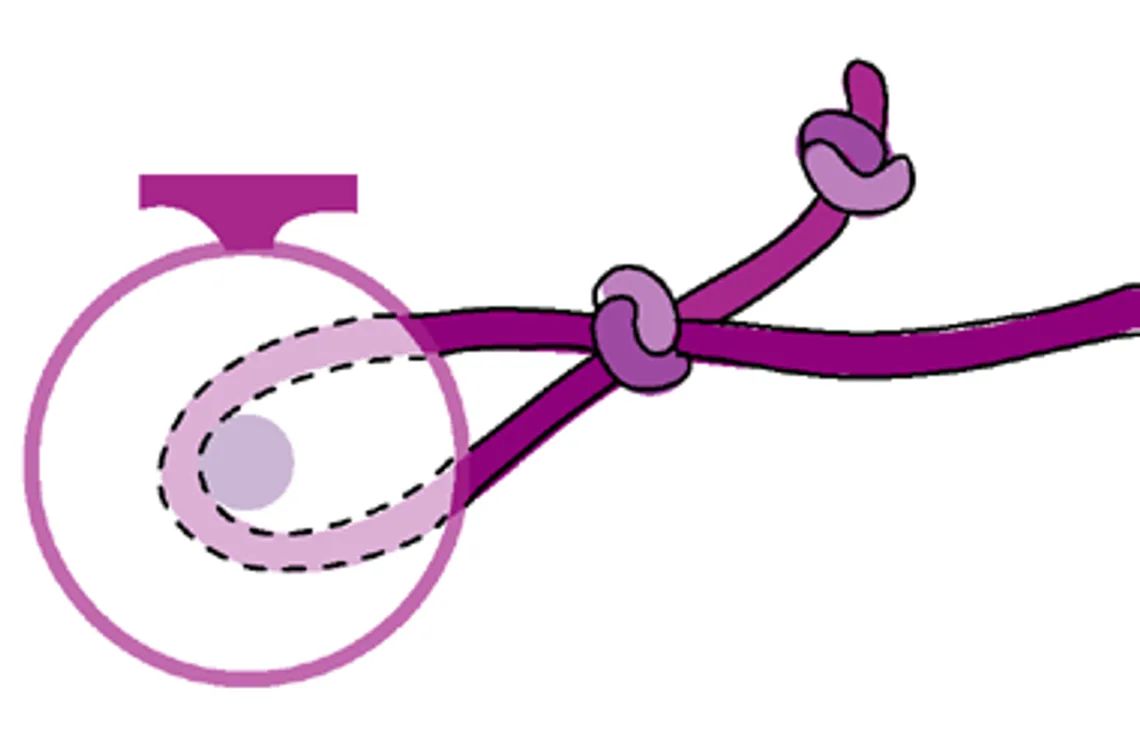 Both overhands snugged. One more pull on the standing line slides the pair down onto the arbor. Diagram: LadyofHats (Mariana Ruiz), Wikimedia Commons, public domain.
The noose-first shortcut. When the arbor is easy to reach, tie the knot in your hand first: make the noose, drop it over the arbor and pull it tight. Some guides start the other way round, with the stopper overhand tied first, which makes the wrap easier to hold. The one way to get it wrong is a slip knot, which will just pull undone.
To take it off, pull the tag. Pulling on the stopper end loosens the first knot and releases it.

Free PDF · Water temperature chart Which fish are biting at today's water temperature?
One reading, and the 16-page chart shows which of 26 fish are spawning, feeding hard or slowing down; for bass, crappie, bluegill and walleye, where they sit and what to throw. Every number sourced.
Enter your email, confirm it with one click, and the PDF is in your inbox. Plus one email a week on what's biting. Unsubscribe anytime. Privacy.
What changes on each kind of reel?
Spinning reel. Open the bail before you tie. Tie it with the bail closed and the line runs on the wrong side of the bail arm. The full winding procedure, with the filler spool direction and the slack test, is on the how to put fishing line on a reel page.
Baitcaster. Run the line through the rod guides and then the reel’s line guide, the level wind, before you tie. It is an easy step to forget. Many baitcaster spools have holes in the arbor. Push the line through until about an inch sticks out the other side, pin it with a thumb and crank four or five turns to lock it, no knot needed. A spool without holes gets an arbor knot.
Spincast. Zebco’s sequence is to remove the front cover and thread the new line through the hole in the cover. Then tie an arbor knot around the spool, pull it tight and put the cover back. Tie first and you will be cutting the knot off again. Use mono: Zebco says braid “may not work with spincast reels”. The spincast reel page covers the rest.
Fly reel. Here the arbor knot ties the backing to the reel. Tie an overhand knot in the end of the backing, pass the backing around the arbor, tie a second overhand around the standing part and pull it tight against the arbor. The fly line then joins the backing with an Albright knot, the usual knot for that join, which slides through the guides when a fish runs that far.
Why does the arbor knot slip?
A spool that turns under the line feels like a drag that never stops giving. There are three causes.
Braid. Braided line slips on a bare spool regardless of the knot used. Lew’s gives the reason: braid is “so slick” that no knot alone holds it on the spool, and the whole spool of line turns as a block. The fixes:
- Mono backing. On a 2500-size spinning reel, tie 20–30 yd (18–27 m) of 8–10 lb mono to the spool with an arbor knot. Join the braid to it with a double uni knot; an Albright or blood knot works just as well. The backing grips the spool, the braid grips the backing, and you buy less braid.
- Tape. A wrap of electrical tape on the arbor before the knot.
- A spool sold as braid-ready.
A polished spool. On a highly polished arbor, some anglers take the line around the arbor two or three times before tying, for friction. Animated Knots calls the direction of those turns critical: lay the wraps so that turning the reel tightens them, not loosens them.
A knot that never seated. If the stopper is not jammed hard against the first knot, the noose can open again under the first turns of line. Wet it, pull it hard, and check before you wind.
Which setup for which reel and line?
The tie-on, what goes under the line and the fill level, from the reel makers’ guides. The fill levels match the spooling page.
| Reel and line | Tie-on | Under the line | Fill to |
|---|---|---|---|
| Spinning, mono or fluoro | Arbor knot, bail open | Nothing | 1/8 in (3 mm) below the lip |
| Spinning, braid | Arbor knot in the backing | 20–30 yd (18–27 m) of 8–10 lb mono, double uni to the braid; or tape; or a braid-ready spool | 1/8 in (3 mm) below the lip |
| Baitcaster, any line | Through the level wind, then the arbor holes or an arbor knot | 8–10 lb mono; Kevin Short fills half to three-quarters of the spool with it | About 1/8 in (3 mm), even with the bevel |
| Spincast, mono only | Through the front cover, then an arbor knot | Nothing; no braid | 1/8 in (3 mm) below the top of the spool |
| Fly reel | Arbor knot in the backing | The backing itself; fly line joined with an Albright | The reel’s rated capacity |
Why the fill line matters: underfilling a reel costs casting distance and cranking speed, and overfilling invites backlashes.
The same knot off the reel
The arbor knot also keeps a loose filler spool tidy in the tackle bag, with no rubber band or tape. The method is credited to Aaron Martens:
- Hold the tag end of the line on the spool.
- Run a finger under the line on the spool and follow it all the way round until you are back at the tag.
- Pass the tag under and tie an overhand with the tag around the line.
- Pull the knot tight.
- Pull the tag while you rotate the filler spool. Turned the right way, the knot walks down onto the spool and the line snugs up.
It is not only a fishing knot. The Ashley Book of Knots lists it twice, as numbers 190 and 1114. Bushcrafters call the same knot the Canadian jam knot and use it with light rope to cinch a load such as a rolled sleeping bag; its nickname is the “bushcraft zip tie”.
Mistakes that cost you
- Braid straight onto a bare arbor. The classic “my drag slips” that is not the drag.
- A slip knot instead of a noose. It pulls straight off; start again.
- Bail closed or level wind skipped. The line sits on the wrong side of the bail or outside the guide, and the knot has to be cut.
- Winding without tension. Loose coils bury under the first good fish and throw loops on the next cast.
- Filling to the lip. The last 1/8 in is the loop that jumps off.
- Leaving a long tag. It lies under the first turns and makes a lump that catches line on the cast.
When does another knot matter more?
On the spool itself there is no better knot; the only choice is what goes under the line. Where the choice matters is the knot that joins braid to its backing or leader. For a braid to mono knot, the choice is the double uni (the uni knot tied twice) or the FG knot.
Free PDF · 16 pages
Know what's biting before your first cast
The Water Temperature Fishing Chart. Take one water temperature reading, find it on the chart, and see which of 26 freshwater fish are spawning, feeding hard or slowing down. Six pages go deeper: bass, crappie, bluegill, walleye, catfish and trout. For your phone and the tackle box.
- Where they sit and what to throw at every band: bass, crappie, bluegill and walleye; catfish by species; trout: the 68 °F line where you stop, and where they hide
- A bass that drops 3 ft feels more pressure change than the biggest cold front: the front day by day, and what to throw on each
- The three thermometer mistakes that make a reading lie (the first one is the surface)
- The 26-fish chart: who's spawning, feeding hard or slowing down at your reading
The chart's numbers come from state fish and wildlife agencies and fisheries research: 61 sources, each listed on the site.
Enter your email, confirm it with one click, and the PDF is in your inbox. Plus one email a week on what's biting. Unsubscribe anytime. Privacy.
Related
Section guide
Fishing Knots: Which Knot for Which Line and JobFishing knots by job and line: the five to learn first (Palomar, uni, FG, surgeon's, loop), the knot for braid, and what three pull tests measured.
 FG Knot: How to Tie It, and What the Pull Tests Show
The FG knot step by step: 12–15 pairs of wraps on a tight braid, the hitches, the setting pull, and what four named pull tests measured.
 Surgeon's Knot for Fishing: How to Tie It, and How Strong It Is
The fishing surgeon's knot in five steps, from 4–6 in of overlap to all four ends pulled, and what three pull tests measured: up to 64.6% of 50 lb braid.
 Uni Knot: One Knot for Hooks, Leaders, Snells and Loops
How to tie the uni knot in six steps, the turns for mono, fluorocarbon and braid, its six uses from hook to reel spool, and the pull tests.
 Palomar Knot: How to Tie It, How Strong It Is, When Not to Use It
How to tie the Palomar knot in six steps, its pull-test scores (89% on 10 lb mono, 82% on fluorocarbon), the double version for braid, and when to skip it.
Sources
- Animated Knots, Arbor knot
- Wikipedia, Arbor knot
- Orvis Learning Center, Arbor knot
- Wired2Fish (Jason Sealock), How to tie an arbor knot
- Take Me Fishing, How to spool a spinning reel with braided line
- Tackle Warehouse, How to tie an arbor knot for bass fishing
- Lew's, How to spool a spinning reel
- Lew's, How to spool a baitcast reel (with Kevin Short)
- Zebco, Spincast reel troubleshooting: changing the line
- Animated Knots, Albright knot