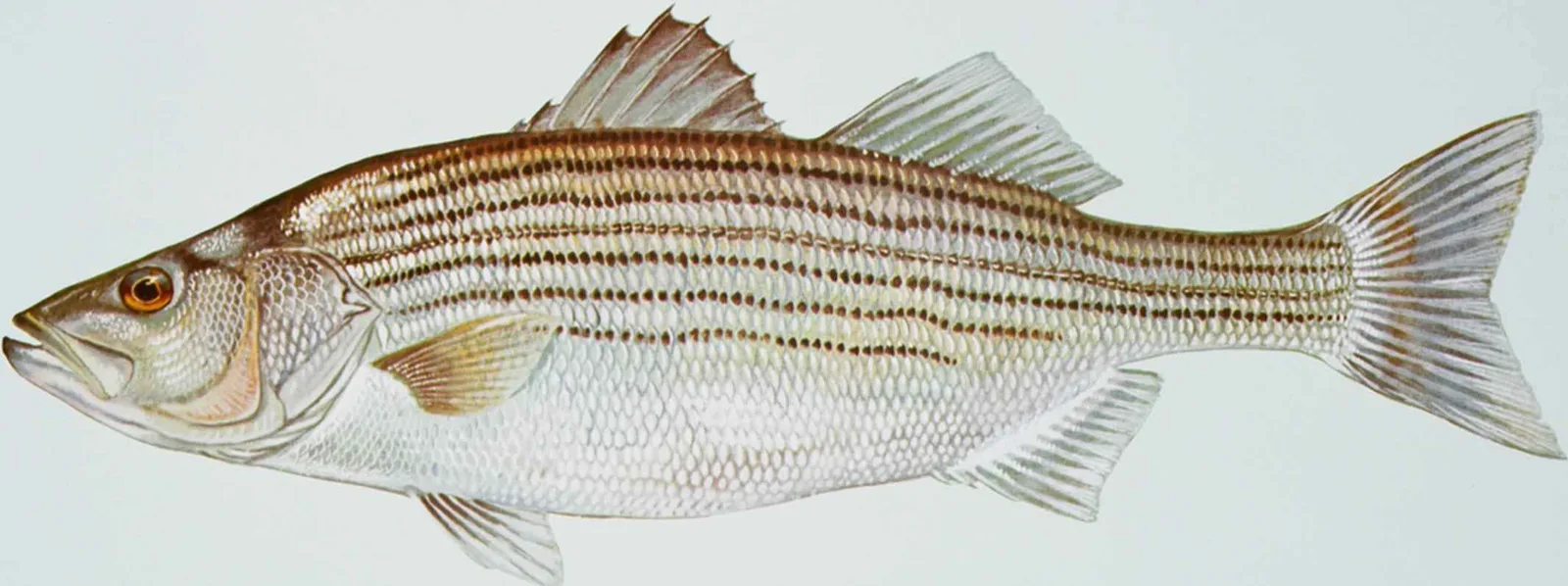
The striped bass is a cool-water fish that lives about 30 years and has been caught at 81 lb 14 oz on rod and reel. Most Atlantic stripers start life in the Chesapeake Bay, which produces 70 to 90 percent of the coast’s fish. Inland it is a stocked fish, in reservoirs across the South and West. Striper, rockfish and linesider all mean this one fish, Morone saxatilis, and along the Atlantic in 2026 you may keep exactly one a day, inside a narrow slot.
Most stripers over 30 lb are female, and a 55-lb cow carries about 4.2 million eggs. Maryland’s nursery has missed seven spawns in a row; that fish is the one the slot exists to send back.
Start here
- White bass: the small river cousin most often mistaken for a young striper, and the one-tooth-patch test that ends the argument.
- Water temperature: stripers feed hardest at 55–68 °F and fish over 10 lb depend on cool water; the chart shows when each species switches on.
- Fish species: every other fish, from largemouth to catfish, with the marks that identify each.
Is it a striper, a white bass or a hybrid?
Five fish in North America carry the temperate-bass look, and three of them get called “striper” at the ramp. The stripes are the first glance; the tongue is the answer. Open the mouth and look at the back of the tongue for the rough patches of teeth.
| Fish | Stripes | Tooth patches on the tongue | Body and dorsal fins | Size |
|---|---|---|---|---|
| Striped bass | 7–8 dark, unbroken, gill to tail | Two distinct, parallel patches | Slender, no arch behind the head, round in cross-section; two separate dorsal fins | Adults 10–30 lb (4.5–14 kg); record 81 lb 14 oz (37.1 kg) |
| White bass | Faint; only the center stripe reaches the tail | One patch, heart-shaped | Deep, flattened side to side, back arched behind the head; two separate dorsals | 10–15 in (25–38 cm), ½–1½ lb (0.2–0.7 kg); record 6 lb 13 oz (3.1 kg) |
| Hybrid (wiper, palmetto, sunshine) | Distinct but broken or wavy, especially the lower ones; several reach the tail | Two patches close together, sometimes merged into one | Slightly arched, deeper than a striper’s; two separate dorsals | 2–5 lb (1–2.3 kg) common, 7–10 lb (3–4.5 kg) in Missouri; record 27 lb 5 oz (12.4 kg) |
| Yellow bass | Sharply broken and offset above the front of the anal fin; brassy yellow | None | Small and deep; dorsal fins joined by a membrane | Seldom over 12 in (30 cm) or 1 lb (0.45 kg); record 2 lb 9 oz (1.16 kg) |
| White perch | No stripes on adults | None | Deep, dark domed back; dorsals slightly connected with a deep notch | 7–10 in (18–25 cm) typical |
The marks come from the state and federal identification keys. Texas Parks and Wildlife covers the four bass, and Virginia DWR and Oklahoma’s ODWC the striper. Missouri Conservation and the USFWS cover the hybrid and white bass, Missouri and Iowa the yellow bass, and the USGS the white perch. The sizes are the agencies’ typical ranges (the Chesapeake Bay Program’s for adult stripers) and the IGFA all-tackle records.
The stripe test is the one every forum repeats, and it is the one that fails. USGS biologists call it “broken line syndrome” and say it “is not a reliable method of identification”. Texas Parks and Wildlife’s key says of hybrids that “all characteristics should be considered in combination”. Oklahoma’s field key fits on one line: white bass, arched back and one tongue patch; hybrid, slightly arched back, two patches, some broken lines; striper, no arch, two distinct patches, unbroken lines.
If you want to be certain, count the anal spines. All of them have three. On a striper the second is about half the length of the third; on a white bass it is about two-thirds, a stair step. On a yellow bass the second and third are nearly equal and both much longer than the first. Wisconsin’s DNR verified its 2025 state-record yellow bass by counting fin rays, not by reading its stripes.
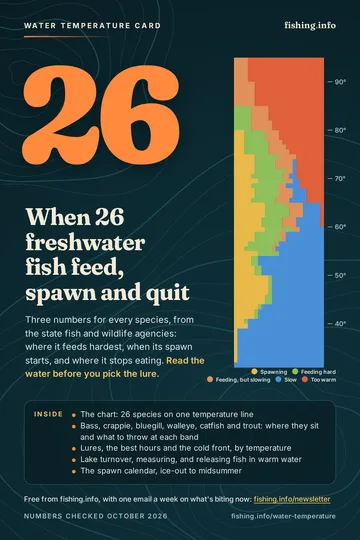
Free card: what 26 species do at your water temperature
Plus one email a week on what's biting now. No sales pitches. Privacy.
Where do stripers live?
The striper is native from the St. Lawrence River to the St. Johns in Florida, and along the Gulf to Louisiana. It was carried to the Pacific coast in 1879.
Almost every striper on the Atlantic coast was born in one of three river systems. The Chesapeake Bay produces 70 to 90 percent of the coastal population, with the Hudson and the Delaware adding most of the rest. North Carolina’s Albemarle Sound–Roanoke River stock is the third largest; its adults swim about 130 miles up the Roanoke each spring to spawn. The young stay in their sound or estuary for two to four years, then join the ocean population. That population moves north in summer and south in winter, and Massachusetts sees it from May to November.
A second race lives in the Gulf of Mexico, with a higher temperature tolerance than its Atlantic cousins. Texas Parks and Wildlife says dams and channel work in the 1950s and 60s are thought to have stopped it from reproducing. It survives as a hatchery-supported remnant in the Apalachicola–Chattahoochee–Flint system.
Inland, the striper is a stocked fish. Its eggs are semi-buoyant and must drift in current for two or three days before they hatch; in still water they sink into the sediment and die. That is why Virginia calls reservoir spawning “almost entirely unsuccessful”, and why nearly every landlocked striper came from a truck. Lake Texoma is the famous exception. Fish there can run 60 to 90 miles up the Red and Washita rivers, and the lake has sustained itself since the 1970s.
Wherever it lives, the striper is a cool-water fish. Texas Parks and Wildlife puts its preferred water below 75 °F (24 °C) and calls fish over 10 lb “particularly dependent on cool water”. Angler sources put the feeding band at 55–68 °F (13–20 °C). That band sends reservoir fish deep by midsummer and drives the whole coastal migration.
What do stripers eat, and what is the best bait?
A coast-wide diet study (Walter, Overton, Ferry and Mather, 2003) found that from age one on, menhaden, anchovies, river herring and Atlantic herring dominate the diet in every region and most seasons. South of Cape Cod that means menhaden first. North of it, where menhaden are sporadic, herring and sand eels take over; Maine’s 2025 study found sand eels, Atlantic herring, pogies and squid. In reservoirs the menu is threadfin shad, gizzard shad and blueback herring. At Lake Powell, 28 percent of 321 stomachs held threadfin shad and none held one of the Colorado River’s threatened or endangered native fish.
The best bait for striper fishing, then, is the local forage, alive if the rules allow. The world record took a live eel, the landlocked record a live gizzard shad. Circle hooks are mandatory with bait along the Atlantic coast.
How old is a 40-lb striped bass?
A 40-lb striper is roughly 15 to 16 years old, give or take a few, and almost certainly a female. Stripers grow fast for four years and then slow, and the sexes part company early. Females grow larger and make up almost every fish over 30 lb; in a mid-Atlantic study (Schiano et al. 2025) they kept gaining length and weight to age 22 or older. In the table, the lengths are Chesapeake fish aged by Nelson, Smith and Quinn (2025), in fork length by sex. The weights are New York DEC’s approximate age-weight sheet, and the reservoir figures are from Texoma and Lake Cumberland.
| Age | Chesapeake female | Chesapeake male | Approximate weight | Reservoir benchmark |
|---|---|---|---|---|
| 2 | — | — | — | Texoma: 16–19 in (41–48 cm) |
| 3 | 16.6 in (42 cm) | 15.3 in (39 cm) | — | Cumberland: 22 in (56 cm) minimum reached in three years |
| 6 | — | — | ~10 lb (4.5 kg) | — |
| 8 | 30.8 in (78 cm) | 26.7 in (68 cm) | ~13 lb (6 kg) | — |
| 10 | — | — | ~18 lb (8 kg) | — |
| 11 | — | — | — | Cumberland: about 11 years to 30 in (76 cm) |
| 15 | — | — | ~36 lb (16 kg) | — |
| 20 | — | — | ~70 lb (32 kg) | — |
On the same sheet a 50-lb striper falls between 17 years (47 lb) and 18 years (55 lb). So the 40-pounder is about 15 or 16, and a slot fish of 28–31 in is about seven to eight years old if it is a female, and a year or two older if it is a male. California’s transplanted fish grow faster than Chesapeake fish at most ages up to eight. Older mid-Atlantic fish have been getting longer (Schiano et al. 2025). From 1998 to 2019, length at age rose by an average of about 3.5 in (8.9 cm) for males aged 10 to 14 and about 3 in (7.8 cm) for females aged 10 to 15. Massachusetts calls a fish over 50 lb rare and puts the lifespan at up to 40 years; ASMFC and NOAA say at least 30.
When do stripers spawn?
Spawning starts when a river warms to about 55–62 °F (13–17 °C), depending on the agency measuring it, and peaks near 65 °F (18 °C). In 2026 the Choptank spawn ended when the water hit 68 °F (20 °C). The fish run upstream to fresh, flowing water in March through May; on the Roanoke as many as 20 males surround a single female. A 12-lb female drops about 850,000 eggs, a 55-lb female about 4.2 million. Males mature at two to four years, females at four to eight.
Why only one fish? The 2026 stock, plainly
The Atlantic striped bass stock is overfished. The 2024 assessment update put the female spawning stock at 191 million lb (86,600 t) in 2023. That is below the 197 million lb threshold and well below the 247 million lb target. Fishing pressure itself is under the limit, so ASMFC’s official wording is “overfished, overfishing not occurring”. The chance of rebuilding by the 2029 deadline under the current rules is less than 50 percent.
The rules that followed:
- 2019. The benchmark assessment finds the stock overfished and overfishing occurring. Addendum VI cuts harvest and makes circle hooks mandatory with bait from January 1, 2021.
- 2023. An emergency 31-in maximum protects the strong 2015 year class.
- 2024. Addendum II sets the slots that stand today: ocean 28–31 in (71–79 cm), Chesapeake Bay 19–24 in (48–61 cm), one fish a day, commercial quotas cut 7 percent.
- October 2025. ASMFC’s board rejects Addendum III’s proposed 12 percent cut, citing lower-than-expected 2025 catch and the economic cost, and keeps the 2025 slots and quotas for 2026. Total length is now defined as a straight line with the tail lobes squeezed together.
Behind the numbers is the nursery. Maryland has seined the same 22 Chesapeake sites every summer since 1954 to count juvenile stripers, and the long-term average is 11 per haul. The 2024 index was 2.0 and the 2025 index 4.0, the seventh straight year of poor spawning. Drought and warm winters are the causes the agencies name.
Anglers matter to this stock more than commercial boats do. Recreational fishing accounts for about 82 percent of removals. Roughly 90 percent of the recreational catch is released alive, but about 9 percent of those fish die. Unhooking a 40-lb cow in the water is not etiquette; it is the management plan.
The stock has been here before. Maryland closed its fishery entirely from 1985 until 1990, the coast protected the 1982 year class, and ASMFC declared the stock recovered in 1995. Today’s 191 million lb is still more than three times the biomass of the mid-1980s.
Are striped bass good to eat?
Yes, and the questions about eating striped bass are mercury and PCBs, not taste. The FDA’s survey of commercial fish puts the mean mercury in striped bass at 0.167 ppm (median 0.094, from 101 samples). That is a little above canned light tuna at 0.126 and far below swordfish at 0.995.
The PCB problem is local. New York’s health department rates the Hudson from Troy to Catskill do-not-eat. Below Catskill it allows one meal a month for women under 50 and children, and four meals a month for everyone else. Trimming the belly fat and the dark lateral-line meat removes about half the PCBs, the department notes. Maryland’s advice for smaller Chesapeake stripers is three meals a month, and its trimming study cut PCBs by 75 to 91 percent.
What are the striped bass records?
The all-tackle world record is Greg Myerson’s 81 lb 14 oz striper, 54 in long, caught on a live eel in Long Island Sound on the night of August 4, 2011. It was weighed the next morning in Westbrook, Connecticut. It ended the 29-year reign of Albert McReynolds’ 78 lb 8 oz fish from an Atlantic City jetty, taken on a Rebel plug in a nor’easter in September 1982. The landlocked record is James Bramlett’s 69 lb 9 oz fish from the Black Warrior River in Alabama, February 2013, on a live gizzard shad.
Striper, rockfish or linesider? The names
Striper is the name everywhere. From New Jersey south, and all through the Chesapeake, the same fish is rockfish or just rock; linesider is the old surfcaster’s word. The confusion starts on the Pacific coast, where rockfish means Sebastes, an unrelated genus of more than 100 species. That is why a “world record rockfish” claim splits in two. The biggest striped bass ever documented was a 125-lb fish netted at Edenton, North Carolina, in 1891, and it has nothing to do with a Pacific rockfish.
Striped bass is not a sea bass either. It belongs to the temperate basses, family Moronidae, with the white bass, yellow bass and white perch of North America and the sea bass of European waters (Dicentrarchus). The hybrid is a hatchery cross of striped bass and white bass: wiper or whiterock in the Plains, palmetto bass in the South, sunshine bass in Florida. It exists only through stocking.
The striper is the state fish of Maryland (since 1965), Rhode Island and South Carolina, and the state saltwater fish of New York, New Jersey, Virginia and New Hampshire.
All articles
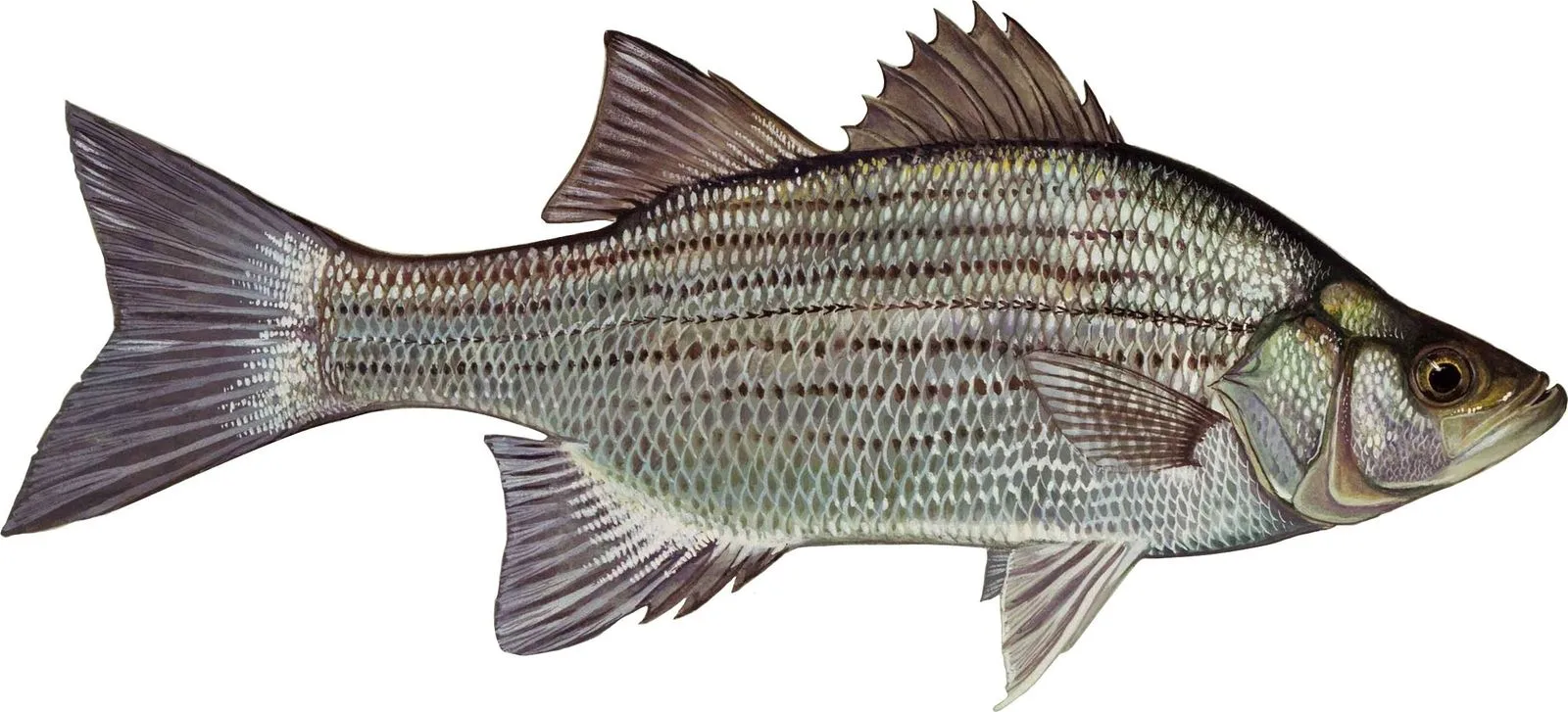 White Bass: How Big They Get, Where They Live and How to Catch Them
White bass from the agency data: how big they get, why most die by age four, the one-tooth-patch test against stripers and the 55–60 °F run.
Free download
The water temperature card
Read your water temperature and the card tells you who is spawning, who is feeding and what to throw. 26 species, 16 pages, for your phone and the tackle box.
Plus one email a week on what's biting now. No sales pitches. Privacy.
Sources
- Atlantic States Marine Fisheries Commission, Atlantic striped bass
- ASMFC press release, Board approves Addendum III without reductions (October 2025)
- On The Water, 2025 striped bass spawning survey delivers more bad news
- Texas Parks and Wildlife, bass comparison and identification
- Missouri Department of Conservation, hybrid striped bass
- Massachusetts Division of Marine Fisheries, learn about striped bass
- Nelson, Smith and Quinn 2025, striped bass length at age by sex, Marine and Coastal Fisheries
- New York DEC, Growing Up as a Striped Bass (weight by age)
- Salt Water Sportsman, world record striped bass certified by IGFA
- IGFA, yellow bass world records (John Chappell, Duck River, Tennessee, 1998)
- FDA, mercury levels in commercial fish and shellfish (1990–2012)
- New York State Department of Health, can you eat that striped bass from the Hudson?
- NOAA Fisheries, Atlantic Striped Bass
- Chesapeake Bay Program, Striped Bass (field guide)
- ASMFC, Atlantic Striped Bass Addendum III
- Virginia DWR, Striped Bass
- NC Wildlife, Striped Bass
- Oklahoma Department of Wildlife Conservation, Striped & Hybrid Striped Bass Angler Guide: Top Tips & Area Highlights (2024)
- Texas Parks and Wildlife, Striped Bass in the Gulf of Mexico?
- TPW magazine, Size Matters at Lake Texoma (March 2020)
- Kentucky Afield Outdoors, Striped bass fishing at Lake Cumberland improving after challenging years (NKyTribune, 2023)
- USGS Nonindigenous Aquatic Species, wiper (Morone chrysops × saxatilis) species profile
- Walter, Overton, Ferry and Mather 2003, Atlantic coast feeding habits of striped bass: a synthesis supporting a coast-wide understanding of trophic biology, Fisheries Management and Ecology
- University of Maine Staudinger Lab, Maine Striped Bass Foraging Ecology Study
- Persons and Bulkly 1982, Feeding activity and spawning time of striped bass in the Colorado River Inlet, Lake Powell, Utah, North American Journal of Fisheries Management (USGS)
- Schiano et al. 2025, Trends in Atlantic Striped Bass growth in the mid-Atlantic, USA, Transactions of the American Fisheries Society