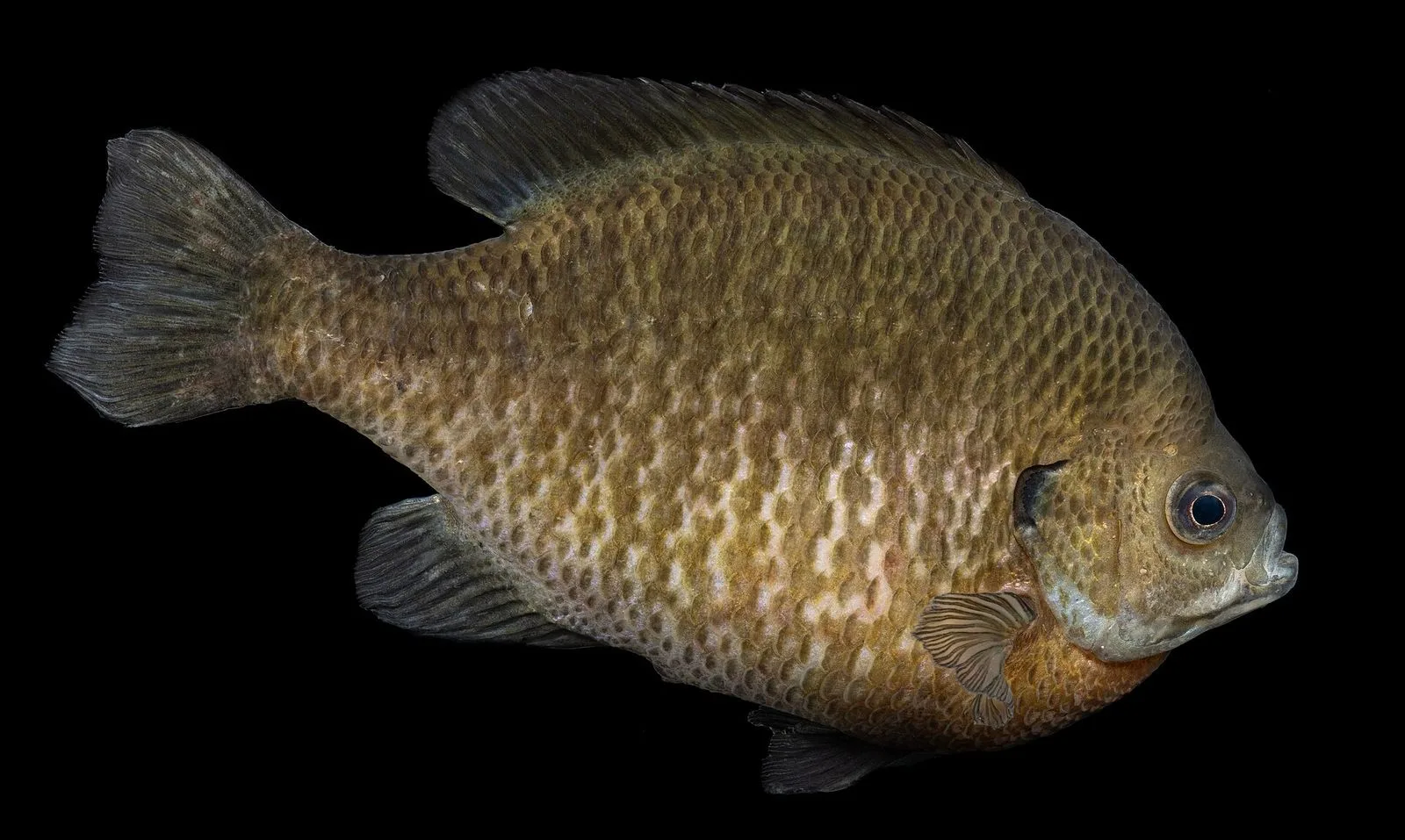
A bluegill is the sunfish with a solid black ear flap and no colored edge, and in most waters it never grows past 9.5 in (24 cm) or 12 oz (340 g). It is native to the East, stocked through the West, and lives in Hawaii, Puerto Rico and, through one diplomatic gift, every river in Japan. It spawns in summer in colonies of 50 or more nests, and the big males guarding them are the fish to put back.
A male bluegill takes seven years to earn a nest. A “sneaker” matures at two, never builds one, and darts through the nest while the female is laying; by four he turns “satellite”, wears female colors and spawns in the middle of the pair.
How do you tell a bluegill from other sunfish?
Three marks settle it. The ear flap on the gill cover is solid black to the very edge, with no red, orange or white border. The pectoral fin is long and pointed: fold it forward and the tip reaches past the front of the eye. And the mouth is small, so small that the upper jaw stops short of the front of the eye.
A blue wash on the chin and gill cover gives the fish its name. Males darken in the spawn and show a yellow breast; females stay paler.
| Mark | Bluegill | Pumpkinseed | Redear | Green sunfish |
|---|---|---|---|---|
| Ear flap | Solid black, no colored edge | Black with a bright red-orange half-moon at the tip | Black with a red (male) or orange (female) edge on a white border | Dark with a pale margin |
| Pectoral fin | Long and pointed, past the front of the eye | Long and pointed | Long and pointed | Short and rounded |
| Mouth | Small; jaw stops short of the eye | Very small | Small | Large; jaw reaches the middle of the eye |
| Other marks | Black blotch at the rear of the soft dorsal; 5–9 bars | Wavy turquoise lines on the cheek; spotted soft dorsal | Faint bars, no dorsal blotch | Turquoise flecks; fins tipped yellow or white |
| Typical size | 6–10 in (15–25 cm) | 6–10 in (15–25 cm) | 8–10.5 in (20–27 cm) | 6–8 in (15–20 cm) |
Every one of these fish will cross with a bluegill where they nest side by side. A fish with a black flap and a green sunfish’s mouth is a wild hybrid, not a misprint. The full nine-species table, rock bass and warmouth included, is on the panfish hub.
Is a bluegill a crappie? No. Both belong to the sunfish family, but crappie are silver fish with speckles and a far bigger mouth. Their spawn starts at 58 °F (14 °C) for black crappie and 60 °F (16 °C) for white, before the first bluegill bed forms.
Where do bluegill live?
A bluegill wants warm, clear water with weeds or wood, in anything from a farm pond to a reservoir or a slow river. Missouri notes it does not tolerate high turbidity. Young fish live inside the weeds; bigger ones feed along the outer edge, and the biggest move offshore to deep water for the winter.
The native range runs through the St. Lawrence–Great Lakes and Mississippi basins, from Quebec and New York to Minnesota and south to the Gulf. It continues along the Atlantic and Gulf slopes from North Carolina’s Cape Fear River to the Rio Grande. Stocking did the rest. Bluegill were first recorded in Utah in 1890, California and Washington in 1891, Nevada in 1909 and Arizona in 1934. They have been carried to Europe, Africa, Asia, South America and Oceania.
Japan learned what that means. It started with a gift from Chicago mayor Richard J. Daley to the visiting Crown Prince Akihito.
| Year | What happened |
|---|---|
| 1960 | On October 3, at the Shedd Aquarium, Daley nets 18 bluegills from a tank for Akihito; fifteen survive the flight and Japan’s Fisheries Agency breeds them |
| 1966 | Their descendants are released into Lake Ippeki |
| 1999 | Bluegill have colonized every freshwater system in the country |
| 2005 | Shiga prefecture spends $1.2 million removing 420 tons of invasive fish, bluegill and bass, from Lake Biwa |
| 2007 | Japan’s bluegill number about 25 million; with largemouth bass they make up 90 percent of the fauna in Lake Biwa, once home to 30 native fish species; Emperor Akihito says in public that his heart aches to see how it turned out |
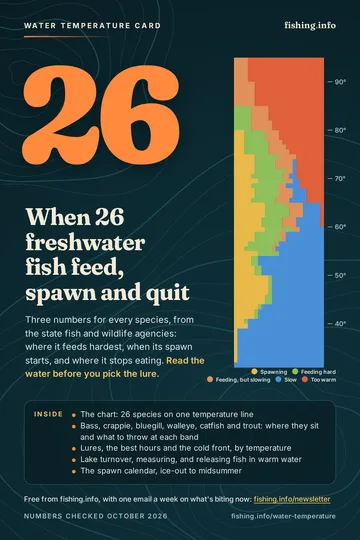
Free card: what 26 species do at your water temperature
Plus one email a week on what's biting now. No sales pitches. Privacy.
Where are they through the year, and how do you catch them?
Find the fish first; the season tells you where. Wisconsin’s DNR puts summer plainly: most large bluegill are taken in deep water, drifting worms with the wind.
| Season | Water | Where they are | How to fish it |
|---|---|---|---|
| Spring | 55–67 °F (13–19 °C) | Staging on the first drop outside the spawning bays, feeding hard | – |
| Spawn | 67–80 °F (19–27 °C) | On the beds in the backs of protected pockets | Jason Sealock (Wired2Fish) looks for clusters of light or dark circles with polarized glasses; fan-casts a bobber rig until the first bite, then works the school |
| Summer | – | Big fish leave the shallows, down the weed growth to deep weedlines, offshore humps with shell or rock, steep banks | Nick Petrou’s (Wired2Fish) drop-shot: 18–24 in (46–61 cm) leader, size 4–6 red octopus hook, 3/16–3/8 oz weight, a leech or half a nightcrawler |
| Fall | Cooling | Back into shallow brush and the brush piles just off the bank, then out again as the water cools | – |
| Winter | – | Stacked on deep breaks and cover: brush piles covered in bluegill in 20 ft (6 m), bull bream in 50 ft (15 m) (Sealock) | Drop-shots and small jigging spoons; under the ice, Wisconsin’s anglers jig the weeds with grubs |
Why is a bluegill hard to catch when the pond is full of them? Because the small ones are easy and the big ones are not. Keith Sutton’s rule in Game & Fish is that big bluegill sit below the rest of the school, on or near the bottom, and that heavier line catches fewer of them. He fishes 2–4 lb line, 1/32 oz spinners and, for the giants, 2–3 in (5–8 cm) minnows, and he moves “quiet as a mouse”.
The tackle is simple. Wisconsin’s DNR calls plain garden worms the favorite bait; a worm, a cricket or a grub goes on a small hook under a bobber. Sealock uses a No. 6 Aberdeen on 4 lb monofilament, with split shot 12–18 in above it and the bobber a couple of feet higher. Iowa suggests a long-shank No. 8 and North Carolina a No. 10; the hook size chart shows the spread.
Sealock’s everyday lure is a 1/32 oz jig with a grub or spider of 1 in (2.5 cm) or less; a bit of worm on the hook catches a lot more. Fly-rod poppers work best, Wisconsin’s DNR says, in spring and early summer, when the nests are shallow. North Carolina’s rule: no bluegill in 15 minutes, move.
How big do bluegill get, and how old is a 10-inch fish?
Adult bluegill run 6–10 in (15–25 cm). Bigger fish exist, but they are old: across 18 Nebraska sandhill lakes, an 8-in (20 cm) fish was anywhere from 4.3 to 8.3 years old, depending on the lake. Most bluegill live five to eight years; eleven is about the ceiling.
Fisheries biologists use a standard-weight equation, which gives the weight of a bluegill in good (75th-percentile) condition at any length. Put age and weight together and the table reads like a birth certificate.
| Length | Standard weight | Age | What it means |
|---|---|---|---|
| 1–2 in (2.5–5 cm) | End of first summer (Iowa) | ||
| 3.5 in (9 cm) | 2 (Iowa) | ||
| 4.5 in (11 cm) | 1 oz (28 g) | 3 (Iowa) | The pond fish that steals your worm |
| 6 in (15 cm) | 2.6 oz (73 g) | 4 (Iowa); 3–4 (Missouri) | The first size worth cleaning |
| 8 in (20 cm) | 0.42 lb (190 g) | 4–8 (Nebraska sandhill lakes) | A quality fish; most bluegill caught are smaller |
| 9 in (23 cm) | 0.62 lb (280 g) | older still | Ten ounces, whatever the scale at the dock says |
| 10 in (25 cm) | 0.88 lb (400 g) | older still | Michigan’s Master Angler minimum |
| 11 in (28 cm) | 1.21 lb (550 g) | older still | Any 11-incher is a pound |
| 12 in (30 cm) | 1.61 lb (730 g) | older still | The top of Iowa’s range: 12 in and 2 lb |
| 15 in (38 cm) | 3.37 lb (1.53 kg) | unknown | The world record, at 4 lb 12 oz, was 141 percent of this |
That is the one-pound rule: a pound needs a fat 10-incher or any 11-incher. A nine-inch fish, however proud its captor, weighs ten ounces. Michigan set its Master Angler minimum at 10 in for exactly that reason.
Bluegill grow fastest in warm water, but not without limit. In the laboratory they put on weight fastest at 86–88 °F (30–31 °C), and both growth and food conversion fell off at 93 °F (34 °C). So the claim that bluegill grow faster once a pond passes 85 °F holds for only a few more degrees.
Food does the rest. A bluegill feeds by sight at every depth, and midge larvae can be half its diet; adults add small fish, crayfish and snails. In one small impoundment its daily meal ran from 0.8 percent of body weight in February to 3.2 percent in June (Kolehmainen 1974).
What is the world record bluegill?
The all-tackle world record weighed 4 lb 12 oz (2.15 kg). It measured 15 in (38 cm), with an 18.25 in (46 cm) girth. T. S. Hudson caught it on April 9, 1950, at Ketona Lake, Alabama, on red worms fished without a weight from a cane pole. Nothing has beaten it since. It weighed 141 percent of a standard fish that length: record bluegill are fat, not long.
Ketona Lake is two flooded limestone quarry pits of 18–20 acres north of Birmingham’s airport, filled when a blast opened an underground spring. Hudson was not the first to pull a giant out of it. In May 1947 Coke McKenzie took a 4 lb 10 oz bluegill there on unweighted red worms under a quill float. He gigged it, because the bank was sheer and the water 10 ft (3 m) deep, and left it in a pan of water overnight before weighing it. Hudson repeated the method three years later and beat him by two ounces.
Biologists found no genetic secret. Limestone made the water rich, the sheer banks left almost no spawning habitat, and heavy bass predation kept the bluegill few, old and enormous. The pits are private and closed to fishing.
The state records tell the same story about age and girth.
| Record | Weight | Where and when |
|---|---|---|
| World (all-tackle) | 4 lb 12 oz (2.15 kg), 15 in (38 cm) | Ketona Lake, Alabama, 1950 |
| Georgia | 3 lb 5 oz (1.5 kg) | Shamrock Lake, 1977 |
| Iowa | 3.13 lb (1.42 kg) at only 12.88 in (33 cm) | 1986 |
| Michigan | 2.75 lb (1.25 kg) | |
| Vermont | 1 lb 15.7 oz (0.9 kg) | Miller Pond, 2016 |
The panfish hub sets the panfish records side by side, with the redear from Lake Havasu.
How do bluegill spawn?
Bluegill are the last of the spring spawners. The beds form when a bay holds 67–80 °F (19–27 °C), from late May into August in the North and longer in the South. The bluegill spawn temperature page has the month-by-region table and how to find a bed.
A bluegill bed is a colony. Each male fans a dish 6–12 in (15–30 cm) across into sand or gravel, rim to rim with his neighbors, in 1–2 ft (0.3–0.6 m) of water. A colony can hold 50 or more nests. Colonies counted in Wisconsin and on Ontario’s Lake Opinicon held 4 to 272 nests, each about 2 in (5 cm) from the next. The crowding is protection. An edge nest loses at least three times as much brood to raiders as one in the middle. A male nesting alone loses twice as many eggs to fungus (38 against 19 percent), probably because he chases predators instead of fanning.
A female lays 10 to 30 eggs per dip and dips several hundred times. An average female carries about 12,000 eggs, a big one 25,000 or more. The eggs hatch in two to five days, and the male guards the brood for about ten days, until the fry swim up. Then it starts again: Wisconsin’s biologists recorded 4 to 11 bouts in seasons of 31 to 112 days. Texas A&M counts about five spawns per female a summer in small east-Texas reservoirs.
That answers the full-moon question too. Guides swear by the full and new moons, but no peer-reviewed study has tested the moon for bluegill. Wisconsin’s bouts come about every ten days, so some land on a full moon either way.
Now the males, and the fact worth taking to the water. Bluegill males come in two life histories. Parental males mature at about seven, fight for a nest in the middle of the colony and raise the brood. Cuckolders mature at two and never build a nest. At two and three they are sneakers, hovering at the edge of the colony and darting through a nest the moment the female dips. From about four they are satellites, taking on female coloring and sliding in between the pair to spawn in the open.
| Parental male | Cuckolder | |
|---|---|---|
| Matures at | About 7 | 2 |
| Nest | Builds and guards one | Never builds one |
| Testes, share of body weight | 1.2 percent | 5.6 percent |
| Growth | 30 percent slower | |
| Chance of survival | About 15 percent of a parental’s | |
| Lives to | Eleven | Most dead by five |
Some lakes have cuckolders and others, North Dakota’s biologists note, do not.
The lesson follows from the biology. The fish that hits a bait dropped into a nest is a parental male, the biggest and oldest fish in the colony and the only one raising fry. Take the big males off the beds and the colony loses its guards. In Murphy Flowage, Wisconsin, with no bag limit, 8-in-plus bluegill per acre fell 90 percent from 1955 to 1958. Where the daily limit was cut from 25 to 10 on seven lakes, the average bluegill grew 0.8 in (2 cm) longer, up to 2 in (5 cm) on some. Keep the 6–8 in fish for the pan and put the hand-sized males back over the nests.
Can you keep and eat bluegill?
Yes, and Missouri’s field guide calls the flesh “firm, flaky, and well flavored”. The only caution is how often. Minnesota’s Department of Health, which sets its advice on average mercury, PFOS and PCB levels, puts sunfish in the same statewide group as crappie and yellow perch. Most adults may eat up to four servings a week; children under 15 and anyone pregnant, breastfeeding or who may become pregnant, one.
Daily limits vary widely; check the state booklet, because the lakes with reduced limits are where the experiment above is running.
| State | Daily limit |
|---|---|
| Texas | None, and no minimum length |
| Alabama | 50 bream |
| Wisconsin | 25 panfish, cut to 10 on selected lakes |
| Michigan | 25 sunfish, crappie and rock bass combined |
Bluegill as bait is legal in some states and not in others. Texas bans game fish as bait, but sunfish are not on its game-fish list, and they appear by name on the permitted live-bait list for a set of West Texas counties. California bans fin fish as bait district by district, except the species each district lists; sunfish are on the list for the Colorado River District, not for the Southern District. Read your state’s bait rules before a bluegill goes on a catfish hook.
What else is a bluegill called?
It is a bream in the South, a sunperch in Texas and a “perch” across half the country; Texas Parks and Wildlife also lists brim and sunfish. “Coppernose” is the Florida subspecies, L. m. mystacalis, which outgrew native Texas bluegill in Texas A&M’s pond trials with the same cold tolerance. The scientific name is Lepomis macrochirus, and crappie are a different genus, Pomoxis.
What no biologist calls it is a perch. The true perches are on the yellow perch page, and the white perch page covers the other “perch” that is not a sunfish at all.
Free download
The water temperature card
Read your water temperature and the card tells you who is spawning, who is feeding and what to throw. 26 species, 16 pages, for your phone and the tackle box.
Plus one email a week on what's biting now. No sales pitches. Privacy.
Related
Section guide
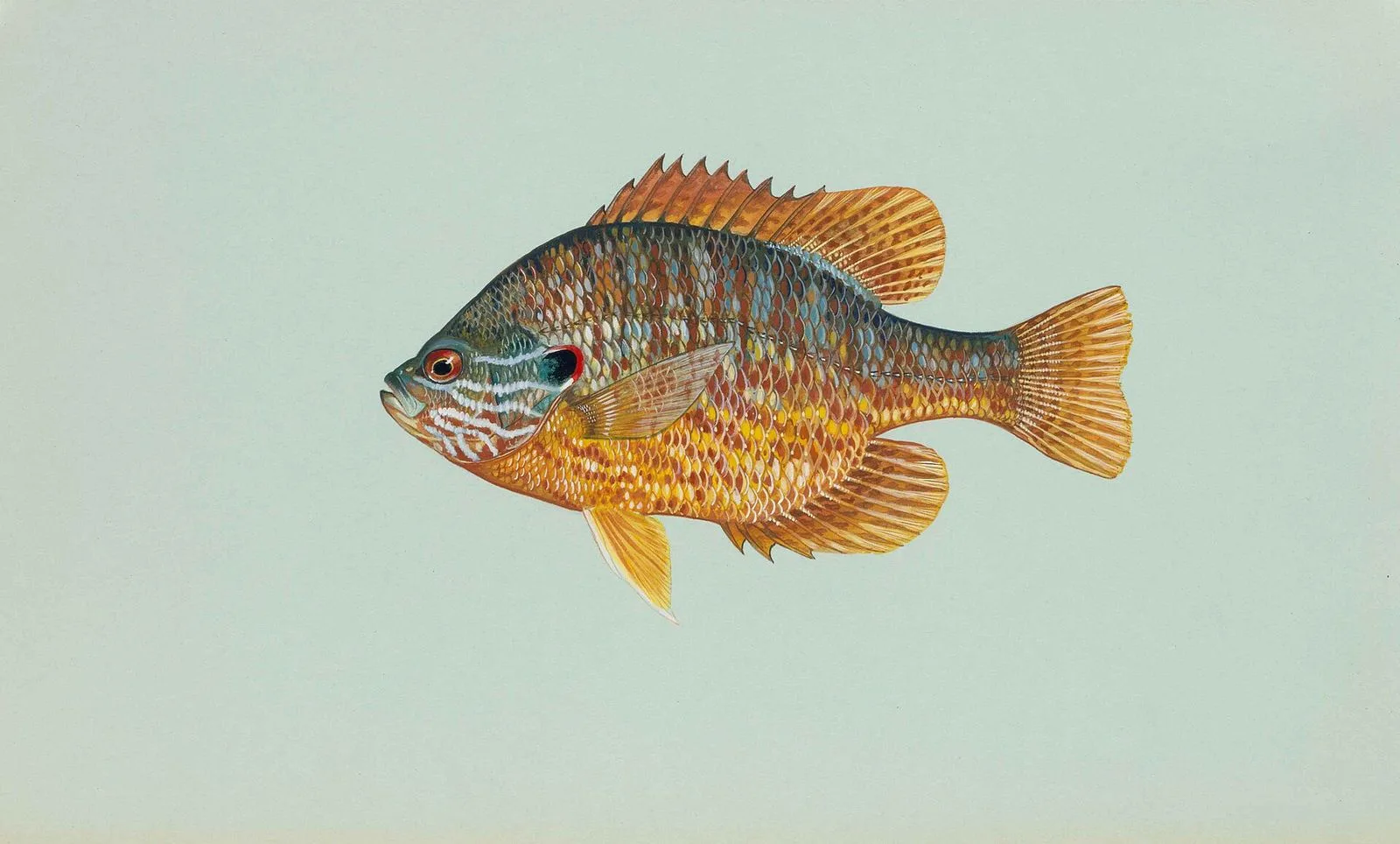
Panfish: Which Fish Count and How to Tell Them ApartPanfish are bluegill, the sunfish, crappie and yellow perch. Tell 9 sunfish apart by the ear flap, plus records and limits from 50 a day to none in Texas.
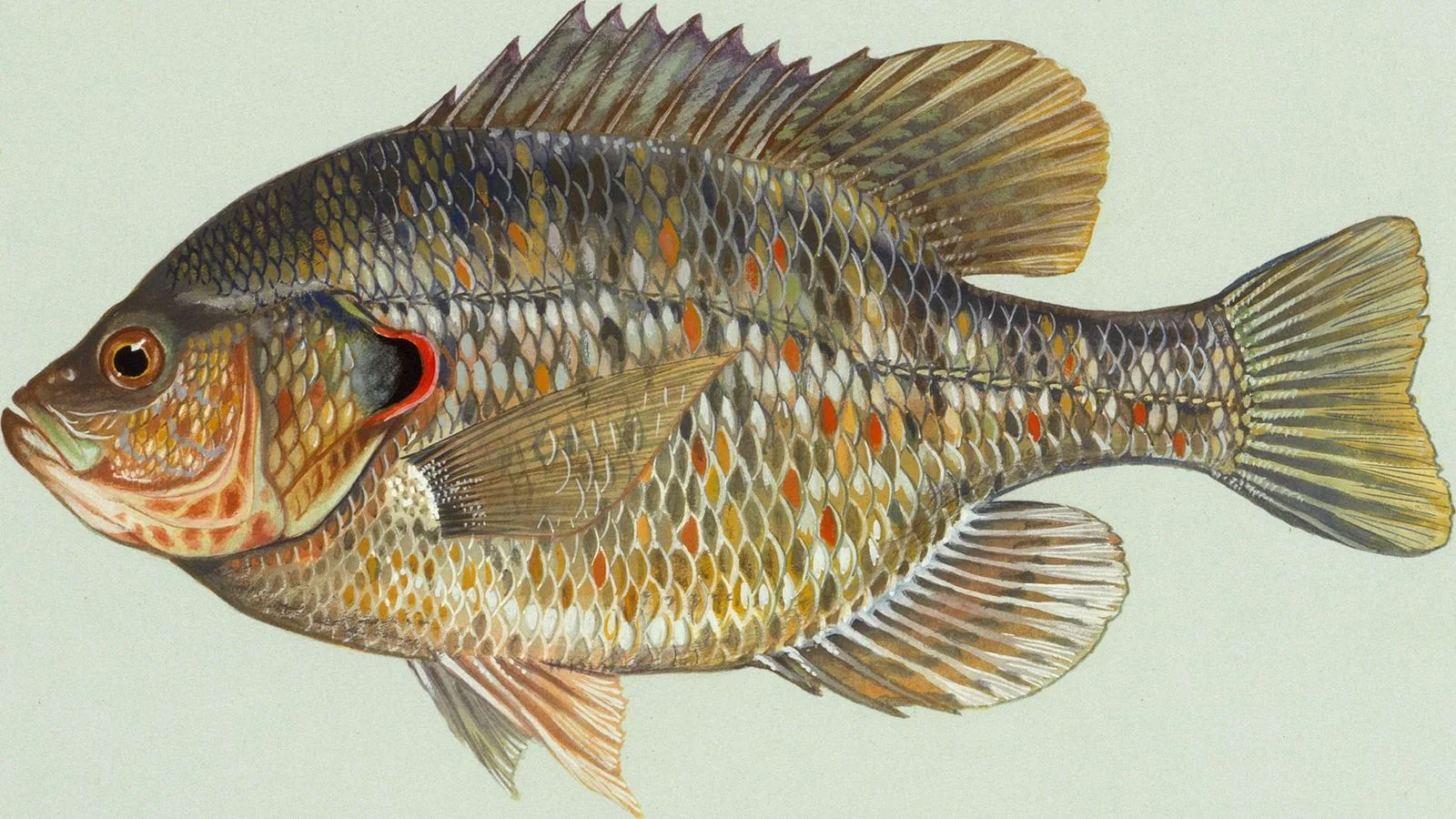 Bream Fish: What Southern Anglers Mean, and Which Bream You Have
In the South a bream is any sunfish, the bluegill first. In Europe it is a carp relative, on a menu a sea bream. How to tell which bream you have.
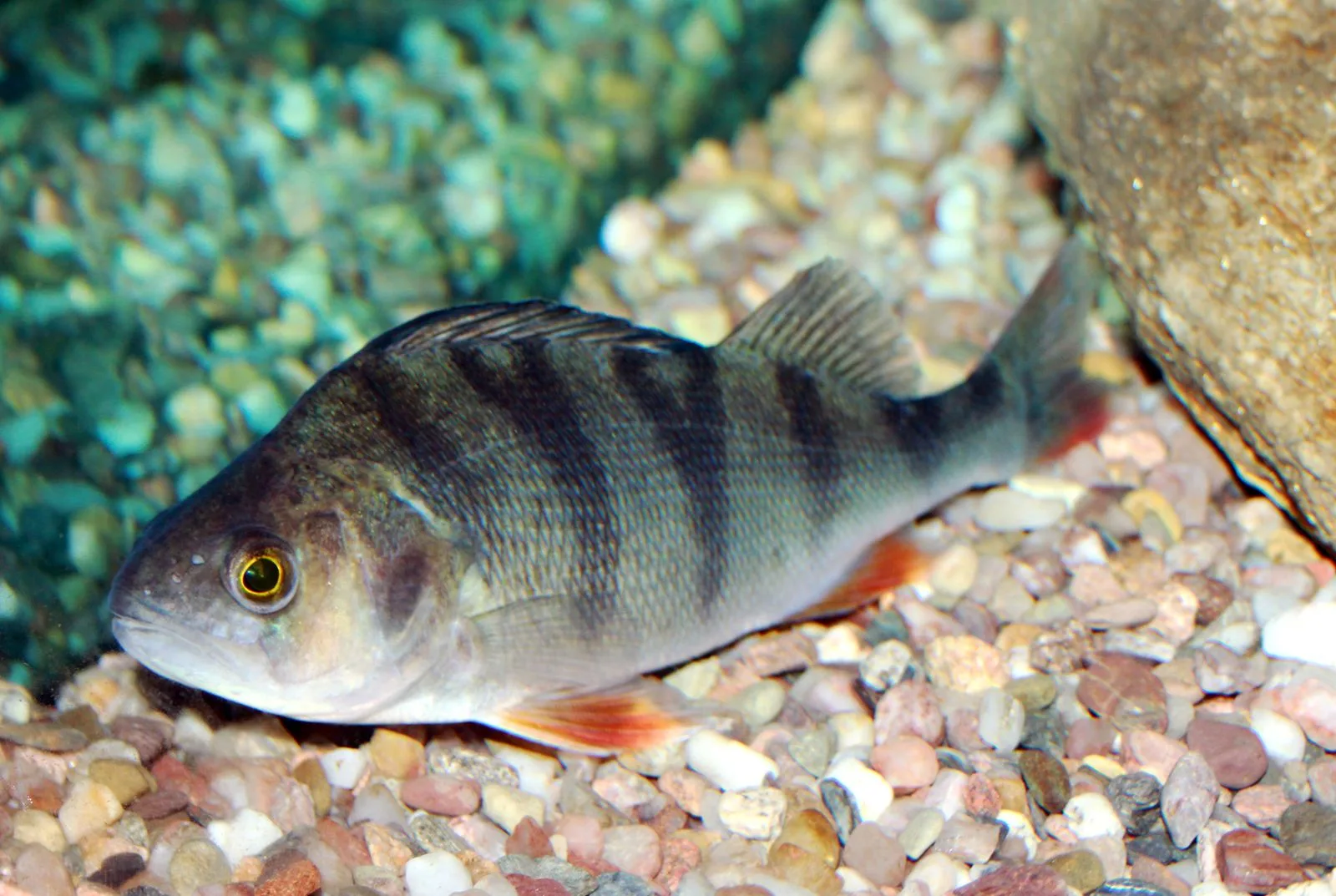 Perch Fish: What a True Perch Is, and Which Perch Are Not
A true perch is one of three Perca species. White perch, ocean perch, Nile perch and surfperch borrow the name: what each really is, and the records.
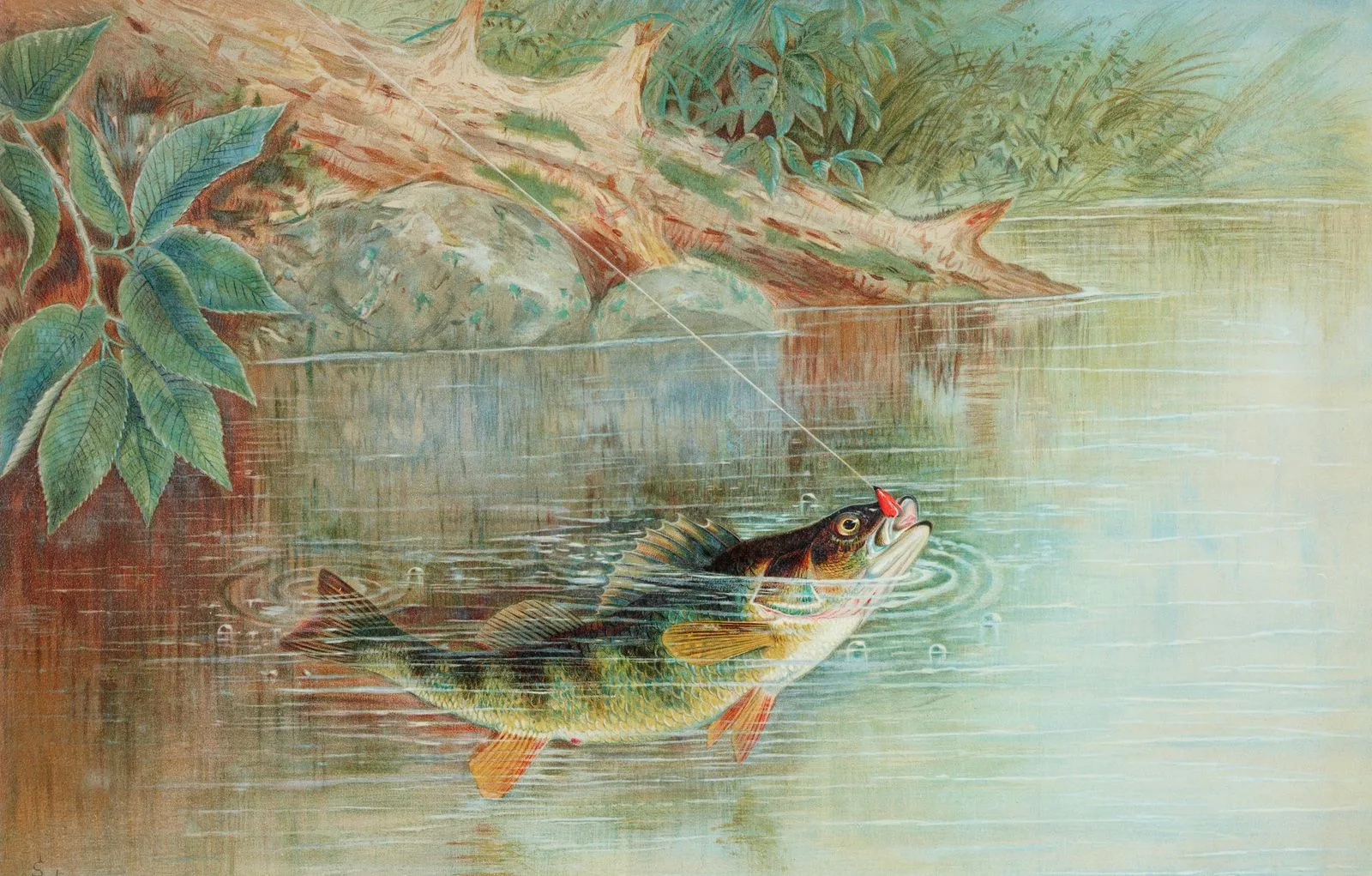 Perch Fishing: Where to Find Them, the Rigs That Work, and When They Bite
How to catch yellow perch: where the schools sit each season, the spreader and jig rigs, how far off the bottom to fish, the bait, and the ice.
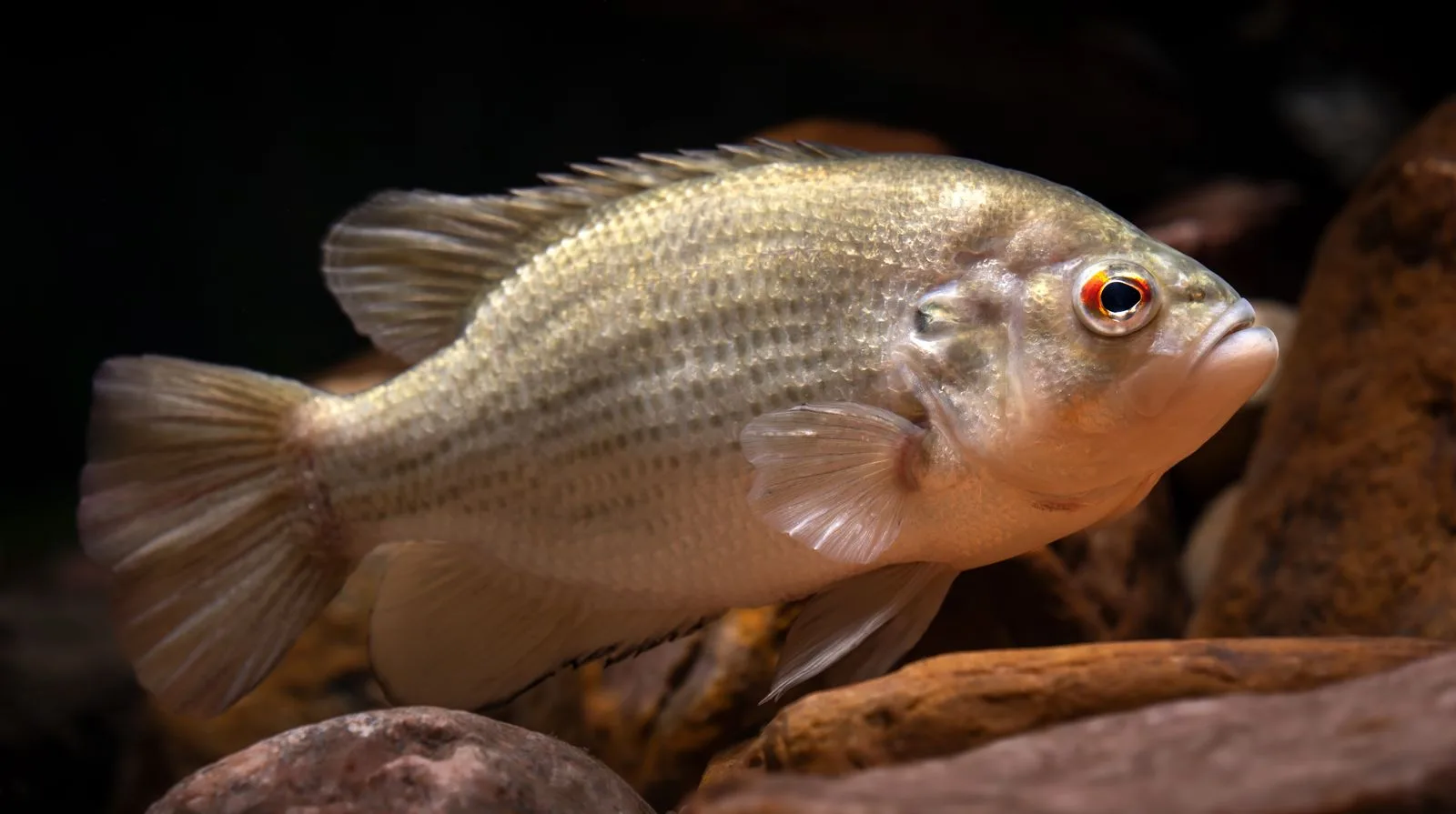 Rock Bass: How to Identify, Find and Catch the Goggle-Eye
How to tell a rock bass from a warmouth or a smallmouth, where it lives, what it bites, how big it gets and the 3 lb world record that is a tie.
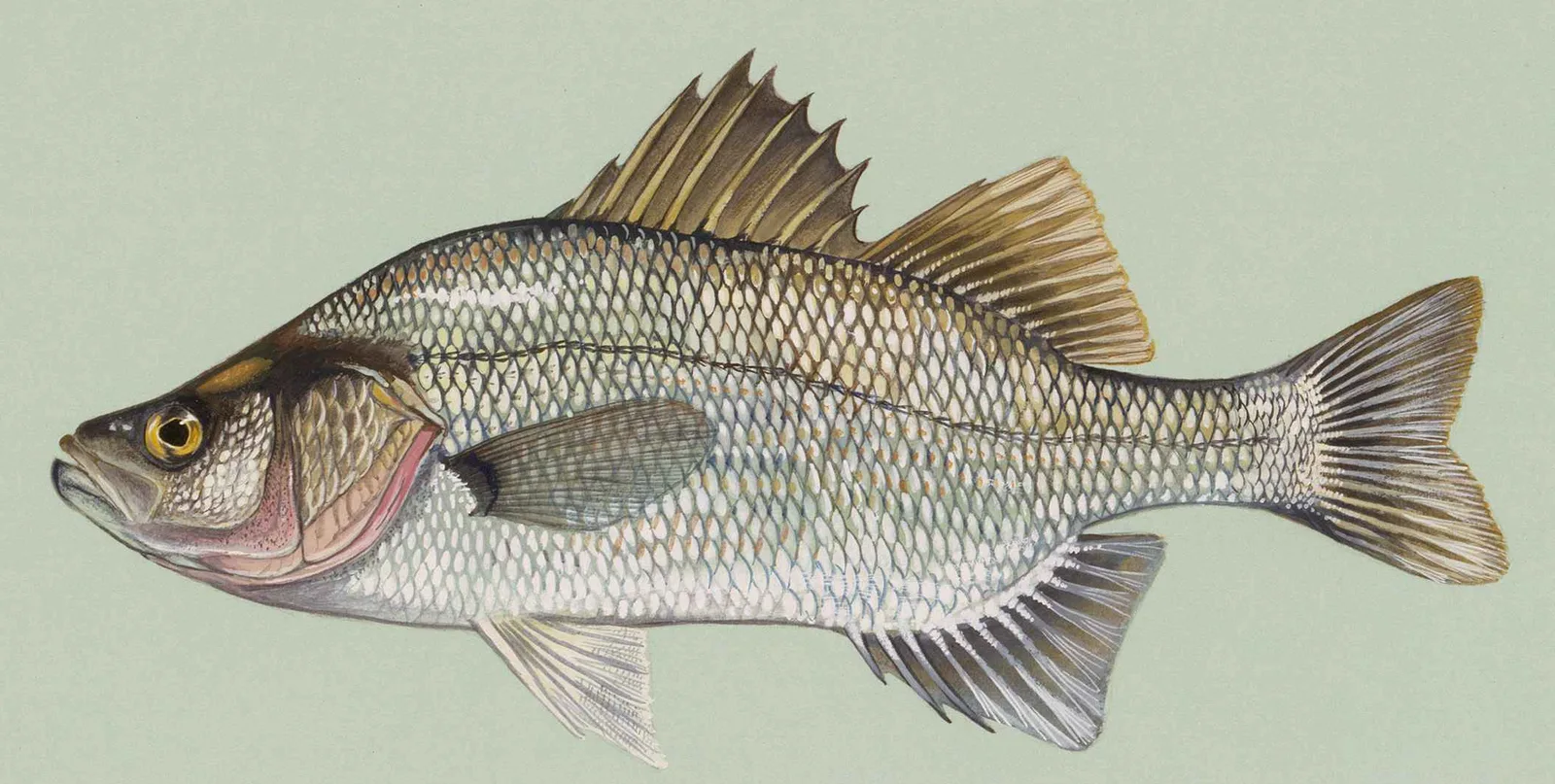 White Perch: The Striped Bass Cousin That Is Not a Perch
The white perch is a temperate bass, not a perch: how to tell it from yellow perch and white bass, its Great Lakes invasion, spawning and the record.
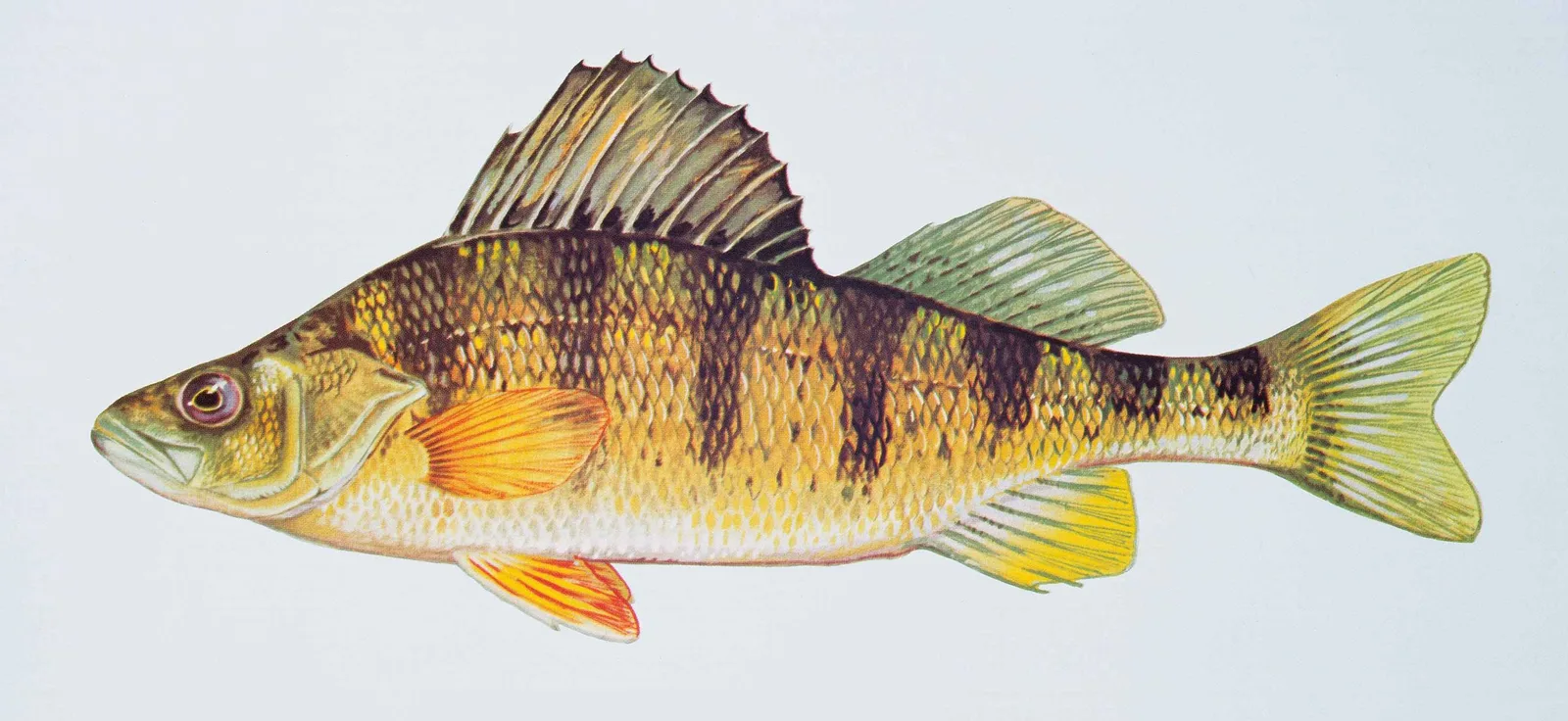 Yellow Perch: Identification, Size by Age, and the 1865 Record
Yellow perch (Perca flavescens): how to tell it from walleye, how old a 10-inch perch is, whether it is a bottom feeder, and the 1865 record.
Sources
- Texas Parks and Wildlife, bluegill (Lepomis macrochirus)
- Missouri Department of Conservation, bluegill
- Iowa DNR, bluegill (growth by age, state record)
- U.S. Fish & Wildlife Service, bluegill (Lepomis macrochirus)
- USGS Nonindigenous Aquatic Species, bluegill (native and introduced range)
- Neuswanger et al. (2015), A Synoptic Review of the Ecology and Management of Bluegill, Wisconsin DNR (Beard 1982, Neff 2004, Gross 1982, Rypel 2015, Paukert 2002, Beitinger and Magnuson 1979)
- Wisconsin DNR, bluegill (spawning window, baits, seasons)
- Texas A&M AgriLife, bluegill (spawning, eggs, coppernose trials)
- North Dakota Game and Fish, the bluegill spawn (eggs per dip, parental care, cuckolders)
- Queen's University Biological Station, alternative male life histories in bluegill (Gross and Charnov 1980)
- FSA WSlit standard-weight table (Hillman 1982 bluegill equation)
- Michigan DNR, Master Angler minimum entry lengths and state records
- Outdoor Life, the biggest panfish of all time (IGFA all-tackle records)
- FishingBama, Alabama's record bluegill and shellcracker (the Ketona Lake story)
- National Geographic, the prince, the mayor, and the U.S. fish that ate Japan
- Minnesota Department of Health, fish consumption guidelines
- Texas Parks and Wildlife, general fishing regulations (game fish as bait)
- Game & Fish, 16 go-to tips for catching trophy bluegill (Keith Sutton)
- Wired2Fish, go deep for big summertime bluegills (Nick Petrou)
- Wired2Fish, how to catch bluegill: a simple guide to bluegill fishing (Jason Sealock, 2023)
- North Carolina Wildlife Resources Commission, bluegill (hook size, when to move)
- Outdoor Alabama, freshwater creel and size limits (bream)
- Michigan general fishing regulations, eRegulations (sunfishes, NOTE 6)
- Texas Parks and Wildlife, freshwater bag and length limits 2026-27 (sunfish)
- Georgia DNR Wildlife Resources Division, state record freshwater fish
- Vermont Fish & Wildlife, panfish (state records)
- Cal. Code Regs. tit. 14, § 4.10, bait fish use in the Southern District (Cornell LII)
- Cal. Code Regs. tit. 14, § 4.15, bait fish use in the Colorado River District (Cornell LII)
- Kolehmainen (1974), Daily Feeding Rates of Bluegill (Lepomis macrochirus) Determined by a Refined Radioisotope Method, Journal of the Fisheries Research Board of Canada 31(1): 67-74