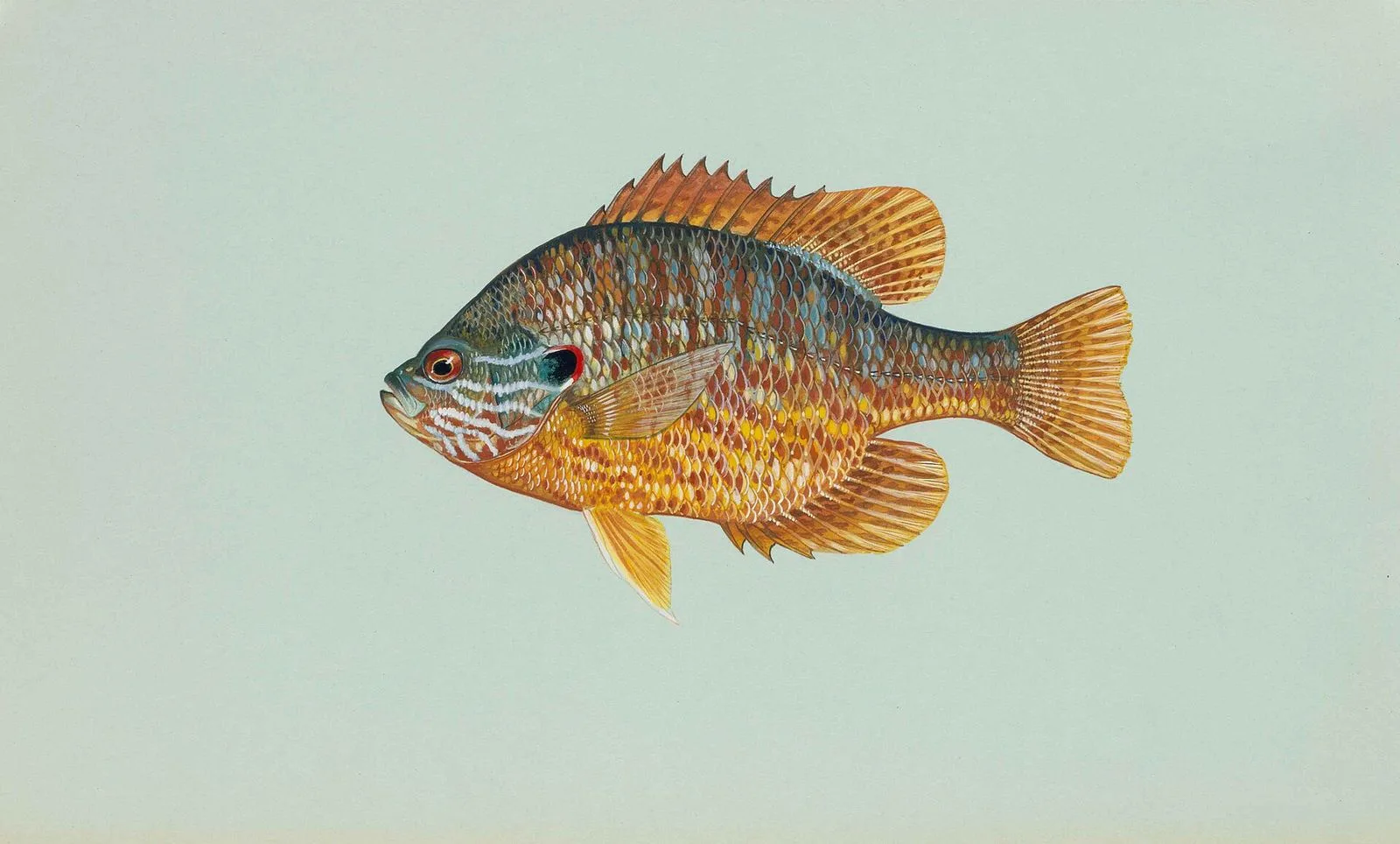
Panfish is an angler’s word, not a biologist’s: any small freshwater fish that fits a frying pan. In practice that means the sunfish (bluegill, redear, pumpkinseed and their kin), the two crappies, the yellow perch and, in the Northeast, the white perch. Few rule books define the word. Wisconsin’s bag-limit table counts bluegill, pumpkinseed, yellow perch and crappie as panfish and nothing else; Pennsylvania’s 50-fish “panfish” group throws in catfish, suckers and carp. Vermont’s page uses the pumpkinseed, “a small, brightly colored sunfish”, as the type specimen for a group that takes in bluegill, redbreast sunfish, rock bass and both crappies, fish that “rarely exceed 10 inches”.
The heaviest panfish on the record books is not a bluegill but a 6 lb 4 oz redear from Lake Havasu, Arizona, caught in 2021. It was the lake’s third world record since quagga mussels arrived in 2007 and handed its redear an all-you-can-eat buffet.
Start here
- Bluegill: the fish most anglers catch first, the one-pound rule, and why the big males on the beds are the ones to release.
- Yellow perch: the fish-fry fish of the Great Lakes, whether it really is a bottom feeder, and why a jumbo is nearly always a female.
- White perch: a small striped bass relative, not a perch, that invaded the Great Lakes through the canals.
- Bluegill spawn temperature: the 67–80 °F (19–27 °C) window and how to find the beds.
- Crappie spawn temperature: black crappie at 58–68 °F (14–20 °C), white at 60–70 °F (16–21 °C), and why the spawn looks longer than it is.
Which sunfish is it? The ear flap settles it
The ear is the flap on the gill cover, and three marks sort nine sunfish in the hand. First, the color on the margin of the ear flap: none on a bluegill, red or orange on a redear, a red half-moon on a pumpkinseed, white on a longear. Second, the pectoral fin: long and pointed on bluegill, redear and pumpkinseed, short and rounded on green sunfish, longear and warmouth. Third, the mouth: a bluegill’s jaw stops short of the eye, while a green sunfish’s or warmouth’s reaches the middle of it. Every row below comes from the state agency named in the second table.
| Species | Ear flap | Pectoral fin | Mouth |
|---|---|---|---|
| Bluegill | Solid black, no colored edge | Long, pointed; folded forward it reaches past the eye | Small; jaw stops short of the eye |
| Redear (shellcracker) | Black with a white border and a red (male) or orange (female) edge; never long | Long, pointed | Small |
| Pumpkinseed | Black with a bright red-orange half-moon at the tip and a white edge | Long, pointed | Very small |
| Green sunfish | Black with a pale white-to-yellow margin; not long | Short, rounded | Large; jaw reaches the middle of the eye |
| Longear | Long, black, always trimmed in white on adults | Short, rounded | Moderate; jaw nearly to the eye |
| Warmouth | Often red-tipped on breeding males | Rounded | Large; jaw to or past the middle of the eye |
| Redbreast | Longest of all: narrow, black, often over 1 in (2.5 cm), no wider than the eye | Short, rounded | Moderate |
| Rock bass | A dark patch on the gill cover, no real flap | Rounded | Large; past the middle of the eye |
| Hybrid bluegill | Dark; marks of both parents show | In between | In between |
| Species | Body marks | Typical size | Maximum | Source |
|---|---|---|---|---|
| Bluegill | Black blotch at the rear of the soft dorsal; 5–9 vertical bars; blue chin and gill cover | 6–10 in (15–25 cm), under 12 oz (340 g) | 16 in (41 cm); 4 lb 12 oz | MDC, TPWD, USFWS |
| Redear | Golden-olive with faint bars and red-flecked spots; no dorsal blotch | 8–10.5 in (20–27 cm) | 17 in (43 cm); 6 lb 4 oz | MDC, TPWD |
| Pumpkinseed | Wavy turquoise lines across the cheek; orange belly; spotted soft dorsal | 6–10 in (15–25 cm) | 11 in (28 cm); 1 lb 8 oz | Iowa DNR, Maine IFW, Oregon ODFW |
| Green sunfish | Turquoise flecks; fins tipped yellow to salmon; dark blotch at the rear of the dorsal | 6–8 in (15–20 cm) | About 10 in (25 cm) in the wild; 2 lb 2 oz | MDC, TPWD |
| Longear | Sky-blue squiggles on an orange head; orange belly | 5–6 in (13–15 cm) | About 7 in (18 cm), 4.5 oz (130 g) in Missouri | MDC, TPWD |
| Warmouth | 4–5 red-brown streaks fanning back from a red eye; mottled brown; teeth on the tongue; 3 anal spines | 4–10 in (10–25 cm) | 12 in (30 cm); 2 lb 7 oz | MDC, TPWD |
| Redbreast | Yellow to orange-red breast; blue lines on the head; faint bars | Most under 1 lb (450 g) | About 12 in (30 cm); 1 lb 12 oz | TPWD, USGS |
| Rock bass | Red eye; six anal spines; rows of dark spots in lines along the sides; changes shade in seconds | To 11 in (28 cm), 1 lb (450 g) | About 17 in (43 cm); 3 lb 0 oz | MDC, Illinois DNR |
| Hybrid bluegill | Male bluegill × female green sunfish; nearly all male, so it barely reproduces | ½–¾ lb (225–340 g) in ponds | Over 11 in (28 cm) and 1 lb; 2 lb rare | MDC, Oklahoma DWC |
The sunfish cross freely where they nest together, green sunfish most of all, and a fish with marks from two rows is not a mistake in the table. Wild hybrids stay a small share of any population. The hybrid bluegill sold to pond owners is bred on purpose and grows faster than either parent. Because nearly every one is male, it has to be restocked when the catch rate drops.
Counts settle what color cannot. Rock bass and warmouth get confused, and the one count that separates them is six anal spines against the warmouth’s three. Black crappie carry 7 or 8 dorsal spines, white crappie 5 or 6, and that count beats color every time, because breeding males of both species turn dark. White perch is told from a white bass by what it lacks: no horizontal stripes, and dorsal fins joined by a deep notch rather than separated.
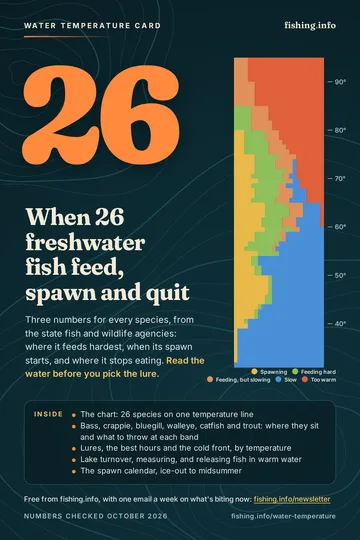
Free card: what 26 species do at your water temperature
Plus one email a week on what's biting now. No sales pitches. Privacy.
How big is big? The one-pound bluegill
A bluegill grows slowly. In Iowa one reaches 1–2 in (2.5–5 cm) in its first year, 3.5 in (9 cm) in its second, 4.5 in (11 cm) in its third and 6 in (15 cm) in its fourth. Most bluegill caught are under 8 in (20 cm), and in the Nebraska sandhill lakes an 8-in fish is 4 to 8 years old, depending on the lake. That is why a pound is a real trophy. On the standard-weight curve fisheries biologists use, a bluegill in average condition weighs:
| Length | Standard weight |
|---|---|
| 8 in (20 cm) | 0.42 lb (190 g) |
| 9 in (23 cm) | 0.62 lb (280 g) |
| 10 in (25 cm) | 0.88 lb (400 g) |
| 11 in (28 cm) | 1.21 lb (550 g) |
A pound needs a fat 10-incher or any 11-incher. Michigan’s Master Angler program sets its bluegill minimum at exactly 10 in (25 cm). It asks 9 in (23 cm) for pumpkinseed, green sunfish and warmouth, and 10 in for redear and hybrids.
Redear grow bigger and die sooner. Missouri’s field guide gives them more than 12 in (30 cm) and over 4 lb (1.8 kg) at the top, but Texas Parks and Wildlife warns that “few individuals survive more than six summers”. Rock bass reach 11 in (28 cm) and a pound. And the record fish are fat rather than long. T. S. Hudson’s world-record bluegill measured only 15 in (38 cm) but weighed 141 percent of a standard fish that length; Thomas Farchione’s record redear was 17 in (43 cm) at 159 percent.
When do panfish spawn?
The panfish year opens with the perch. Yellow perch drape their egg ribbons over weeds, brush and fallen trees at 44–52 °F (7–11 °C), shortly after ice-out, with no nest and no guard. Rock bass nest alone rather than in colonies at 55–59 °F (13–15 °C), timed with the smallmouth. Crappie follow at 58–70 °F (14–21 °C), black before white.
The sunfish come last. Bluegill males dig their saucers in colonies of fifty or more once the water passes 70 °F (21 °C); a Wisconsin study found no spawning below that figure and little above 80 °F (27 °C). A lake’s colonies spawn in four to eleven bouts a season. A male guards his nest for about ten days, until the fry swim up and leave, and a new bout starts about every ten days. Redear bed deeper than the other sunfish, Texas Parks and Wildlife notes, and often so close together the nests almost touch. The two temperature pages under “Start here” give the month-by-region tables.
What bait, and what hook?
Worms win everywhere; small jigs and spinners earn their place on the days you want to cover water. The Wisconsin DNR calls plain garden worms “the favorite bait”. The redear lives on snails and mussels, so it wants earthworms and grubs and “rarely approach[es] the surface to take flies”, in the words of Texas Parks and Wildlife. Hook sizes from the agencies run small: a No. 10 from North Carolina, a long-shank No. 8 from Iowa, and size 10 to 14 under a bobber for pumpkinseed from Oregon. Bluegill feed by sight and, Texas A&M’s fisheries extension notes, mostly in the low light of dawn and dusk.
Crappie anglers split between minnows and jigs of 1/32–1/8 oz (1–3.5 g) on 4–6 lb line. Perch anglers on Lake Erie hold shiners near the bottom on a spreader rig with a 3/4–1 oz (21–28 g) sinker, because a perch bite is a “soft tap”. North Carolina’s rule for a slow bank: no bluegill in fifteen minutes, move.
Where they sit changes with the season. After the spawn the big fish leave the beds. The Wisconsin DNR says “most large bluegills are taken in deep water during the summer months by drifting with the wind using worms.” In winter it points ice anglers to “jigging in the weed beds with grubs or mousies on ice jigs.”
Can the fish see you on the bank?
Yes, and better than most anglers think. A fish looking up sees the whole sky and shoreline squeezed into a cone about 97 degrees wide. A person standing tall at the water’s edge is in plain view, while one crouched or sitting is not; how a fish sees has the optics. Big bluegill also sit below the rest of the school, near the bottom, and the writers who chase them fish “quiet as a mouse” on 2–4 lb line.
How many may you keep?
The bag limit says a lot about how a state sees its panfish:
| State | Daily limit | What it covers |
|---|---|---|
| Texas | None | Sunfish: no limit, no minimum length |
| Alabama | 50 | Bream |
| Pennsylvania | 50 | Panfish combined, inland waters, no size limit |
| Wisconsin | 25 | Panfish total; 10 on selected lakes |
| Michigan | 25 | Sunfish and crappie in any combination |
| Minnesota | 10 | Crappie, statewide |
| Ohio (Lake Erie) | 30, 10 or 20 | Yellow perch by zone: west, central, east; 2026–27 |
The lower numbers rest on evidence. When Wisconsin cut seven lakes from 25 to 10 bluegill a day, the average bluegill grew 0.8 in (2 cm) longer, and on some lakes 2 in (5 cm). At Murphy Flowage, three years of unlimited harvest cut the number of bluegill over 8 in (20 cm) by 90 percent. Check the current regulations before you fill a bucket. The tables change yearly: Lake Erie’s total allowable perch catch was cut 10 percent in 2025, and the lake’s yellow perch task group advised cutting it again in three of its four management units for 2026.
Are panfish good to eat?
Yes: the Missouri Department of Conservation calls bluegill flesh “firm, flaky, and well flavored”, and yellow perch is the fish-fry fish of the lower Great Lakes. The nuance is how often. Minnesota’s Department of Health, working from average mercury, PFOS and PCB readings, puts sunfish, crappie and yellow perch in the same statewide group. Most adults may eat up to four servings a week; children under 15 and anyone pregnant, breastfeeding or who may become pregnant, one. Yellow perch carry under 1 percent body fat, so the PCB concern is lower than for predators, though they can accumulate mercury. On the Hudson River below Catskill, white perch is limited to one meal a month for PCBs. The rule of thumb: the small, short-lived sunfish you catch in a clean lake are among the safest fish in it; check your state’s advisory for the water you fish.
The records, all eleven panfish in one place
The all-tackle records from the IGFA list, the redear confirmed by the IGFA’s own July 2021 release and the yellow perch by its record page:
| Fish | Weight | Angler | Where | Year |
|---|---|---|---|---|
| Redear sunfish | 6 lb 4 oz (2.83 kg) | Thomas Farchione | Lake Havasu, Arizona | 2021 |
| Black crappie | 5 lb 7 oz (2.47 kg) | Lionel Ferguson | Richeison Pond, Tennessee | 2018 |
| White crappie | 5 lb 3 oz (2.35 kg) | Fred Bright | Enid Lake, Mississippi | 1957 |
| Bluegill | 4 lb 12 oz (2.15 kg) | T. S. Hudson | Ketona Lakes, Alabama | 1950 |
| Yellow perch | 4 lb 3 oz (1.91 kg) | Dr. C. Abbot | Bordentown, New Jersey | 1865 |
| White perch | 3 lb 8 oz (1.59 kg) | Val Percuoco | Wachusett Reservoir, Massachusetts | 2016 |
| Rock bass | 3 lb 0 oz (1.36 kg), tie | Peter Gulgin; Herbert Ratner Jr. | York River, Ontario; Lake Erie, Pennsylvania | 1974; 1998 |
| Warmouth | 2 lb 7 oz (1.10 kg) | Tony Dempsey | Guess Lake, Florida | 1985 |
| Green sunfish | 2 lb 2 oz (0.96 kg) | Paul Dilley | Stockton Lake, Missouri | 1971 |
| Redbreast sunfish | 1 lb 12 oz (0.79 kg), tie | Alvin Buchanan; Lester Roberts | Suwannee River, Florida; Satilla River, Georgia | 1984; 2022 |
| Pumpkinseed | 1 lb 8 oz (0.68 kg) | Robert Warne | Honeoye, New York | 2016 |
The longear, the ninth sunfish in the identification table, has its own mark: 1 lb 12 oz (0.79 kg), Patricia Stout, Elephant Butte Lake, New Mexico, 1985.
Three of these carry a story. The bluegill record came from two flooded limestone quarry pits north of Birmingham, private and closed to fishing. Sheer banks left the fish little spawning habitat, and heavy bass predation kept them few, old and enormous. Hudson caught his on worms and light line from a long cane pole, standing back from the sheer bank so the fish would not see him. The yellow perch record is the oldest standing freshwater record in North America, 160 years and counting.
And the white perch record was, for more than twenty years, a 4 lb 12 oz mount in the Maine State Museum. A suspicious curator finally had it examined: white perch in front, largemouth bass behind. The record passed to lighter, honest fish, and now stands at 3 lb 8 oz from a Massachusetts reservoir. Both crappie records came from the South: a 5 lb 7 oz black from a Tennessee pond and a 5 lb 3 oz white from Mississippi’s Enid Lake.
The names, if you want them
Most panfish are sunfish. The sunfish family, Centrarchidae, has eight genera and takes in the black bass and the crappies as well as the fish people mean when they say “sunfish”. Those are the genus Lepomis: thirteen species that all share three spines in the anal fin, spiny and soft dorsal fins joined into one, and the ear flap. Every bluegill is a sunfish; not every sunfish is a bluegill, and the ear flap above tells them apart. Rock bass is a sunfish too, but from the genus Ambloplites, and crappie are the two species of Pomoxis.
The perches are the outsiders. Yellow perch is a true perch, Perca flavescens, the small cousin of the walleye and sauger in the family Percidae. The other two Perca live in Europe and Central Asia, so every other American “perch” is borrowing the name; the perch page lists them all. White perch is Morone americana, a temperate bass in the striped bass family and, as the IGFA puts it, “not a true perch”.
Then there are the local names. In the South “bream” or “brim” means any Lepomis, and “perch” almost always means a sunfish rather than a Perca. Texas Parks and Wildlife lists the bluegill as bream, brim, perch, sunfish and sunperch. Its redear is shellcracker, Georgia bream, cherry gill and sun perch. The warmouth is goggle-eye, stump knocker and, confusingly, “rock bass”; the green sunfish is goggle-eye, rock bass and branch perch. Black crappie are specks in Florida and calico bass in the Northeast. In Louisiana both crappies are sac-a-lait, the Cajun French name, and “white perch” in the north of the state. What anglers mean by a slab or a bull is in the slang list. When a stranger at the ramp tells you what he caught, ask what it looked like; every other fish starts from the species hub.
All articles
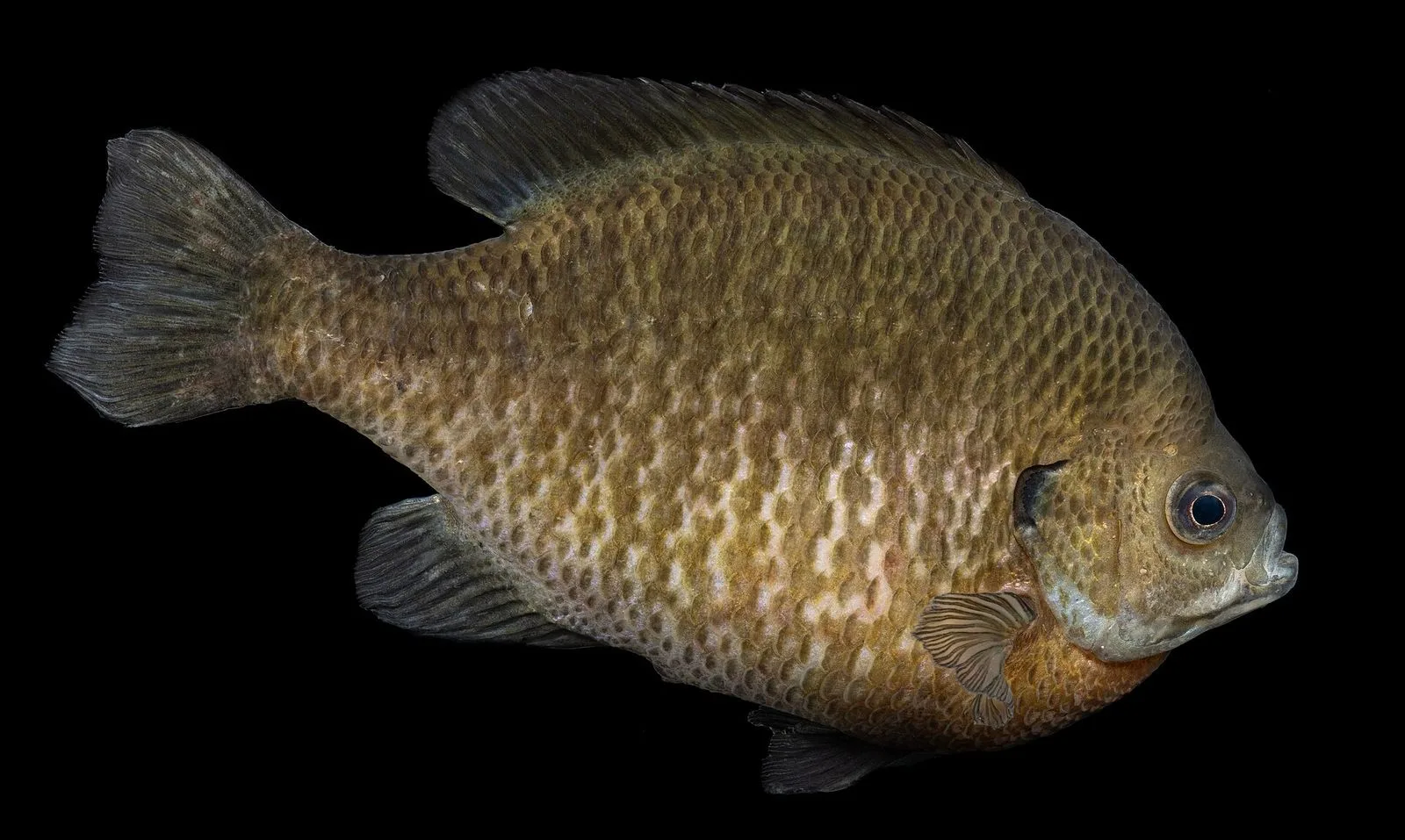 Bluegill: How to Identify It, How Big It Gets and How It Spawns
How to identify a bluegill, how old an 8- or 10-inch fish is, why a pound is a trophy, the 4 lb 12 oz record and the sneaker males on the beds.
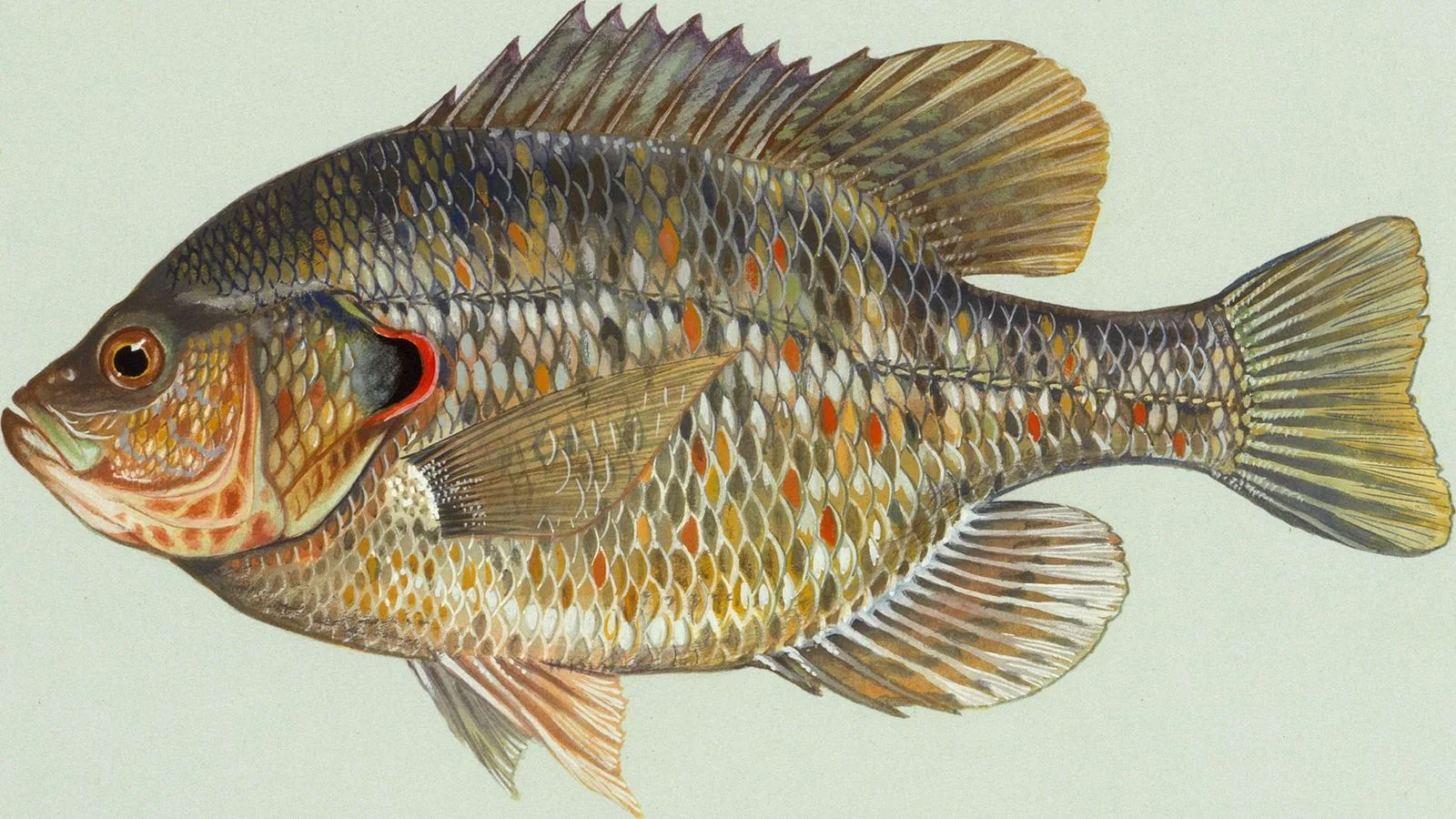 Bream Fish: What Southern Anglers Mean, and Which Bream You Have
In the South a bream is any sunfish, the bluegill first. In Europe it is a carp relative, on a menu a sea bream. How to tell which bream you have.
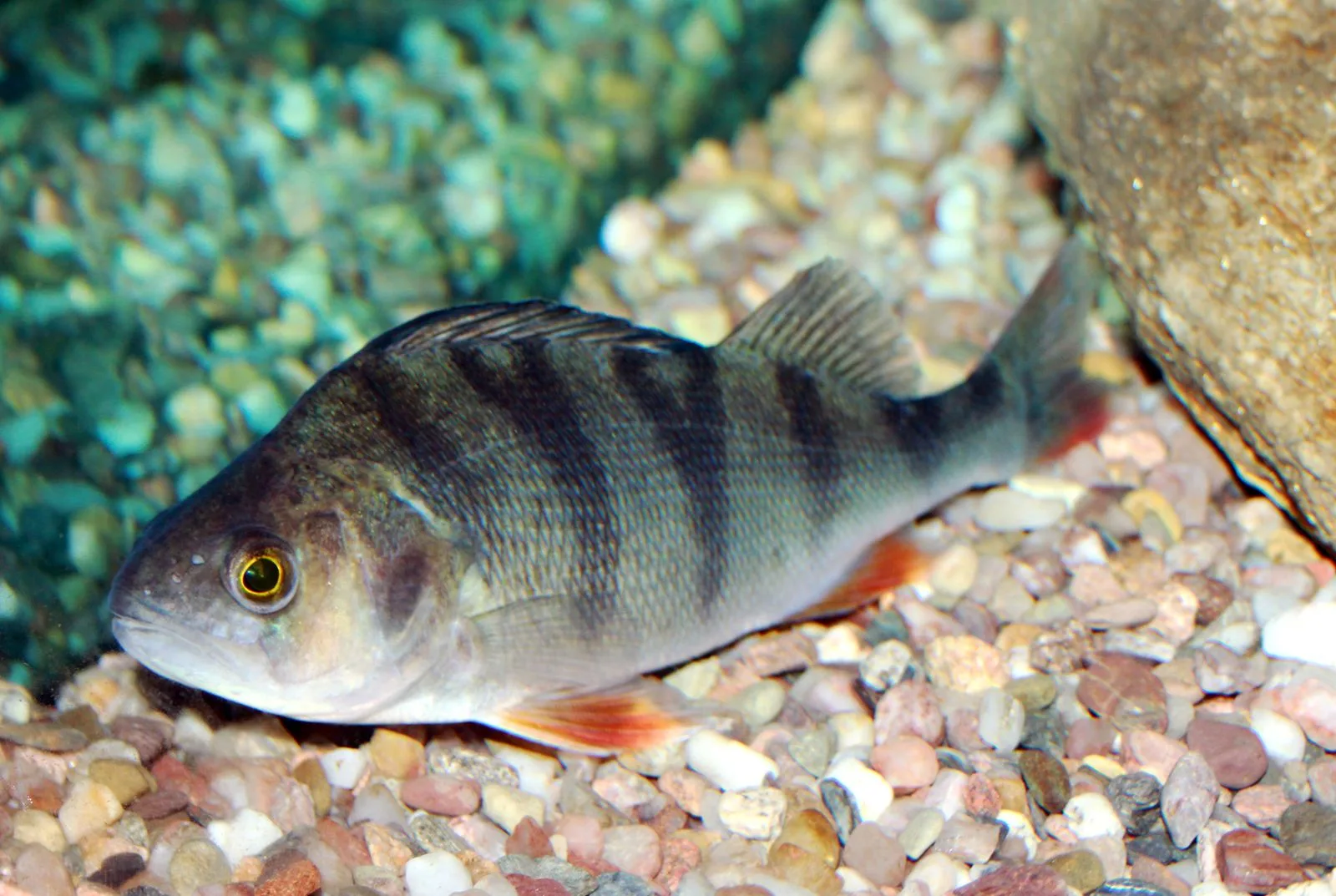 Perch Fish: What a True Perch Is, and Which Perch Are Not
A true perch is one of three Perca species. White perch, ocean perch, Nile perch and surfperch borrow the name: what each really is, and the records.
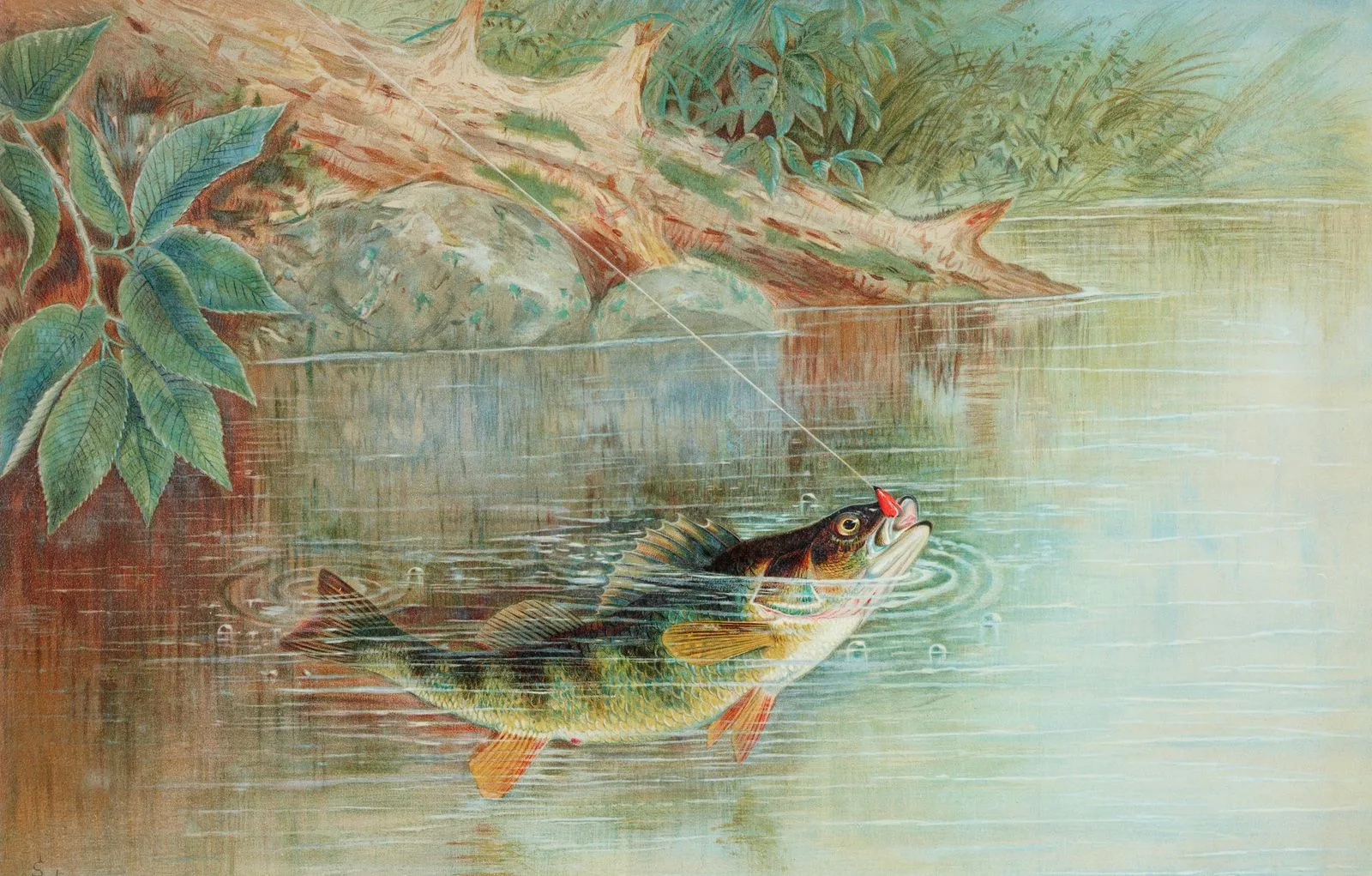 Perch Fishing: Where to Find Them, the Rigs That Work, and When They Bite
How to catch yellow perch: where the schools sit each season, the spreader and jig rigs, how far off the bottom to fish, the bait, and the ice.
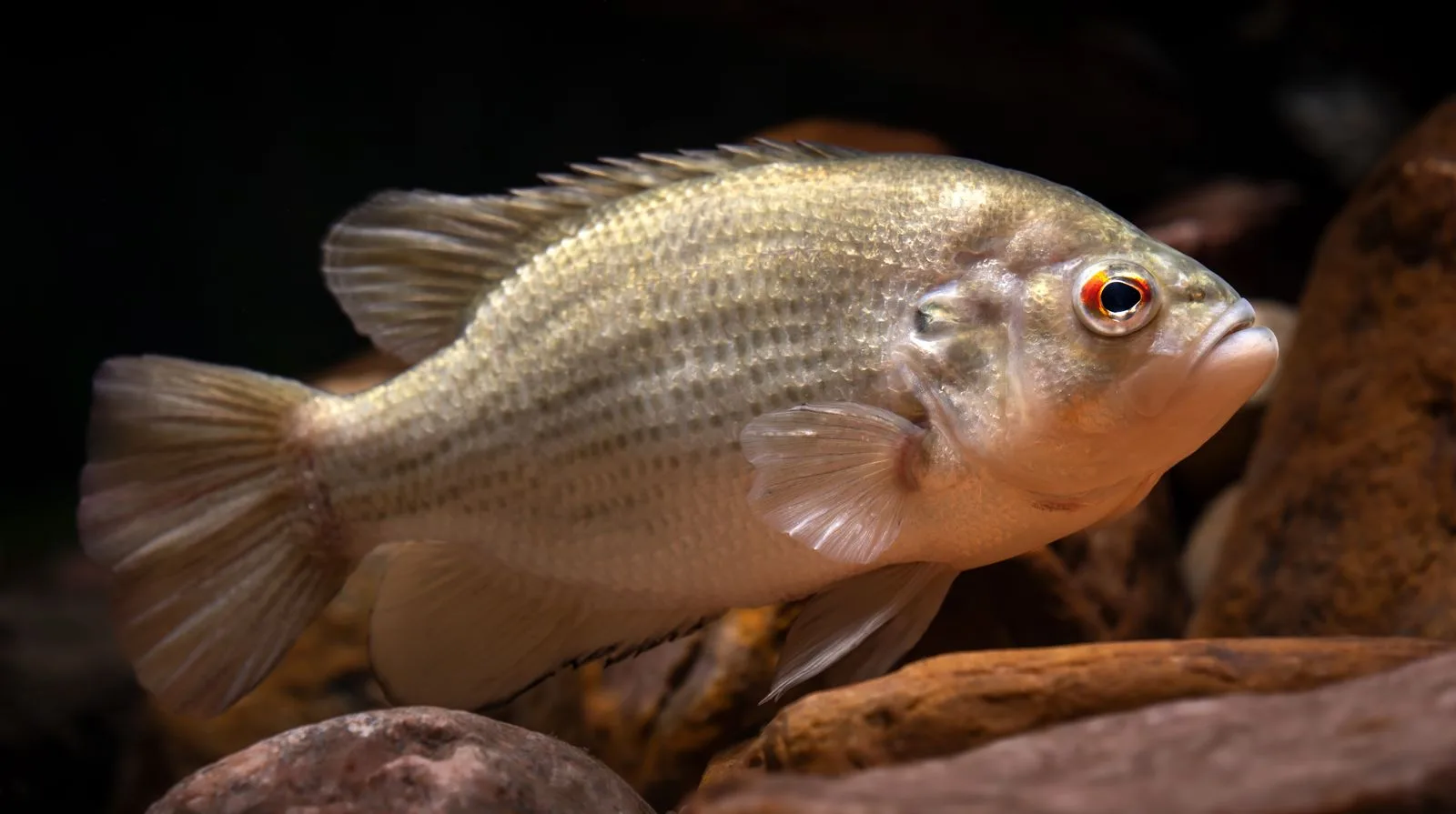 Rock Bass: How to Identify, Find and Catch the Goggle-Eye
How to tell a rock bass from a warmouth or a smallmouth, where it lives, what it bites, how big it gets and the 3 lb world record that is a tie.
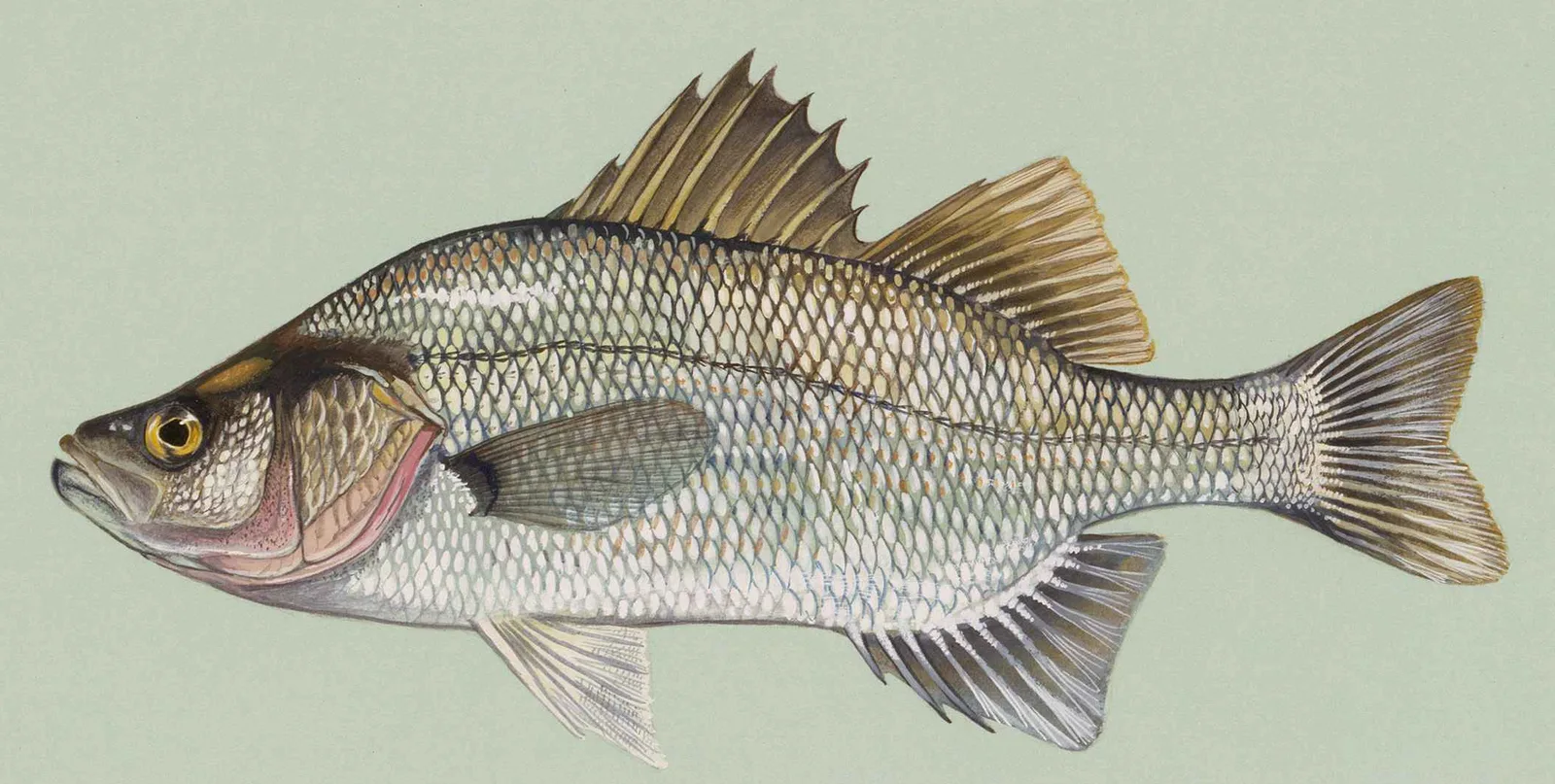 White Perch: The Striped Bass Cousin That Is Not a Perch
The white perch is a temperate bass, not a perch: how to tell it from yellow perch and white bass, its Great Lakes invasion, spawning and the record.
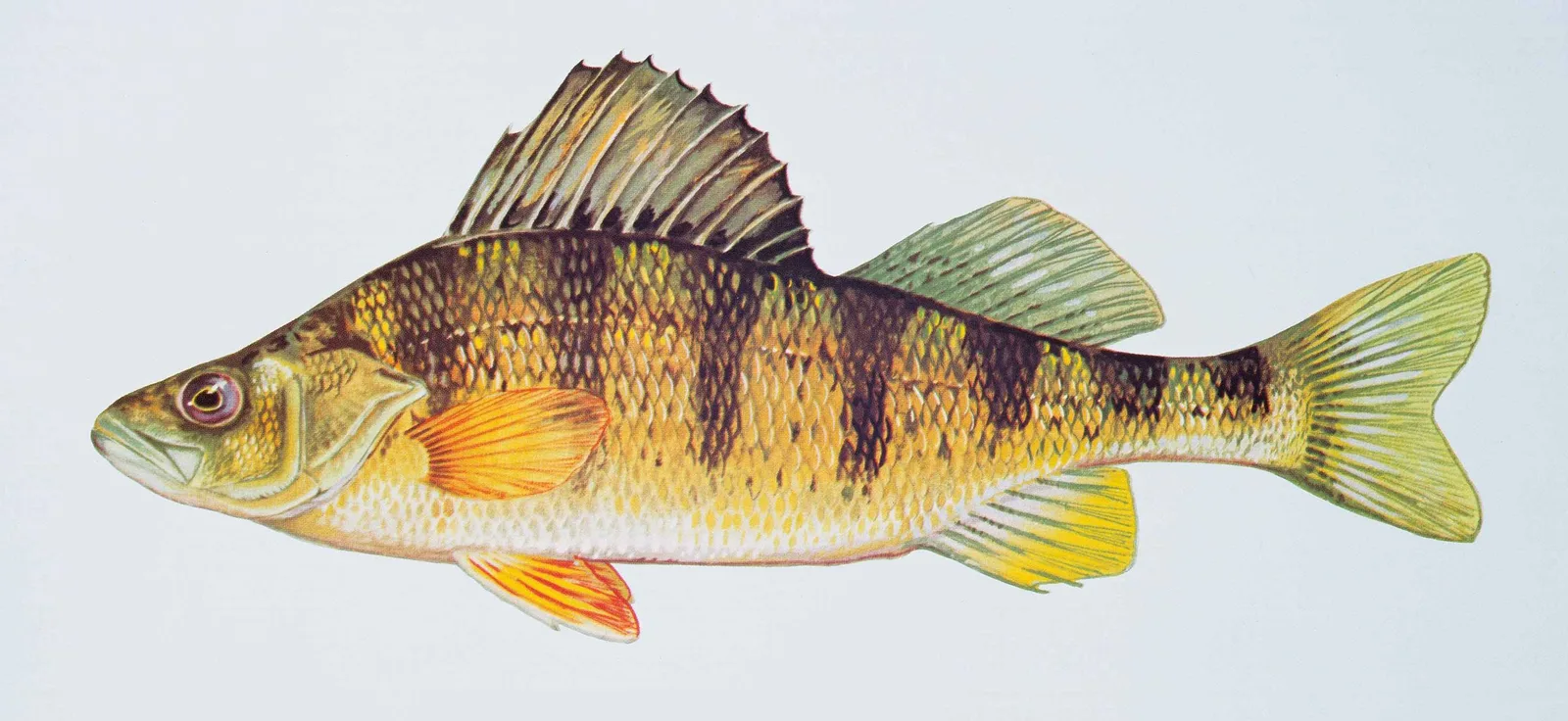 Yellow Perch: Identification, Size by Age, and the 1865 Record
Yellow perch (Perca flavescens): how to tell it from walleye, how old a 10-inch perch is, whether it is a bottom feeder, and the 1865 record.
Free download
The water temperature card
Read your water temperature and the card tells you who is spawning, who is feeding and what to throw. 26 species, 16 pages, for your phone and the tackle box.
Plus one email a week on what's biting now. No sales pitches. Privacy.
Sources
- Wisconsin DNR, daily bag limits (the regulatory definition of panfish)
- Vermont Fish & Wildlife, panfish
- Missouri Department of Conservation, bluegill
- Missouri Department of Conservation, northern rock bass
- Neuswanger et al. 2015, A Synoptic Review of the Ecology and Management of Bluegill, Wisconsin DNR
- Maine Department of Inland Fisheries & Wildlife, pumpkinseed sunfish
- Iowa DNR, pumpkinseed
- Michigan DNR, Master Angler minimum entry lengths and state records
- Minnesota Department of Health, fish consumption guidelines
- Jerald Horst, LSU AgCenter and Louisiana Sea Grant, Sack of Milk (the crappie's Louisiana names)
- Texas Parks and Wildlife, white crappie (other names)
- IGFA, world records for July 2021 (the 2.83 kg redear)
- IGFA, yellow perch world records
- Outdoor Life, the biggest panfish of all time (IGFA all-tackle summary)
- Ohio DNR, yellow perch fishing zone boundaries and 2026–27 limits
- Pennsylvania Fish and Boat Commission, Commonwealth inland waters limits (via eRegulations)
- Missouri Department of Conservation, green sunfish
- Missouri Department of Conservation, longear sunfish
- Missouri Department of Conservation, warmouth
- Missouri Department of Conservation, redear sunfish
- Missouri Department of Conservation, pond fish management (hybrid sunfish)
- Oklahoma Department of Wildlife Conservation, the hybrid sunfish pond
- Texas Parks and Wildlife, bluegill
- Texas Parks and Wildlife, redear sunfish
- Texas Parks and Wildlife, green sunfish
- Texas Parks and Wildlife, longear sunfish
- Texas Parks and Wildlife, warmouth
- Texas Parks and Wildlife, redbreast sunfish
- U.S. Fish & Wildlife Service, bluegill
- North Dakota Game and Fish, the bluegill spawn (the ten-day nest guard)
- Texas A&M AgriLife, bluegill (sight feeding at dawn and dusk)
- Iowa DNR, bluegill
- Wisconsin DNR, bluegill (bait, summer and winter fishing)
- Wisconsin DNR, Yellow Perch (PUB-FM-711)
- Illinois DNR, rock bass
- U.S. Fish & Wildlife Service, Ecological Risk Screening Summary: white perch (January 2026)
- North Carolina Wildlife Resources Commission, bluegill
- Oregon Department of Fish and Wildlife, pumpkinseed sunfish
- Game & Fish, trophy bluegill tactics
- FishingBama, Alabama's record bluegill and shellcracker (the Ketona Lake story)
- Wired2Fish, Welcome to Lake Havasu: quagga mussels and three redear world records (Brent Frazee, 2026)
- Texas Parks and Wildlife, bag and length limits
- Outdoor Alabama, freshwater creel and size limits
- Michigan DNR, general fishing regulations (via eRegulations)
- Minnesota DNR, fishing regulations
- Minnesota Department of Health, statewide safe-eating guidelines, general population (PDF)
- Minnesota Department of Health, statewide safe-eating guidelines, sensitive population (PDF)
- New York State Department of Health, Hudson River and tributaries fish advisories
- Lake Erie Committee, Yellow Perch Task Group report, March 2026 (2025 TAC and 2026 advice)