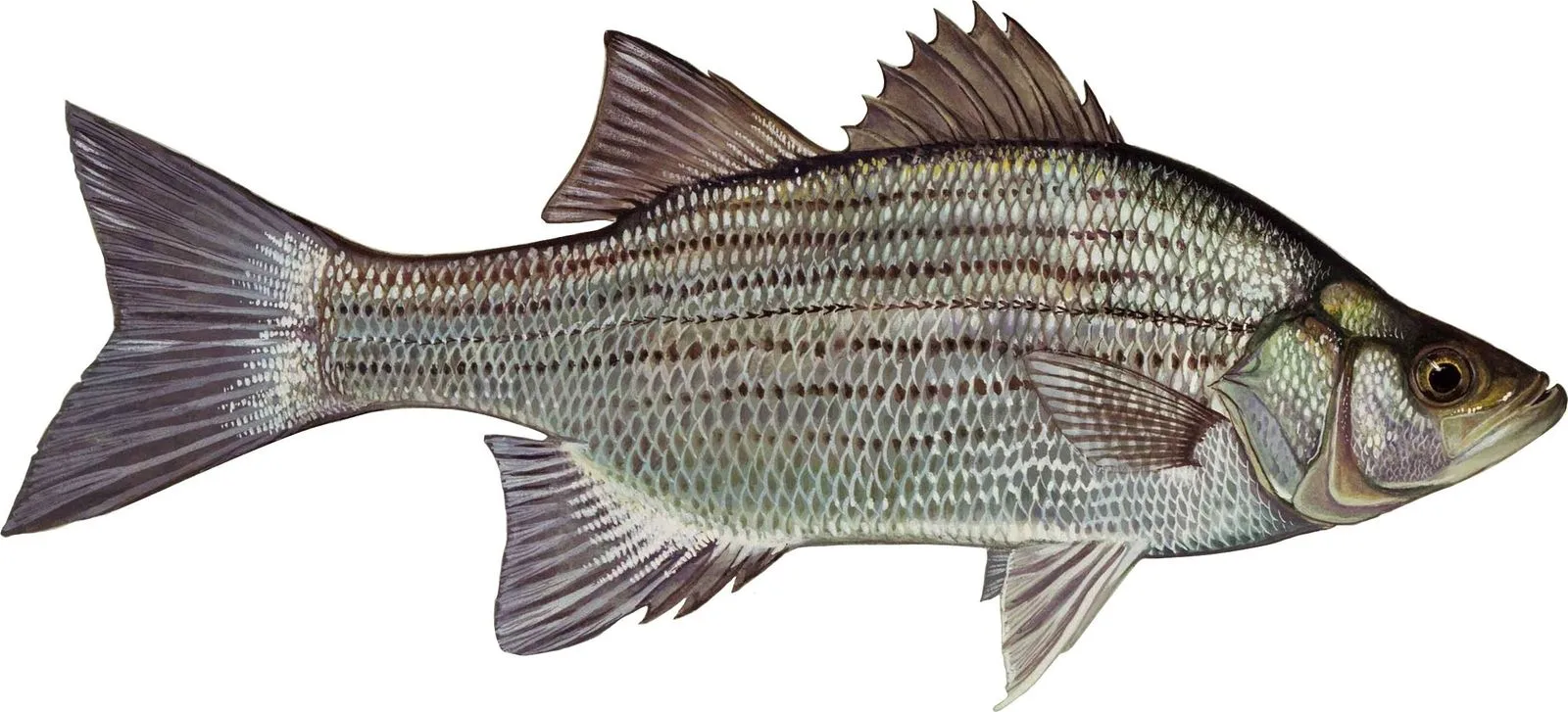
A white bass is a 10-to-15-inch (25–38 cm) silver fish of half a pound to a pound and a half, a schooling open-water hunter of big reservoirs and rivers. It is the small cousin of the striped bass, not of the largemouth. It runs up rivers by the thousand each spring, eats shad all summer under diving gulls, and rarely lives past its fourth year.
One female white bass carries up to a million eggs, and most of the fish spawning in any given spring were not alive four years earlier: the agencies agree that white bass more than four years old are rare.
How do you tell a white bass from a striper, hybrid or yellow bass?
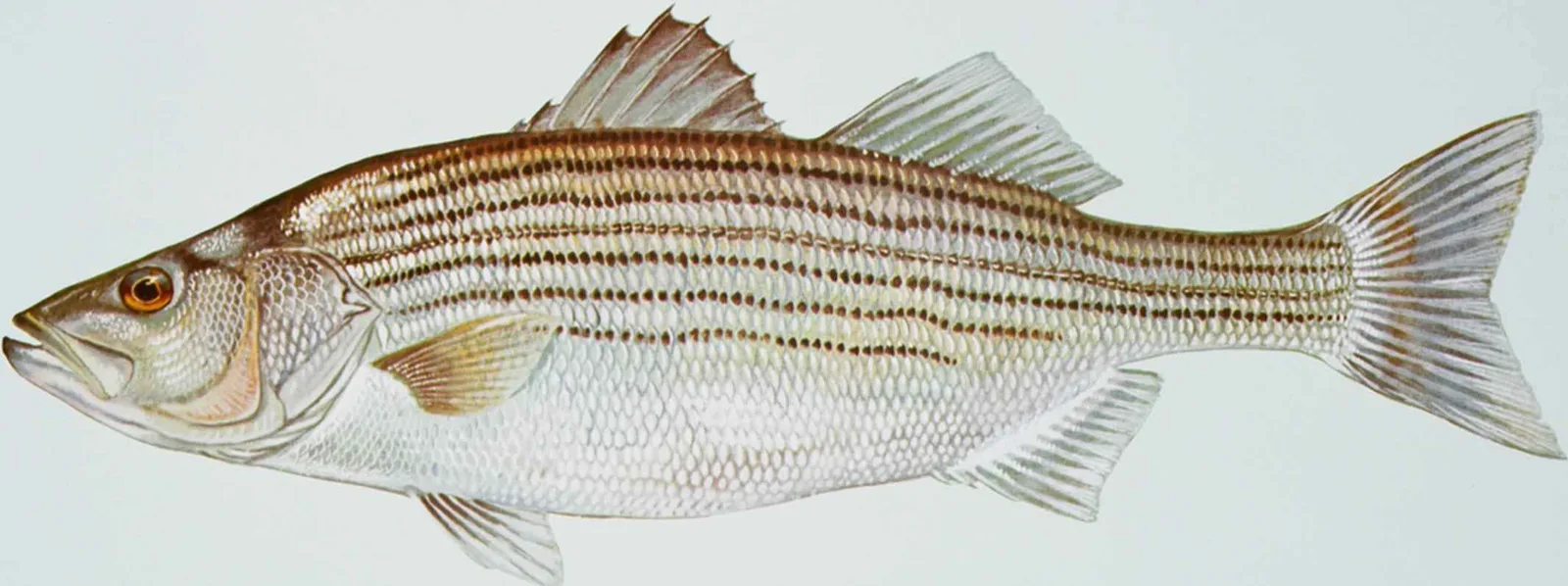
Look at the tongue. A white bass has one tooth patch on it, a striper or a hybrid two, a yellow bass none. Four fish wear silver and stripes in the same reservoirs, and the forum answer, “broken stripes mean hybrid”, is the one that fails. The USGS calls the broken-stripe test “broken line syndrome” and says it “is not a reliable method of identification”. Biologists use the tongue and the shape of the body. The marks below are Texas Parks and Wildlife’s identification key, with the fin counts from its species pages.
| Mark | White bass | Hybrid (wiper, palmetto) | Striped bass | Yellow bass |
|---|---|---|---|---|
| Stripes | Faint; only one reaches the tail | Distinct, usually broken; several reach the tail | Distinct, unbroken; several reach the tail | Distinct, sharply broken and offset above the anal fin |
| Tooth patch on tongue | One, near the midline at the back | Two, distinct or so close they look like one | Two distinct patches, side by side | None |
| Body | Deep, more than a third of its length; back arched behind the head | Deep, more than a third of its length; back slightly arched | Slender, less than a third of its length; no arch | Small and deep; silvery yellow |
| Dorsal fins | Two, separate | Two, separate | Two, separate | Joined by a membrane |
| Anal spines | Second about two-thirds the third | Three | Second about half the third | Second and third nearly equal |
| Typical size | 10–15 in (25–38 cm), ½–1½ lb (0.2–0.7 kg) | 2–5 lb (0.9–2.3 kg) common, 7–10 lb in Missouri | 5–20 lb (2–9 kg) landlocked | Seldom over 12 in (30 cm) or 1 lb (0.45 kg) |
Texas adds a caution worth keeping: “all characteristics should be considered in combination, as characteristics in individual fish may vary.” Oklahoma’s field key fits in one breath. White bass: arched back and one patch of teeth on the tongue. Hybrid: slightly arched back, two patches, some broken lines. Striper: no arch, two distinct patches, unbroken lines.
The gill cover settles the closest call: a white bass has one sharp point on it, a striper two. The full comparison, with white perch in the fifth column, is on the striped bass hub. For a fish that could be either, the side-by-side check is in white bass vs striped bass.
Two more fish get mixed up with the white bass. A white perch, Morone americana, is a temperate bass too: the Great Lakes invader with no stripes on the adult and a deep notch between its dorsal fins. A white crappie is not. Crappies are sunfishes, the family of the largemouth and bluegill on the panfish hub, with a single dorsal fin and no tooth patch. All they share with white bass is the same lakes and the same jigs.
Where do white bass live?
White bass are native to the St. Lawrence and Great Lakes, the Red River of the North and the whole Mississippi basin, from Quebec and Manitoba south to Louisiana. In Texas they are native only to the Red River drainage. Everywhere else in the state they arrived by stocking, and the USGS logs introduced white bass in 39 states in all, from California to Colorado to Utah.
Oklahoma’s field guide says the species was “not found in great numbers until large reservoirs were constructed”. The big reservoirs built across the South and the Plains in the last century, full of gizzard and threadfin shad, made the white bass the fish it is.
Their habitat is open water. The USFWS describes “a migratory pelagic (open-water) fish” that spends “most of their lives chasing schools of baitfish”. They prefer the deeper pools of streams, the open water of lakes and reservoirs, and firm sand or rock bottom over mud. Wired2Fish’s tips page describes them on sonar as tight schools of 30 to 300 fish, around points, humps and brush.
In summer the schools hold at 14–30 ft (4–9 m), sometimes to 50 ft (15 m), and in winter they sink to 30 ft (9 m) and deeper. In spring and fall they are on the bank. They are most active at dawn and dusk, and Texas puts out the same reminder every February: at night, fish under lights or around lighted docks.
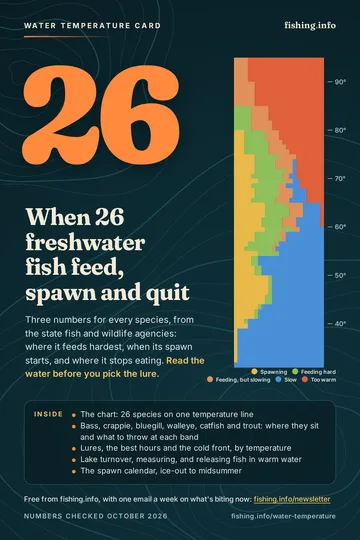
Free card: what 26 species do at your water temperature
Plus one email a week on what's biting now. No sales pitches. Privacy.
When is the spring run?
The run starts when the lake passes 50 °F (10 °C) and peaks at 55–60 °F (13–16 °C) with a rise in flow, “when the redbud trees begin to bloom” in Oklahoma’s words. White bass build no nest and guard nothing. They broadcast eggs over gravel or rock in moving water and leave. A large female releases “nearly a million small eggs”, Texas says, and they hatch in two or three days. The agencies do not quote one temperature, so here they are side by side:
| Source | Water temperature | Timing | Detail |
|---|---|---|---|
| Oklahoma DWC | Starts at 50 °F (10 °C), peak about 55 °F (13 °C); a good river run needs 55–60 °F (13–16 °C) and moderate rain | Mid-March to early May | One to three weeks on any given water; “when the redbud trees begin to bloom” |
| USFWS | About 57 °F (14 °C) | February in the South to late May in the North | Fish mature at age 2 in the South |
| Iowa DNR | 58–70 °F (14–21 °C) | April to mid-June | 241,000–933,000 eggs per female |
| Missouri DC | – | March to mid- or late April | Five to ten days per locality; hatch in about two days |
| Texas PWD | – | Early spring; males move upstream first | Running water over gravel or rock; without rain the run can stretch over one to two months |
Put together: fish gather at the creek and river mouths when the lake passes 50 °F, the run is on at 55–60 °F with a rise in flow, and it is over by the upper 60s. Males go first; the females follow one to four weeks behind, as much as a month in Texas.
The big runs are on the tributaries of the big reservoirs. In Texas they are the Sabine above Toledo Bend, the Colorado above Lake Buchanan, the Brazos above Whitney and the San Gabriel above Granger. In Ohio they are the Maumee, Sandusky and Portage. In Wisconsin it is the Wolf River above Lake Winnebago, where the run builds from late April and picks up at the beginning of May.
Oklahoma’s advice on timing is practical: the local game warden knows which creek is running this week. The water temperature chart puts the white bass’s 55–70 °F (13–21 °C) spawning window beside the walleye and crappie that use the same weeks.
What do you throw, season by season?
Spring. Oklahoma’s guide starts at the creek mouths and follows the fish upstream to riffles, shoals and brushy banks. Its lure list is long and cheap: curly-tail grubs, small paddletail swimbaits, inline spinners, spoons and slabs, lipless crankbaits, jerkbaits and marabou jigs, in white, silver or chartreuse, on a steady retrieve. Its jighead rule is the one to remember: 1/16 oz in 1–6 ft (0.3–1.8 m), 1/8 oz in 6–12 ft (1.8–3.7 m), 1/4 oz deeper than that. Clear water gets white and silver with a dark back; stained water gets chartreuse and red. Kansas’s state record came on a Road Runner in the river above John Redmond Reservoir.
Summer. Watch for gulls circling and diving, or for the surface boiling: the school has pushed shad to the top. When they are up, throw a walk-the-dog bait, a prop bait or a small popper from the topwater box. When they go down, drop a jigging spoon or slab to the bottom and rip it up. Oklahoma describes the retrieve: lift the rod tip from 3 o’clock to 12, let the spoon flutter back, and expect the bite on the drop. Wired2Fish’s tips page has the summer and winter schools at 15–30 ft (5–9 m) and hovers a spoon or a jig-and-minnow above them.
Fall. The pre-winter feed. Oklahoma puts the fish on dam riprap and windblown points at first and last light, chasing shad to the bank. The schools are fat and aggressive, and the same spoons and lipless baits work faster.
Winter. Deep and stationary. The schools sit at 30 ft (9 m) and more on channel edges, and vertical jigging over them on electronics is the method.
Bait and tackle. Live minnows and small shad go under a slip float or on a weighted rig. Oklahoma’s guide gives the reason to fish small: “more often than not white bass are munching on 1–2 inch shad, even the bigger fish”. Match that. Its spec for white bass is a medium-light to medium rod and 6–12 lb line, a step up from crappie tackle. Oklahoma’s striper and hybrid guide steps up to medium to medium-heavy and 8–14 lb.
How big do white bass get?
Not very, and not for long. Missouri gives the typical adult as 9–15 in (23–38 cm) and ¼–1¼ lb (0.1–0.6 kg). Oklahoma says most fish “average between a half-pound and pound-and-a-half, with potential growth up to five pounds, but rarely exceed three-and-a-half-pounds”. The USFWS puts the common length at 12.5 in (32 cm) and the maximum reported at 17.7 in (45 cm). A 16-in (41 cm) white bass is a big one on any water.
What makes the species unusual is how quickly it reaches that size and how soon it is gone. Growth in the South is startling: Texas Parks and Wildlife says white bass “may grow eight or nine inches during the first year”. Iowa’s fish start slower and stay two to four inches behind.
| Age | Iowa (northern lakes) | Carter Hill Reservoir, Tennessee | What it means |
|---|---|---|---|
| Age 1 | 4–6 in (10–15 cm) | About 8 in (20 cm) | Texas: 8–9 in in year one |
| Age 2 | 9–10 in (23–25 cm) | 14 in (36 cm) | Most males spawn at 2 |
| Age 3 | 12–14 in (30–36 cm) | 16 in (41 cm) | Females mature; three southeastern reservoirs all hit 12 in by 3 |
| Age 4 | – | 17 in (43 cm) | Texas: fish “more than four years of age are rare” |
The Tennessee lengths are the Carter Hill figures quoted by Outdoor Alabama. It adds that Auburn’s 1999–2000 study found white bass “rarely live to age 5”. Missouri says they “can live about 4 years”, and Iowa that they “seldom live beyond 4 years and few are larger than 2- or 3-pounds”.
The oldest fish on record came from a 2019–20 study of Kentucky Lake, the Tenn-Tom Waterway and Grenada Lake: age 9, “the oldest maximum age reported for southern populations”. Even there, 84 percent of the fish were four or younger. Read a 16-in white bass as a three- or four-year-old at the end of its life, not the start.
For weight from length, state agencies score condition with the species’ standard-weight equation (Brown and Murphy 1991). It gives a 12-in fish about 0.85 lb (385 g) and a 14-in fish 1.4 lb (0.6 kg). A 16-in fish weighs 2.1 lb (0.95 kg), and an 18-in (46 cm) fish 3.0 lb (1.35 kg). Iowa’s 21.70-in state record weighed 5.11 lb (2.32 kg), a shade under that curve.
What is the world record white bass?
The IGFA all-tackle world record is a tie at 6 lb 13 oz (3.09 kg), and the two fish are 21 years apart. Ronald Sprouse caught his at Lake Orange, Virginia, on July 31, 1989; Corey Crochet caught his in the Amite River, Louisiana, on August 27, 2010. The Louisiana fish is usually listed at 6.8 lb, which rounds to the same ounce.
The state records show how flat the top end is:
| State | Record | Where and when |
|---|---|---|
| Kansas | 5.67 lb (2.57 kg) | River above John Redmond Reservoir, on a Road Runner |
| Wisconsin | 5 lb 3.8 oz (2.38 kg) | Mississippi River, 2019 |
| Iowa | 5.11 lb (2.32 kg) | East Okoboji, 2019 |
| Georgia | 5 lb 1 oz (2.30 kg) | Lake Lanier, 1971 |
| Ohio | 4 lb (1.81 kg) | A Cincinnati gravel pit, 1983 |
A five-pound white bass is a record fish almost anywhere; a three-pounder is the fish of a season. A fish much over that is almost always a hybrid, and the tongue will tell you.
What are the limits, and are white bass good to eat?
Limits are generous because the fish are abundant and short-lived. Rules change by water and by year, so the agency page is the last word.
| State | White bass limit | Note |
|---|---|---|
| Texas | 25 a day, 10 in (25 cm) minimum | Hybrids and stripers separate: 5 a day, 18 in minimum |
| Oklahoma | No daily or size limit statewide | Hybrids 20 a day, only 5 over 20 in |
| Missouri | 15 a day, white, yellow, striped and hybrid combined; only 4 over 18 in | Possession 30 |
| Ohio | 30 a day, striped, hybrid and white bass combined; only 4 over 15 in | Lake Erie district and Pymatuning differ |
Texas Parks and Wildlife says white bass “are considered superb table fare”. Anglers who disagree are usually describing the red muscle along the lateral line, which is where the strong taste lives. The fix is in the cleaning: bleed the fish or get it on ice at once, and cut the dark strip away from each fillet. Many soak the fillets in milk or brine before frying; that is preference, not necessity. The flesh is white and flaky, and milder than most people expect once the red is gone.
One caution. White bass eat shad in open water all their lives, and that puts them on some advisories. In December 2015 the Texas Department of State Health Services listed white bass among seven species on the Lake Livingston and Trinity River advisory for dioxins and PCBs. Your state health department keeps a list by lake, and a fish from a reservoir below a big city is worth checking before it becomes a weekly meal.
What else are white bass called?
Anglers call it sand bass in Texas and Oklahoma, silver bass on the Great Lakes, and “sandies” or “whites” almost everywhere. Morone chrysops belongs to the temperate basses, the family of the striper, the hybrid and the yellow bass. So no, a white bass is not the same as a striped bass: different species, same family, and striper fishing is a heavier game. And it is not a crappie at all.
Free download
The water temperature card
Read your water temperature and the card tells you who is spawning, who is feeding and what to throw. 26 species, 16 pages, for your phone and the tackle box.
Plus one email a week on what's biting now. No sales pitches. Privacy.
Related
Section guide
Striped Bass: The Striper, Its Kin and the 2026 StockStriped bass, striper, rockfish: one fish. The tongue test that sorts it from white, hybrid and yellow bass, its age by weight, and the 2026 stock.
Sources
- Texas Parks and Wildlife, white bass species profile
- Texas Parks and Wildlife, bass comparison and identification
- Texas Parks and Wildlife, freshwater bag and length limits
- Oklahoma Department of Wildlife Conservation, white bass angler guide
- Oklahoma Department of Wildlife Conservation, field guide: white bass
- Missouri Department of Conservation, white bass field guide
- Missouri Department of Conservation, white bass fishing regulations
- Missouri Department of Conservation, hybrid striped bass field guide
- Iowa DNR, Fish Iowa: white bass
- Outdoor Alabama, white bass
- U.S. Fish and Wildlife Service, white bass (Morone chrysops)
- USGS Nonindigenous Aquatic Species, white bass fact sheet
- USGS Nonindigenous Aquatic Species, wiper fact sheet (broken line syndrome)
- Miles and Neal 2022, age and growth of white bass in three southeastern reservoirs, SEAFWA Journal
- Ohio Administrative Code 1501:31-13-08, bag limits
- Louisiana Sportsman, tips to identify white bass, stripers and hybrid striped bass (Jerald Horst)
- FSA WSlit standard-weight table (Brown and Murphy 1991 white bass equation)
- Wisconsin DNR, record fish list
- IGFA world records, white bass
- Texas Parks and Wildlife, yellow bass species profile
- Texas Parks and Wildlife, Timely Rain is Key to the 2026 White Bass Run (February 23, 2026)
- Texas A&M Fisheries, pond management: hybrid striped bass
- Oklahoma Department of Wildlife Conservation, statewide daily and size limits
- Oklahoma Department of Wildlife Conservation, striped and hybrid striped bass angler guide
- Wired2Fish, White Bass Fishing 101: Tips, Tactics, and Tackle (Sam Hanggi)
- MeatEater, how to catch white bass
- Maumee Tackle, white bass
- Fox 11 (WLUK), white bass run on Wolf River continues (May 28, 2026)
- Kansas Department of Wildlife and Parks, state record fish
- Georgia DNR Wildlife Resources Division, freshwater state record fish list (PDF)
- Farm and Dairy, Ohio state record fish list (Outdoor Writers of Ohio State Record Fish Committee)
- KTRE, state issues advisory for seven fish in Lake Livingston (Texas DSHS, December 2015)