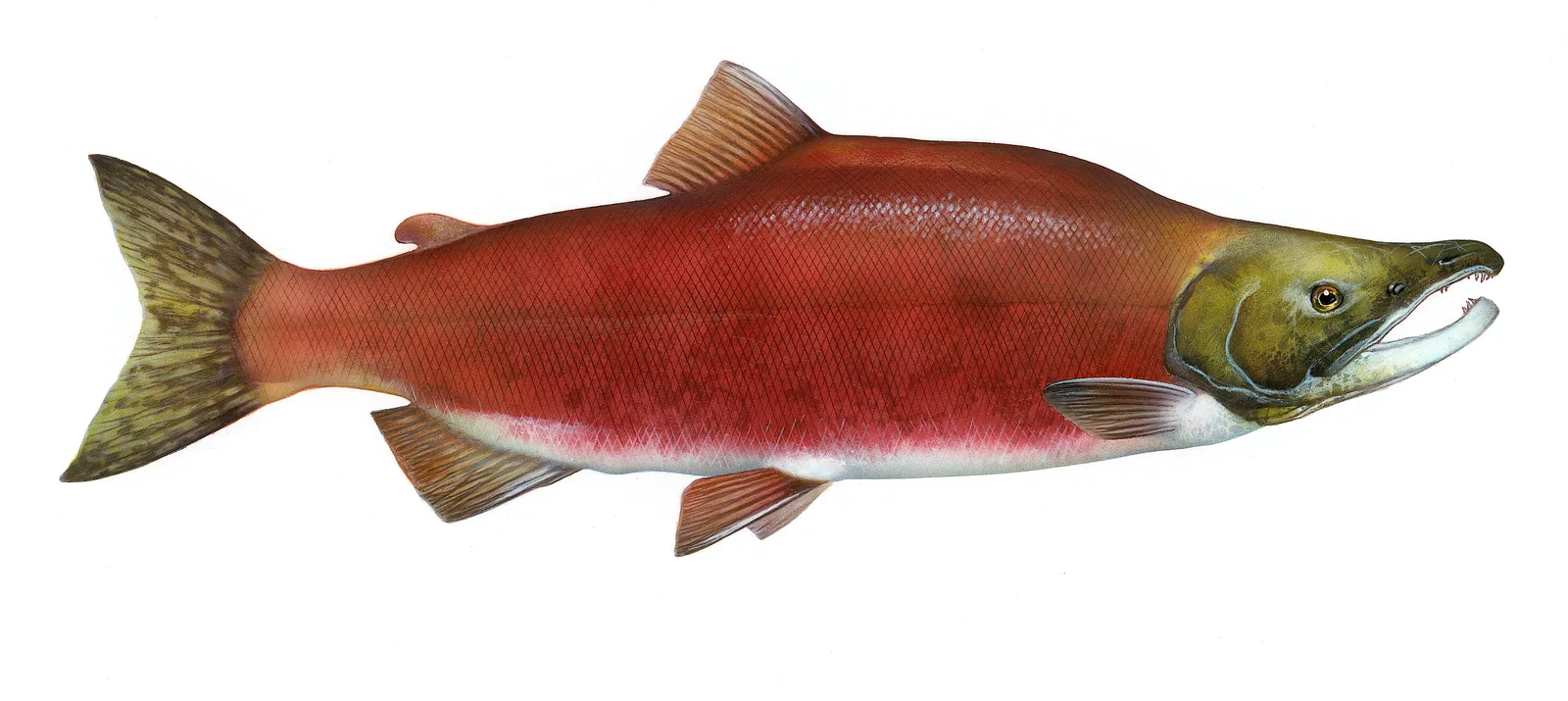
The sockeye salmon, called the red salmon in Alaska, is a Pacific salmon of 18 to 31 in (46–79 cm) and 4 to 15 lb (1.8–6.8 kg) that depends on lakes more than any other salmon. At sea it is silver with the blue-green back that earns it the name blueback salmon; on the spawning run it turns bright red with a green head. It strains plankton from the water, and in Alaska’s rivers most anglers fish for it with a small fly drifted near the bottom. Its meat is the reddest of the wild salmon.
Every sockeye entry in the IGFA record book, all 39 of them, was caught in Alaska. Twenty-five came from the Kenai River or the Russian River that feeds it, including Stan Roach’s 15 lb 3 oz world record of August 9, 1987.
Sockeye or chum: check the teeth
Fresh from the sea, sockeye and chum are the two salmon with a white mouth, a white gum line and no spots on the tail. The teeth split them. Washington’s identification card calls the sockeye almost toothless, while a chum has well-developed teeth. Alaska’s and Washington’s cards both give the sockeye a large, bright gold eye.
| Mark | Sockeye | Chum | Coho | Pink |
|---|---|---|---|---|
| Gum line | White | White | White | Black |
| Teeth | Small; almost none to see | Well developed | Sharp, medium size | Almost none at sea |
| Tail | No spots | No spots; silver streaks | Spots on upper half | Large oval spots, both halves |
| Other mark | Large gold eye | White tip on the anal fin | Wide wrist of the tail | Very small scales |
A pink salmon is easy to rule out by its black gums and big oval tail spots. Still unsure between sockeye and chum? Count the gill rakers on the first arch. Alaska’s wildlife notebook gives a sockeye 28 to 40 long, slender ones and a chum 19 to 26 short, stout ones. Those rakers are the sieve a sockeye feeds with.
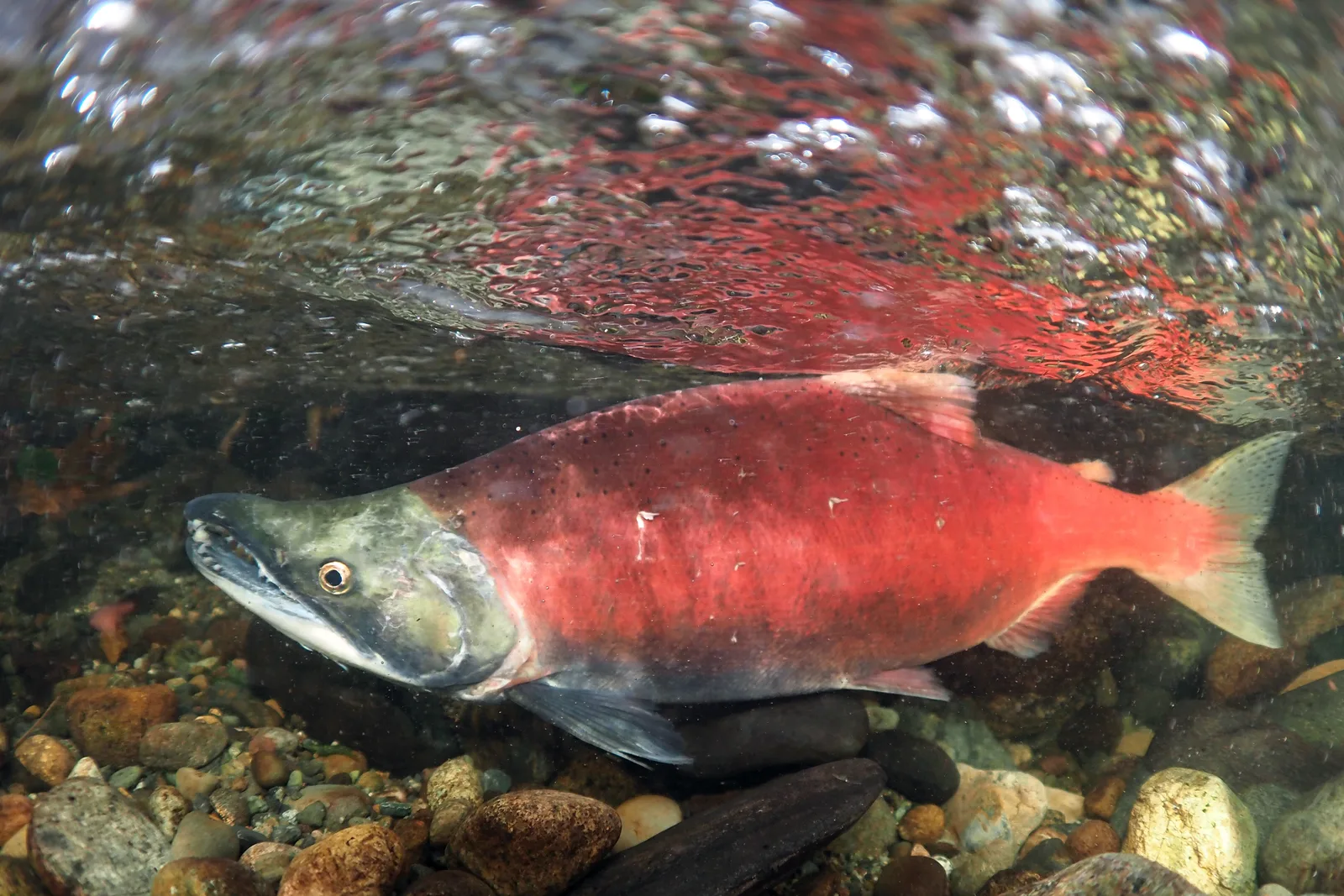
On the spawning run there is no doubt. Both sexes turn brilliant to dark red on the back and sides, with a pale to olive-green head. The male grows a humped back and a hooked jaw, the kype, full of sharp teeth. A few populations stay dull green or yellowish with little red. The salmon hub sets all six North American salmon side by side, and the coho salmon page covers the silver, the other white-gummed salmon.
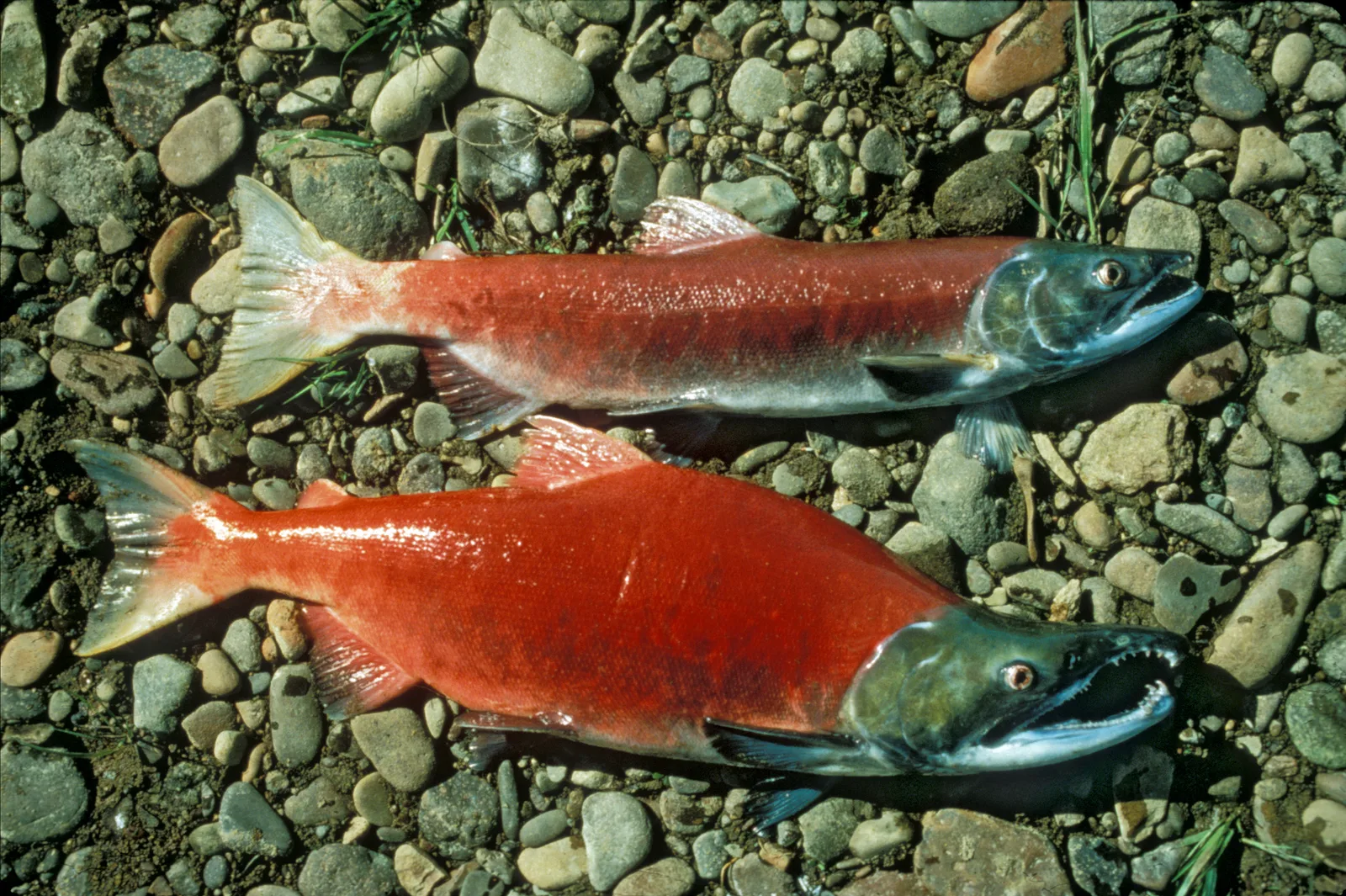 Male (bottom) and female sockeye in spawning colors. Photo: David Menke, U.S. Fish and Wildlife Service (public domain)
Where sockeye run, and when
A sockeye river has a lake in it. Washington’s fish and wildlife department says the fry need a lake to rear in; by NOAA’s count the young spend one to three years there before going to sea. In Alaska most adults return in June and July. The largest runs go to the rivers of Bristol Bay and to Canada’s Fraser River. Bristol Bay saw 79.0 million sockeye in 2022, the biggest inshore run on record, and its commercial fishery took a record 60.1 million of them.
| Water | When | How it is fished | Worth knowing |
|---|---|---|---|
| Russian River, Alaska | Early run by June 15, midpoint June 27; larger second run from mid-July | Fly cast 10–15 ft upstream, drifted near the bottom | Fly-fishing only most of the year; weight placement restricted |
| Kenai River, Alaska | Late run peaks mid- to late July | Flies; dipnets at the mouth | Dipnetting July 10–31, Alaska residents only |
| Bristol Bay rivers, Alaska | June and July | Flies; ADF&G suggests small shrimp patterns | Runs of tens of millions in good years |
| Lake Washington, Seattle | Counted at the Ballard Locks, June–July | Not given | Opens only when the run is forecast above the 350,000-fish goal |
| Brewster Pool, Columbia River | July | Trolled dodger and lure tipped with shrimp, 20–25 ft (6–7.6 m) down | Catch card required; closed early in warm water in 2015 |
| Lake Wenatchee, Washington | Late July to August, when open | Not given | Selective gear: barbless hooks, no bait or scent (2022) |
Seasons on all of these waters open and close by emergency order as the fish are counted, so read the current rules before every trip. In 2026, Washington did not open the Upper Columbia to sockeye from Priest Rapids to Chief Joseph Dam. Managers had expected about 275,000 sockeye; by early July the forecast had fallen below 80,000.
In a lake, sockeye go deep. In Lake Washington, adults spend most of their time below the thermocline in water of 48 to 52 °F (9–11 °C), rarely warmer or cooler. How a summer lake layers is on the lake water temperature page.
Free card: what 26 species do at your water temperature
Plus one email a week on what's biting now. No sales pitches. Privacy.
Do sockeye salmon bite?
Yes, but they are filter feeders, so the fishing is about putting a fly where the fish already is. Alaska’s fishing guide says most anglers cast a short way upriver and let the current carry the fly down, and that small shrimp flies work well. ADF&G says sport anglers prize sockeye for their tenacious fight as well as their food quality.
- Cast short and fish close. On the Russian River, ADF&G describes a cast 10 to 15 ft (3–4.6 m) upstream at about 45 degrees, then a dead drift to the end of the swing. Sockeye travel very close to shore. Beginners often wade or cast too far out while the fish pass behind them.
- Get the weight right. The agency rates the weight as perhaps more critical than the fly. Use enough that the fly bounces very near the bottom, and check the booklet: the Russian River limits where the weight may sit.
- Keep the fly sparse. The bucktail Russian River Coho fly is the local standard. Other anglers prefer sparse patterns such as the Green Lantern, the Comet or a shrimp pattern. Many good sockeye flies carry enough hackle to aggravate a fish into biting.
- Troll in big water. At the Brewster Pool on the Columbia, guide Dave Grove told Northwest Fishing Reports he took 90% of his fish 20 to 25 ft down at 1.3 mph. He ran a size 0 dodger ahead of a pink-and-silver Smile Blade tipped with fresh shrimp. Guide Jerrod Gibbons runs four rods on downriggers to hold the depth.
- Expect few in salt water. Sockeye are a rare catch at sea, usually hooked by anglers fishing for other salmon.
One rule decides what you keep. In Alaska’s fresh water, a fish hooked anywhere but the mouth is snagged, and it must be released immediately; snagging on purpose is illegal. Near the Russian River, ADF&G asks anglers to clean fish at home or cut the carcass into small pieces and drop them in deep, fast water, away from bears.
How big do sockeye get, and what is the record?
Most sockeye run 18 to 31 in and 4 to 15 lb by Alaska’s figures, and the agency’s typical fish is 24 in (61 cm) and 6 lb (2.7 kg). Early-run Russian River fish average about 6 lb, and a few reach about 10 lb (4.5 kg). The state’s species profile gives a record weight of 16 lb (7.3 kg) and a record length of 31 in.
| Record | Size | Who, where, when |
|---|---|---|
| World, all-tackle (IGFA) | 15 lb 3 oz (6.88 kg) | Stan Roach, Kenai River, Alaska, August 9, 1987 |
| All-tackle length (IGFA) | 27.6 in (70 cm), a tie | Dennis Triana, Kenai River, and William Kneer IV, Kisaralik River, August 2024 |
| All-tackle length, fly (IGFA) | 29.1 in (74 cm) | Bob Gaines, Kenai River, August 20, 2011 |
The IGFA’s book holds 39 sockeye entries across its weight, length, line-class, fly and junior categories; a few are the same fish listed twice. Not one came from outside Alaska.
Is sockeye salmon good to eat?
Yes, and it is one of the most valued salmon on the market. NOAA says its rich flavor rivals that of chinook, and calls its flesh the reddest of the wild salmon: bright red raw and still red when cooked. The color comes from the plankton and krill sockeye eat at sea. It sells for more per pound than any Pacific salmon except chinook, and Alaska’s agency calls it the preferred species for canning.
It is also a wild fish. The Marine Stewardship Council notes that most Atlantic salmon on sale is farmed, while NOAA rates U.S. wild-caught sockeye a smart choice because it is sustainably managed. Fresh sockeye fillets are in season in summer and early fall; frozen, canned and smoked sockeye is sold year-round.
Alaska puts all its wild salmon on the unrestricted list for mercury, and the FDA counts salmon among its “Best Choices.” NOAA calls it a good source of omega-3 fatty acids; a raw 100 g (3.5 oz) portion holds 168 calories and 21.3 g of protein. One kitchen note from NOAA’s own recipes: cooked sockeye looks underdone because its color stays vivid.
How does sockeye compare with pink and Atlantic salmon? NOAA’s figures per raw 100 g (3.5 oz):
| Salmon | Calories | Protein | Fat | Source of supply |
|---|---|---|---|---|
| Sockeye | 168 | 21.3 g | 8.56 g | Wild |
| Pink | 116 | 19.94 g | 3.45 g | Wild; lean and mild-flavored |
| Atlantic | 142 | 19.84 g | 6.34 g | All farm-raised in U.S. markets |
Pink is the leaner, milder fish; sockeye carries more protein and more fat per portion. That is also why sockeye costs more: it is wild only, sold fresh only in summer and early fall, and its flesh is the reddest of the wild salmon.
Which sockeye runs are protected?
Alaska has hundreds of sockeye stocks, and none is listed under the Endangered Species Act. Two populations farther south are. Snake River sockeye have been endangered since November 20, 1991, and Lake Ozette sockeye on Washington’s coast threatened since 1999.
The Snake River fish make the hardest trip. They swim more than 900 miles up the Columbia and Snake, past eight dams, to Redfish Lake in Idaho’s Sawtooth Mountains. In 1992 a single male made it, and no other sockeye was there. He became Lonesome Larry, and biologists used his sperm to fertilize eggs for the recovery program.
Warm water is the newer threat. In 2015 more than 500,000 sockeye passed Bonneville Dam, the second-highest count on record, but only about 277,000 reached McNary Dam, 146 river miles upstream. Washington biologists estimated at least 100,000 more died in that stretch than in a normal year. The river ran above 70 °F (21 °C) for weeks, and prolonged water above 68 °F (20 °C) is lethal for salmon. Where salmon and trout feed best is on the water temperature chart.
Runs can come back. Sockeye returning to Baker Lake in Washington’s Skagit system fell to 99 fish in the mid-1980s. In 2025 more than 91,880 returned, helped by a trap below Lower Baker Dam that carries adults around both dams. The lake now has a growing sport fishery.
How long do sockeye salmon live?
Three to seven years, by Alaska’s count. Like every Pacific salmon, a sea-run sockeye is anadromous: born in fresh water, grown at sea. NOAA says most mature at about five, and that four is more common in the Pacific Northwest. A female digs a nest, a redd, with her tail and lays 2,000 to 5,000 eggs that hatch in winter. The fry move into a lake and feed on zooplankton for one to three years. Then they go to sea as smolts weighing a few ounces.
After one to three years at sea, the adults find their home stream by smell. Fish that return early are almost always males, called jacks. Every sockeye dies within a few weeks of spawning.
A sockeye that never goes to sea is a kokanee, the same species living out its life in a lake and rarely longer than about 14 in (36 cm). The name sockeye itself comes from the Salish name suk-kegh, “red fish.” For every other fish, start at the species guides.
Free download
The water temperature card
Read your water temperature and the card tells you who is spawning, who is feeding and what to throw. 26 species, 16 pages, for your phone and the tackle box.
Plus one email a week on what's biting now. No sales pitches. Privacy.
Related
Section guide
Types of Salmon: The Five Pacific Species and the Atlantic, Told ApartThe six types of salmon a North American angler meets: chinook, coho, sockeye, pink, chum and Atlantic, by gum line, tail spots, size and record.
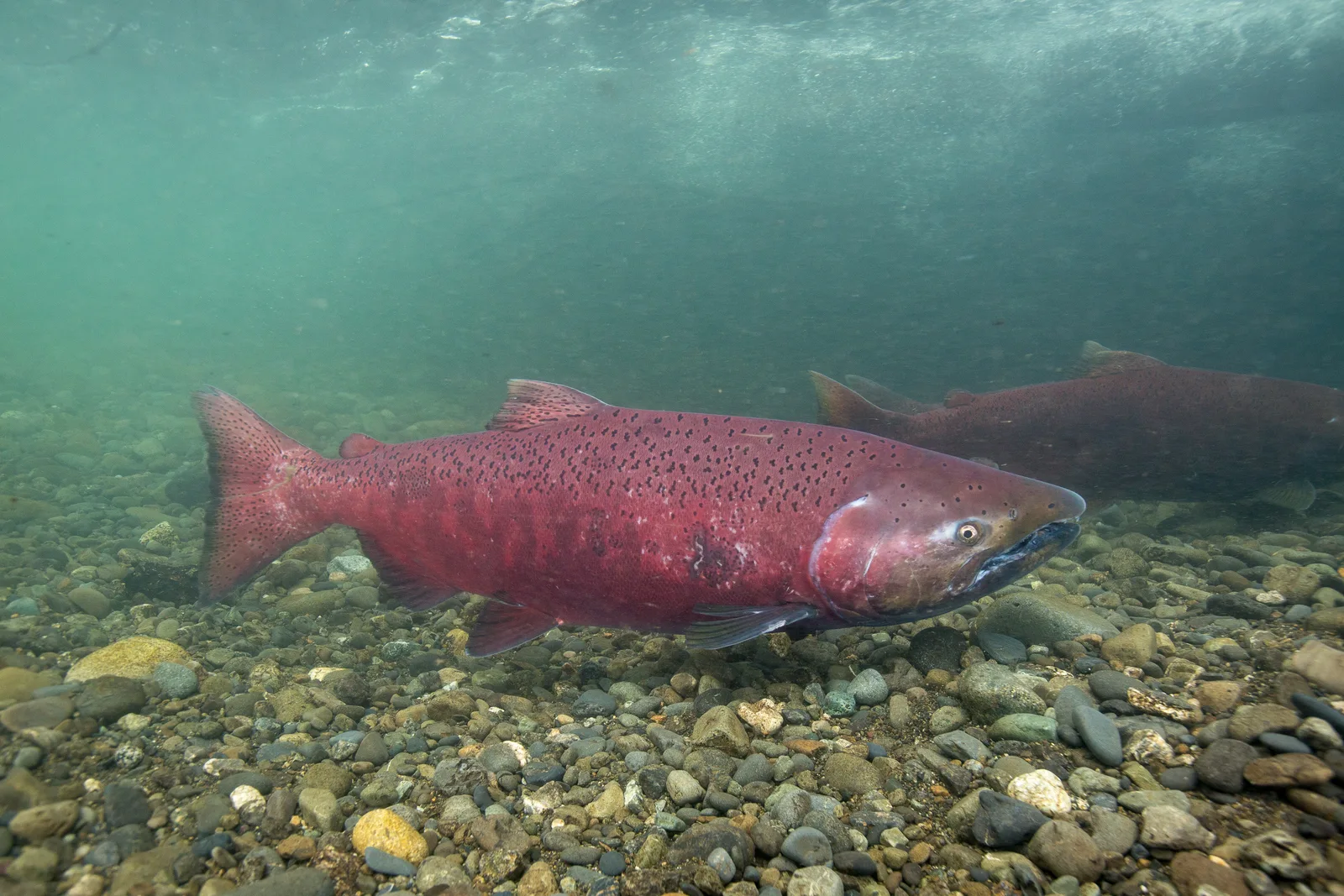 King Salmon (Chinook): Black Gums, Size, Runs and the 97-Pound Record
King salmon, or chinook: the black gums that mark a king, how big they get from Alaska to the Great Lakes, when each run starts, and the 97 lb 4 oz record.
 Kokanee Salmon: The Landlocked Sockeye, Season by Season
Kokanee salmon are sockeye that never reach the sea. How to tell one, the 50 °F depth they hold at each season, how to troll for them, and the record.
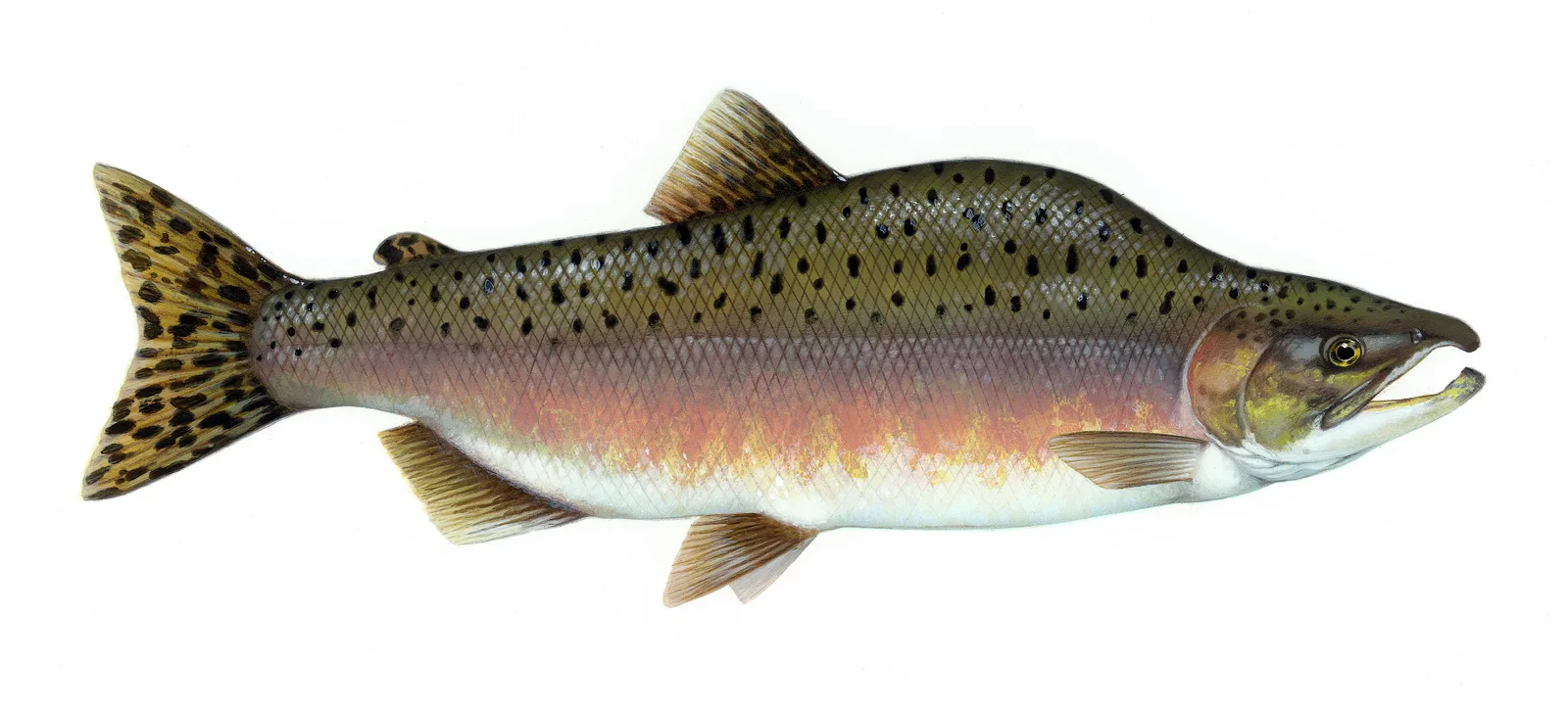 Pink Salmon: Odd-Year Runs, How to Tell a Humpy, Size and Records
Pink salmon live two years, so Puget Sound gets humpies only in odd years. When they run, how to tell one from a king, how to catch it and the record.
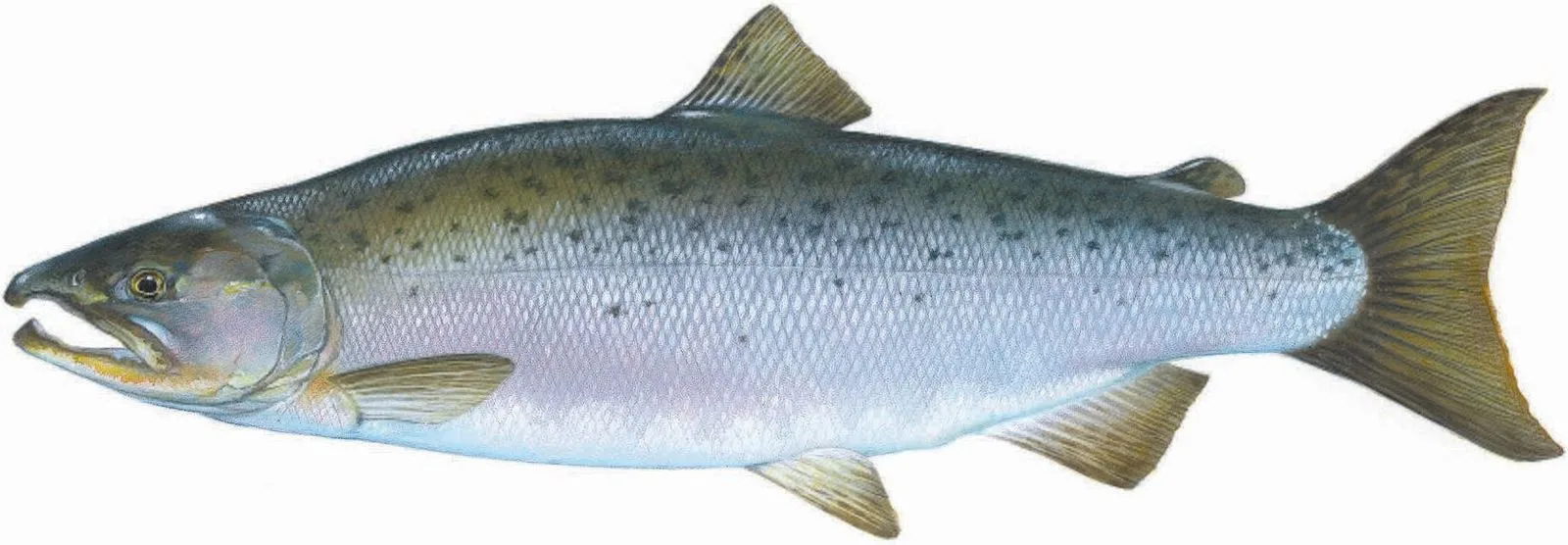 Coho Salmon: How to Tell a Silver From a King, Size, Runs and Records
Coho salmon: the white gum line that separates a silver from a king, how big they get, when they run from Alaska to the Great Lakes, and the record.
Sources
- Alaska Department of Fish and Game, Sockeye salmon species profile: size, names, life history, range, uses
- Alaska Department of Fish and Game, Sockeye salmon, Wildlife Notebook Series: gill rakers, spawning colors
- Alaska Department of Fish and Game, Alaska salmon fishing guide: sizes and methods
- Alaska Department of Fish and Game, Salmon identification, 2018 Southcentral regulation booklet
- Ryan Ragan, Alaska's five species of Pacific salmon, Alaska Fish & Wildlife News (ADF&G, 2015)
- Alaska Department of Fish and Game, Fishing the Russian River (2022)
- Alaska Department of Fish and Game, 2025 Southcentral sport fishing regulations: snagging
- Alaska Department of Fish and Game, Personal use fishing
- Alaska Department of Fish and Game, Kenai River personal use dipnet fishery
- Alaska Department of Fish and Game, 2022 Bristol Bay salmon season summary
- Alaska Public Media (2026), Sockeye slow to arrive on Kenai River, according to Fish and Game
- IGFA world records, Salmon, sockeye
- NOAA Fisheries, Sockeye salmon: appearance, biology, range, seafood profile
- NOAA Fisheries, Sockeye salmon (protected)
- NOAA Fisheries, Snake River sockeye salmon
- NOAA Fisheries, Lake Ozette sockeye salmon
- NOAA Fisheries, Sockeye salmon recipes
- Washington Department of Fish and Wildlife, Sockeye salmon (Oncorhynchus nerka)
- Washington Department of Fish and Wildlife, Pacific salmon ID card (2024)
- Washington Department of Fish and Wildlife, Lake Washington salmon counts
- WDFW (2022), Lake Wenatchee and Wenatchee River to open for sockeye fishing amid strong returns
- Puget Sound Energy, Upper Skagit Indian Tribe, Swinomish Indian Tribal Community and WDFW (2025), record return of sockeye salmon
- Northwest Power and Conservation Council (2015), Warm water wreaks havoc on Columbia River fish
- ODFW and WDFW joint staff, 2026 summer fact sheet no. 1
- FISHBIO, reposting Northwest Public Broadcasting (2026): Fewer sockeye are returning to the Upper Columbia. Washington closed its fishery to protect the salmon
- Roscoe, Hinch, Cooke and Patterson (2010), Behaviour and thermal experience of adult sockeye salmon migrating through stratified lakes near spawning grounds, Ecology of Freshwater Fish 19
- National Wildlife Federation (2020), Who was Lonesome Larry?
- Alaska Science Forum, UAF Geophysical Institute, The loneliest sockeye salmon in the world
- Northwest Fishing Reports, Brewster sockeye recap
- Seattle Times (2003), Notebook: Record-size small fish alluring to anglers, too
- Wild Salmon Center, Sockeye
- Alaska Public Media (2014), State releases new guidelines for mercury and fish
- U.S. Food and Drug Administration, Advice about eating fish
- Marine Stewardship Council, Sockeye
- NOAA Fisheries, Pink salmon: seafood profile and nutrition facts
- NOAA Fisheries, Atlantic salmon: farm-raised in U.S. markets, nutrition facts
- FishBase, Oncorhynchus nerka (Walbaum, 1792) summary