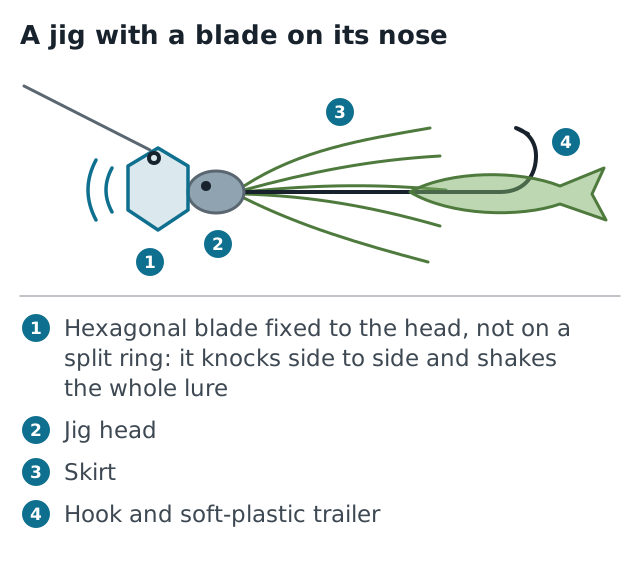
A chatterbait is a skirted jig with a thin hexagonal blade fixed to its nose: on a straight retrieve the blade knocks side to side against the head and the whole lure shakes. Throw it from pre-spawn through the spawn, when bass sit on emerging grass in 48–70 °F (9–21 °C) water, and any time the water is stained or the wind is up. In 2025 the ½ oz Z-Man JackHammer turned up in the winning tackle at both the St. Johns River and Lake Okeechobee Elite Series events. It is a bass lure first. Z-Man’s own guide also aims it at walleye, pike and redfish, and its Micro model is sold for crappie; the species pages give the sizes.
Ron Davis’s ChatterBait went on sale on March 10, 2004; by 2006 Bryan Thrift had won so much on it that every lure company had a bladed jig within a year.
Start here
- How to fish a chatterbait: the retrieves, the tackle, and where it beats the other moving baits.
- Chatterbait trailers: fluke, paddle tail or craw, and when each one wins.
- Spinnerbaits: the other wire-and-blade lure, and the one anglers most often compare it with.
- Jigs: the jig the chatterbait is built on.
- Bass fishing: the season table that puts the chatterbait in pre-spawn.
Why does it vibrate?
The blade is not on a split ring. It is fixed to the head in a way that, in Bryan Thrift’s words, “restricts and optimizes the blade’s movement and vibration and provides a side-to-side stopping point.” That restriction is the whole design. A blade that could swing freely would flutter. A blade that can only knock between two stops starts vibrating the instant the retrieve begins. With a thin trailer, it breaks into a random left-and-right hunting action. Imitations that hang the blade loosely lose exactly that.
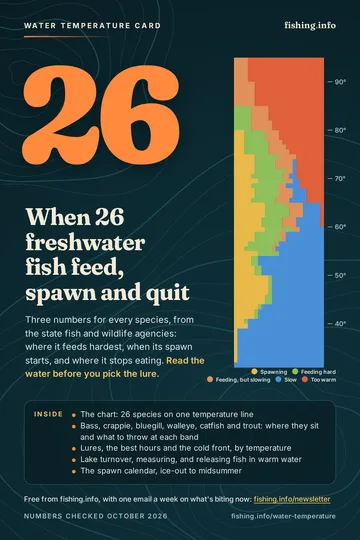
Free card: what 26 species do at your water temperature
Plus one email a week on what's biting now. No sales pitches. Privacy.
How do you fish it?
The retrieve is straight: burn it over the top of grass, or slow-roll it along the bottom, and let the blade and the trailer do the work. It needs no added weight, because the lead is in the head and the head weight sets the depth. Z-Man burns a 1/2–3/4 oz bait along a grass line and goes to a 3/4 or 1 1/4 oz JackHammer to fish deep. Two things improve the retrieve.
- A change of direction. A burst of the reel handle or a pull of the rod makes the lure dart, and often draws the strike from a following fish.
- Contact. When the blade catches a grass stalk, rip it free; the sudden acceleration is the trigger.
The tackle is simple. Use a 6 ft 6 in to 7 ft 3 in medium or medium-heavy rod with a moderate or moderate-fast action, so the single hook is not torn out on the strike. Spool 15–20 lb fluorocarbon or 20–30 lb braid; the line hub explains the choice.
Trailers set the action. A thin soft jerkbait such as a Zoom Super Fluke or Z-Man RaZor ShadZ gives the hunting action. A paddle-tail swimbait lifts the lure over grass, and a craw suits slow-rolling. The soft plastics hub covers all three.
Which Z-Man model?
ChatterBait is Z-Man’s trademark, and the name has become the generic word for every bladed jig. Z-Man now lists seventeen models. The table has eight of them, and the Z-Man ChatterBait page covers the rest. The JackHammer is the chatterbait in the first box of ten on best fishing lures.
| Model | Hook | Blade | Weights | For |
|---|---|---|---|---|
| Original | 5/0 | Hex stainless | 1/4, 3/8, 1/2 oz (7, 11, 14 g) | The affordable all-rounder, stained water |
| Elite EVO | 5/0 custom | Hex, electroplated | 3/8, 1/2 oz (11, 14 g) | Clearer, pressured water |
| Tungsten Elite EVO | 5/0 | Hex | 3/8, 1/2 oz (11, 14 g) | Compact head, finesse |
| JackHammer (with Evergreen) | 5/0 Gamakatsu | Hex stainless | 3/8, 1/2, 3/4, 1¼ oz (11, 14, 21, 35 g) | The tournament standard, about $20 |
| Baby Jack | 3/0 | Hex | 1/4, 3/8, 1/2 oz (7, 11, 14 g) | Clear water, pressured fish |
| StealthBlade | 4/0 | Clear polycarbonate | 3/8, 1/2 oz (11, 14 g) | Very clear water |
| MiniMax | 2/0 heavy wire | Hex | 1/4, 3/8, 1/2 oz (7, 11, 14 g) | Smallmouth |
| Big Blade | 6/0 | Oversized hex | 1/2, 5/8, 3/4 oz (14, 18, 21 g) | Dirty water and wind |
Where did it come from?
Ron Davis of Rock Hill, South Carolina, built the lure with his father. He named it for the vibration that made his “teeth chatter.” The first ones went on sale on March 10, 2004, through a tackle shop in Greenwood, South Carolina, under the RAD Lures name, and about five thousand sold that year.
The break came in January 2006. Bryan Thrift, one of the first pros to fish it, won the FLW event on Lake Okeechobee and then a second major straight after. Demand outran the Davises’ shop. Z-Man Fishing Products took over manufacturing and the brand, and patented the design in the United States.
Of the six lure families in the lures section, the chatterbait is the youngest, and it was the fastest to conquer tournament fishing.
All articles
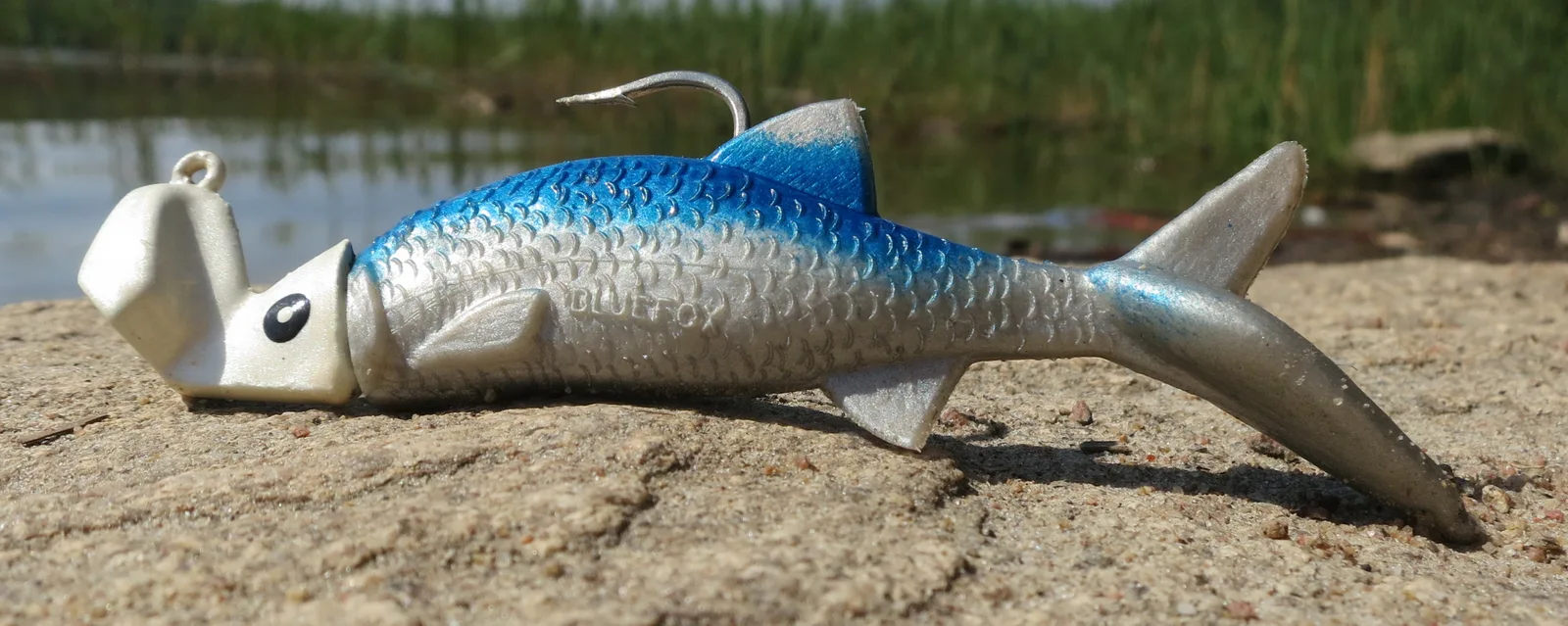 Chatterbait Trailers: Fluke, Paddle Tail or Craw, and When
The best chatterbait trailers by job: a soft jerkbait for the erratic hunting action, a paddle tail for kick and lift over grass, a craw for slow-rolling.
- How to Fish a Chatterbait: Retrieves, Tackle and Where It Wins
How to fish a chatterbait: the steady retrieve with pulses, the rip out of grass, the slow-roll and the burn, on a moderate rod with 15–20 lb fluorocarbon.
Free download
The water temperature card
Read your water temperature and the card tells you who is spawning, who is feeding and what to throw. 26 species, 16 pages, for your phone and the tackle box.
Plus one email a week on what's biting now. No sales pitches. Privacy.