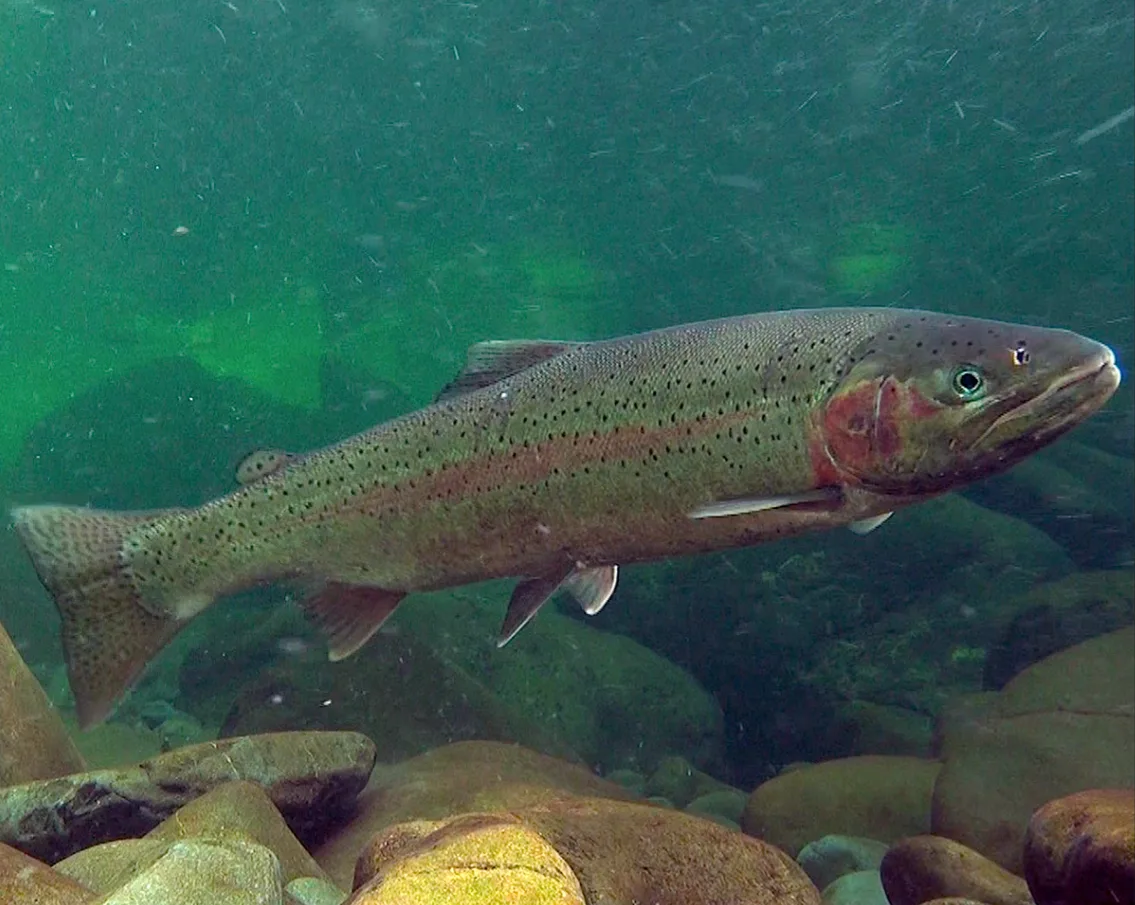
A steelhead trout is a rainbow trout that leaves its river for the ocean, or for one of the Great Lakes, and comes back to spawn at 8–11 lb on average. A rainbow that stayed home runs 11–18 in. Same species, same spots, different life. And unlike the Pacific salmon it swims with, a steelhead can spawn, go back to sea, and return to do it again.
A salmon dies after spawning; a steelhead often does not. In Alaska 20–30 percent of steelhead come back to spawn a second time. In the Columbia Basin, behind the dams, about 2 percent do.
Is a steelhead a rainbow trout?
Yes. Idaho Fish and Game’s biologists call the two “different life history forms of the same species.” A resident rainbow lives its whole life in fresh water. A steelhead is born in a river and turns silver. It migrates to sea as a smolt, feeds on the rich ocean food, and returns to its home river, usually much larger.
The two forms share rivers and interbreed. In Idaho’s words, “their offspring can adopt either life history”: a resident female can produce young that become steelhead. Which way a young fish goes depends on its genes, its condition and its environment.
How do you tell a steelhead on the bank?
The difference is mostly color and size. A fresh-run steelhead is chrome, with the rainbow’s pink band faint or missing and its black spots on the back and tail. The longer it sits in the river before spawning, the darker and pinker it turns, until it looks like a big resident rainbow. If cutthroat share the river, look under the jaw: a steelhead, like any rainbow, has no red slash there.
On many West Coast rivers the other mark that matters is the adipose fin, the small fleshy fin on the back near the tail. Hatchery steelhead usually have it clipped. A fish with the fin intact is presumed wild, and many rivers require wild fish to be released unharmed. The rainbow trout page has the full identification table.
Free card: what 26 species do at your water temperature
Plus one email a week on what's biting now. No sales pitches. Privacy.
When do steelhead run?
West Coast steelhead come in two broad types, named for when they enter fresh water. Summer-run fish enter rivers in summer, mostly east of the Cascades, and hold there until they spawn the next spring. Winter-run fish spawn closer to the ocean and need less travel time. Great Lakes fish follow the same pattern, with the lake standing in for the sea.
| Region | Run | When fish enter the rivers |
|---|---|---|
| Oregon coast and east side | Summer | From March near the coast to October–November in eastern Oregon |
| Oregon | Winter | Late fall and early winter |
| Alaska | Spring / summer / fall | March–early June / July (rare) / August–October |
| Idaho (Snake, Salmon, Clearwater) | Summer fish, fished fall to spring | Season opens in August and runs about nine months |
| Lake Erie tributaries | Fall to spring | October through April or May, after rain raises the creeks |
Timing on any single river is its own, and the state fishing reports are the only reliable calendar. The steelhead fishing guide covers the methods for each run.
Where do Great Lakes steelhead come from?
Steelhead are not native to the Great Lakes. They are rainbows stocked into the tributaries, and they live much as sea-run fish do, with the lake as their ocean. In Ohio, yearlings of 7–9 in go into the tributaries in April and May and move out to Lake Erie within weeks. There they feed on shiners, smelt and gobies. After two or three years they come back up the tributaries, from fall through spring.
Ohio stocks about 450,000 steelhead a year into seven tributaries:
| Tributary | County | Stocked a year |
|---|---|---|
| Vermilion River | Erie | 50,000 |
| Rocky River | Cuyahoga | 80,000 |
| Cuyahoga River | Cuyahoga | 60,000 |
| Chagrin River | Lake | 80,000 |
| Grand River | Lake | 80,000 |
| Ashtabula River | Ashtabula | 50,000 |
| Conneaut Creek | Ashtabula | 50,000 |
Pennsylvania stocks over a million juvenile steelhead a year into the Erie tributaries and Presque Isle Bay. It lists more than a dozen creeks with public fishing, from Conneaut and Elk Creek to the numbered “Mile” creeks. Its biologists put the average adult at 6–11 lb and 24 in, a trophy at over 10 lb and 30 in, and the life span at about eight years.
The fishery is big. Nearly a quarter-million steelhead trips a year are made to Pennsylvania’s Erie shore, and Ohio’s tributaries draw anglers from 20 states, Canada and overseas.
How do you catch Great Lakes steelhead?
In the lake itself, steelhead are caught from May through September on spoons and trolled lures. In fall they gather along the breakwalls, staging to run upriver. Once the rain comes and the creeks rise, the tributary season is on. Pennsylvania’s guide puts the best chance when the water is rising or falling, and the most activity near dawn and dusk.
Lake Erie’s shoreline between Ohio, Pennsylvania and New York is known to anglers as Steelhead Alley. The steelhead fishing guide has the methods and tackle, and the fishing knots section the knots that hold a steelhead.
How big do steelhead get?
The time a steelhead spends in the river and at sea sets its size when it comes back. In Alaska a young fish spends two to five years in fresh water before the smolt migration, typically three, then usually two years in the ocean. Idaho sorts its fish by years at sea, and the sizes jump with each one.
| Fish | Years at sea (or lake) | Typical size on return | Returns |
|---|---|---|---|
| Idaho A-run | 1 | 23–26 in (58–66 cm), 4–6 lb (1.8–2.7 kg) | Usually June–August |
| Idaho B-run | 2 | 31–34 in (79–86 cm), 10–13 lb (4.5–5.9 kg) | Late August–September |
| Idaho three-year fish | 3 | Over 37 in (94 cm), often over 20 lb (9 kg) | – |
| Lake Erie steelhead | 2–3 in the lake | About 24 in (61 cm), 6–11 lb (2.7–5 kg) | October–April |
At the upper end a steelhead reaches about 40 in and 30 lb. Most live five to eight years, and a few reach eleven.
The IGFA keeps no separate steelhead category. A steelhead is a rainbow trout, and the all-tackle rainbow record is the 48 lb farm-escaped triploid from Saskatchewan’s Lake Diefenbaker. The biggest sea-run fish on record is older. In June 1970, David White caught a 42 lb 3 oz steelhead at Bell Island near Ketchikan. In 2010 the Anchorage Daily News called it Alaska’s oldest angling record, and it still heads the state list.
Idaho’s record is 30 lb 2 oz, from the Clearwater River in 1973. Pennsylvania’s record is 20 lb 3 oz, from Walnut Creek in 2001.
The fight is the reason anglers drive through the night for these fish. The U.S. Fish and Wildlife Service credits steelhead with going from zero to 25 mph in one second, and with jumping 11 ft when climbing waterfalls.
Why are wild steelhead protected?
Wild steelhead on the West Coast are in trouble. NOAA Fisheries lists 11 distinct population segments under the Endangered Species Act. One, Southern California, is endangered.
Ten are threatened: California Central Valley, Central California Coast, Lower Columbia River, Middle Columbia River, Northern California, Puget Sound, Snake River Basin, South-Central California Coast, Upper Columbia River and Upper Willamette River. There is also an experimental population in the Middle Columbia. The threats NOAA names are dams and other barriers, habitat loss and degradation, fishing and climate change.
For anglers, that is why the rules are what they are: wild-fish release, closed tributaries, barbless hooks on many rivers, and seasons built around hatchery returns. Read the regulations for the river, not the state summary. The fish anglers keep are mostly hatchery fish with a clipped fin; the wild ones go back, handled as little as possible. The catch-and-release guide has the handling steps.
Is steelhead trout good to eat?
Yes, and it eats like a milder, leaner salmon. A steelhead is a rainbow trout, which Illinois-Indiana Sea Grant describes as mild in flavor and delicate in texture, with flesh “from white to pink and even orange based on diet.” USDA figures put farmed rainbow trout at 6.2 g of fat per 100 g (3.5 oz), against 13.4 g for farmed Atlantic salmon, so the fillet is less oily.
Trout sits on the FDA’s Best Choices list for low mercury. For fish you catch yourself, the FDA’s advice is to check the state advisory for that water first. Raw steelhead carries the risk of any raw fish: the FDA calls cooking to 145 °F (63 °C) the safest route, and says fish eaten raw should be previously frozen to kill parasites.
Most steelhead sold in stores is farmed. NOAA describes the Puget Sound operation as “ocean-going rainbow trout” raised in marine net pens, sterile and all-female so escapees cannot breed with wild fish. On the river, a hatchery steelhead with a clipped fin is usually yours to keep where the rules allow it; a wild one belongs to the next run.
Why do some steelhead spawn twice?
Spawning happens in spring in most rivers: mid-April to late June in Idaho, where the fish have come far inland from the Pacific. The female digs her nest in gravel riffles like any rainbow. Then, instead of dying, the spent fish, called a kelt, drops back downstream.
Whether it survives the trip decides how many come back. In Alaska, repeat spawners are typically 20–30 percent of a run, as low as 10 and as high as 50. Older, larger females survive best and males worst.
On the Columbia and Snake, only about 2 percent of steelhead spawn twice, because thousands of kelts die trying to get downstream past the hydroelectric dams. The Columbia River Inter-Tribal Fish Commission runs a kelt project to change that. It holds spent wild fish in tanks, feeds them back into condition and releases them below the dams to try again.
The name, if you want it
Steelhead and rainbow trout share one scientific name, Oncorhynchus mykiss: “steelhead” names a life, not a species. The trout hub covers every trout and char.
Free download
The water temperature card
Read your water temperature and the card tells you who is spawning, who is feeding and what to throw. 26 species, 16 pages, for your phone and the tackle box.
Plus one email a week on what's biting now. No sales pitches. Privacy.
Related
Section guide
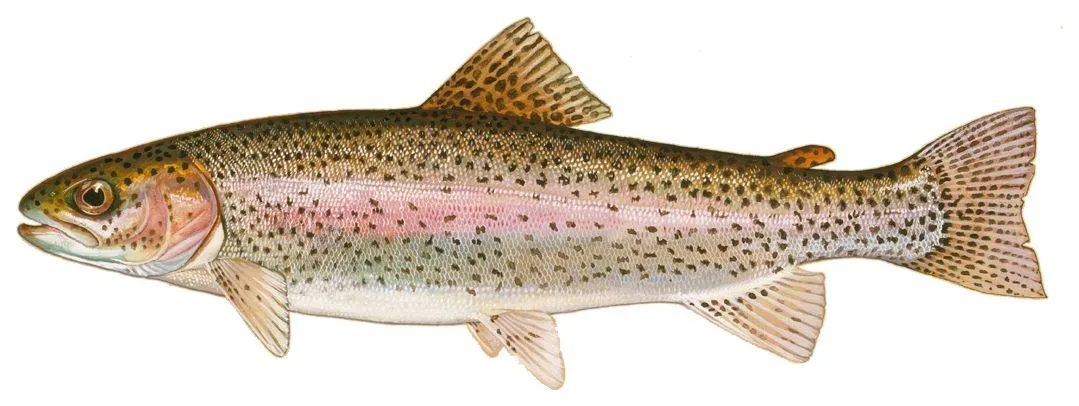
Trout: The Types of Trout and How to Tell Them ApartThe types of trout anglers catch, from rainbow and brown to brook and lake trout (two are chars): the marks that identify each, spawn seasons, records.
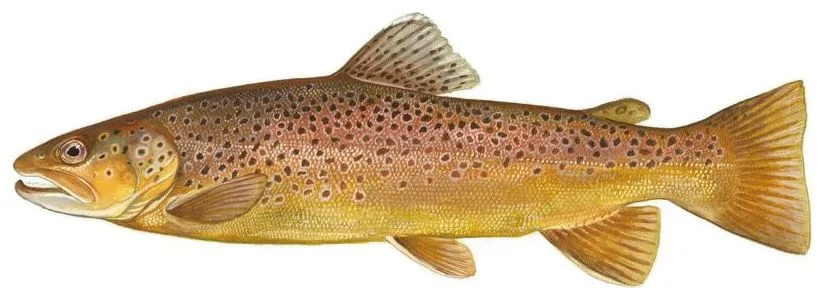 Brown Trout: Identification, History, Habits and Records
Brown trout from the agency data: how to tell one from a rainbow or brook, the 1883 import, night feeding, the fall spawn and the 44 lb record.
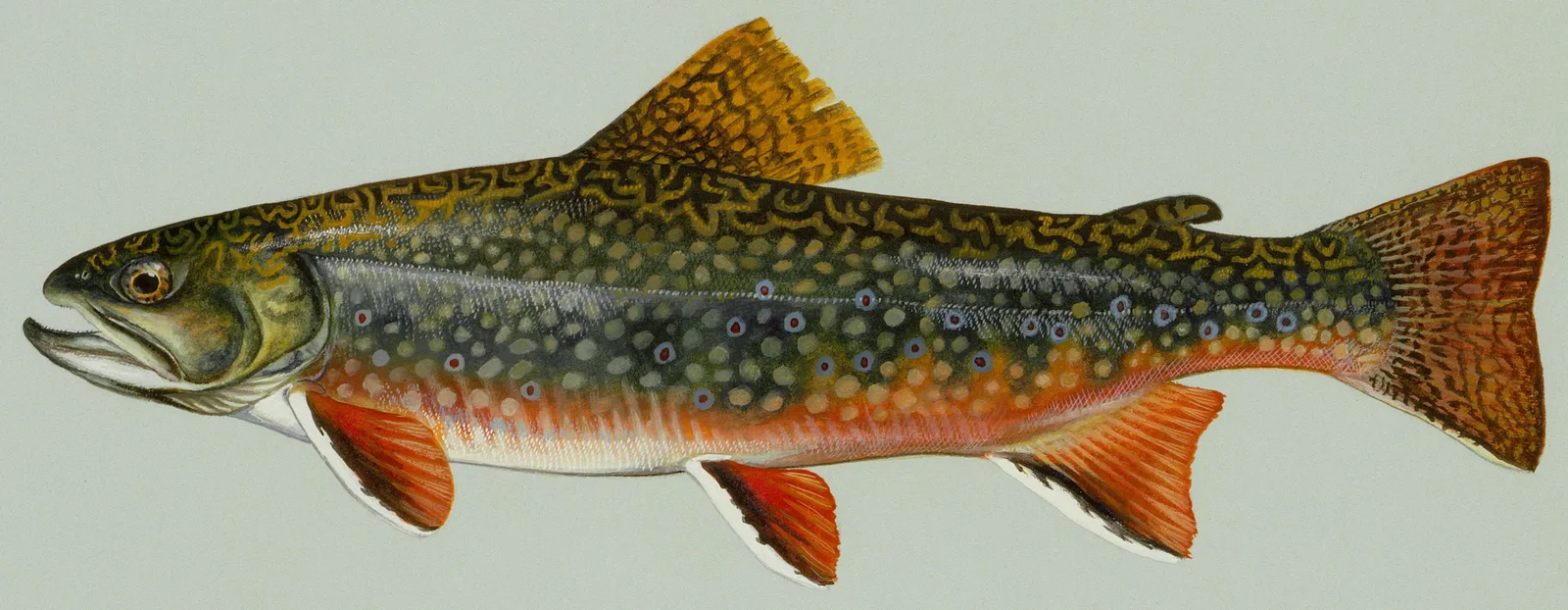 Brook Trout: The Char That Marks America's Coldest Water
The brook trout is a char, not a trout: how to tell it apart, where it still lives, why it lost 28% of its range, and the 1915 record.
- Rainbow Trout: Identification, Range, Spawning and Record
Rainbow trout from the agency data: how to tell one from a steelhead, cutthroat or brown, the temperatures that matter, spawning, and the 48 lb record.
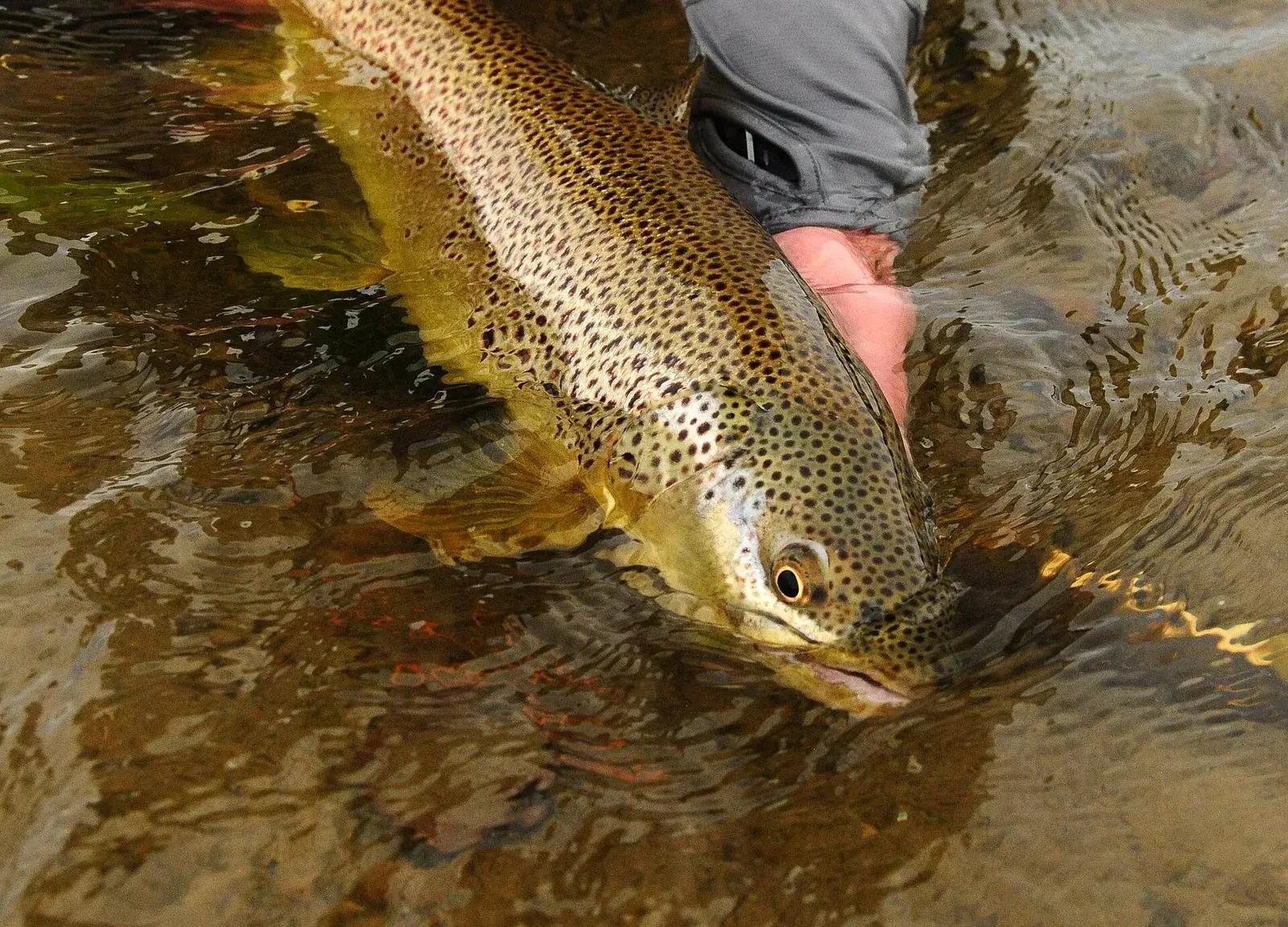 How to Hold a Trout Without Hurting It: Grip, Photo, Release
How to hold a trout so it swims off healthy: the belly cradle and tail grip, no lipping, the 10-second photo, and what the release studies found.
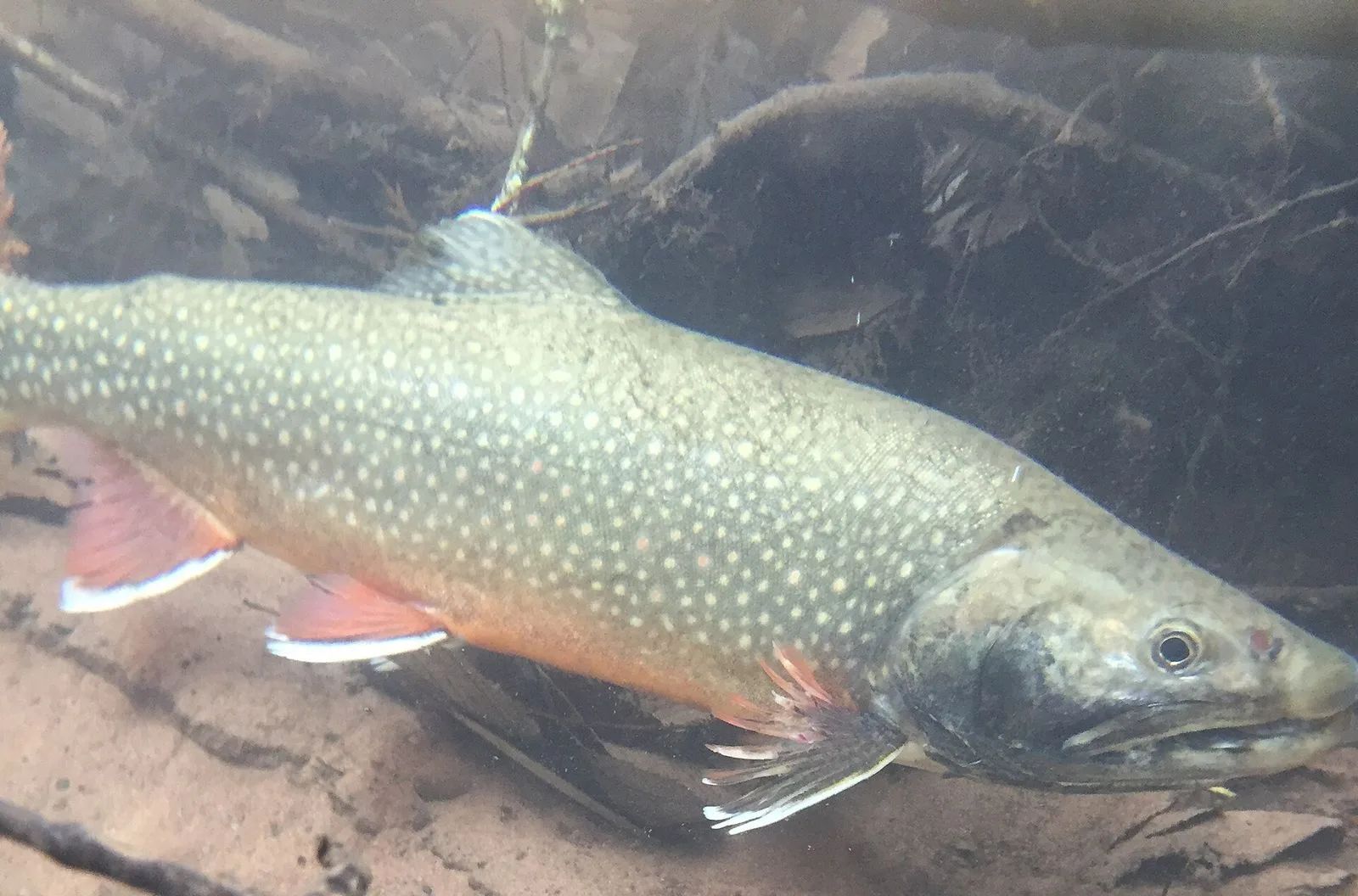 Splake: The Brook Trout and Lake Trout Hybrid
Splake are a hatchery cross of lake trout and brook trout. How to tell them apart, whether they can reproduce, the 20 lb record and how to catch them.
Sources
- PFBC, Pennsylvania state record fish
- NOAA Fisheries, steelhead species profile
- Idaho Fish and Game, rainbow trout and steelhead: what's the difference?
- Idaho Fish and Game, what is a steelhead? (A-run and B-run)
- Alaska Department of Fish and Game, steelhead and rainbow trout species profile
- Washington Department of Fish and Wildlife, rainbow trout and steelhead
- Oregon Department of Fish and Wildlife, how to fish for steelhead
- Columbia River Inter-Tribal Fish Commission, the kelt project
- Ohio Division of Wildlife, Ohio's steelhead program (fact sheet 024FH, 2025)
- Pennsylvania Fish and Boat Commission, fall is time to target steelhead
- Pennsylvania Fish and Boat Commission, intro to PA steelhead fishing reference guide
- Anchorage Daily News, every record fish has a story
- NOAA Fisheries, net-pen aquaculture in the Pacific Northwest: FAQ
- U.S. Fish & Wildlife Service, rainbow trout (steelhead)
- Wild Steelheaders United, the how-to fly fishing guide for steelhead
- U.S. Food and Drug Administration, advice about eating fish
- Purdue Extension and Illinois-Indiana Sea Grant, Farmed fish fact sheet: rainbow trout (FNR-622-W)
- USDA FoodData Central, rainbow trout, farmed, raw (SR Legacy 173717)
- USDA FoodData Central, Atlantic salmon, farmed, raw (SR Legacy 175167)
- U.S. Food and Drug Administration, Selecting and serving fresh and frozen seafood safely