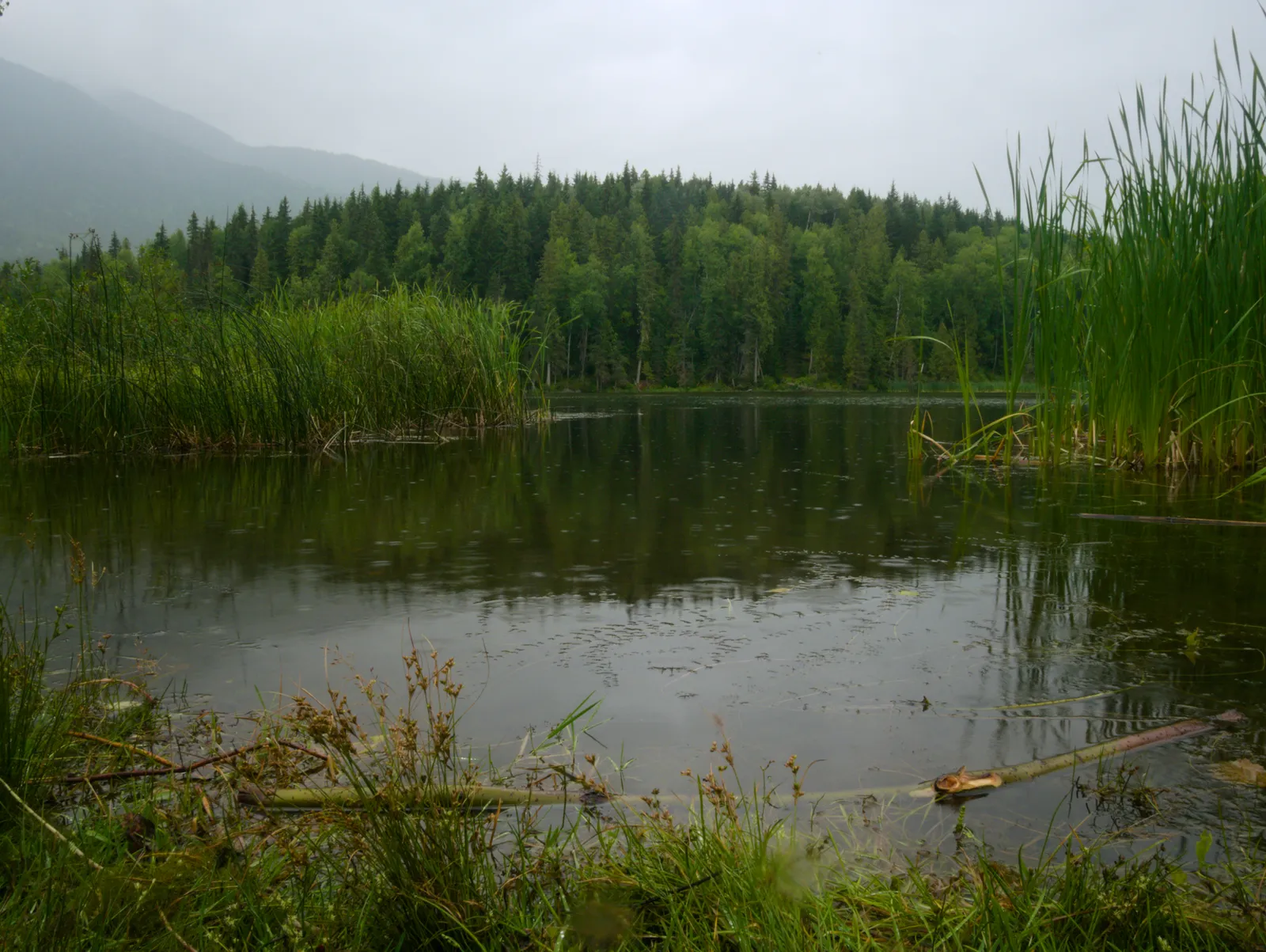
Fishing in the rain is usually good, but not because of the rain. No study has ever tested rainfall against feeding. The gains anglers report come from what travels with a shower: cloud, cooler water, insects washed off the bank and muddy runoff. Each of those can be read before the first drop and fished after the last one.
Thirteen years of compulsory creel records on Escanaba Lake, Wisconsin, found no effect of precipitation on walleye catches. Bright sun did lower them. Fish the cloud, not the rain.
Do fish bite in the rain?
Start with what is missing. There is no peer-reviewed study of rain and feeding in any freshwater gamefish. What exists is a handful of catch-rate studies with rain as one variable among many, and they agree: the drops are not the driver.
The strongest rests on 13 years of compulsory creel records on Escanaba Lake, Wisconsin. Precipitation had no measurable effect on walleye or muskie trips. Solar radiation did: bright sun lowered the odds of a successful walleye trip (p≈0.04). Barometric pressure was not significant either (p=0.12). Cloud, not rain, is the part of a wet day the fish respond to.
Trout Unlimited biologist John McMillan gives the same answer from the stream side. In his account, the benefit of rain is cloud cover, cooling in summer, insects and worms washed in, and the turbidity that lets fish feed shallow without feeling exposed. The rain itself is incidental.
Two things you will read elsewhere have no support. “Rain adds oxygen to the water” appears on hundreds of pages and in no source that measured it; treat it as unproven. And bass do not bite in low light because sun hurts their eyes: largemouth strike success stays above 95 percent from daylight down to moonlight. Low light helps the ambush, not the eyesight.
So are fish more likely to bite during rain? In a warm, light rain under a gray sky, often yes. In a cold, hard rain behind a front, often no. Same rain, different weather.
What happens before the rain?
The hours before a front are the one window almost every source agrees on. The barometer falls, the wind swings warm and steady, the cloud thickens, and the bite picks up.
Ralph Manns’ Lake Travis logs put 65 percent of bass strikes on slow-falling pressure against 30 percent on slow-rising. Manns himself adds that no study demonstrates a pressure effect, and names the confounders: the wind, cloud and warmth that arrive with the fall. Florida’s wildlife agency warns the opposite, that a downward trend “can often ruin fishing”. Two experienced sources, opposite advice: the needle is not the mechanism. The weather is. What the barometer can and cannot tell you has a page of its own.
Fish the windward bank where the wind pushes bait, and keep moving baits working longer into the day. A spinnerbait or a topwater that dies at nine on a bluebird morning keeps producing under pre-frontal cloud until the rain turns cold. The other conditions that shape a day, from wind to cold fronts, are on the fishing conditions hub.
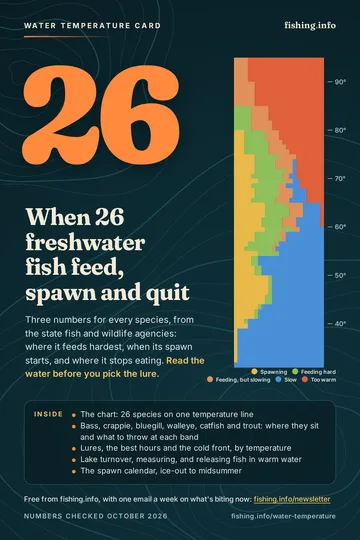
Free card: what 26 species do at your water temperature
Plus one email a week on what's biting now. No sales pitches. Privacy.
What changes while it rains?
A steady summer rain takes the sun off the water, which the Escanaba data says matters, and cools the surface. In July that pulls bass and crappie shallower along the banks they left at breakfast, and stretches the feeding window into the afternoon. Where the water sits on the water temperature chart still decides which species is eating; rain only moves the clock.
The best bait when it is raining is the one the fish can find. Under a dark sky and a dimpled surface, vibration and bulk beat finesse: a spinnerbait, a buzzbait, a dark topwater, a wide-wobbling crankbait. For catfish nothing changes, and fresh cut bait keeps working; the ranking is on best catfish bait. Trout in a light rain take terrestrials knocked off the bank, so a beetle or ant fished tight to the grass is the day’s fly.
The one rule that overrides all of this is lightning. The National Weather Service gives it a 30-30 rule. If thunder follows the flash within 30 seconds, the storm is close enough to strike you: get off the water and away from the shoreline. Wait 30 minutes after the last thunder before going back. A graphite rod on an open lake is the tallest thing for a quarter mile.
Where are the fish after heavy rain?
A soaking rain of an inch (25 mm) or more changes a lake for days. Runoff arrives through every creek, culvert and ditch, carrying worms, insects, crawfish and tributary minnows. It is cooler than the lake in summer, warmer in early spring, and muddy.
Fish sort themselves along that mud. In a clear lake the stain is cover: bass hold on the mud line, the edge where muddy meets clear, and the first clean water below an inflow is the spot. In a lake that was already stained, a chocolate inflow is too much, and the fish back out to the nearest clear water. Catfish follow the current and the smell into the inflow itself; the mouth of a feeder creek on the first night after a storm is as good as catfishing gets.
Crappie do the opposite. Texas Parks and Wildlife biologist Craig Bonds tracked white crappie with telemetry on Lakes LBJ and Waco. The fish moved away from increasing inflow, sliding deeper and out of the current as the creeks rose. Fish the main-lake side of a flooded creek arm until the inflow drops; the temperature side of that decision is on crappie water temperature.
Rising water moves bass and catfish into newly flooded grass and brush, because the food is there. River walleye pull to the seams out of the heaviest flow. Trout hold the soft edges of a rising stream and feed on what the rise dislodges, until it blows out to the color of coffee; then a clear tributary is the better bet.
The other “after” is the cold front. Behind a front, Schramm’s review records surface drops of 8–10 °F (4–6 °C) and a post-front bite under five bass an hour. The rain was not the problem; the bright, cold day behind it is. Slow down, go deeper and tighter to cover, downsize.
Where is each species before, during and after?
The table assumes a warm-season rain of an inch (25 mm) or more. A light shower changes the light and little else.
| Species | Before (falling barometer, cloud) | During | After heavy rain |
|---|---|---|---|
| Largemouth and smallmouth bass | Windward banks; spinnerbait, topwater all day | Shallower, still moving; dark lures with vibration | Mud-line edges, first clear water below inflows, flooded brush on rising water |
| Catfish | Bite steady; cut bait on flats | Unchanged, scent carries | Inflows and creek mouths, first night; cut bait in the current |
| Crappie | Brush and docks in mid-depth | Rise with the cooling; minnows over brush | Main-lake side of creek arms, deeper; avoid the rising inflow |
| Walleye | Shallow rock and weed edges under cloud | Keep fishing; low light extends the bite | River seams and slack water; lake points near stained inflows |
| Trout | Rising to hatches under cloud | Terrestrials along grassy banks | Soft edges of rising water, then clear tributaries when the main stream blows out |
Water clarity decides the last column: in a clear lake the stain is cover and the fish go to it; in a stained lake they leave the chocolate for the nearest clean edge.
How do you plan a rain day?
- Check the timing, not the rain total. Rain ahead of a front is the good window; rain behind a cold front brings a bright, cold day. Fish the first hard, plan a slow day for the second.
- Check the temperature direction. Summer rain cools the surface and moves the bite shallower and later. Spring rain is often warmer than the lake and pulls bass and catfish into inflows.
- Fish the light, not the drops. Under cloud, keep spinnerbaits, topwater and crankbaits working through midday. Sun back out means slow down and go deep.
- Find the water color. After heavy rain, check the ramps and creek mouths first. Clear lake with a mud line: fish the edge. Stained lake with a chocolate inflow: fish the cleanest arm.
- Pick the species the runoff favors. Catfish and bass to the inflows and flooded cover; crappie and walleye out to the main-lake side and the seams.
- Match the bait to the visibility. Stained water and dim light call for vibration, dark colors and bulk; clear water after a light rain still fishes natural colors.
- Watch the sky. Thunder within 30 seconds of the flash: off the water. Thirty minutes after the last thunder: back on. That rule is not about fish.
None of this needs the barometer. The cloud, the wind and the color of the water coming in tell you more about the next three hours than the needle does.
Free download
The water temperature card
Read your water temperature and the card tells you who is spawning, who is feeding and what to throw. 26 species, 16 pages, for your phone and the tackle box.
Plus one email a week on what's biting now. No sales pitches. Privacy.
Related
Section guide
Fishing Weather: What Wind, Cloud, Pressure, Rain and the Moon Really Do to the BiteWhat weather is good for fishing, ranked by the evidence: light and hour first, then temperature trend, wind and cloud, the moon, and last the barometer.
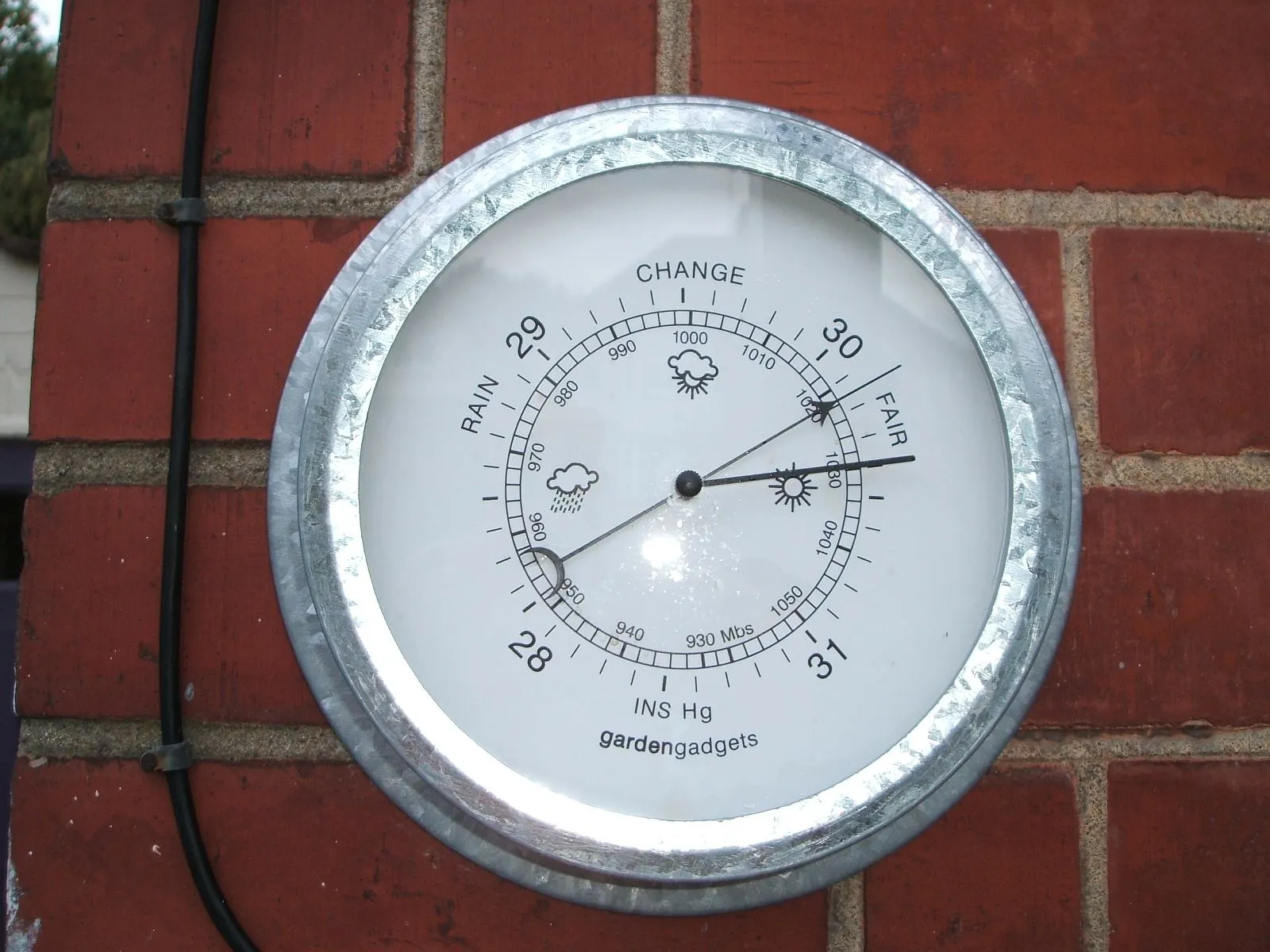 Best Barometric Pressure for Fishing: The Chart Everyone Shares, and What the Studies Say
The chart says 29.70–30.40 inHg is the best barometric pressure for fishing. A whole cold front equals 16 in of water and no study finds a feeding effect.
 Best Time of Day to Fish: Dawn, Dusk, Midday and Night, Species by Species
Dawn and dusk beat midday for most fish, and catfish, walleye and big brown trout bite after dark. A species-by-species table of when to go.
 Cold Front Fishing: A Day-by-Day Plan for the Front, the Bluebird Days After, and the Wind
Cold front fishing day by day: the pre-front window, why days 1–2 after run slow, what to change, and when wind helps the bite.
 Moon Phase Fishing: The Solunar Theory, the Studies That Tested It, and a Verdict for Each Phase
No moon phase reliably out-fishes another: a 1,355-hour trout test found no solunar effect. Where the moon does matter, and a verdict per phase.
Sources
- MeatEater (Lungren, 2020), Fact Checker: Is fishing better when it's raining? (John McMillan, Trout Unlimited)
- Shaw, Renik and Sass (2021), Angler catch of walleye and muskellunge, Escanaba Lake, PLOS ONE
- National Weather Service, lightning safety (the 30-30 rule)
- In-Fisherman (Straw, 2014), Crappies: Weather Vanes of the Fishing World (Craig Bonds, TPWD, telemetry)
- In-Fisherman (Manns, 2017), Barometric Pressure and Bass
- In-Fisherman (Schramm, 2017), The Effects of Cold Fronts on Bass
- McMahon and Holanov (1995), Foraging success of largemouth bass at different light intensities, Journal of Fish Biology
- Florida Fish and Wildlife Conservation Commission, freshwater fishing tips