 By
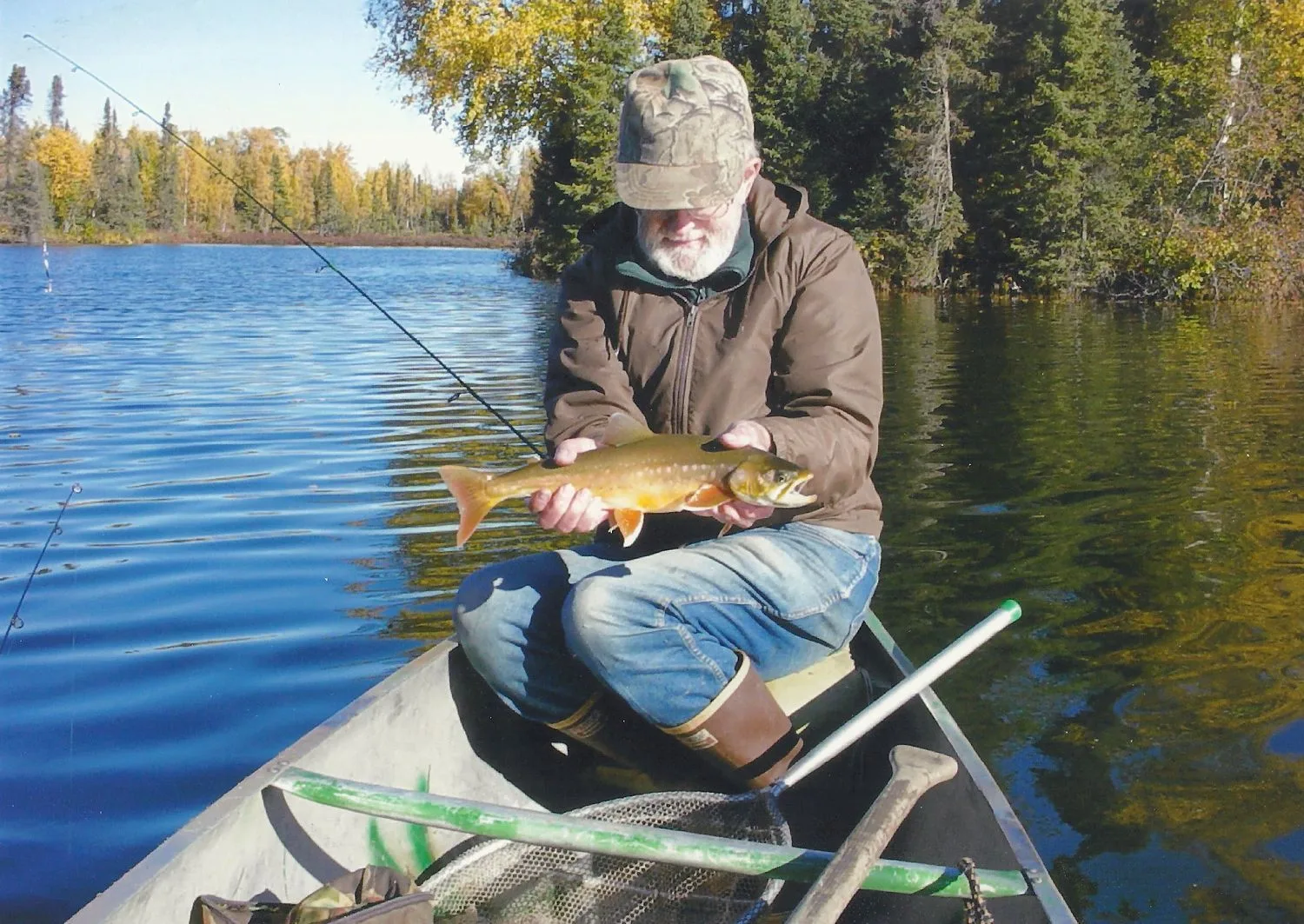
The Arctic char is a cold-water char of the far north, the most northerly freshwater fish in the world. In the United States you find it in two places only: Alaska’s lakes and a handful of remote Maine ponds. It carries pale spots on a dark back and, at spawning time, a gold to orange belly. Most of the giant, red, sea-run char in fishing photos come from Arctic Canada, Greenland, Iceland and Norway. In the US, catching one means cold, deep lakes, small spoons and flies, and a lot of patience.
The Arctic char lives farther north than any other freshwater fish, and Maine IFW notes it sometimes lives in lakes and ponds with no other fish at all. In the lower 48, the only intact native populations left are in Maine.
Is an Arctic char a trout, a salmon or a char?
None of the first two. The Arctic char, Salvelinus alpinus, is a char: a member of the salmon family, Salmonidae, in the genus Salvelinus, the branch that also holds the brook trout, the lake trout, the bull trout and the Dolly Varden. The Alaska Department of Fish and Game (ADF&G) gives the two marks of the group: “light spots on a dark background” and no teeth on the shaft of the vomer, a bone in the roof of the mouth.
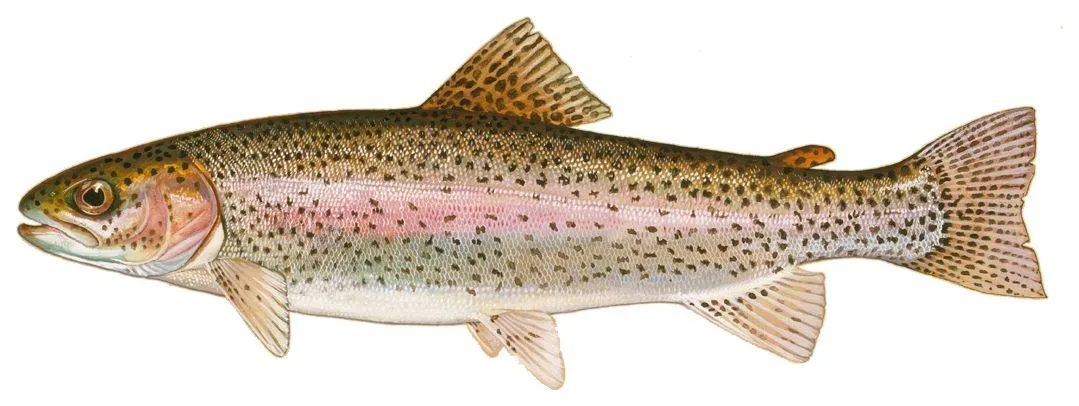
That one rule sorts most of the fish you will meet. True trout and salmon, such as the rainbow trout and the brown trout, carry dark spots on a light body; a char shows the reverse. The types of trout page lays the whole family out by that rule.
The spelling varies too. Maine’s biologists write “charr,” while ADF&G and the International Game Fish Association (IGFA) write “char.” Both mean the same fish. IGFA also lists the old names blueback char, blueback trout, Sunapee trout and golden trout (Sunapee). That last one has nothing to do with California’s golden trout, a rainbow relative.
How to tell an Arctic char from a Dolly Varden, bull trout, lake trout or brook trout
Look at the spots against the eye. IGFA’s test: “The spots on the Dolly Varden are usually smaller than the pupil of the eye, while on the Arctic char they are larger than the pupil.” ADF&G adds that an Arctic char has fewer, larger spots, a more deeply forked tail and a narrower base of the tail than a Dolly. It also warns that a sure ID “requires close examination of several body structures.” The pupil test is a good field guess, not a lab result. Two more clues: IGFA describes the leading edges of the lower fins as “milk white,” and ADF&G says spawning char turn “gold, orange, yellow or rose and only infrequently red.”
| Fish | Spots | Tail | Other marks | Where it meets Arctic char in the US |
|---|---|---|---|---|
| Arctic char | Few pink to red spots, larger than the pupil | Moderately to deeply forked | White-edged lower fins; spawns gold to orange, rarely red | Alaska lakes; 14 Maine lakes and ponds |
| Dolly Varden | Many small spots, smaller than the pupil | Less forked | Big kype on spawning males; red belly, red spots | Alaska coast and streams |
| Bull trout | Pale yellow, pink or orange spots on olive-gray | Slightly forked | Dorsal fin “lacks light or dark markings” (ODFW) | Nowhere: bull trout live in the Northwest |
| Lake trout | White or nearly white spots, also on the dorsal and tail; no red spots | Deeply forked | No red or haloed spots of any kind (IGFA) | Alaska lakes; rarely in the same Maine lake |
| Brook trout | Pale spots plus red spots with blue halos | Square | Worm-like marks on the back; dorsal fin with black markings | The same Maine charr ponds, in shallower water |
In Maine, the fish anglers mix it up with is the brook trout. The two share the same ponds, with brook trout in the shallows and char deeper. Maine’s 2001 charr plan raised the point after clerk surveys found one char kept in 461 hours of fishing: if anglers were logging char as brook trout, the real char catch may have been higher. The dorsal fin settles it. A brook trout’s carries solid black markings with sharp edges, the mark Oregon uses to tell a brook trout from a bull trout; an Arctic char’s dorsal fin is plain.
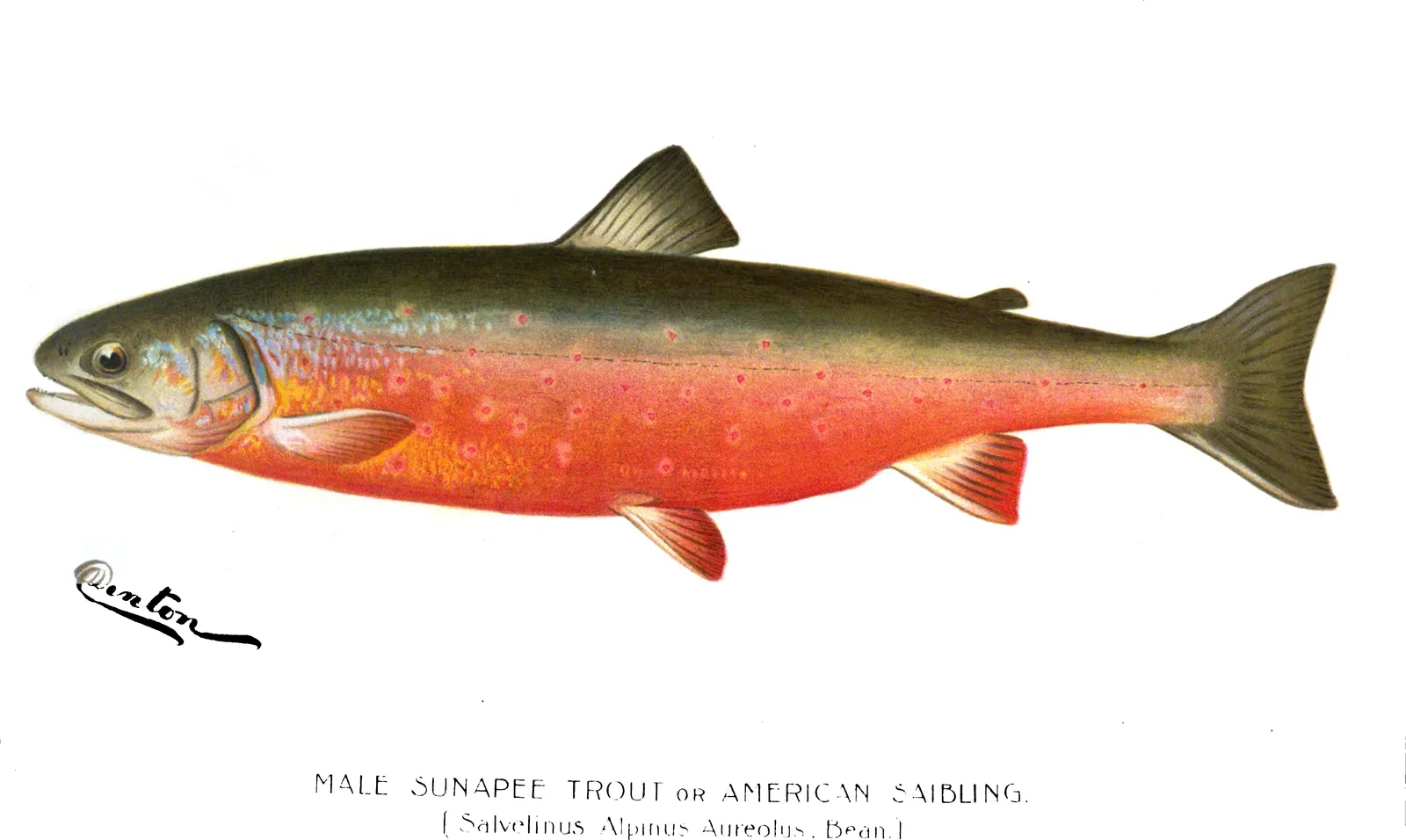 A male Sunapee trout, the New England form of the Arctic char, in spawning colors. Painting: Sherman F. Denton, 1897, Commissioners of Fisheries, Game and Forests of the State of New York (public domain)

Free PDF · Water temperature chart When do trout bite?
One reading, and the 16-page chart shows which of 26 fish are spawning, feeding hard or slowing down; for bass, crappie, bluegill and walleye, where they sit and what to throw. Every number sourced.
Enter your email, confirm it with one click, and the PDF is in your inbox. Plus one email a week on what's biting. Unsubscribe anytime. Privacy.
Where to catch Arctic char in the United States
Alaska and Maine are the only two states. They hold very different fish.
Alaska. ADF&G says “all known populations of Arctic char appear to spend their entire lives in lakes and do not migrate”, and that sea-run (anadromous) char “have not been observed in Alaska.” So the Alaska char is a lake fish. ADF&G names lakes in the Brooks Range, the Kigluaik and Kuskokwim Mountains and the Alaska Peninsula, plus the Kenai Peninsula, Kodiak Island and a small area of Interior Alaska near Denali Park. “The largest Arctic char in Alaska probably occur in some of Bristol Bay’s large lakes,” the agency writes. Dolly Varden have larger populations and a wider range, ADF&G adds, so a sea-run char from an Alaska coastal stream is a Dolly.
Maine. Maine IFW counts 14 lakes and ponds where charr exist and naturally reproduce, two of them stocked by moving fish from other waters. Maine calls them landlocked Arctic charr, subspecies S. alpinus oquassa, the “blueback.” The 2001 plan lists the waters, mostly remote ones in Aroostook and Piscataquis counties: Deboullie, Gardner, Black and Pushineer in the north, Big Reed and Wadleigh among the rest. Floods Pond, the home of the “silver charr,” is closed to all fishing to protect a town water supply.
These are glacial relics. Maine’s plan describes them as descendants of sea-run char that reached coastal waters during the Ice Age and were left behind in cold, deep lakes. Other New England populations did not last. Maine IFW says several have been lost over the last 115 years, and Lake Sunapee’s “golden trout” in New Hampshire “either hybridized with introduced lake trout or were extirpated in the 1950s,” according to the Lake Sunapee Protective Association.
Beyond the US. IGFA calls the species circumpolar: it runs from Maine across northern Canada and Alaska to Russia, south to Lake Baikal and Kamchatka, and turns up in Iceland, Great Britain, Scandinavia and the Alps. The big sea-run fish that fill the photos come from Arctic Canada: the Tree River and Victoria Island in Nunavut, northern Labrador and Ungava Bay, plus Greenland, Iceland, northern Norway and Russia.
When and how to fish for Arctic char
Char want cold water. Maine IFW says they “prefer water temperatures less than 55 degrees Fahrenheit” (13 °C), and through the summer that sends them down to the thermocline, the layer where warm surface water meets cold deep water. The year in a Maine charr pond, in Maine IFW’s own description:
| When | Where the char are | How Maine anglers fish them |
|---|---|---|
| Ice-out to early summer | Anywhere in the water column at first; then feeding forays into shallow and surface water | Trolling small fish patterns “a few feet from the surface”; fly anglers cast insect patterns on or just under the surface |
| July to mid-September | At the thermocline and deeper, “generally 20-30 feet” (6–9 m) | Trolling deep; some anglers “plug fish” with lures, worms or dead baitfish where the water’s rules allow |
| Late September | Surface feeding, “mostly in the evening hours up until dusk” | Maine IFW calls it “a great time” |
| Winter | Under the ice | Closed: Maine’s 2001 plan closed every charr water to ice fishing; check each pond’s current rule |
Expect to work for one. Volunteer angler diaries in Maine’s 2001 plan logged 0.034 to 0.036 char per hour, or 28.6 hours of fishing per legal fish. That is the number to keep in mind before a long hike into a Maine pond.
In Alaska, ADF&G points to late May through early July in the big Bristol Bay lakes, when char “congregate to feed on salmon smolts as they move toward the sea.” Smolts are young salmon on their way to sea, such as those of the sockeye salmon, so a small silver spoon or a streamer of that size makes sense. Small trout lures cover the rest of the lake fishing.
The sea-run char of the Canadian Arctic take heavier gear. Plummer’s lodge, which runs the Tree River camp, recommends a medium-heavy rod and a reel that holds 100 m (110 yd) of 20–30 lb mono. Its most popular lure is a 1 oz Pixie spoon in red, pink, orange or chartreuse. For the fly, it recommends 8 to 10-weight single-hand rods or 7 to 8-weight spey rods, with sink tips and streamers. Release any char you will not keep the way you would a trout (how to hold a trout shows the grip).
How big do Arctic char get? Size and records
It depends on the water. ADF&G puts Alaska char at “up to 38 inches and 15 lbs.” In some Alaska lakes fish over 10 lb are “not uncommon,” while other lakes “may not produce fish over 2 pounds.” Maine’s are small. Maine IFW says adults reach “about 20 inches and 3 pounds,” but most are closer to 6 in and a few ounces. “A fish larger than 2 pounds is of significant size.”
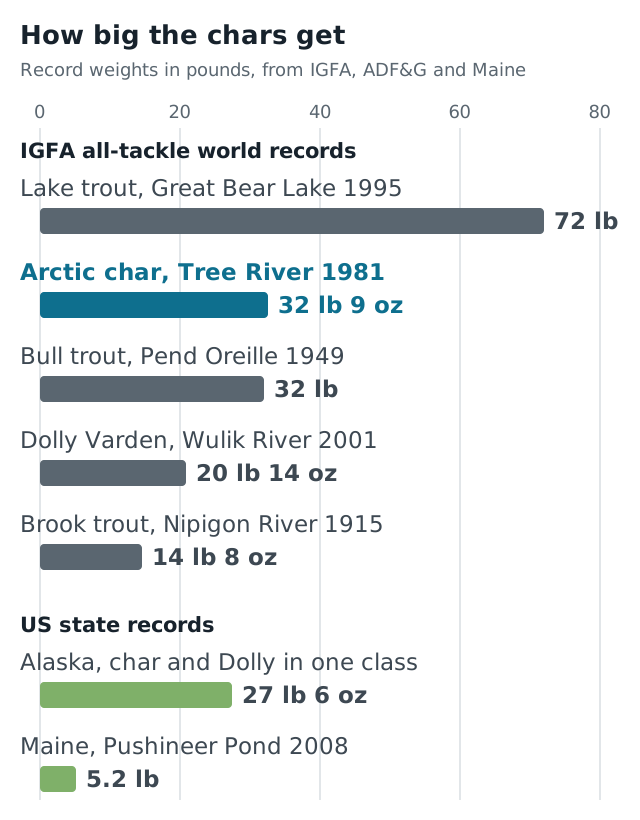
The world record. The IGFA all-tackle record is 32 lb 9 oz (14.77 kg), caught by Jeffery Ward in the Tree River, then in the Northwest Territories, on July 31, 1981. A new claim is pending. IGFA lists a 32 lb 11 oz (14.83 kg) char caught by James Schmid in the same river, now part of Nunavut, in August 2026. Until IGFA approves it, the 1981 fish stands. No other water has produced as many IGFA records for the species: besides the all-tackle fish and the pending claim, the Tree River holds five of the eleven fly-tippet records and two of the ten line-class records. The US entries on IGFA’s list for the species all come from Alaska: Dillingham, Ugashik Narrows and Togiak.
Alaska. ADF&G’s trophy list has one class for “Arctic char/Dolly Varden” combined. The record is 27 lb 6 oz, caught by Mike Curtiss in the Wulik River. To enter the trophy program, a fish must weigh 10 lb. The Wulik is better known as a Dolly Varden river, and it also produced the IGFA Dolly Varden record.
Maine. The state record is 5.2 lb and 25.4 in, caught by 11-year-old Carter McLaughlin in Pushineer Pond on August 20, 2008, the Bangor Daily News reported. The previous record, 4 lb 4 oz from Basin Pond in 1973, was a stocked fish.
Arctic char rules in Alaska and Maine
Limits change by area and by year, so read the current booklet for the water you fish. Two examples show how different the rules are.
| Water | What you may keep | Source |
|---|---|---|
| Bristol Bay, June 8 – Oct 31 | 3 a day, char and Dolly Varden combined, no size limit | ADF&G 2026 |
| Bristol Bay, Nov 1 – June 7 | 10 a day, combined | ADF&G 2026 |
| Iliamna River drainage | Catch-and-release only | ADF&G 2026 |
| Floods Pond, Maine | Closed to all fishing | Maine law book |
| Deboullie and Gardner lakes, Maine | 2 brook trout a day, charr counted; no ice fishing | Maine law book |
| Wadleigh Pond, Maine | Catch-and-release | Bangor Daily News, 2023 |
In Bristol Bay, ADF&G’s 2026 summary puts Arctic char and Dolly Varden in one combined bag. From June 8 to October 31 it is 3 per day and 3 in possession, with no size limit. From November 1 to June 7 it is 10 per day. Some waters are stricter. The Iliamna River drainage is catch-and-release only for both fish.
Maine protects its char closely. In the current law book, Floods Pond is closed to all fishing, and Deboullie and Gardner lakes are closed to ice fishing and to the taking of live baitfish, with a daily limit of two brook trout that counts charr. In 2023 the Bangor Daily News counted seven of the ten open native charr waters at the 6-inch general minimum length and three at 10 in; Wadleigh Pond is catch-and-release. The rules sit under each pond’s name in the Maine law book, so check it before you go. Never move fish or baitfish between waters: Maine’s plan blames introduced fish, such as rainbow smelt and landlocked salmon, for the loss of Rangeley Lake’s bluebacks.
A trip to Nunavut, the Northwest Territories or Labrador needs that territory’s or province’s own license and limits.
Is Arctic char good to eat?
Yes, and it is one of the easiest fish to buy with a clear conscience. “Most Arctic char you’ll find in the U.S. is rated green or certified,” the Monterey Bay Aquarium says. Its Seafood Watch program rates three sources Best Choice: farmed char from Iceland, char raised in indoor recirculating tanks, and wild char from Cambridge Bay in Nunavut. ASC-certified char is listed too, and “There are no red ratings for Arctic char.” Char is also on the Super Green List, the seafood Seafood Watch calls good for you and the planet.
Arctic char vs salmon and trout. The Monterey Bay Aquarium describes char as “milder in flavor than salmon” with “a light, flaky texture” and “delicate pink flesh.” Fish markets place it between salmon and trout; one calls it “sort of between salmon and trout in terms of flavor.” Per 100 g serving, the aquarium lists 19 g of protein, 464 IU of vitamin D and more than 1,000 mg of the omega-3s DHA and EPA. That puts it level with salmon and trout on omega-3s, the aquarium says, so it is about as healthy as salmon with a milder taste. Frozen fillets “can cost about 50 percent less than fresh,” and fresh char should be used within two days.
Farmed char is harvested young. Ontario’s aquaculture profile says it is sold from about 1 kg (2.2 lb), before the fish mature at around 3 years, because flesh quality falls once they breed. It adds a link to the fishing: Canadian farm broodstock came partly from the Tree River and Nauyuk Lake in Nunavut, the record water.
Can you eat it raw? In the Arctic, char has long been eaten raw, cooked or dried in traditional Inuit diets, the Monterey Bay Aquarium notes. A wild char you catch yourself is another matter. ADF&G calls climate change perhaps the most urgent threat to Alaska’s char, and warns that warming may raise mercury levels in Arctic fresh waters. A wild Maine char, rare and protected, is best released.
The biology behind the fishing
| Alaska (ADF&G) | Maine bluebacks (Maine IFW) | |
|---|---|---|
| Mature at | 6 to 9 years | Males 2 to 4, most females 4 |
| Spawning | August to October, often every other year | Late October into November, below 50 °F (10 °C) |
| Where they spawn | Near inlet streams and channels between lakes | Rocky, windswept shoals 1.5–6 ft (0.5–1.8 m) deep |
| Food | Zooplankton and insects to other fish | Mainly plankton; adults partly fish |
Char grow slowly. ADF&G calls growth “slow for Arctic char in Alaska’s cold, often nutrient-poor lakes,” and Alaska fish mature at six to nine years and live over 20. Maine’s bluebacks mature far younger: males at age 2 to 4, most females at 4. That is why a big char is old, and why a lake gives up its big fish slowly.
Spawning comes in fall. In Alaska it runs from August to October, often near inlet streams or the channels between lakes. ADF&G says char there “usually spawn only every other year.” Maine’s fish spawn from late October into November, as the water falls below 50 °F (10 °C), over rocky, windswept shoals 1.5 to 6 ft (0.5–1.8 m) deep. The eggs hatch after about two months, usually before spring.
What char eat explains the tackle. ADF&G lists “zooplankton and insects to other fish (including smaller char).” Maine’s bluebacks feed mainly on plankton, and only the adults shift partly to fish. That is why small lures, insect flies and smolt-sized streamers do the work.
One lake can hold two kinds of char. Maine IFW says char “commonly display polymorphism,” with two or more distinct types in the same lake, and ADF&G describes dwarf and normal forms living side by side. They can also go deep: Maine IFW notes a char “recently found living at 1,475 feet” in a Norwegian lake. For the other chars and trout that share their water, the trout hub is the place to go next.
Free PDF · 16 pages
Know what's biting before your first cast
The Water Temperature Fishing Chart. Take one water temperature reading, find it on the chart, and see which of 26 freshwater fish are spawning, feeding hard or slowing down. Six pages go deeper: bass, crappie, bluegill, walleye, catfish and trout. For your phone and the tackle box.
- Where they sit and what to throw at every band: bass, crappie, bluegill and walleye; catfish by species; trout: the 68 °F line where you stop, and where they hide
- A bass that drops 3 ft feels more pressure change than the biggest cold front: the front day by day, and what to throw on each
- The three thermometer mistakes that make a reading lie (the first one is the surface)
- The 26-fish chart: who's spawning, feeding hard or slowing down at your reading
The chart's numbers come from state fish and wildlife agencies and fisheries research: 61 sources, each listed on the site.
Enter your email, confirm it with one click, and the PDF is in your inbox. Plus one email a week on what's biting. Unsubscribe anytime. Privacy.
Related
Section guide
Trout: The Fish, Where They Live, When They Bite and How to Catch ThemTrout are cold-water fish of the salmon family. The five you'll catch, the 68 °F line, when each spawns and how to catch them; every type on its own page.
 Trout Magnet: How to Rig and Fish the 1/64 oz Jig and Float
Trout Magnet rigging step by step: the 1/64 oz jig under the E-Z float, how deep to set it, the twitch, 2 lb line, colors, and what a rigged lure costs.
 Dolly Varden: Alaska's Sea-Run Char and How to Catch One
The Dolly Varden is a char, not a trout: how to tell it from Arctic char and bull trout, where it runs, when to fish for it and the 20 lb record.
 Bull Trout: How to ID the Threatened Char, and Where to Fish
Bull trout are a threatened char: how to tell one from a brook trout, lake trout or Dolly Varden, the few waters where you may fish, and the 32 lb record.
 Golden Trout: California's State Fish and Where to Catch One
The California golden trout: native to two Kern Plateau creeks, stocked in high lakes from Wyoming to Washington, and the 1948 record Wyoming now doubts.
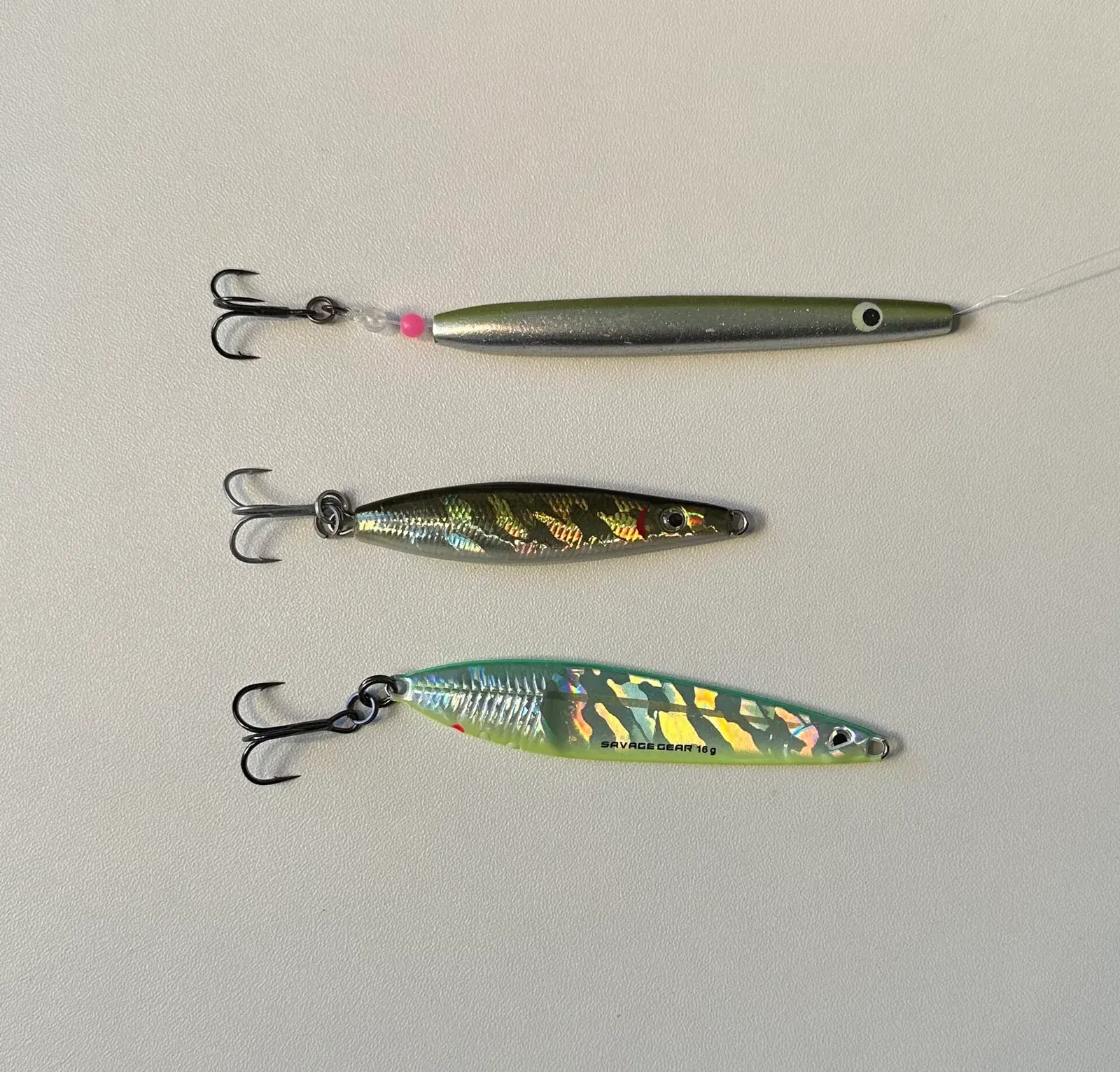 Trout Lures: Spinners, Spoons, Jigs and Minnows, and How to Fish Each
Trout lures come in five types: inline spinners, spoons, micro jigs, sinking minnows and jerkbaits, mostly 1/64–1/4 oz. Sizes by trout, colors by water.
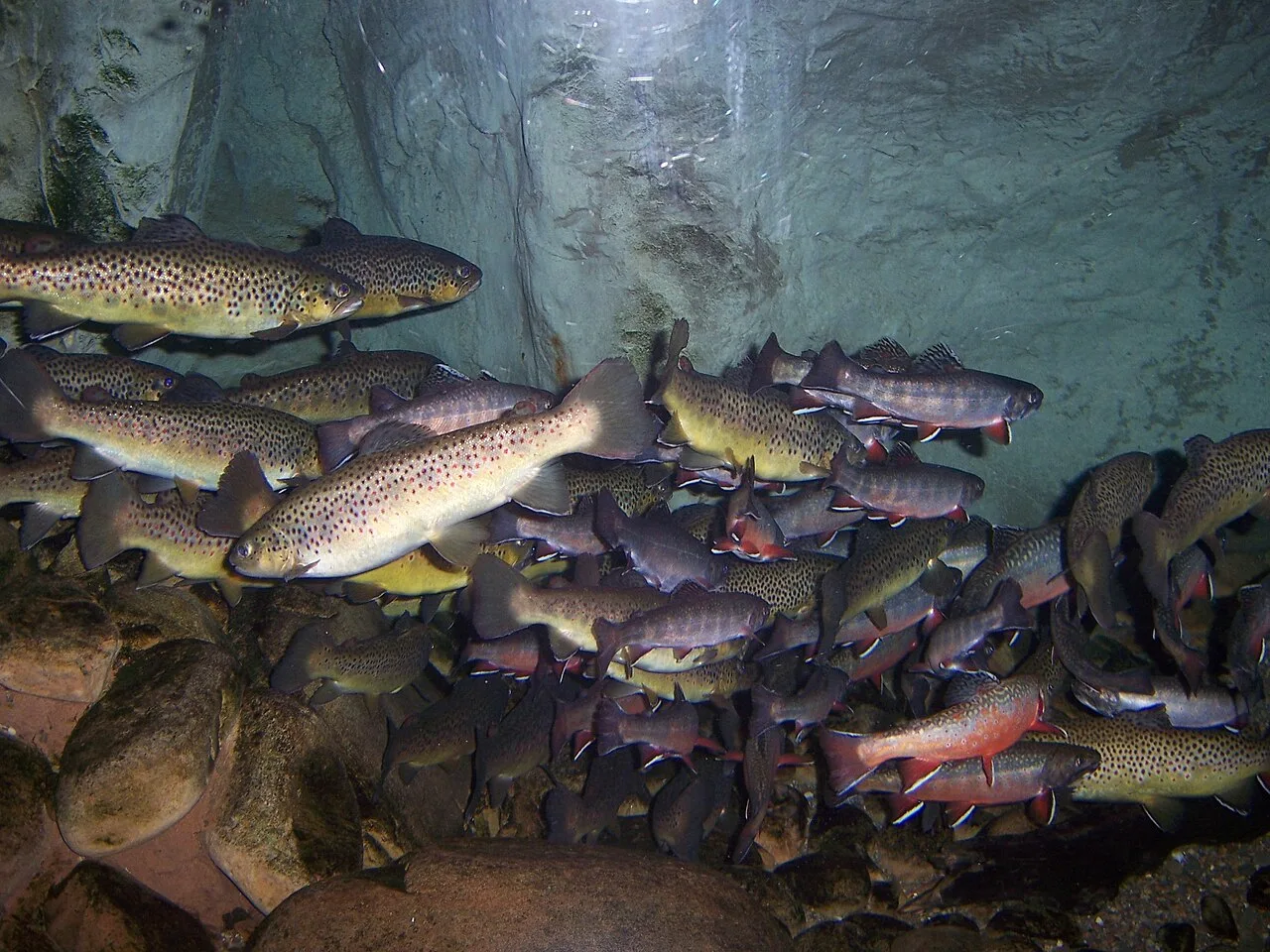 Types of Trout: Every US Trout and Char and How to Tell Them Apart
The types of trout in the US, rainbow and brown to bull trout and Arctic char: the group each belongs to, where it is native, and the one mark that IDs it.
Sources
- Alaska Department of Fish and Game, Arctic Char Species Profile
- Maine Department of Inland Fisheries and Wildlife, Arctic Charr
- Maine IFW, Arctic Charr Management Plan (Frank O. Frost, November 2001)
- IGFA World Record Search, Char, Arctic (and Dolly Varden, bull trout, lake trout, brook trout)
- Alaska Department of Fish and Game, Trophy Fish Program (record holders)
- ADF&G, 2026 Southwest Alaska Sport Fishing Regulations Summary, Bristol Bay
- Maine IFW, Special Fishing Laws (law book by water)
- Bangor Daily News, Arctic charr conservation proposal (July 6, 2023)
- Bangor Daily News, Young angler hooks record Arctic char (September 12, 2008)
- Lake Sunapee Protective Association, A Brief History of Lake Sunapee Fish
- Plummer's Arctic Lodges, Arctic Char Fishing (Tree River)
- Oregon Department of Fish and Wildlife, Bull trout identification guide
- Seafood Watch, Arctic char recommendations
- Monterey Bay Aquarium, Arctic char
- Ontario Ministry of Agriculture, Food and Agribusiness, Species profiles for aquaculture: Arctic char
- City Fish Market, About Arctic Char: Facts, Cooking Tips and Simple Recipe Ideas
- FishBase, Salvelinus alpinus, Arctic char