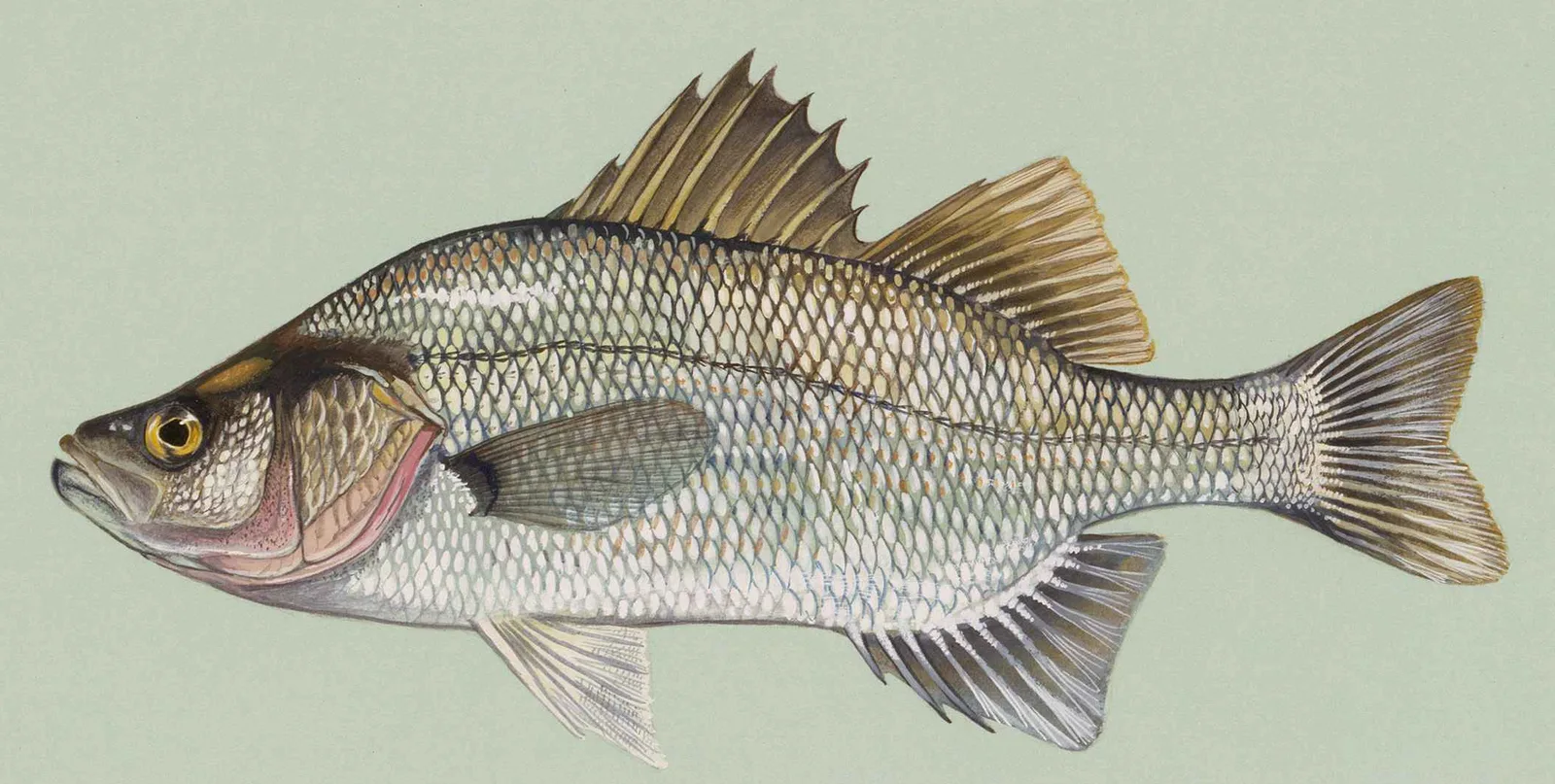
The white perch is not a perch but a temperate bass, a small cousin of the striped bass, and a typical one runs 7–10 in (18–25 cm) and rarely tops a pound. It is native to the Atlantic estuaries from Quebec to South Carolina. Across the Great Lakes and the Midwest it is an invader that eats walleye eggs by the stomachful. Maryland and Ohio set no bag limit on it at all.
For more than 20 years the “world record” white perch, 4 lb 12 oz from Maine’s Messalonskee Lake, sat in the Maine State Museum. When biologists finally opened the case, around 2002, the mount was a white perch in the front and a largemouth bass in the back.
How do you tell a white perch from a yellow perch or a white bass?
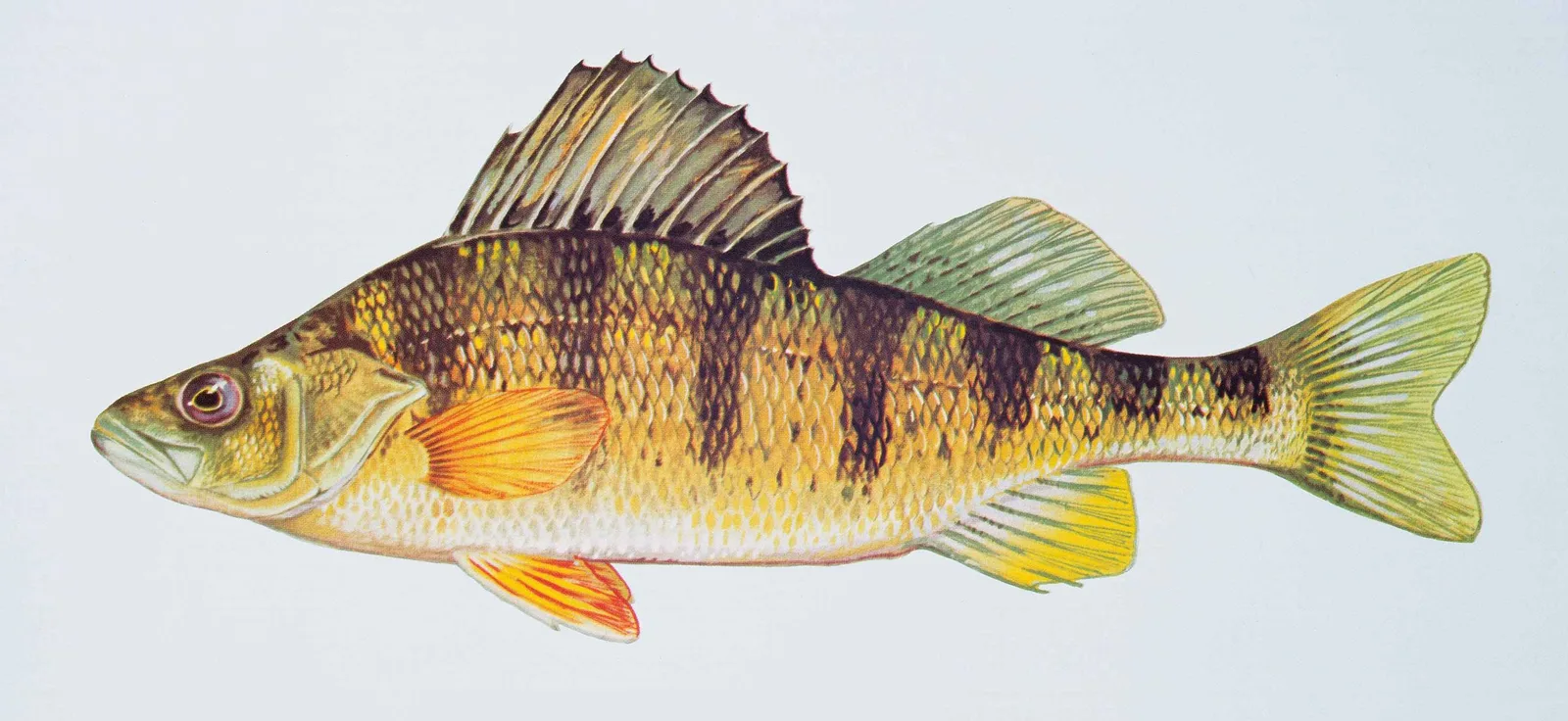
Three counts settle it on the boat. Stripes: a white perch has none. Dorsal fins: a white perch’s two fins are joined by a deep notch, where a yellow perch and a white bass carry two separate fins. Anal spines: three on a white perch, not stair-stepped; two on a yellow perch; three on a white bass, stair-stepped, the second about two-thirds the length of the third.
| Mark | White perch | Yellow perch | White bass |
|---|---|---|---|
| Stripes or bars | None on adults | 6–8 dark vertical bars | Faint dark horizontal lines; one reaches the tail |
| Dorsal fins | Two, joined by a deep notch | Two, separate | Two, separate |
| Anal fin | 3 spines, not stair-stepped; 9–10 rays | 2 spines, 7–8 rays | 3 spines, stair-stepped; more than 10 rays |
| Body | Deepest ahead of the spiny dorsal; domed back, lower jaw projects | About 3.5 times as long as deep; hump behind the eyes | Deepest under the spiny dorsal; strongly arched back |
| Color | Gray-green back, silver sides, white belly; bluish lower jaw in clear water | Yellow to brassy green; yellow to red lower fins | Silver, dark gray back, white belly |
| Typical size | 7–10 in (18–25 cm), rarely 1 lb (0.5 kg) | 6–10 in (15–25 cm); 12 in and up a jumbo | 9–15 in (23–38 cm), ¼–1¼ lb (0.1–0.6 kg) |
USGS calls the two “visually quite similar” and settles it on the anal rays, where the body is deepest, and the lines.
In Lake Erie the answer can be “both”. White perch × white bass hybrids turned up in the western basin in the early 1980s, the first naturally occurring Morone hybrid ever recorded. Because they backcross with both parents, they dilute the gene pool of each. In the Illinois River, white perch have crossed with yellow bass since 2000. A fish with faint, broken lines and a shallow notch may be neither species. The full key against the striper and the hybrid is on the white bass page; the yellow perch page covers the true perch.
Across the South, “white perch” is also a name for both crappies, and in north Louisiana the usual one, but crappie are sunfish. A crappie has 5–8 dorsal spines and a papery mouth; the Morone white perch has a small mouth, a domed back and the build of a miniature striper.
Where do white perch live?
The native range is the Atlantic slope from the St. Lawrence and Lake Ontario south to the Pee Dee River in South Carolina. The fish lives in fresh, brackish and coastal water, and it is semi-anadromous: it runs from the saltier bays up into the fresher reaches of rivers to spawn. In the Chesapeake each river seems to hold its own population, and a fish spends its whole life in the bay and its tidal tributaries. IGFA says it is most abundant in the Hudson and the Chesapeake. Maine’s inland lakes hold native white perch too. Adults prefer open water with little cover over sand, silt or mud.
Everything west of that is an invasion.
| Year | Where | What happened |
|---|---|---|
| 1950 | Cross Lake, central New York | First Great Lakes-basin record, after the fish moved through the Erie Barge Canal from the Hudson and Mohawk |
| 1953 | Lake Erie | First record, by way of the Welland Canal from Lake Ontario |
| 1964 | Nebraska | Fry raised from New Jersey stock escaped a hatchery into a reservoir with access to the Missouri River |
| 1974–75 | Western Lake Erie | 3 confirmed fish in 1974, then 34 in 1975; Busch, Davies and Nepszy declared the species established |
| 1977 | Lake St. Clair | First record |
| Early 1980s | Western Lake Erie | White perch × white bass hybrids first noted, as white perch numbers climbed |
| 1986 | Duluth Harbor, Lake Superior | First record; likely a separate introduction, possibly by ballast water, a year before Lake Huron |
| 1987 | Lake Huron | First record |
| 1988 | Lake Michigan | Green Bay and the Fox River in May, Chicago in September |
The Nebraska escape is the textbook case of what a white perch does to new water. In one southeast Nebraska reservoir the fish matured one to two years sooner than in its home estuaries. Within three years the population had flipped from 74% black bullhead to 70% white perch. Then it stunted.
USGS lists the species as established outside its native range in 15 states, from Nebraska and Minnesota to North Carolina. The Fish & Wildlife Service’s January 2026 risk screening rates both its history of invasiveness and its overall risk “High”. Nebraska ranks it a Category 2 priority aquatic invasive species.
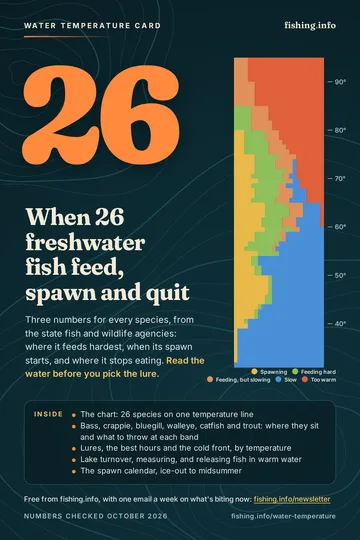
Free card: what 26 species do at your water temperature
Plus one email a week on what's biting now. No sales pitches. Privacy.
When is the best time to catch white perch?
White perch spawn in spring at 50–61 °F (10–16 °C) in estuaries and at 59–68 °F (15–20 °C) in landlocked lakes. Chesapeake runs begin when the water starts to warm in late March, and the fish push up the tidal rivers into fresh or barely brackish water. Lake fish move from deep water to the shallows and, says the federal risk screening, “may show no preference for habitat.” Wired2Fish’s feature is about winter, when white perch “will keep your line tight throughout the winter doldrums.”
Spawning lasts 10–21 days, and a female spawns more than once. The eggs are adhesive, broadcast over sand and left; there is no nest and no care. The water temperature chart puts these numbers beside the walleye and white bass whose eggs the white perch eats.
How to catch white perch
On the Chesapeake, FishTalk’s John Unkart fishes the spring push up the tributaries at 50–60 °F (10–16 °C). Early on he fishes bloodworms, clam, peeler crab and, his first choice, minnows on the bottom. As the water warms he moves to Mepps #2 spinners, shad darts, small bucktails and a spinner-jig tipped with a minnow. For fish holding deep, a Sabiki rig with its string of small hooks finds the school. Four-pound mono or 10-lb braid is plenty.
In the tidal creeks of the Northeast, the Long Island tackle-shop anglers in a Wired2Fish feature fish the outgoing tide at the dams of ponds that drain to salt water. The ebb flushes forage into the deep holes of the canals below, and the perch sit there. Their baits: a 2.75 in soft jerkbait in white or a shiner pattern on a 1/16–1/8 oz head, a small marabou jig in white or hot pink, or grass shrimp deadsticked with a split shot. They fish 5-lb braid with a 4–6 lb fluorocarbon leader, cast upcurrent and work the bait along the bottom.
In lakes the white perch roams open water. Paul Mueller, a Bassmaster Elite pro who guides on Candlewood Lake in Connecticut, says the young-of-the-year alewife decide everything. His approach: match them with a 2.5 in crappie fluke, add glow to the plastic and the jighead, fish cloudy days, dawn and dusk, and use forward-facing sonar to find the schools around bait. His line on the species: “Whites aren’t like yellows or crappies. They attack a bait a lot faster.”
New York’s DEC agrees: “once located, [white perch] can provide a lot of action” on jigs, worms and minnows. Handle them like a walleye. The gill plates are sharp and the fins are all spine.
How big do white perch get?
Size depends on water and crowding more than on years. In Maine a six-year-old white perch can be anywhere from 6 to 12 in (15–30 cm) long. The average Maine fish of 8–10 in weighs about 0.45 lb (0.2 kg) and is about four years old. The Fish & Wildlife Service puts the ceiling at 19.5 in (49.5 cm), 4.9 lb (2.2 kg) and an age of 16; the Chesapeake Bay Program has aged fish to 17.
Wired2Fish’s Long Island feature draws the line anglers see. Tidal fish average 8–14 in, and 16 in is a big one; landlocked fish stunt at 6–8 in, and 14 in is a trophy. The stunting has a mechanism. A female sheds 20,000 to 457,000 eggs, and the fish matures at one to four years, sooner still in a new reservoir. So a pond fills with white perch faster than anything can eat them, and the whole population stalls at hand size.
The record that was a largemouth
For decades the world record was a 4 lb 12 oz fish from Messalonskee Lake, Maine, caught by Dorathea A. Small of Waterville in the late 1940s. It sat in the Maine State Museum under a “World’s Record White Perch” label. Around 2002 a curator grew suspicious and called the state’s biologists. Out of its Plexiglas box, the Associated Press reported, the mount “resembled a white perch in the front and a largemouth bass in the back.”
Largemouth were rare in central Maine then; the taxidermist had been told it was a perch and made it look like one. The fish was 55% heavier than any white perch weighed before or since. The record passed to a 3 lb 1 oz fish caught by Edward Tango in New Jersey in 1989.
The IGFA all-tackle record today is 3 lb 8 oz (1.59 kg), caught by Val Percuoco in Wachusett Reservoir, Massachusetts, on October 16, 2016. It was 18 in (46 cm) long with a 13.5 in girth, 3 oz over the 1994 state record it replaced. The IGFA length record is 13.8 in (35 cm), from Lake Winnipesaukee, New Hampshire, 2014.
| Record | Weight | Where and when |
|---|---|---|
| IGFA all-tackle | 3 lb 8 oz (1.59 kg) | Wachusett Reservoir, Massachusetts, October 2016 |
| New York | 3 lb 4 oz (1.47 kg) | Cross River Reservoir, November 2025, 3 oz over a 1991 record |
| Maryland (Chesapeake) | 2 lb 10 oz (1.19 kg) | Dundee Creek, 1979 |
| Wisconsin | 1 lb 9.6 oz (0.73 kg), 13.75 in | Green Bay, November 2023 |
The Wisconsin line is the invasion in one row: a state record for a fish that did not exist in Green Bay before May 1988.
Can you keep them, and are they good to eat?
Where the white perch is native, the rules are loose. Maryland’s 2026 tidal rules: season open year round, no daily creel limit, and no minimum size for hook and line; the 8 in minimum applies only to other gear. Where it is invasive, the rules split. Ohio’s Lake Erie limits table does not mention white perch at all, though Ohio bans possessing one alive. In Minnesota and Indiana it is unlawful even to possess a white perch.
Mueller calls white perch “the closest thing to eating striped bass” from fresh water: firm, flaky, with a red-meat line near the skin to trim off. The catch is where it swims. In Lake Erie, white perch carry the algal toxin microcystin at about 37 ng/g of flesh, second only to walleye at 71 and far above yellow perch at 8.1.
On the Hudson from the Rip Van Winkle Bridge at Catskill to the Battery, New York’s health department limits white perch to one meal a month for everyone, for PCBs. Yellow perch from the same stretch may be eaten four times a month by the general population. Maryland’s environment department posts PCB advisories river by river; its 2024 advisory holds white perch from the Patapsco River and Baltimore Harbor to one meal a month for everyone. A white perch from a clean tidal creek in spring is a fish fry; one from an industrial harbor is a question to look up first.
Why do biologists call it a problem?
The case against it is written in walleye eggs. Schaeffer and Margraf’s three-year study of western Lake Erie, published in 1987, found that walleye or white bass eggs can make up 100% of the white perch’s diet, depending on which is spawning. Eggs were the only significant food adults ate in two of the three years. They were eaten for an unusually long stretch, in large volumes per fish, and most fish were feeding. The collapse of the walleye fishery in the Bay of Quinte on Lake Ontario coincided with the rise of white perch there. White perch also eat their own eggs and feed heavily on shiners.
Its diet is highly opportunistic: macroinvertebrates, crustaceans, small fish and, in spring, eggs. The Chesapeake Bay Program lists small fish, insects, and fish eggs and larvae.
Between spawns it competes. Parrish and Margraf (1990) called the diet overlap with yellow perch “considerable” and, in one sample, found white perch eating 27% more food than the yellow perch beside them. Yellow perch growth in the western basin has slowed since the invasion. In the central basin a large part of the diet is zooplankton, with a taste for the spiny water flea, another invader.
Why is it called a perch?
The perches (Perca) are the walleye’s family. The white perch, Morone americana, belongs to the Moronidae, the temperate basses, with the striped bass, the white bass and the yellow bass. IGFA calls it “not a true perch”. Ocean perch is no relative either; NOAA Fisheries lists it as a rockfish, the Acadian redfish. The old names are more honest: narrow-mouthed bass, sea perch, silver perch, in Nebraska gray perch or blue-nose perch, and among Northeast anglers silver bass. The perch page lists every fish anglers call perch, and the panfish hub sets them beside the sunfish and crappies.
Free download
The water temperature card
Read your water temperature and the card tells you who is spawning, who is feeding and what to throw. 26 species, 16 pages, for your phone and the tackle box.
Plus one email a week on what's biting now. No sales pitches. Privacy.
Related
Section guide
Panfish: Which Fish Count and How to Tell Them ApartPanfish are bluegill, the sunfish, crappie and yellow perch. Tell 9 sunfish apart by the ear flap, plus records and limits from 50 a day to none in Texas.
 Bream Fish: What Southern Anglers Mean, and Which Bream You Have
In the South a bream is any sunfish, the bluegill first. In Europe it is a carp relative, on a menu a sea bream. How to tell which bream you have.
 Perch Fish: What a True Perch Is, and Which Perch Are Not
A true perch is one of three Perca species. White perch, ocean perch, Nile perch and surfperch borrow the name: what each really is, and the records.
 Perch Fishing: Where to Find Them, the Rigs That Work, and When They Bite
How to catch yellow perch: where the schools sit each season, the spreader and jig rigs, how far off the bottom to fish, the bait, and the ice.
 Rock Bass: How to Identify, Find and Catch the Goggle-Eye
How to tell a rock bass from a warmouth or a smallmouth, where it lives, what it bites, how big it gets and the 3 lb world record that is a tie.
 Bluegill: How to Identify It, How Big It Gets and How It Spawns
How to identify a bluegill, how old an 8- or 10-inch fish is, why a pound is a trophy, the 4 lb 12 oz record and the sneaker males on the beds.
 Yellow Perch: Identification, Size by Age, and the 1865 Record
Yellow perch (Perca flavescens): how to tell it from walleye, how old a 10-inch perch is, whether it is a bottom feeder, and the 1865 record.
Sources
- USGS Nonindigenous Aquatic Species, white perch (Morone americana) fact sheet
- USGS Nonindigenous Aquatic Species, white perch in the Great Lakes
- U.S. Fish & Wildlife Service, Ecological Risk Screening Summary: white perch (January 2026)
- Busch, Davies & Nepszy (1977), Establishment of white perch in Lake Erie
- Maine Department of Inland Fisheries & Wildlife, white perch
- Chesapeake Bay Program field guide, white perch
- Nebraska Invasive Species Council, white perch
- Texas Parks & Wildlife, white bass (anal spine and stripe marks)
- Iowa DNR, yellow perch (fin counts)
- Wisconsin DNR, Yellow Perch (PUB-FM-711): bars, body depth, fin color
- Texas Parks & Wildlife, bass identification key (white bass: only one stripe reaches the tail)
- Missouri Department of Conservation, white bass field guide (arched back, size)
- Jerald Horst, LSU AgCenter and Louisiana Sea Grant, Sack of Milk (the crappie names in Louisiana)
- Texas Parks and Wildlife, white crappie (other names: white perch, sac-a-lait)
- Mississippi Wildlife, Fisheries & Parks, black crappie (also called white perch in the South)
- IGFA world records, white perch
- Associated Press via Rutland Herald, Record perch was a largemouth
- On The Water, new Massachusetts state record white perch (2016)
- New York DEC, new state record white perch (December 2025)
- Wisconsin DNR, state record fish, hook and line
- Maryland 2026 Chesapeake Bay seasons, sizes and limits (eRegulations)
- Ohio DNR, Ohio Fishing Regulations 2026–2027
- New York State Department of Health, Hudson River fish advisories
- Maryland Department of the Environment, Baltimore Harbor fish consumption advisory (2024)
- NOAA Fisheries, Acadian redfish (ocean perch)
- FishTalk, Fishing for White Perch (John Unkart)
- Wired2Fish, White Perch: America's Most Underrated Panfish (January 2025)