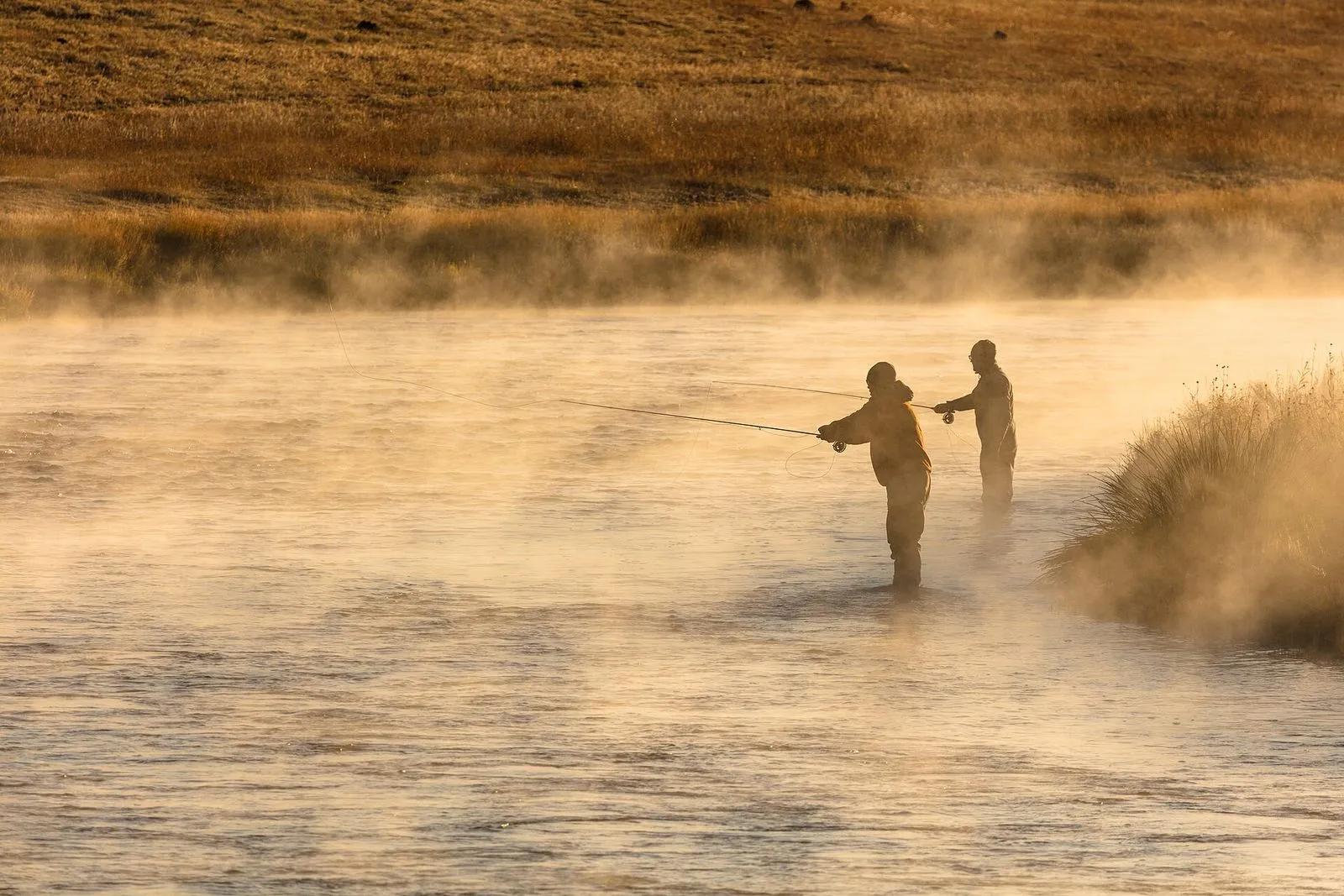
The best time of day to fish is the first hour of light and the last one, for almost every species an American angler chases. Bass, walleye, crappie and trout peak at dawn and dusk; catfish take over after dark; pike, bluegill and perch keep office hours. The reason is light. Twilight changes who can see whom, shakes baitfish out of their schools, and in summer brings the coolest water of the day.
In McMahon and Holanov’s tanks, largemouth bass caught their prey more than 95% of the time from dim daylight all the way down to moonlight. By starlight the success rate fell to 62%. In total darkness it was about zero.
When does each species bite?
Read the table as odds, not rules. “Best” is when the studies find the species most active or feeding hardest; “off” is when it rests.
| Species | Dawn | Midday | Dusk | Night |
|---|---|---|---|---|
| Largemouth bass | best | slow | best | good |
| Smallmouth bass | best | fair | best | slow |
| Walleye | good | slow | best | best |
| Channel catfish | fair | slow | good | best |
| Flathead catfish | off | off | fair | best |
| Crappie | best | slow | good | good |
| Brown trout | good | slow | best | good |
| Rainbow trout | good | fair | best | slow |
| Northern pike | good | good | good | slow |
| Bluegill | good | best | good | off |
| Yellow perch | good | best | good | off |
The reason behind each row, and who measured it:
| Species | Why |
|---|---|
| Largemouth | Rests offshore by day, forages inshore at dusk and night, most mobile at dawn (Sammons & Maceina 2005); needs moonlight to catch prey (McMahon & Holanov 1995) |
| Smallmouth | Sight feeder that rests at night outside the spawn; nest-guarding males stay on duty around the clock (Reebs 2002) |
| Walleye | The tapetum lucidum trades sharpness for low-light sensitivity; feeds by day only at depth or in turbid water (Keyler 2026; Reebs 2002; Iowa DNR) |
| Channel catfish | Feeds by taste, mostly sunset to midnight; 27 tagged Wabash fish moved most at night in all four seasons (Kruckman 2016; Minnesota DNR) |
| Flathead | Moves from about 9 p.m. to 5 a.m. and stops at sunrise (American Midland Naturalist 2006) |
| Crappie | Stomachs fullest late at night and early in the morning on five 24-hour sampling dates (Schneider, Ohio State) |
| Brown trout | Most active at dusk in every season; dominant fish take the dusk-to-dawn shift (Ovidio 2002; Alanärä 2001) |
| Rainbow trout | Crepuscular in Reebs’s review, with a wider daytime window than browns; heat limit on the trout temperature page |
| Pike | More active by day than at night, summer and winter (Baktoft 2012), with dawn and dusk peaks on top (Toronto 2026) |
| Bluegill | Tracks lights-on and shelters at night (Beitinger 1975, in Reebs 2002) |
| Yellow perch | Schools break up at dusk; the fish rest on the bottom until first light (Helfman 1979) |
Why are dawn and dusk better than midday?
Three things happen at the edges of the day, and they stack.
The first is the light handover. Timed on perch and bass, twilight is a changeover of roughly 30 minutes in which the daytime fish stop and the night fish start. Yellow perch schools break up at dusk in a fixed sequence and settle on the bottom. Prey that spent the day in tight schools is loose. A predator that sees better in low light than its prey gets half an hour of easy meals.
The second is movement. Largemouth tracked by telemetry in Lake Seminole rested offshore near wood by day. At dusk and through the night they moved inshore to forage, and they were most mobile of all at dawn. A 2026 accelerometry study in Toronto found the same dawn-and-dusk peaks in largemouth and pike. A moving fish is a fish that meets your lure.
The third is temperature, and it only counts in summer. Water is coolest just before sunrise and warmest in late afternoon. Above about 85 °F (29 °C) a largemouth feeds in short bursts at the edges of the day; the water temperature pages carry the bands per species.
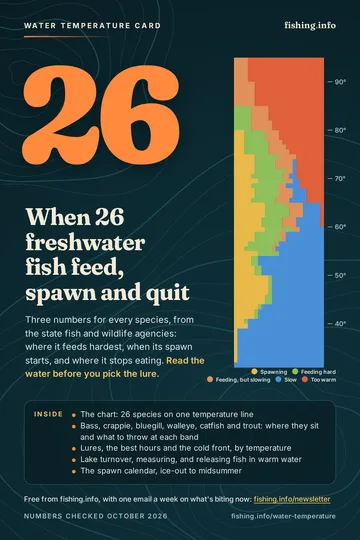
Free card: what 26 species do at your water temperature
Plus one email a week on what's biting now. No sales pitches. Privacy.
How do you plan a day around the light?
Seven decisions, in the order they come up:
- Pick the species before the hour. Catfish, walleye and big browns mean an evening trip. Bass, crappie and trout mean an alarm clock. Pike, bluegill and perch fit a working day.
- Read the water temperature. Largemouth above 85 °F (29 °C): fish dawn and a moonlit night, skip the middle. Any species below 50 °F (10 °C): fish 1 p.m. to dusk, when the water is warmest.
- Read the clarity. Clear water sharpens the dawn and dusk peaks. Stained water flattens them; a midday bite is real there, and night walleye will be in the top 6 ft (1.9 m).
- Read the sky and the wind. Cloud and a chop act like dusk, so a gray, windy noon fishes like early evening. A bright, calm noon in summer is the hour to eat lunch.
- Check the moon before a night trip for bass. Bass hunt by sight down to moonlight and no further, so a full or near-full moon is the night to go. Catfish and walleye do not care.
- Be in position before the light changes. The twilight changeover lasts about 30 minutes. Arriving at sunrise means arriving after dawn.
- Fish the edge of the light, not the clock. Shade lines, drop-offs and turbid inflows give a fish its twilight at any hour. When the hour is wrong, find the light that is right. The rest of the conditions guide covers pressure, moon, rain and fronts the same way.
Do fish bite at night?
Yes, and for four species night is the best shift of the day.
Catfish are first. A channel catfish finds food by taste, through the barbels and the skin, so darkness costs it nothing. State agencies from Minnesota to Florida put its feeding window at sunset to midnight, and tagged Wabash River fish moved most at night in every season. Randolph and Clemens found the biggest channel cats hitting the feeder in late afternoon and early night. Flatheads are stricter: on the move from about 9 p.m. to 5 a.m., then parked at sunrise. The catfish temperature page has the bands that switch them on.
Walleye are second, and the reason is anatomy. A 2026 study measured the walleye’s night vision: peak sensitivity at 500–550 nm, the blue-green of moonlit water, thanks to the tapetum lucidum behind the retina. The trade is sharpness. The same paper modeled how deep a walleye can still hunt by moonlight: 36 ft (11 m) in clear water, 6 ft (1.9 m) in turbid water. In a clear lake, night walleye can be deep; in a muddy river, they will be shallow.
Big brown trout are third. The dominant browns feed from dusk to dawn while the small fish get the daylight. Below 46–50 °F (8–10 °C), Heggenes found the whole population turning nocturnal. A winter night is brown trout time.
Summer bass are fourth, with a footnote. Warm water holds less oxygen: about 10 mg/L at 60 °F (16 °C) against about 7 in the low 90s (33 °C). BassResource and BassForecast report bass moving after dark from 15–25 ft (4.6–7.6 m) up to 4–8 ft (1.2–2.4 m); that is a magazine account, not a study.
The study is McMahon and Holanov’s: bass need moonlight, not starlight, to hunt. Their night-feeding depth ran 5–43 ft (1.6–13 m) under a full moon, against 18–144 ft (5.5–44 m) by day. Fish a bright moon, shallow, with a black topwater that shows against the sky.
When is midday fine, and when should you stay home?
The worst hour is a bright, calm, summer midday over clear, shallow water. The light is flat and full, the water is at its warmest, and the day fish have finished their morning. Largemouth are resting near wood offshore; walleye are deep or done.
Midday is a good hour in four cases, and each removes a reason from that list:
- Stained or turbid water. Turbidity does the work of dusk all day. Walleye feed by day in turbid water, and their moonlight depth drops from 36 ft to 6 ft, so the shallow bite runs on the clock rather than the sun.
- Deep structure. Light fades with depth. A walleye on a 30 ft (9 m) hump at noon sits in the light it likes at dusk on a 10 ft (3 m) flat.
- Winter afternoons. The warmest water of a winter day comes mid-afternoon, and a cold fish eats when it is warmest. Wild largemouth tracked through the winter kept slow-swimming and probably feeding a little the whole time.
- Pike, bluegill and perch. These are day fish. Tracked pike were more active by day than at night in both summer and winter, and perch rest on the bottom after dusk. Noon is their hour.
How do the seasons move the windows?
The table is the summer and fall picture, when the light edges are sharp. The seasons bend it.
In spring the windows widen. Brown trout tracked in a small stream were most active at dusk in every season. Their activity spread across the day in spring and summer and narrowed to twilight in autumn and winter. Spawning bass, perch and sunfish drop the daily rhythm altogether while they guard nests.
In summer the windows split to the edges and into the night. In the Lake Seminole study, largemouth night movement rose with the heat. Flathead activity jumps once the water passes 64–67 °F (17.8–19.6 °C).
In fall the bite tightens back to dawn and dusk, and the day fish, pike above all, keep feeding through the middle. In winter, afternoon wins for most species and night wins for brown trout below 46–50 °F. Channel catfish still move at night, but less.
Free download
The water temperature card
Read your water temperature and the card tells you who is spawning, who is feeding and what to throw. 26 species, 16 pages, for your phone and the tackle box.
Plus one email a week on what's biting now. No sales pitches. Privacy.
Related
Section guide
Fishing Weather: What Wind, Cloud, Pressure, Rain and the Moon Really Do to the BiteWhat weather is good for fishing, ranked by the evidence: light and hour first, then temperature trend, wind and cloud, the moon, and last the barometer.
 Best Barometric Pressure for Fishing: The Chart Everyone Shares, and What the Studies Say
The chart says 29.70–30.40 inHg is the best barometric pressure for fishing. A whole cold front equals 16 in of water and no study finds a feeding effect.
 Cold Front Fishing: A Day-by-Day Plan for the Front, the Bluebird Days After, and the Wind
Cold front fishing day by day: the pre-front window, why days 1–2 after run slow, what to change, and when wind helps the bite.
 Moon Phase Fishing: The Solunar Theory, the Studies That Tested It, and a Verdict for Each Phase
No moon phase reliably out-fishes another: a 1,355-hour trout test found no solunar effect. Where the moon does matter, and a verdict per phase.
 Fishing in the Rain: What Really Improves the Bite Before, During and After a Shower
Fishing in the rain works because of cloud, cooling and runoff, not the drops. Before, during and after a shower, by species, plus the lightning rule.
Sources
- McMahon, T. E. and Holanov, S. H. (1995), Foraging success of largemouth bass at different light intensities, Journal of Fish Biology 46:759–767
- Sammons, S. M. and Maceina, M. J. (2005), Activity patterns of largemouth bass in a subtropical US reservoir, Fisheries Management and Ecology 12:331–339
- Keyler, T. D. et al. (2026), Scotopic visual sensitivity of walleye, PeerJ
- Kruckman, T. (2016), Movement and habitat use of channel catfish in the Lower Wabash River, Eastern Illinois University thesis
- Seasonal and diel activity of flathead catfish, The American Midland Naturalist 155 (2006)
- Ovidio, M. et al. (2002), Seasonal variations of activity pattern of brown trout in a small stream, Hydrobiologia 470:195–202
- Alanärä, A., Burns, M. D. and Metcalfe, N. B. (2001), Intraspecific resource partitioning in brown trout: the temporal distribution of foraging is determined by social rank, Journal of Animal Ecology 70:980–986
- Helfman, G. S. (1979), Twilight activities of yellow perch, Canadian Journal of Fisheries and Aquatic Sciences 36:173–179
- Reebs, S. G. (2002), Plasticity of diel and circadian activity rhythms in fishes, Reviews in Fish Biology and Fisheries 12:349–371
- Baktoft, H. et al. (2012), Seasonal and diel effects on the activity of northern pike studied by high-resolution positional telemetry, Ecology of Freshwater Fish 21:386–394
- Animal Biotelemetry (2026), Acceleration telemetry of largemouth bass and northern pike in Toronto Harbour
- Schneider, Crappie diet and diel feeding periodicity, Ohio State University thesis
- Minnesota DNR, How to catch channel catfish
- Brownscombe, J. W. et al. (2025), Winter behaviour and energetics of largemouth bass, Canadian Journal of Fisheries and Aquatic Sciences
- Iowa DNR (2015), What's the best time of day to catch fish?