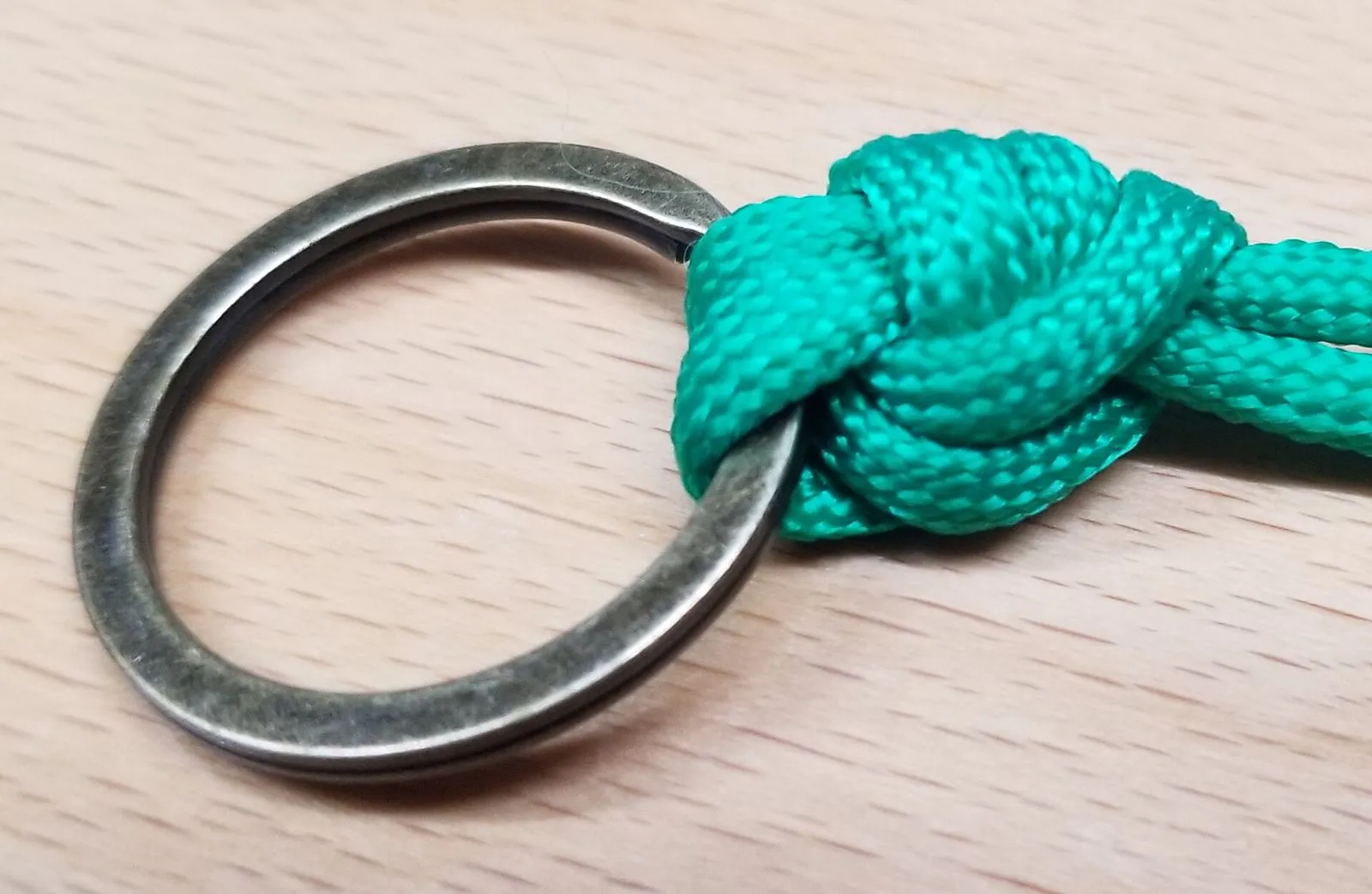
Five fishing knots cover nearly every connection on the water. The Palomar ties on a hook or lure, the uni handles braid and joins, the FG joins braid to a leader, the surgeon’s joins line to line, and a non-slip loop lets a lure swing. Which one you tie depends less on the fish than on the line on your reel.
On the IGFA’s test machine, “15 lb” braid broke at 34.4 lb. A “100 percent knot” is one that breaks at or above the label, not one that never breaks.
Which knot for which job?
Pick the row that matches the connection you are about to tie. Every knot in the table has its own page with a numbered procedure, the turns for your line and the mistakes that cost strength.
| Job | Line | Knot | Why |
|---|---|---|---|
| Hook, lure or swivel | Mono or fluorocarbon | Palomar; Trilene knot when the lure will not pass through the loop | Doubled line through the eye shares the load; first in Salt Strong’s snug-knot ranking |
| Hook, lure or swivel | Braid | Uni, or Palomar | Uni averaged 20.2 lb against 18.4 lb for a Palomar on 10 lb braid; a clinch slips |
| Lure that should swing | Mono or fluorocarbon leader | Non-slip loop or Rapala knot | A fixed loop lets a jerkbait or topwater move; 83 percent of 10 lb fluorocarbon |
| Braid to leader | Braid to fluorocarbon or mono | FG; Alberto when speed matters; double uni with five wraps a side | FG beat the Alberto five bouts out of five and is the slimmest join |
| Line to line, similar size | Mono or fluorocarbon | Blood knot; surgeon’s when speed matters | Blood knot kept 83 percent where a surgeon’s kept 65 on 10 lb line |
| Line to line, unequal size | Light mono to heavier mono | Surgeon’s, three passes | Held 13–15 lb where the double uni held 7–12 lb on 10 lb to 30 lb mono |
| Bait, circle or flipping hook | Any | Snell | The pull runs along the shank; a circle hook turns, a flipping hook kicks |
| Line to the reel spool | Mono; braid over mono backing or tape | Arbor knot | Bare braid spins on the spool whatever knot you tie |
| Wire to mono, fly line to backing | Mono, wire | Albright | The Albright’s remaining jobs; braid slips out of it |
The figures come from the three published pull-test series laid out further down, each cited with its lines on the knot page it belongs to. They are single testers’ results on named lines, not a laboratory standard, and that matters for how far you trust a percentage. Where you fish decides the rest: the bass line page sets out which line goes on which rod, and the fishing leader page covers material and length for the join.
Which five knots should you learn first?
- Palomar knot. Line to a hook, lure or swivel. Six steps, no turns to count, and it holds on mono, fluorocarbon and braid. Its one limit is that the lure has to pass through a loop of doubled line.
- Uni knot. The all-rounder: a hook knot, a sliding loop, a snell along the shank, two lines joined as the double uni, and the knot that beat the Palomar on braid.
- Surgeon’s knot. Two lines laid together and tied in a double or triple overhand. The fast line-to-line knot, and the one that tolerates unequal diameters and cold hands.
- Non-slip loop knot. Lefty Kreh’s loop leaves a jerkbait, walking bait or jig free to swing, and finishes with the tag pointing at the hook so it sheds weed.
- FG knot. Braid to a fluorocarbon or mono leader, the strongest and slimmest join you can tie without a tool. The last to learn because it needs tension on the braid the whole time.
If your reels carry monofilament, add the improved clinch, the fastest knot on nylon and the one most anglers were taught first. How to tie a fishing knot teaches the Palomar step by step, then the rest in this order, and ends with a kitchen-table pull test for checking your own hands.
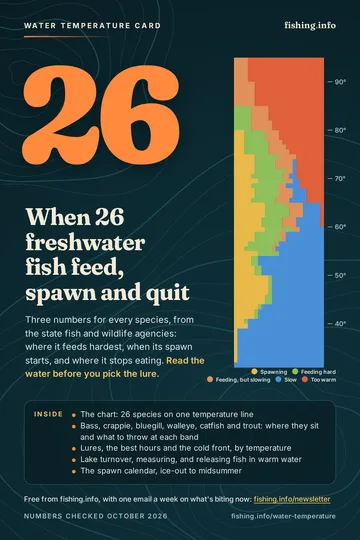
Free card: what 26 species do at your water temperature
Plus one email a week on what's biting now. No sales pitches. Privacy.
Why does the line decide the knot?
Three things decide how much strength survives a knot: the bend radius, the friction and the heat. A doubled strand or a wrap over a thicker line spreads the load at the first bend, which is why the Palomar doubles the line and the FG wraps the leader. Friction is what holds a knot together, and braid is so slick that knots relying on a few wraps simply slide apart. Heat from seating a knot dry glazes fluorocarbon and scuffs the coating on braid.
The practical rule follows from the friction. On monofilament nearly any well-tied knot holds; in Field & Stream’s test a five-turn improved clinch kept 96 percent of 10 lb mono, but only “if they were tied with extreme care”. On fluorocarbon the same knot kept 75 percent, and the Palomar and non-slip loop did better. On braid an eight-turn clinch “would not hold at all” and slipped out at about 10 lb on 14 lb line. Braid wants the uni or the Palomar at the hook, more turns than nylon, and a leader joined with a knot built to grip it.
Lines are also rated below their real break, so compare knots with each other inside one test and never with the label. The line hub compares the three materials on stretch, diameter and visibility, which is where the choice of line itself begins.
Which knot ties on a hook or lure?
The Palomar knot is the first choice on mono, fluorocarbon and braid. Chester Palomar, a Scout leader from Pomona, California, showed it at a fishing show in 1971 and DuPont adopted it for its Stren line. The line is doubled, passed through the eye, tied in a loose overhand, and the hook goes through the loop before the knot is drawn down. Salt Strong ranks it first of eight snug knots; Field & Stream measured it at 89 percent on 10 lb mono and 82 on fluorocarbon. It is awkward with a big crankbait or a lure on a pre-tied rig, because all of that has to pass through the loop.
The improved clinch knot is the classic mono knot: five turns around the standing line, back through the small loop at the eye, then through the big loop just formed. Tied with care it matches the best mono knots, and it goes through a small hook eye the doubled Palomar will not. It is not recommended above 30 lb test, and it is never a braid knot. Its cousin the Trilene knot passes the line through the eye twice first. That double pass is the version the tests treat most kindly: 96 percent on 10 lb mono, level with a careful clinch and ahead of the Palomar.
The uni knot is the knot to learn if you fish braid. A loop is laid along the standing line and the tag end wraps through it around both strands, five turns on nylon and ten on braid. Tied once it holds a hook; tied twice, back to back, it joins two lines; tied along the shank it is a snell; left loose it is a sliding loop. It was published in 1944 as the gallows knot, re-invented by Norman Duncan in the 1960s, and named by Vic Dunaway in 1970. If you have never tied a knot on a hook, how to tie a fishing knot on a hook puts these three side by side with a drawing for each.
Which knot joins braid to a leader?
The FG knot is not a knot in the usual sense. The leader is wrapped under and over a tensioned braid 12 to 15 times each way, and the braid’s coils grip it like a Chinese finger trap, locked with half hitches. The leader never doubles back, so the join is slim enough to run through the guides on a cast. In Salt Strong’s head-to-head pulls on 10 lb braid to 30 lb fluorocarbon it beat the Alberto five bouts out of five. The price is that the braid must stay tight while you wrap, so it is tied with the braid held under tension, often by bending the rod tip.
The Alberto knot is the practical alternative. The braid passes through a loop in the leader, wraps seven times up and seven times back over itself, and exits the loop. Alberto Knie, the surfcaster who built it, says the idea came from a Chinese finger-trap toy. It needs no tension trick and ties in the dark; in the same Salt Strong series it beat a 14-wrap Albright three bouts to two. The double uni knot is the easiest join of all, two uni knots slid together, and its strength hangs on the wraps. On the IGFA’s machine five wraps a side kept 55.8 percent of the braid’s real break, four wraps 40.1.
The Albright knot once did this job and has lost it. Jimmie Albright, the Islamorada guide whose name it carries, tied it for tarpon leaders in the 1950s. On braid it unravels; The Fisherman calls it “not a good connection when joining mono to gelspun”. It remains the knot for single-strand wire to mono and for fly line to backing. The braid to mono knot page sets all four joins against each other with a decision list by situation.
Which knot joins two lines of nylon?
The blood knot is the join for two mono lines of similar size: each line wraps around the other, five to seven turns a side, and the tags tuck through the center in opposite directions. Orvis calls it the best knot for sections that differ by no more than .002 in, one or two tippet sizes, which is why it builds every tapered fly leader. In Field & Stream’s test a five-turn blood knot kept 83 percent of 10 lb line where a three-turn surgeon’s kept 65. Salt Strong’s six-pull contest on 20 to 30 lb mono found it about 13 percent stronger than the double uni.
The surgeon’s knot trades a little strength for speed and tolerance. Two lines laid side by side, tied together in a double overhand, a third pass for the triple: it takes “moderately unequal” diameters, cold fingers and a rocking boat. In Salt Strong’s 2015 mono contest the three-pass surgeon’s held 13 to 15 lb and won, while the double uni held 7 to 12 and the Albright 6 to 8. Fly anglers add tippet with it; inshore guides put on a leader with it.
When does a lure need a loop knot?
A snug knot pins the lure to a fixed point. A loop knot leaves a small fixed loop in the eye, so a jerkbait darts, a walking topwater glides and a jig falls level. Lefty Kreh’s non-slip loop is the one to learn. The turns follow the line test, seven on 6 to 8 lb down to two above 60 lb, and the tag finishes pointing at the hook so it does not catch grass on the retrieve. In Field & Stream’s test it held 83 percent of 10 lb fluorocarbon, a point ahead of the Palomar. The Rapala knot is its older relative, rated a tad stronger in Salt Strong’s loop ranking, with the tag pointing back up the line where it collects more weed.
When do you snell a hook?
A snell knot wraps the leader five to eight times around the hook shank instead of tying it to the eye, so the pull runs straight down the hook. It began on hooks that had no eye at all and survives for two jobs. On a circle hook with bait, the in-line pull lets the hook rotate into the corner of the mouth, which is why it belongs with the handling advice on the catch and release page. On a straight-shank flipping hook, threaded in from the point side, the hook kicks its point outward on the hookset, which is what sent bass anglers punching mats toward it. The uni snell does the same thing with a knot you already know.
How do you tie line to the reel?
The arbor knot is two overhand knots: one in the tag around the standing line, one in the tag alone as a stopper that jams against the first on the center of the spool. It carries almost nothing once the spool is full, which is why no one has published a break test for it. Its one weakness is braid, which slips on a bare arbor however well the knot is tied. Wind on a few turns of mono backing first, or lay a strip of tape over the arbor; how to put fishing line on a reel has the backing and fill level by reel type.
What do the pull tests actually show?
Knot strength is thinner ground than most knot pages admit. No standard test exists, and only three testers have published figures together with their lines and method. Salt Strong runs mostly head-to-head bouts, two knots on one strand pulled until the weaker breaks, so each figure is the losing knot’s break. Field & Stream tied each knot to a lure and reported the result as a percentage of the line’s measured unknotted strength. Sport Fishing pulled 53 anglers’ braid-to-leader knots on the IGFA’s Instron machine, three samples each, as a percentage of the braid’s real break.
| Test | Line | Knot | Result |
|---|---|---|---|
| Field & Stream | 10 lb mono to a lure | Trilene knot; improved clinch; Palomar | 96%; 96% “with extreme care”; 89% |
| Field & Stream | 10 lb fluorocarbon to a lure | Non-slip loop; Palomar; improved clinch | 83%; 82%; 75% |
| Field & Stream | 14 lb braid to a lure | Palomar; eight-turn clinch | 63%; slipped out at about 10 lb |
| Field & Stream | 10 lb mono to 10 lb fluorocarbon | Blood knot, five turns; surgeon’s, three turns | 83%; 65% |
| Salt Strong 2020 | 10 lb braid to a swivel | Uni; Palomar | 20.2 lb average; 18.4 lb, one break |
| Salt Strong 2020 | 10 lb braid to 30 lb fluorocarbon | FG against Alberto | FG won 5–0; the Alberto broke at 8.7–14.6 lb |
| Salt Strong 2015 | 10 lb to 30 lb mono | Surgeon’s, three passes; double uni; Albright | 13–15 lb; 7–12 lb; 6–8 lb |
| Sport Fishing, IGFA machine | 15 lb braid (breaks at 34.4 lb) to 30 lb fluorocarbon | PR bobbin; improved FG; best FG | 84.3%; 80.9%; 73.4% |
| Sport Fishing, IGFA machine | same | Double uni, five wraps; four wraps | 55.8%; 40.1% |
| Sport Fishing, IGFA machine | same | Best Albright; best Alberto | 46.2%; 42.2% |
Two lessons sit in that table. The testers disagree on mono to a lure, where Salt Strong ranks the Palomar first and Field & Stream measured the Trilene knot ahead of it, and they agree everywhere else. And the hands matter almost as much as the knot: four anglers tied an FG for the same machine on the same lines, and their knots held anywhere from 49 to 73 percent. The best fishing knots page lays every published figure out by job and names each test’s conditions.
How do you keep any knot from breaking?
- Wet it before you seat it. A dry knot pulled tight heats the line. Heat glazes fluorocarbon and scuffs the coating on braid, and the knot breaks below its number.
- Seat it slowly and fully. One steady pull on the standing line until the wraps stop moving and lie side by side. Crossed wraps cut each other; a knot that seats under the weight of a fish seats in the wrong shape.
- Trim to 1/8 in (3 mm), never flush. Every knot slips a fraction as it settles, and a tag cut flush pulls through. Berkley’s braid instructions leave about 1/4 in (6 mm).
- Test it, and retie it. Give the knot a hard pull by hand before the first cast. The first inch above the knot takes every bit of the abrasion, so after a big fish, a snag or a stretch of line that feels rough, cut it off and tie again.
Where did the knots come from?
Most of them are younger than they look. The Palomar is from 1971, the uni got its name in 1970, the Albright is a 1950s Keys tarpon knot, and the non-slip loop went into Lefty Kreh’s 1972 knot book. The FG’s name is disputed between “fine grip”, “freaking good” and an unconfirmed originator, which is fitting for a knot that is really a splice. Each knot page carries its own story, the numbered procedure with the turns for your line test, and the mistakes that cost strength; start with the Palomar if you are starting from nothing.
All articles
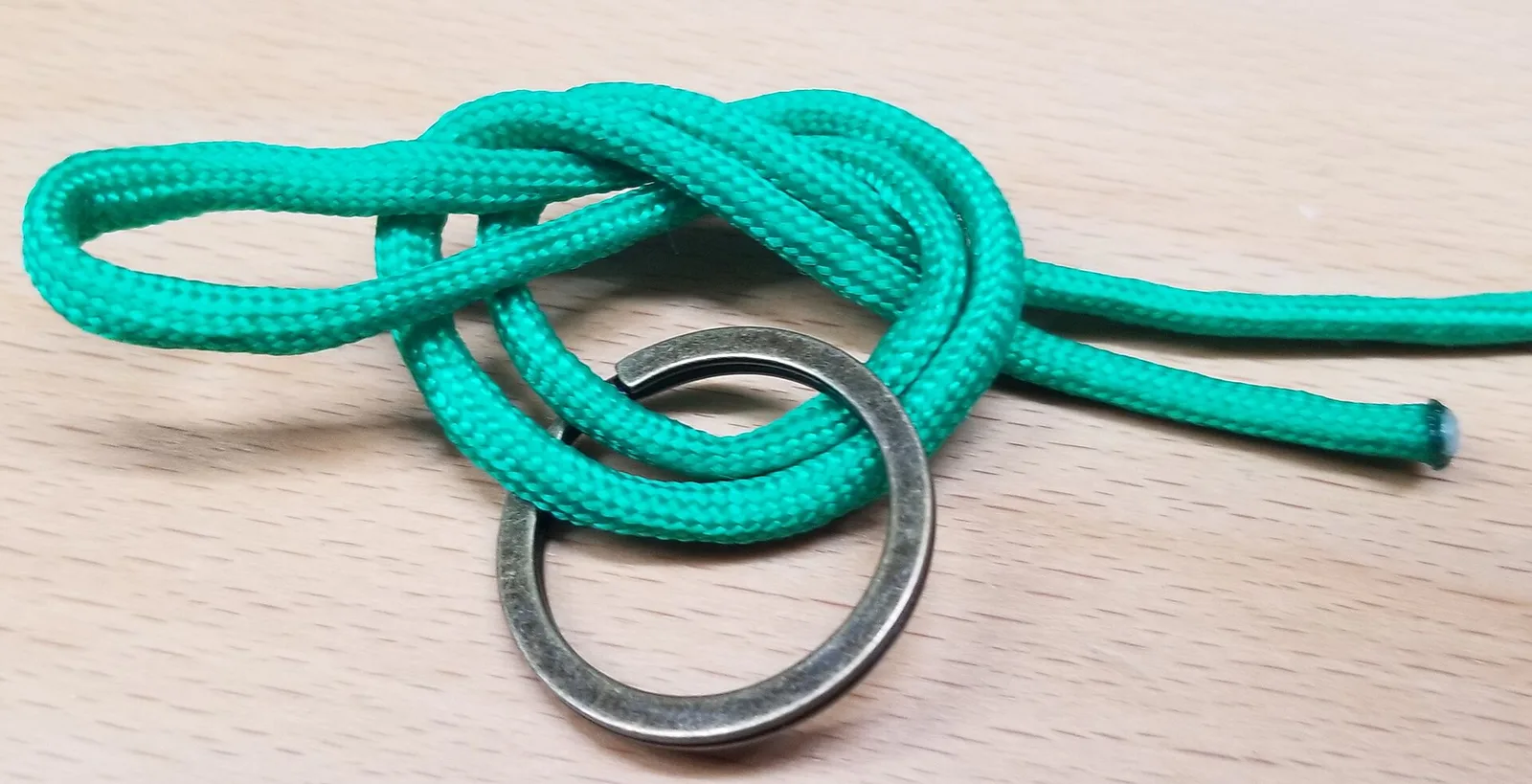 Palomar Knot: How to Tie It, How Strong It Is, When Not to Use It
The Palomar knot step by step, the pull tests behind its reputation on mono, fluorocarbon and braid, the double Palomar, and the rigs it does not suit.
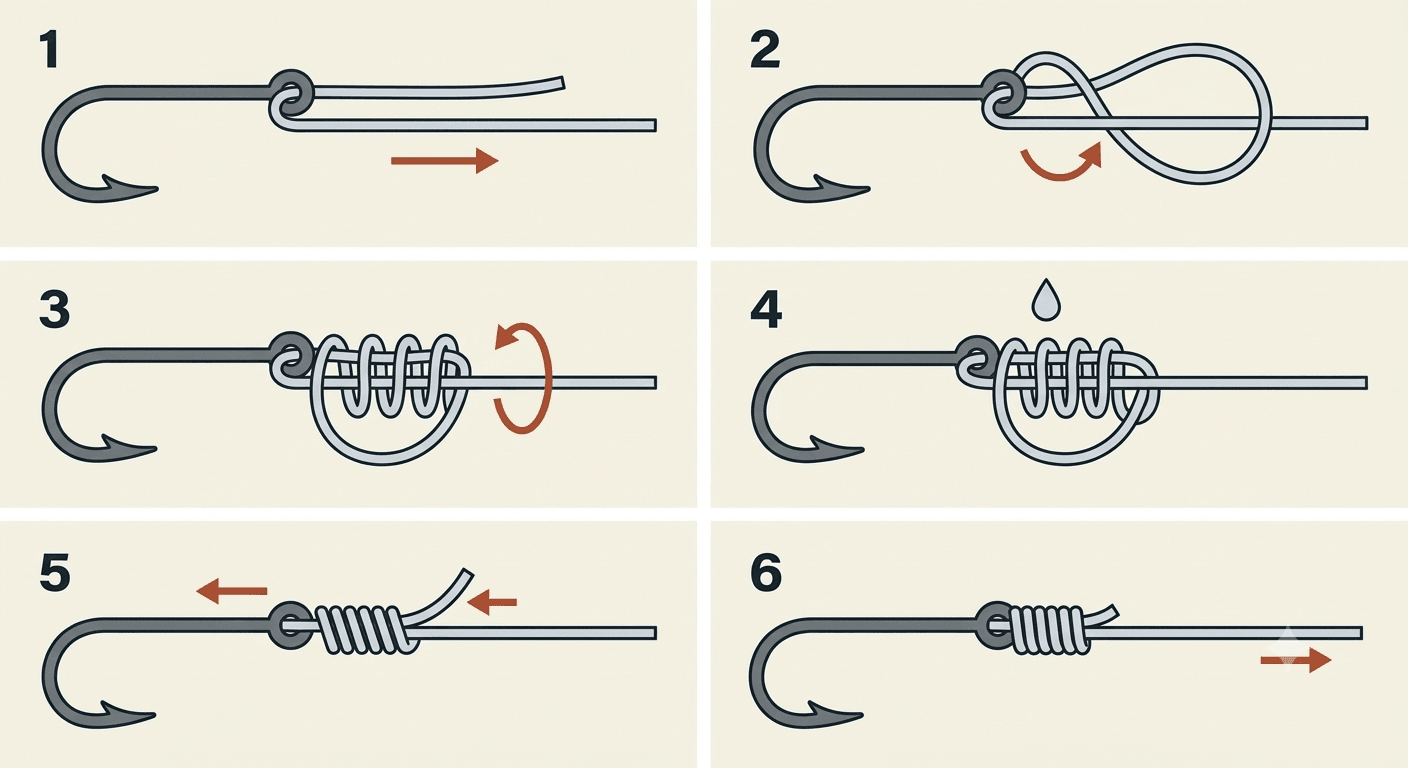 Uni Knot: One Knot for Hooks, Leaders, Snells and Loops
How to tie the uni knot in six steps, the turns for mono, fluorocarbon and braid, its six uses from hook to reel spool, and the pull tests.
Free download
The water temperature card
Read your water temperature and the card tells you who is spawning, who is feeding and what to throw. 26 species, 16 pages, for your phone and the tackle box.
Plus one email a week on what's biting now. No sales pitches. Privacy.
Sources
- Luke Simonds, The best fishing knots of all time, ranked strongest to weakest, Salt Strong (2018; order only, no pound figures)
- Luke Simonds, Palomar knot vs uni knot with braided line (strength test, 10 lb braid), Salt Strong (2020)
- Luke Simonds, The Albright vs the Alberto vs the FG knot (head-to-head pulls, 10 lb PowerPro to 30 lb Ande fluorocarbon), Salt Strong (2020)
- Luke Simonds, The strongest line-to-line fishing knot (10 lb Trilene XL to 30 lb Trilene Big Game), Salt Strong (2015)
- Luke Simonds, Uni knot vs clinch knot strength test (20 lb Ande mono, 20 lb Seaguar fluorocarbon, 10 lb PowerPro), Salt Strong (2021)
- Sean Person, Blood knot vs double uni knot (six pulls, dry and wet, 20 lb to 30 lb Ande mono), Salt Strong (2021)
- John Merwin, Tie the strongest fishing knots, Field & Stream (percent of the line's measured unknotted strength; 10 lb mono, 10 lb fluorocarbon, 14 lb braid)
- Doug Olander, Strongest fishing knots connecting braid to leader (53 knots on the IGFA's Instron 5543, mean of three breaks), Sport Fishing
- Bear Essentials Outdoors, The science of fishing knot strength (bend radius, friction, heat)
- Wikipedia, Palomar knot (Chet Palomar, 1971)
- Wikipedia, Uni knot (gallows knot 1944, Duncan loop, Vic Dunaway 1970)
- Animated Knots, Improved clinch knot (five turns, not recommended over 30 lb)
- Animated Knots, FG knot (12–15 pairs of wraps, names, tension)
- Animated Knots, Non-slip mono knot (Lefty Kreh's loop; turns by line test; tag toward the hook)
- Animated Knots, Snell knot (eyeless hooks; wraps on the shank)
- Orvis Learning Center, Blood knot (the .002 in rule; turns by diameter)
- The Fisherman, Albright knot (1950s tarpon origin; wire; slips on gelspun braid)
- Outdoor Life, How to catch a 50-pound striper from the surf (Alberto Knie; the finger-trap idea)
- Berkley, Fishing knots 101 (tag length on braid knots; the 30 lb limit for the clinch)
- Wikipedia, Arbor knot