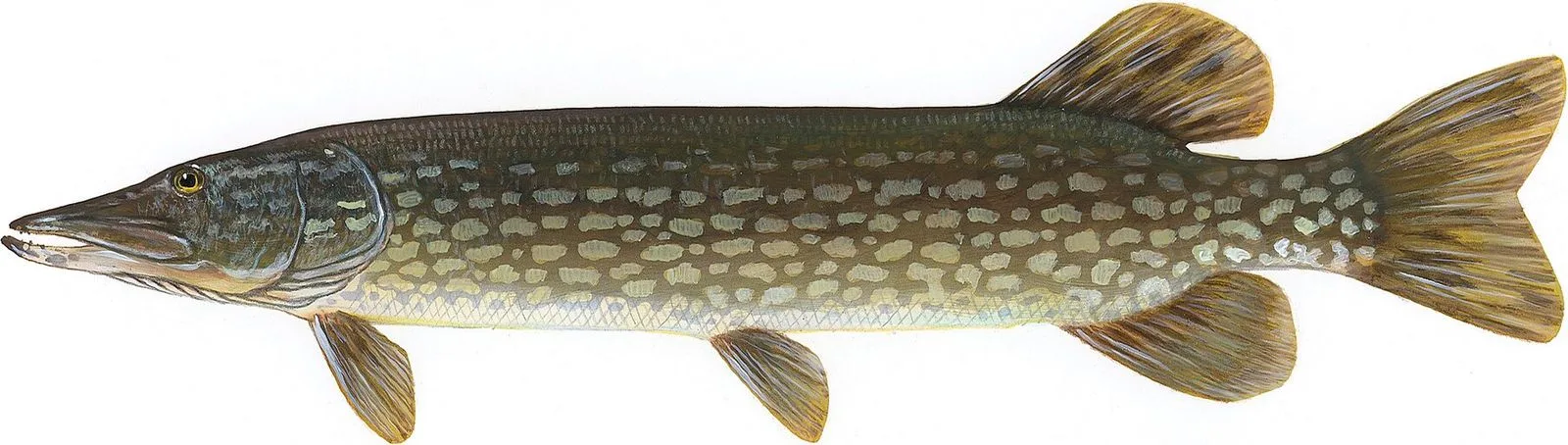
The northern pike (Esox lucius) is the pike of the whole northern world, the same fish from Minnesota to Ireland to Siberia. In American water a typical one is 18 to 30 in (46–76 cm) and 2 to 10 lb (0.9–4.5 kg), dark green with rows of pale spots, lying still in the weeds until something swims past. Below: how to tell it from a muskie, how old and how heavy a pike of any length is, what is true about its teeth, and where the big ones go when summer anglers stop catching them.
Pike do not shed their teeth in summer. In 1935 two Michigan biologists examined 188 pike through the year and found no trace of it. They suspected guides had kept the story alive as an excuse for slow August days.
Northern pike or muskie?
Three checks, in the order the agencies give them.
- Pattern. A pike has light, bean-shaped spots in rows on a dark body. A muskie is the reverse, dark marks on a light body.
- Cheek. A pike’s cheek is covered in scales; only the upper half of its gill cover is. A muskie’s cheek is scaled on the upper half only.
- Pores. Turn the fish over and count the pores under one side of the lower jaw: about five on a pike, six to nine on a muskie.
A pike’s fins and tail tips are rounded, and the fins carry dark spots or wavy lines. Young pike wear pale bars that break up into spots as they grow. The pike family page sets the pike beside the muskie, the tiger muskie and the chain pickerel in one table.
How big do northern pike get?
Wisconsin DNR puts the common catch at 18 to 20 in and about 2 lb. Ohio’s range is 20 to 30 in and 2 to 10 lb. Fish of 20 lb (9 kg) are common in some Alaskan rivers and rare almost everywhere else in the United States. European and Asian pike grow larger than American ones, which is why the world record is German.
The best age data is Michigan’s: 7,726 pike from 109 lakes, aged between 1990 and 2015.
| Age | Michigan average | Maine, fast water | Minnesota good lakes, female |
|---|---|---|---|
| 1 | 12.0 in (30 cm) | 14.3 in (36 cm) | Not given |
| 2 | 17.3 in (44 cm) | 19.3 in (49 cm) | 16.8 in (43 cm) |
| 3 | 20.7 in (53 cm) | 23.7 in (60 cm) | 21.1 in (54 cm) |
| 4 | 22.7 in (58 cm) | 27.6 in (70 cm) | 23.5 in (60 cm) |
| 5 | 24.6 in (62 cm) | 31.3 in (80 cm) | Not given |
| 7 | 28.2 in (72 cm) | Too few fish | Not given |
| 10 | 36.6 in (93 cm) | 42.0 in (107 cm) | Not given |
So an average Michigan pike reaches 24 in between ages four and five and needs about ten years to make 36 in. A new, lightly fished population grows much faster: Maine’s pike, colonizing fresh water full of food, were 31 in at five. In Alaska’s cold Interior a 25 in, 5 lb pike may be six to eight years old, and a fish over 15 lb is 10 to 17.
Crowding stunts them. Michigan’s overpopulated pike lakes hold mostly fish under 18 in.
How much does a pike weigh?
North Dakota Game and Fish publishes the average weight of its pike at every length. In-Fisherman’s chart is the standard-weight curve, which describes a well-fed fish.
| Length | Average fish (North Dakota) | Well-fed fish (standard weight) |
|---|---|---|
| 24 in (61 cm) | 3.2 lb (1.5 kg) | Not charted |
| 28 in (71 cm) | 5.1 lb (2.3 kg) | 5.4 lb (2.5 kg) |
| 30 in (76 cm) | 6.3 lb (2.9 kg) | 6.7 lb (3.1 kg) |
| 34 in (86 cm) | 9.2 lb (4.2 kg) | 9.9 lb (4.5 kg) |
| 36 in (91 cm) | 11.0 lb (5.0 kg) | 11.8 lb (5.4 kg) |
| 40 in (102 cm) | 15.2 lb (6.9 kg) | 16.4 lb (7.4 kg) |
| 44 in (112 cm) | 20.3 lb (9.2 kg) | 22.0 lb (10.0 kg) |
| 48 in (122 cm) | 26.5 lb (12.0 kg) | 28.9 lb (13.1 kg) |
A female before the spawn runs heavier than the table: she is carrying eggs. For any length in between, the fish weight calculator does the sum.
Northern pike teeth
A pike’s mouth holds hundreds of teeth, in two kinds. The big ones are the canines along the back two thirds of each lower jaw, flat-sided and knife-like. The roof of the mouth and the tongue carry short, brush-like teeth that slant backward and fold down, so prey slides in and cannot slide out.
The count of big teeth never changes. Trautman and Hubbs found about 16 canines on each side of the lower jaw in pike of 5 in and in pike of 3 ft. Teeth are replaced constantly, in every month of the year. That finding, from 188 fish, is what killed the idea that pike shed them all in late summer and stop feeding with sore gums.
For the angler it means two things. Use a wire leader; Wisconsin DNR lists one as standard pike tackle. And carry long-nosed pliers, because the unhooking is where hands get cut.
Where pike live
The northern pike has the widest range of any pike: across Canada and the northern United States, and from Ireland through Europe and Siberia to the Pacific. In the United States it is native from Alaska to Labrador and south to Pennsylvania, Missouri and Nebraska.
It is a weed fish. Minnesota DNR points to beds of aquatic plants and stumps in shallow water; Wisconsin adds marshes and weed beds when the water is cool. But the big ones have a second address. In three Minnesota lakes, tracked pike longer than 28 in (71 cm) chose water of 61 to 70 °F (16–21 °C) in August, though water of 82 °F (28 °C) was available, while small pike stayed in the warm lily pads. The upper lethal temperature is about 85 °F (29 °C). The water temperature chart puts those numbers beside 24 other species.
When pike spawn
Early: as the ice goes out. Minnesota gives April and May at 40 to 50 °F (4–10 °C); Iowa sees fish moving under the ice and spawning from 35 °F (2 °C). They run into marshes and flooded grass in water a foot deep or less, one female with one to three males, scattering a few dozen eggs at a time for an hour or more. A female of 25 to 28 in carries about 63,000 eggs; a 25 lb fish can carry a quarter of a million.
Nobody guards them. The eggs hatch in about two weeks, and Wisconsin DNR estimates that more than 99% of the young are gone by fall.
Where and when to catch pike
| Season | Where the fish are | Source |
|---|---|---|
| Ice-out | Shallow weedy bays where they spawn; the year’s best chance at a big one | Maine IFW |
| Late spring | Weed lines and flats in cool water | Maine IFW, Wisconsin DNR |
| High summer | Small pike in the weeds; big pike in the cool depths, near springs and inlets | Wisconsin DNR |
| Fall | Back in the shallows | Maine IFW |
| Winter | Under the ice, and easier to catch than in summer | Wisconsin DNR |
Pike feed by day. Wisconsin’s list for open water is short: a sturdy rod, a wire leader, spoons, and live suckers or chubs up to 8 in for those who prefer bait, and keep it moving. Alaska adds large bright spinners, diving plugs, surface lures over the weeds and a fast retrieve. A pike will follow a lure to the boat before it strikes, so fish every cast to the end.
For a big fish in July and August, In-Fisherman’s Dan Johnson quotes biologist Bruce Carlson: on a deep lake with oxygen below the thermocline, by late August virtually all the big pike are down there, in 55 to 60 °F water at 35 ft (11 m) and more.
Good to eat, and bony
Yes, with a knife trick. Pike have a row of forked Y-bones along each side. Alaska’s fish and game department notes that small pike eat better than big ones and have no more bones than other fish, only differently shaped ones, and publishes a five-fillet cut that leaves the Y-bones behind. Minnesota’s advice is the same in fewer words: eat smaller pike, and cook them fresh.
Keeping the small ones is also the right thing for the lake. On a 100-acre Minnesota lake, pike aged six and older add only about 10 lb of new growth a year. One 35 in fish in the cooler is that whole year’s production of big pike.
Trophy here, pest there
Minnesota’s northeast zone requires the release of every pike from 30 to 40 in. In Southcentral Alaska, where pike are not native, every pike caught must be killed. Check which map you are on before the trip.
The records
The IGFA all-tackle record is 55 lb 1 oz (25 kg), caught by Lothar Louis in Germany on October 16, 1986. The North American record is far older and smaller: Peter Dubuc’s 46 lb 2 oz (20.9 kg) pike from New York’s Sacandaga Reservoir, September 15, 1940. He never had it mounted. The taxidermist wanted $52.50.
Related
- Pike, muskie and pickerel: the whole family, told apart.
- Muskie: the pike’s bigger, rarer cousin.
- Yellow perch: the pike’s neighbor in northern weed beds.
- Fish species: every species guide in one place.
Sources
- Smith, Kovacs and others (2016), Management Plan for Northern Pike in Michigan, Michigan DNR Fisheries Report 15: length at age, temperature, growth
- Trautman and Hubbs (1935), When do pike shed their teeth?, Michigan Institute for Fisheries Research Report 310
- Wisconsin DNR, Northern Pike (Esox lucius), PUBL-FM-707 (2008): identification, size, spawning, season, tackle
- Minnesota DNR, MinnAqua species profile: northern pike
- Minnesota DNR, Northern pike zones
- Pierce, Long-term evaluations of northern pike experimental regulations in Minnesota lakes, Minnesota DNR Investigational Report 556
- Minnesota DNR, Northern pike regulation toolbox: growth in low-density lakes
- Pierce and others (2013), Depths and thermal habitat used by large versus small northern pike in three Minnesota lakes, Transactions of the American Fisheries Society 142(6)
- Harvey (2009), A biological synopsis of northern pike, Fisheries and Oceans Canada: range, temperature, spawning
- Alaska Department of Fish and Game, Wildlife Notebook Series: northern pike
- Alaska Department of Fish and Game, Northern pike handout: methods, eating, the five-fillet cut
- Kristine Dunker, Native vs. invasive pike: a tale of two ranges, Alaska Fish and Wildlife News
- Maine Department of Inland Fisheries and Wildlife, Northern pike assessment: growth, spawning, seasons
- Ohio DNR, Northern pike
- Iowa DNR, Fish Iowa: northern pike
- North Dakota Game and Fish, Fish length-weight table
- Rob Neumann, Pike length to weight conversion chart, In-Fisherman (2022)
- Dan Johnson, Big pike don't disappear in summer. They move here, In-Fisherman (2026)
- New York State DEC, Freshwater fishing records: Dubuc, 46 lb 2 oz
- IGFA (2026), 12 of the largest northern pike in IGFA world record history