 By
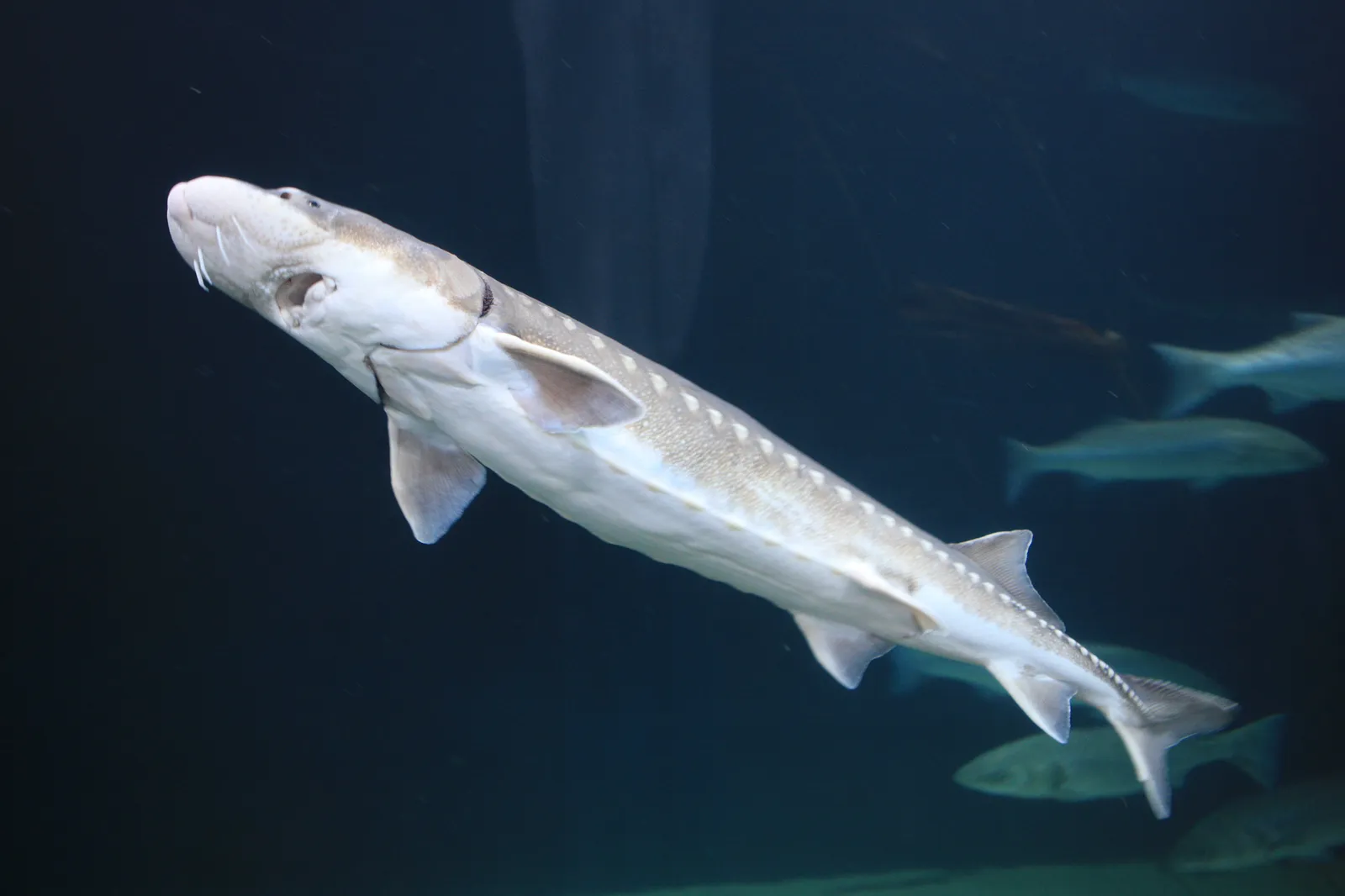
A sturgeon is a big, armored fish with a skeleton of cartilage, five rows of bony plates along its body, four whiskers under its snout and a toothless mouth that vacuums food off the bottom. Nine sturgeons live in US waters: eight species and the Gulf sturgeon, a subspecies of the Atlantic. They range from a 30 in (76 cm) river fish to the white sturgeon of the Pacific coast, the largest freshwater fish in North America. Six of the nine may not be kept anywhere, so for most sturgeons the first question at the water is not how to catch one but whether you may.
The world record white sturgeon, 468 lb, was caught at Benicia, California, in 1983. Today a big white must stay in the water in California and Washington, so the giants are released without ever being weighed.
What is a sturgeon?
Sturgeons are an old family of fish that has changed little since the age of the dinosaurs; the U.S. Fish and Wildlife Service dates its fossil record back 120 million years. Four things mark one at a glance.
- Armor instead of scales. Five rows of bony, diamond-shaped plates called scutes run along the body, and the skin between them is rough and scaleless, like a shark’s. On young fish and on green sturgeon the scutes “can be quite sharp,” the agency warns, so wear gloves.
- A skeleton of cartilage. Like a shark, a sturgeon has more cartilage than bone, which is why a big one lifted out of the water can be injured by its own weight.
- Four barbels. The barbels hang in a row under the snout and feel and taste for food on the bottom.
- No teeth. The mouth sits underneath and shoots out “like a vacuum cleaner (no, they don’t have teeth),” in the Fish and Wildlife Service’s words. Florida’s wildlife commission puts it plainly: sturgeon cannot bite.
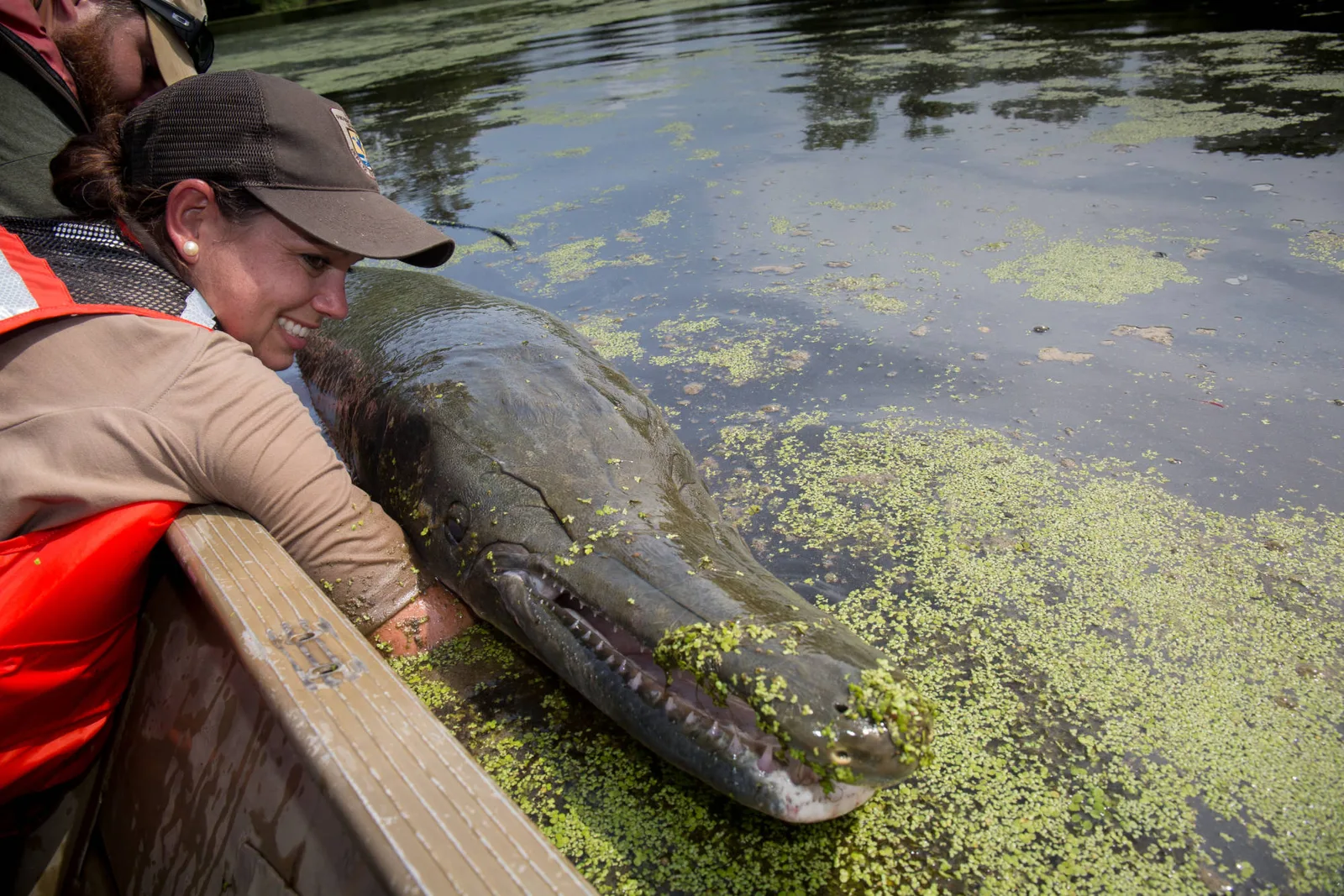
They are slow fish in every sense. Sturgeon “mature late (around 15 years old) and don’t spawn every year,” the Fish and Wildlife Service notes, so a population that is fished down is slow to recover. There are about 27 sturgeon species in the world, all in the Northern Hemisphere, and 8 of them in North America. With the Gulf subspecies, that makes nine sturgeons in US waters. Among the freshwater fish outside the big families they share the top of the size table with the alligator gar, which only the white sturgeon outgrows in North American fresh water.
The nine US sturgeons at a glance
Six of the nine belong to Acipenser: five species, plus the Gulf sturgeon as a subspecies of the Atlantic. The three river sturgeons of the Mississippi basin and Alabama, Scaphirhynchus, are smaller fish with flat, shovel-shaped snouts. The last column is the one most anglers need.
| Sturgeon | Size | Where in the US | Federal status | Can you keep one? |
|---|---|---|---|---|
| White | Delta average 3.6 ft (1.1 m); 20 ft (6.1 m) in historical records | Pacific coast: Sacramento–San Joaquin, Columbia, Snake, Kootenai | Kootenai River population endangered (1994); San Francisco Estuary population a candidate (2026) | Only in a few Oregon and Washington seasons (Columbia pools, Lake Roosevelt, upper Willamette); release only in California |
| Green | 4.5–6.5 ft (1.4–2 m) average, up to 350 lb (159 kg) | Pacific coast, Sacramento to the Rogue and Klamath | Southern population threatened (2006) | No; California bans fishing for it |
| Lake | 4–6 ft (1.2–1.8 m), 30–80 lb (14–36 kg); largest about 7 ft (2.1 m) | Great Lakes, Mississippi and Hudson Bay basins, 24 states | Not listed (2024 finding) | One a year where a season is open |
| Shovelnose | Up to 30 in (76 cm), rarely over 5 lb (2.3 kg) | Missouri and Mississippi rivers | Listed only for its likeness to the pallid (2010), commercial fishing | Yes where states allow it, such as Missouri |
| Pallid | Up to 6 ft (1.8 m) | Missouri and Mississippi rivers | Endangered (1990) | No: release unharmed |
| Alabama | About 30 in (76 cm) | Mobile basin, Alabama | Endangered (2000) | No |
| Atlantic | Up to 14 ft (4.3 m); largest 811 lb (368 kg) | Atlantic rivers and coast, Maine to Florida | Endangered, Gulf of Maine population threatened (2012) | No; state waters closed since 1998 |
| Gulf | Up to 9 ft (2.7 m), 385 lb (175 kg) | Gulf rivers, the Pearl east to the Suwannee | Threatened (1991) | No |
| Shortnose | About 4.5 ft (1.4 m), up to 50 lb (23 kg) | Atlantic coast, at least 41 bays and rivers | Endangered (1967) | No |
Free PDF · Water temperature chart Which fish are biting at today's water temperature?
One water temperature reading, and the 16-page chart tells you who's spawning, who's feeding hard, where they sit and what to throw. 26 fish, every number sourced.
Enter your email, confirm it with one click, and the PDF is in your inbox. Plus one email a week on what's biting. Unsubscribe anytime. Privacy.
Where do sturgeon live?
In four regions of the US, and in each one the big rivers are the key. Sturgeon spawn in fresh water, but several species spend most of their lives in estuaries and at sea.
- The Pacific coast. White and green sturgeon live from California to Alaska “in freshwater, in saltwater, and all the estuaries in between,” in the Fish and Wildlife Service’s phrase: the Sacramento–San Joaquin, the Columbia, the Snake and the Fraser in Canada. The Sacramento–San Joaquin whites are the species’ southernmost spawning population. Some whites never reach the sea at all: the Kootenai River fish of Idaho and Montana are one of 18 land-locked populations.
- The Great Lakes and the Mississippi. The lake sturgeon covers the Great Lakes, the Mississippi and the Hudson Bay drainage, in 24 states. “Contrary to its name, lake sturgeon can thrive in both lakes and rivers,” the Fish and Wildlife Service notes, and in Missouri it is almost always found in big rivers.
- The Missouri and the Mississippi. Shovelnose and pallid live in the open, flowing channels of these big rivers; pallids like deep, swift and murky water. A shovelnose has been tracked traveling as far as 560 miles.
- The Atlantic and Gulf coasts. Atlantic sturgeon run from southern Canada to northern Florida. Their young drift down to brackish water, stay one to five years, then move to the coast; adults return to their home rivers to spawn. The shortnose lives in at least 41 bays and rivers along the East Coast, and the Gulf sturgeon spawns in seven rivers from the Pearl to the Suwannee; in the Suwannee alone, Florida’s wildlife commission puts the spawning adults at about 10,000.
Dams are the common thread in what threatens them now. NOAA Fisheries names dams and other barriers that block the way to spawning grounds among the main threats to Atlantic, Gulf and green sturgeon, alongside vessel strikes and habitat degradation.
How do you tell the sturgeons apart?
Where only one sturgeon lives, the river tells you which it is. Three places hold look-alikes, and two of those mix-ups matter because one fish of the pair is protected.
| Pair | What to check | Source |
|---|---|---|
| White or green (Pacific coast) | Green: a green stripe on sides and belly, a pointed snout with the barbels midway to the mouth, 8–11 sharp scutes on the back. White: no stripes, a blunter snout with the barbels closer to its tip, 11–14 dull scutes. | USFWS |
| Shovelnose or pallid (Missouri, Mississippi) | Pallid: grayish white, a longer and more pointed snout, thin and weakly fringed inner barbels whose bases form a crescent, a belly bare or with scattered plates. Shovelnose: thicker, more fringed inner barbels and a belly covered with plates. | Missouri Department of Conservation |
| Lake or shovelnose (Mississippi basin) | Lake: a short, rounded, conical snout, smooth barbels, a two-lobed lower lip and a small opening (spiracle) behind the eye. Shovelnose: a flat, shovel-shaped snout, fringed barbels, a four-lobed lip and no spiracle. | Missouri Department of Conservation |
| Shortnose or Atlantic (East Coast) | Shortnose: smaller, with a larger mouth, a shorter snout and a different pattern of scutes near the tail. | NOAA Fisheries |
The shovelnose and pallid pair is the one with legal weight. The Fish and Wildlife Service listed the shovelnose in 2010 because the two “are difficult to differentiate in the wild” and commercial shovelnose fishing was killing pallids, which is what similarity of appearance means in the endangered species rules. The two also hybridize. On the Missouri or the Mississippi, a sturgeon you cannot name with confidence goes back.
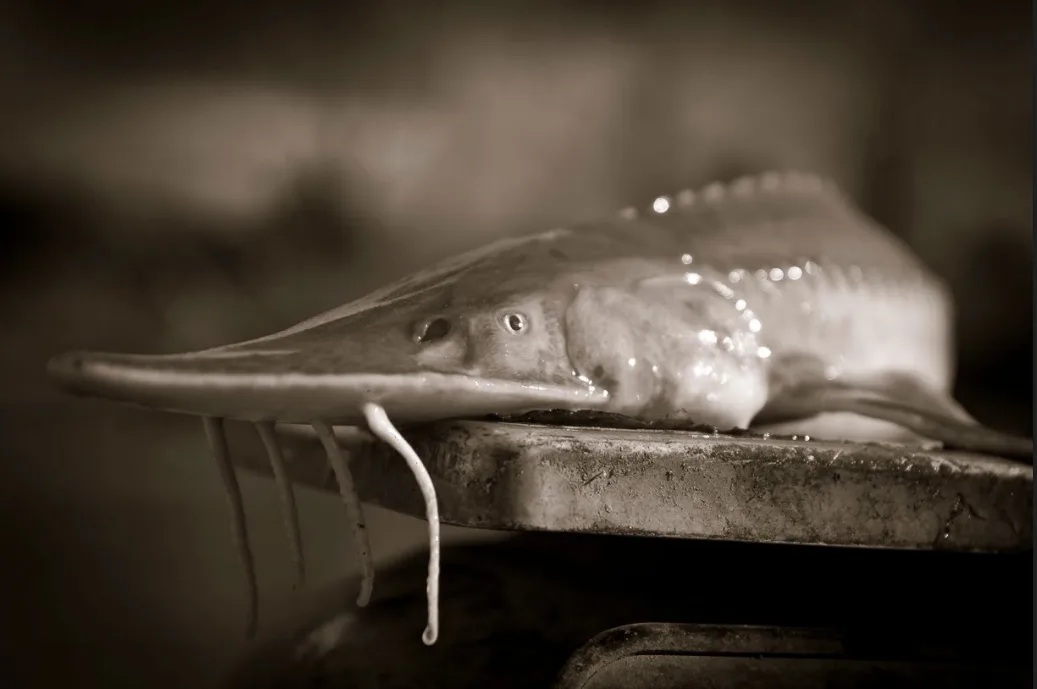
Photo: Sam Stukel, U.S. Fish and Wildlife Service (public domain)
Green and white sturgeon share San Francisco Bay. A green has to be released at once in California, Oregon and Washington, so a West Coast angler checks the stripe and the snout before anything else.
How big do sturgeon get?
The white sturgeon is the largest, and California’s wildlife department calls it “the largest fish that can be found in freshwater in North America.” There are historical records of whites as long as 20 ft (6.1 m), but in California today it is rare to see one over 6.5 ft (2 m), and the average Delta fish is about 3.6 ft (1.1 m). The Fish and Wildlife Service writes that “10–12 feet is considered large by today’s standards.”
The heaviest US sturgeon an agency puts a weight on is a sea-run fish. The Atlantic sturgeon reaches 14 ft (4.3 m), and the largest weighed 811 lb (368 kg), “caught in coastal waters off Canada.” The lake sturgeon tops out at about 7 ft (2.1 m) and 200 to 300 lb (91 to 136 kg). At the small end, the shovelnose reaches about 30 in and rarely passes 5 lb.
The largest sturgeon in the world is the beluga of the Caspian and Black seas, which FishBase lists at up to 8 m (26 ft) and 3.2 metric tons.
How old do sturgeon get?
The lake sturgeon is the oldest of the nine. It lives to 150 years, according to the Fish and Wildlife Service, and Minnesota’s DNR says females can live over 150 years while males live about 65 to 90. The oldest white sturgeon on record was 103 years old at the time of capture, the California Department of Fish and Wildlife reports.
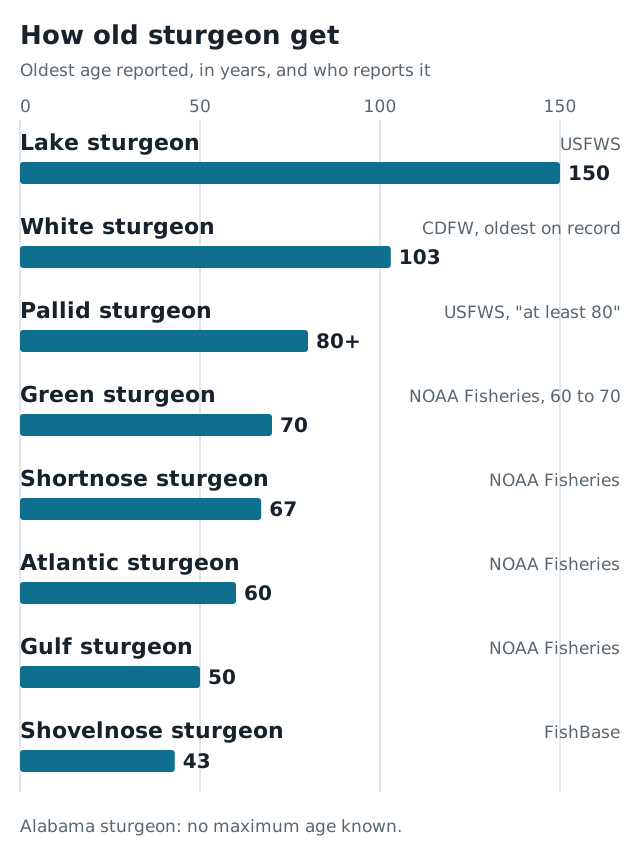
Long life comes with a late start. Lake sturgeon females mature at about 24 to 26 and spawn every four to six years, Minnesota’s DNR writes. On the lower Columbia a white sturgeon matures at “approximately 6 feet in length, or around 25 years old,” and the females spawn every four to six years too. A lake sturgeon female caught at 20 has not yet spawned once.
How old is a 1,000 lb sturgeon? None of the agency sources gives an age for a fish that size; the 103-year-old white is the best guide.
What are the sturgeon world records?
The International Game Fish Association (IGFA) keeps all-tackle records for four of the US sturgeons. Two of the four come from Canada.
| Sturgeon | All-tackle record | Where and when | Angler |
|---|---|---|---|
| White | 468 lb (212.28 kg) | Benicia, California, July 9, 1983 | Joey Pallotta III |
| Lake | 168 lb (76.2 kg) | Georgian Bay, Ontario, May 29, 1982 | Edward Paszkowski |
| Shortnose | 33 lb (14.97 kg) | Saint John River, New Brunswick, November 24, 2019 | Samuel N. Andrews |
| Shovelnose | 11 lb 13 oz (5.36 kg) | Rock River, Illinois, October 21, 2022 | Kashten Gustafson |
Why is the white sturgeon record more than 40 years old when far bigger fish are caught every year? Because the rules changed under it. In California a white over 60 in fork length may not be taken out of the water, and in Washington the line is 55 in. A fish that cannot leave the water cannot go on a certified scale, so today’s giants are measured, photographed and let go.
The lake sturgeon record is smaller than two Wisconsin fish. Wisconsin’s state hook-and-line record is a lake sturgeon of 170 lb 10 oz and 79 in, caught on Yellow Lake in Burnett County on September 22, 1979. Its record for other methods is a speared fish of 212 lb 3.2 oz and 84.25 in from Lake Winnebago, February 13, 2010. Neither is in the IGFA’s books.
Can you fish for sturgeon, and can you keep one?
You can fish for some sturgeon in some places, and keep very few. The answer depends on the species first and the state second.
The six you may never keep. Green, pallid, Alabama, Atlantic, Gulf and shortnose sturgeon are protected under the Endangered Species Act, and none may be kept. NOAA Fisheries’ advice for the East Coast fish is short: “If you accidently hook a sturgeon, be prepared to catch and release with care.” California makes it illegal even to fish for green sturgeon, and Oregon says green sturgeon “may not be targeted for retention or catch-and-release angling.” Missouri’s rule for the pallid: release it unharmed. Under the act, even hooking a listed fish by accident counts as take, so release it at once.
White sturgeon. In California the fishery has been catch and release only, with a bag limit of zero, since the state made the white sturgeon a candidate for its endangered list in 2024. The federal government followed in July 2026, finding a listing of the San Francisco Estuary fish “warranted but precluded.” Washington’s coast and Puget Sound and the Columbia below Bonneville Dam are catch and release too. Most kept whites come from the Columbia pools above Bonneville, where Washington and Oregon open short retention seasons each winter. The limit there is one fish a day and two a year, inside a slot of 38 to 54 in fork length in the Bonneville Pool and 43 to 54 in in the pools above it. Washington also opens a fall season on Lake Roosevelt for fish of 55 to 63 in, and Oregon allows retention year-round above Willamette Falls. The days change every year; check the Oregon and Washington agencies before you go.
Lake sturgeon. The Fish and Wildlife Service decided in April 2024 that the lake sturgeon does not need federal listing, but most states still protect it. Where a season exists the limit is one fish a year:
- Michigan bans fishing for lake sturgeon everywhere except the waters its fisheries order names, and allows one fish a year, registered within 24 hours.
- Wisconsin runs a September hook-and-line season with a 60 in minimum and a harvest tag, and the February spearing season on the Lake Winnebago system with a 36 in minimum. Both allow one fish per season; see the Wisconsin fishing guide for the state’s waters.
- Minnesota allows one lake sturgeon per calendar year, with a tag, on its border waters with Ontario, Lake of the Woods and the Rainy River.
- Missouri protects the lake sturgeon: any one caught must be returned to the water.
Shovelnose. It is the one sturgeon many states still treat as an ordinary sport fish. Missouri lists it as a permitted sport fish but makes it illegal to harvest for commercial purposes, because it “so closely resembles” the endangered pallid. The federal similarity rule targets commercial fishing, not anglers.
How to handle one. The release rules say the same thing in different words. California bans gaffs, tail ropes, snares and lip grippers on sturgeon, and forbids holding one by the gills, mouth or tail alone. Its advice for a fish under 60 in: hold it with two hands, one under the head and pectoral fins and one in front of the tail, and wear gloves. Minnesota’s DNR asks anglers to support the fish horizontally for a photo and never hold it vertically. A deep hook gets cut, not pulled: “sturgeon process and expel hooks and tackle well,” California’s wildlife department notes.
How do anglers catch sturgeon?
On the bottom, with bait. “Sturgeon are bottom feeders and typically don’t take lures,” California’s wildlife department says, and the tackle follows from the size of the fish and the strength of the current.
| White sturgeon (California) | Lake sturgeon (Minnesota) | |
|---|---|---|
| Rod and line | Medium-heavy to heavy rods with soft tips, 50–100 lb line, braid or mono | A stout muskie rod, level-wind reel, 80–100 lb braid |
| Weight | Pyramid sinkers of 4–16 oz (113–454 g), by the current | No-roll slip sinkers of 1–5 oz (28–142 g) |
| Hook | One single-point barbless hook (the law in California) | A 5/0 circle hook on a 12–18 in (30–46 cm) leader |
| Bait | Ghost, mud or grass shrimp, lamprey, salmon roe; some use pile worms, nightcrawlers, shad or herring | One or more nightcrawlers, often with a minnow or two added |
| Source | California Department of Fish and Wildlife | Minnesota DNR |
The bite is the hard part. White sturgeon are “extremely subtle when taking bait,” California’s guidance says, so keep the line tight and watch the rod tip for gentle taps and pumps. On a lake sturgeon river, Minnesota’s DNR tells anglers to anchor just above pools and deeper seams, then simply tighten the slack and raise the rod when a fish takes. Lake sturgeon also turn up on catfish baits: Missouri notes they are “often caught by catfish anglers using worms or cut bait.”
Fight a big fish quickly. Long fights are “extremely stressful” for a sturgeon, and from a boat California advises following a hooked fish so it is not fighting the current as well as the line.
Is sturgeon good to eat?
Yes, where you may keep one. Missouri’s conservation department says “the flesh of sturgeons has an excellent flavor, especially when smoked,” and Oregon’s fish and wildlife department calls sturgeon meat “excellent when smoked or prepared any number of other ways for the table.” That is also why poaching for meat and eggs is on California’s list of threats to the white sturgeon.
Check the water before you eat one. Oregon recommends releasing any sturgeon caught from Bonneville Dam to Ruckel Creek, about a mile upstream, because of high levels of PCBs. It also advises pregnant women and children to limit meals of sturgeon from other parts of the lower and middle Columbia, because of PCBs and mercury.
Caviar: why sturgeon are protected
Sturgeon eggs are caviar, and the demand for them drove the first crash of the American sturgeons. On the East Coast in the late 1800s, people went looking for “caviar riches” in what NOAA Fisheries calls the “Black Gold Rush.” The crash was fast: “In 1890, over 7 million pounds of sturgeon were caught in 1 year alone. By 1920, only 23,000 pounds of sturgeon were caught; a decline of more than 99 percent.” California shut its commercial white sturgeon fishery in 1901. In Minnesota, lake sturgeon were first treated as a nuisance that tore nets, “stacked on the shorelines like logs” and burned as fuel in steamboats, then caught by the thousand for caviar until the population crashed in the early 1900s.
Is a sturgeon killed for caviar? Traditionally, yes: “Harvesting caviar kills the fish,” Missouri’s conservation department notes in its sturgeon field guide. The United States stopped imports of beluga caviar from the Caspian Sea states in September 2005. The international CITES treaty covers the American species too: the Atlantic is on Appendix II, and the shortnose on Appendix I, where international trade is banned.
At home, the law follows the fish. Washington makes it unlawful to have sturgeon eggs in the field without the carcass they came from. The federal Lacey Act adds a second layer. It makes it a crime to sell, buy or transport across state lines any fish taken in violation of a state’s law, so an illegal sturgeon or its roe can become a federal case.
Do sturgeon jump, and are they dangerous?
Sturgeon jump clear of the water, and on Florida’s rivers that is a real danger to boaters. Florida’s wildlife commission says Gulf sturgeon jump to communicate and to refill the swim bladder that keeps them at neutral buoyancy, mostly from May to early August and at dawn and dusk. In 2015 there were five reportable accidents involving sturgeon strikes on the Suwannee and Santa Fe rivers, with one death and eight injuries. The commission’s advice for boaters: go slow, wear a life jacket and stay off the bow.
They cannot bite (see the toothless mouth above). The real hazards for an angler are the sharp scutes of a young fish and the weight of a big one in the boat.
What eats a sturgeon? Crayfish and small fish eat the eggs, and herons take the young. “By the time sturgeon reach 20 inches or more in length their primary predator is humans,” Minnesota’s DNR writes.
When do sturgeon spawn, and what do they eat?
Most sturgeon spawn in spring in fresh water, over clean rock and gravel in current; Atlantic sturgeon in rivers from Georgia to the Chesapeake also spawn in late summer and fall. Lake sturgeon start moving when the water reaches about 50 °F (10 °C) and spawn at about 55 °F (13 °C), Minnesota’s DNR says, on shallow, clear riffles with gravel or cobble free of silt. A lake sturgeon female lays hundreds of thousands of eggs, and the larvae drift downstream after hatching. The Atlantic, Gulf, shortnose and green sturgeons live at sea or in the estuaries and run up rivers to spawn; the lake, shovelnose, pallid and Alabama sturgeons live only in fresh water.
What they eat depends on the species and its size. Lake sturgeon eat snails, crayfish, mussels and aquatic insects, the Fish and Wildlife Service says, with some small fish and eggs. Adult pallids eat mostly fish. On the Columbia, the Fish and Wildlife Service notes that sturgeon gorge on shad and even feed on full-grown salmon. Gulf sturgeon stop eating in fresh water after their first year and fast from spring to fall, losing up to 20 percent of their weight, which is why Florida anglers rarely hook a large one.
Put the pieces together and the rules make sense. A fish that matures at 15 to 25, spawns every few years and lives a century recovers slowly: sturgeon “populations are slow to respond to conservation actions,” the Fish and Wildlife Service writes. The one-fish seasons, the slot limits and the keep-it-in-the-water rules are there so the big females, the ones carrying the eggs, get to spawn again.
Free PDF · 16 pages
Know what's biting before your first cast
The Water Temperature Fishing Chart. Take one water temperature reading, find it on the chart, and you know which of 26 freshwater fish are feeding today, where they are and what to throw. For your phone and the tackle box.
- Where they sit and what to throw at every band: bass, crappie, bluegill and walleye; catfish by species; trout: when to stop and where they hide
- The best hours at your reading, the cold front day by day, and the spawn calendar from ice-out to midsummer
- The three thermometer mistakes that make a reading lie (the first one is the surface)
- The 26-fish chart: who's spawning, feeding hard or shut down at your reading
Every number from state fish and wildlife agencies and fisheries research: 61 sources, all on the site.
Enter your email, confirm it with one click, and the PDF is in your inbox. Plus one email a week on what's biting. Unsubscribe anytime. Privacy.
Related
Section guide
Freshwater Fish Species Outside the Big Families: Sturgeon, Gar, Bowfin, BurbotThe freshwater fish species outside the bass, trout, catfish and pike families: sturgeon, gar, bowfin, burbot, drum, eel and paddlefish, with records.
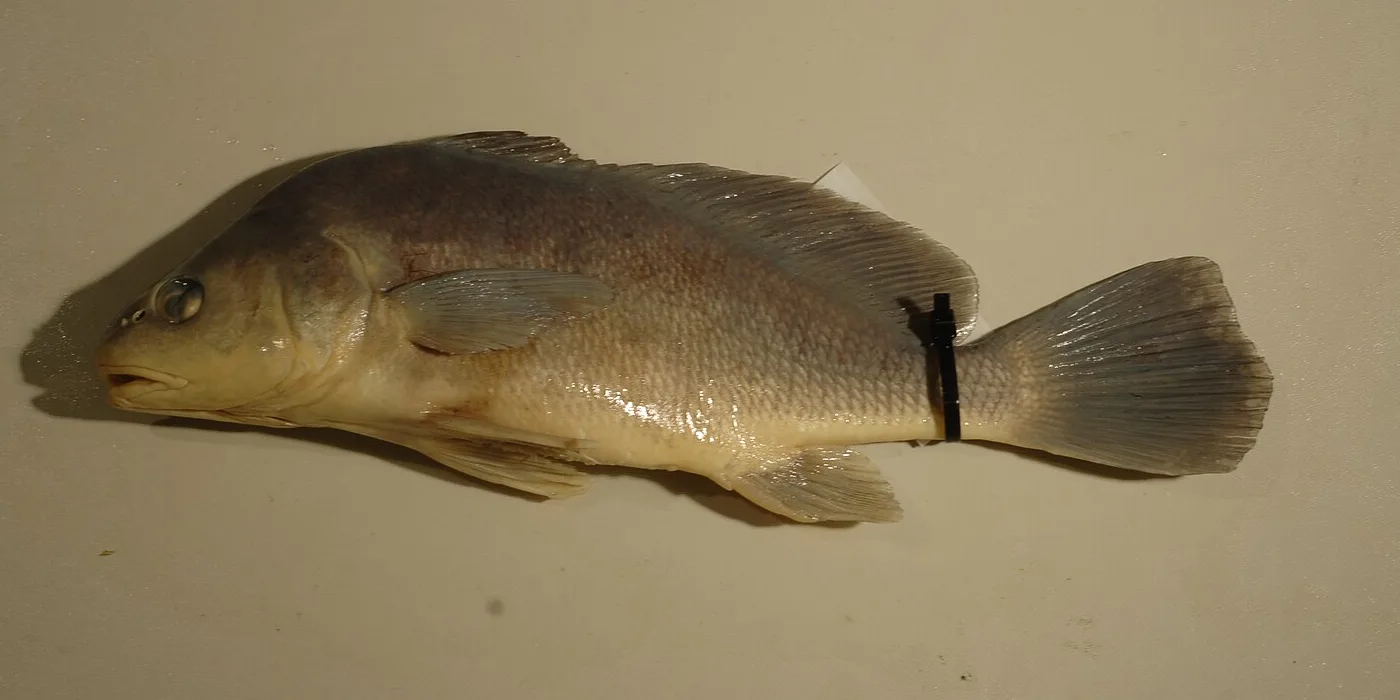 Freshwater Drum: Sheepshead, Gaspergou and How to Catch Them
Freshwater drum, or sheepshead, mostly run 1 to 5 lb; the record is 54 lb 8 oz. How to tell one apart, the rig that catches it and how to cook it.
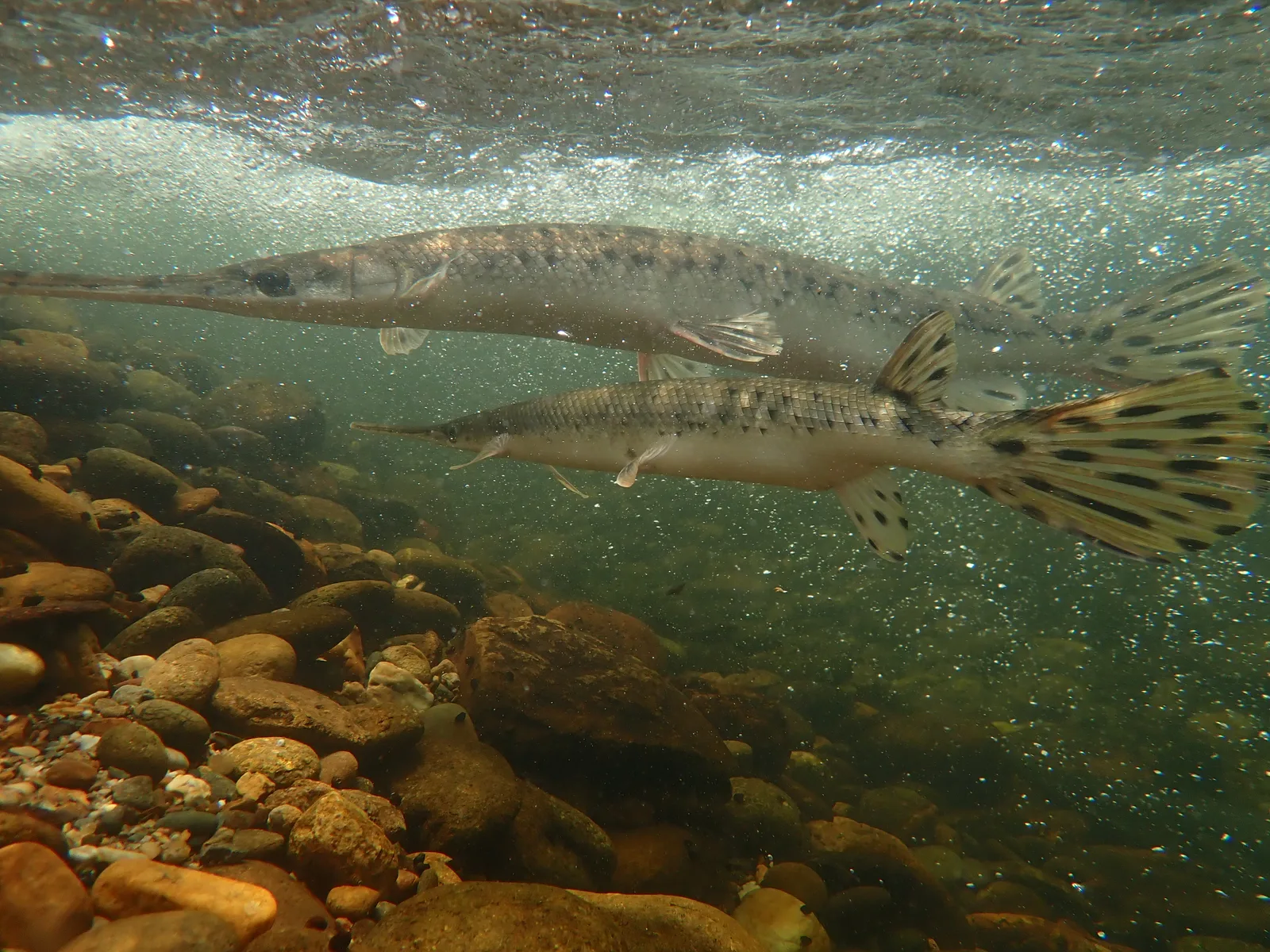 Longnose Gar: Identification, Size, Records, and How to Catch One
Longnose gar commonly reach 3 ft and 5 to 6 lb; the IGFA record is 43 lb, yet four states certify bigger fish. How to ID, find and catch one.
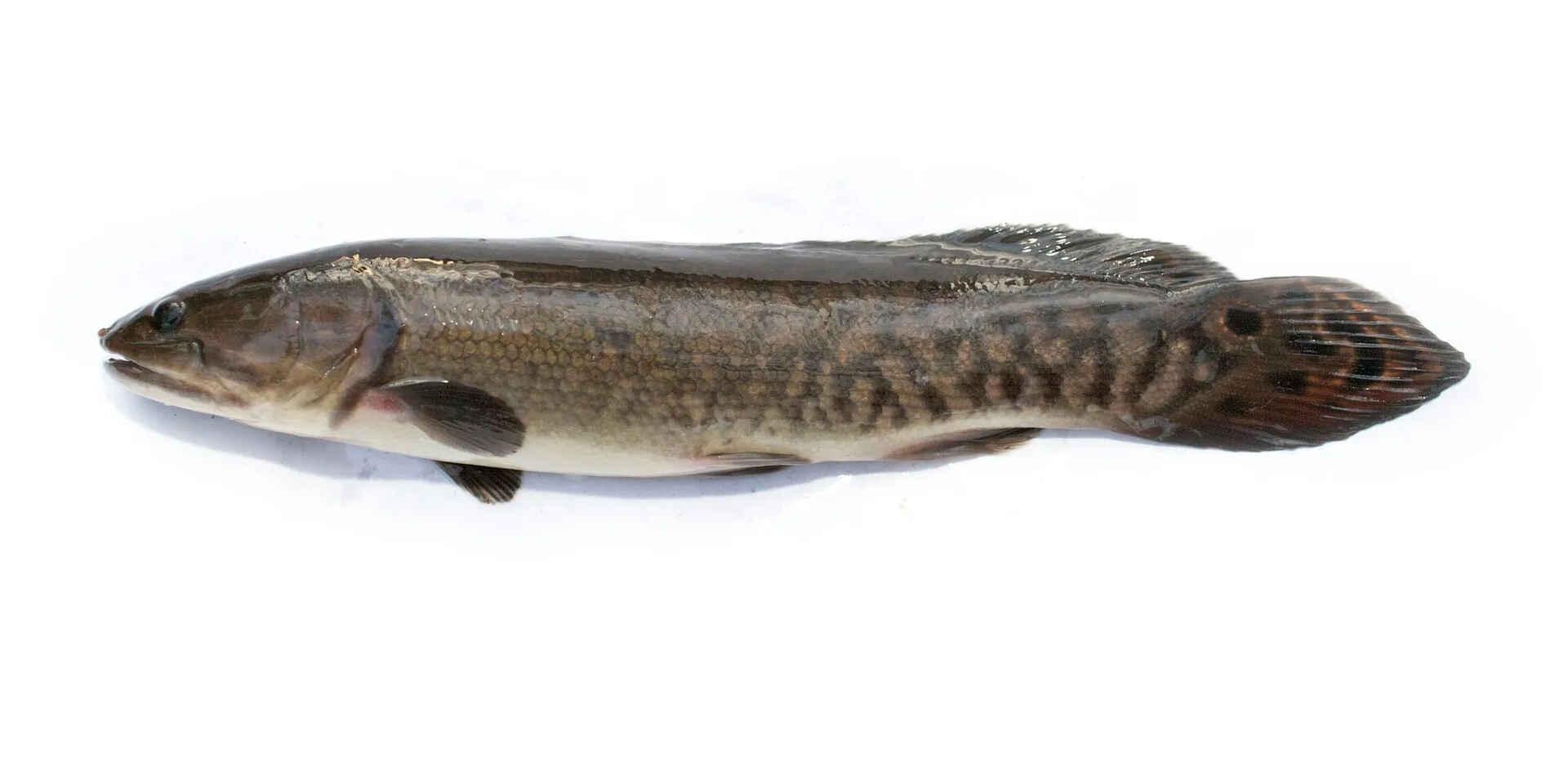 Bowfin: Identification, Bowfin Fishing, and the Snakehead Look-Alike
The bowfin is a native, air-breathing predator with a 21 lb 8 oz world record. How to identify one, tell it from a snakehead, and catch one.
 Gar Fishing: Rope Lures, Live Bait and Bowfishing for Every Gar
Gar fishing for all five US gars: hookless rope lures, live bait, fly and bow, the alligator gar rig, and how to handle a mouth full of teeth.
- Alligator Gar: Size, Teeth, Records, and How to Catch One
Alligator gar reach 8 ft and 300 lb and can live past 90 years. How to tell them from other gars, how to catch one, the records and the rules by state.
 Burbot: The Freshwater Cod That Spawns Under the Ice
Burbot, the only freshwater cod: one chin barbel, 15–28 in, 1.5–5 lb. When and where they bite through the ice, the glow jig that works, and the rules.
Sources
- U.S. Fish & Wildlife Service, Lake Sturgeon (Acipenser fulvescens)
- U.S. Fish & Wildlife Service, White sturgeon (Acipenser transmontanus)
- U.S. Fish & Wildlife Service, Pallid Sturgeon (Scaphirhynchus albus)
- U.S. Fish & Wildlife Service, Atlantic sturgeon (Acipenser oxyrinchus oxyrinchus)
- U.S. Fish & Wildlife Service, Alabama sturgeon (Scaphirhynchus suttkusi)
- U.S. Fish & Wildlife Service, Sturgeon Snoots and Scutes
- U.S. Fish & Wildlife Service ECOS, species listing status (sturgeon)
- NOAA Fisheries, Atlantic Sturgeon
- NOAA Fisheries, Shortnose Sturgeon
- NOAA Fisheries, Green Sturgeon
- NOAA Fisheries, Gulf Sturgeon
- California Department of Fish and Wildlife, White Sturgeon
- California Department of Fish and Wildlife, White Sturgeon (fishing)
- Washington Department of Fish and Wildlife, White Sturgeon
- Washington Administrative Code 220-316-010, Sturgeon—Areas, seasons, limits and unlawful acts
- Oregon Department of Fish and Wildlife, Sturgeon fishing in Oregon
- Oregon Department of Fish and Wildlife, White Sturgeon
- Oregon Department of Fish and Wildlife, Green Sturgeon
- Minnesota DNR, Lake Sturgeon (MinnAqua species profile)
- Minnesota DNR, How to catch lake sturgeon
- Michigan DNR, Fisheries Order FO-240, Lake Sturgeon Fishing Regulations
- Wisconsin DNR, Lake sturgeon hook and line season
- Wisconsin DNR, 2026 Lake Sturgeon Spearing Season report
- Wisconsin DNR, The 2026 Hook And Line Sturgeon Season Opens Sept. 5
- Wisconsin DNR, Lake sturgeon fishing seasons
- Wisconsin DNR, Hook and line record fish
- Wisconsin DNR, Alternate methods record fish
- Missouri Department of Conservation, Shovelnose Sturgeon
- Missouri Department of Conservation, Pallid Sturgeon
- Missouri Department of Conservation, Lake Sturgeon
- Florida Fish and Wildlife Conservation Commission, Sturgeon
- IGFA World Record Search: Sturgeon, white; Sturgeon, lake; Sturgeon, shovelnose; Sturgeon, shortnose
- Federal Register, Threatened Status for Shovelnose Sturgeon Under the Similarity of Appearance Provisions (September 1, 2010)
- Federal Register, 12-Month Finding for Lake Sturgeon (April 23, 2024)
- Federal Register, 12-Month Finding for the San Francisco Estuary DPS of White Sturgeon (July 21, 2026)
- Federal Register, Notice of Suspension of Trade in Threatened Beluga Sturgeon (September 30, 2005)
- 16 U.S.C. § 3372, Lacey Act prohibited acts (LII)
- FishBase, Acipenser fulvescens
- FishBase, Scaphirhynchus platorynchus
- FishBase, Huso huso