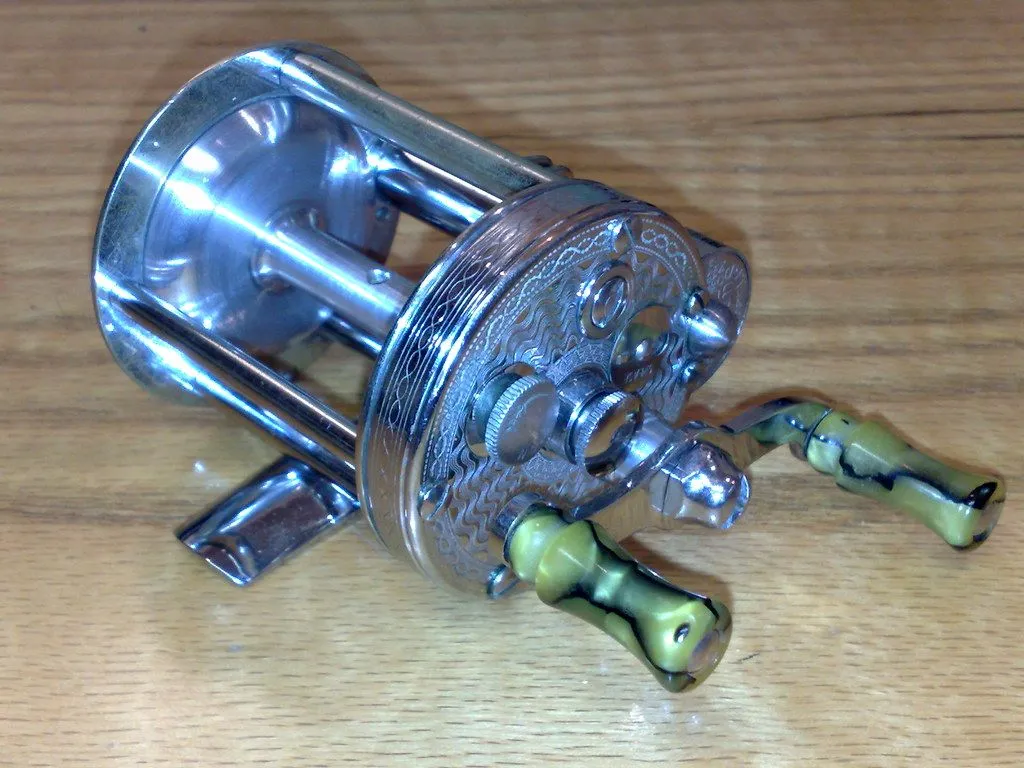
A baitcaster is a reel that sits on top of the rod with a spool that turns as you cast. That one fact explains everything else about it: the accuracy and power that make it the tournament angler’s default, the backlash that makes it the beginner’s nightmare, and the three controls, tension knob, brake and thumb, that stand between the two. Below: how the reel works, who it is for, what the numbers on the box mean, and the set-up procedure that stops the backlash before it starts. By the end you should be able to take a new baitcaster out of the box, set it up for a given lure, and cast it without picking out a bird’s nest every third throw.
Set the spool tension so the lure falls slowly when you press the thumb bar, and set the brakes to half. Do that before the first cast and most backlashes never happen.
What you need
- A baitcasting reel, low-profile for bass and most freshwater fishing, round for musky, pike, salmon and heavy line. The reels hub covers the designs and the Shimano and Daiwa ladders.
- A casting rod: reel seat on top, a trigger under it, small guides along the top of the blank. A spinning rod will not work. The rods hub explains power and action.
- Line of 12 lb or heavier: 15–20 lb fluorocarbon or 30–50 lb braid is the normal range. Baitcasters and light line do not mix; the line hub has the table.
- A practice lure of 3/8–1/2 oz (11–14 g) with the hooks removed, and a lawn.
How a baitcaster works
On a spinning reel the spool is fixed and the line peels off its end; on a baitcaster the spool itself rotates, driven by the weight of the lure pulling line off it. The problem is momentum. Early in the cast the lure accelerates the spool; late in the cast the lure slows down in the air but the spool wants to keep spinning, and when it turns faster than the lure is taking line, the loose line piles up on the spool and tangles. That is the backlash. Three things control it. The spool tension knob, a small cap on the handle side, presses on the spool shaft and sets how freely the spool starts. The brake slows the spool during the cast: centrifugal brakes are small shoes inside the side plate that fly outward and rub a ring as the spool speeds up, so they brake hardest at the start of the cast; magnetic brakes are a ring of magnets whose distance from the spool is set by a dial, and they brake without touching anything. Shimano’s DC brake is a magnetic brake switched electronically by a circuit the spool’s own rotation powers. The thumb does the rest, feathering the spool as the lure slows and stopping it dead when the lure lands; Bass Pro’s guide is honest about the ranking: “thumbing the spool correctly is still your best bet for trouble-free casting”.
Setting up a baitcaster, step by step
- Spool it correctly. Fill to about 1/8 in (3 mm) below the rim. An overfilled spool backlashes; an underfilled one casts short.
- Tie on the practice lure and hold the rod at about 45 degrees with the lure hanging a foot below the tip.
- Set the spool tension. Press the thumb bar. If the lure drops, tighten the tension knob a click at a time until it just stops falling; then back the knob off a quarter turn so the lure falls slowly and steadily, taking about three seconds to reach the ground, and the spool stops turning the moment it lands. Repeat this every time you change to a lure of a different weight.
- Set the brakes high. On a magnetic dial, 7 to 9 out of 10; on a centrifugal system, four of six pins on, or 50–75% of the range. The brake should do most of the work while you learn; the tension knob only fine-tunes the start.
- Cast with your thumb on the spool. Make an easy overhead lob, not a full-power cast, and keep light thumb contact with the spool all the way; press as the lure slows and stop the spool the instant it hits.
- Reduce the brakes one step at a time, only after ten clean casts in a row at the current setting. Distance comes from lower brake settings, and lower brake settings come from a trained thumb.
- Pick out a backlash without cutting. Press the thumb bar, pull the loose line gently until it stops, wind two or three turns while pressing the spool with your thumb to trap the overrun, then pull again. Most bird’s nests come free in a minute.
What the numbers mean
The gear ratio is how many times the spool turns for one turn of the handle: on a 6.4:1 reel the spool turns 6.4 times per crank. What actually matters is inches per turn, which depends on the spool diameter and how full it is; Abu Garcia’s example is that a 10.1:1 reel picks up about 410 ft of line a minute at 120 rpm and a 5.4:1 reel about 220 ft, roughly 34 in against 18 in per turn. The ratio also sets torque: a slow reel winds a deep crankbait against its own resistance without tiring you, a fast reel picks up slack for a hookset and moves a lure quickly.
| Ratio | Inches per turn | Best for |
|---|---|---|
| 5.1–5.4:1 (low) | 20–24 in (51–61 cm) | Deep crankbaits, big swimbaits, slow-rolled spinnerbaits, cold water |
| 6.1–6.5:1 (medium) | 26–28 in (66–71 cm) | Squarebills, medium crankbaits, spinnerbaits, jerkbaits; the one-reel choice |
| 7.1–8.1:1 (high) | 28–32 in (71–81 cm) | Jigs, Texas rigs, Carolina rigs, topwater, frogs, flipping |
| 9–10.1:1 (extra high) | 34 in (86 cm) and up | Fast topwater, punching, picking up slack on long casts |
Beyond the ratio, Bass Pro’s guide lists what separates a good reel from a cheap one: a one-piece aluminum frame over graphite, a forged rather than die-cast aluminum spool, shielded or sealed bearings (“quality matters more than quantity”), a drag rated for the line you use, and titanium or ceramic line guides.
Baitcaster or spinning reel?
| Situation | Baitcaster | Spinning reel |
|---|---|---|
| Lure weight | 3/8 oz (11 g) and up | 1/16–3/8 oz (2–11 g) |
| Line | 12–25 lb mono or fluoro, 30–65 lb braid | 4–12 lb mono or fluoro, 10–20 lb braid |
| Cover | Flipping, pitching, punching mats, frogs, docks | Open water, finesse around cover |
| Accuracy | Better; the thumb stops the lure exactly | Good with practice |
| Wind | Worse; a headwind slows the lure and backlashes the spool | Better |
| Learning curve | Days of practice | Minutes |
| Typical techniques | Jigs, Texas rigs, crankbaits, spinnerbaits, chatterbaits, frogs, swimbaits | Drop shot, Ned rig, wacky rig, small crankbaits, trout and panfish |
Bass Pro’s short list for when to buy a baitcaster is the honest one: flipping and pitching, heavy cover, large gamefish and heavy lures. If none of those describes your fishing, the spinning reel is not the beginner’s compromise; it is the right tool.
Mistakes to avoid
- Casting into the wind on a new reel. The lure stalls, the spool does not, and the backlash is total. Learn with the wind at your back.
- Using light line. Under 12 lb test the line digs into the spool under a backlash and cannot be picked out. Start at 15 lb fluorocarbon or 40 lb braid.
- Leaving the tension knob set for the last lure. A heavier lure on a loose spool overruns on the first cast. Reset it whenever the weight changes.
- Powering the cast. A baitcaster casts on a smooth, loaded rod, not arm speed; the harder the snap, the sooner the spool outruns the lure.
- Running the drag tight with braid. Braid has no stretch; set the drag by pulling line off by hand, about a quarter to a third of the line’s breaking strain, and let the reel absorb the surge.
When to use something else
A spinning reel wins for anything under 3/8 oz, for light line, for skipping small baits under docks and for every finesse rig on the jigs and rigs page. A spincast reel, the push-button design in the reels hub, is the right first reel for a child. And a round baitcaster or a conventional reel takes over when the line goes above 25 lb mono, for musky, catfish on heavy bait and saltwater trolling. The catfish hub covers that tackle.
Sources
- Bass Pro Shops, A guide to choosing baitcast reels
- Lew's, Understanding gear ratios in casting reels
- Wired2Fish, Choosing the right gear ratio fishing reel
- Abu Garcia, Reel gear ratios explained
- U.S. patent 7,618,003, Baitcast reel having externally adjustable dual brakes (centrifugal and magnetic)
- Lamiglas, The difference between casting and spinning rods