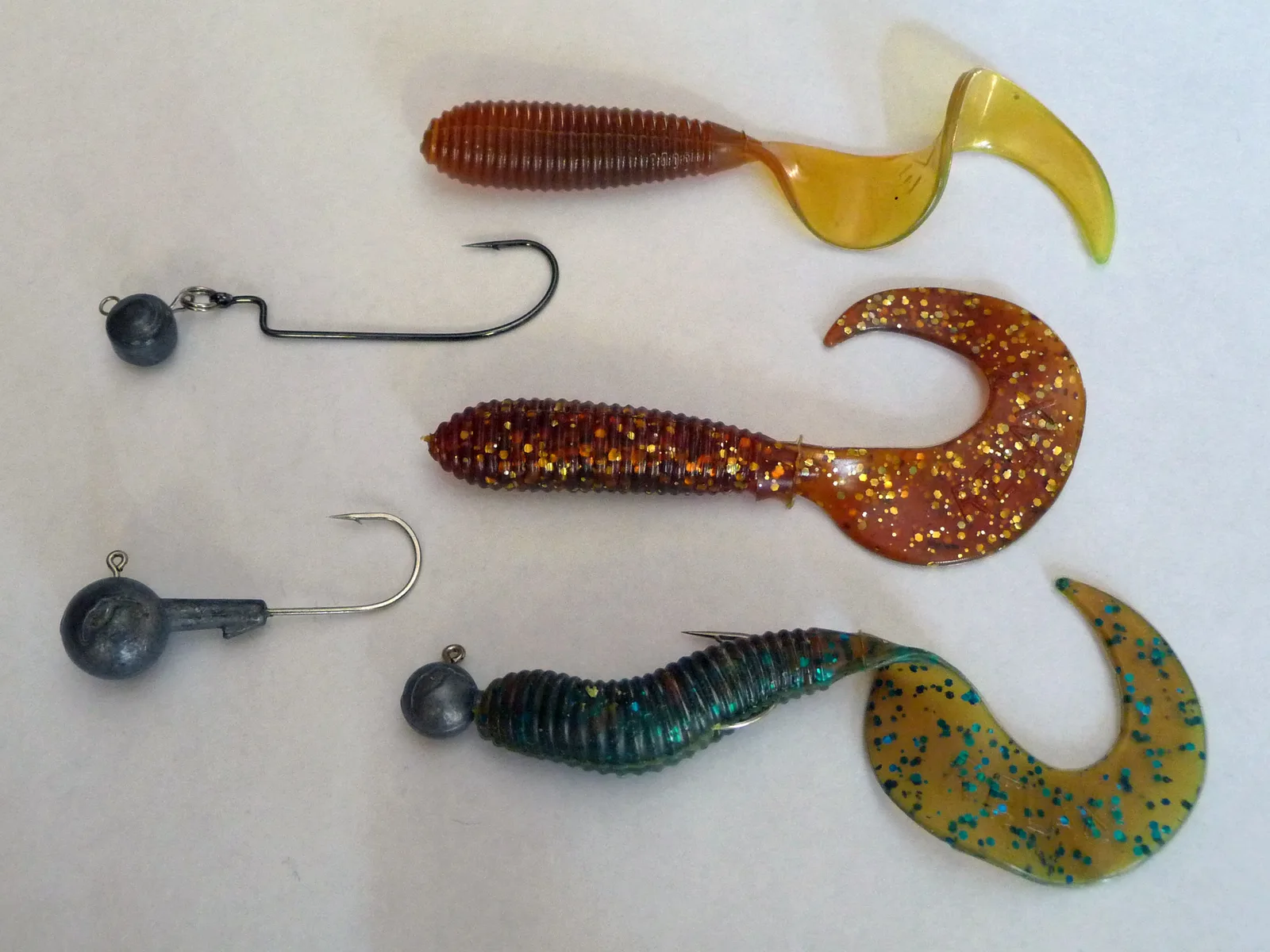
A shaky head jig is a light jig head, 1/16 to 3/8 oz (1.8–10.5 g), with a worm hook and a screw-lock or barbed keeper, rigged with a 4–7 in finesse worm Texas-style so the point is buried and the worm stands up off the bottom with its tail in the current. The retrieve is in the name: drag the head to a spot, stop, and shake the rod tip so the tail waves while the head stays put. It is the finesse rig for bass in clear, pressured water, the one tournament anglers tie on when the bite is slow, and it works twelve months a year. Michael Iaconelli finished second at Lake Conroe on it, fishing a riprap wall in 6–8 ft of water; Paul Marks placed at the 2025 Lake Hartwell Elite event with a 3/16 oz shaky head and a Zoom Fluke Stick Jr.
Iaconelli calls it a true 50-50 bait: half the bites come on the fall, half on the bottom. His 9 lb 8 oz Lake Conroe bass bit as the worm popped free of a rock, and it won him a truck.
Where it came from
The rig is older than the name. Iaconelli writes that it has been around “for half a century, if not longer” as the jighead worm; Ned Kehde traces the Texas-rigged jig worm to Chuck Woods in Kansas City in the 1960s, and Florida Sportsman names the 1970s slider head, a 4 in worm on a flat-sided jig head with the hook exposed, as the direct ancestor. The modern head arrived in 2001: Roy Altman of Buckeye Lures, founded with his son in 2000 near Clark Hill Lake, Georgia, began fishing the FLW Tour as a co-angler, saw from the back of a pro’s boat the need for a flat-bottomed head that would stand any soft plastic up, and molded the Spot Remover. It sold out of the Augusta tackle shops, went nationwide in 2005, and by 2010 Iaconelli could write that only the name was new.
What you need
- A shaky head: 1/16–3/8 oz, with a 3/0–5/0 light-wire worm hook and a screw-lock spring or a barb to hold the worm’s nose; five are in the table below.
- A finesse worm, 4–7 in (10–18 cm), thin and straight-tailed, ideally one that floats so the tail lifts off the head. Green pumpkin, watermelon, June bug.
- A 6 ft 10 in to 7 ft 2 in (2.1–2.2 m) medium-light or medium spinning rod with a fast tip, a 2500 or 3000 reel, 10–15 lb braid to a 6–12 lb fluorocarbon leader.
- Restraint with the shake. Scott Martin, who fishes it for a living, drags far more than he shakes.
The heads, head by head
Two shapes do the work. A stand-up or flat-bottomed head sits on its base so the worm stays vertical, the shape the Spot Remover introduced and the one that slides through rock without hanging; a ball head rolls and hops along the bottom with a more natural wobble. Both carry a keeper for the worm’s nose: a screw-lock spring holds a bulky worm or creature bait, a barb or wire keeper suits a thin finesse worm and, as Florida Sportsman notes, lets the worm slide down the hook on the set instead of kinking. Weights, hooks and prices are from the maker and retailer pages.
| Head | Weights | Hook and keeper | Price | Shape and when |
|---|---|---|---|---|
| Buckeye Spot Remover Pro Model | 1/8, 3/16, 1/4, 5/16 oz (3.5–8.9 g) | 90-degree Mustad Ultrapoint; molded spring (notched barb on the Jig model) | — | The original flat bottom; stands any worm up on rock |
| Strike King Tour Grade Shakey Head | 1/8, 3/16, 1/4 oz (3.5–7 g) | Gamakatsu 60-degree flat eye; barb keeper that holds ElaZtech | $5.99 for 3 | Round-sided stand-up; the general head |
| Owner Shakey Ultrahead | 1/16, 3/32, 1/8, 3/16, 1/4, 3/8 oz (1.8–10.5 g) | 4/0 light-wire round bend; TwistLock centering-pin spring | $5.49–6.49 for 4 | Contoured bottom that rocks nose-down; the widest weight range |
| Gamakatsu G-Finesse Tricky Head | 1/16, 3/32, 1/8, 3/16 oz (1.8–5.3 g) | 3/0 O’Shaughnessy; lockdown tin keeper | $6.99–7.49 for 3 | Shin Fukae’s design; stays vertical and glides over rock, for the lightest line |
| Jewel Baits Magnum Shakey Head | 5/16 oz (8.9 g) | Medium wire; wire keeper | — | Stephen Browning’s power head for a 7 in worm and 16 lb fluorocarbon |
The Tour Grade and the Ultrahead between them cover almost every day: the Strike King for the 1/8–1/4 oz general rig, the Owner for the 1/16 oz shallow work and the 3/8 oz deep work. The jig heads page has the other shapes, from football to mushroom.
The worms
A shaky head worm is thin so the tail moves on a small shake, straight-tailed so it stands rather than swims, and salt-light or floating so the tail rises off the head. Florida Sportsman’s rule: a floating worm sits at about 45 degrees to the bottom at rest and wiggles at every twitch. Iaconelli’s rule is the flat side: his worm has one, and rigged with the flat side away from the hook point it glides on the fall and, he says, draws about twice the bites on the way down. Lengths are the makers’.
| Worm | Length | Body | When |
|---|---|---|---|
| Zoom Trick Worm | 6½ in (16.5 cm) | The original floating worm, segmented, salt-impregnated | The default on docks, shallow cover and in spring; Zoom calls it the standard on a shaky head |
| Zoom Finesse Worm | 4½ in (11.4 cm) | A slim, tapering Trick Worm | Clear water, pressured fish, a 1/16–1/8 oz head |
| Roboworm Straight Tail | 4½ and 6 in (11.4 and 15 cm), 10 a pack at $4.79–4.99 | Hand-poured, thin, with a salt core that releases on the bite | Scott Martin’s worm; clear western and southern water; fragile, so bring the pack |
| Strike King KVD Finesse Worm | 5 and 6½ in (12.7 and 16.5 cm) | Straight-tail finesse worm | Light-line work on small heads; the 6½ in when the forage is bigger |
| Yamamoto Kut Tail | 5 and 7¾ in (12.7 and 19.7 cm) | Senko-dense, salt-heavy, with a cut tail that flutters | The 5 in for most days; the 7¾ in on a 1/4–5/16 oz head for bigger fish |
| Z-Man Mag FattyZ | 7¼ in (18.4 cm) | Thick, buoyant ElaZtech | Browning’s power shaky head around grass, brush and docks |
Iaconelli fishes two colors, June bug and green pumpkin, and sizes by the forage: 6 in most days, 4 in when the forage is tiny or the fish are pressured, 7 in when they feed on bigger prey. The Zoom page has the rest of that catalog; a Senko on a shaky head is the heavier, faster-falling version of the same idea.
Rigging it, step by step
- Seat the nose. Turn the worm onto a screw-lock until it sits flush against the head; on a barb or wire keeper, push the nose over the keeper and against the lead. A gap here is what makes the worm spin.
- Measure the hook. Lay the hook along the worm from the head and mark with a thumbnail where the point will come out, so the worm hangs straight.
- Flat side away from the point. If the worm has a flat side, rig it facing away from the hook point; that is the side that glides on the fall.
- Thread and skin-hook it. Push the point into the body at the mark, out the other side, and bury the point just under the skin so it comes through rock and wood weedless. Tackle Warehouse’s tip: weave the point in and out of the plastic a few times first to cut a channel, so the set drives through nothing.
- Open the hook a hair. Scott Martin bends the point out a fraction so it stands clear of the worm on the set and needs a lighter hookset. Iaconelli puts it the other way: there is no such thing as forcing the hook through the plastic before you drive it into the fish.
- Check the hang and tie on. The worm should hang dead straight; a bend spins it on the fall. Tie the head on with a Palomar.
Choosing the weight
The rule from every source is the lightest head that keeps contact with the bottom; too heavy and the worm lies down and stops waving. The numbers below are Iaconelli’s (1/8 oz to about 10 ft, heavier as he goes deeper), Martin’s (3/16 and 1/4 oz for most casting, 1/8 oz to skip docks) and Browning’s (5/16 oz in cover).
| Situation | Head weight | Hook | Worm |
|---|---|---|---|
| Shallow, calm, 2–8 ft (0.6–2.4 m) | 1/16–1/8 oz (1.8–3.5 g) | 3/0 | 4–5 in |
| The all-round setup to 10 ft (3 m) | 1/8–3/16 oz (3.5–5.3 g) | 3/0–4/0 | 5–6 in |
| Wind, current, 10–20 ft (3–6 m) | 3/16–1/4 oz (5.3–7 g) | 4/0 | 6 in |
| Skipping docks | 1/8 oz (3.5 g) ball head | 3/0 | 5 in |
| Grass, brush, docks on casting gear | 5/16–3/8 oz (8.9–10.5 g) | 4/0–5/0, medium wire | 7 in and up |
The retrieve
Cast past the target and let the head fall on a semi-slack line. Under 10 ft, Iaconelli lets it drop with a slight bow in the line; in 20–30 ft he feathers the line with his index finger so it falls straight. Half the bites come here, so watch the line, and never shake the rod while the worm is falling.
On the bottom there are four moves, and the trick is knowing which one.
- Drag. Rod low and to the side, a slow pull of a foot or two, reel up the slack, pause. This is most of Martin’s fishing: the head tells him whether he is on rock or in grass. On the days after a cold front, when the bass sit on the secondary points and will not chase, Wired2Fish’s Walker Smith drags it briskly to cover water and leaves after ten casts without a bite.
- Shake. When the head hangs on a rock or a stump, stop and shake the rod tip four or five times with the wrist, the tip moving a few inches, so the line quivers and the tail waves while the head stays put. Iaconelli shakes only when the worm snags; Smith shakes in place where he knows bass are, on a ledge, in a ditch or at the end of a point, until one swats the thing out of irritation.
- Hop. Lift the tip from three o’clock to one o’clock and let the worm settle. Not higher: a crawfish is not a high jumper. Smith’s hop is for sluggish fish after a full moon, when the crawfish are out on the rock.
- Swim. Keep the head ticking the bottom on a slow retrieve, a bigger-bodied worm on the hook; on overcast days when spotted bass roam, a worm that swims past them is something they have not seen.
A bite is a tick, a sudden weight, a line that swims sideways or goes slack. Reel until the rod loads and sweep sideways, the way you set a crankbait; the light-wire hook and the skin-hooked point need a firm sweep, not a snap. Iaconelli fishes with the rod a couple of inches below vertical so he never loses touch with the worm.
The rod, the reel and the line, in numbers
Two setups. The finesse rig everyone starts with, and the power rig Stephen Browning fishes around grass, brush and standing timber, where light spinning tackle cannot clear a bass from the cover.
| Part | Finesse (spinning) | Power (casting) |
|---|---|---|
| Rod | 6 ft 10 in to 7 ft 2 in (2.1–2.2 m), medium-light or medium, fast | 7 ft 3 in (2.2 m), heavy, moderate-fast |
| Reel | 2500–3000 spinning | Casting reel, 8.3:1 |
| Line | 10–15 lb braid to a 6–12 lb fluorocarbon leader of 5–6 ft, or straight 8–10 lb fluorocarbon | Straight 14–20 lb fluorocarbon; Browning fishes 16 lb |
| Head and worm | 1/16–1/4 oz, 4–6 in worm | 5/16 oz Jewel Magnum, 7 in Mag FattyZ |
Martin fishes 10 lb braid to a 10 lb fluorocarbon leader tied with a double uni knot, and on a baitcaster he spools straight 10 lb fluorocarbon. The braided line page explains why braid shows a slack-line bite that mono hides, and the fluorocarbon and leader pages cover the leader that keeps the rig invisible in clear water.
Where it wins
Iaconelli has fished it from a foot of water to 40 ft; Martin works it from the bank out to 10–15 ft, and says deeper than that it gets hard to fish. The places that pay:
- Rock, riprap and points. The head slides over rock and the worm stands up on it. Iaconelli’s Lake Conroe fish, 8 lb 1 oz and 9 lb 8 oz, came off a rocky point by a highway bridge and a long underwater riprap wall in 6–8 ft, and bit as the bait popped free of the rocks.
- Docks. A 1/8 oz ball head skips under a dock better than anything heavier, and a shaky head on a dock cable is a spotted bass rig all summer.
- After a front. The bright, calm day behind a cold front is when the chasing stops; the bass water temperature page says to back up one step toward the drop, and that is where a dragged shaky head finds them.
- Summer and winter, deep. Tackle Warehouse’s guide puts the rig at its best when the fish are slow and offshore; a 1/4 oz head on a 6 in worm dragged over deep rock is the summer-and-winter version.
- Shallow, clear, pressured water on any day: Florida’s Mark King fishes it over Okeechobee’s rock reefs and the Everglades canals in spring and catches a bigger bass on average on the shaky head than on a surface lure.
Largemouth are its main customer, smallmouth on river rock and clear lakes eat it as readily, and spotted bass under docks may be its best customer of all.
Shaky head, Ned rig or Texas rig
| Shaky head | Ned rig | Texas rig | |
|---|---|---|---|
| Bait | 4–7 in finesse worm, stands up | 2–3 in stub of buoyant plastic, stands up | Any plastic, 4–10 in |
| Head or weight | 1/16–3/8 oz jig head, hook buried | 1/16–1/8 oz mushroom head, hook exposed | 1/8–1 oz bullet weight, hook buried |
| Action | Drag, shake in place, hop | Swim-glide-shake, drag, deadstick | Lift and drop |
| Cover | Rock, docks, sparse grass | Rock, gravel, open bottom | Anything, including matted grass and wood |
| Line | 6–12 lb fluoro leader | 6–8 lb fluoro leader | 15–20 lb fluoro or braid |
The Ned rig is the finesse cousin: the same slow bottom work with a bait half the size on a head a third of the weight, and it gets the bite when a shaky head draws followers. When the cover thickens, the Texas rig takes over with its weight table, and when the fish are suspended off the bottom rather than on it, the drop shot holds the same worm above them.
Mistakes to avoid
- Shaking the whole time. The name misleads. Drag, stop, shake, drag; Martin’s ratio is mostly drag.
- Shaking it on the fall. Half the bites come on the drop; let it fall on a semi-slack line and watch.
- A heavy head. The worm lies flat and the rig becomes a bad Texas rig. Go lighter until you lose the bottom, then one step up.
- A thick worm. A finesse worm is thin so the tail moves; a 7 in ribbon tail belongs on a Texas rig.
- Braid straight to the head in clear water. The leader is the point of the rig.
- A snap hookset. Reel down and sweep; a light-wire hook straightens and a skin-hooked point needs the pull, not the shock.
Related
The jigs and rigs hub sets the shaky head beside the other rigs, and the wacky rig is the finesse rig for the fall rather than the bottom. For the words, the fishing terms page defines the jighead, the Texas rig and the finesse family.
Sources
- Bassmaster (Michael Iaconelli), Shaky head: only the name is new
- Bassmaster (Michael Iaconelli), Ike: the mighty shaky head, part 1
- Wired2Fish (Walker Smith), 4 different ways to fish a shaky head
- Wired2Fish (David Appleton, with Stephen Browning), How to power fish a shaky head worm for bass
- BassResource (Scott Martin), Fishing a shaky head worm: tips
- Florida Sportsman (Mike Conner), Shaky head fishing for bass
- Tackle Warehouse, Shakey heads gear guide
- Tackle Warehouse, Strike King Tour Grade Shakey Head
- Tackle Warehouse, Owner Shakey Ultrahead
- Tackle Warehouse, Gamakatsu G-Finesse Trickyhead Shakey Head
- Hunting Life, Gamakatsu G-Finesse Tricky Head press release (June 2020)
- Bassin' USA, Buckeye Lures product review (Spot Remover)
- Omnia Fishing, Buckeye Lures brand history
- WRDW News, Buckeye lures: local and American made (2018)
- Zoom Bait Company, Trick Worm
- Zoom Bait Company, Finesse Worm
- Tackle Warehouse, Roboworm Straight Tail Worms
- Discount Tackle, Strike King KVD Finesse Worm
- Discount Tackle, Gary Yamamoto Kut Tail Worm 5 in
- Discount Tackle, Gary Yamamoto Kut Tail Worm 7¾ in
- Bassmaster, Best of 2025 Elite Series top lures
- In-Fisherman (Ned Kehde), a history of Midwest finesse fishing and the Ned rig
- Norrik, the shaky head rig
- Obee Baits, how to rig a finesse worm: the five best setups