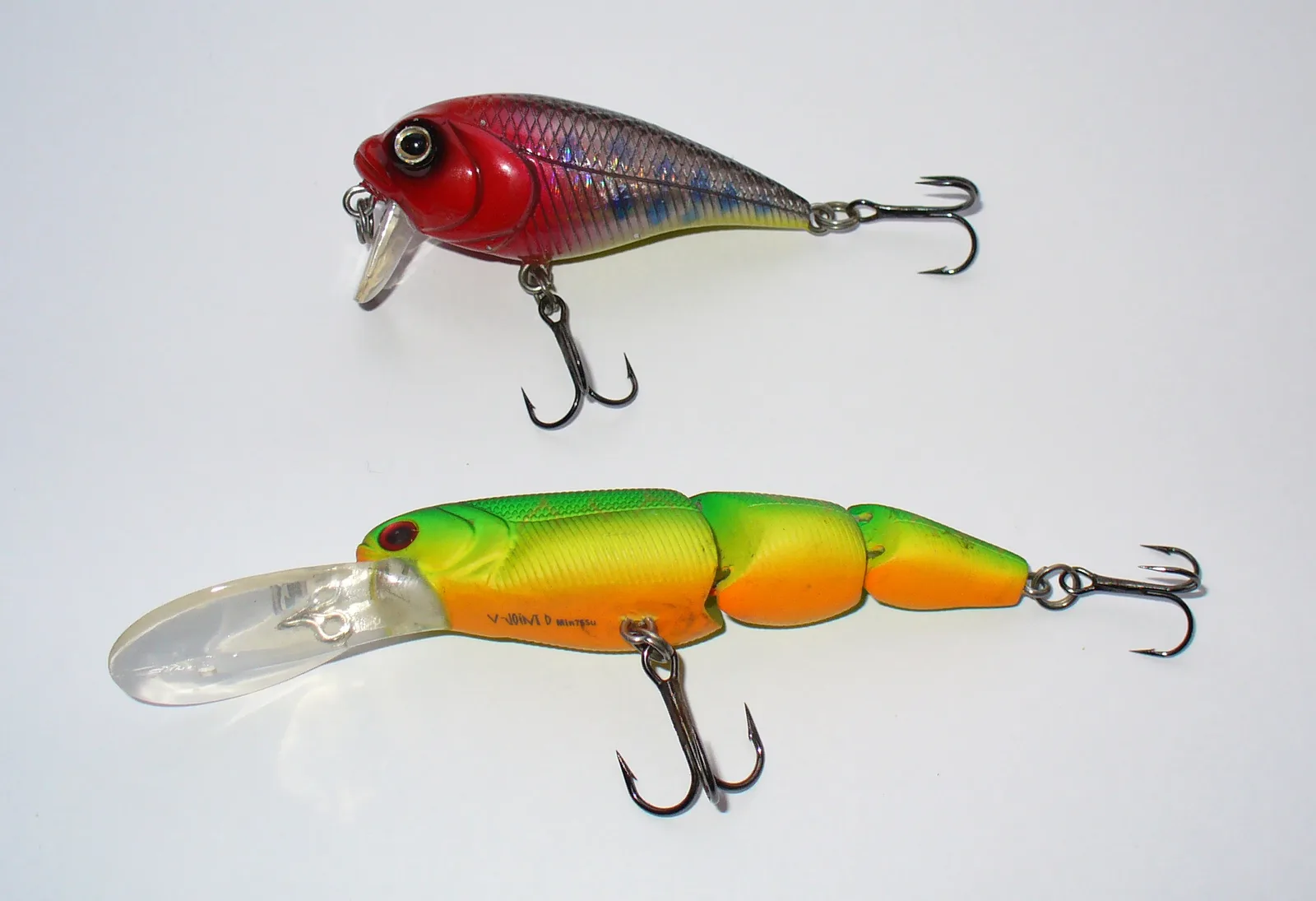
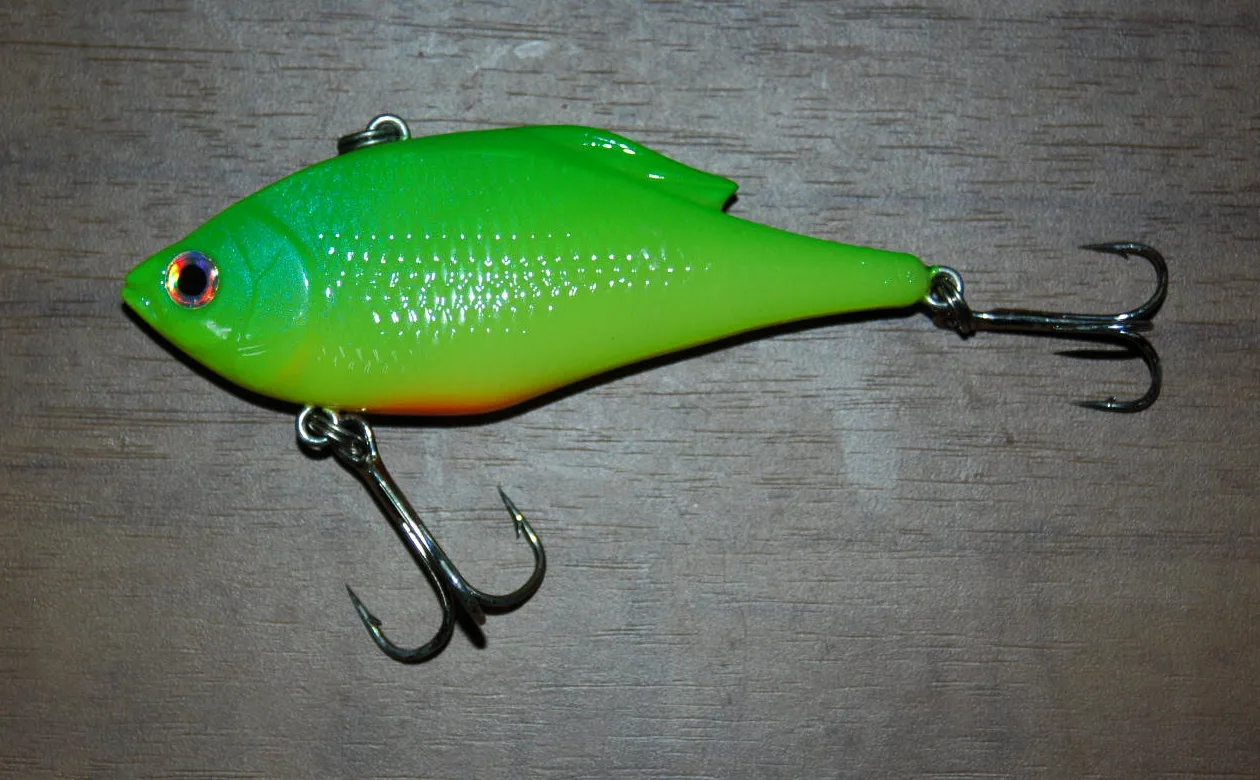
A squarebill crankbait is a short, fat crankbait with a square, stubby lip that runs 0–6 ft (0–1.8 m) and is built to be crashed into things. A round-lipped crankbait that hits a stump wedges its lip and hangs; a squarebill’s flat lip hits first, the body rolls off, and the bait kicks sideways and keeps swimming. That stumble, a baitfish bouncing off a log, is what a bass strikes. So the retrieve is the opposite of careful: cast past the laydown, the riprap, the dock or the stump row, and bang the bait off every piece of cover on the way back.
The first squarebill was whittled, not molded. Fred Young of Oak Ridge, Tennessee, carved more than 3,700 balsa Big Os by hand and sold them signed and numbered for $10 apiece. When Cotton Cordell put the plastic version in his 1973–74 catalog, it sold 1.3 million in 13 months.
Why doesn’t a squarebill snag?
A crankbait’s lip does two jobs: it pulls the bait down, and it meets the cover first. A long, round lip is a diving plane, angled to dig. When its curve meets a branch, it wedges in and the trebles follow.
A square lip is short and nearly flat-fronted, so it hits a stump broadside. The bait stalls for an instant, and its buoyancy and the corner of the lip tip it to one side. The body rolls off the wood before the hooks arrive.
The lip corners set how hard it kicks. The rounded corners of the Bandit 100 slip through cover with less deflection and get the bait back on track quicker. The sharper corners of the KVD 1.5 kick out wider.
Buoyancy is the other half. A plastic squarebill floats up slowly; a balsa one, like the Rapala OG Rocco or the Black Label Wreck, shoots up. A bait that rises fast clears a limb a slow floater would hang on.
When a squarebill does lock up in a laydown, do not pull. Give it a moment of slack and it usually backs out and floats free. That stunned rise off the cover is a second strike trigger in its own right.
What you need
- A squarebill. The Strike King KVD 1.5 is the reference bait, and the Bill Lewis SB-57 is its match in size and depth. A 1.0 or a Bandit 100 for small forage and pressured fish, a 2.5 for riprap and bigger water.
- A 7 ft to 7 ft 5 in (2.1–2.3 m) medium-heavy casting rod with a moderate action, glass or composite. The slow bend lets a bass take the bait before you feel it, keeps the trebles pinned, and lets the bait deflect rather than snag. In grass, a graphite cranking rod with a moderate bend has the power to snap the bait free.
- A baitcaster at 6.4:1 to 7:1. The slower end for a steady crawl through wood, the faster to cover a bank.
- 15–20 lb fluorocarbon around cover, 12 lb when a small bait needs to run deeper; Mark Menendez fishes 15–25 lb. Monofilament floats and stretches more, so it runs the bait shallower; the fluorocarbon vs monofilament page has the numbers. Braid only in grass.
- Sharp treble hooks, split-ring pliers and a hook file. Riprap and dock pilings dull a point in an afternoon; the tournament guides describe changing hooks daily.
Free card: what 26 species do at your water temperature
Plus one email a week on what's biting now. No sales pitches. Privacy.
How deep does it run?
The two standard-size baits, the KVD 1.5 and the SB-57, are 2 1/4 in (5.7 cm) long and rated 3–6 ft. The small ones run 2–4 ft.
The depth printed on the box is the maximum, on the line the maker recommends, with a long cast and the rod tip low. Thinner line runs it deeper and thicker line shallower, holding the rod tip high keeps it well above the rated depth, and a short cast never reaches the number at all.
These are the makers’ figures for the squarebills that keep coming up in the buyers’ guides.
| Model | Length | Weight | Rated depth | What sets it apart |
|---|---|---|---|---|
| Strike King KVD 1.5 | 2 1/4 in (5.7 cm) | 3/8 oz (11 g) | 3–6 ft (0.9–1.8 m) | The benchmark; silent, rattling and Hard Knock versions |
| Strike King KVD 2.5 | 2 3/4 in (7 cm) | 5/8 oz (18 g) | 3–6 ft (0.9–1.8 m) | Bigger profile, harder rocking wobble; riprap and deeper laydowns |
| Bill Lewis SB-57 | 2 1/4 in (57 mm) | 3/8 oz (11 g) | 3–6 ft (0.9–1.8 m) | Circuit-board lip, one-knocker rattle, floats up slowly |
| Lucky Craft LC 1.5 | 2.4 in (6 cm) | 1/2 oz rated; 3/8 oz (11 g) measured | 3–4 ft (0.9–1.2 m) | Once a premium bait, about $15 by TackleTour’s recollection; $8.99 list now; silent version for clear water |
| Bandit 100 | 2 in (5 cm) | 1/4 oz (7 g) | 2–5 ft (0.6–1.5 m) | Rounded lip corners slip through cover |
| Rapala BX Brat 03 / 06 | 2 in (5 cm) | 3/8 oz (11 g) | 3 ft or 6 ft (0.9 or 1.8 m) | Balsa core in a copolymer shell; two lips, one body |
| SPRO Little John 50 | 2 in (50 mm) | 1/2 oz rated; 3/8 oz (11 g) measured | 3–5 ft (0.9–1.5 m) | Tungsten weight transfer for distance; circuit-board lip |
Two baits on the list are rated 1/2 oz and weigh 3/8 oz on TackleTour’s scale, so the whole standard class casts about the same. The BX Brat is the odd one: the same 2 in body with two lips, a 3 ft lip and a 6 ft lip. It is the clearest demonstration anywhere that the lip, not the body, sets the depth.
Squarebills are the shallow row of the crankbaits hub’s depth table; deep diving crankbaits are its long-lipped end.
How do you fish it?
- Cast past the cover, parallel to a bank or a riprap wall rather than at it, so the bait runs along the cover for the whole retrieve instead of crossing it once.
- Reel steadily at a medium pace with the rod tip low, so the bait reaches its depth and stays there. Crawl the bait through and over the cover; do not burn it.
- Hit things. Steer the bait into the laydown, the dock post, the rocks. When it hits, keep reeling. The deflection is the trigger, and a yank with the rod tip is what sets the hooks in the wood.
- Slow down on contact. When the lip starts grinding a limb, ease the retrieve rather than stopping. If the bait locks, give it slack and let it float out.
- Pause after the deflection, half a second, when fish follow and do not eat. The bait rising off the cover is the second trigger.
- Cast again to the same piece of cover, then once more from a different angle. Mark Menendez, with three Bassmaster wins, fishes squarebills this way: bass hold together, and the second fish is often behind the first.
- Set the hook with a sweep, not a snap, when the rod loads; the moderate rod does the rest.
Where and when does it work?
| Cover | Depth | Season | Color |
|---|---|---|---|
| Riprap, rock banks | 2–5 ft (0.6–1.5 m) | Pre-spawn, 48–55 °F (9–13 °C); fall | Craw: red, brown, orange belly |
| Laydowns and stump rows | 1–4 ft (0.3–1.2 m) | Spring and fall | Craw in cold water, shad in warm |
| Docks | 2–5 ft (0.6–1.5 m) | Post-spawn, summer mornings | Shad, bluegill |
| Shallow grass edges | 1–3 ft (0.3–0.9 m) | Spring | Chartreuse, sexy shad |
| Bank cover in stained water after rain | 1–3 ft (0.3–0.9 m) | Any | Chartreuse with a black back, fire tiger |
| Shad in the creeks | 2–5 ft (0.6–1.5 m) | Fall, 75 cooling to 55 °F (24–13 °C) | Shad, chrome |
Kevin VanDam’s six-season guide puts a deep craw crankbait and a lipless bait in pre-spawn and shallow-to-medium crankbaits in fall, and calls summer, where weeds are thin, the best time to crank. The squarebill is the shallowest of those crankbaits, and the one for the bank angler: everything it fishes is within a cast of the shore.
In summer the squarebill does not go away; it moves to shade. Fish dock posts, the deeper branches of a laydown, and grass edges early and late, in shad colors first and bluegill when the fish short-strike. In cold water a squarebill is too fast, and the jerkbaits page takes over. The best bass lures page puts the squarebill on its season table, next to the other lures that cover a largemouth year.
Silent, rattling or hard knock?
Squarebills come in three sounds, and the choice is as real as the color.
- Rattling: a chamber of loose beads or shot that rattles on every wobble.
- One-knocker: a single heavy ball that clacks once per wobble, like the SB-57’s “subtle one-knocking noise” and Strike King’s Hard Knock.
- Silent: nothing inside.
One Wired2Fish reviewer fished the KVD 1.5 Hard Knock on a tournament lake where the shallow crankbait bite had faded under weekend pressure. The one sound the bass had not heard got bites again: a pronounced clack you can hear from the boat as the bait comes in.
The working rule follows from that. Stained water, wind and a fast retrieve want a rattle. Clear, calm, pressured water wants silence, which is why the KVD 1.5 Silent and the Lucky Craft LC 1.5 Silent exist. A lake where everyone throws the same rattling squarebill wants the knock. Carry one of each in the same color before you carry one sound in six colors.
Where did the squarebill come from?
Every squarebill on the table descends from a hand-carved balsa bait. Fred Young whittled his Big Os in Oak Ridge, Tennessee, named them for his brother Otis, “Big Otis”, and sold them for $10 each. Bobby Murray, who had won the first Bassmaster Classic, brought one back from Beaver Lake, Arkansas, to Cotton Cordell. The plastic Big O was in Cordell’s 1973–74 catalog.
Wired2Fish’s lure collectors call it “the original squarebill, the one that got it all started”, designed for grass with a tight wiggle and good deflection. Jim Bagley’s Balsa B followed in the 1970s as the original balsa squarebill. It was so buoyant that an angler could stop on contact and let it float straight up out of a laydown.
Among modern plastic squarebills, the Lucky Craft RC 1.5 and 2.5, the baits Rick Clunn designed, earned a cult following; one Wired2Fish editor threw nothing else for five years. Then Kevin VanDam put his own dimensions into the Strike King KVD 1.5.
In February 2011, VanDam cranked the 1.5 and the 2.5 in the Louisiana Delta and won the Bassmaster Classic in a black-back chartreuse. His 69 lb 11 oz was then the heaviest winning weight of the five-bass era. It stood until Easton Fothergill’s 76 lb 15 oz at Lake Ray Roberts in 2025. The KVD 1.5 has been the bait every other squarebill is measured against since.
Rapala’s balsa line, the BX Brat and Ott DeFoe’s OG Rocco, carries the Big O’s wood into the present.
Mistakes to avoid
- Fishing it in open water. A squarebill with nothing to hit is a small, dull crankbait; fish it into cover, or tie on something else.
- Stopping or yanking on the impact. Keep reeling through the deflection; slack only when it locks.
- A fast, stiff rod. The fish come off on the jump; glass or composite, moderate action.
- Casting at the cover instead of along it. A parallel cast keeps the bait against the cover for the whole retrieve, not for one crossing.
- Not checking the hooks. Riprap dulls a treble in an afternoon; a bait that runs true with dull hooks loses the fish it earned.
Squarebill, lipless or spinnerbait?
| Squarebill | Lipless crankbait | Spinnerbait | |
|---|---|---|---|
| Cover | Wood, rock, docks; deflects | Grass; rips free | Wood and grass; the arm guards the hook |
| Depth | 0–6 ft (0–1.8 m) | Any; it sinks | 1–10 ft (0.3–3 m) |
| Trigger | Deflection off cover | The rip out of grass, the fall | Blade flash and thump, a bump into cover |
| Water color | Any; craw colors in stained | Stained | Stained to muddy |
| Hooks | Trebles; snags in grass | Trebles; snags in wood | Single; the least snagging |
On wood and rock the squarebill wins. On grass the lipless crankbait wins, and in mud and wind the spinnerbait for bass wins. Most spring days on a reservoir, all three are tied on; the lures hub maps the rest of the families.
Free download
The water temperature card
Read your water temperature and the card tells you who is spawning, who is feeding and what to throw. 26 species, 16 pages, for your phone and the tackle box.
Plus one email a week on what's biting now. No sales pitches. Privacy.
Related
Section guide
Crankbaits and Jerkbaits: Depth Classes, Lips and How to Fish ThemA crankbait's lip sets its depth: squarebills 0–6 ft, medium divers 6–12, deep divers to 25. Which class to throw, how to fish it, and the rod and line.
 Jerkbait: How to Fish It in Cold Water, the Cadence, and Which to Buy
A jerkbait is a slim minnow plug you twitch and pause; in cold water a suspender hangs still and bass bite on the pause. Cadence, depths and six models.
 Lipless Crankbait: How to Fish It, Sizes, and the Rat-L-Trap Story
A lipless crankbait sinks, rattles and fishes any depth: eight models, six retrieves, the pre-spawn grass rip, and the soft rod that keeps trebles pinned.
Sources
- Wired2Fish (Shaye Baker), best squarebill crankbaits for bass
- Wired2Fish (Walker Smith), Strike King KVD 1.5 Hard Knock squarebill review
- Wired2Fish, 8 cult-classic squarebills you need to own
- Louisiana Sportsman, an old crankbait becomes new again (the Big O story)
- Rapala, BX Brat specifications
- Bandit Lures (Lurenet), Bandit 100 series
- Tackle Warehouse, Bandit Series 100 crankbait (length, weight, depth)
- Anglers Channel, ICAST 2019: Bill Lewis SB-57
- Tackle Warehouse, Bill Lewis SB-57 squarebill crankbait (depth, rattle, float)
- Tackle Warehouse, Strike King KVD HC squarebill (Black Back Chartreuse, the 2011 Classic color)
- In-Fisherman, Fothergill wins the 2025 Bassmaster Classic with a record weight
- Discount Tackle, Strike King KVD Square Bill 1.0 Silent (maker specs)
- Discount Tackle, Strike King KVD Square Bill 1.5 Silent (maker specs)
- Discount Tackle, Strike King KVD Square Bill 2.5 Silent (maker specs)
- TackleTour, Lucky Craft LC 1.5 review (measured weight and depth)
- TackleTour, SPRO Little John review (measured weight and depth)
- Tackle Warehouse, squarebill crankbait patterns and techniques
- Advanced Angler, Mark Menendez on squarebills
- Bassmaster, 2011 Bassmaster Classic by the numbers
- Bassmaster, KVD's 6-season bass guide
- Field & Stream (Shaye Baker), best crankbaits of 2026