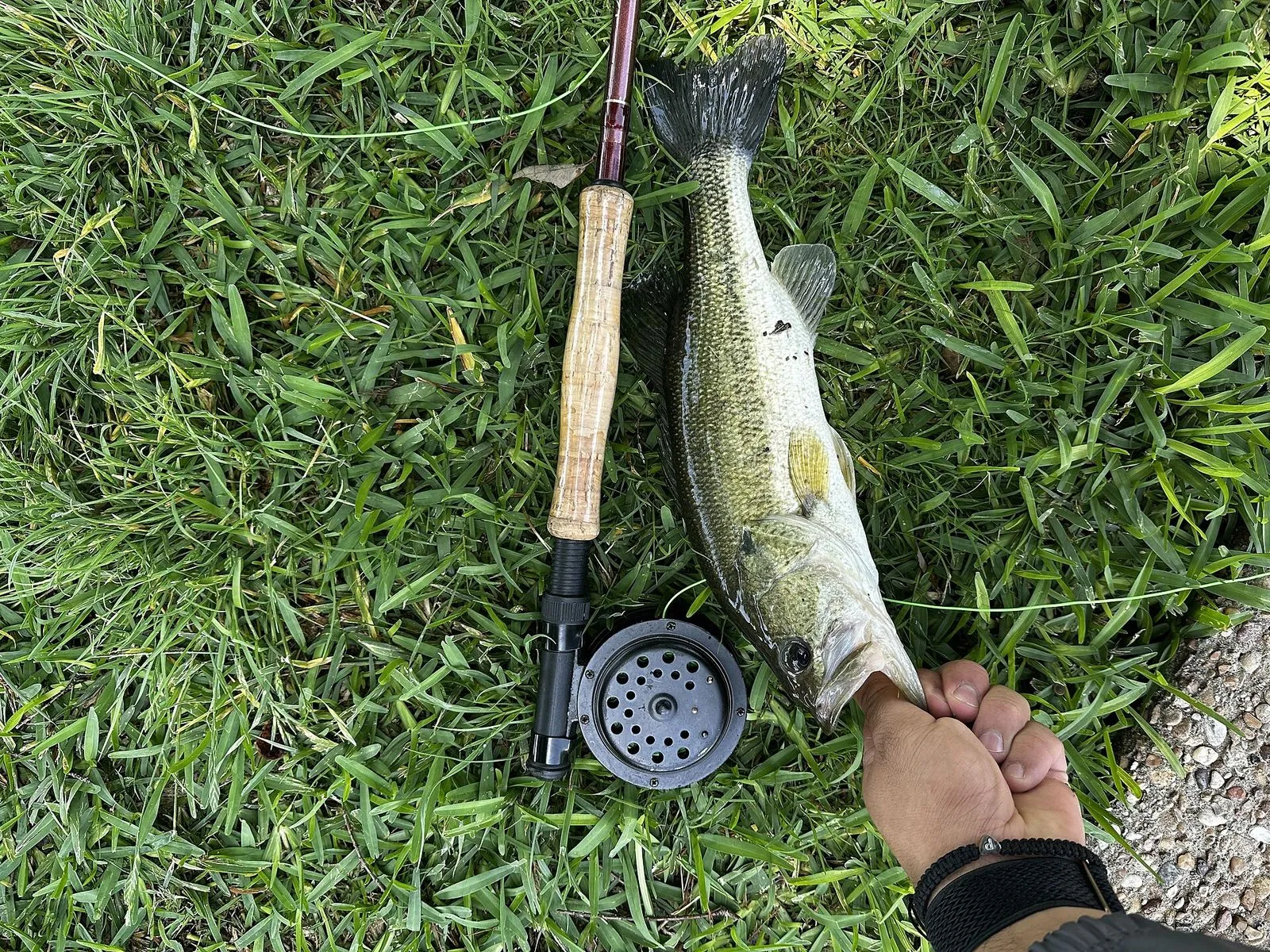
To fish for bass you need to know two things: where the bass are today, and what to put in front of them. Both follow the water temperature. Largemouth live in almost every pond, lake and slow river in the country, and they are a forgiving fish to learn on, because they eat almost anything that moves near cover. One spinning outfit, five lures and a cheap thermometer cover a beginner’s whole first year.
Bass are shallow when the water is 55 to 75 °F and at dawn and dusk in summer; deep when it is cold or hot and the sun is high. Fish the right depth and half the problem is solved.
What you need: one outfit, five lures
One spinning outfit covers a beginner’s year, and the five lures below cover every row of the season table. Prices are list or retail prices from October 2026; sale prices run $30–40 lower across the set.
| Item | Pick | Size | List price |
|---|---|---|---|
| Rod and reel | Ugly Stik GX2 combo, or Pflueger President combo | 7 ft (2.1 m) medium, size 30–35 reel | $80–112 |
| Main line | PowerPro braid | 10 lb, 150 yd (137 m) | $18.50 |
| Leader | Seaguar Red Label fluorocarbon | 10 lb, 200 yd (183 m); lasts seasons | $16.99 |
| Hooks and weights | Gamakatsu offset EWG 3/0 and 4/0; Eagle Claw 1/4 oz (7 g) bullet weights | two 5-packs; 8-pack | $12.77 |
| Stick worm | Yamamoto Senko | 5 in (13 cm), pack of 10 | $7.99 |
| Creature bait | Zoom Baby Brush Hog | 4 in (10 cm), pack of 12 | $6.49 |
| Squarebill crankbait | Strike King KVD 1.5 | 2 1/4 in (6 cm), 3/8 oz (11 g) | $9.99 |
| Spinnerbait | Strike King Premium Plus, white | 3/8 oz (11 g) | $10.99 |
| Walking topwater | Heddon Super Spook Jr | 3 1/2 in (9 cm), 1/2 oz (14 g) | $9.99 |
| Total | $175–205 |
A 7 ft medium rod with a fast tip casts a 1/4 oz worm and a 1/2 oz topwater off the same blank. That range is why it is the rod to start with. The beginner’s rod page compares eight combos at this spec; the spinning rod and spinning reel pages explain the parts. Braid casts far and never twists on a spinning reel. The 4–6 ft (1.2–1.8 m) fluorocarbon leader is near-invisible and sinks, which a worm on the bottom wants. Join the two with a double uni or Alberto knot and tie every lure on with a Palomar. Add polarized sunglasses, a water thermometer and the license your state sells online; fishing for beginners has the rules by state and age.
Where are the bass today?
Largemouth spawn at about 60 °F (16 °C), stop feeding below 41 °F (5 °C) and above about 98 °F (37 °C), and spend the rest of the year moving between those points. Kevin VanDam’s six seasons turn that into a table, quoted here as his, with the beginner’s lure for each row.
| Season | Water temperature | Where the bass are | Beginner’s lure |
|---|---|---|---|
| Winter | ≤48 °F (9 °C) | Deep, on steep banks, bluffs and channel drops; slow | A jig or a stick worm fished very slowly on the bottom; the hardest season, skip it at first |
| Pre-spawn | 48–55 °F (9–13 °C) | Moving from deep water toward spawning flats, holding on the first structure outside them | Spinnerbait slow-rolled; squarebill on rock and wood |
| Spawn | 55–70 °F (13–21 °C) | Shallow, 2–8 ft (0.6–2.4 m), on flat protected banks, on and around nests | Weightless stick worm; wacky rig |
| Post-spawn | 70–75 °F (21–24 °C) | Just off the spawning flats, near the first drop and vertical cover | Walking topwater early and late; spinnerbait |
| Summer | 75–90 °F (24–32 °C) | Deep in the day (points, humps, ledges, 10–25 ft / 3–8 m), shallow at dawn and dusk; under weed mats | Topwater at dawn; Texas rig on deep structure and in weeds |
| Fall | 75 down to 55 °F (24 down to 13 °C) | Following shad into creeks and coves, shallow and active | Spinnerbait, squarebill; cover water |
The spawn row is the easiest fishing of the year. The bass spawn page has its calendar by region, February in Florida to June in Minnesota. The bass water temperature page goes band by band, with one rule worth carrying: a warming 52 °F (11 °C) fishes better than a stable 58 °F (14 °C) after a cold front.
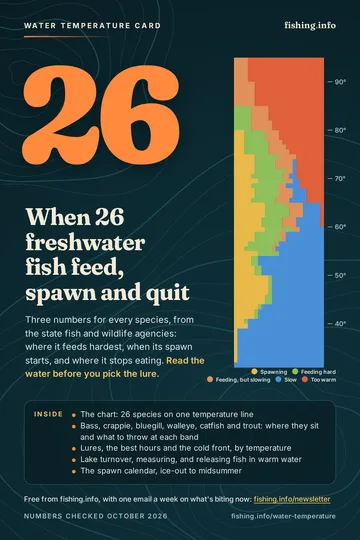
Free card: what 26 species do at your water temperature
Plus one email a week on what's biting now. No sales pitches. Privacy.
Where to cast: read the bank
The table gives the depth; this list gives the spot. Bass hold beside something and wait, so every cast goes to an edge, a shadow or a change. In roughly the order a beginner will find them productive:
- Points. A finger of land that keeps going under the water, giving a bass shallow and deep water within one tail-kick. Cast along it, not across it, so the lure follows the depth change.
- Docks. Shade, posts to hold against and the bluegill under them. Fish the shady side and the deepest posts; a stick worm skipped under the walkway reaches the bass nobody else casts to.
- Grass edges. The outside line where the weeds stop is the most reliable edge in a weedy lake. Spinnerbait along it, Texas rig into the gaps.
- Laydowns. A fallen tree is cover from trunk to last twig. Outer branches first, then the trunk, so a hooked fish does not spook the one deeper in.
- Shade lines. In summer the shadow of a bank, a tree or a bridge is where bass sit at midday, like a dog under a porch. Cast along it.
- Riprap and seawalls. Broken rock warms early in spring and holds crayfish; a squarebill banged along it is the classic pre-spawn cast.
- Pinch points and current. Where a creek arm narrows or water runs under a bridge, bass wait on the downstream side of whatever breaks the flow. From the bank, these funnels into spawning bays are the first place to look.
None of this is in open, featureless water. If you cannot see or feel something under the lure, move.
When to go
Dawn and dusk are measured, not folklore. In a 1995 laboratory study, largemouth caught the prey they struck at more than 95% of the time in dim light, 62% by starlight and almost never in full dark. A bass hunts by sight and does best when the light hides it but still lets it see. That means the first and last hour of the day, and in summer those are the only hours when the shallow rows of the table apply. The best time to fish for bass page has the hour-by-season version.
Weather works through the same two levers, light and temperature. Cloud and a light wind stretch the dawn bite through the day. A cold front is the one event worth planning around: the day before it is often the best day of the week, and the bright, calm day or two after it the slowest. The cold front page says what to change afterward: slow down, fish tight to cover, a little deeper. Wind is a friend on a spinnerbait. Cast to the bank it blows onto, where it pushes the baitfish.
The first day, step by step
- Check the water temperature and find the row in the table. It tells you the depth and the cover to fish.
- Go to the cover. Pick two or three spots from the list above: a point, a dock, a grass edge.
- Start with the Texas rig or the stick worm on the bottom. Cast past the cover, let it fall on a slack line, watch the line. Lift, drop, wait. The Texas rig page has the rigging and the Senko page the six ways to fish a stick worm. The 2025 Elite Series data says this is still the bait that catches the most bass.
- If nothing bites in twenty minutes, change speed, not color. Tie on the spinnerbait or the squarebill and cover the same water faster. Bass that will not pick up a worm often hit a moving bait.
- Fish the low light on top. In post-spawn and summer, the first and last hour belong to the walking topwater along the same cover.
- Set the hook by reeling until the rod loads, then sweeping, not by jerking at the first tap. Keep the rod bent and the line tight; bass jump and throw slack hooks.
- Handle the fish by the lower jaw, horizontally for a big one, with wet hands. Quick photo, back in the water within half a minute.
- Write down the temperature, the depth and what worked. Bass fishing is pattern fishing: what caught them today catches them tomorrow in the same conditions.
The five lures and when each wins
| Lure | Rig | When | How |
|---|---|---|---|
| 5 in stick worm | Weightless on a 3/0 wide-gap hook, or wacky on an O-ring | Spawn, post-spawn, any time fish are shallow and slow | Cast to cover, let it fall, lift and drop |
| Creature bait, Texas rig | 4/0 hook, 1/4 oz (7 g) bullet weight, point buried | All year on the bottom; the all-round bait | Hop and drag along the bottom |
| Squarebill crankbait | Tied direct, moderate retrieve | Pre-spawn and fall on rock and wood, 0–5 ft (0–1.5 m) | Reel steadily and let it bounce off cover |
| 3/8 oz spinnerbait | Tied direct | Pre-spawn, fall, stained water, wind | Steady retrieve just above the cover; slow-roll it deeper in cold water |
| Walking topwater | Tied direct, on mono or braid, never fluorocarbon | Post-spawn and summer at dawn and dusk, 65–85 °F (18–29 °C) | Twitch the rod tip so it walks side to side; pause after a boil |
Depth and cover come before lure and color, and a soft plastic on the bottom is the default. The squarebill and spinnerbaits for bass pages carry the retrieves in detail, and the best bass lures page shows what the 2025 Elite Series was actually won on.
What a bite feels like, and how to set the hook
A bass bite on a worm is rarely a pull. It is a tick in the line, the line moving sideways, or the line going slack when it should be falling, because the fish has picked the bait up and swum toward you. On a moving bait the rod simply loads up and the fish has usually hooked itself.
The hookset is where most first fish are lost. Denny Brauer describes the mistake: recreational anglers, “as soon as they realize they have a bite, they rear back and pull”. Slack line and a rod already pointing at the sky give the hook nothing to drive against. On a spinning rod with braid: drop the rod tip toward the fish, reel until you feel weight, then sweep the rod low and to the side in one firm motion. Braid does not stretch, so firm is enough. On the squarebill and the spinnerbait, Rick Clunn’s rule is the one to copy: set once, firmly, then keep the pressure on.
Set the drag before the first cast, at a quarter to a third of the line’s breaking strength. With a 10 lb leader that is about 2.5–3.5 lb (1.1–1.6 kg) of pull: enough to drive the hook, not enough for a 5 lb (2.3 kg) bass to break the leader on a surge. Pull line off by hand and turn the knob until it comes grudgingly. When a bass jumps, drop the rod tip to the water so it has no slack to throw the hook with.
Landing and releasing the fish
Land a bass by its lower jaw: thumb inside the mouth, fingers under the chin, and the fish comes up calm. Hold anything over about 3 lb (1.4 kg) horizontally with the other hand under the belly; its jaw was not built to carry its weight. Wet your hands first.
Two numbers decide how the fish does afterward. The first is where the hook sat: jaw-hooked bass die at 1–2%, and more than half of those hooked in the throat, so cut the line on a bass that has swallowed the worm. The second is air time. At 77 °F (25 °C) and above, a largemouth starts to lose its balance after 30 seconds out of the water. In summer: photo first, unhook in the water, gone before you have counted to thirty. The catch and release page has the ten-step version and the studies behind both numbers. Keeping a bass is legal within your state’s limits; a largemouth takes three years to reach 16 in (41 cm), which is why most anglers put them back.
The three mistakes that keep beginners fishless
- Fishing open water. The cast to the middle of the lake passes nothing a bass wants. If the spot has no edge, the spot is wrong, not the lure.
- Fishing the wrong depth for the temperature. The commonest reason a spring angler blanks in July is fishing the bank at noon when the fish are on the first drop in 12 ft (3.7 m). Read the thermometer before the tackle box.
- Changing colors instead of speed or depth. Two colors cover a beginner’s year: green pumpkin for the plastics, white for the moving baits. When the bite is off, change how fast and how deep the lure moves, and only then what it looks like.
When something else wins
In very clear water, or on a lake that sees a lot of boats, the finesse rigs on the rigs page out-fish everything here: the Ned rig and the drop shot. In matted grass it is a frog from the topwater hub on a heavier rod. And when a video says the fish are on structure, not cover, the water and structure terms say what the difference is.
After the first season, the largemouth bass page explains why the fish does what the table says, and the bass hub carries the same season pattern for smallmouth and spotted bass.
Free download
The water temperature card
Read your water temperature and the card tells you who is spawning, who is feeding and what to throw. 26 species, 16 pages, for your phone and the tackle box.
Plus one email a week on what's biting now. No sales pitches. Privacy.
Related
Section guide
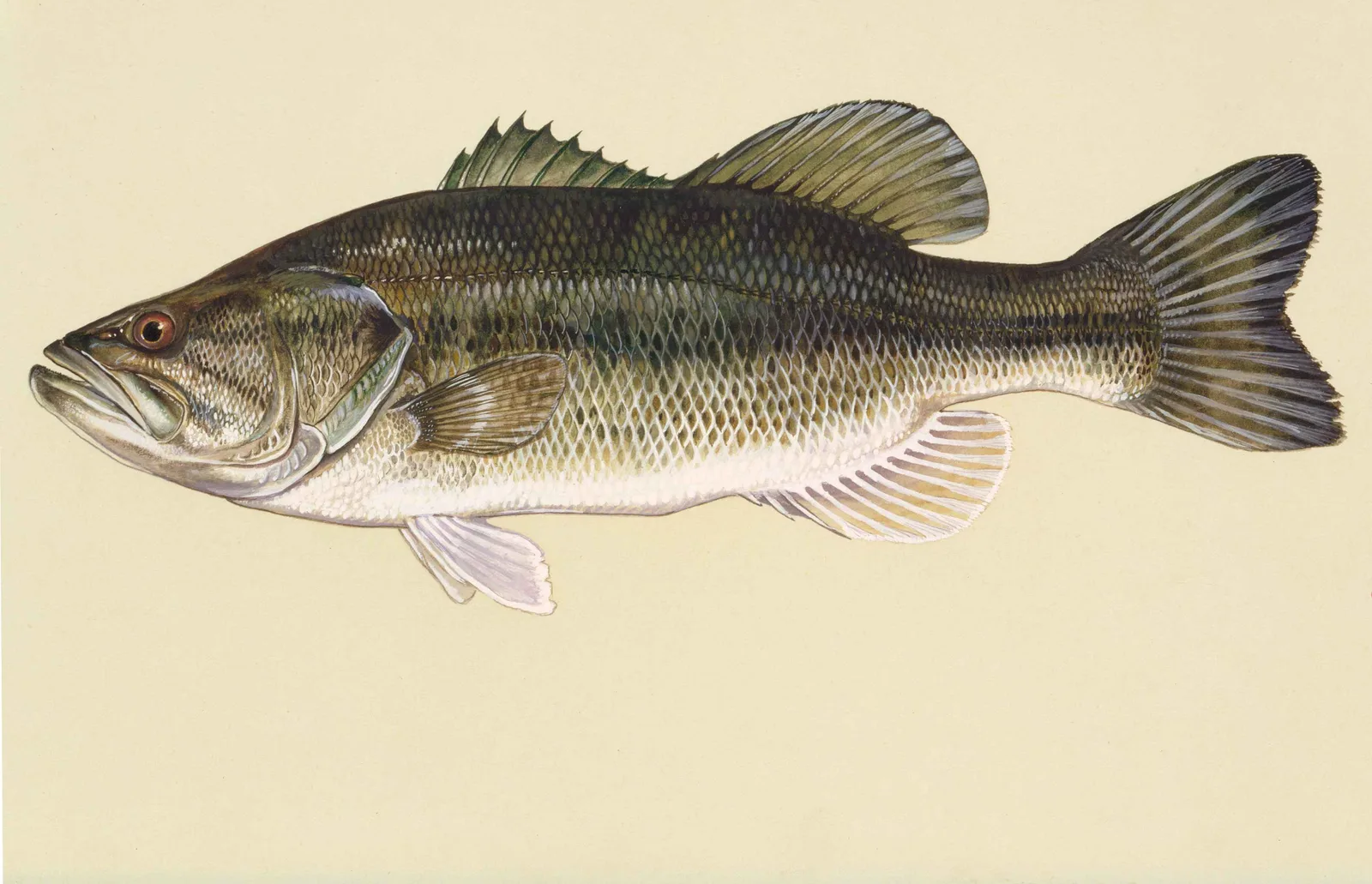
Bass Fishing: Where the Bass Are, What to Throw, and the Three Bass You Will MeetBass fishing from the angler's side: where largemouth, smallmouth and spotted bass are at each water temperature, what to throw first, how to tell them apart.
 Best Time to Fish for Bass: Season, Time of Day and Weather
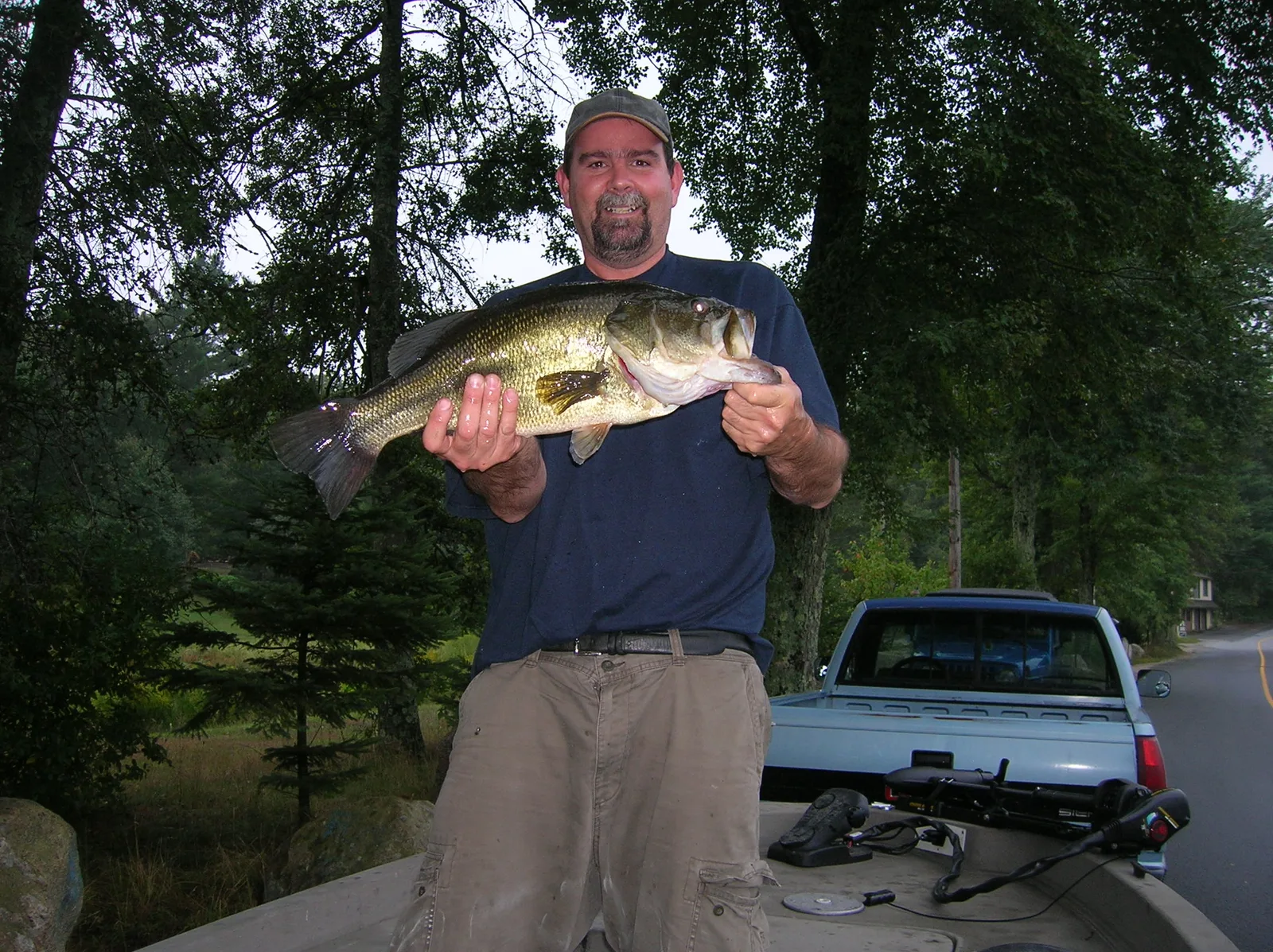
The best time to fish for bass is the pre-spawn at 48–55 °F and the fall feed, at dawn and dusk. Season table, hours, night and weather.
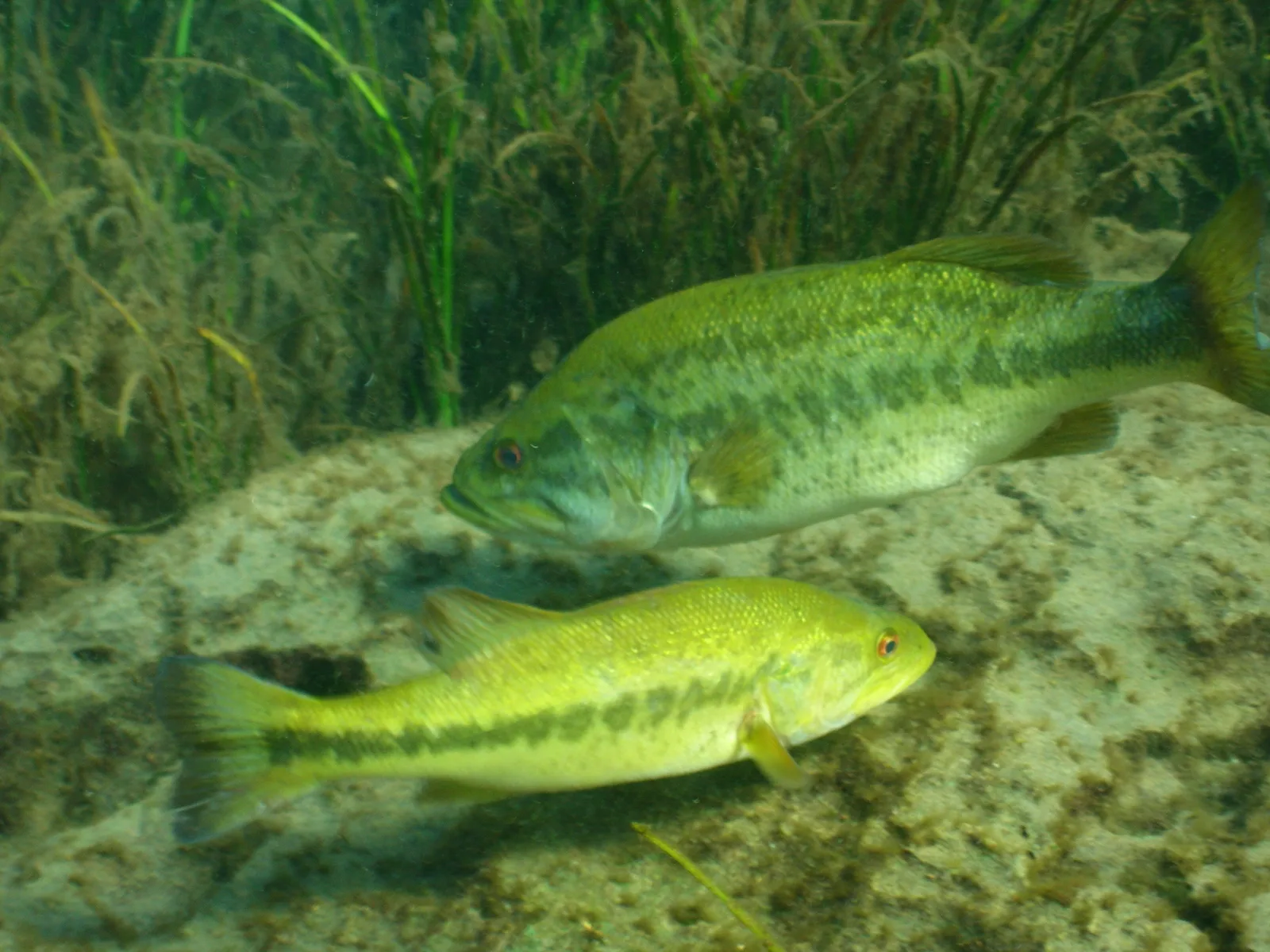 When Do Bass Spawn? Water Temperature and Timing by Region
Bass spawn when the water holds about 60 °F: February in Florida, June in Minnesota. The temperature bands, a calendar by region and how to fish each stage.
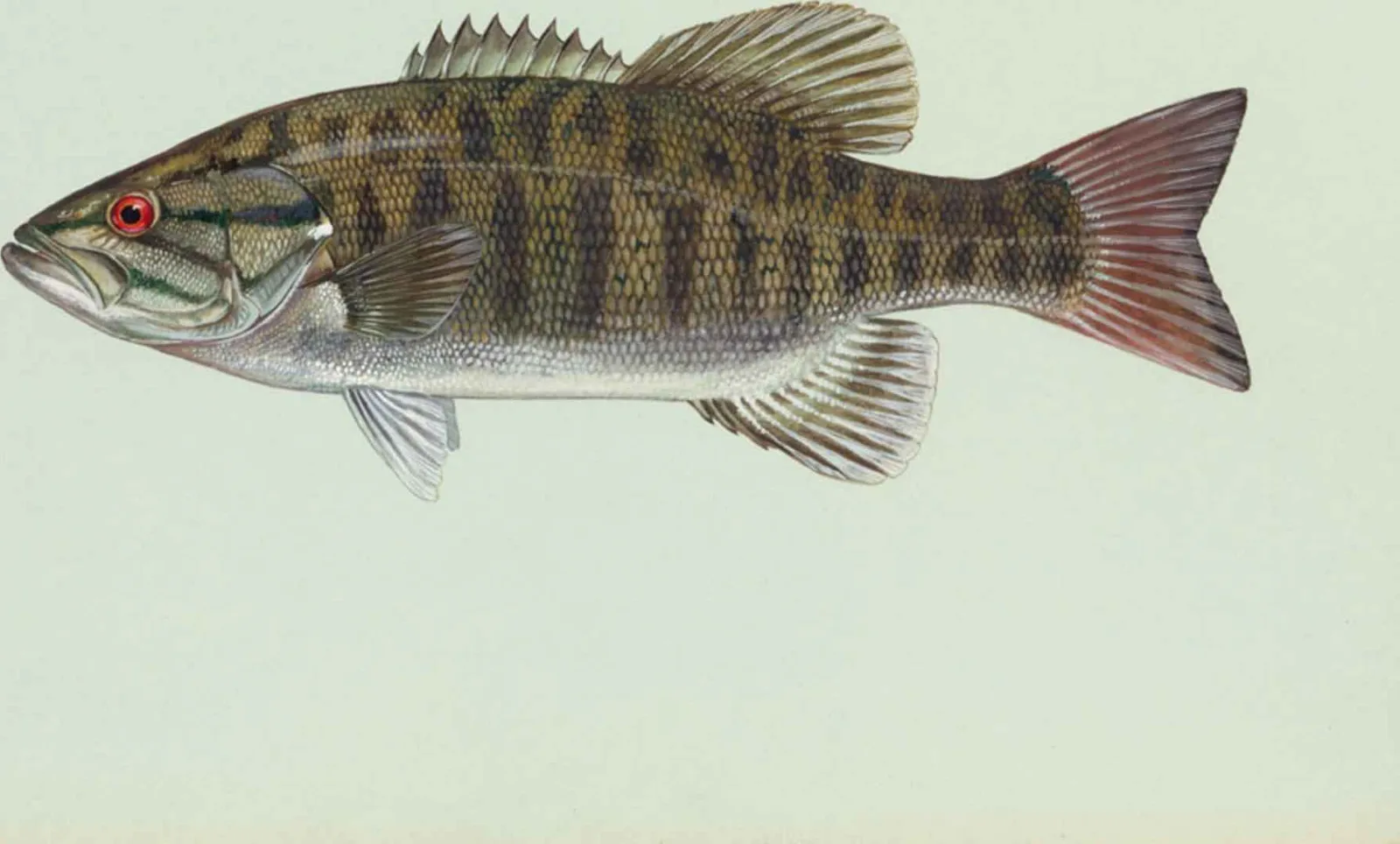 Smallmouth vs Largemouth Bass: How to Tell Them Apart
Smallmouth vs largemouth bass: the jaw, the stripe and the dorsal fin settle the identification in seconds. Then habitat, size, records and how each one fights.
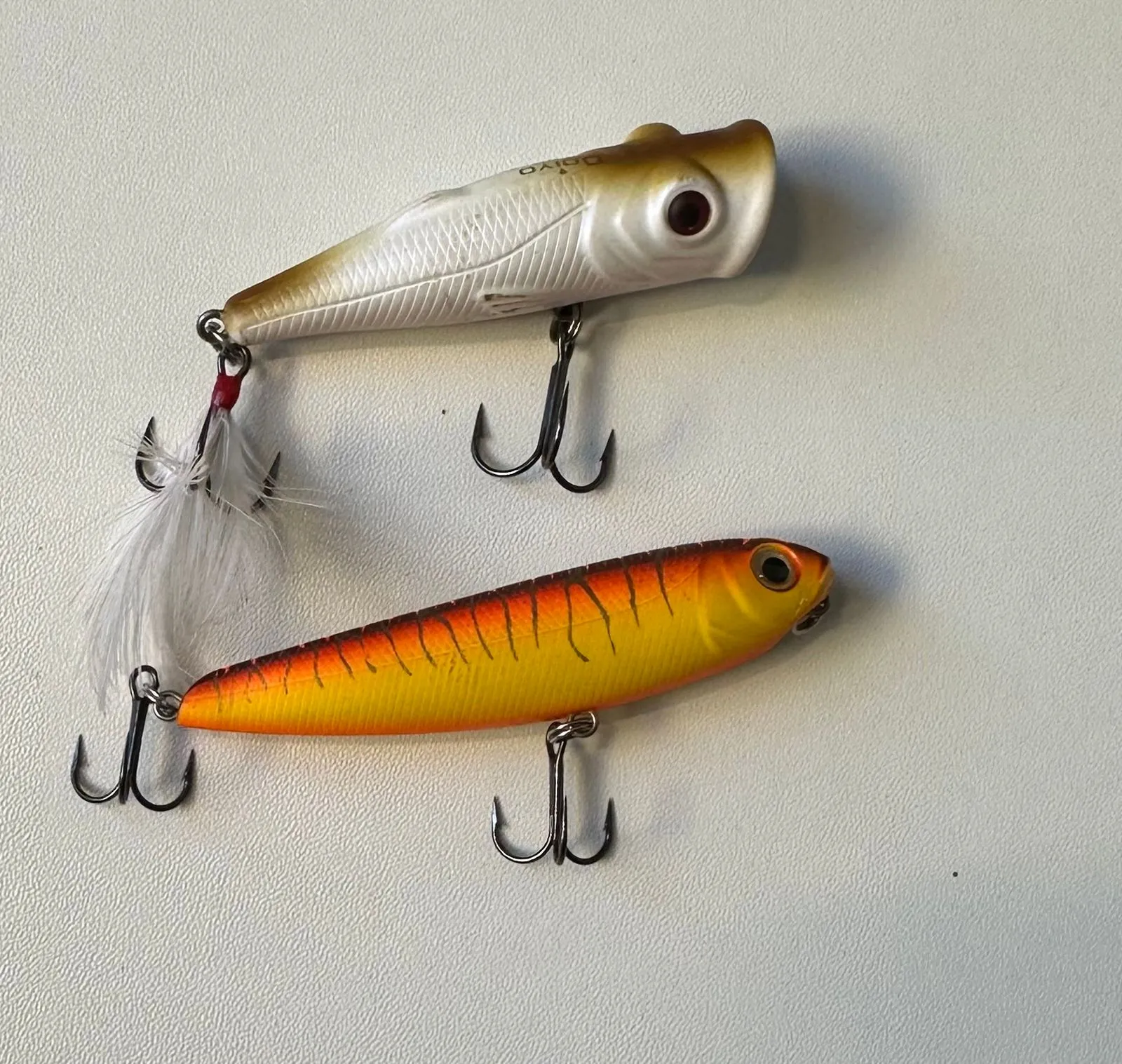 Best Bass Lures: What Won the 2025 and 2026 Elite Series, Season by Season
Best bass lures from two seasons of Elite Series winning baits: a lure for each water color, depth, cover and season, with smallmouth and spotted bass picks.
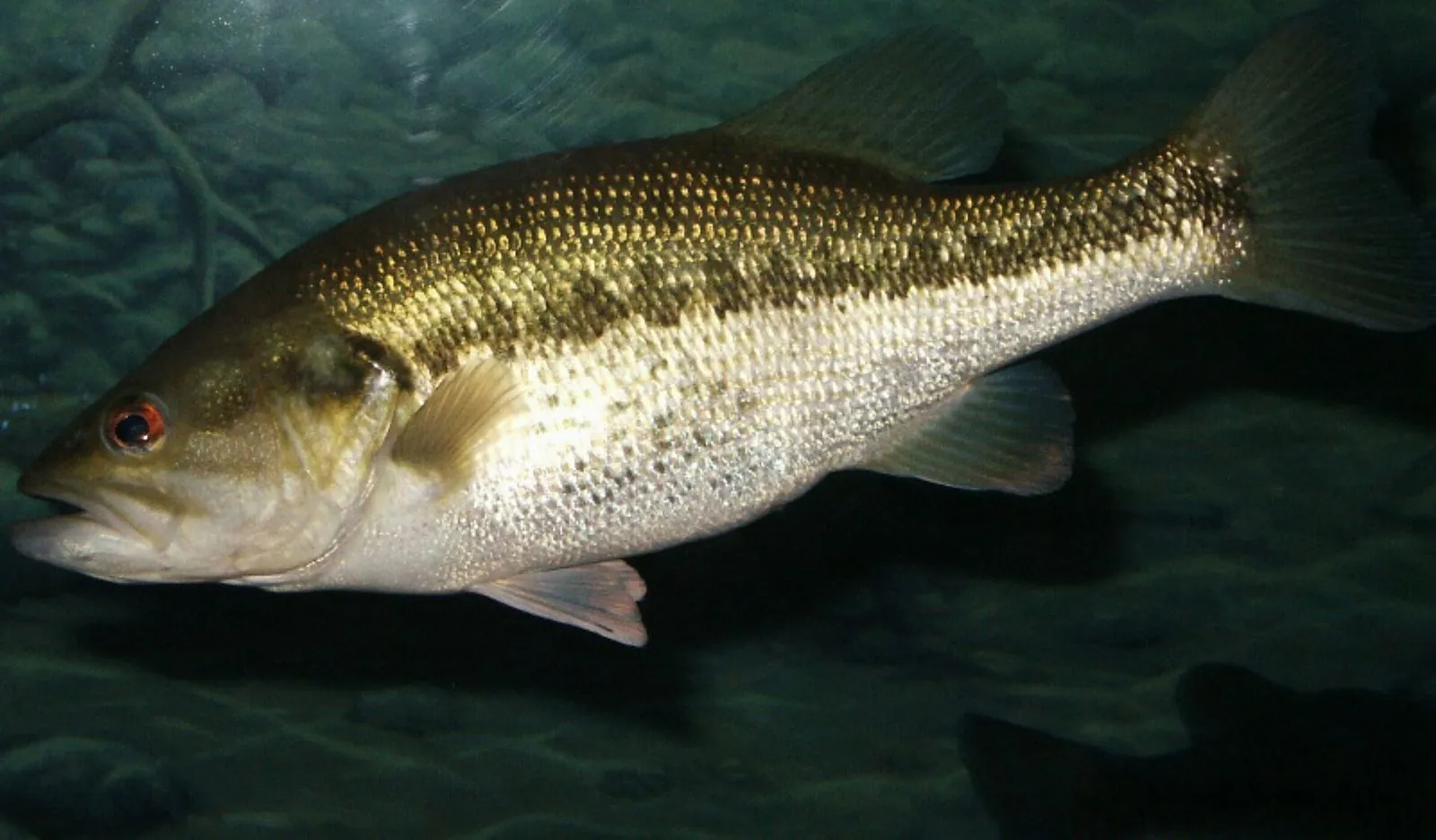 World Record Largemouth Bass: Perry, Kurita and Dottie
The world record largemouth bass is 22 lb 4 oz, caught in Georgia in 1932 and tied in Japan in 2009: the documented story, the IGFA rules, and Dottie.
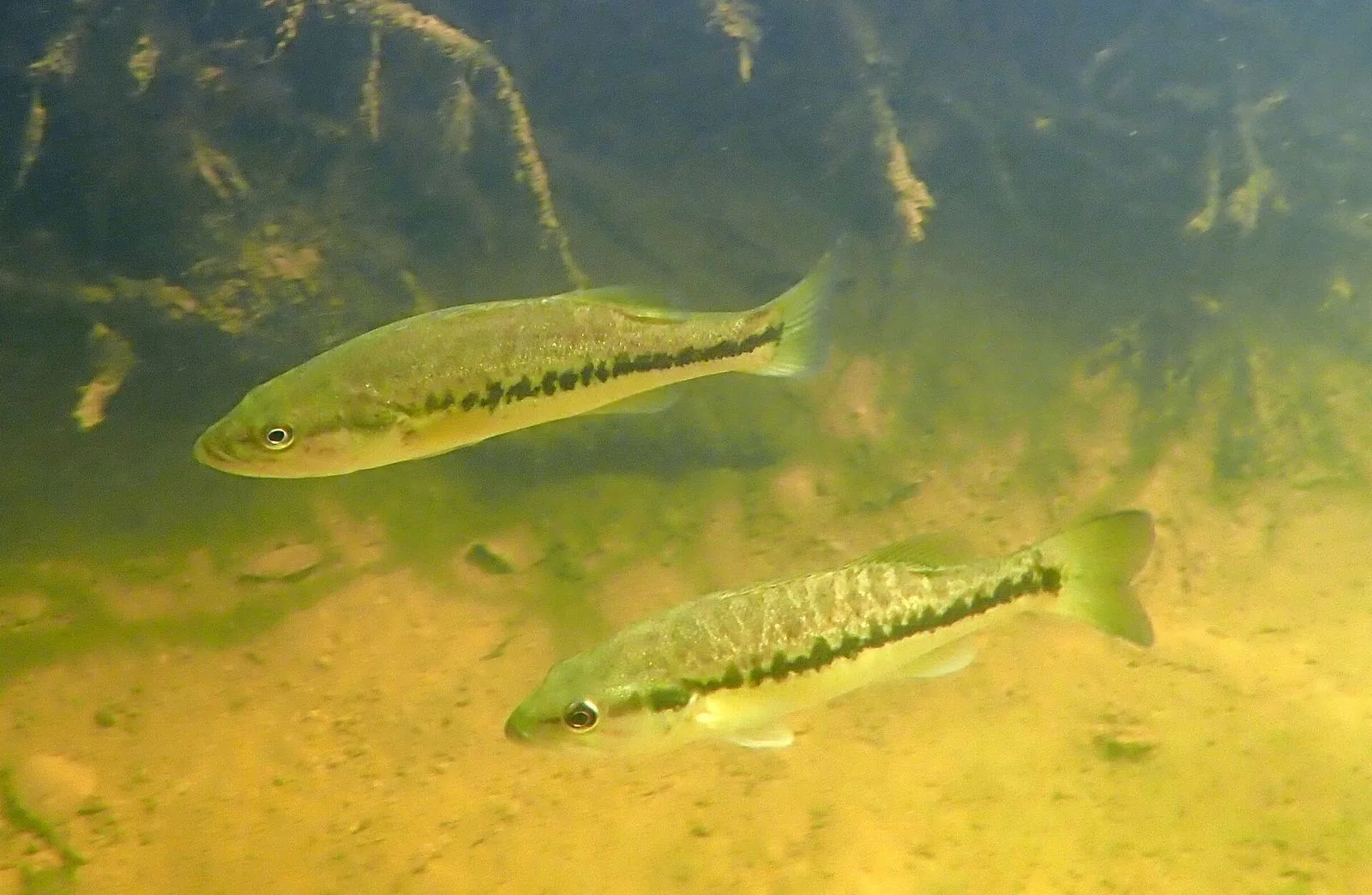 Spotted Bass: How to Tell It From Largemouth and Alabama Bass
Spotted bass from the agency data: the tooth patch, jaw and scale counts that separate it from largemouth and Alabama bass, habitat, spawning, and records.
Sources
- Bassmaster, KVD's 6-season bass guide
- Texas Parks and Wildlife, largemouth bass species profile
- U.S. Fish and Wildlife Service, largemouth bass
- Bassmaster, Fishing rods: lengths, powers and actions
- Bassmaster, Best of 2025 Elite Series top lures
- Bassmaster, The pros' guide to setting the hook (Brauer, Clunn)
- Tactical Bassin (Matt Allen), Best fishing line: braid, mono or fluorocarbon
- Wired2Fish (Jason Sealock), How to catch bass: pinch points, transitions, bank fishing
- McMahon, T. E. and Holanov, S. H. (1995), Foraging success of largemouth bass at different light intensities, Journal of Fish Biology 46:759–767
- FishTalk Magazine, Setting a fishing reel drag
- Cooke, S. J. and Suski, C. D. (2005), Do we need species-specific guidelines for catch-and-release recreational angling, Biodiversity and Conservation 14:1195–1209
- Bartholomew, A. and Bohnsack, J. A. (2005), A review of catch-and-release angling mortality, Reviews in Fish Biology and Fisheries 15:129–154
- Ugly Stik, GX2 spinning combo (MSRP)
- Pflueger, President spinning combo (MSRP)
- Tackle Warehouse, PowerPro Spectra braided line
- Tackle Warehouse, Seaguar Red Label fluorocarbon
- Tackle Warehouse, Gamakatsu offset EWG worm hooks
- Discount Tackle, Eagle Claw lead worm weights
- Yamamoto Baits, 5 in Senko (price and pack size)
- Discount Tackle, Zoom Baby Brush Hog 4 in, 12 pack
- Discount Tackle, Strike King KVD 1.5 squarebill (retail price, size, weight)
- Discount Tackle, Strike King Premium Plus spinnerbait (retail price, weights)
- Discount Tackle, Heddon Super Spook Jr (retail price, size, weight)