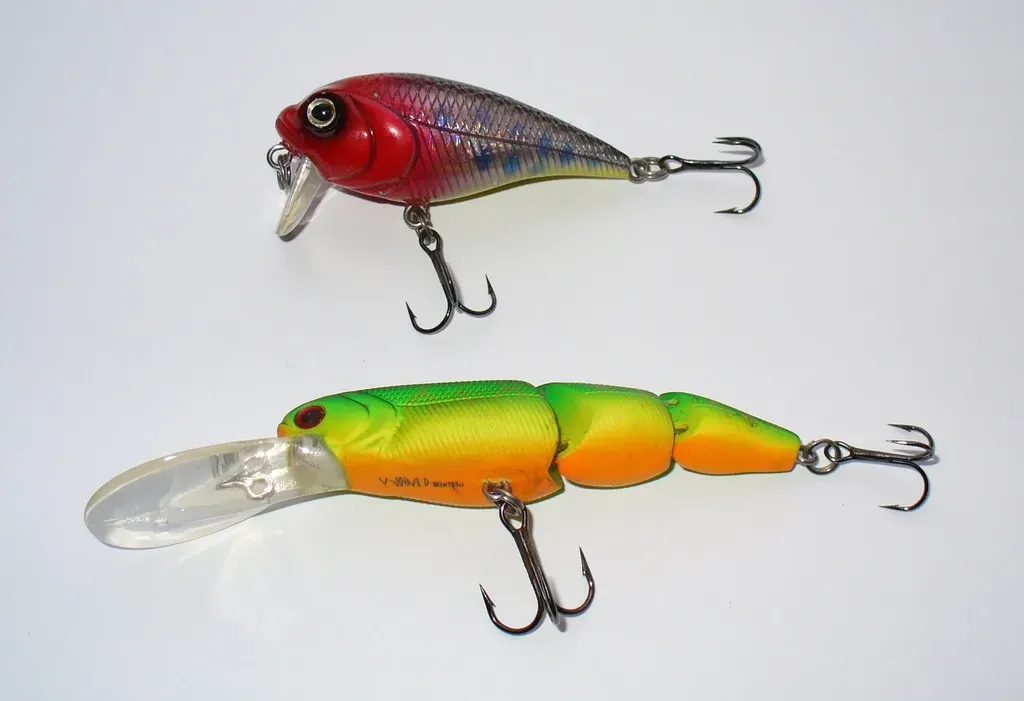
A crankbait is a hard-bodied lure with a lip that makes it dive and wobble when you reel it, and the lip is the whole design. Its size and angle set how deep the bait runs, its shape sets the wobble and what the bait bounces off, and the body behind it sets the profile and the sound. Jerkbaits belong to the same family: slender lipped minnows fished with twitches and pauses rather than a steady retrieve. So do lipless crankbaits, which have no lip at all and sink.
Lauri Rapala carved the first floating minnow from cork in 1936. Every lipped bait since is a descendant.
Start here
- Squarebill crankbait: the shallow bait, 0–5 ft, that deflects off wood and rock.
- Deep diving crankbaits: the long-lipped baits for 12–25 ft, and how to get them down.
- Lipless crankbait: the Rat-L-Trap, its sizes and the three ways to fish it.
- Jerkbaits: the cold-water bait and the cadence of pauses.
- Rapala lures: the model ladder from the Original Floater to the DT series.
How deep does each crankbait run?
| Class | Lip | Runs | Wobble | Reference baits |
|---|---|---|---|---|
| Squarebill | Short, square | 0–5 ft (0–1.5 m) | Tight; deflects off wood and rock | Strike King KVD 1.5, Bill Lewis SB-57 (3–6 ft, 0.9–1.8 m) |
| Medium diver | Round, medium | 6–12 ft (1.8–3.7 m) | Wider, slower | Strike King Series 4 Pro (6–10 ft, 1.8–3 m), Rapala Shad Rap (about 7 ft, 2.1 m) |
| Deep diver | Long, round | 12–20 ft (3.7–6.1 m) | Wide | Strike King 6XD (19 ft, 5.8 m), Rapala DT16 (16 ft, 4.9 m), Norman DD22 (17 ft, 5.2 m) |
| Extra-deep | Very long | 20–25 ft (6.1–7.6 m) | Wide | Strike King 8XD and 10XD, Rapala DT20 |
| Lipless | None; line tie on the back | Any; it sinks | Tight shimmy with rattles | Bill Lewis Rat-L-Trap in 1/4, 1/2, 3/4 and 1 oz (7, 14, 21 and 28 g) |
| Flat-sided | Small | Shallow to mid | Very tight | Balsa and circuit-board baits for cold water |
| Jerkbait | Small, slender body | 3–8 ft (0.9–2.4 m), suspends | Darts on the twitch | Megabass Vision 110, Rapala Husky Jerk |
The depth printed on the package is the maximum on the line the maker recommends. Thinner line lets the bait dive deeper; thicker line holds it up. Choose by depth first: a squarebill around cover in less than five feet, a medium diver from five to ten, a deep diver beyond that. The ledges a deep diver is built for are easiest to find with a fish finder.
Crankbaits were designed around bass. The bass hub sets them in the seasons: crankbaits in pre-spawn and summer, jerkbaits in winter. The same baits, sized up or down, are trolled for walleye and cast for pike, stripers and redfish, and the lures hub puts them beside every other family.
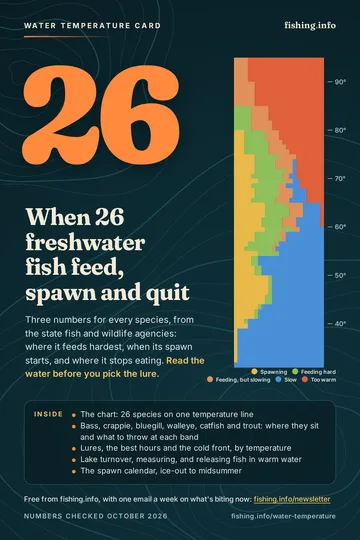
Free card: what 26 species do at your water temperature
Plus one email a week on what's biting now. No sales pitches. Privacy.
How do you fish a lipless crankbait?
The lipless bait fishes three ways. Reel it steadily over grass so it ticks the tops, and rip it free when it catches. “Yo-yo” it: let it fall to the bottom and pull it up a foot or two, so it flutters back down like a dying shad. In winter, jig it vertically with 12 to 36 inch strokes.
Bill Lewis, a Second World War bomber pilot, built the first lipless crankbait in the late 1960s and early 1970s in Boyce, Louisiana. He sold it from the trunk of his car at the Toledo Bend marinas. When it caught on he moved to Alexandria, Louisiana, where the lures are still assembled by hand. The rattle chamber inside was the innovation, and it spread from there into topwaters, jigs and spinnerbaits.
Why a jerkbait in cold water?
A suspending jerkbait hangs motionless in the water when the retrieve stops, and that pause is what catches fish when the water is cold. FishUSA’s cadence guide puts the productive range at 38 to 55 °F and the sweet spot at 40 to 52. When the water is in the high 30s and low 40s, the pause runs ten seconds or longer. The Rapala Husky Jerk is the affordable neutrally buoyant standard. The Megabass Vision 110, with its weight-transfer ball for casting, is the bait the tournament anglers hoard.
What rod and line do crankbaits need?
Crankbaits carry treble hooks, and trebles pull out of a fish’s mouth when the rod has no give. So the crankbait rod is a moderate action, often fiberglass or a graphite-glass composite. Most baits want 6 ft 8 in to 7 ft 2 in; deep divers that need casting distance want 7 ft 6 in or longer. The line is 10–14 lb monofilament or 12 lb fluorocarbon, whose stretch cushions the hookset.
Jerkbaits want the same moderate rod, shorter for the cadence. Spool 10–12 lb fluorocarbon, or 20 lb braid to a 10 lb mono leader.
Where did the crankbait come from?
Lauri Rapala carved the first floating minnow in Finland in 1936 from cork, with foil from chocolate wrappers and melted photographic film as the coating. A local cooperative sold the lures from 1938, and exports began in the mid-1950s. A Life magazine feature in the August 1962 issue paid for Rapala’s first factory. That issue also covered Marilyn Monroe’s death and became the magazine’s best-selling issue. The Shad Rap arrived in 1982, and the company now sells in 140 countries.
When crankbaits stop working in warm, shallow water, the topwater baits take over; for the bottom, start with soft plastics and jigs.
All articles
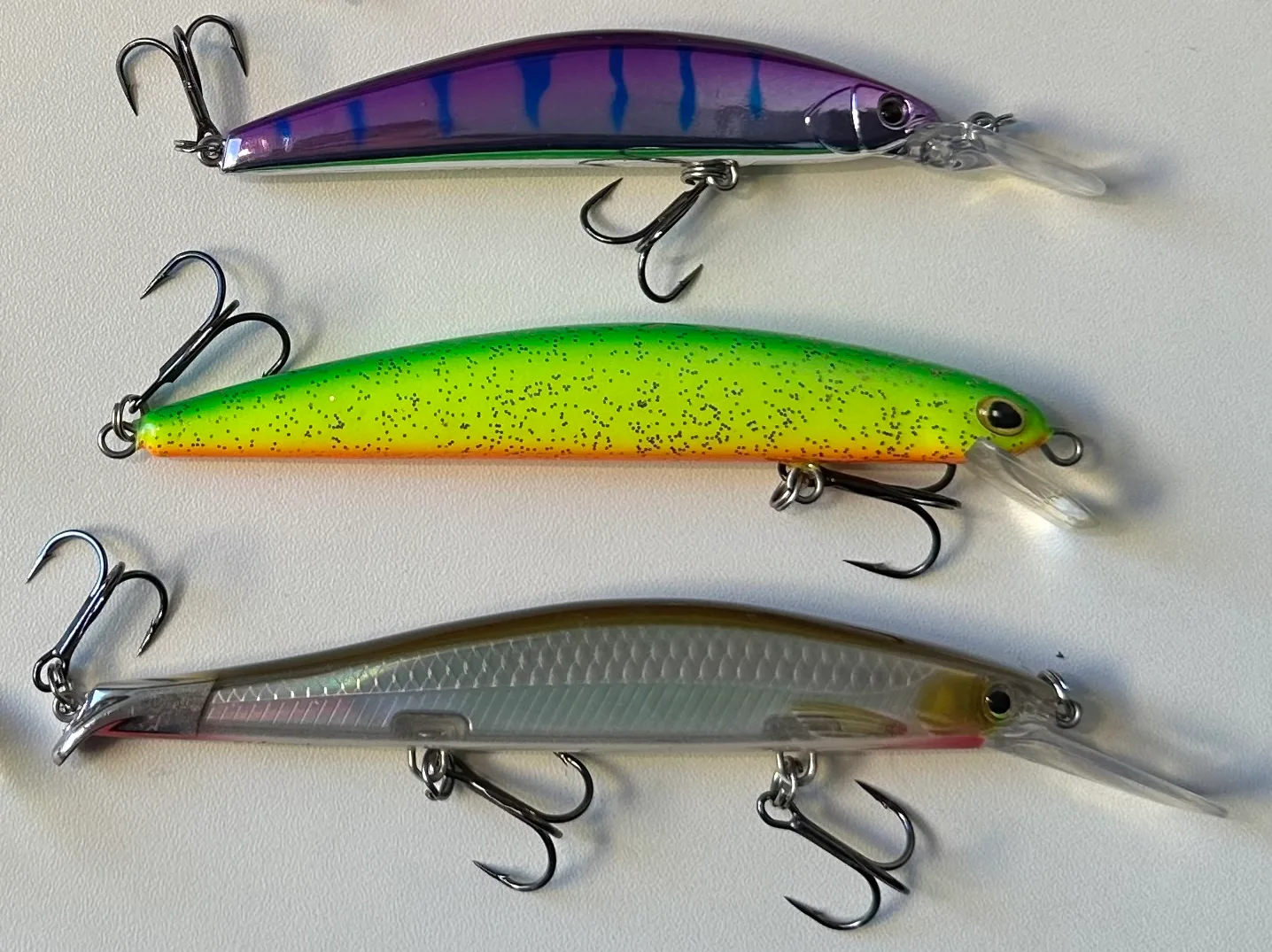 Jerkbait: How to Fish It in Cold Water, the Cadence, and Which to Buy
A jerkbait is a slender minnow plug twitched and paused; suspending models hang in place at 38–55 °F where bass will not chase. The cadence by temperature.
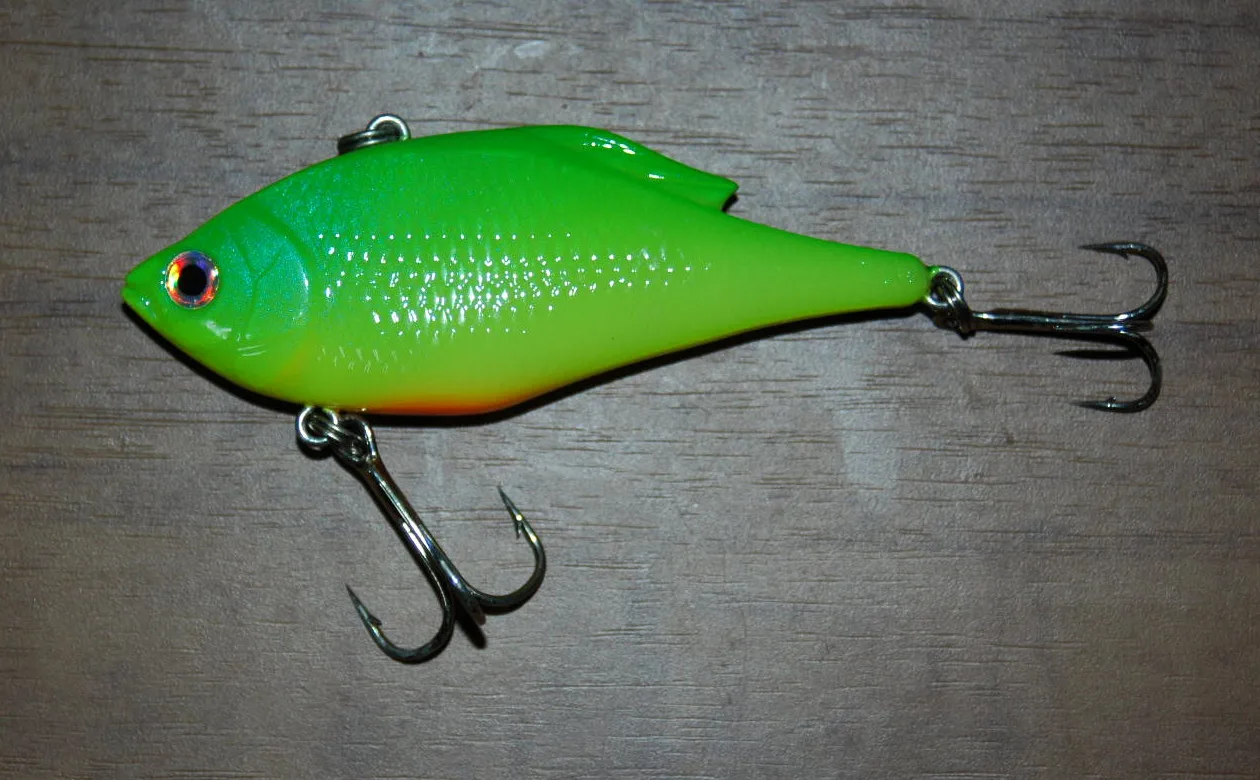 Lipless Crankbait: How to Fish It, Sizes, and the Rat-L-Trap Story
A lipless crankbait sinks, rattles and fishes any depth: eight models compared, six retrieves, the pre-spawn grass rip, and the rod that keeps trebles pinned.
Free download
The water temperature card
Read your water temperature and the card tells you who is spawning, who is feeding and what to throw. 26 species, 16 pages, for your phone and the tackle box.
Plus one email a week on what's biting now. No sales pitches. Privacy.