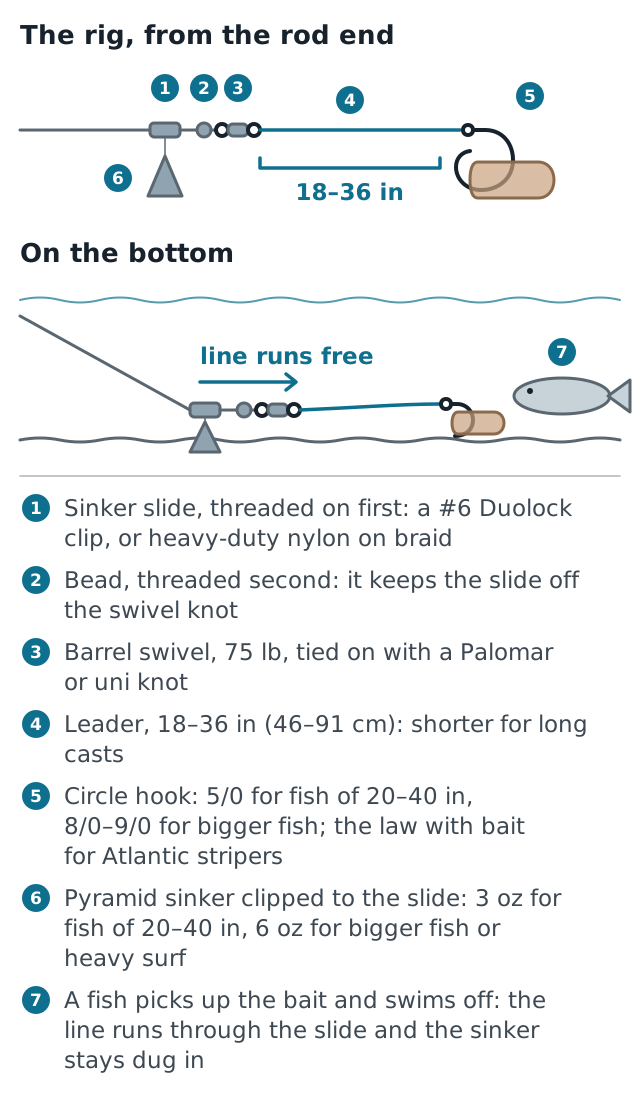
A fish finder rig is a sinker clipped to a slide that runs on the main line, above a bead and a barrel swivel, with a leader of 18–36 in (46–91 cm) to the hook. A fish picks up the bait and swims off, the line runs through the slide, and it never feels the weight. It is the standard bait rig of the surf, from striped bass and red drum to whiting and pompano. Looking for the sonar unit instead? See fish finders.
Slide first, bead second, swivel third. Thread them the other way around and the slide hammers the swivel knot on every cast.
Why does it work, and where does it fail?
The rig splits two jobs. The pyramid sinker digs into the sand and holds the bait in the wash. The slide lets the line pass through it, so a striper or drum can move off with a chunk of bunker before it feels anything. Field & Stream adds a second benefit: once the rig lands, the waves move the bait around without dragging the weight.
It is a rig for open sand: beaches with waves and current and little structure on the bottom. Over dense weed, rock, reef or wreck the sinker wedges and the leader wraps; a hi-lo rig, with its hooks on droppers above the sinker, is the better choice there.
The same idea runs through freshwater fishing. The Carolina rig is a bass angler’s fish finder rig with an egg sinker and a soft plastic, and the catfish slip-sinker rig in catfish rigs is the fish finder rig scaled down for a river.
What do you need?
Seven parts. The first column is a standard surf build for fish of 20–40 in (51–102 cm), the size most surf species run. The second is for fish over 40 in (102 cm). Heavy surf alone calls only for the heavier sinker.
| Part | Standard build, fish of 20–40 in | Fish over 40 in | Why |
|---|---|---|---|
| Sinker slide | #6 Duolock slide clip | Heavy-duty nylon slide on braid | Line runs through it; braid cuts thin plastic |
| Bead | Plastic bead | Plastic bead | Keeps the slide off the swivel knot |
| Swivel | Barrel swivel, 75 lb | Barrel swivel, 75 lb or heavier | A stop for the bead; stops line twist |
| Leader | 12–18 in (30–46 cm), 40 lb mono | 18–24 in (46–61 cm), 50 lb mono | Light enough to cast, tough on teeth and sand |
| Hook | 5/0 circle | 8/0–9/0 circle | A circle hook sets in the jaw corner |
| Sinker | 3 oz (85 g) pyramid | 6 oz (170 g) pyramid or a sputnik (also for heavy surf) | Holds the bait in the wash |
| Main line | 40–50 lb | 100 lb or more for sharks | Strength for a heavy sinker cast |
The leader, hook and sinker sizes are Tackle Village’s; the slide and swivel are Nick Honachefsky’s build in Wired2Fish. Honachefsky warns that braid cuts cheap plastic slides, so on a braided main line use a heavy-duty nylon one. For sharks he moves the leader to wire, or to 80–130 lb mono.
Tackle shops sell the rig pre-tied, and a bought one catches fish. Tying your own lets you set the leader length and the hook for the fish in front of you, and it costs a few cents in parts.
Smaller fish need a smaller rig, not a different one. For whiting, pompano, spot and croaker, Honachefsky drops to #8–2/0 baitholder hooks; the hook size chart explains how those numbers run.
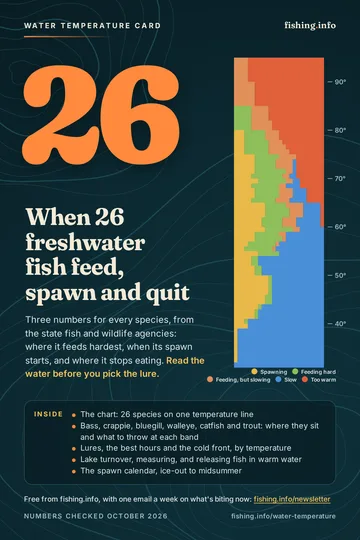
Free card: what 26 species do at your water temperature
Plus one email a week on what's biting now. No sales pitches. Privacy.
How do you tie a fish finder rig, step by step?
The parts in threading order, and the rig on the bottom. Drawing: fishing.info.
- Thread the sinker slide onto the main line. It goes on first, before anything else.
- Thread the bead onto the line behind it. The bead sits between the slide and the knot you are about to tie and takes the knock.
- Tie the main line to one eye of the barrel swivel with a Palomar knot or a uni knot.
- Cut the leader to length and tie it to the swivel’s other eye with the same knot.
- Tie the hook to the end of the leader, with a uni knot or a snell. A snell pulls straight down the shank, which suits a circle hook.
- Clip the sinker to the snap on the slide. Changing weight is now a matter of seconds, with no knot to retie.
- Check that the line runs free. Hold the sinker and pull the main line: it should slide through without catching. Then bait the hook and cast.
The order is the whole trick. With the bead threaded first, the slide ends up against the swivel and wears the knot on every cast.
How heavy a sinker?
Surf sinkers run from 2 oz to 8 oz (57–227 g), Florida Sportsman notes, and the waves and the cast decide the weight. A pyramid digs into sand but pops out and rolls once it is disturbed. A sputnik sinker has wire arms that dig in and hold, then trip on the retrieve so it comes in easily; it casts well but costs more.
| Surf | Sinker | Notes |
|---|---|---|
| Calm, fish close in | 2–4 oz (57–113 g) bank or pyramid | Four-sided pyramids hold sand better than three-sided |
| Normal surf, 11–13 ft (3.4–4 m) rod | 4–6 oz (113–170 g) pyramid | The everyday range for a beach rod |
| Long casts needed | 5–6 oz (142–170 g) pyramid | Weight carries the bait out |
| Strong current, heavy surf | 6 oz (170 g) or a sputnik | The wires hold where a pyramid rolls |
Tackle Village’s 3 oz in the parts table is the light end; Dr.Fish Tackle calls 4 oz the minimum for most surf.
If the line goes slack and the rig washes up the beach, the sinker is too light. Go up one size, or switch to a sputnik.
How long should the leader be?
Most builds use 18–36 in. Dr.Fish Tackle’s rule of thumb: longer when you fish close to the break line, shorter for long casts. A long leader helicopters in flight, the bait spinning around the main line, and that costs distance.
| Situation | Leader |
|---|---|
| Red drum, a compact rig for the cast | 6–8 in (15–20 cm) |
| Fish of 20–40 in, standard surf | 12–18 in (30–46 cm) of 40 lb mono |
| Flatfish near the break line | 24–30 in (61–76 cm) of mono |
| Striped bass with chunks | 3–4 ft (0.9–1.2 m) of 30–50 lb fluorocarbon |
| Bluefish and sharks | 20–24 in (51–61 cm) of wire |
The red drum leader comes from Field & Stream, which calls it a common tactic of surf anglers after drum; the striper leader is The Tackle Room’s. The flatfish and wire rows are Tackle Village’s. Fluorocarbon or mono for the leader is a choice of its own, set out in fluorocarbon vs monofilament.
When is a circle hook the law?
On a fish finder rig, more often than many anglers think. The rig is built for natural bait, and that is what most circle-hook rules cover.
- Atlantic striped bass. The Atlantic States Marine Fisheries Commission’s Addendum VI requires circle hooks when fishing for striped bass with bait. The states from Maine to North Carolina had to put it in place by January 1, 2021. Maryland spells out non-offset circle hooks. An artificial lure tipped with bait is exempt; Massachusetts names the tube and worm. Maine has required circle hooks with bait since 2013.
- Florida sharks. When you target or keep sharks with natural bait, from shore or from a boat, non-offset circle hooks that are not stainless steel are required. You also need a tool that cuts the leader or hook quickly.
New Jersey gives the reason for the striper rule. About 90 percent of the striped bass caught on the coast are released, and an estimated 9 percent of those die. That is nearly half of all the striped bass that die at human hands each year.
A circle hook changes the bite. Do not strike. Maine’s Department of Marine Resources tells anglers to point the rod at the fish and reel slowly: the hook sets itself, usually in the corner of the mouth. The circle hook page has the full table of rules by state.
Which fish, and which baits?
The rig works on every coast with sand. The fish and baits change by region:
- Northeast and mid-Atlantic: striped bass, bluefish and weakfish on bunker, clams and worms.
- Southeast and Gulf: red drum, snook and tarpon on mullet, shrimp and sand fleas; whiting, pompano, spot and croaker on smaller pieces and smaller hooks.
- California: rays, halibut, surfperch and corbina on sand crabs.
On the Atlantic, the striper is the reason most surfcasters tie this rig. The striped bass hub covers the seasons and the size limits the circle hook rule sits inside.
How do you fish it?
Cast, let the sinker settle, then reel until the line is tight to the weight. A sand spike holds the rod upright while you watch the tip.
When a fish moves off with the bait, the line runs through the slide and the rod tip pulls down. With a circle hook, that is your cue to reel steadily into the weight, no jerk.
Dr.Fish Tackle offers one variation. A small foam float pegged a few inches above the hook lifts the bait off the sand, away from crabs and small fish. It suits sharks, bluefish and stripers, but leave it off for wary feeders like snook.
Mistakes to avoid
- The bead before the slide. The slide sits on the knot and wears it through. Slide first, then bead.
- A cheap plastic slide on braid. Braid saws through it. Use a heavy-duty nylon slide.
- A long leader on a long cast. It helicopters and falls short. Cut it down toward 12–18 in.
- Too light a sinker. A rolling pyramid drags the bait into the trough or up the beach. Go heavier or use a sputnik.
- A J-hook with bait for stripers. On the Atlantic coast, that breaks the law. Use an inline circle hook.
Fish finder rig or something else?
Over rock, reef or weed, choose a hi-lo rig. It also suits small bottom fish, and Field & Stream names flounder among the fish it is typically used for. In fresh water, use the Carolina rig for bass and the slip-sinker rig for catfish. On open sand with bait and a fish that runs, the fish finder rig is the default for a reason. The rigs hub sets the freshwater rigs side by side.
Free download
The water temperature card
Read your water temperature and the card tells you who is spawning, who is feeding and what to throw. 26 species, 16 pages, for your phone and the tackle box.
Plus one email a week on what's biting now. No sales pitches. Privacy.
Related
Section guide
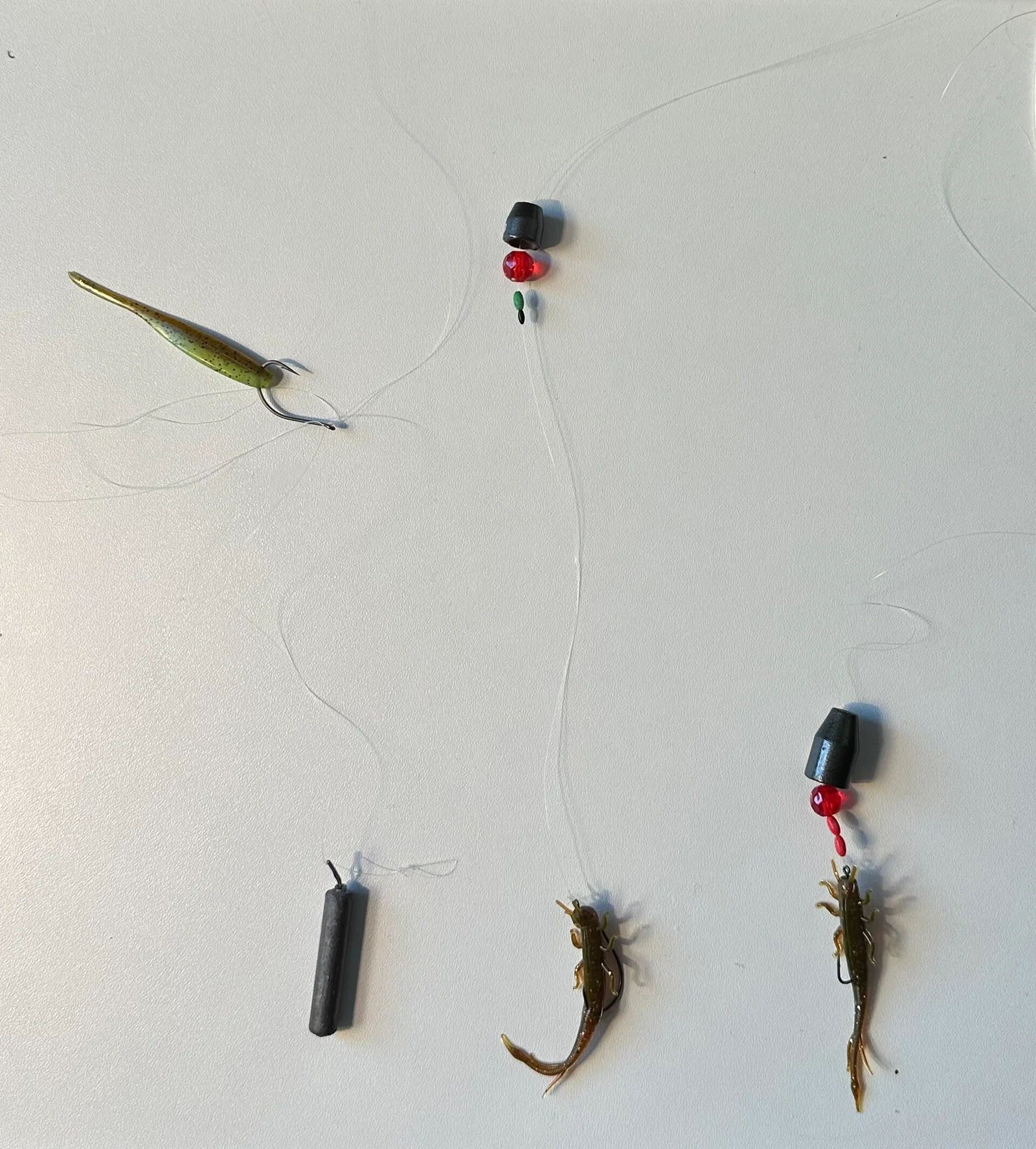
Fishing Rigs: Texas, Carolina, Drop Shot, Ned and WackyFishing rigs explained: the Texas, Carolina, drop shot, Ned and wacky rigs, the weight for each depth, and which rig fits which cover and fish.
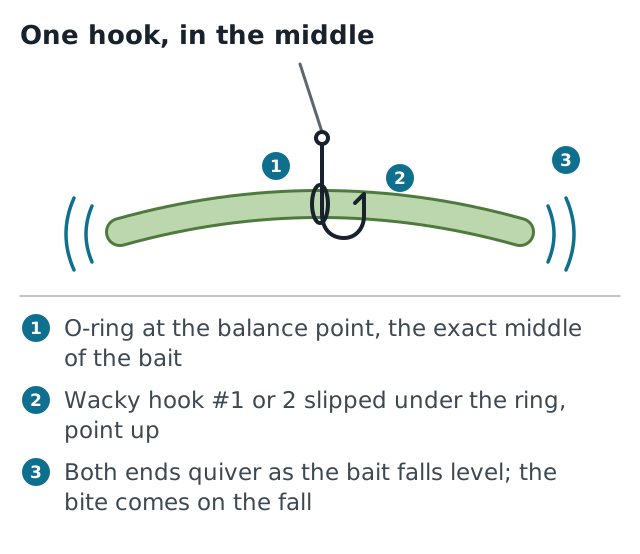 Wacky Rig: How to Rig It, and When It Beats a Texas Rig
The wacky rig hooks a stick bait through its middle so both ends quiver on the fall. The O-ring method, hook and line, weightless or weighted, when to use it.
 Drop Shot Rig: How to Tie It, Hook and Weight Sizes, How to Fish It
The drop shot rig step by step: a small hook tied 12–18 in above a 1/8–1/4 oz weight, the Palomar trick that stands the hook out, baits, tackle and retrieve.
 Ned Rig: How to Fish It, the Right Jig Head and Where It Came From
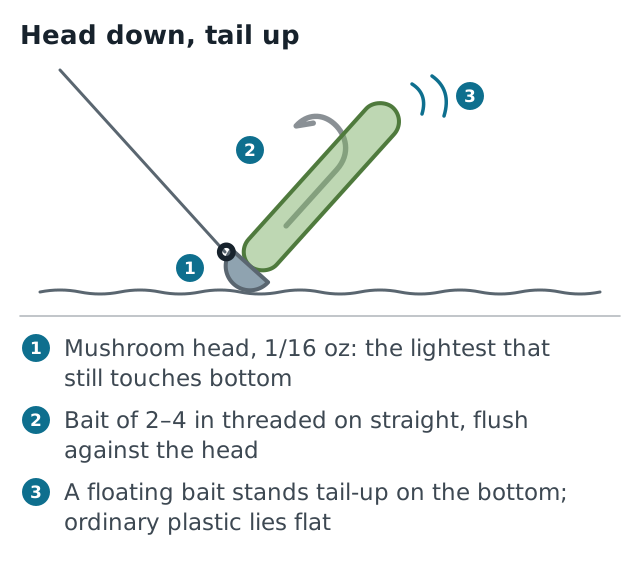
The Ned rig: a 2–4 in buoyant bait on a 1/20–1/5 oz mushroom head, the heads and baits in tables, six retrieves, the tackle, and the 2006 day it began.
- Carolina Rig: How to Tie It, Leader Length and When to Use It
How to tie a Carolina rig, every part with its size, the leader by season and clarity, five baits, the drag-and-sweep retrieve, and when a Texas rig is better.
 Texas Rig: How to Rig It, Which Weight and Hook, and How to Fish It
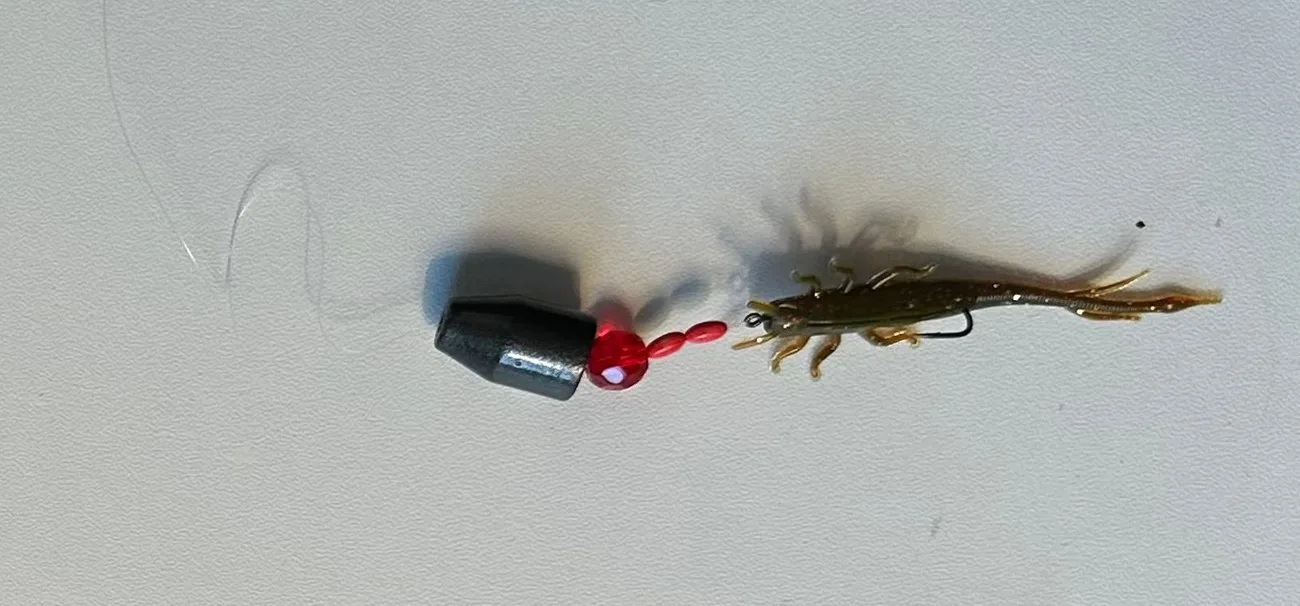
How to tie a Texas rig, which bullet weight and hook to use by depth and cover, how to fish it slowly on the bottom, and where the rig came from.
Sources
- Wired2Fish (Nick Honachefsky), How to fish and tie the fish finder rig
- Dr.Fish Tackle, Fish finder rig basics for surf fishing
- Field & Stream (Joe Cermele), The best surf fishing rigs
- Tackle Village, Fish finder rig: sinker, leader and hook sizes
- Florida Sportsman, Choosing the right sinker
- On The Water, 6 sinkers for surf fishing
- The Tackle Room, Striped bass fishing guide
- ASMFC, Atlantic Striped Bass Board approves Addendum VI (circle hooks with bait by January 1, 2021)
- New Jersey Fish and Wildlife, striped bass circle hook requirement (2021)
- Maryland DNR, circle hooks
- Massachusetts Division of Marine Fisheries, recreational saltwater fishing regulations
- Florida FWC, shark fishing regulations
- Maine DMR, tips for using circle hooks