 By
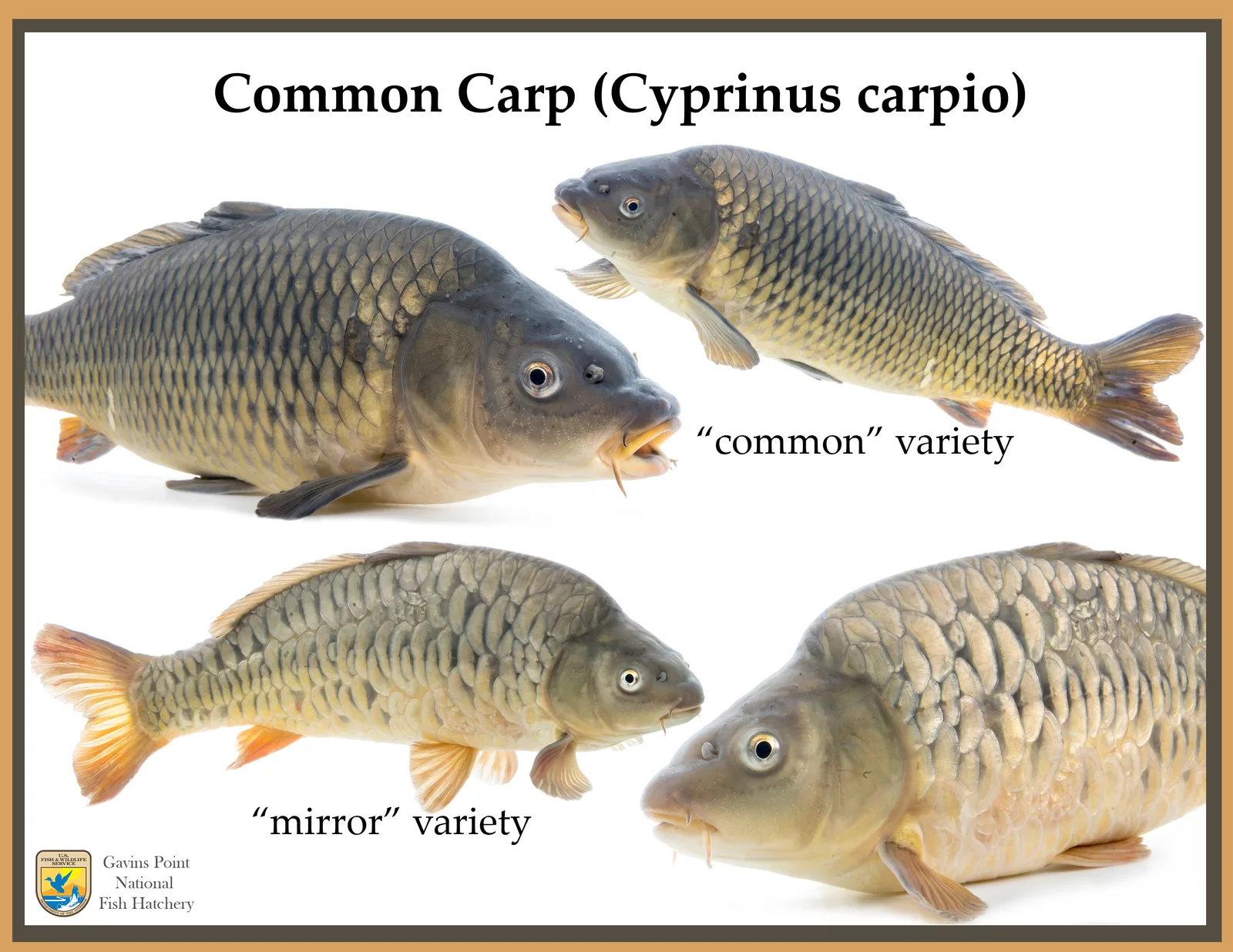
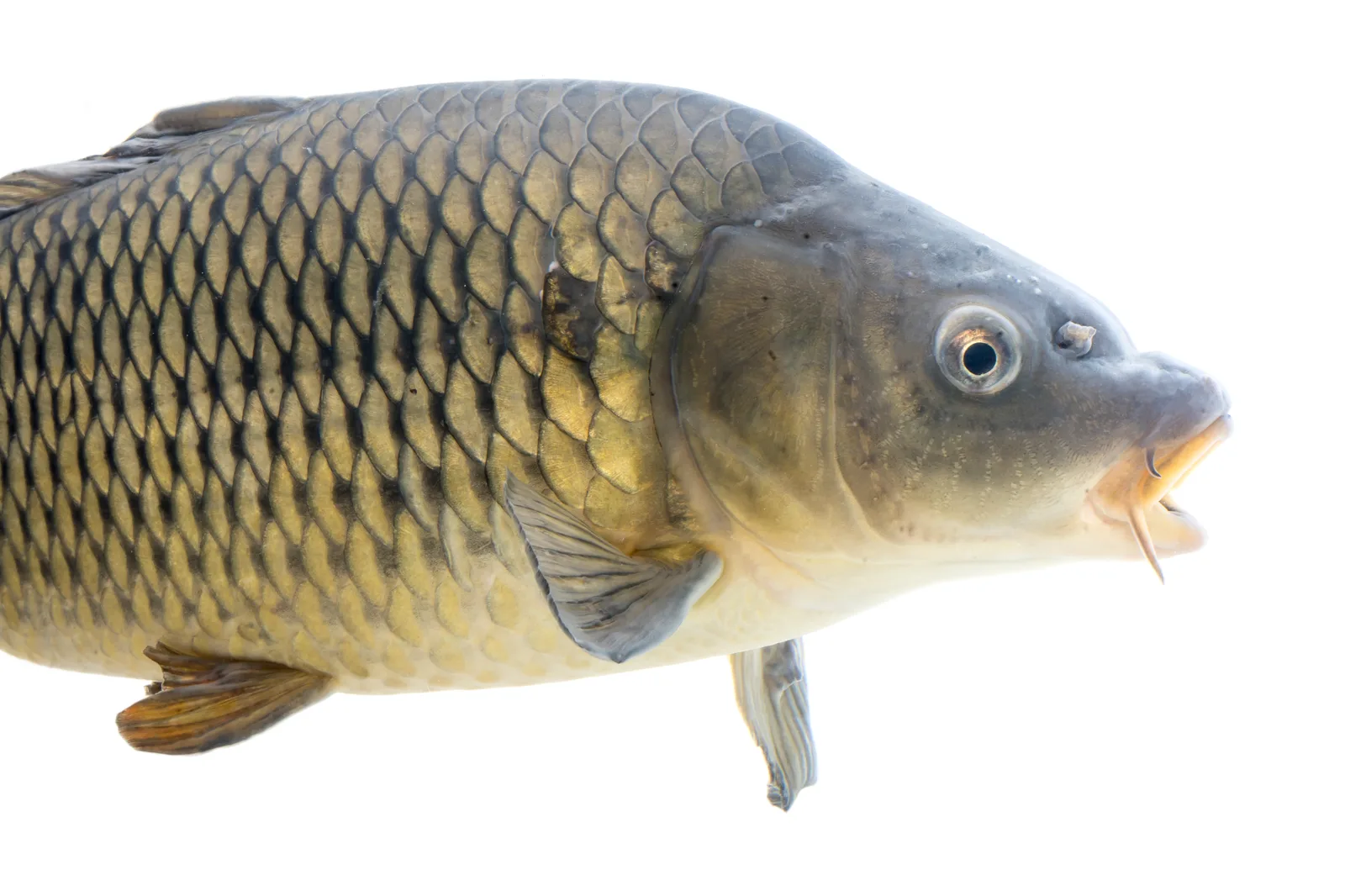
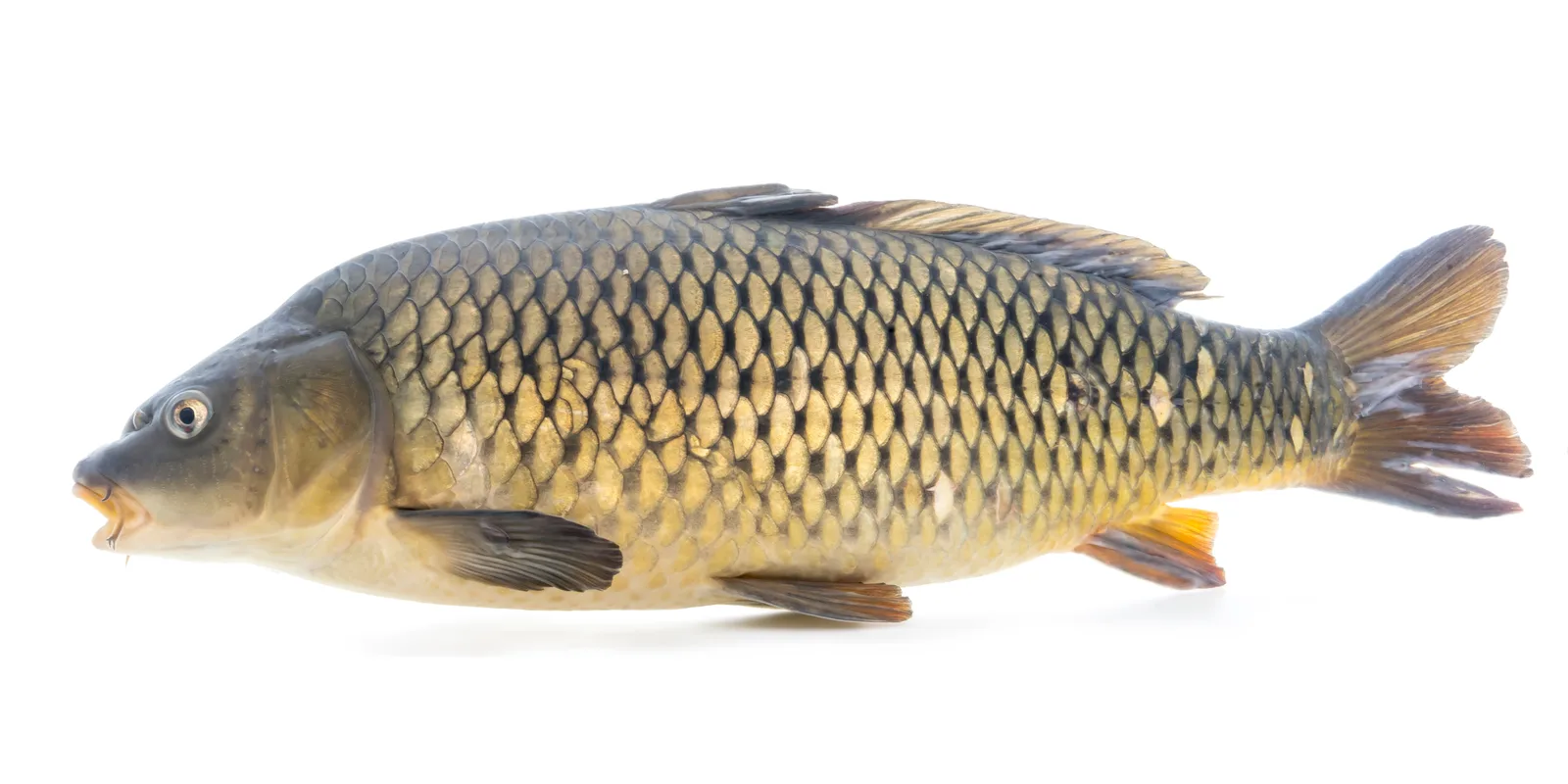
The common carp is a heavy, bronze fish of 12 to 25 in (30–64 cm) and 1 to 8 lb, with whiskers at the mouth and a saw-toothed spine in its long back fin. It is native to Europe and Asia, and USGS has records from every state but Alaska, most of them from warm, muddy lakes, reservoirs and slow rivers. It is the carp American anglers fish for, and state records run past 50 lb.
A common carp has no teeth in its mouth and no stomach. It chews with molar-like teeth in its throat, strong enough to crush shells.
How do you identify a common carp?
Check the mouth. A common carp has two barbels on each side of the upper jaw, fleshy whiskers that may help it feel for food in the mud. North Carolina’s wildlife agency notes that the barbels separate a carp from the native suckers. The mouth is small, points down and can be pushed out (“protractile,” in IGFA’s word).
Then the back: one long dorsal fin with 17 to 21 rays, led by “a stout, saw-toothed spine,” as is the anal fin, in the Missouri Department of Conservation’s description. Strictly, USGS notes, it is not a true spine. The back and sides are brassy olive, the belly yellowish white, and each big scale has a dark edge, which gives the crosshatched look. The tail is often red, the lower fins yellow or orange.
Three fish get mistaken for it. A goldfish has the spine but no barbels. A grass carp has neither, plus a short back fin and a small, low eye. A buffalo, a native sucker, has a long sickle-shaped fin and no spine or barbels. The carp page sorts all of them in one table.
Mirror, leather or koi: is it still a common carp?
Mostly, yes. The scale forms arose as carp were domesticated in Europe, where monks spread carp farming between the 13th and 16th centuries, and the U.S. Fish Commission’s 1877 shipment from Germany already held common, mirror and leather carp, per the American Carp Society. In law and in biology they are one species. A mirror carp is, in the U.S. Fish and Wildlife Service’s words, “just a rare variety of common carp.”
Common and mirror carp at Gavins Point National Fish Hatchery, South Dakota. Photo: Sam Stukel, U.S. Fish and Wildlife Service (public domain).
| Form | Scales | What it is | Worth knowing |
|---|---|---|---|
| Common (fully scaled) | Large, dark-edged scales over the whole body | The wild-type Cyprinus carpio | The fish in most American water |
| Wild river carp | Fully scaled | The original Danube form | Slimmer: length about four times the depth |
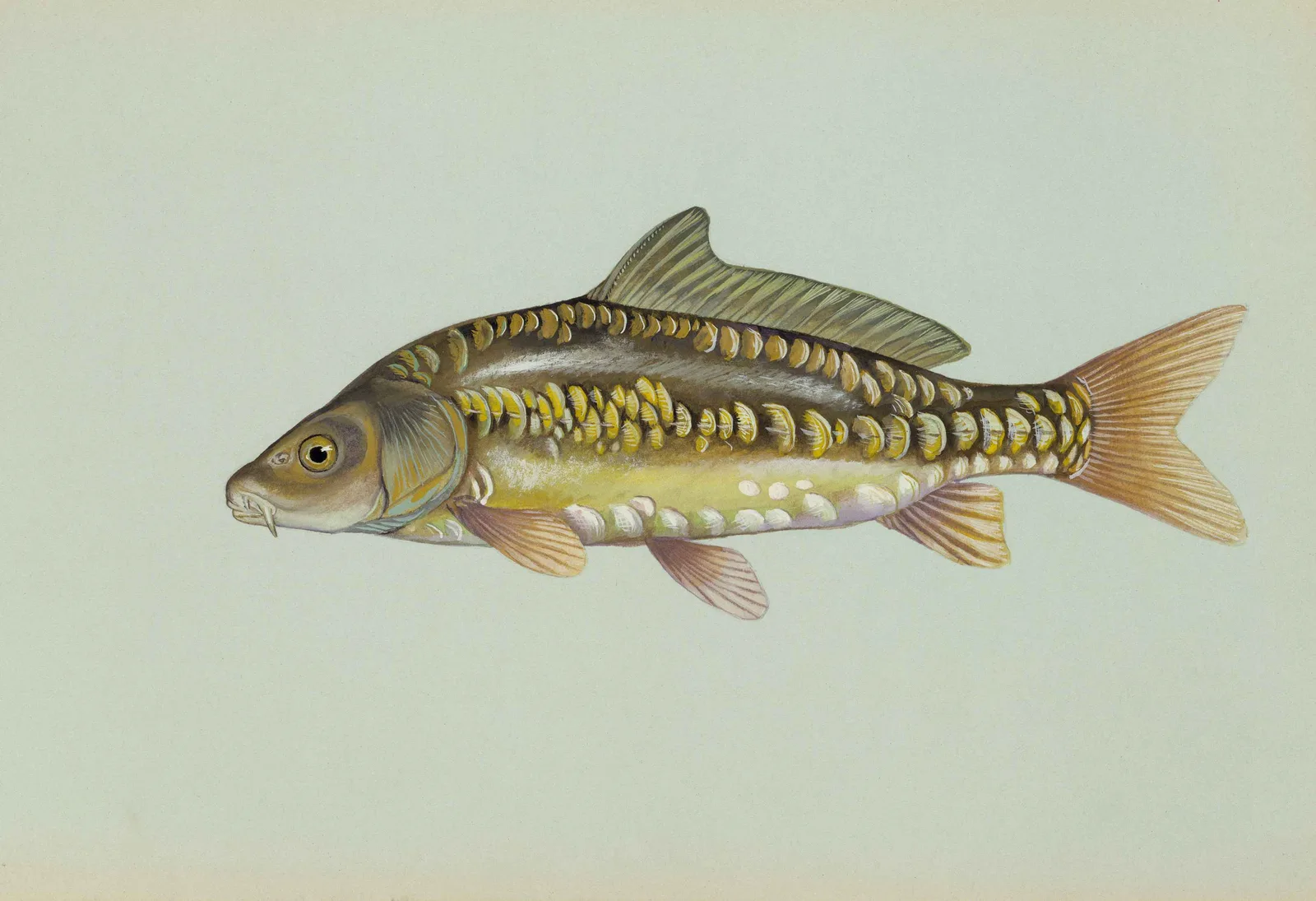
| Mirror | A few large, irregular, mirror-like scales | A recessive scale gene | “A rare variety,” per USFWS |
| Linear mirror | Bare except one row along the lateral line | A mirror form from Germany | Same species |
| Leather | Almost none | A second scale mutation | Grows slower than scaled carp |
| Ghost carp | Scaled, in many colors | Common carp crossed with platinum koi | Sold as a pond fish |
| Koi | Bred for color | Amur carp, Cyprinus rubrofuscus | Now a separate species, per Missouri |
Common carp can also cross with goldfish; IGFA calls the goldfish a close relative with which the carp hybridizes. Amur carp and common carp are told apart by meristics, the counts of scales and fin rays, and by genetics, and they can interbreed, per Wikipedia. US rules still list koi as Cyprinus carpio: Minnesota’s invasive species list and Pennsylvania’s baitfish code both do.
Free PDF · Water temperature chart When do carp bite?
One water temperature reading, and the 16-page chart tells you who's spawning, who's feeding hard, where they sit and what to throw. 26 fish, every number sourced.
Enter your email, confirm it with one click, and the PDF is in your inbox. Plus one email a week on what's biting. Unsubscribe anytime. Privacy.
Where do common carp live?
Almost anywhere warm and slow: their habitat is still or slow water with a soft bottom. USGS finds them most abundant “in manmade impoundments, lakes, and turbid sluggish streams” fed by sewage or farm runoff, and scarce in clear, steep streams. In Missouri, adults in rivers hold in the deeper pools. They have been caught in US coastal water of 17.6 parts per thousand salt, about half as salty as the sea, USGS reports. When oxygen runs low, they gulp air at the surface.
Temperature sets the season. On our water temperature chart, common carp are most comfortable at 70–85 °F (21–29 °C), spawn at 63–75 °F (17–24 °C) and are stressed above 95 °F (35 °C). They feed hardest “in late evening or early morning, sometimes in very shallow water,” says Missouri’s field guide, so dawn and dusk are when to look.
Not every lake gets overrun. Researchers at the University of Minnesota’s Aquatic Invasive Species Research Center (MAISRC) found two filters: lake productivity and bluegills, which eat carp eggs and larvae. Carp boom in rich lakes with few bluegills; in clear, nutrient-poor lakes or lakes full of bluegills they stay scarce. In Minnesota they have not become established in some waters, the Boundary Waters among them.
When and how do common carp spawn?
In spring, in the shallowest weedy water they can reach. Adults “migrate into shallow wetlands to spawn,” and MAISRC found they return to their home lakes to spawn, “like salmon.” There is no nest and no parental care; the eggs are scattered and stick to submerged vegetation, logs and stones.
The numbers depend on the fish and the source. Illinois DNR says a female lays “more than 50,000 sticky eggs”; the Ontario database gives 36,000 to 2,208,000; MAISRC says a female can carry up to 3 million. The eggs hatch within a week by MAISRC’s count and in 12 days by Illinois DNR’s. Spawning runs from March to June in Missouri and from April to August in Illinois.
Few of those eggs make it. In most Minnesota lakes, MAISRC found, panfish eat the eggs and larvae. The nurseries are marshes that winterkill: the oxygen runs out under the ice, the predators die, and carp spawned there face few egg eaters. A carp matures at 12 to 15 in (30–38 cm), at two to three years old (MAISRC) or about three (Illinois).
What do common carp eat?
Nearly everything on the bottom: the common carp is an omnivore. USGS lists organic detritus, mostly from plants, along with midge larvae, small crustaceans and snails; MAISRC says they forage mainly on plant seeds and insect larvae in the sediment. Missouri ranks aquatic insects first and adds that carp probably find food “more by taste than by sight.” North Carolina’s agency adds algae and the odd small fish.
The feeding is what anglers see. A carp sucks up mud, keeps the food and spits the rest, which clouds the water and leaves pits in the bottom. The food goes back to the pharyngeal teeth in the throat: ten of them, per Wikipedia, “similar to human molars,” North Carolina says, “used for crushing shells, seeds and plants.” There is no stomach.
Carp also eat fish eggs. USGS cites white sturgeon eggs found in carp stomachs in the Columbia River. That taste for spawn, the cloudy water and the uprooted weeds are the case against them.
How big and how old do common carp get?
Illinois DNR puts the top end at “48 inches and more than 80 pounds,” with an average of 2 to 5 lb. The IGFA all-tackle record is 75 lb 11 oz (34.35 kg), from France in 1987. The IGFA’s length record is American: a 106 cm (41.7 in) carp from Oxford, Connecticut, in June 2025. The heaviest carp in the IGFA book is not a common carp but a 112 lb 5 oz black carp from Missouri, caught in 2021; the carp page has the full table.
How fast a carp gets there depends on the lake. The table runs FishBase’s growth parameters for three US waters: Hennepin and Hopper Lakes in Illinois, where carp grow fast, and Pelican and Marsh Lakes in Nebraska, where Marsh Lake’s grow slowest. Weight comes from the Ontario length-weight equation. A dash means that lake’s carp, on average, stop growing short of that length.
| Fork length | Weight (computed) | Age, Illinois lakes | Age, Pelican Lake | Age, Marsh Lake |
|---|---|---|---|---|
| 12 in (30 cm) | 1.3 lb (0.6 kg) | 1 year | 2 years | 4 years |
| 16 in (41 cm) | 3 lb (1.4 kg) | 2 | 3 | 6 |
| 20 in (51 cm) | 5.8 lb (2.6 kg) | 3 | 5 | 10 |
| 22 in (56 cm) | 7.7 lb (3.5 kg) | 4 | 6 | 13 |
| 24 in (61 cm) | 10 lb (4.5 kg) | — | 8 | 19 |
| 30 in (76 cm) | 19 lb (8.7 kg) | — | — | — |
So how old is a 40 lb carp? By the same weight equation it is about 38 in (97 cm) long. That is about a foot longer than the average maximum length of the carp in any of these lakes, 24 to 27 in (61–68 cm), so none of these growth curves can age it. Only an otolith, the ear stone biologists read like tree rings, can. USGS says common carp typically live around 20 years in the wild; Missouri says few pass 12 in the wild, though in captivity they can live nearly 50.
These are averages, and single fish grow past them: that is where the 30 and 40 lb carp come from. State records include Wisconsin’s 57 lb 2 oz (25.9 kg) hook-and-line fish from Lake Wisconsin in 1966 and Michigan’s 61 lb 8 oz (27.9 kg) carp, speared in Wolf Lake in 1974. The carp page lists seven states.
Why are common carp a problem?
Because of how they feed. MAISRC says carp degrade water quality and destroy waterfowl habitat, and USGS calls the common carp “a pest fish” for uprooting plants and raising turbidity, the cloudiness of the water. MAISRC estimates that over 70% of lakes in southern Minnesota have lost their plant cover and suffer algal blooms because of carp foraging. The muddy water also hurts sight-feeding predators such as bass and sunfish, USGS notes. So no, common carp will not clean up a pond; the weed eater is the grass carp, a different fish.
Control is hard once they are in. MAISRC’s work points at the weak spots: adults shoal tightly under the ice, where they can be found by telemetry and seined out, and their spawning runs into marshes can be blocked.
Missouri’s field guide adds a fair word: the complaints are true, but “the carp’s nuisance qualities may be somewhat exaggerated.” And in its native rivers the wild carp is in trouble: FishBase records a continuous decline from river regulation and from crossing with farmed stocks and East Asian relatives.
The rules follow the reputation. North Dakota lists the common carp as an aquatic nuisance species; Minnesota allows you to keep and transport one but not to release it. Pennsylvania bans common carp and koi as baitfish. Never move a live carp to another water.
How do you catch a common carp?
With corn or dough and a slack line. Missouri lists dough balls, whole kernel corn and worms, and says a carp “can put up a fight equal to that of any game fish of similar size.” Carp drop a bait that pulls back, which is why the hair rig and an open bail matter. How to catch carp has the two rigs and the tackle, and carp bait the recipes. If you put your carp back, catch and release has the handling steps.
Are common carp good to eat?
Yes, if you deal with the bones. North Carolina calls carp “a popular food fish in many countries, although they are bony”; New York’s DEC describes two rows of small floating bones, above and below the lateral line, and says to score or grind the fillets. In January 2025, Seafood Watch rated common carp netted in Illinois a Best Choice, and listed a market price of $0.09 to $0.30 a pound for wild invasive carp. Carp live long and carry fat, so check your state’s fish consumption advisory for the water you fish.
What else is the common carp called?
The common carp is Cyprinus carpio Linnaeus 1758, also called European carp or German carp, and it gives its name to the carp family, Cyprinidae. Missouri’s field guide notes that the grass, silver, bighead and black carp now sit in a separate family, the East Asian minnows; the common carp and the goldfish stay in the Cyprinidae. For the buffalo and other native fish anglers call carp, see other freshwater fish.
Free PDF · 16 pages
Know what's biting before your first cast
The Water Temperature Fishing Chart. Take one water temperature reading, find it on the chart, and you know which of 26 freshwater fish are feeding today, where they are and what to throw. For your phone and the tackle box.
- The 26-fish chart: who's spawning, feeding hard or shut down at your reading
- Where they sit and what to throw at every band: bass, crappie, bluegill, walleye, catfish and trout
- The best hours at your reading, the cold front day by day, and the spawn calendar from ice-out to midsummer
- The three thermometer mistakes that make a reading lie (the first one is the surface)
Every number from state fish and wildlife agencies and fisheries research: 61 sources, all on the site.
Enter your email, confirm it with one click, and the PDF is in your inbox. Plus one email a week on what's biting. Unsubscribe anytime. Privacy.
Related
Section guide
Carp: Common, Grass and Asian Carp, How to Tell Them Apart and Catch ThemCarp fish in US waters: common, mirror, grass and the invasive Asian carp told apart, where and when they feed, baits and rigs, records, laws and eating.
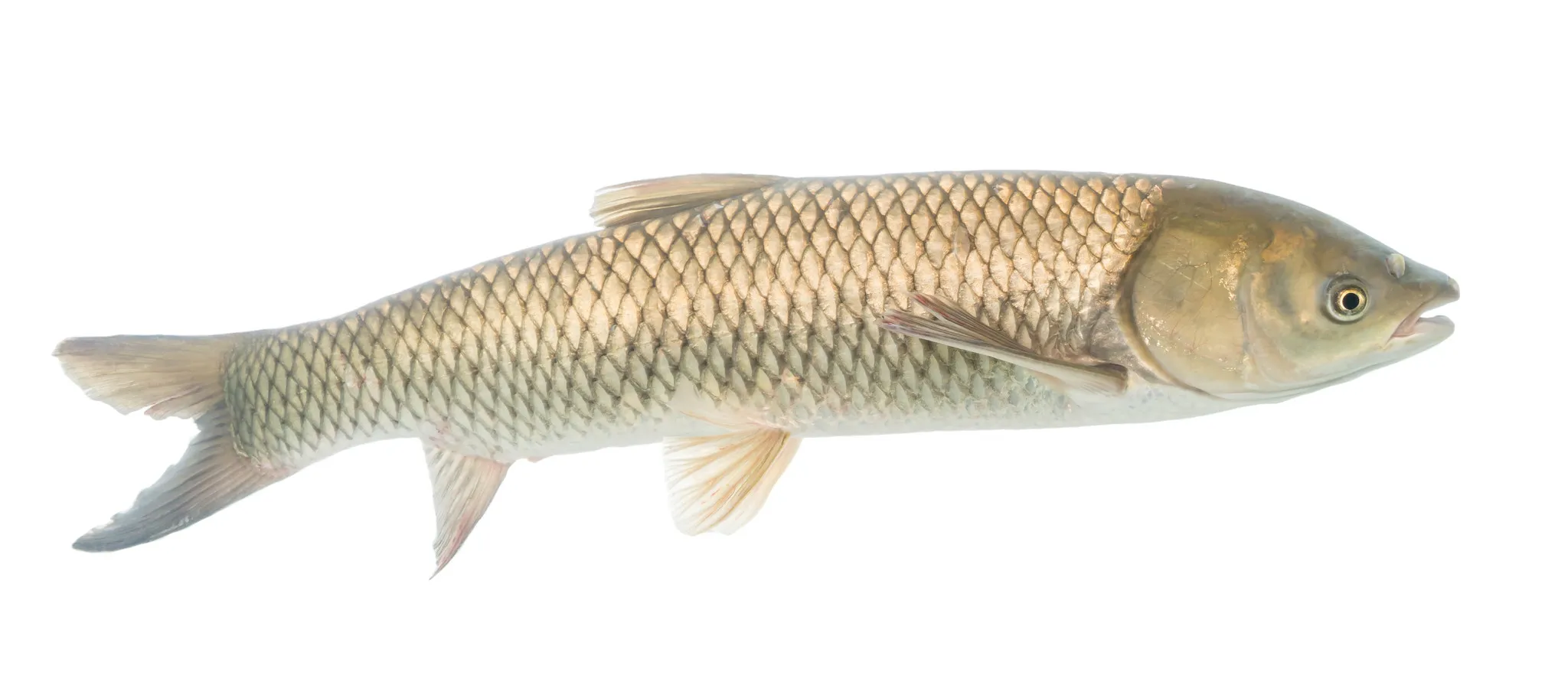 Grass Carp: How to Identify, Catch and Eat the White Amur
Grass carp (white amur): no barbels, a short back fin, up to 48 in and 50 lb or more. Triploid rules by state, the baits that catch them, and eating one.
 Carp Bait: What Works, Homemade Recipes and How to Rig It
Carp bait: start with canned sweet corn or bread. Eight baits with their recipes and ratios (the 1-2-3 doughball, pack bait, field corn) and the chum laws.
 Carp Fishing: How to Catch Carp With a Simple Rig or a Hair Rig
Carp fishing for beginners: the setup, where carp feed by season, bread free-lined close in, and the hair rig with a baitrunner for big carp.
Sources
- Common Carp (Cyprinus carpio) - Species Profile (USGS Nonindigenous Aquatic Species)
- Common Carp | Missouri Department of Conservation
- Common carp (Illinois DNR, Wild About Illinois Fishes)
- Common Carp | Minnesota Aquatic Invasive Species Research Center (MAISRC)
- Common Carp | NC Wildlife
- Common Carp | North Dakota Game and Fish
- Common Carp (Chesapeake Bay Program field guide)
- Cyprinus carpio, Common carp : fisheries, aquaculture, gamefish, aquarium (FishBase)
- Species Population Growth List - Cyprinus carpio (FishBase): growth parameters for Hennepin and Hopper Lakes, Illinois, and Marsh and Pelican Lakes, Nebraska
- Ontario Freshwater Fishes Life History Database, Common Carp: length-weight regression, fecundity
- Common carp - Wikipedia: scale forms, wild carp, pharyngeal teeth, no stomach, hybrids
- Two Varieties of Common Carp (Cyprinus carpio), USFWS Mountain-Prairie (Wikimedia Commons)
- IGFA World Record Search, Carp, common: all-tackle weight and length records
- American Carp Society, US Carp History: the 1877 shipment of common, mirror and leather carp
- Wisconsin DNR, record fish (hook and line): common carp
- Michigan DNR, State Record Fish: common carp, 61.5 lb, 1974, spear, Wolf Lake, Jackson County
- Minnesota DNR, Invasive species laws: common carp (koi) a regulated invasive species
- 58 Pa. Code § 63.44 - Illegal baitfish (Cornell LII)
- NY DEC, Let's Go Carp Fishing: floating bones, scoring the fillets
- Monterey Bay Aquarium Seafood Watch, invasive carp assessment (January 2025): common carp ratings and market price