 By
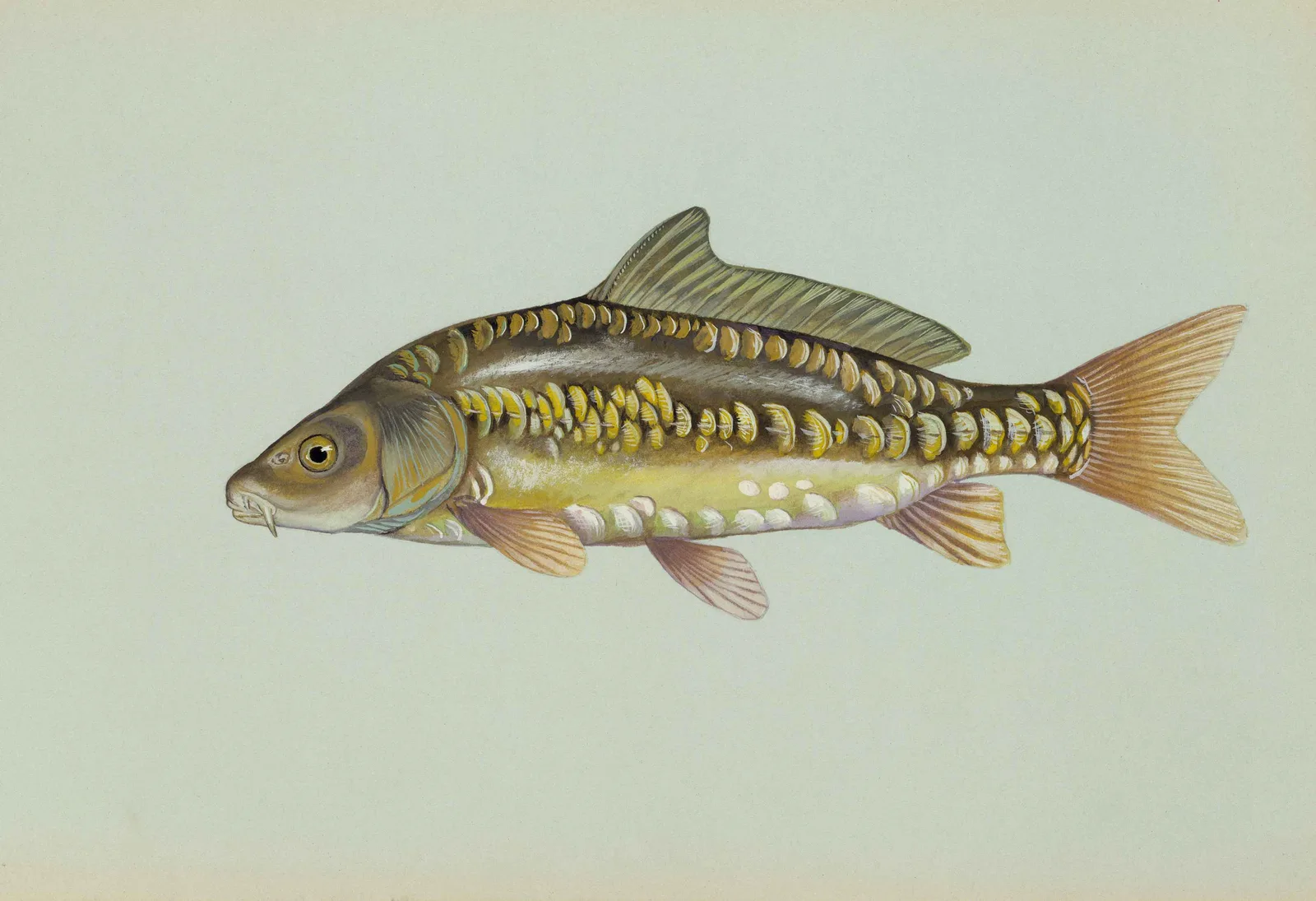
In American water, carp first means the common carp: a bronze, whiskered fish of 12 to 25 in (30–64 cm), recorded in every state but Alaska. It is most comfortable in water of about 70 to 85 °F (21–29 °C), rooting along the bank, at times so shallow that its back shows. The starter kit, per the American Carp Society and IGFA, is a can of sweet corn, a size 6 or 8 hook and 8 to 12 lb line. Four carp from Asia, the goldfish and two native suckers share the name, and the mouth tells them apart.
Carp did not sneak into America. The U.S. Fish Commission imported 345 of them from Germany in 1877 and soon shipped more than 6,000 young carp to 273 applicants in 24 states.
Start here
- How to catch carp: where carp feed season by season, the setup, and the two rigs that catch them.
- Carp bait: the baits that work, the homemade recipes with their ratios, and where chumming is legal.
- Common carp: mirror, leather and koi, spawning, and how old a 20 in carp is.
- Grass carp: the weed eater, the triploid rules by state, and how to catch one by sight.
- Water temperature for fishing: common carp spawn at 63 to 75 °F (17–24 °C).
Which carp is it?
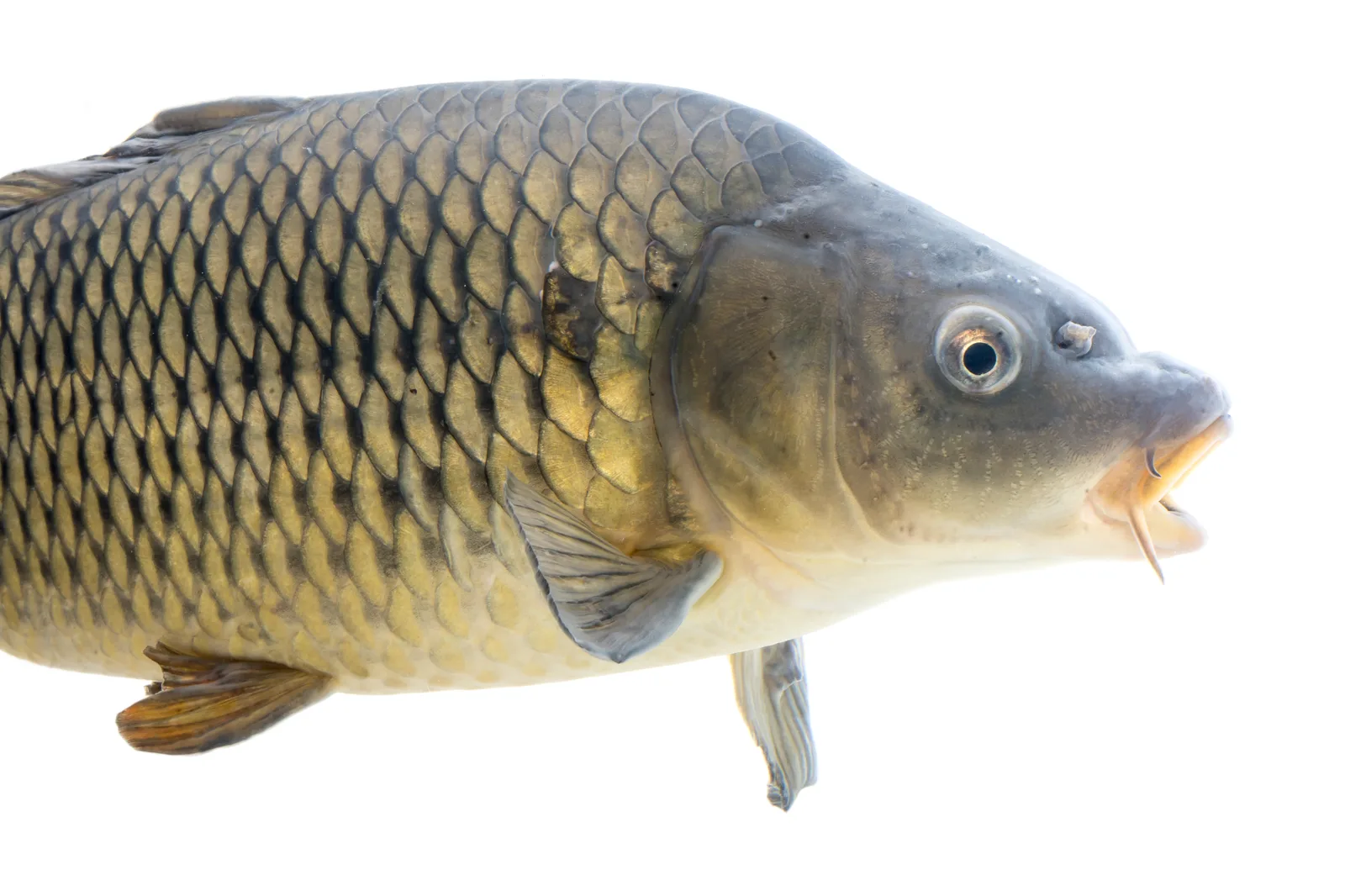
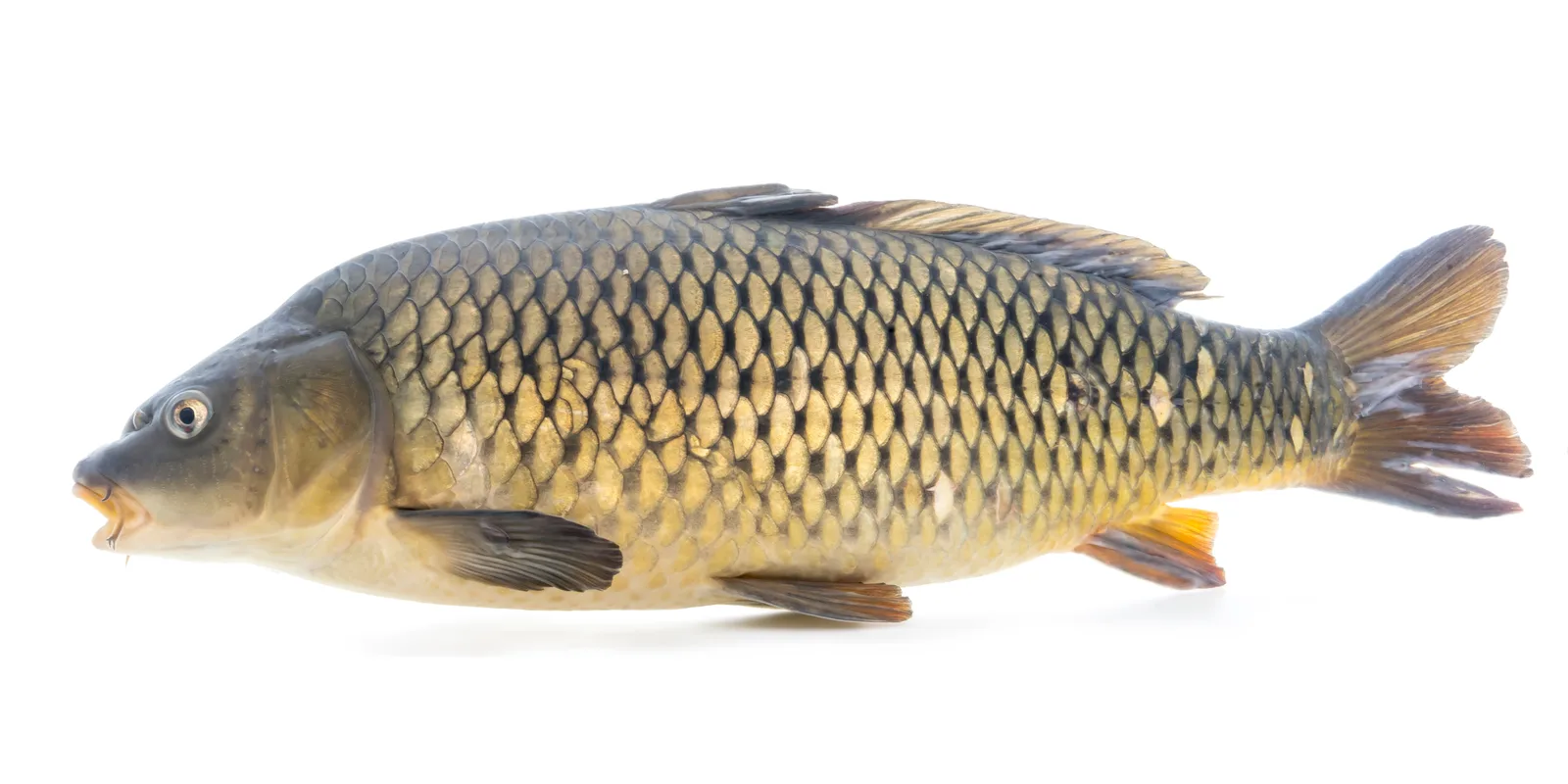
Two marks sort them. The first is the barbels, the fleshy whiskers at the mouth: a common carp has two pairs, the rear pair the obvious one. The second is a saw-toothed spine, a hardened ray, at the front of the back fin (the dorsal fin).
| Fish | Barbels and mouth | Back fin | The mark that settles it | Status |
|---|---|---|---|---|
| Common carp | Two pairs; mouth points down | Long, saw-toothed spine | Large dark-edged scales, reddish tail | Nonnative |
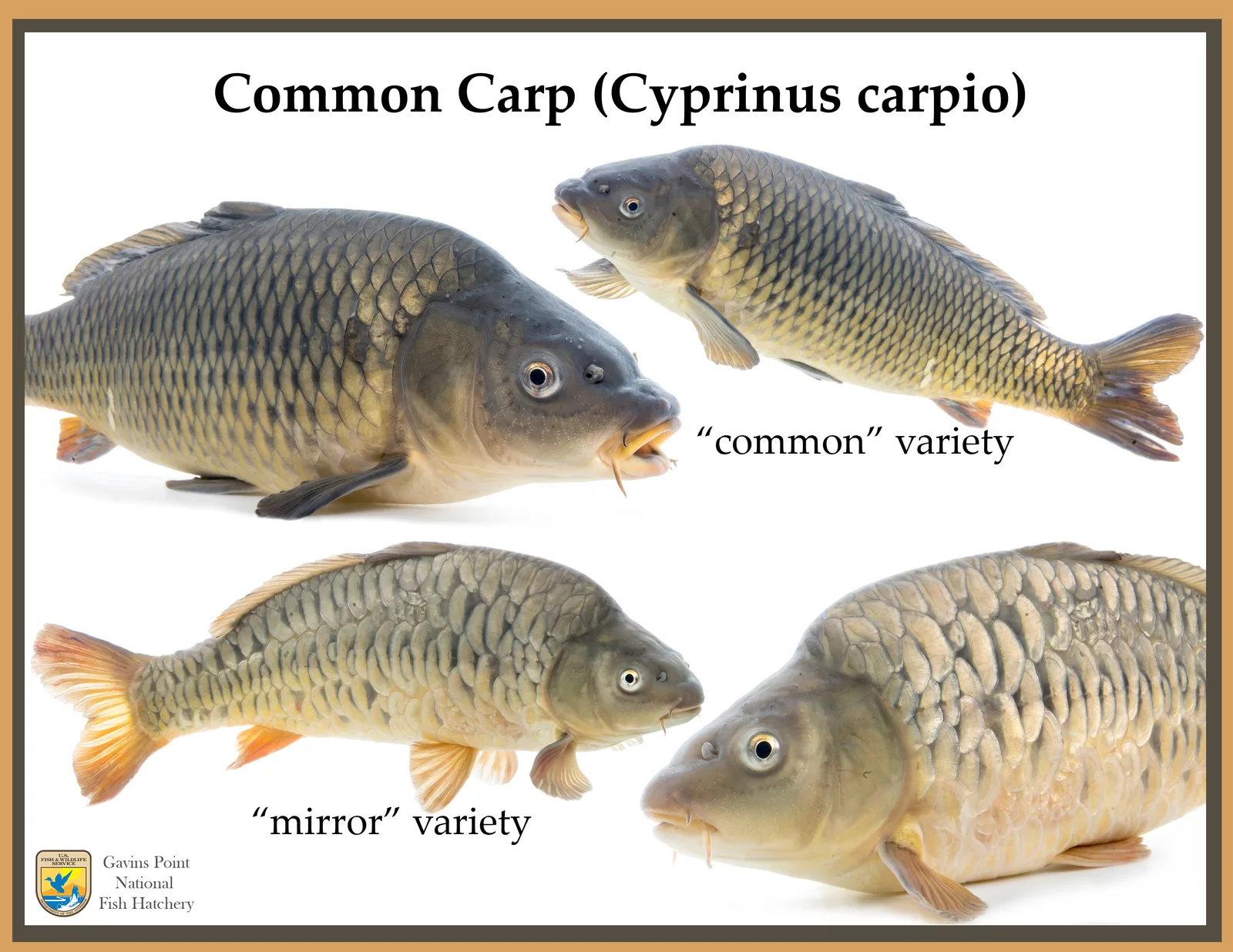
| Mirror, leather carp | As common carp | As common carp | A few big scales (mirror) or almost none (leather) | Same species |
| Grass carp | None; broad blunt head | Short, no spine | Small eye set low; crosshatched scales | Invasive carp |
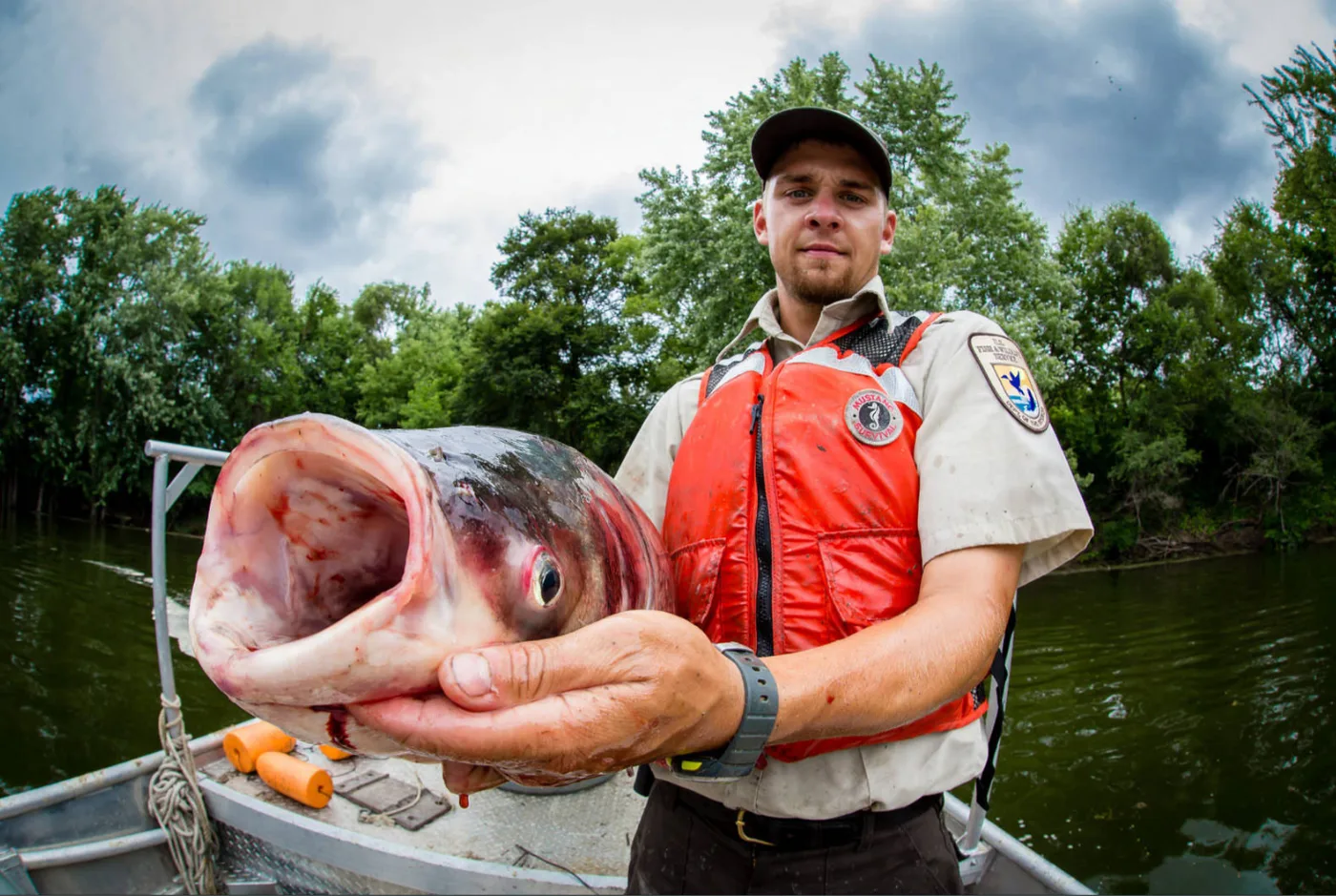
| Bighead carp | None; large upturned mouth | Short, no spine | Dark blotches; belly keel ends at the pelvic fins | Invasive, injurious |
| Silver carp | None; upturned mouth | Short, no spine | Tiny scales, no blotches; keel nearly to the throat | Invasive, injurious |
| Black carp | None; somewhat pointed snout, per Louisiana fishers | Short, no spine | Darker than grass carp, not black; molar-like throat teeth | Invasive, injurious |
| Goldfish | None | Long, saw-toothed spine | Gold to olive, even creamy white; reported to 23 in (59 cm) | Nonnative |
| Buffalo | None; thin (bigmouth) or thick grooved lips (smallmouth) | Long, sickle-shaped, no spine | Large scales without dark edges | Native sucker |
| River carpsucker | None; sucker mouth | Long, sickle-shaped, no spine | A nipple-like point on the lower lip | Native sucker |
The field rule:
- Barbels: a common carp, whatever its scales (or an escaped koi).
- No barbels, saw-toothed spine: a goldfish.
- No barbels, no spine, short back fin: an invasive carp. A belly keel means bighead or silver.
- No barbels, no spine, long sickle-shaped fin: a native buffalo or carpsucker.
Missouri’s field guide notes that river carpsuckers get called white or silver carp in error. Koi count under rule 1: they are Amur carp, now a separate species by Missouri’s account, and ghost carp are common carp crossed with koi. A mirror or leather carp is still a common carp: the same species with fewer scales.
The buffalo deserves the second look. In 2019, a study that aged bigmouth buffalo from their ear stones found fish of 112 years, “the oldest known freshwater teleost” (bony fish). A 2025 study in Saskatchewan aged one at 148. Many populations were 85 to 90 percent fish over 80.

Free PDF · Water temperature chart When do carp bite?
One reading, and the 16-page chart shows which of 26 fish are spawning, feeding hard or slowing down; for bass, crappie, bluegill and walleye, where they sit and what to throw. Every number sourced.
No card, nothing to buy, and the PDF is yours to keep. Confirm with one click and it's on its way. Then a few short emails and one a week on what's biting. Unsubscribe anytime. Privacy.
Which carp can you catch, and what does the law say?
The four groups an angler meets live very different lives: they eat different food, so they take different baits, and the law treats each one differently.
| Fish | In US water since | What it eats | On a hook | The rules |
|---|---|---|---|---|
| Common carp | 1877, by the U.S. Fish Commission | Insects, snails, plant matter from the bottom | Corn, dough balls, bread, worms | Nonnative; banned as baitfish in Pennsylvania |
| Grass carp | 1963, to fish farms in Alabama and Arkansas | Water plants | Bread, berries, cherry tomatoes, corn | Sterile triploids by permit in Texas; prohibited in Minnesota |
| Bighead, silver carp | 1973, by an Arkansas fish farmer | Plankton strained from the water | Rarely (Missouri, silver carp) | Federally injurious; illegal as live bait in Missouri |
| Black carp | Early 1970s, in grass carp shipments | Snails, mussels, clams | On record: IGFA, 112 lb 5 oz (2021) | Federally injurious |
The common carp and the grass carp are the two anglers set out to catch. Missouri lists “dough balls, whole kernel corn, and worms” for the common carp, and Connecticut’s grass carp program sight-fishes with bread and berries. Of the silver carp, Missouri says “the take from anglers is minimal.”
What are Asian carp, and can you keep one?
Asian carp is the old name for four fish from eastern Asia: grass, bighead, silver and black carp. The U.S. Fish and Wildlife Service calls them invasive carp; it dropped the name Asian carp in April 2021. Grass carp came in 1963, bighead and silver carp in 1973 through an Arkansas fish farmer, and black carp in the early 1970s as a “contaminant” in grass carp shipments.
Why are they bad? Bighead and silver carp strain the same plankton the natives live on. Missouri says they “can outcompete native plankton-eating fish, including paddlefish, bigmouth buffalo” and the young of other native fish. The silver carp also jumps: USGS describes it “leaping out of the water when startled (e.g., by noises such as a boat motor),” and Missouri warns that large ones “can leap from the water and injure boaters.”
The law is strict. Bighead, silver, black and largescale silver carp are federal injurious wildlife under the Lacey Act (50 CFR 16.13): no import, transport or acquisition without a permit. Missouri bans silver and bighead carp as live bait, though bighead may be used dead or cut, and says: “Do not collect, transfer, or dump this fish!” Minnesota lists grass carp as a prohibited invasive species, wants any catch reported to the DNR immediately, and requires a special permit to keep one. Whatever your state allows, never move one alive.
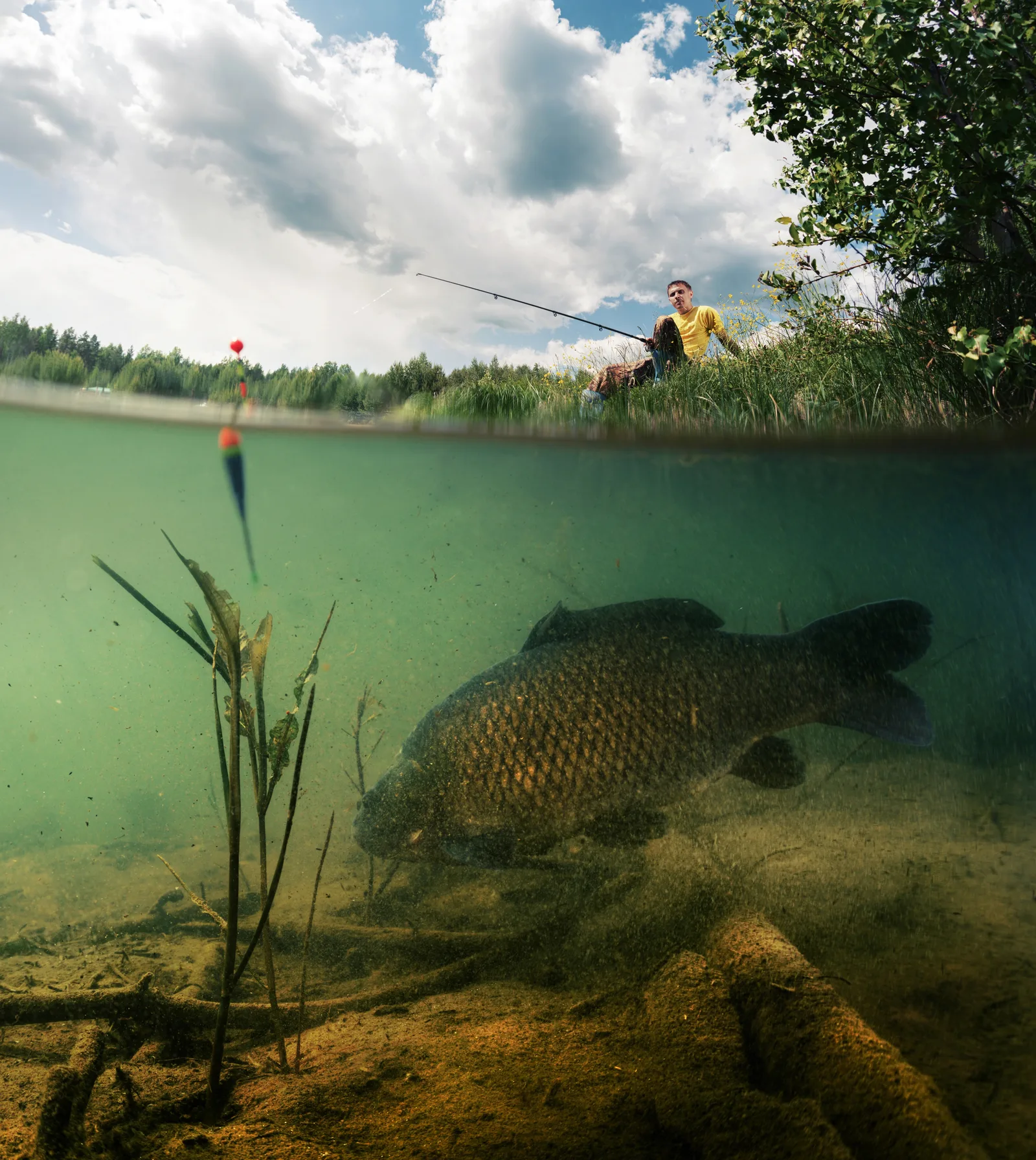
A carp under the water, the angler on the bank. Photo: mihtiander / Depositphotos.
Where and when do you find carp?
Look in warm, slow, rich water with a soft bottom. USGS finds common carp more abundant in impoundments, lakes and turbid, sluggish streams, and less common in clear or steep ones. Missouri puts them “least abundant in clear, high-gradient streams of the central Ozarks,” with adults in the deeper pools.
Then pick the hour. Missouri’s field guide says feeding “peaks in late evening or early morning, sometimes in very shallow water.” The American Carp Society adds the night, and says the cold months are harder because carp feed less.
Water temperature sets the season. On the water temperature chart, common carp are most comfortable at 70–85 °F (21–29 °C), spawn at 63–75 °F (17–24 °C) and are stressed above 95 °F (35 °C). Spawning runs from March to June in Missouri and can continue into early fall. Adults “migrate into shallow wetlands to spawn,” in University of Minnesota researchers’ words. In summer, look for weed beds, reeds and warm inlets. Under the ice, carp shoal tightly enough to be tracked by radio tag and netted out.
Depth is mostly shallow. The ACS puts carp from a foot down to 30 ft or more, and its fly-fishing page says “the carp will usually be feeding in 3-5 feet of water and at times even shallower than that.” Carp give themselves away there:
- Mudding: clouds of silt where a carp roots in the bottom.
- Tailing: a tail breaking the surface over a feeding fish.
- Rolling: backs and splashes at sunrise and before sunset.
Each one shows you where the carp are, and the mudding and tailing fish are the ones feeding. The season-by-season table, with where to look in each, is in how to catch carp.
Where are America’s best carp waters?
Some are in the middle of a city. New York’s DEC says the state “has many waters with abundant carp in the 10-30 pound range,” and its list of carp waters includes Central Park Lake and the Harlem Meer in Manhattan. For fish over 30 lb, it points to the Hudson River and the lower Niagara River, and to Cuba Lake, with “abundant carp up to 40 pounds.”
New York is also where the world came to fish. In 2005 the American Carp Society hosted the World Carp Championships on the St. Lawrence River: “One Hundred and One teams of two from 17 countries,” with a $1 million purse for breaking the state record.
Elsewhere, the state records mark the water. Texas’s record, 43.75 lb on maize in 2009, came from Lady Bird Lake in Austin. Wisconsin’s, from Lake Wisconsin, has stood since 1966. Washington’s 49 lb 8 oz fish came from Moses Lake in 2006, one of the two lakes where WDFW lets you fish for carp without a license.
What do carp eat, and do they have teeth?
Almost anything on the bottom. A common carp is an omnivore: USGS lists plant detritus, midge larvae, small crustaceans and snails, and Missouri ranks aquatic insects first. Larger carp, IGFA adds, take crayfish and mussels. Food “is probably located more by taste than by sight,” Missouri adds, so a bait has to smell right before it looks right.
Carp have no teeth in the mouth. They chew with pharyngeal teeth in the throat, “similar to human molars,” in North Carolina’s words, “used for crushing shells, seeds and plants.” A common carp has no stomach. Do fish have teeth? sets the carp’s throat teeth beside a pike’s needles.
The other carp eat differently, and it shows in how often they bite. Grass carp eat plants, bighead and silver carp strain plankton through their gill rakers, and black carp crush native snails, mussels and clams. Many of those mussels and snails are endangered or threatened, USGS notes.
A narrow river at sunrise. Photo: Givaga / Depositphotos.
How do you catch carp?
Put corn or bread on the bottom where carp feed, and let them take it without feeling a thing. New York’s DEC puts the whole problem in one line: carp “tend to drop a bait at the slightest resistance.” So the bail stays open, or a baitrunner lets the line run.
The bait. Canned sweet corn goes on the hook straight from the can, three or four kernels at a time. Bread molded around the hook with the point showing catches carp where people feed ducks. Boilies are “dense, flavored dough balls popular in Europe,” in Wired2Fish’s words, and go on a hair rig. Flavors lean sweet: savory baits, Outdoor Life warns, “often catch more catfish than carp.” The recipes, from the 1-2-3 doughball to boiled field corn, are in carp bait.
The rig. Two cover nearly all carp fishing:
- Free-line or running rig for fish feeding within an easy cast. Bread or corn on the hook, no weight or a sliding sinker, bail open.
- Hair rig for bigger fish and longer sessions. The bait hangs on a short line below a bare hook, and in IGFA’s description “the hook turns when the fish eats the bait and safely hooks most fish in the bottom lip.”
The tackle, in short. NY DEC’s carp page says rods of at least 6 ft work, but “longer rods in the 8 1/2 to 12 foot range are preferred,” with 10 to 15 lb mono or braid. The sources put the hook anywhere from size 4 to 10; IGFA’s six or eight is the place to start. Wired2Fish goes heavier: a 10 to 12 ft rod, 12 to 20 lb mono or 30 to 50 lb braid. A landing net and hemostats finish the kit; how to catch carp compares five sources side by side.
Carp cruising clear shallows take a fly, too. The American Carp Society’s fly guide says not to cast onto the fish, but to lead the fly into its path; how to catch carp gives the rod weight and the patterns.
Will a carp eat a hot dog? None of the agency and carp-society guides this page draws on names hot dogs; they name corn, bread, dough balls and worms. A savory bait also brings the catfish, so you may land one of those instead.
What fights harder, bass or carp? Missouri says a carp “can put up a fight equal to that of any game fish of similar size.” NY DEC warns that carp “fight hard and make long runs,” so set the drag smooth. If it goes back, catch and release has the handling steps.
Do you need a license, and can you shoot carp with a bow?
Check your state’s rules as you would for any fish. In Washington, a new law requiring a fishing license for carp took effect on June 6, 2024. Moses Lake and Vancouver Lake are exempt, and WDFW sets no daily limit.
Bowfishing for carp has its own record books. Oklahoma’s bow record common carp weighs 48 lb 13 oz, and its bow grass carp 77 lb. Washington asks for a bow with a draw weight of at least 30 lb.
Before you shoot, run the field rule. The bigmouth buffalo lives in the same shallows, and the 2019 longevity study found its “harvest is virtually unregulated and unstudied” while the population declines. A fish without barbels and with a long, sickle-shaped back fin is a native that may be older than your grandfather.
How did carp get to America?
The common carp is a fish of Europe and Asia. IGFA puts its original range in “temperate Asia and the rivers of the Black Sea and Aegean basins, notably the Danube.” Then, “in 1877, the U.S. Fish Commission imported Common Carp from Germany,” as the U.S. Geological Survey puts it. A private import came first: in 1872, J. A. Poppe of Sonoma, California, brought five fish over from Germany. The commission’s 345 common, mirror and leather carp were bred in ponds in Baltimore, then near Washington. By 1880 it was getting 2,000 letters a year.
Carp were often released from railroad tank cars at bridge crossings into streams. They took: in 1884 alone, the American Carp Society records, 453,000 lb of carp came out of the Upper Mississippi. Most states stopped stocking them in the mid-1890s.
Why do anglers hate carp, when Europe prizes them?
Carp became America’s trash fish when the price fell. Carp from shallow, stagnant ponds tasted of mud, and by the 1890s they sold for “3 cents or 4 cents a pound”. The wealthy switched to fish the poor could not get. In the American Carp Society’s history, the carp became “the perfect scapegoat” for losses that changes in land use did more to cause.
The damage is real too. A feeding carp stirs up the bottom and uproots plants, which USGS links to cloudier water and University of Minnesota researchers to poorer water quality and algal blooms. MAISRC estimates that over 70% of southern Minnesota’s lakes have lost their plant cover and suffer algal blooms because of carp foraging. Missouri’s field guide still adds a fair word: “the carp’s nuisance qualities may be somewhat exaggerated.”
Europe never fell out of love. Carp were first introduced to the ponds of Austrian nobility in 1227 and brought to England in 1496 “exclusively for the use of the royalty,” the ACS history records. “In much of Europe, carp remain a delicacy,” and a game fish: the IGFA calls the carp “one of the hardest fighting freshwater game fish in the world,” and accepted the hair rig in 2007.
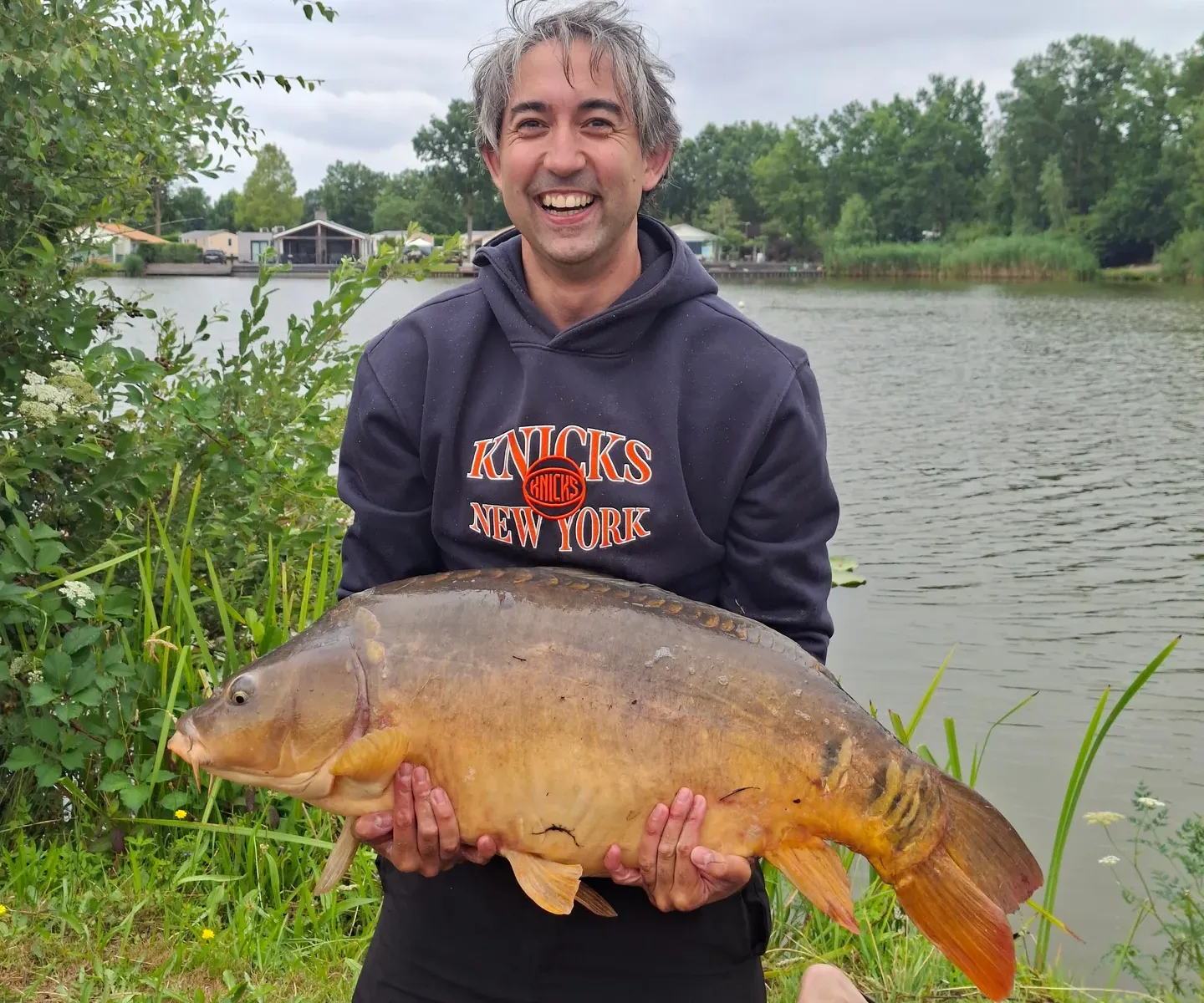
A European prize: the author, Jeroen Leidelmeijer, with his personal-best 40 lb (18.3 kg) mirror carp. Photo: Jeroen Leidelmeijer.
What is a predator of carp?
A small fish does the most. In most Minnesota lakes, MAISRC found, bluegills and other panfish eat carp eggs and larvae, so young carp survive poorly; carp boom where bluegills are scarce, in rich lakes and in marshes that winterkill. Carp that reach the juvenile stage are eaten by northern pike and largemouth bass, by cormorants, herons, goosanders and ospreys, and by otters and mink.
Grown carp are taken by people: by the commercial gillnet fisheries Seafood Watch rates, and by bowfishers. Lake managers have one more handle. Carp return to their home lakes to spawn, “like salmon,” which MAISRC calls “important for selecting locations to disrupt their life cycle.”
Are carp good to eat?
Yes, with two cautions. In January 2025, Seafood Watch rated common carp netted in Illinois a Best Choice. The first caution is bones: New York’s DEC describes two rows of floating bones along each side and says to score or grind the fillets. The second is the water. Long-lived and fatty, carp gather contaminants, especially in urban and suburban water, so check your state’s advisory as you would for bass you plan to keep.
So why do so few Americans eat carp? Mostly history: the price collapsed in the 1890s, and carp from stagnant ponds got a name for tasting of mud.
The Asian carp eat well too. Missouri says of the bighead that “its meat is delicious,” and Illinois markets silver, bighead and grass carp as copi. Commercially it is cheap fish: Seafood Watch gives a market price of $0.09 to $0.30 a pound for wild invasive carp.
How big and how old do carp get?
Illinois puts the top end at “48 inches and more than 80 pounds”. Growth depends on the lake. Computed from FishBase growth data, a carp of 20 in (51 cm) to the fork of the tail is about 3 years old in Illinois’s Hennepin and Hopper lakes but about 10 in Nebraska’s Marsh Lake. To age a carp, biologists count the yearly rings on its otoliths. These small inner-ear stones, unlike scales, do not reabsorb in lean times. USGS puts the wild lifespan at about 20 years; Missouri says few pass 12 in the wild.
The IGFA all-tackle world records for carp and their look-alikes:
| Fish | IGFA all-tackle record | Angler, year | Water |
|---|---|---|---|
| Common carp | 75 lb 11 oz (34.35 kg) | Leo van der Gugten, 1987 | Lac de St. Cassien, France |
| Grass carp | 87 lb 10 oz (39.75 kg) | Stoian Iliev, 2009 | Piasuchnik Dam, Bulgaria |
| Bighead carp | 97 lb (44 kg) | George Chance, 2024 | Mississippi River, Missouri |
| Silver carp | 70 lb 8 oz (32 kg) | Chongdae Lim, 2006 | Andong, Korea |
| Black carp | 112 lb 5 oz (50.94 kg) | Jesse Hughes, 2021 | Osage River, Missouri |
| Crucian carp | 5 lb 5 oz (2.41 kg) | Giacomo Schiavon, 2014 | Lago Fasson, Italy |
| Goldfish | 9 lb 6 oz (4.26 kg) | Matthew Servant, 2002 | Lindo Lakes, California |
| Bigmouth buffalo | 70 lb 5 oz (31.89 kg) | Delbert Sisk, 1980 | Bastrop, Louisiana |
| Smallmouth buffalo | 82 lb 3 oz (37.29 kg) | Randy Collins, 1993 | Athens Lake, Texas |
Oklahoma’s state record bighead, 118 lb 10 oz on rod and line in 2025, outweighs the IGFA fish. Common carp state records run lighter; Michigan’s, the heaviest here, was speared:
| State | Common carp record | Water, year |
|---|---|---|
| Michigan | 61 lb 8 oz (27.9 kg), speared | Wolf Lake, 1974 |
| Wisconsin | 57 lb 2 oz (25.9 kg) | Lake Wisconsin, 1966 |
| New York | 50 lb 6 oz (22.8 kg) | Tomhannock Reservoir, 1995 |
| Washington | 49 lb 8 oz (22.5 kg) | Moses Lake, 2006 |
| Virginia | 49 lb 4 oz (22.3 kg) | Lake Prince, 1986 |
| Texas | 43.75 lb (19.8 kg) | Lady Bird Lake, 2009 |
| Montana | 40.2 lb (18.2 kg) | Nelson Reservoir, 1998 |
| Oklahoma | 39 lb 10.4 oz (18 kg) | Grady County pond, 2002 |
Will carp clean up a pond?
Grass carp will eat the weeds, though Missouri warns that they commonly remove too much. USGS notes that what they pass undigested enriches the water and promotes algal blooms. Common carp make a pond muddier. In Texas only triploid grass carp, made sterile in the hatchery, are legal, by permit, and Texas A&M AgriLife recommends 7 to 15 per acre. Check your state first: Minnesota prohibits them.
What kind of fish is a carp?
Carp names many larger fish of the minnow family, Cyprinidae; the verb “to carp” has a separate root. The common carp, also called German or European carp, is Cyprinus carpio; koi were bred, by most accounts, from the Amur carp, Cyprinus rubrofuscus. Goldfish and crucian carp are Carassius, in the same family. The grass, silver, bighead and black carps now sit in a family of their own, the Xenocyprididae, Missouri notes. The buffalo and carpsuckers are suckers, covered with the other natives in other freshwater fish, and every other fish is in the species guide.
All articles
 Bighead Carp: How to Identify One and What to Do With It
Bighead carp: eyes set below the mouth, dark blotches, no barbels. How to ID one, what to do if you catch it, records to 125 lb, and eating it.
 Carp Bait: What Works, Homemade Recipes and How to Rig It
Carp bait: start with canned sweet corn or bread. Eight baits with their recipes and ratios (the 1-2-3 doughball, pack bait, field corn) and the chum laws.
 Carp Fishing: How to Catch Carp With a Simple Rig or a Hair Rig
Carp fishing for beginners: the setup, where carp feed by season, bread free-lined close in, and the hair rig with a baitrunner for big carp.
 Common Carp: Identification, Mirror and Leather Carp, Size and Age
Common carp: two barbels each side and a saw-toothed back fin, 12–25 in and 1–8 lb. Mirror and leather forms, spawning, and how old a 20 in carp is.
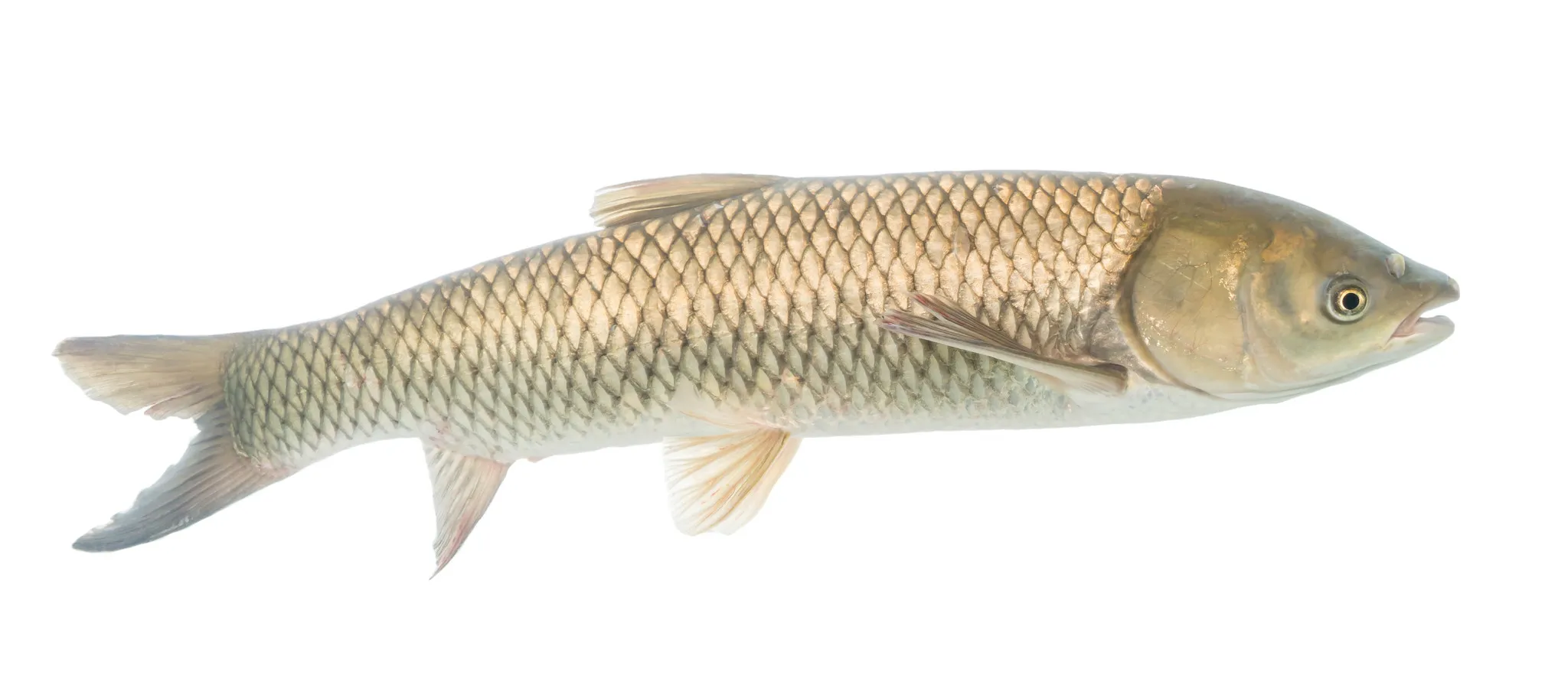 Grass Carp: How to Identify, Catch and Eat the White Amur
Grass carp (white amur): no barbels, a short back fin, up to 48 in and 50 lb or more. Triploid rules by state, the baits that catch them, and eating one.

Free PDF · 16 pages
Stop guessing. Know what's biting before your first cast
A whole Saturday on the water with nothing to show for it. One reading tells you who's feeding.
The Water Temperature Fishing Chart. Take one water temperature reading, find it on the chart, and see which of 26 freshwater fish are spawning, feeding hard or slowing down.
- Where bass, crappie, bluegill and walleye sit, and what to throw. Trout: the reading where you stop.
- Why a 3 ft drop beats a cold front, and what to throw each day of the front
- The three thermometer mistakes that make a reading lie
The chart's numbers come from state fish and wildlife agencies and fisheries research: 61 sources, each listed on the site.
No card, nothing to buy. Confirm with one click and the PDF is on its way, one version for your phone and one to print, yours to keep. Then a few short emails and one a week on what's biting, with an unsubscribe link in every one. Privacy.
Sources (54)
- Lackmann, Sereda, Villeneuve, Foley, Pollock, Bryshun, McCallum, Englot, Zak, Rehbein, Bielak-Lackmann and Clark (2025), Within-Ecosystem Comparison of Bigmouth Buffalo Ictiobus cyprinellus and Common Carp Cyprinus carpio Reveals Diverging Population Trajectories, Declining Recruitment, and a Lifespan of 148 Years, Ecology and Evolution 15(11):e72483
- USGS Nonindigenous Aquatic Species, common carp fact sheet: other names (European carp, German carp), range (all states but Alaska), the 1872 Poppe import, the 1877 import, rail-car stocking, habitat, diet, turbidity, lifespan
- USGS Nonindigenous Aquatic Species, grass carp: identification, the 1963 import, plant removal, undigested plant matter that enriches the water and promotes algal blooms
- USGS Nonindigenous Aquatic Species, bighead carp: first imported into the United States in 1973 by a private fish farmer in Arkansas
- USGS Nonindigenous Aquatic Species, silver carp: first brought into the United States in 1973 by a private fish farmer in Arkansas; leaping out of the water when startled, by noises such as a boat motor
Show all 54 sourcesShow fewer sources
- USGS Nonindigenous Aquatic Species, black carp: a contaminant in grass carp shipments in the early 1970s, darker than grass carp but not black, the somewhat pointed snout, molar-like throat teeth, native snails, mussels and clams as food
- USGS Nonindigenous Aquatic Species, goldfish: serrated spine, gold to olive or creamy white, size, all 50 states
- Missouri Department of Conservation field guide, common carp: barbels, spine, scales, color, typical size, habitat, feeding times, food by taste, baits, the fight, spawning months, nuisance qualities, koi as Amur carp, the Xenocyprididae
- Missouri Department of Conservation field guide, goldfish: lacks barbels at the corners of the mouth, unlike the common carp
- Minnesota DNR, Have you seen an invasive carp? (2024 flyer): no barbels on silver, bighead, grass and black carp or on bigmouth and smallmouth buffalo; barbels on common carp
- Wikipedia, Smallmouth buffalo: all catostomids (suckers) lack the barbels of carp
- Montana Field Guide, common carp: two barbels on each side of the upper jaw, the rear pair more conspicuous
- Wikipedia, Common carp: the mirror and leather scale forms, ghost carp, no stomach, the throat teeth, the fish, birds and mammals that prey on juvenile carp
- NC Wildlife, Common Carp: throat teeth similar to human molars, used for crushing shells, seeds and plants
- Missouri Department of Conservation field guide, bighead carp: large upturned mouth, dark blotches, belly keel to the pelvic fins, outcompetes paddlefish and bigmouth buffalo, meat, live-bait rule
- Missouri Department of Conservation field guide, silver carp: upturned mouth, tiny scales, no blotches, keel nearly to the throat, leaps and injures boaters, minimal take by anglers, live-bait rule
- Missouri Department of Conservation field guide, grass carp: head, eye, scales, removing too much vegetation
- Missouri Department of Conservation field guide, bigmouth buffalo: thin lips, oblique mouth, sickle-shaped fin, large scales without dark edges
- Missouri Department of Conservation field guide, smallmouth buffalo: thicker, more strongly grooved lips
- Missouri Department of Conservation field guide, river carpsucker: nipple-like lower lip, names used in error
- Bigmouth Buffalo Ictiobus cyprinellus sets freshwater teleost record as improved age analysis reveals centenarian longevity (Lackmann, Andrews, Butler, Bielak-Lackmann and Clark, Communications Biology, 2019)
- Illinois DNR, Wild About Illinois Fishes, common carp: maximum size, feeding in water so shallow the back shows
- American Carp Society, US Carp History: the 1877 import numbers, the 1884 Upper Mississippi catch, the 1890s price collapse, the scapegoat, Europe, IGFA and the hair rig in 2007
- American Carp Society, Intro to Carp Angling: bread and sweet corn, hook size, line, depth, rolling and feeding times
- American Carp Society, Common Carp (fly fishing): feeding in 3-5 feet of water, mud clouds and tailing, leading the fly into the fish's path
- IGFA, Carp Angling in North America (Wayne Boon, 2019): the game-fish quote, the hair rig
- IGFA World Records search: all-tackle records for the carp, goldfish and buffalo
- NY DEC, Let's Go Carp Fishing: slightest resistance, floating bones, contaminants and the health advisory
- NY DEC, Carp Fishing in New York: carp in the 10-30 pound range, carp waters by region (Central Park Lake, Harlem Meer, Hudson, lower Niagara, Cuba Lake), rods of 8 1/2 to 12 feet preferred, 10 to 15 lb line, hooks 4 to 8
- American Carp Society, History: the 2005 World Carp Championships on the St. Lawrence River, the hair rig ratified by IGFA in 2007
- Wired2Fish, Carp Fishing: How to Catch Carp (David Schlake, 2025): boilies, pre-baiting, the hair rig on a baitrunner
- Outdoor Life, The Best Carp Baits (2022): savory flavors catch more catfish than carp
- Connecticut DEEP, Triploid Grass Carp Fishing Tactics and Tips (2023): sight fishing, bread, berries, cherry tomatoes and corn
- Monterey Bay Aquarium Seafood Watch, invasive carp assessment (January 2025): common carp ratings by state (p. 7), market price $0.09/lb to $0.30/lb (p. 18), gillnet and trammel-net fisheries
- Illinois DNR, Choose Copi: silver, bighead and grass carp marketed as copi
- University of Minnesota MAISRC, common carp: spawning in shallow wetlands, return to home lakes, winter aggregations, panfish and bluegills that eat carp eggs and larvae, lost plant cover, turbidity and nutrients that feed algal blooms
- FishBase, growth parameters for common carp (US populations), basis of the computed age at 20 in
- Texas A&M AgriLife Extension, Pond management: grass carp (triploids, permit, 7 to 15 per acre)
- Minnesota DNR, grass carp: prohibited invasive species, report immediately, special permit to possess
- 50 CFR 16.13, injurious fish: bighead, silver, largescale silver and black carp
- 58 Pa. Code §63.44, illegal baitfish: goldfish, koi and common carp
- NBC News / Associated Press (July 2021): Fish and Wildlife Service switched to "invasive carp" in April
- Washington Department of Fish and Wildlife, common carp: license required from June 6, 2024, no daily limit, bow draw weight, state record
- Wisconsin DNR, record fish (hook and line): common carp
- Michigan DNR, State Record Fish: common carp, 61.5 lb, 1974, spear, Wolf Lake, Jackson County
- NY DEC, Angler Achievement Awards Program: state record common carp
- Virginia DWR, state record fish: common carp
- Texas Parks and Wildlife, state freshwater records: common carp
- Montana FWP, state record fish: common carp
- Oklahoma Department of Wildlife Conservation, state record fish: common carp, bighead carp, bow records
- Wikipedia, Carp: the generic name, family Cyprinidae, Carassius
- Wikipedia, Koi: most ornamental koi breeds originate from Amur carp (Cyprinus rubrofuscus)
- Wiktionary, carp: the separate roots of the fish and the verb
- Wikipedia, Otolith: aging fish by the annual rings, which unlike scales do not reabsorb