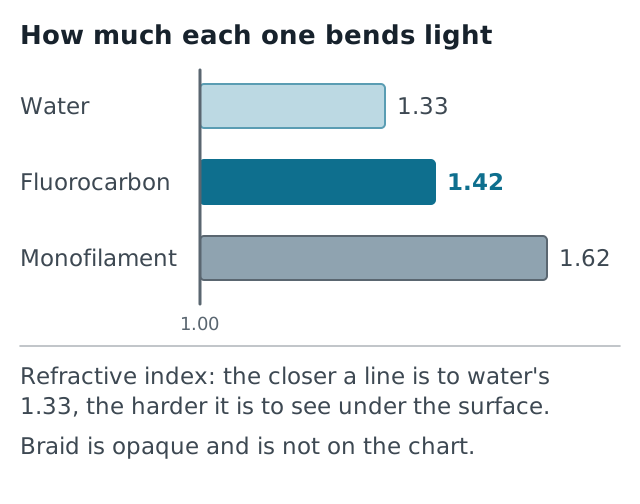
Fluorocarbon fishing line is hard for a fish to see, it sinks, and it is as strong at the end of a wet day as it was dry. Three measured properties of the resin explain that: how it bends light, how dense it is, and how little water it takes up. It also stretches less than nylon, shrugs off rock and shell, and costs two to five times as much per yard. Leave it off topwaters, where it sinks the lure’s nose.
Nylon monofilament soaks up to 10 percent of its weight in water and loses strength doing it. PVDF absorbs 0.03 percent, which is why a fluorocarbon leader is the same line at dusk as it was at dawn.
What makes it different from mono?
Fluorocarbon is a single strand of polyvinylidene fluoride, PVDF. Kureha, the Japanese chemical company behind Seaguar, publishes the resin’s test data. Its refractive index is 1.42 against water’s 1.33; nylon’s is 1.62, by Seaguar’s FAQ. Its specific gravity is 1.77 to 1.79, where water is 1.00. So it is hard to see, and it sinks.
| Property | Fluorocarbon | Who measured it | At the water |
|---|---|---|---|
| Refractive index | 1.42 (water 1.33, nylon 1.62) | Kureha, ASTM D542; Seaguar FAQ | Less visible in clear water; not invisible |
| Specific gravity | 1.77–1.79 (water 1.00, nylon about 1.14) | Kureha, ASTM D792 | Sinks without a weight; keeps line off the surface in wind |
| Water absorption | 0.03% at 73 °F (23 °C); nylon up to 10% | Kureha, ASTM D570; Game & Fish | Same strength and stiffness wet as dry |
| Stretch | 10–15%; mono 25–30% | The Tackle Room; Seaguar: “less than mono” | Feels the tap, drives a single hook; less cushion on trebles |
| UV | “Not affected”; nylon loses up to 20% in 100 hours | Seaguar FAQ; Game & Fish | A spool lasts seasons, not months |
| Abrasion | Harder surface; “diameter matters most” | Field & Stream | Rock, shell, docks; thicker beats thinner |
| Diameter at 12 lb | 0.011–0.013 in (0.28–0.33 mm) by brand | Retailer spec charts, table below | A 12 lb spool is not one thing |
| Knot strength, Palomar | 72–101% of the label, by brand | TackleTour, 14 lines | The knot is where fluorocarbon breaks |
One of those figures explains why anglers lose lures: the knot. TackleTour pulled a Palomar to failure in fourteen fluorocarbons, and only five reached 90 percent of the label. The vs page sets those numbers against a mono baseline.
The stretch figure cuts both ways too. Less stretch means a drop-shot tap arrives at the rod. It also means a bass jumping on a crankbait tears a treble loose more easily; that is mono’s case on the squarebill.
Main line or leader?
| Fishing | How to run it | Test | Why |
|---|---|---|---|
| Bass, casting jigs, Texas rigs, worms | Main line on a baitcaster | 12–20 lb | Sinks with the bait, feels bottom, drives one big hook; Sunline’s Lawyer runs 14, 16 or 20 by cover |
| Bass, crankbaits and jerkbaits | Main line | 10–15 lb | Gets the lure to its rated depth; Game & Fish’s 12 or 15 lb for cranking |
| Bass, drop shot, shaky head, Ned rig | Leader on 10 lb braid, spinning | 6–8 lb | Sunline says 5–7 lb are the finesse sellers and 7 lb the best-selling spinning size |
| Trout, spinning in clear streams | Main line or leader | 4–6 lb | Wary fish, small lures |
| Trout, nymphs on the fly rod | Tippet | 4X–5X (8.4–5.7 lb in Cortland’s) | Sinks, survives rock; nylon for dry flies |
| Inshore redfish, snook, seatrout | Leader on 10–15 lb braid | 20–30 lb | Oysters and pilings; Salt Strong runs 20–25 lb for reds and trout, 25–30 for snook |
| Inlets, big snook and reds in structure | Leader on 20–30 lb braid | 40–60 lb | Salt Strong’s heavy class; many run mono here, see below |
| Topwater, frogs, buzzbaits | Not at all | – | It sinks the nose; mono or braid |
The honest footnote on the saltwater rows: Salt Strong runs mono leaders of those same tests, because in its own leader tests fluorocarbon “has not justified the price difference.” The case for fluorocarbon inshore is the clear flats, where the leader is the only thing a redfish can see. The fishing leader page covers the lengths and the knot to braid.
For bass, the best fishing line for bass page sets every technique against braid and mono. The Texas rig, drop shot and jerkbait are where fluorocarbon earns its price.
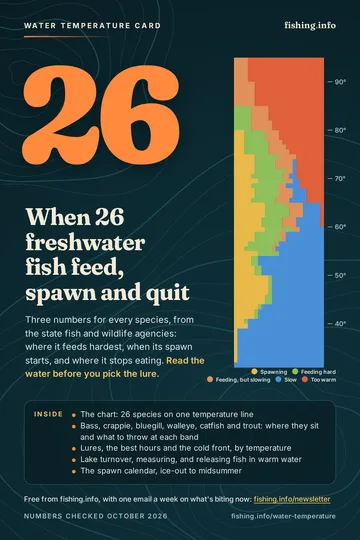
Free card: what 26 species do at your water temperature
Plus one email a week on what's biting now. No sales pitches. Privacy.
Which spool should you buy?
Two things on the label matter. “100% fluorocarbon” means solid PVDF from end to end. A “fluorocarbon-coated” line is nylon with a PVDF skin and behaves like mono, at a mono price; the fluorocarbon vs monofilament page sorts those hybrids out.
And “leader” and “main line” are different products, not different lengths of the same spool. Seaguar’s FAQ says leader material is built to be stronger over short lengths, and main line to absorb shock over a long cast. Its leaders fuse a hard inner resin for tensile strength with a softer outer one for knot strength, which Seaguar calls Double Structure.
Then there is thickness. Wired2Fish hung the same bead from 3 in lengths of two 12 lb fluorocarbons and watched one sag further than the other. Seaguar Gold Label is 0.265 mm thick, Sufix Advance 0.30 mm, both labeled 12 lb. That gap, and the price gap under it, is the whole buying decision. Diameters and prices below are the retailers’ spec charts and list prices in fall 2026; prices drift.
| Line | Tests | Diameter at 12 lb | Spool and price | Built for |
|---|---|---|---|---|
| Seaguar BasiX | From 4 lb | 0.012 in (0.305 mm) | 200 yd, $10.99 | A first fluorocarbon; the budget main line |
| Seaguar Red Label | 4–20 lb | 0.011 in (0.28 mm) | 200 yd, $18.99 | Stiffer; baitcasters, jigs, a cheap leader |
| Seaguar InvizX | 4–25 lb | 0.011 in (0.285 mm) | 200 yd, $24–30 | Soft and castable; the one line for spinning and casting |
| Seaguar AbrazX | 4–25 lb | 0.011 in (0.285 mm) | 200 yd, $34.99 | Rock, wood, docks; stiffer, harder to knot |
| Seaguar Tatsu | 4–25 lb | 0.011 in (0.285 mm) | 200 yd, $52.99 | Double Structure; the limpest and dearest main line |
| Sunline FC Sniper | 2–30 lb | 0.011 in (0.29 mm) | 200 yd, $26.49–29.99 | Finesse on spinning gear; 7 lb is the seller |
| Sunline Shooter | 7–30 lb | 0.011 in (0.285 mm) | 165 yd, $44.99 | Stiffer than Sniper; three tiers, Finesse to Power |
| Berkley Trilene 100% | 4–25 lb | 0.013 in (0.33 mm) | 200 yd, $21.99–24.99 | Dense and fast-sinking; cranking; Field & Stream’s budget pick |
| Berkley Vanish | 6–60 lb | 0.012 in (0.30 mm) | 250 yd, $14.99 | Clear water on a budget; more memory |
| P-Line Tactical | 6–20 lb | 0.012 in (0.298 mm) | 200 yd, $21.99–22.99 | All-round main line; 1,000 yd bulk spools |
| Yo-Zuri H.D. Carbon | 2–200 lb | 0.012 in (0.297 mm) | 30 yd, $8–10 | Saltwater leader; Field & Stream’s pick for tuna and inshore |
Read the table with the reel in mind. On a spinning reel the thin, supple lines (InvizX, FC Sniper, Tatsu) cast a light bait and stay on the spool; the stiff ones (Red Label, AbrazX, Shooter) spring off it in coils. On a baitcaster the stiffness is harmless, and the hardness pays around wood and rock.
Which knots hold, and which slip?
Fluorocarbon is harder and slicker than nylon, and the failure is nearly always friction. A knot pulled tight dry heats at the wraps, and the outer resin glazes. The line then parts at the knot on the next fish, leaving a curly pigtail where the lure was. BassResource’s rule is the one to repeat: “slobber up heavily, make pretty knots, and a slow cinch.” Wet the knot, lay the wraps so none crosses another, and pull the tag and the standing line together, slowly.
For the lure, the Seaguar knot guide lists three: the Palomar, the double San Diego jam and the improved clinch. The Palomar is the simplest, and the knot TackleTour’s figures in the table were pulled on. On heavy line the San Diego jam ties easier and holds. The improved clinch works when it is wet and the wraps are neat, and slips when they are not.
For joining a fluorocarbon leader to braid, the FG knot is the slimmest. Jeremy Lawyer, the Bass Pro Tour pro in Sunline’s leader article, ties it to his fluorocarbon leaders, and Salt Strong ties it to its mono ones. The double uni is bulkier and easier; BassResource uses it or the J-knot to join fluorocarbon to the mono backing. Salt Strong’s loop of choice for a lure on a fluorocarbon leader is the non-slip (Kreh) loop, because a snug knot kills the action of a small plug. The braid to mono knot page shows the joins step by step.
How do you spool it on a baitcaster without the coils?
Fluorocarbon’s memory is the coil of the filler spool, and most of the trouble is put on at the kitchen table.
- Put mono underneath. Tie a cheap 12–15 lb mono to the arbor, or keep the mono already there. BassResource’s method: make your longest cast with a heavy lure, strip 30–40 ft (9–12 m) more off the reel, cut, and join the fluorocarbon there with a double uni. One 200 yd spool now fills two or three reels.
- Soak the filler spool. Capt. Curtis LeNormand sets the spool in a bowl with water halfway up it and winds the line on wet; warm water softens PVDF and takes the coil out.
- Feed off the top. Stand the filler spool on edge so the line comes off the top into the reel, turning the same way the reel spool turns. Fed off the wrong side, it twists.
- Firm, not tight. Pinch the line ahead of the reel. Seaguar’s tip is firm tension that lays the line flat without crimping it; braid wants it cranked down, fluorocarbon does not.
- Stop short of the lip. LeNormand leaves 1/16 to 1/8 in (1.5–3 mm) below the rim; an overfilled spool throws coils on the first cast.
- Condition it. A line conditioner on the new spool, Seaguar says, helps memory and casting; respray every few trips.
- Set the reel. Tighten the spool tension knob until the lure just falls when the thumb bar is pressed. Cast heavy and short for the first dozen, then open it up. The how to put fishing line on a reel page has the same steps for every reel type.
How long does it last, and why does it cost so much?
Seaguar says fluorocarbon is not affected by UV light and needs no dark storage. Nylon, by contrast, loses up to a fifth of its strength after 100 hours in the sun. BassResource reckons a fluorocarbon spool outlasts nylon four to one, and Field & Stream still changes it once a season, for the nicks, the sand and the salt rather than the age.
The honest rule: the line does not go off, the last ten yards do. Run the leader between finger and thumb after every fish and every rock; a rough patch is a retie. So is a leader that has just been pulled near its breaking strength by a big fish or a snag, because it is weaker than it looks. Cold is the one weather that changes it. The line stiffens and coils more on a frozen lake, which is why Berkley sells a thinner, softer Ice version of its Trilene fluorocarbon.
The price is chemistry, not marketing. BassResource explains it: PVDF resin costs four to five times what nylon costs, and because it is nearly twice as dense, a pound of it makes half the yards. Hence 5.5 cents a yard for BasiX and 26 cents for Tatsu, against two or three cents for a good mono. The cost table on the vs page works it out per reel per year. The short version: $11 to $53 for a baitcaster that gets one fill a year, and a $10 leader spool that lasts a season on a spinning reel.
Where did fluorocarbon come from?
Kureha’s chemists made the first PVDF fishing line in 1971 and named it Seaguar; Kureha still makes the resin, KF Polymer, at its Iwaki factory. For twenty years it was a leader material. Fly fishers bought it as tippet and saltwater anglers as bite leader, because it was stiff, hard and invisible. BassResource’s history puts its arrival as a bass main line in the mid-1990s, when softer formulations made it castable.
Mistakes to avoid
- The dry knot. Most fluorocarbon break-offs are the knot, and the knot was tied dry and yanked tight. Wet it, go slow.
- Heavy, stiff fluorocarbon on a spinning reel. 15 lb Red Label on a 2500-size spinning reel coils off the spool and wind-knots. Wired2Fish’s rule is thin and supple for spinning, thick and stiff for casting reels. Spinning gear wants 6–8 lb, or braid to a fluorocarbon leader.
- Trusting invisibility in muddy water. Fish cannot see any line in a foot of visibility. Matt Allen of Tactical Bassin runs a mono leader in stained water because it is cheaper and stretches; save the fluorocarbon for water you can see into.
- Fluorocarbon under a topwater. It sinks, the lure’s nose follows, and a walking bait stops walking. Mono floats and braid floats; the monofilament page has the topwater case.
- Leader material as main line. A 25 yd leader spool is stiffer and harder than main line by design; spooled on a reel it casts like wire.
When does another line win?
Braid wins for frogs, punching and anything that needs 50 lb in the diameter of 12 lb mono; the braided fishing line page has the strand-count and diameter tables. Mono wins on topwater, on trolling rods, on circle-hook bait rigs and on a beginner’s first reel, where its stretch forgives the hookset and its price forgives the backlash.
The line hub lays the three materials out together. The right answer for most anglers is all three on the boat, and fluorocarbon where the water is clear and the hook is single.
Free download
The water temperature card
Read your water temperature and the card tells you who is spawning, who is feeding and what to throw. 26 species, 16 pages, for your phone and the tackle box.
Plus one email a week on what's biting now. No sales pitches. Privacy.
Related
Section guide
Fishing Line: Monofilament, Fluorocarbon and Braid ComparedThe three kinds of fishing line compared on stretch, visibility, diameter, sink rate and life, which line each technique wants, and why braid needs a leader.
 Monofilament Fishing Line: What It Is Good For, and Where It Loses
Monofilament fishing line stretches, floats, ties easily and costs a cent a yard. Where that wins, topwater, trolling, bait and beginners, and where it loses.
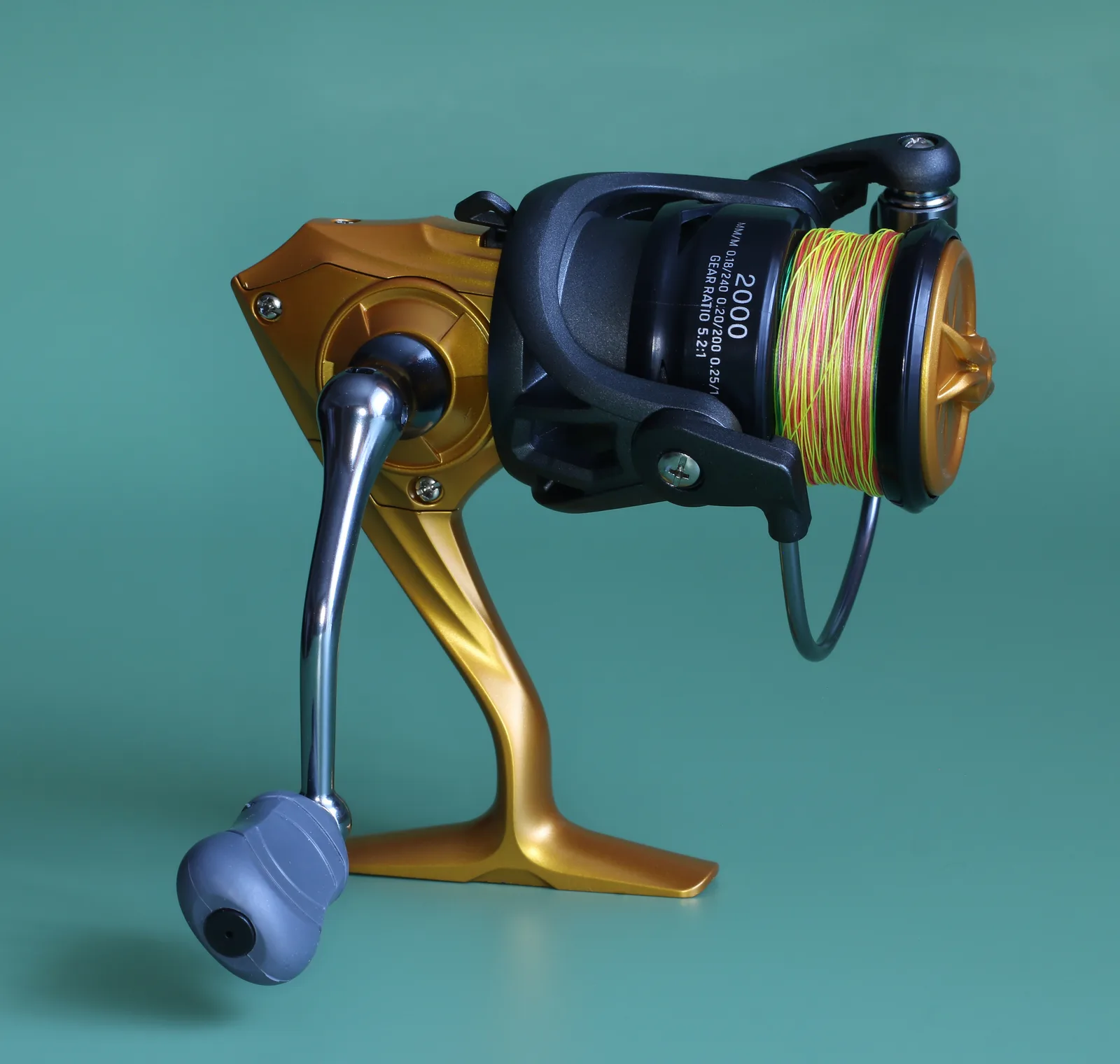 Best Braided Fishing Line: The Reviewers' Picks Compared
The best braided fishing line: eight braids compared on carriers, diameter and price per yard, with picks for flipping, finesse, inshore, surf, catfish and ice.
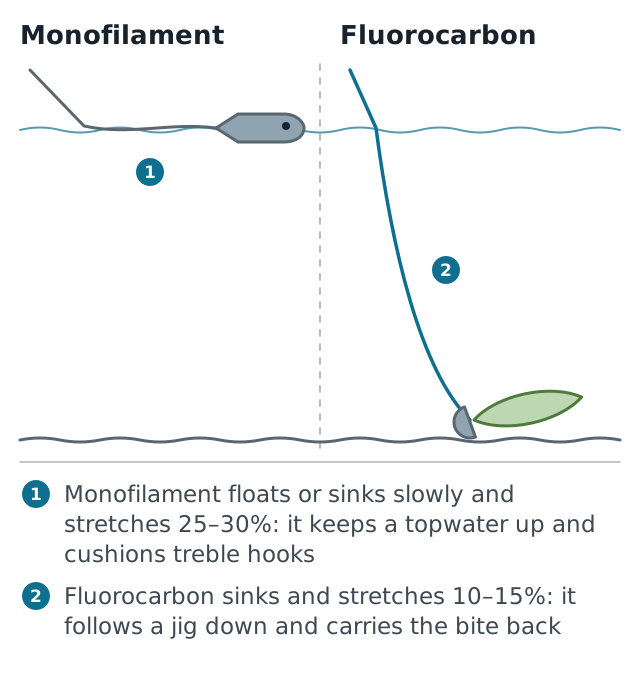 Fluorocarbon vs Monofilament: Which Line Wins for Each Technique
Fluorocarbon versus monofilament on the numbers: stretch, visibility, sink rate, abrasion and price, then a technique-by-technique verdict with pound tests.
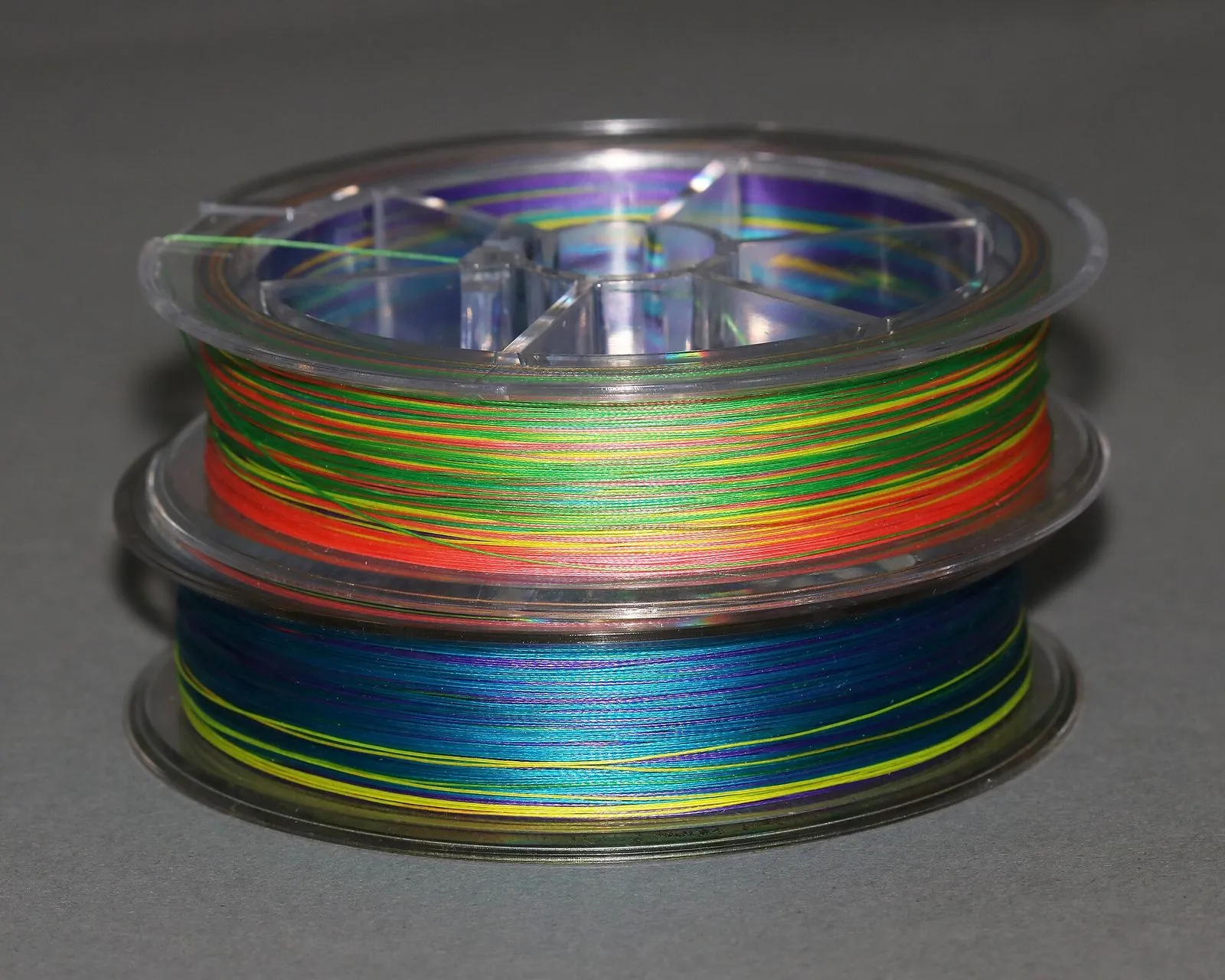 Braided Fishing Line: Strength, Diameter, Pros and Cons Explained
Braided fishing line explained: what it is made of, the pound-test and diameter table against mono, why it needs a leader and backing, and when not to use it.
Sources
- Seaguar, understanding fluorocarbon (FAQ): refractive indices, Double Structure, leader vs main line, UV
- Kureha, Seaguar fishing line: 1971, world's first fluorocarbon (PVDF) line, KF Polymer
- Kureha, KF Polymer (PVDF) properties: specific gravity, water absorption, refractive index (ASTM)
- Game & Fish, 50 years of fluoro: nylon's water absorption and UV loss, density
- BassResource, The Fluorocarbon Advantage: history, resin cost, mono backing, knots
- Wired2Fish, How-to handle fluorocarbon correctly (Seaguar line tip): spooling, backing, conditioner
- Wired2Fish, Best fluorocarbon fishing lines: the 12 lb diameter test, main line vs leader material
- Field & Stream, Best fluorocarbon fishing line of 2026: picks, test ranges, diameters
- TackleTour, Fluorocarbon showdown: Palomar knot strength against rated strength, 14 lines
- The Tackle Room, mono vs fluorocarbon vs braid (stretch figures)
- Tactical Bassin (Matt Allen), best fishing line: braid, mono or fluorocarbon
- Louisiana Sportsman, re-spool with wet monofilament line, guide says (Capt. Curtis LeNormand)
- Sunline, FC Sniper: test range, spool lengths, which tests sell for spinning
- Sunline, Shooter: test range, spool lengths, the three tiers
- Sunline, why a fluorocarbon leader helps (Lawyer's leader tests and knots)
- Salt Strong, how to tie a leader for snook, redfish and seatrout: leader tests, lengths, knots
- Cortland, Ultra Premium fluorocarbon tippet: X sizes, break strength, diameter
- Yo-Zuri, H.D. Carbon leader, 12 lb diameter
- Berkley, Trilene 100% Fluorocarbon Ice (thinner and more supple for cold weather)
- P-Line, Tactical Fluorocarbon: tests and spool lengths
- Tackle Warehouse, Seaguar InvizX: diameter chart
- Tackle Warehouse, Seaguar Tatsu: 12 lb 200 yd price
- Tackle Warehouse, Seaguar Red Label: 12 lb 200 yd price
- Tackle Warehouse, Sunline Shooter: 12 lb diameter, price
- Omnia Fishing, Seaguar AbrazX: 12 lb diameter and price
- Omnia Fishing, Seaguar BasiX 12 lb 200 yd price
- Omnia Fishing, Seaguar Red Label: diameter chart
- Omnia Fishing, Sunline FC Sniper 12 lb: diameter and price
- Omnia Fishing, Berkley Trilene 100% Fluorocarbon: 12 lb price
- Omnia Fishing, Berkley Vanish 12 lb 250 yd: diameter and price
- Omnia Fishing, P-Line Tactical 12 lb 200 yd price
- Cabela's, Berkley Trilene 100% Fluorocarbon 200 yd: 12 lb diameter
- Discount Tackle, Seaguar BasiX: diameter chart
- Discount Tackle, Seaguar Red Label: 4–20 lb range
- Discount Tackle, P-Line Tactical: diameter chart
- Discount Tackle, Yo-Zuri H.D. Carbon 30 yd leader spool: price
- Discount Tackle, Seaguar knot guide: Palomar, double San Diego jam, improved clinch