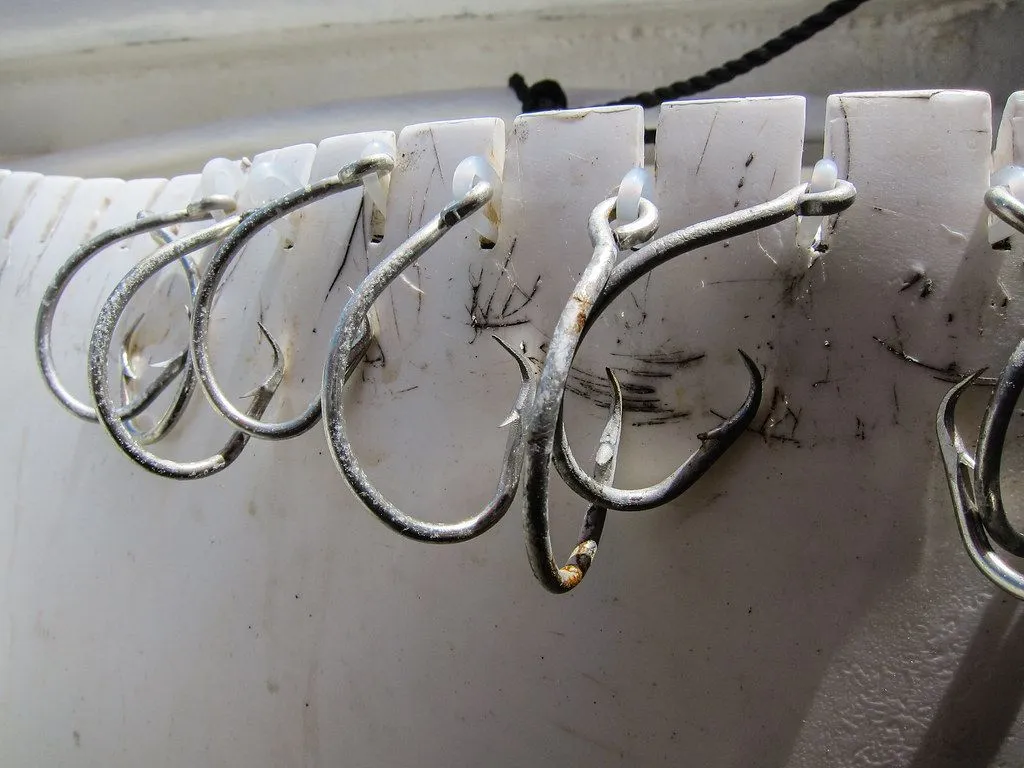
A circle hook has its point curved back toward the shank, so far that the gap between them is a near-circle, and it hooks a fish without the angler striking. A fish takes the bait, turns and swims off, and the line comes tight. The hook slides out of the throat and along the jaw to the corner of the mouth, where the curved point rotates and sets itself. The result is far fewer gut-hooked fish, and a growing list of waters where the law requires one.
Point the rod at the fish and reel. The hook does the rest. Strike, and you pull it straight out of the mouth.
How does a circle hook set itself?
Picture the hook inside a fish that has swallowed the bait. On a J hook the point faces up the throat, so the first pull drives it into whatever it touches: gullet, gill arch, the heart behind them. On a circle hook the point faces inward, toward its own shank, and a straight pull drags the hook flat along the throat without catching. It slides until the bend reaches the hinge of the jaw, the one place the line has to turn a corner. There the hook pivots around the jawbone, and the point swings in and locks through the corner of the mouth. That spot has bone, little blood and nothing vital.
That is also why striking defeats it. A snap of the rod at the first tap jerks the hook up the throat before it has reached the corner. The inward point finds nothing to bite on and comes out clean. Cooke and Suski’s 2004 review of the research notes that circle hooks work best on fish that turn after taking the bait, and worst on species that nibble while holding still.
Commercial longliners and trotliners used them long before anglers did, because a fish that swims off with a baited circle hook hooks itself and stays hooked. Reindeer-horn hooks of the same shape have been dug up in Japan.
How do you fish a circle hook?
Maine’s one-sentence instruction stands: “simply point the tip of the rod at the fish and slowly begin to reel in. The hook will set itself, usually in the corner of the mouth.”
- Rig for a slow take. A softer rod and monofilament, which stretches, give the fish time to turn with the bait before the line comes tight; a fast rod and braid snatch the hook out. A slip-sinker rig helps for the same reason: the fish feels no weight when it picks up the bait.
- Leave the rod in the holder, drag light or clicker on, so the fish can take the bait and move off.
- Wait for the rod to load. The tip pulls down and stays down as the fish moves off; that is the fish hooking itself. A tap or a bounce is a fish mouthing the bait, not yet time.
- Tighten the drag and reel. Steadily, rod pointed at the fish or held low and off to one side at about 45 degrees, never high, until the rod bends fully.
- Then lift and fight. The hook is in the corner of the jaw.
- A fish swimming at you is the hard case. The hook needs line angle to reach the corner; let it run to the side before the line comes tight.
- Never set the hook. Catfish guide John Jamison says the complaint from anglers new to circle hooks is always missed fish. It disappears “with a little coaching” once the reflex to strike is unlearned.
The slip-sinker rig on the catfish rigs page is built around a circle hook. The drift rig there uses the same move: when a rod goes down, crank ten or fifteen turns, then lift. In fresh water, circle hooks do most of their work on catfish, and the catfish hub is the place to start.
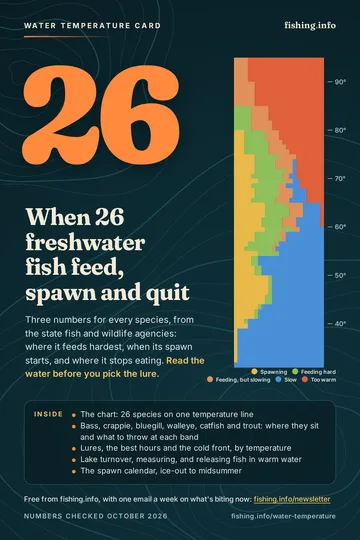
Free card: what 26 species do at your water temperature
Plus one email a week on what's biting now. No sales pitches. Privacy.
How do you get a circle hook out?
A circle hook usually sits in the corner of the jaw, easy to reach. Leave the fish in the water and remove the hook with needle-nose pliers or a dehooker. If the fish must come out, NOAA’s ideal is under 60 seconds in the air, with wet hands. Cut a deep hook off rather than pull it.
How do you rig the bait so the hook can turn?
A circle hook can only rotate if its point is clear and its gap is open. So the rigging rule is the opposite of the J-hook habit of hiding the hook in the bait. Push the point through and out the other side; a point buried in a bunker chunk or a ball of chicken liver has nothing to catch with when it reaches the jaw. Hook a bait once, through a thin part: cut bait through the skin at a corner, a live shad or shiner through the nostrils or behind the dorsal fin, an eel through the lips. Soft baits that fish nip at, such as clams in the surf or a ball of bloodworms, go on with elastic thread rather than threaded onto the bend. Choose the hook for the bait, not the fish: the whole hook has to disappear into the mouth with the gap still open.
Attach the hook with a snell knot or a knot that cinches on the eye, so the hook lies flat along the leader and the pull comes straight down the shank. On a loop knot the hook swings, and a swinging hook turns late or not at all.
What size circle hook for each fish?
Go one or two sizes bigger than the J hook you would have used, because with a circle hook the gap is what matters. The table gives the range by fish and bait.
| Fish | Circle hook size | Bait | Note |
|---|---|---|---|
| Channel catfish | 2/0–4/0; 6/0 covers everything to the mid-teens | Cut bait, prepared bait | FishUSA and Catfish Pro consensus |
| Blue catfish | 5/0–8/0 with chunks; 8/0–10/0 with heads | Fresh cut shad | Heavy wire; a trophy hook “can hold a 100-pound catfish” |
| Flathead catfish | 7/0–10/0; to 12/0 for big live baits | Live bluegill, sunfish | Hook through the nostrils or behind the dorsal |
| Largemouth bass | 4/0–5/0 | Live wild shiners | Scott Martin’s Okeechobee size; the fish can “eat the shiner a split-second longer” |
| Striped bass | 4/0 for worms; 5/0–8/0 for chunks, clams and eels; 8/0–10/0 for large baits and big fish | Bunker, clam, eel, bloodworm | Snelled, inline, non-stainless |
| Redfish | 1/0–3/0 | Cut mullet, shrimp | Academy chart |
| Snapper, grouper | 2/0–5/0 snapper; 8/0–12/0 grouper | Cut bait, live pinfish | Non-offset in Gulf and north-Florida waters |
| Tarpon, tuna | 3/0–7/0 tarpon; 7/0–10/0 tuna | Live mullet, crab; live bait, chunks | Above 10/0 the point can tear the jaw externally |
| Bluegill, sunfish | 6–10 | Worm, cricket | Intermediate sizes in the Cooke 2005 test; 1/0 was too big to hook them |
| Carp | 2–4 | Corn on a snelled hook | Aaron Huffman’s preference in Outdoor Life; most carp anglers run a smaller bait hook |
The what size hook for catfish page has the catfish table by bait size, and the hook size chart explains the numbering.
Inline or offset: which one, and why does the law care?
Inline. North Carolina’s regulators define a circle hook as one “with the point pointed perpendicularly back toward the shank”, with the point and barb in the same plane as the shank. That plane is what “inline” or “non-offset” means: lay the hook on a table and the whole hook lies flat. An offset hook has the point bent to one side, by a few degrees on a minor offset and about 15 degrees on a severe one.
The offset hooks more fish, and faster, which is why Jamison prefers it for river blues. It also hooks deeper, because the point now sticks out sideways and can catch in the throat on the way up. In a sailfish study cited in Cooke and Suski’s review, fish on severely offset circle hooks were deep-hooked 44 percent of the time. That is about the same as sailfish on J hooks, at 46 percent, while inline and minor-offset hooks mostly took fish in the jaw.
Every regulation that requires a circle hook for conservation therefore says non-offset. That covers the Atlantic striped bass rule, Florida’s reef fish rule and the federal billfish-tournament rule, which forbids “a J-hook or an offset circle hook in combination with natural bait.” The federal Gulf reef fish rule asks only for “non-stainless steel circle hooks,” and that part has its own logic. A hook left in a fish that broke off rusts away in weeks; a stainless one does not. Buy inline, non-stainless circle hooks for bait, and every rule in the next table is satisfied at once.
Where are circle hooks the law?
On the Atlantic coast for striped bass fished with bait, in Gulf and north-Florida reef fishing, and in federal billfish and shark tournaments. The table has the rule and the date for each.
| Jurisdiction | Rule | Since |
|---|---|---|
| Atlantic coast, striped bass with bait, Maine to North Carolina | Inline (non-offset) circle hooks whenever natural bait is fished for striped bass, under the Atlantic States Marine Fisheries Commission’s Addendum VI; artificial lures with bait attached, such as a tube and worm, are exempt | January 1, 2021 (Maine since 2013, with bluefish) |
| North Carolina, ocean waters | Non-offset, non-stainless circle hooks for striped bass with natural bait; not in internal coastal waters | January 1, 2021 |
| Maryland, Chesapeake Bay and coastal waters | Non-offset circle hooks when chumming or live-lining, and with bait for striped bass; the Bay rule is seasonal (May 16 to December 31), the coast year-round | State rule; check DNR |
| Federal, Gulf of Mexico reef fish | “Non-stainless steel circle hooks are required when fishing with natural baits”; a dehooking device and a venting tool or descending device on board (50 CFR 622.30) | Federal rule, in force |
| Florida, reef fish | Non-stainless, non-offset circle hooks with natural bait in Gulf state waters and in Atlantic state waters north of 28° N (about Melbourne); south of that, other non-stainless hooks allowed for yellowtail snapper | Atlantic rule January 1, 2021 |
| Federal, Atlantic billfish and shark tournaments | Non-offset circle hooks with natural bait or bait-lure combinations in billfish tournaments; non-offset, corrodible circle hooks for sharks (50 CFR 635.21) | January 1, 2008 |
The striped bass rule is the one most anglers meet, and New Jersey’s agency puts the reason for it plainly. About 90 percent of the striped bass caught on the coast are released, and an estimated 9 percent of those die. That adds up to nearly half of all the striped bass that die at human hands each year, commercial harvest included. Every rule in the table changes; the state’s current regulation page is the authority. The striped bass hub carries the season and size rules the circle hook sits inside.
Do circle hooks really save fish?
In most of the research, yes. Cooke and Suski’s review covered 43 studies on 25 species, 28 of the studies in salt water, with striped bass the most-studied fish. Mortality on circle hooks ran from 0 to 33.8 percent and on J hooks from 0 to 46 percent, with circle hooks lower in most paired comparisons. They also meant more jaw hooking, less gut hooking and less bleeding. The catch and release page carries the survival figures for everything else that decides whether a released fish lives.
| Fish | Hooking location, circle against J | Mortality, circle against J | Study |
|---|---|---|---|
| Striped bass | Deep-hooked 10.6 percent against 45.6 | 0.8 against 9.1 (Maryland 1999); 1.9 against 8.7 (Maryland 2000); 3 against 15.5 (Massachusetts); 5.9 against 18.2 (North Carolina) | Lukacovic and Uphoff 2002; Lukacovic; Caruso 2000; Hand 2001 |
| Atlantic bluefin tuna | 96 percent shallow-hooked on circle hooks | 4 against 28 percent | Skomal et al. 2002 |
| Pacific sailfish | J-hooked fish 21 times more likely to bleed; 10.25 against 6.34 fish per unit effort in favor of circle hooks | Not measured | Prince et al. 2002 |
| White marlin | Mostly jaw-hooked on circle hooks | Release mortality cut by two-thirds or more | Horodysky and Graves, cited by the White Marlin Open |
| Red drum (redfish) | Jaw-hooked 95.8 against 45.6 percent; gut-hooked 4.2 against 48.9 | Not measured | Aguilar et al. 2002 |
| Largemouth bass, live minnows | Gullet-hooked 4.8 against 9.7 percent; bleeding 15.2 against 25.4 | 5.1 against 6.6 percent; circle hooks caught half as many fish | Cooke et al. 2003 (circle against octopus hooks) |
| Bluegill | Eye-hooked 22.8 percent on circle hooks, twice the other hook types | 0.2 against 1.2 percent | Cooke et al. 2003 |
| Chinook salmon, mooching | More jaw hooking | 31 against 46 percent | Grover et al. 2002 |
Two caveats come with the table. For largemouth bass, Cooke’s own 2003 study reports only a “minimal conservation benefit” and half the catch rate of a conventional hook, so the case for it is weakest where most American anglers fish. For bluegill the injury was worse, not better: a hook too big for the mouth catches the eye instead of the jaw. The later bluegill study tested five sizes from 1/0 down to 14. It concluded that “circle hooks function most effectively when the entire hook can fit in the mouth of the fish.”
The treble hook is the other hook the rules single out, and barbless hooks are the other conservation choice.
When is a circle hook the wrong tool?
- Lures. A lure is struck, not swallowed, and a J hook or treble sets on the strike while a circle hook mostly does not. The one exception is the coon-pop, a tarpon jig with a circle hook through its eye that the review credits with a large drop in Texas and Louisiana tarpon mortality.
- Soft plastics. A Texas-rigged worm is fished with a hookset, and the plastic itself fills the gap; use the worm hook the rig was designed for. The types of hooks page sets the circle beside the octopus, Kahle, worm and J hooks it gets confused with.
- Fish that nibble in place. Bluegill, perch and trout pick at a worm without moving off, so the hook never travels to the corner; a small Aberdeen or bait hook hooks more and, for bluegill, hurts less.
- Big baits that plug the gap. A whole bluegill on a 5/0 or a fist of liver on a 2/0 stops the hook turning; size up or hook the bait thinner.
- Anglers who cannot stop striking. A Kahle hook, halfway between J and circle, forgives both styles.
Which mistakes cost fish?
Striking is the first. The rest follow from the same misunderstanding, that a circle hook is a J hook with a bent point.
- Burying the point in the bait. At the jaw it has nothing to catch with; push it through and out.
- Holding the rod high. Point it at the fish, or hold it low and off to one side.
- Tying on with a loop knot. The hook swings and turns late or not at all; snell it or cinch the knot on the eye.
- Picking the hook by the fish rather than the bait. A bluegill gets a 1/0 in the eye, or a big cat spits a 2/0 with the gap plugged.
- Pulling at a fish that has swallowed the hook anyway. When a circle hook does end up in the gut, Virginia’s marine agency says to “cut the leader as close as you can to the hook and leave it in the fish”. A corroding hook left in place kills far fewer fish than one torn out.
The hooks hub covers the ten hook types.
Free download
The water temperature card
Read your water temperature and the card tells you who is spawning, who is feeding and what to throw. 26 species, 16 pages, for your phone and the tackle box.
Plus one email a week on what's biting now. No sales pitches. Privacy.
Related
Section guide
Fishing Hooks: Sizes, Types and Which Hook for Which FishHow fishing hook sizes work from 32 to 20/0, the parts of a hook, the ten hook types and what each is for, and which hook suits each fish.
 Types of Hooks: The Ten Fishing Hook Styles and What Each One Is For
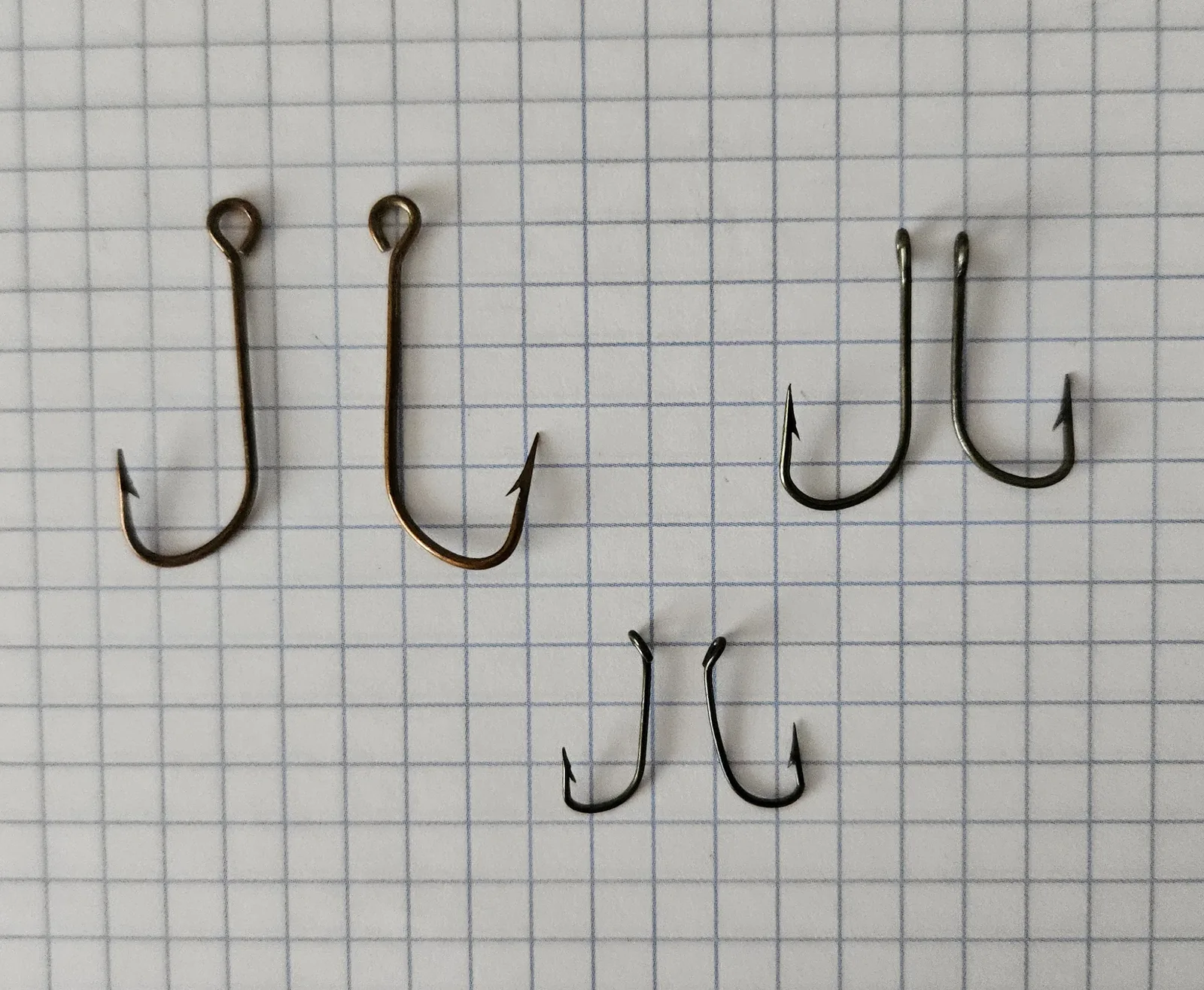
The types of fishing hooks explained: bait, circle, octopus, Aberdeen, Kahle, siwash, worm, jig, drop-shot and treble, and how to read each shape.
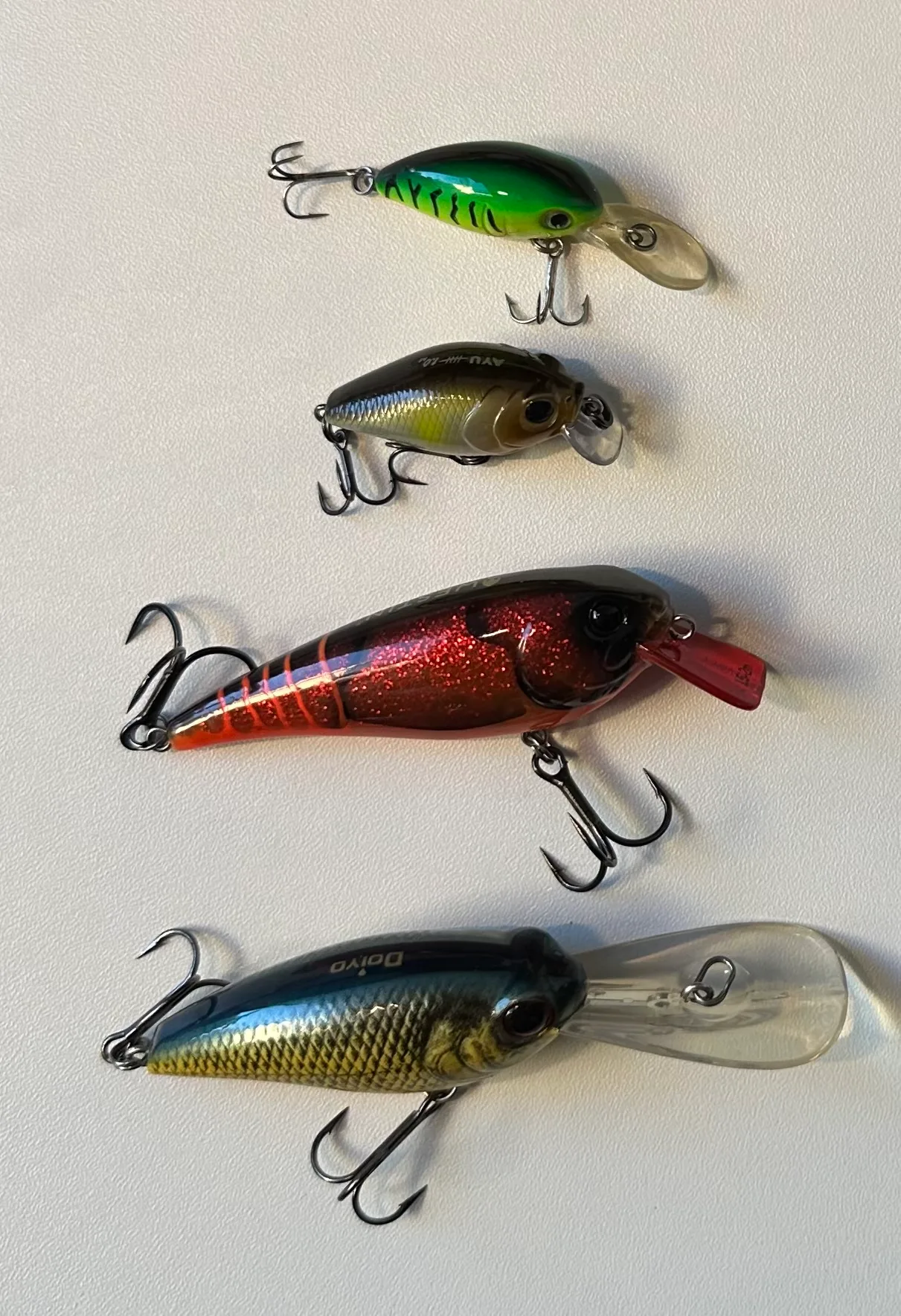 Treble Hook: Sizes, When to Change Them, and the Single-Hook Waters
A treble hook has three points on one shank and comes on almost every crankbait and topwater. Sizes by lure, when to change them, and the single-hook waters.
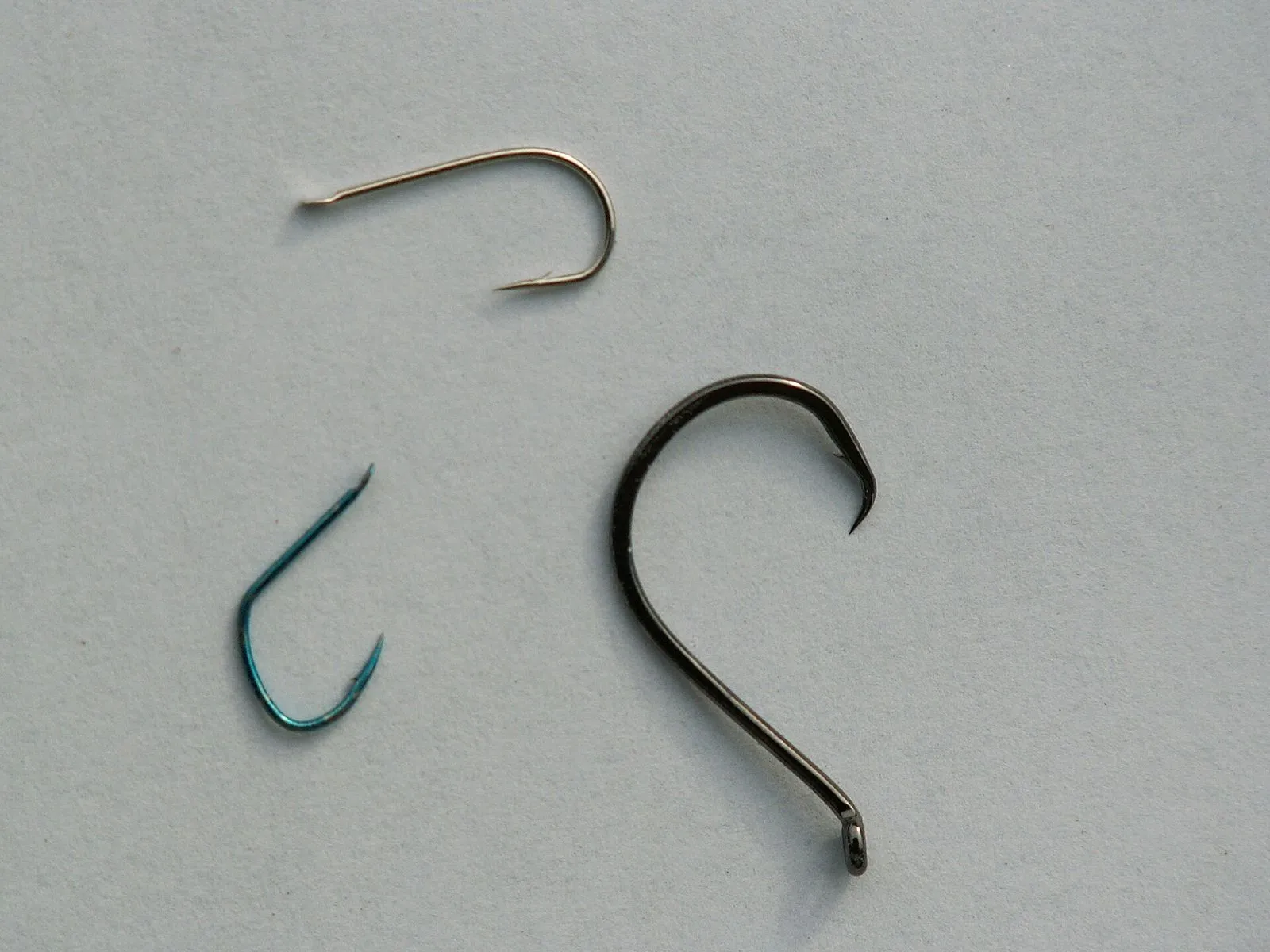 Fishing Hook Size Chart: How Sizes Work, With Hooks by Species
The fishing hook size chart explained: why #4 is bigger than #6 and 2/0 bigger than 1/0, the gap the number describes, and a size-by-species and bait chart.
Sources
- Cooke, S. J. and Suski, C. D. (2004), Are circle hooks an effective tool for conserving marine and freshwater recreational catch-and-release fisheries? Aquatic Conservation 14:299–326
- Cooke, S. J. et al. (2003), Injury rates, hooking efficiency and mortality potential of largemouth bass captured on circle hooks and octopus hooks, Fisheries Research 61:135–144
- Cooke, S. J. et al. (2005), Influence of circle hook size on hooking efficiency, injury and size selectivity of bluegill, North American Journal of Fisheries Management
- Maine DMR, tips for using circle hooks
- NC DEQ, circle hooks required for ocean striped bass from 1 January 2021
- New Jersey Fish and Wildlife, striped bass circle hook requirement (2021)
- ASMFC, Atlantic striped bass management (Addendum VI)
- Maryland DNR, circle hooks
- 50 CFR 622.30, required fishing gear for Gulf reef fish
- 50 CFR 635.21, gear and methods for Atlantic highly migratory species (billfish and shark tournaments)
- Florida FWC, reef fish gear rules
- NOAA Fisheries, Catch and release fishing best practices
- Florida Sportsman, new hook regulations for reef fishing in Atlantic state waters (2021)
- Virginia MRC and On The Water, how to use circle hooks for striped bass
- The Fisherman, Inshore: circle hook stripers
- In-Fisherman, Circle hooks today (2012)
- In-Fisherman, 2015 gear guide: circle hooks
- Mercury Dockline, how to fish with circle hooks
- White Marlin Open, hook types and the tournament rule
- Tackle Village, what size hooks for striped bass
- Outdoor Life, best carp baits
- FishUSA, best hooks for catfish
- Academy Sports, fishing hook size chart by species