 By
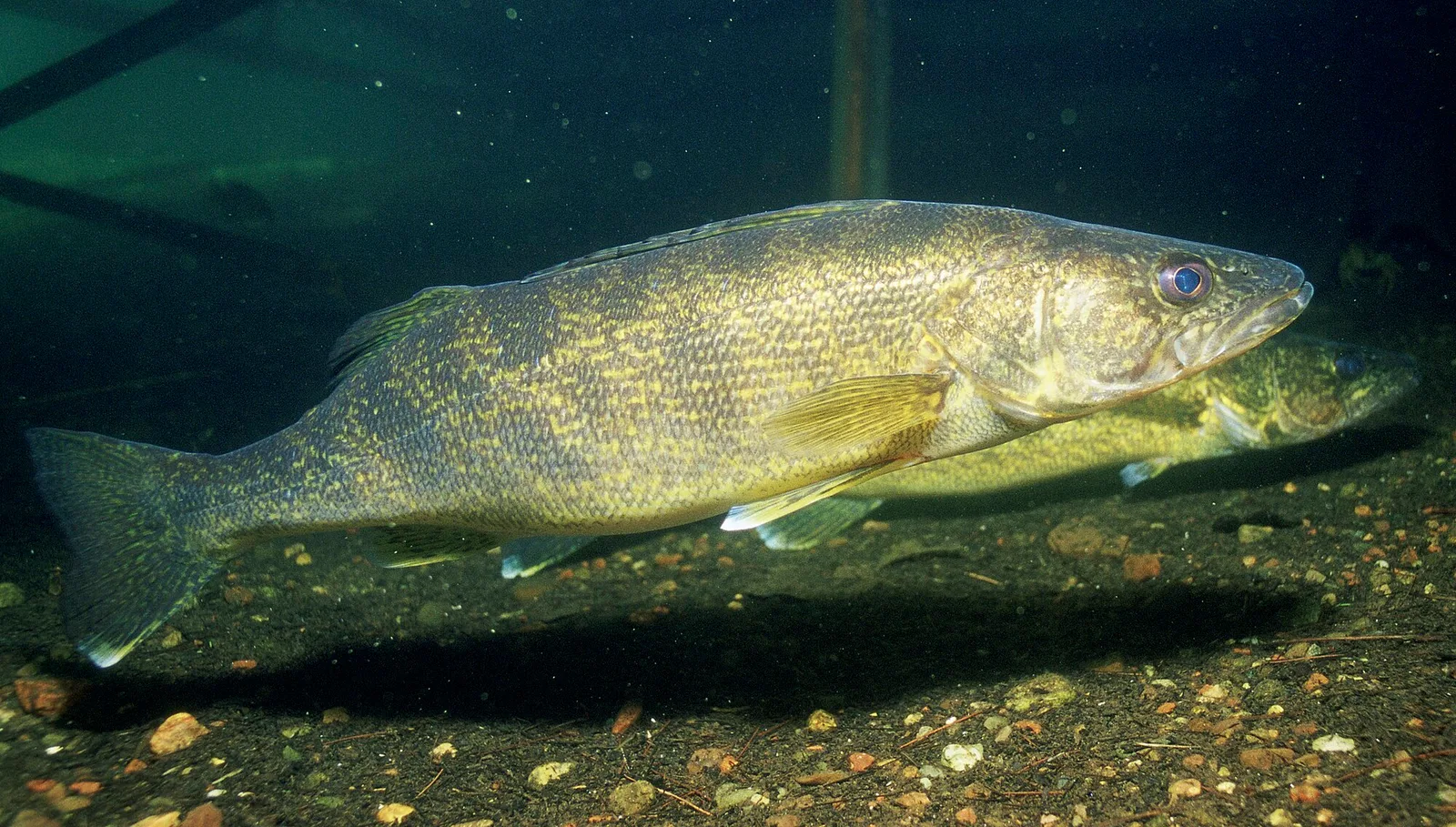
The walleye is the largest member of the perch family, a cool-water predator of big lakes, large rivers and reservoirs, and the state fish of Minnesota. It is named for a large, glassy eye that lets it hunt at night and in murky water. Most run 14 to 22 in (36–56 cm) and 2 to 4 lb, Ohio DNR says, and they bite best when the light is low. Two close relatives, the sauger and the hatchery-made saugeye, share its waters and are easy to mix up with it.
The biggest walleyes in the world record book did not come from Minnesota or Lake Erie. Every IGFA walleye over 18 lb was caught in Tennessee, Arkansas or Missouri.
Start here
- Walleye water temperature: the 42–50 °F spawn window, the summer band, the 76 °F ceiling and where the fish go at each step.
- Fish weight calculator: measure a walleye, release it, and read its weight off two states’ averages.
- Fishing thermometers: one water reading tells you whether the spawn window is open.
- Landing nets: which mesh and hoop size to use for a fish you may want to release.
- Fillet knives: the blade length that suits a walleye, and manual against electric.
- Fishing stringers: how to keep a legal fish alive and fresh until you clean it.
What kind of fish is a walleye?
A walleye is a perch, not a pike. It belongs to the family Percidae with the yellow perch and the sauger, and it has the perch family’s two separate dorsal fins, the first one spiny. The IGFA calls walleye the largest members of that family. The mix-up with pike comes from old names: Ohio DNR lists “pickerel”, “yellow pike” and “walleyed pike” among them, so a “yellow pike” on a menu or in an old record book is a walleye. A real northern pike has a single soft dorsal fin set far back by the tail.
The eye is the fish. Minnesota DNR explains that its pearly look comes from the tapetum lucidum, “a reflective layer of pigment that helps the fish to see and feed at night or in turbid water”. That one feature explains most walleye fishing. The fish feed hardest at dawn, dusk and after dark, and they keep feeding by day when clouds, stained water or wind dim the light. Anglers call that wind a walleye chop, and federal fisheries biologists explain it the same way: wind stirs up the bottom, the water turns murky, and a fish that sees well in murk hunts well.
The eye also decides what walleye eat. In many Minnesota lakes their main food is the yellow perch, which cannot see as well in low light and is easy prey at night. In Ohio it is gizzard shad, and Missouri adds mayflies “throughout life”. Minnesota’s biologists draw the angler’s lesson: perch and walleye year classes rise and fall together, and “fishing may be poor when forage-size perch are abundant, simply because walleye are well fed.”
Mind the mouth. Kentucky’s fish and wildlife agency describes “enlarged canine teeth”, and Minnesota’s walleye guide tells anglers to carry first-aid items “as walleyes have sharp teeth”. Unhook one with pliers. The fish teeth page explains which fish you can safely hold by the lip, and a walleye is not one of them.
Free PDF · Water temperature chart When do walleye bite?
One reading, and the 16-page chart shows which of 26 fish are spawning, feeding hard or slowing down; for bass, crappie, bluegill and walleye, where they sit and what to throw. Every number sourced.
Enter your email, confirm it with one click, and the PDF is in your inbox. Plus one email a week on what's biting. Unsubscribe anytime. Privacy.
Walleye, sauger or saugeye: which one did you catch?
Three fish share the walleye’s shape. The sauger is its smaller cousin of big, murky rivers. The saugeye is a hybrid, a female walleye crossed with a male sauger in a hatchery and stocked into reservoirs and tailwaters. The agencies separate them on two marks: the first dorsal fin and the lower tip of the tail.
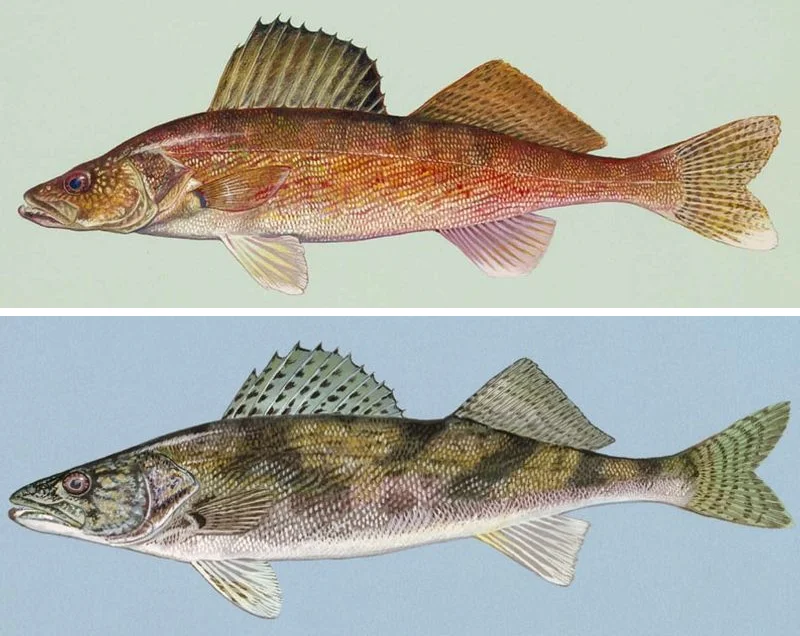
Walleye (top) and sauger. Paintings by Duane Raver, U.S. Fish and Wildlife Service (public domain).
| Mark | Walleye | Sauger | Saugeye |
|---|---|---|---|
| First dorsal fin | No spots; a large dark blotch at the rear base | Rows of dark spots; no rear blotch | Bars or smeared spots between the spines; rear blotch usually visible, less clear |
| Lower tail lobe | Large white tip | No white tip, or a thin, often yellowish edge | A white tip, smaller than a walleye’s (Colorado: none) |
| Usual size (Ohio DNR) | 14–22 in (36–56 cm), 2–4 lb | 9–15 in (23–38 cm), under 1 lb | 12–18 in (30–46 cm), 1–2 lb |
| Can reach (Ohio DNR) | 36 in (91 cm), 16 lb (7.3 kg) | 24 in (61 cm), 7 lb (3.2 kg) | 30 in (76 cm), 14 lb (6.4 kg) |
| Water | Clear to slightly turbid lakes and rivers | Large, murky rivers | Turbid reservoirs and tailwaters |
Start with the dorsal fin. A walleye’s is plain except for the dark patch at the back; a sauger’s is dotted with rows of black spots. Then check the tail. A white lower tip is the walleye’s mark, and Iowa DNR describes it as “silver or milk-white”.
The saugeye is where the agencies disagree. Ohio DNR gives it a white tail tip, more defined than a sauger’s and less than a walleye’s, while Colorado Parks and Wildlife says saugeye have “tails that do not have a white tip”. Take the white tip as a lean toward walleye, not proof, and let the spotted or barred dorsal decide. In Ohio it rarely matters at the cooler: the state counts walleye, sauger and saugeye together in one daily limit.
One more myth to drop: saugeye are not sterile. Ohio’s biologists say “a small percentage” can reproduce with each other or with either parent, and Oklahoma’s wildlife department also says they are not sterile but must be stocked routinely anyway. Europe’s walleye, the zander, lives in one American water, Spiritwood Lake in North Dakota. Genetic samples there found no crossing with walleye.
Where do walleye live?
Walleye are native to the “St. Lawrence-Great Lakes, Arctic, and Mississippi River basins from Quebec to Northwest Territories, and south to Alabama and Arkansas”, USGS records. Stocking has carried them much farther. One of the earliest moves was in 1874, when adults from Vermont were released into California’s Sacramento River. Reservoirs did the rest: dam building let walleye survive in many new places. Oklahoma, for one, first stocked them in 1950 at Tenkiller and Canton. Even North Carolina has walleye: its Wildlife Resources Commission stocks them in mountain and Piedmont reservoirs.
Away from home they are not always welcome. On the Columbia River, walleye are estimated to eat two million salmon smolts a year, about a third of the loss to predators there, in a 1996 study by McMahon and Bennett.
Inside their range, the habitat is simple to describe. Federal biologists put walleye in clear or turbid, shallow or deep water, cold or cool, but “they are not found in warm water”. Minnesota’s biologists call it a cool-water fish: warmer than trout, cooler than bass. That state alone has about 1,700 walleye lakes and 100 warm-water walleye streams, with natural populations in large, windswept lakes such as Mille Lacs, Leech, Winnibigoshish, Upper and Lower Red, Lake of the Woods and Vermilion.
Many famous fisheries are made by hand. Except for the Mississippi and Missouri rivers, Iowa DNR says, “most walleye fisheries in Iowa are maintained through aggressive stocking”, nearly 125 million fry a year. Kentucky stocks its reservoirs with a Lake Erie strain while it restores a native river strain. North Dakota’s Missouri River system grows walleye of 10 to 14 lb on its rich forage base, the state reports, while its prairie lakes that run on fathead minnows “are not topping 8 pounds”.
Where are they in your lake right now? That follows the water temperature, which the walleye temperature guide tracks band by band, and the light, which the best time of day page covers for walleye and a dozen other fish.
How do you catch walleye, season by season?
Minnesota DNR names the four methods that do most of the work: casting a jig and minnow, trolling live bait on a slip-sinker rig, casting or trolling hard lures, and fishing a bobber. “All work,” the agency adds, and the smart move is to pick one and hone it.
| Season | Where the walleye are | What anglers use |
|---|---|---|
| Ice-out, before the spawn | Below dams, deep river pools, riffles and rock near spawning areas (Iowa DNR) | A 1/8 oz jig with a twister tail or minnow; a slip bobber with a minnow or leech; fish at night (Iowa DNR) |
| Late spring, early summer | Shallow or semi-shallow near shore; big sand flats with shiners (Minnesota DNR) | Jig and minnow, 1/8 to 3/8 oz, “heavy enough so that you can feel the bottom” (Minnesota DNR) |
| Summer | Mid-lake humps, saddles and points; outside weed edges, drop-offs, riprap (Minnesota, Iowa) | Slip-sinker rig with a minnow, crawler or leech; slip bobber over reefs, bait within a foot of bottom |
| Fall | Back to weedlines, gravel bars, points and rocky shores (Minnesota, Iowa) | Hard baits trolled “in the one mile per hour range” (Minnesota DNR) |
| Under the ice | Points, humps, narrows and saddles; 10 ft (3 m) or less at dawn and dusk, deeper at midday (Minnesota DNR) | A jig near bottom tipped with a minnow or minnow head; tip-ups on stained lakes (Wisconsin DNR) |
Minnesota DNR’s slip-sinker rig is the Lindy rig: a walking sinker, a swivel and a long leader to a small hook. Its advice for the bite is patience: on the “tap, tap, tap”, let line run “for several seconds” before you set the hook. For a slip bobber, set the stop so the bait hangs just off the bottom. The hard baits themselves, crankbaits and minnow-shaped stickbaits, are on the crankbaits and jerkbaits page.
Iowa DNR’s bait rule follows the calendar: minnows from late fall to early spring, crawlers and leeches from late spring to early fall. Its color rule is the classic one: natural colors in clear water, bright colors in stained water.
For walleye on lakes, Minnesota DNR suggests a medium spinning rod with 6 to 10 lb line, braid with a monofilament leader if you like. Iowa DNR suggests a 6 to 6½ ft medium-light or medium spinning rod with 6 to 8 lb line, and adds a casting rod with 8 to 10 lb line for crankbaits and three-way rigs. Under the ice, Wisconsin fisheries biologist Skip Sommerfeldt finds tip-ups outfish jigging on stained lakes, while jigging may win on clear ones. On stained lakes his best window is “the hour and a half before dark”; on clear ones the best catches often come after dark.
When do walleye spawn?
Walleye spawn in early spring, soon after the ice goes out, over rock, rubble and gravel. Minnesota DNR puts the spawning sites in 1 to 6 ft of water in rivers or on windswept shallows; Ohio’s walleye use tributary riffles and Lake Erie’s reefs. Iowa DNR notes that the spawning itself happens at night. Nobody guards the eggs: they settle into the rock, and the parents leave.
The temperature is a range, and each agency draws it a little differently:
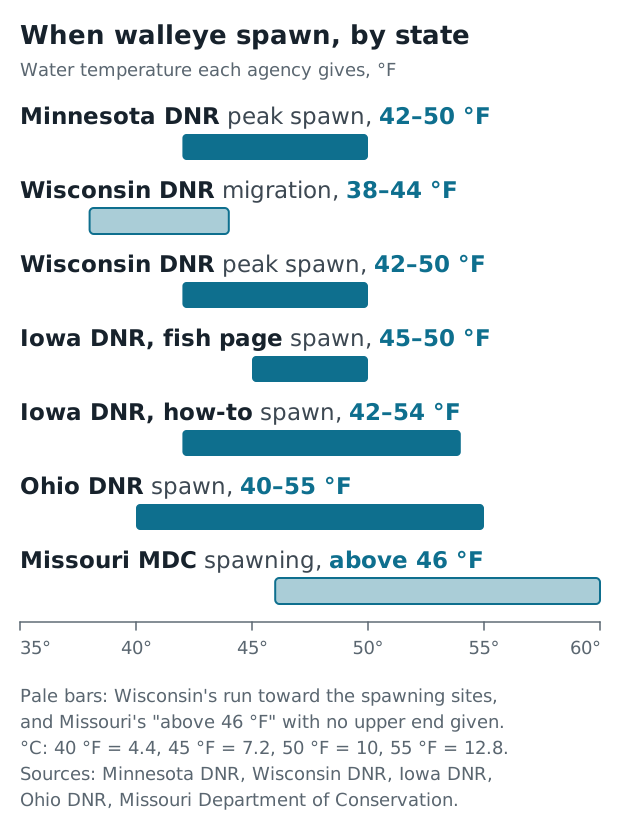
Read them together and the heart of the spawn is 42 to 50 °F (6–10 °C), with the run toward the rocks starting a little colder. A fishing thermometer tells you which side of it your water is on.
The numbers behind the spawn are big. A 5 lb female lays “more than 100,000” eggs, Minnesota DNR says; Iowa DNR gives 23,000 to 50,000 eggs per pound of fish, and Ohio up to 400,000. Iowa adds that about 95% are fertilized but only 5 to 20% hatch, after 12 to 18 days. Weather decides the rest. Minnesota DNR says the strength of a year class “can vary 100-fold” from one spring to the next.
For the angler, the spawn is mostly a time of closed seasons. Many states shut the walleye season through it, and Minnesota’s inland opener comes in mid-May. Where the run is open, Iowa DNR notes that most walleye caught on the spawning grounds are “the more aggressive males”, and that fishing is hard for a couple of weeks afterward.
How big do walleye get, and how old is a 20-incher?
A walleye of 20 in is six to seven years old in Iowa and weighs about 3 lb. Growth is quick at first and slows a little every year after, as Iowa DNR’s length-at-age figures show. Females grow faster than males and reach a larger size.
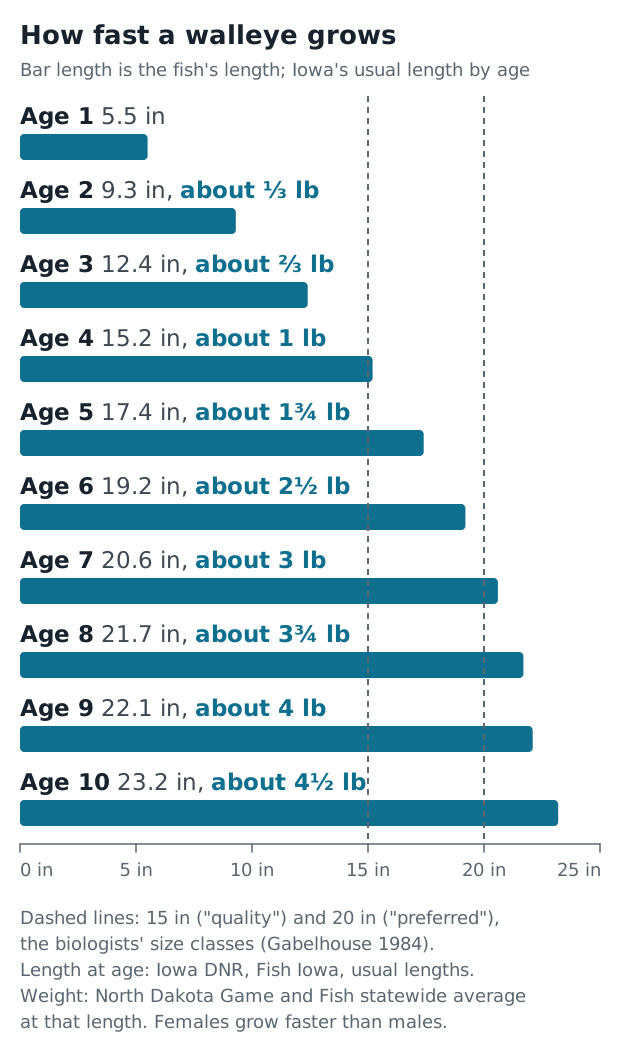
The weights on the chart are North Dakota’s statewide averages at each length. Pennsylvania’s table agrees with North Dakota’s within 0.4 lb at every inch from 15 to 30. On those two tables a walleye reaches 3 lb at about 20 in, 5 lb at about 24 in and 10 lb at about 29½ in (75 cm). Biologists sort the fish into size classes: 15 in is “quality”, 20 in “preferred”, 25 in “memorable” and 30 in “trophy”. The fish weight calculator has the full walleye chart from 12 to 30 in.
How long do they live? Five to ten years on average, the Fish and Wildlife Service says, and it records 29 as the oldest reported age. Walleye spawn for the first time at three to four years, the Service says. On Iowa’s curve a fish of 25 in is older than ten, so it has likely spawned for years.
The world record walleye: Mabry Harper’s 25-pounder
The all-tackle world record walleye weighs 25 lb (11.34 kg). Mabry Harper caught it at Old Hickory Lake on the Cumberland River in Tennessee in August 1960. The IGFA lists August 2; Tennessee’s own record book says August 3. Harper entered the fish with Field & Stream, then “the official record keeping body at the time”, at a length of 41 in (104 cm).
The record has not always stood. In 1996 the Fresh Water Fishing Hall of Fame removed it from its list, based on an Outdoor Life article that estimated the fish’s length from Harper’s hand in a photo and concluded it could not have been 41 in. John Dettloff’s article for the Hall lays out the evidence that brought it back. It cites two newly found photos of Harper’s wife holding the fish in front of a 1959 Plymouth Custom Suburban and preserved scale samples. It also cites affidavits from Tennessee game warden James Spurling, who “personally checked the scale”. Because the fish’s length is about nine times Harper’s hand spread, Dettloff argues, any error in guessing the hand grows about ninefold. The Hall reinstated the fish, and both record bodies now list it.
Does 25 lb at 41 in add up? Our check against the biologists’ yardstick: the standard weight of a well-fed walleye (Murphy, Brown and Springer, 1990) at 41 in is about 30.7 lb. Harper’s fish was about 81% of that, a lean fish for its length rather than an impossibly heavy one. Pennsylvania’s 2021 state record shows the other end: Richard Nicholson’s 18 lb 1 oz walleye from the Youghiogheny River measured 34 in, about 107% of standard weight. The Fish and Wildlife Service’s fact sheet gives the largest walleye ever caught as 42 in and 25 lb, an inch longer than Harper’s entry form.
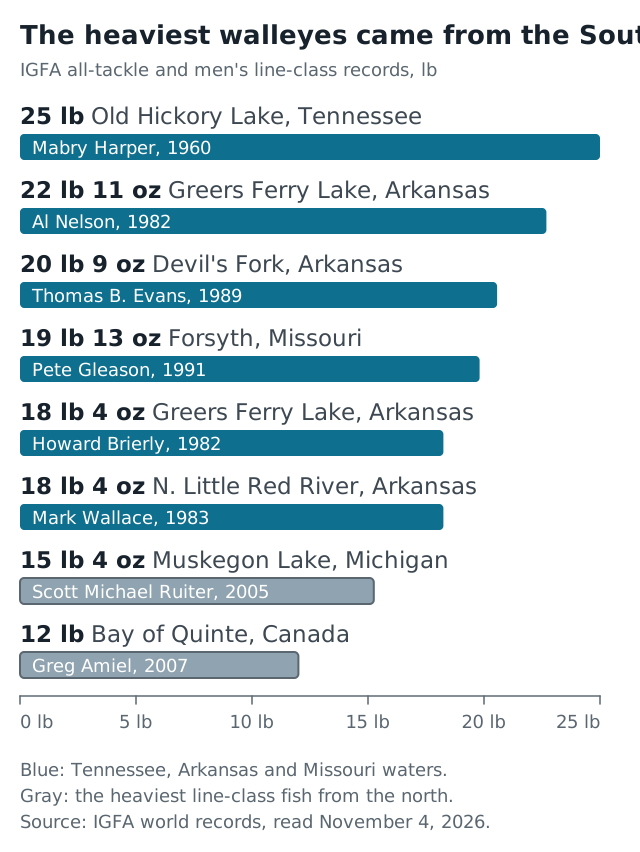
The surprise is where the giants live. After Harper’s fish, the heaviest walleye in the IGFA book is Al Nelson’s 22 lb 11 oz from Greers Ferry Lake, Arkansas, in 1982, a line-class record on 12 lb line. The next four, from 20 lb 9 oz down to 18 lb 4 oz, came from Arkansas and Missouri waters between 1982 and 1991. The heaviest line-class walleye from the northern states weighed 15 lb 4 oz, from Muskegon Lake, Michigan, in 2005.
| Fish | IGFA all-tackle record | Where and when |
|---|---|---|
| Walleye | 25 lb (11.34 kg) | Old Hickory Lake, Tennessee, Mabry Harper, 1960 |
| Walleye, by length | 79 cm (31.1 in) | St. Mary’s Reservoir, Alberta, Jason Auld, 2015 |
| Sauger | 8 lb 12 oz (3.96 kg) | Lake Sakakawea, North Dakota, Mike Fischer, 1971 |
| Saugeye | 12 lb 13 oz (5.81 kg) | Clendening Reservoir, Ohio, Fred Sulek, 2001 |
Are walleye good to eat?
Yes, and that is half the reason people fish for them. Minnesota DNR says walleye “tastes excellent”, Missouri’s conservation department praises its “firm, tender flesh”, and Oklahoma’s wildlife department calls walleye and saugeye “some of the best eating fish in freshwater”. Sauger get the same praise: “excellent table fare”, in Minnesota’s words. The fillet knife guide covers the blade length that suits a walleye.
The stringer page covers keeping a fish alive until you clean it. Then think about size, because Minnesota’s health department draws its mercury line by length. Its statewide guideline (updated August 2026) lets men and boys 15 and older, and women not planning a pregnancy, eat one walleye meal a week. For children under 15 and anyone pregnant, breastfeeding or who may become pregnant, it is one meal a month of walleye shorter than 20 in, and none of 20 in or longer. In Cook, Lake and St. Louis counties in the northeast the line drops to 18 in. Other states publish their own advisories, so check yours before you keep a big one.
Walleye rules anglers ask about
Walleye are managed lake by lake, and the rules change every season. Three examples show the range; check the current regulations for your water before a fish goes in the cooler.
- Mille Lacs, Minnesota. For the 2026 open-water season, anglers may keep three walleyes from the May 9 opener through November 30. Each must be 17 in or longer, with only one over 20 in. The lake’s harvest is shared: 105,300 lb for state-licensed anglers and 79,700 lb for Tribal fishing.
- Lake Erie, Ohio waters. Ohio’s 2026–27 booklet counts walleye, sauger and saugeye together: six a day, 15 in minimum, from March 1 to April 30, with the limit for the rest of the year announced in late April. On Ohio’s inland waters the six are combined with no minimum length.
- Ohio’s spring river runs. On the Maumee, Sandusky, Portage and Mahoning rivers in March and April, Ohio allows one single hook with a gap of no more than ½ in, bans trebles, and opens parts of the rivers from sunrise to sunset only.
Some rules turn on the hybrid. Virginia treats saugeye as walleye in its regulations and will not stock them where walleye reproduce naturally. Seasons and slot limits differ by state, so the state agency’s current booklet is the last word. For a walleye you plan to release, the landing net guide compares rubber and nylon mesh, and the catch and release guide covers the handling.
The names, if you want them
The walleye is Sander vitreus, described by Mitchill in 1818; vitreus means “glassy”, for the eye. The sauger is Sander canadensis. Older books and some agency pages still print Stizostedion vitreum. The genus name changed after it emerged that Oken’s Sander of 1817 is older than Rafinesque’s Stizostedion of 1820. The American Fisheries Society’s names committee adopted Sander in 2004, and Scharpf and Fricke defended it again in 2021. The European cousin is the zander, Sander lucioperca.
The common names travel too. The IGFA lists yellow walleye, pike perch, walleyed pickerel, yellow pickerel and walleye pike. The sauger answers to jack salmon and sand pike. Minnesota made the walleye its state fish, and two Minnesota towns, Garrison and Baudette, each claim to be the walleye capital of the world. Other cool-water predators are in the pike hub; every species is in the species guide.
Free PDF · 16 pages
Know what's biting before your first cast
The Water Temperature Fishing Chart. Take one water temperature reading, find it on the chart, and see which of 26 freshwater fish are spawning, feeding hard or slowing down. Six pages go deeper: bass, crappie, bluegill, walleye, catfish and trout. For your phone and the tackle box.
- Where they sit and what to throw at every band: bass, crappie, bluegill and walleye; catfish by species; trout: the 68 °F line where you stop, and where they hide
- A bass that drops 3 ft feels more pressure change than the biggest cold front: the front day by day, and what to throw on each
- The three thermometer mistakes that make a reading lie (the first one is the surface)
- The 26-fish chart: who's spawning, feeding hard or slowing down at your reading
The chart's numbers come from state fish and wildlife agencies and fisheries research: 61 sources, each listed on the site.
Enter your email, confirm it with one click, and the PDF is in your inbox. Plus one email a week on what's biting. Unsubscribe anytime. Privacy.
Sources
- Minnesota DNR, Walleye biology and identification (walleye, sauger, yellow perch)
- Minnesota DNR, How to catch a walleye
- Minnesota DNR, Ice fishing for walleye
- Wisconsin DNR, Fishes of Wisconsin: walleye
- Wisconsin DNR, Fishing walleye through the ice (Skip Sommerfeldt)
- Iowa DNR, Fish Iowa: walleye details
- Iowa DNR, Walleye fishing
- Ohio DNR, Walleye
- Ohio DNR, Sauger
- Ohio DNR, Saugeye
- Ohio DNR, Ohio Fishing Regulations 2026–27
- North Carolina Wildlife Resources Commission, Walleye
- Missouri Department of Conservation, Walleye
- Oklahoma Department of Wildlife Conservation, Saugeye
- Colorado Parks and Wildlife, Saugeye
- Virginia DWR, Saugeye
- Kentucky Department of Fish and Wildlife Resources, Walleye
- USGS Nonindigenous Aquatic Species, Sander vitreus fact sheet
- USGS Nonindigenous Aquatic Species, Sander lucioperca (zander) fact sheet
- U.S. Fish & Wildlife Service, Freshwater Fish of America: Walleye
- U.S. Fish & Wildlife Service, Walleye (Sander vitreus)
- IGFA world records: walleye, sauger and saugeye (member portal, read November 4, 2026)
- John Dettloff, Fresh Water Fishing Hall of Fame, The Facts Supporting the Harper Walleye Reinstatement
- Tennessee Wildlife Resources Agency, state fishing records
- Pennsylvania Fish and Boat Commission, New state record walleye recorded (November 2021)
- North Dakota Game and Fish, Fish length-weight table
- North Dakota Game and Fish, Weighing in on the record walleye (July 2018)
- Pennsylvania Fish and Boat Commission, Pennsylvania Angler & Boater, walleye weight-length table
- Ogle and others, FSA R package, PSDlit table: walleye length categories (Gabelhouse 1984)
- Murphy, Brown and Springer (1990), Evaluation of the relative weight (Wr) index, with new applications to walleye, North American Journal of Fisheries Management 10: 85–97
- Minnesota Department of Health, Statewide safe-eating guidelines (updated August 2026)
- Minnesota DNR, DNR keeps three-walleye limit for 2026 open water season on Mille Lacs Lake (March 5, 2026)
- AFS Orange County, Sander is the valid generic name for walleye, sauger and European pikeperches (Scharpf and Fricke 2021)