 By
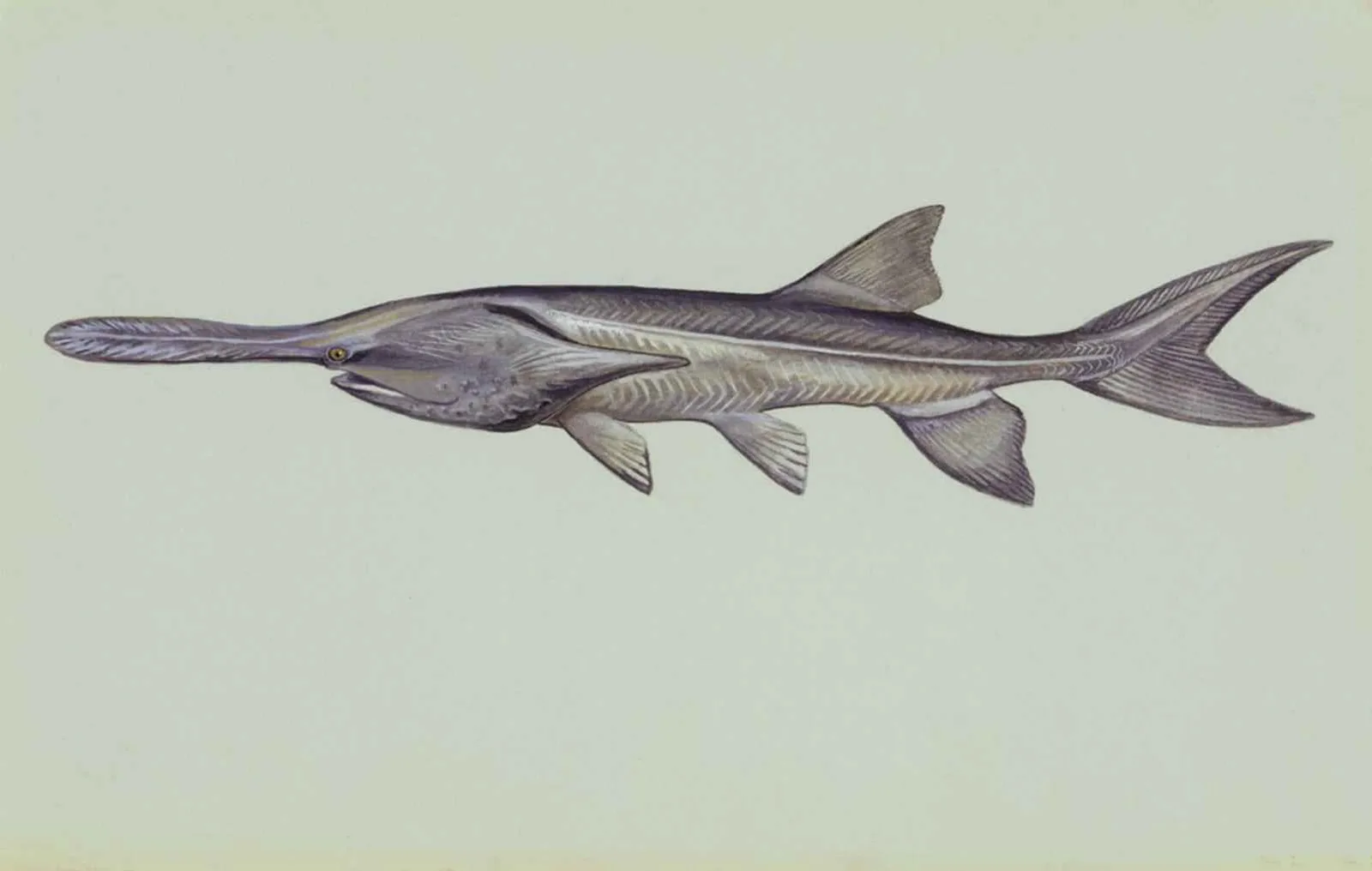
The paddlefish is a big, shark-shaped fish of the Mississippi basin with a flat snout up to a third of its body length, a toothless mouth and a diet of nothing but plankton. It grows to about 7 ft (2.1 m) and close to 200 lb (91 kg). Because it never takes a bait or a lure, the states that allow fishing for it let anglers snag it: in short spring seasons, in set waters, usually with a tag. The same fish goes by spoonbill, and its eggs are sold as caviar, which is why the rules on roe are strict.
There is no IGFA world record for paddlefish. The heaviest on record, 164 lb 13 oz, was snagged at Lake of the Ozarks, Missouri, on March 17, 2024, by an angler on his first paddlefish trip.
What is a paddlefish?
A paddlefish is one of the oldest fish lines still alive. Its ancestors lived in North America “about 125 million years ago,” according to the U.S. Fish and Wildlife Service. It belongs to the order Acipenseriformes, with the sturgeons, and like them it has a skeleton of cartilage. Missouri, where scientists study it as one of the most ancestral fish alive, has made it the state’s official aquatic animal.
Four marks set it apart from every other fish in North American fresh water:
- The paddle. The long, flat snout, the rostrum, runs “up to 1/3 total body length,” the Fish and Wildlife Service says.
- A shark’s outline. Missouri’s field guide describes the body as “sharklike,” with a forked tail whose upper lobe is the longer one. It is not a shark: it is a ray-finned fish, a cousin of the sturgeon.
- No scales and no teeth. The skin is bare except for a patch of scales on the tail, and adults have no teeth.
- A huge mouth. It sits under the head and stays open while the fish swims, filtering food through the gill rakers.
Paddlefish or spoonbill? The same fish. Spoonbill is the common name along the rivers, and some anglers say “spoonbill cat.” It is no catfish: it has no barbels and does not feed on the bottom. Its only close relative, the Chinese paddlefish of the Yangtze, was declared extinct in 2022, so the American paddlefish is the last paddlefish alive.
How big do paddlefish get, and how long do they live?
Up to about 7 ft long and close to 200 lb, though most fish snagged are far smaller. The agencies give different maximum weights and ages, because each describes its own waters:
| Source | Length | Weight | Age |
|---|---|---|---|
| U.S. Fish and Wildlife Service | Up to 7 ft (2.1 m) | Almost 200 lb (91 kg) | Some reports of 50 years or longer |
| Missouri Department of Conservation | About 7 ft (2.1 m); 60 in (152 cm) at age 17 | 160 lb (73 kg) or more | 30 years or more |
| Minnesota DNR | Typical adult 50 in (127 cm); some over 7 ft | Typical adult about 40 lb (18 kg) | Longer than 20 years |
| FishBase | 221 cm (7.25 ft) maximum | 90.7 kg (200 lb) maximum published | 55 years maximum reported |
They grow fast at first. Missouri’s field guide puts young paddlefish at 10 to 14 in (25 to 36 cm) after their first year.
How old is a 40 or 50 lb paddlefish? No agency gives an age for a weight, and the answer depends on the water. In Missouri’s stocked reservoirs females mature at 8 to 10 years; on the Yellowstone and Missouri rivers of North Dakota they mature at 16 to 18. A fish of the same size can be a decade younger in a southern lake than in a northern river.

Free PDF · Water temperature chart Which fish are biting at today's water temperature?
One reading, and the 16-page chart shows which of 26 fish are spawning, feeding hard or slowing down; for bass, crappie, bluegill and walleye, where they sit and what to throw. Every number sourced.
Enter your email, confirm it with one click, and the PDF is in your inbox. Plus one email a week on what's biting. Unsubscribe anytime. Privacy.
What is the paddle for?
The paddle is an antenna, not a shovel. It carries sense organs that pick up weak electric fields, and the plankton a paddlefish eats gives off such fields. The title of a 1997 study in the Proceedings of the Royal Society B says it plainly: “The paddlefish rostrum functions as an electrosensory antenna in plankton feeding.” A 2007 review in BioScience by Wilkens and Hofmann reached the same verdict. Missouri’s field guide puts it more cautiously: the paddle “apparently functions as an electrosensory organ,” letting the fish sense plankton.
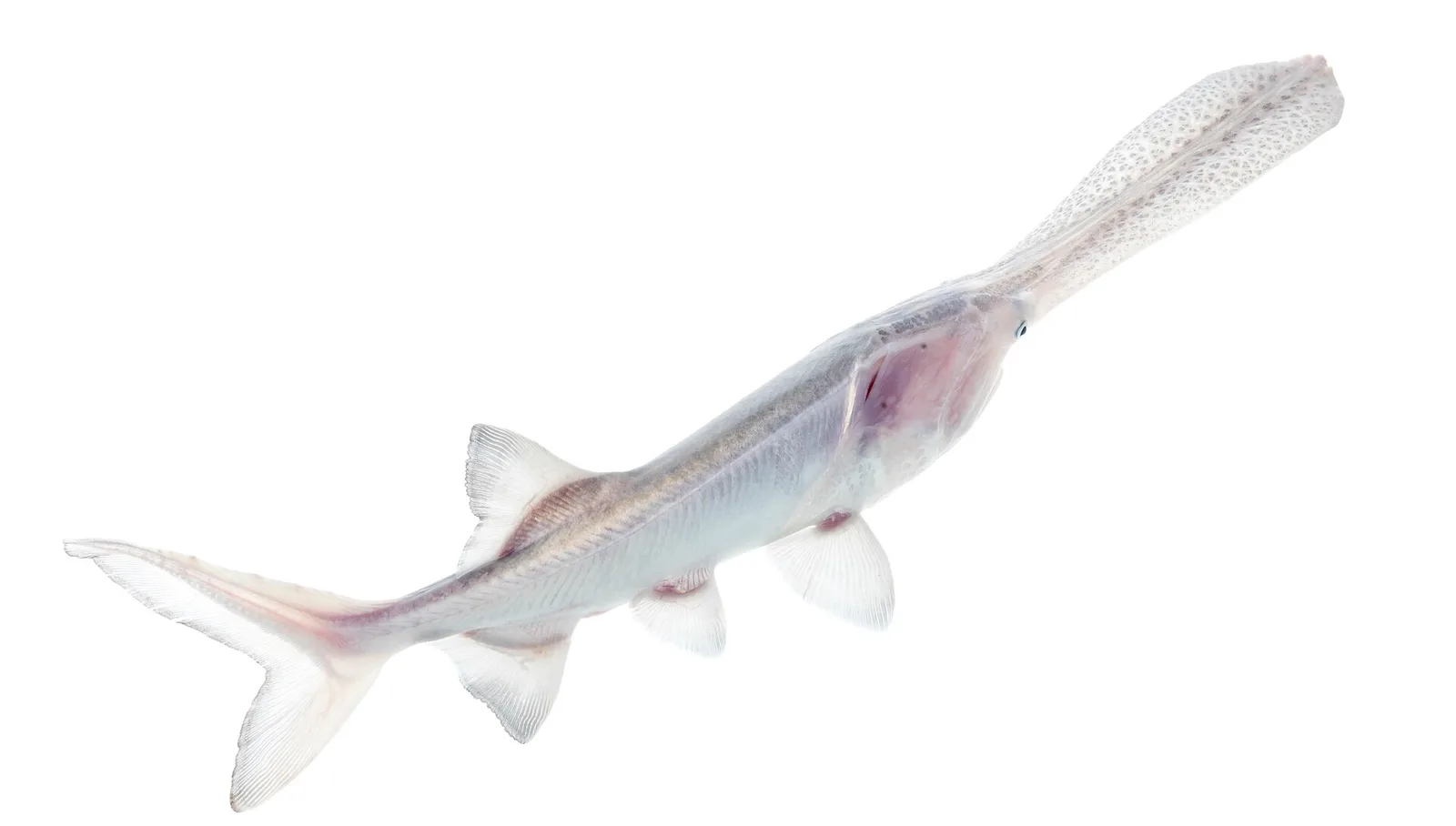
Photo: Sam Stukel, U.S. Fish and Wildlife Service, at Gavins Point National Fish Hatchery, Yankton, South Dakota (public domain)
The speckles on the paddle in the photo above are those sense organs. What the fish eats explains everything about how it is fished. “They only eat plankton, which are microscopic plants and animals,” the Fish and Wildlife Service writes; Missouri lists “tiny crustaceans and insects” strained from the water by the gill rakers. A paddlefish swims with its mouth open and filters. There is nothing on a hook it would eat.
Where do paddlefish live?
In the big rivers of the Mississippi basin, “from southwestern New York to central Montana and south to Louisiana,” in the Fish and Wildlife Service’s words. They are gone from the Great Lakes basin, where they once lived in the Lake Erie drainage. Missouri describes them in the open water of big rivers, “swimming continuously near the surface.”
Dams changed where the biggest fish are now. Many reservoirs have no free-flowing river above them for spawning, so the fish cannot reproduce there, and Missouri says its reservoir populations must be stocked. Missouri has stocked Table Rock Lake since 1972 and stocks Table Rock, Truman Lake and Lake of the Ozarks every year with fingerlings “that are 10-12 inches long,” raised at Blind Pony Hatchery in Sweet Springs. Those stocked lakes and Oklahoma’s Keystone Lake now grow the heaviest paddlefish on record.
The best-known snagging fisheries are in Missouri, Oklahoma, Kansas, Nebraska, South Dakota, North Dakota and Montana. A few states protect the fish instead: Minnesota lists it as threatened and bans recreational and commercial fishing for it, and Texas protects it under state law (see the endangered freshwater fish page).
When and where do paddlefish spawn?
In spring, on high water, over clean gravel. The Fish and Wildlife Service says spawning “occurs in late spring at times of high water,” with eggs laid on silt-free gravel bars, and the fish “can migrate hundreds of miles before spawning.” In Missouri, “when water temperatures reach about 50 to 55 degrees F and flows rise, they migrate upstream to spawn.” In North Dakota they spawn “during high runoff in late spring or early summer,” mostly on flooded gravel bars in the lower Yellowstone River, and “eggs hatch in about 7 days in 60°F water.”
Fish in the north mature much later than fish in the south:
| Stock | Males mature | Females mature | Source |
|---|---|---|---|
| Missouri reservoirs (stocked) | 4 to 5 years, spawn every year | 8 to 10 years, spawn every 2 to 3 years | Missouri Department of Conservation |
| Minnesota | 7 to 9 years | Most at 9 to 12 years | Minnesota DNR |
| Yellowstone and Missouri rivers, North Dakota | About 9 or 10 years | 16 to 18 years | North Dakota Game and Fish |
That spawning run is the snagging season. The fish stack up below dams and in the upper arms of reservoirs when the flow rises, which is why nearly every season sits in spring.
Why do you snag paddlefish instead of using bait?
Because a paddlefish only filters plankton, no bait, lure or fly will catch one on purpose. Snagging means hooking a fish anywhere on the body by sweeping a weighted hook through the water. It is illegal for game fish in most places, so the states that allow it for paddlefish write separate rules. Missouri allows paddlefish to be taken in designated waters by snagging and grabbing only, and keeps the rule that game fish not hooked in the mouth must go back, “except paddlefish legally taken during the paddlefish snagging season.”
Is it legal to catch a paddlefish? Yes, in the states and waters that open a season, with the license, permit or tag that state asks for. It is not legal in Minnesota, and outside the posted areas and dates snagging is illegal even where a season exists.
How do you snag a paddlefish?
From a boat over deep water, with heavy tackle and a big sweep of the rod. The clearest instructions come from the Missouri Department of Conservation, written for its reservoirs:
- Find the fish. “Usually, paddlefish stay near the bottom, often congregating in deep holes near drop-offs.” A depth finder shows the holes and often the fish.
- Use stout tackle. Missouri suggests a “stiff, 6- to 7-foot rod” with a level-wind saltwater reel and braided line of “100-pound test (or heavier).”
- Rig two hooks above a weight. “Attach No. 8 to No. 14 treble hooks to the line,” most anglers two of them, with the lower one 18 to 24 in (46 to 61 cm) above the weight and the hooks rigged to ride upright. A treble hook is the norm in Missouri; Oklahoma allows one hook per line, single or treble, with the barb removed or closed (see barbless hooks).
- Sweep, don’t jerk. Missouri’s advice is to “use a sweeping motion,” swinging the rod toward the boat and letting it back the other way without slack, and to use your legs and back rather than your arms.
- Set the drag right. “Set the drag so you can barely pull line off the spool with your hand,” so it holds on the sweep but gives when the hooks catch bottom or a big fish runs.
Some states set more rules than these. Oklahoma allows one rod and reel per angler, and Missouri measures length from the eye to the fork of the tail, so the paddle does not count.
How do you handle and release a paddlefish?
Carefully, because a paddlefish’s gills and jaw are easy to hurt. The Oklahoma Department of Wildlife Conservation is blunt: “Never, ever lift a paddlefish by the jaw, mouth, or gills.” One person grasps the paddle and a second the tail, with a third in the middle for a big fish. If there are not enough people to lift it safely, Oklahoma’s advice is that you “shouldn’t even remove it from the water.”
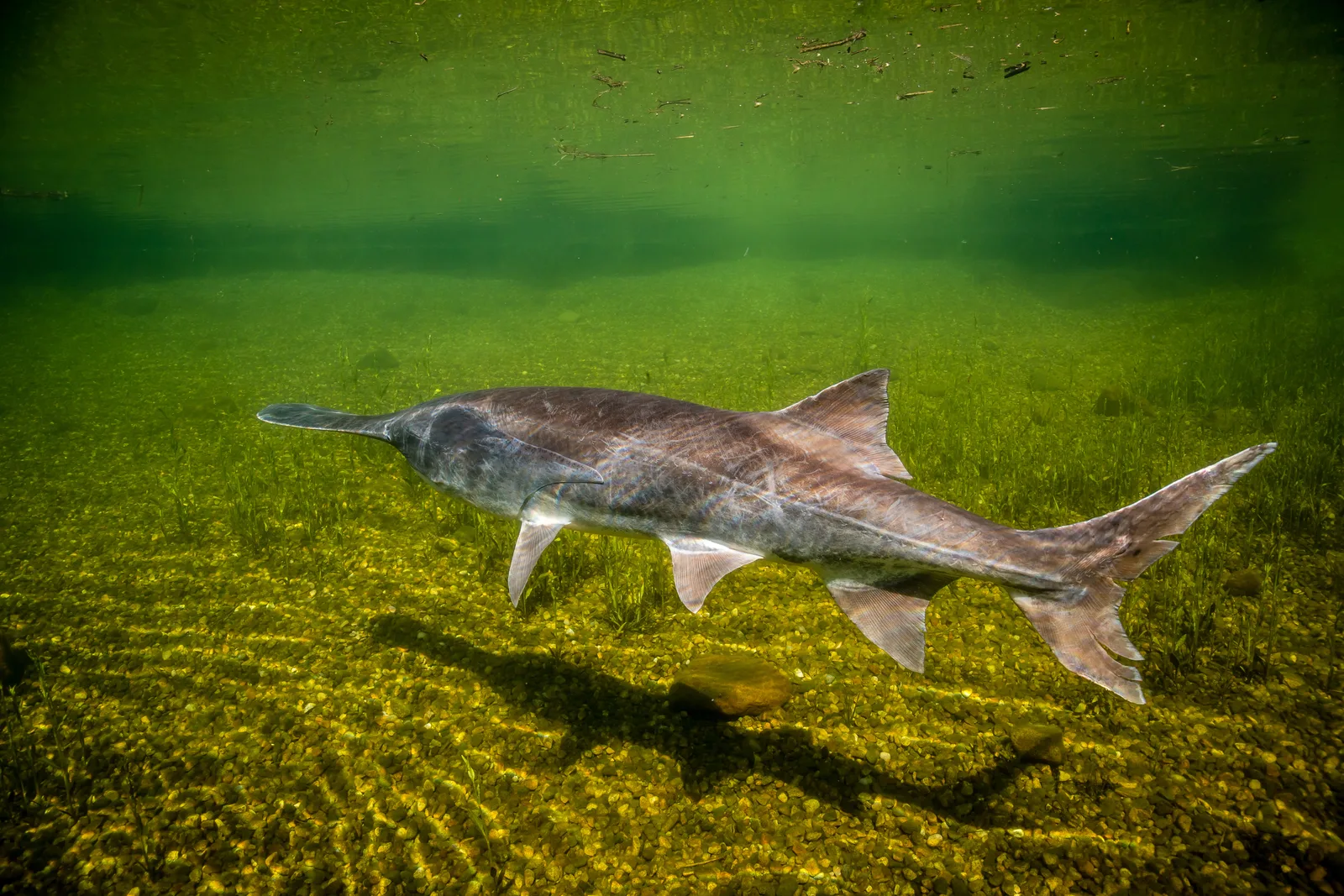
Photo: Ryan Hagerty, U.S. Fish and Wildlife Service, at Gavins Point National Fish Hatchery (public domain). The paddle and the tail are where Oklahoma says to hold one.
“Paddlefish need water flowing over their gills,” so a tired fish is revived by moving it gently through the water. Never weigh a fish you plan to release by hanging it from the jaws or gills; Oklahoma counts that as taking it into possession. A fish that keeps rolling onto its back is badly stressed and often does not recover. Missouri adds: wet your hands first, and “never put your fingers in the gills or eyes.”
Paddlefish snagging seasons by state (2026)
Every state runs its own season, and most are short, tagged or drawn. The table lists the 2026 rules as the agencies publish them; dates and limits change every year, so check the agency before you go.
| State | 2026 season | Where | Limit and tags | Worth knowing |
|---|---|---|---|---|
| Missouri | Mar 15–Apr 30; Mississippi River Mar 15–May 15 and Sep 15–Dec 15 | Designated snagging waters; the main fisheries are Lake of the Ozarks, Truman and Table Rock, plus the Mississippi | 2 a day; 34 in (86 cm) minimum on the three big lakes and their tributaries, 32 in (81 cm) everywhere else | Eye-to-fork length; eggs may not be sold |
| Oklahoma | No season dates on the rule page | Arkansas and Red River systems | 1 a day, 2 a year; free paddlefish permit plus a fishing license | One barbless hook; E-Check within 24 hours; no snagging 10 p.m.–6 a.m. east of I-35 and north of I-40 |
| Kansas | Spring season in posted areas, March 15–May 15 in past KDWP seasons | Designated snagging areas only | Paddlefish permit with carcass tags | Check the current KDWP page; the permit runs to December 31 |
| North Dakota | May 1–21, 7 a.m.–7 p.m. CT; harvest closed May 8 in 2026 | Yellowstone River and the Missouri west of the US 85 bridge | 1 tag per snagger, not transferable | After you keep one, your season is over, snag-and-release included |
| Montana | Upper Missouri May 1–June 15; Yellowstone and Missouri below Fort Peck May 15–June 15 | Three snagging tag areas | Upper Missouri by drawing (1,000 tags in 2025); the other two share a 1,000-fish cap | Below Fort Peck: “Any paddlefish caught must be retained” |
| South Dakota | Lake Francis Case May 1–31; Gavins Point Oct 1–31 | Lake Francis Case; the Missouri from Gavins Point Dam to the Big Sioux | Drawn: 500 tags at Lake Francis Case, 1,550 resident and 50 nonresident at Gavins Point | One fish per license, $30 resident, $50 nonresident |
| Nebraska | Oct 1–31 | The Missouri from Gavins Point Dam to the Big Sioux mouth (mile 734) | Drawn permit, preference points | Apply July 1–14; snagger must be 12 by October 1 |
| Minnesota | Closed | All waters | None | Threatened; no fishing for paddlefish |
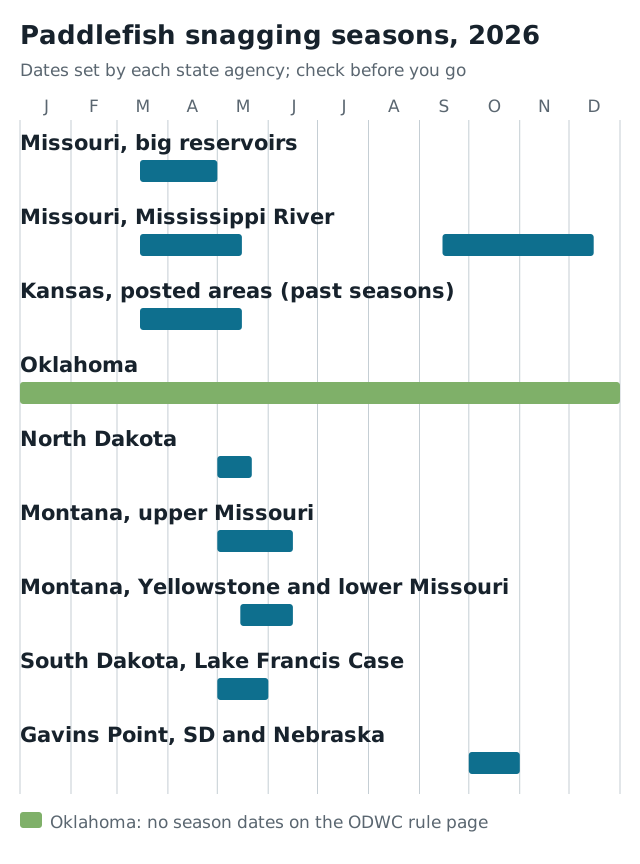
The season follows the fish. Most open between mid-March and mid-June, when the spawning run stacks fish below dams and in the upper ends of reservoirs. Gavins Point on the South Dakota–Nebraska line is the exception, with its snagging season in October. Montana also sells an archery-only tag for the Fort Peck dredge cuts in July and August, where “No snagging is allowed.”
What is the paddlefish world record?
There is no official one. The International Game Fish Association (IGFA) keeps no paddlefish category, and its record database returns no species for the name. As Field & Stream puts it, the IGFA “doesn’t recognize any official records for the species.” The “world record” in the news is simply the heaviest state record.
| Weight | Angler | Water | Year |
|---|---|---|---|
| 164 lb 13 oz (74.8 kg) | Chad Williams | Lake of the Ozarks, Missouri | 2024 |
| 164 lb (74.4 kg) | Grant Rader | Keystone Lake, Oklahoma | 2021 |
| 151 lb 14 oz (68.9 kg) | Cory James Watters | Keystone Lake, Oklahoma | 2020 |
| 149 lb (67.6 kg) | Henry Dyer | Cherokee Lake, Tennessee | 2023 |
| 144 lb (65.3 kg) | Clinton Boldridge | Atchison’s Watershed Dam #7, Kansas | 2004 |
| 142 lb 8 oz (64.6 kg) | Larry Branstetter | Missouri River near Kipp Park, Montana | 1973 |
Williams, from Olathe, Kansas, snagged his fish on March 17, 2024, the opening weekend of Missouri’s season. The Missouri Department of Conservation said it broke “the previous state record of 140 pounds” and “the previous world record of 164 pounds,” Rader’s Keystone Lake fish, which is still Oklahoma’s rod-and-line record. Missouri counts snagging under its alternative-methods records, separate from pole-and-line. The three heaviest fish all came from Keystone Lake and Lake of the Ozarks since 2020: the record has moved from wild rivers to stocked reservoirs.
Paddlefish caviar: what is legal?
The eggs are the reason paddlefish are watched so closely. When wild sturgeon caviar became scarce, the U.S. Fish and Wildlife Service writes, paddlefish roe came under pressure because of “the depletion of European and Asian sturgeon populations due to overharvesting.” The rules for anglers are strict:
- Missouri: “Paddlefish eggs may not be bought, sold, or offered for sale,” and extracted eggs “may not be possessed while on waters of the state or adjacent banks.”
- Oklahoma: you may possess eggs on the membrane from no more than one paddlefish, and no more than 3 lb of processed or loose eggs. Shipping or taking eggs out of the state is prohibited.
- Montana: state law lets anglers donate roe from paddlefish legally taken on the Yellowstone, from Glendive to the North Dakota line, to a nonprofit that sells it as caviar. The Glendive Chamber of Commerce & Agriculture has run it since 1990; the chamber keeps 70% of the money for local grants and the state’s wildlife agency 30% for paddlefish management and research.
Break a state’s roe law and it can become a federal case. In April 2013 seven men were charged in four indictments after a joint investigation by the Fish and Wildlife Service and the Missouri Department of Conservation into paddlefish eggs taken in 2011 and 2012. The federal Lacey Act “prohibits trade in wildlife, fish and plants that have been taken, possessed, transported or sold in violation of state law.” One defendant was charged with trying to export eggs in his checked luggage on an international flight from Washington, DC.
Are paddlefish good to eat?
Yes. Missouri’s conservation department describes paddlefish flesh as “very firm” with “enough fat” that it does not dry out on the grill, and the field guide says the fish “is valued for its flesh as well as for its caviar.” The meat needs cleaning the right way. Missouri’s 2005 Conservationist guide hangs the fish by the nose and cuts around the tail to the notochord, the cartilage backbone that “has the texture of dry silicone,” then pulls it to let the blood drain. The fillets come off both sides of the notochord; trim away the dark, V-shaped strip of red meat down the middle. Keep the meat in salt water until cooking, then fry it or grill 1-inch steaks. Check your state’s fish consumption advice for the water you fish, as you would for any big river fish.
Are paddlefish endangered?
Not under the federal Endangered Species Act, but they are a fish of concern. FishBase, citing the IUCN Red List, lists the American paddlefish as Vulnerable (assessed in 2019) and on CITES Appendix II, which controls international trade in its products. It rates the species’ resilience as low, with a minimum population doubling time of 4.5 to 14 years. Minnesota lists it as threatened and Texas protects it, while states with big stocked or river populations allow a tagged harvest.
FishBase names the threats as “over harvesting, habitat loss and pollution.” Two of them shaped the rules: dams that cut fish off from their spawning gravel, which is why Missouri has to stock its reservoirs, and the caviar trade. The freshwater fish outside the big families share much of that story; the sturgeon page tells it for the paddlefish’s closest relatives.
Free PDF · 16 pages
Know what's biting before your first cast
The Water Temperature Fishing Chart. Take one water temperature reading, find it on the chart, and see which of 26 freshwater fish are spawning, feeding hard or slowing down. Six pages go deeper: bass, crappie, bluegill, walleye, catfish and trout. For your phone and the tackle box.
- Where they sit and what to throw at every band: bass, crappie, bluegill and walleye; catfish by species; trout: the 68 °F line where you stop, and where they hide
- A bass that drops 3 ft feels more pressure change than the biggest cold front: the front day by day, and what to throw on each
- The three thermometer mistakes that make a reading lie (the first one is the surface)
- The 26-fish chart: who's spawning, feeding hard or slowing down at your reading
The chart's numbers come from state fish and wildlife agencies and fisheries research: 61 sources, each listed on the site.
Enter your email, confirm it with one click, and the PDF is in your inbox. Plus one email a week on what's biting. Unsubscribe anytime. Privacy.
Related
Section guide
Freshwater Fish Species Outside the Big Families: Sturgeon, Gar, Bowfin, BurbotThe freshwater fish species outside the bass, trout, catfish and pike families: sturgeon, gar, bowfin, burbot, drum, eel and paddlefish, with records.
 Arapaima: How Big They Really Get, and Where You Can Catch One
The arapaima breathes air, tops out near 10 ft and 440 lb, and is legal to catch in only a few places. Its real size, the record, and where to fish.
 Lake Sturgeon: Size, Age, Where They Live and When You Can Fish
Lake sturgeon grow to 7 ft and may live centuries. How to identify one, where they live, the Winnebago spearing season and where you may keep one.
 Sturgeon Fishing: Where to Go, the Rig, the Bait and the Rules by State
Sturgeon fishing for white and lake sturgeon: where it is open, when to go, the sliding-sinker rig, the best baits and the keep-it-in-the-water rules.
 Freshwater Drum: Sheepshead, Gaspergou and How to Catch Them
Freshwater drum, or sheepshead, mostly run 1 to 5 lb; the record is 54 lb 8 oz. How to tell one apart, the rig that catches it and how to cook it.
 Longnose Gar: Identification, Size, Records, and How to Catch One
Longnose gar commonly reach 3 ft and 5 to 6 lb; the IGFA record is 43 lb, yet four states certify bigger fish. How to ID, find and catch one.
 Bowfin: Identification, Bowfin Fishing, and the Snakehead Look-Alike
The bowfin is a native, air-breathing predator with a 21 lb 8 oz world record. How to identify one, tell it from a snakehead, and catch one.
Sources
- U.S. Fish & Wildlife Service, Paddlefish (Polyodon spathula)
- Missouri Department of Conservation, Field Guide: Paddlefish
- Missouri Department of Conservation, Paddlefish
- Missouri Department of Conservation, Paddlefish: Tips for Fishing
- Missouri Department of Conservation, Paddlefish Regulations
- Missouri Department of Conservation, Fishing Seasons
- Missouri Department of Conservation, Paddlefish: Special Area Regulations
- Missouri Department of Conservation, MDC changes some regulations related to paddlefish (December 23, 2021)
- Missouri Department of Conservation, Conservationist, Paddlefishing (February 2005)
- Labor Tribune, Angler snags world-record paddlefish during snagging season opening weekend (Missouri Department of Conservation release)
- Fox Weather, Angler snags world record on Missouri lake during first-ever paddlefish trip with friends
- Oklahoma Department of Wildlife Conservation, Paddlefish Regulations
- Oklahoma Department of Wildlife Conservation, Paddlefish
- Oklahoma Department of Wildlife Conservation, State Records
- Oklahoma Department of Wildlife Conservation, How to Hug a Paddlefish and Other Safe Handling Tips
- North Dakota Game and Fish Department, Paddlefish Snagging
- North Dakota Game and Fish Department, paddlefish life cycle
- Montana Fish, Wildlife & Parks, Paddlefish regulations
- Montana Fish, Wildlife & Parks Commission, Glendive Chamber of Commerce & Agriculture Paddlefish Grant Committee (April 2020)
- South Dakota Game, Fish and Parks, 2026 Paddlefish application
- Nebraskaland Magazine, Paddlefish Snagging Applications (Daryl Bauer, July 1, 2024)
- Kansas Department of Wildlife and Parks, Paddlefish Snagging
- Kan. Admin. Regs. § 115-18-19, Paddlefish permit; requirements, restrictions, and permit duration (LII)
- Minnesota Conservation Volunteer, Minnesota profile: paddlefish (May–June 2016)
- Texas Parks and Wildlife Department, Paddlefish (Polyodon spathula)
- Field & Stream, The Biggest State-Record Paddlefish Ever (Travis Hall, March 11, 2026)
- IGFA World Record Search, common name search (no paddlefish species returned)
- U.S. Fish & Wildlife Service, Seven men indicted for alleged trafficking of paddlefish caviar (April 15, 2013)
- U.S. Fish & Wildlife Service ECOS, Paddlefish (Polyodon spathula): no ESA listing status
- FishBase, Polyodon spathula
- Wilkens, Russell, Pei and Gurgens (1997), The paddlefish rostrum functions as an electrosensory antenna in plankton feeding, Proceedings of the Royal Society B
- Wilkens and Hofmann (2007), The Paddlefish Rostrum as an Electrosensory Organ, BioScience 57(5)