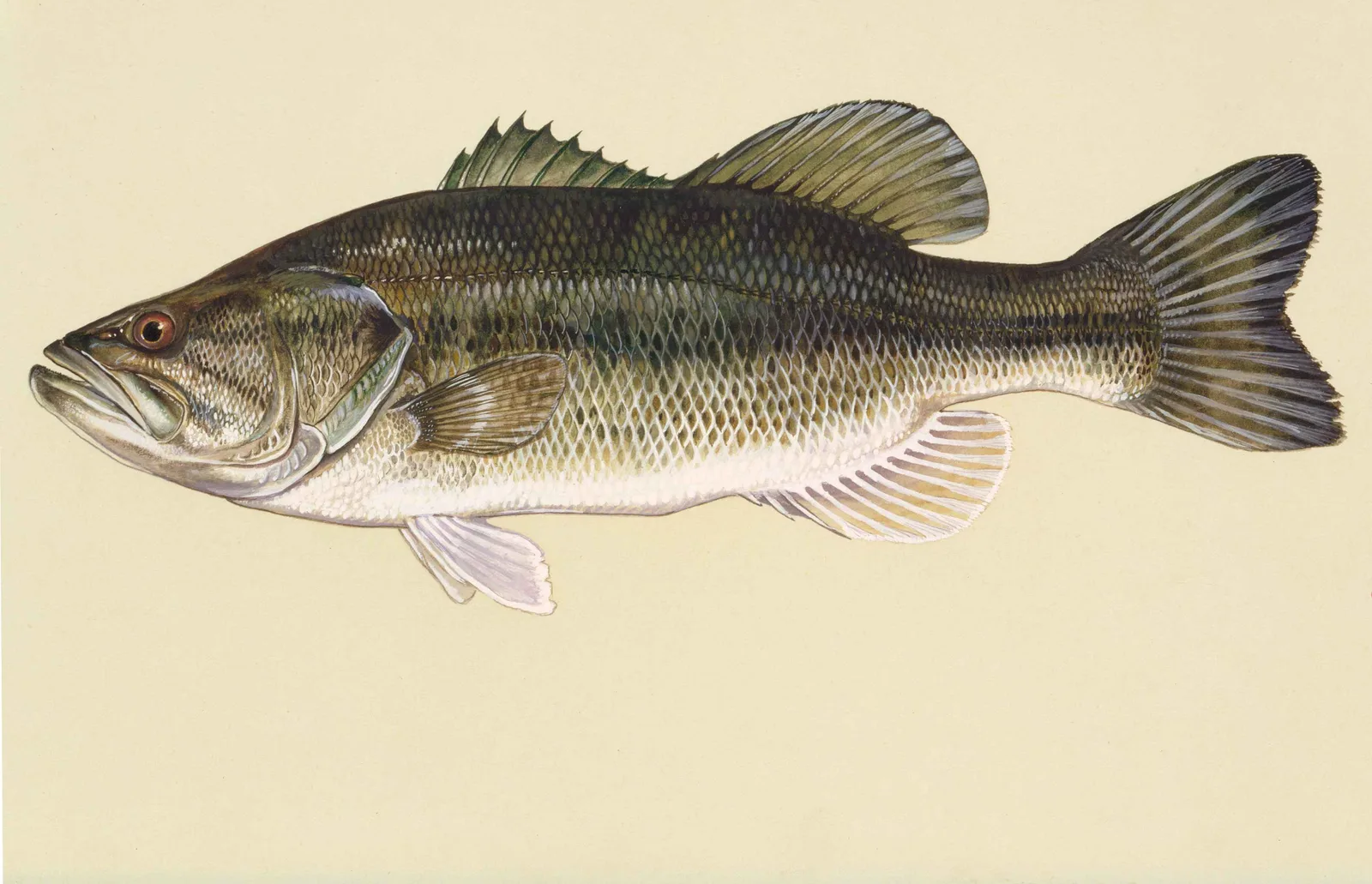
The largemouth bass is the most sought-after freshwater fish in the United States and the reason most of the lure industry exists. Texas Parks and Wildlife’s angler surveys rank it three to one over striped bass and nearly five to one over channel catfish. It is a sunfish, not a true bass, the biggest of the black basses, and since the 2022 genomic revision its scientific name is Micropterus nigricans; the older M. salmoides now belongs to the Florida bass, which agencies still manage as the same fish because the two cannot be told apart by eye. Below: the identification marks, the spawning numbers, the growth and record data and the season pattern, each from the agency or tournament source it came from.
George Perry caught the 22 lb 4 oz world record in a Georgia oxbow in 1932 with a $1.35 lure, weighed it at the post office, and took it home for dinner.
Identification
The single reliable mark is the jaw. On a largemouth the upper jaw extends well past the rear edge of the eye; on a smallmouth it never reaches beyond the eye, and on a spotted bass it stops at the rear margin. The other marks support that one: a dark, blotchy horizontal stripe along the flank, a dorsal fin that is nearly divided into two by a deep notch (nine spines in front, 12–13 soft rays behind), and no tooth patch on the tongue, which spotted and Alabama bass have. Color runs from bright green in clear water to near-black in tannic water and is no help on its own.
| Mark | Largemouth | Smallmouth | Spotted |
|---|---|---|---|
| Upper jaw | Reaches well past the rear of the eye | Never past the eye | Stops at the rear margin of the eye |
| Flank | Dark horizontal stripe of blotches | Dark vertical bars | Stripe plus rows of spots below it |
| Dorsal fin | Nearly divided; 9 spines, 12–13 soft rays | Shallow notch; 13–15 soft rays | 10 spines |
| Tongue | No tooth patch | No tooth patch | Tooth patch |
| Water | Quiet, vegetated, warm | Cool, clear, rocky | Current; warmer and more turbid than smallmouth water |
Where they live
The native range runs east of the Rockies from the St. Lawrence and the Great Lakes down the Mississippi basin and along the Atlantic drainages from North Carolina to Florida and into northern Mexico; stocking has since put largemouth in every state but Alaska and in waters on every continent except Antarctica. The Fish and Wildlife Service describes the habitat as “clear, vegetated lakes, ponds, swamps, and the backwaters of pools, creeks and rivers”, and Texas adds that the fish “prefer clear quiet water, but will survive quite well in a variety of habitats”. What they want is cover: weed edges, laydowns, docks, rock ledges and man-made structure, in water that warms. In Texas and the Southeast the introduced Florida strain grows larger than the native northern strain, which is why the trophy lakes are where they are.
Season and behavior
Kevin VanDam’s six-season framework, published by Bassmaster, is the temperature model the tournament world fishes, and it is quoted here as his. The agency spawning figures sit inside it.
| Season | Water temperature | Where the bass are | What to throw |
|---|---|---|---|
| Winter | ≤48 °F (9 °C) | Main-lake vertical structure: bluffs, channel drops, standing timber | Suspending jerkbaits, leadhead grubs, jigs, spoons |
| Pre-spawn | 48–55 °F (9–13 °C) | Vertical structure next to the spawning flats | Deep crawfish crankbaits, slow-rolled spinnerbaits, lipless crankbaits |
| Spawn | 55–70 °F (13–21 °C) | Flat, protected shallows; nests in 2–8 ft (0.6–2.4 m) | Tubes and floating worms in clear water, soft jerkbaits in stained |
| Post-spawn | 70–75 °F (21–24 °C) | Suspended near vertical cover as they leave the beds | Topwater, spinnerbaits, baits high in the water column |
| Summer | 75–90 °F (24–32 °C) | Humps, points, drop-offs, ledges; weed beds | Crankbaits in stained water, weedless frogs over weeds, topwater early |
| Fall | 75 down to 55 °F (24 down to 13 °C) | Following shad into the creeks | Willow-leaf spinnerbaits, shallow to medium crankbaits |
The spawn itself is well documented. Texas puts the trigger at about 60 °F (16 °C), February to May depending on latitude; the Fish and Wildlife Service gives a range of 59–75 °F (15–24 °C). The male sweeps a nest in 2–8 ft of water, the female lays 2,000 to 43,000 eggs, and the eggs hatch in five to ten days, faster in warmer water. The male guards the eggs and then the fry for a week or more, fanning the nest to keep silt off, and eats little while he does. That is why spawning bass are easy to find and why bed fishing is argued about: a Florida pond study found no significant difference in the number of young bass produced in fished and unfished ponds, while the review literature shows that angled males defend their nests less and abandon them more. The practical rule is to keep bed fish in the water and release them where they were caught. Feeding stops below about 41 °F (5 °C) and above 98 °F (37 °C).
How to catch them
The lure choice follows the table above, and every lure in it has its own page in the lures section. The jigs and rigs hub covers the Texas rig, the Carolina rig, the Ned rig and the drop shot that catch bass on the bottom in every season; the chatterbait and spinnerbait hubs cover the moving baits of pre-spawn and fall; crankbaits work the ledges in summer and the jerkbait in winter; topwater owns the post-spawn and the summer mornings. Tackle for the general case is a 7 ft medium-heavy casting rod with 15–20 lb fluorocarbon for single-hook baits and a 7 ft medium moderate-action rod with 10–14 lb monofilament for treble-hooked baits; the rods and line hubs explain why. The tournament data is the honest guide to what works: at the 2025 Bassmaster Elite event on Lake Tenkiller, six of the final ten anglers were throwing a Texas-rigged soft plastic.
Size, age and records
Growth depends on the length of the growing season. Texas Parks and Wildlife’s figures for the state: 4–6 in (10–15 cm) after the first year, 8–12 in (20–30 cm) at two years, 16 in (41 cm) at three, and an average lifespan of 16 years; the Fish and Wildlife Service gives a common length of 16 in, a maximum recorded length of 38.2 in (97 cm) and a maximum age of 23 years. Northern fish grow more slowly and live longer.
| Age | Texas length (TPWD) | Note |
|---|---|---|
| 1 year | 4–6 in (10–15 cm) | Fry eat zooplankton and insect larvae; at 2 in they turn predator |
| 2 years | 8–12 in (20–30 cm) | Most are mature by 12 in |
| 3 years | 16 in (41 cm) | The common adult length in USFWS data |
| Maximum | 38.2 in (97 cm), 22 lb 4 oz (10.1 kg) | USFWS maximum reported size |
How rare is a 10-pound bass? Florida, the best state for big largemouth, has run the TrophyCatch program since 2012: anglers submit photographs of bass of 8 lb (3.6 kg) or more on a certified scale. By early 2026 the program had verified 16,615 bass of 8 lb or heavier and 168 of 13 lb (5.9 kg) or heavier, from more than 91,000 registered anglers. Ten-pounders are a few thousand fish in fourteen years in the state with the most of them, which is why one is a life goal for most anglers rather than a season goal. The Florida state record is 17.27 lb (7.83 kg); larger fish have been documented but never certified.
The all-tackle world record is 22 lb 4 oz (10.1 kg), caught by George Perry at Montgomery Lake, Georgia, in 1932, and tied within the IGFA’s rules by Manabu Kurita at Lake Biwa, Japan, in 2009 at 22 lb 4.97 oz. Since June 2024 the IGFA requires genetic verification for any new all-tackle largemouth record, so that a Florida bass cannot be certified as a largemouth. The world-record page under the bass hub tells the story of both fish.
Are largemouth bass good to eat?
They are edible and mild, and most are released anyway: the value of a largemouth in the United States is in catching it again. Where anglers keep them, two cautions apply. Smaller fish taste better than old ones, and largemouth are top predators that accumulate mercury, so many states publish consumption advisories for them by waterbody: Texas limits adults to two 8-ounce servings a month on listed lakes, Arizona to 2.5 ounces a week, and Massachusetts tells pregnant women and young children not to eat largemouth over 24 in from any of its freshwater lakes. Check the state health department page for the water you fish.
Related
The bass fishing hub covers all five black bass species and the seasonal pattern; the smallmouth and spotted bass pages under it deal with the look-alikes; the catfish hub is the other freshwater pillar. For what to throw, start with jigs and rigs.
Sources
- Texas Parks and Wildlife, largemouth bass species profile
- U.S. Fish & Wildlife Service, largemouth bass
- Florida FWC, Florida bass / largemouth bass profile
- Kim, Taylor & Near 2022, Phylogenomics and species delimitation of the black basses, Scientific Reports
- Bassmaster, KVD's 6-season bass guide
- FWC news, TrophyCatch Hall of Fame milestones
- Mississippi Sportsman, FWC bed-fishing study and population model