 By
The thermometer
What are you fishing for?
Set to a typical mid-US lake in October. Move it to your own reading.
Bass at 58 °F, cooling: fall feed
- Largemouth bassFall feedfeeds hardest 65°–80°
- Smallmouth bassFall feedfeeds hardest 65°–72°
- Spotted bassSlowfeeds from 65°
Where: the backs of the creeks, isolated wood and docks; in the turnover, water under 6 ft (2 m) and inflowing creeks. Throw: lipless crankbait, spinnerbait, swim jig; a wacky-rigged stick bait at shallow targets during the turnover.
Next, at 54 °F (largemouth bass): steep banks and points outside the coves, hard bottom; smallmouth on rock flats in 1–5 ft (0.3–1.5 m)
The full bass temperature guideNumbers from the chart on the water temperature guide and the species pages; spawn and comfort ranges move with latitude, so read them as the band to start in. Measure at the depth you fish, not at the surface.
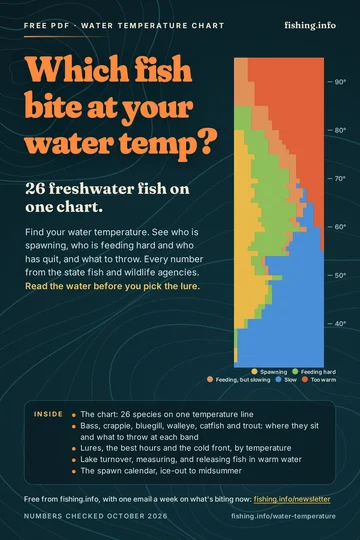
Free PDF · Water temperature chart Take this thermometer to the water.
One water temperature reading, and the 16-page chart tells you who's spawning, who's feeding hard, where they sit and what to throw. 26 fish, every number sourced.
Enter your email, confirm it with one click, and the PDF is in your inbox. Plus one email a week on what's biting. Unsubscribe anytime. Privacy.
Which fish bite at your water temperature?
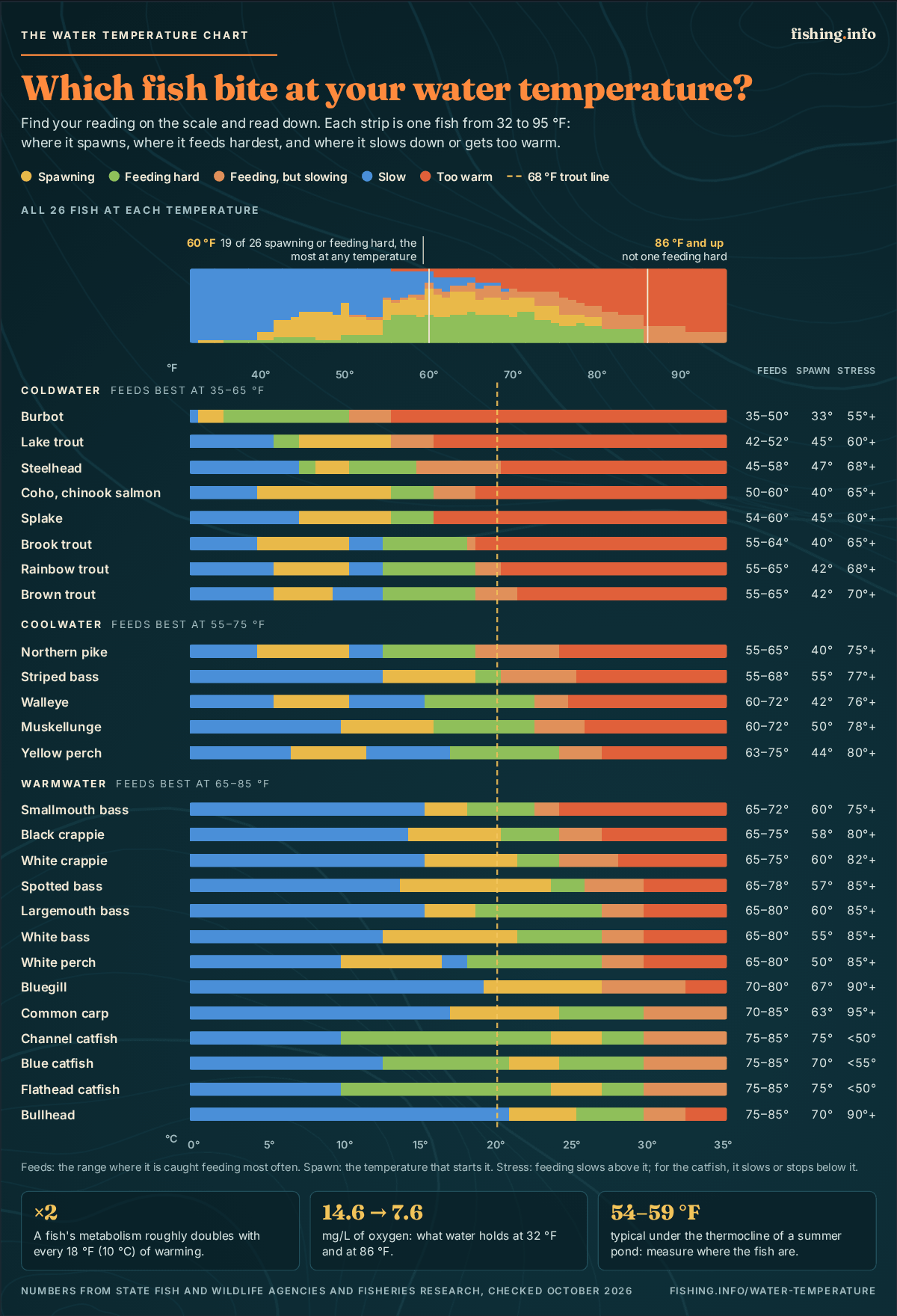
Find your reading on the scale and read down. Each strip is one fish from 32 to 95 °F: where it spawns, where it feeds hardest, and where it slows down or gets too warm.
- Spawning
- Feeding hard
- Feeding, but slowing
- Slow
- Too warm
- 68 °F trout line
All 26 fish at each temperature
At 60 °F, 19 of the 26 species are spawning or feeding hard, more than at any other temperature; from 86 °F up, none is feeding hard.
Coldwater feeds best at 35–65 °F
Coolwater feeds best at 55–75 °F
Warmwater feeds best at 65–85 °F
Feeds: the range where it is caught feeding most often. Spawn: the temperature that starts it. Stress: feeding slows above it; for the catfish, it slows or stops below it.
- ×2A fish's metabolism roughly doubles with every 18 °F (10 °C) of warming.
- 14.6 → 7.6mg/L of oxygen: what water holds at 32 °F and at 86 °F.
- 54–59 °Ftypical under the thermocline of a summer pond: measure where the fish are.
Take the chart with you
- Download the chart (PNG, 1200 px)
- Get the free 16-page PDF: the chart, plus where each fish sits and what to throw at every band
Free to use on your site, in a club newsletter or a classroom, with credit and a link to fishing.info (CC BY 4.0).
Copy the code to embed it
To cite it: fishing.info (2026), The Water Temperature Fishing Chart: 26 freshwater fish, https://fishing.info/techniques/water-temperature/
The best water temperature for fishing, for most freshwater game fish in lakes and rivers, is 65–75 °F (18–24 °C). That is where largemouth bass, walleye, crappie, white bass and yellow perch feed hardest. Trout and salmon mostly want it colder, 50–65 °F (10–18 °C), and catfish and carp want it warmer, 75–85 °F (24–29 °C). Set the thermometer above to your water and it sorts 26 species into spawning, feeding, slowing down and too warm; for the species with their own page it adds where to find them and what to throw.
A fish’s metabolism roughly doubles with every 18 °F (10 °C) of warming and halves with every 18 °F of cooling. A bass at 55 °F needs about half the food a bass at 75 °F needs, which is why the same lure that gets ignored in April gets crushed in June.
What is the best water temperature for each fish?
The chart is for freshwater fish. The comfort range is where the species is most often caught feeding; it often sits below the “preferred temperature” that laboratory charts print (why is below). “Spawn” is the water temperature that starts spawning. “Stress” is where feeding slows and the fish move to find cooler water, or deeper water for the coldwater species. The figures are the state agencies’ and three scientific compilations’, rounded to the degree.
| Species | Comfort range | Spawn begins | Stress point |
|---|---|---|---|
| Largemouth bass | 65–80 °F (18–27 °C) | about 60 °F (16 °C) | above 85 °F (29 °C) |
| Smallmouth bass | 65–72 °F (18–22 °C) | 60–64 °F (16–18 °C) | above 75 °F (24 °C) |
| Spotted bass | 65–78 °F (18–26 °C) | 57–74 °F (14–23 °C) | above 85 °F (29 °C) |
| Striped bass (freshwater) | 55–68 °F (13–20 °C) | 55–65 °F (13–18 °C) | above 77 °F (25 °C) |
| White bass | 65–80 °F (18–27 °C) | 55–70 °F (13–21 °C) | above 85 °F (29 °C) |
| Channel catfish | 75–85 °F (24–29 °C) | 75–80 °F (24–27 °C) | feeding stops below 50 °F (10 °C) |
| Blue catfish | 75–85 °F (24–29 °C) | 70–75 °F (21–24 °C) | slow below 55 °F (13 °C) |
| Flathead catfish | 75–85 °F (24–29 °C) | 75–80 °F (24–27 °C) | slow below 50 °F (10 °C), stops near 43 °F (6 °C) |
| Bullhead | 75–85 °F (24–29 °C) | 70–77 °F (21–25 °C) | above 90 °F (32 °C) |
| Common carp | 70–85 °F (21–29 °C) | 63–75 °F (17–24 °C) | above 95 °F (35 °C) |
| Walleye | 60–72 °F (16–22 °C) | 42–50 °F (6–10 °C) | above 76 °F (24 °C) |
| Northern pike | 55–65 °F (13–18 °C) | 40–50 °F (4–10 °C) | above 75 °F (24 °C) |
| Muskellunge | 60–72 °F (16–22 °C) | 50–60 °F (10–16 °C) | above 78 °F (26 °C) |
| Yellow perch | 63–75 °F (17–24 °C) | 44–52 °F (7–11 °C) | above 80 °F (27 °C) |
| White perch | 65–80 °F (18–27 °C) | 50–61 °F (10–16 °C) | above 85 °F (29 °C) |
| Bluegill | 70–80 °F (21–27 °C) | 67–80 °F (19–27 °C) | above 90 °F (32 °C) |
| Black crappie | 65–75 °F (18–24 °C) | 58–68 °F (14–20 °C) | above 80 °F (27 °C) |
| White crappie | 65–75 °F (18–24 °C) | 60–70 °F (16–21 °C) | above 82 °F (28 °C) |
| Rainbow trout | 55–65 °F (13–18 °C) | 42–50 °F (6–10 °C) | above 68 °F (20 °C) |
| Brown trout | 55–65 °F (13–18 °C) | 42–48 °F (6–9 °C) | above 70 °F (21 °C); dies at 79–81 °F (26–27 °C) |
| Brook trout | 55–64 °F (13–18 °C) | 40–50 °F (4–10 °C) | above 65 °F (18 °C) |
| Lake trout | 42–52 °F (6–11 °C) | 45–55 °F (7–13 °C) | above 60 °F (16 °C) |
| Splake | 54–60 °F (12–16 °C) | 45–55 °F (7–13 °C), fall (inferred from its parent species) | above 60 °F (16 °C) |
| Steelhead | 45–58 °F (7–14 °C) | upper 40s °F (8–10 °C) | above 68 °F (20 °C) |
| Coho and chinook salmon | 50–60 °F (10–16 °C) | 40–55 °F (4–13 °C), fall | above 65 °F (18 °C) |
| Burbot | 35–50 °F (2–10 °C) | 33–35 °F (1–2 °C), under ice | avoids water above 55 °F (13 °C) |
One thing stands out at once: the warmwater and coldwater fish barely overlap. A lake at 50 °F (10 °C) is a slow day for bass and a good one for steelhead and lake trout, and the reverse at 74 °F (23 °C). Pick the fish that suits the water you have, not the other way round.
Why does water temperature change how fish feed?
Because a fish’s body runs at the temperature of the water around it. Cold water slows its metabolism and warm water speeds it up, in the words of Texas A&M’s pond fact sheet. A fish in 50 °F (10 °C) water digests slowly, needs little food and will not chase far for it. The same fish at 70 °F (21 °C) burns through a meal fast and hunts again.
That is the doubling rule in the quote above, and it is a round number. Across 69 species of bony fish, Clarke and Johnston found metabolism rose by a factor of about 1.8 per 18 °F (10 °C) between species, and about 2.4 within a species. For the angler it comes down to one rule: the colder the water, the slower the lure.
Warmth has a ceiling, and oxygen sets it. Cold water holds more dissolved oxygen than warm water (USGS), so the fish’s demand rises just as the supply falls:
| Water temperature | Oxygen the water can hold |
|---|---|
| 32 °F (0 °C) | 14.6 mg/L |
| 50 °F (10 °C) | 11.3 mg/L |
| 68 °F (20 °C) | 9.2 mg/L |
| 86 °F (30 °C) | 7.6 mg/L |
Saturation at sea level, fresh water. Texas A&M AgriLife Extension, Water Quality in Sportfish Ponds.
Water at 86 °F holds about half the oxygen of ice water, and real lakes often hold less than the maximum. Warmwater fish get by on less oxygen than coldwater fish such as trout, one reason trout leave water a bass is happy in. In a weedy pond the oxygen also swings through the day. It peaks in mid-afternoon, when the plants are making it, and falls to its lowest just before sunrise.
So in a hot summer the fish are not looking for the coolest water, they are looking for cool water that still has oxygen. That is shade, current, wind-blown banks, springs, and the top edge of the thermocline, the band where a lake’s temperature drops fast with depth.
Warmwater, coolwater or coldwater: which is your fish?
Fisheries biologists sort freshwater fish into three groups by temperature: cold, cool and warm water fishes, as Magnuson and colleagues named them in 1979. The groups are the shortcut through the chart. Learn which one your fish is in, and the season, the depth and the summer refuge follow from it.
| Group | The fish | Feeds best | Trouble starts |
|---|---|---|---|
| Warmwater | black bass, white bass, white perch, catfish, bullhead, carp, bluegill, crappie | 65–85 °F (18–29 °C) | above 75–95 °F (24–35 °C), smallmouth first, carp last; channel catfish stop below 50 °F (10 °C) |
| Coolwater | walleye, northern pike, muskie, yellow perch, freshwater striped bass | 55–75 °F (13–24 °C) | above 75–80 °F (24–27 °C) |
| Coldwater | rainbow, brown, brook and lake trout, splake, steelhead, salmon, burbot | 35–65 °F (2–18 °C) | above 55–70 °F (13–21 °C), lowest for burbot, highest for brown trout |
Each span runs from the lowest to the highest figure of its fish in the chart above.
The warmwater fish are the summer fish: they bite best when the swimming is good. The coolwater fish are comfortable through spring and fall; by midsummer the shallows run past their range, and walleye move to the thermocline edge and the deep weedlines. The coldwater fish are the reverse of the bass. They are at their best in the cold months, burbot under the ice, and in summer they need cold water to survive, not just to feed.
That is also why one deep lake can hold all three. In a layered summer lake the bass work the warm top, the walleye sit on the thermocline edge, and trout and salmon live in the cold water under it, in clear lakes that keep oxygen down there.
What about saltwater? The chart stops at the shore. Saltwater fish have bands of their own, worked out the same way. Striped bass, which live in both, feed best at about 55–68 °F (13–20 °C) by angler guides’ figures, and Texas Parks and Wildlife puts their preferred water below 75 °F (24 °C).
When does each fish spawn?
The spawn column of the chart is a calendar written in degrees. In spring, fish spawn in the order the water reaches their number. A few spawn as the water cools in fall, and one under the ice.
- Under the ice, 33–35 °F (1–2 °C): burbot, from midwinter into early spring.
- Ice-out, the 40s °F (4–9 °C): northern pike at 40–50 °F, walleye and rainbow trout at 42–50 °F, yellow perch at 44–52 °F, steelhead in the upper 40s.
- The 50s (10–15 °C): muskie at 50–60 °F, white perch from 50 °F, striped bass and white bass from 55 °F, spotted bass from 57 °F, black crappie at 58–68 °F.
- About 60 °F (16 °C): largemouth bass, smallmouth at 60–64 °F, white crappie at 60–70 °F, carp from 63 °F.
- The upper 60s and 70s (19–27 °C): bluegill at 67–80 °F, blue catfish at 70–75 °F, bullhead at 70–77 °F, channel and flathead catfish last, at 75–80 °F in early summer.
- Falling water in fall: brook trout at 40–50 °F, brown trout at 42–48 °F, lake trout at 45–55 °F, and coho and chinook salmon at 40–55 °F on their runs up the tributaries.
A spawn number is where the spawn starts, not a switch. The spawn spreads over weeks as the water warms, and its timing shifts across a species’ range. Hokanson found the biggest differences in spawning time at the edges of a range, the mark of long-term local adaptation. Kevin VanDam, writing on his own site, sees bass spawn “in waters that range anywhere from 55 to 80 degrees.” The crappie, bluegill and walleye pages take each spawn in turn: where the fish go, how deep and for how long.
Is 90 °F too hot to fish, and is 50 °F too cold?
At 90 °F (32 °C) every fish in the chart is past its comfort range. Bluegill and bullhead reach their stress point there, carp hold out to about 95 °F (35 °C), and channel catfish survive indefinitely up to about 95 °F. Bass, walleye, crappie and pike are well past theirs, so fish first and last light. Trout are best left alone above 70 °F (21 °C); the trout water temperature page explains the 68 °F line and where trout go to wait out the heat.
At 50 °F (10 °C) channel catfish stop feeding, and bass and crappie sit far below their comfort range. Lake trout, steelhead and salmon are inside theirs. Neither number is a reason to stay home; it decides which fish to chase.
So at what temperature do fish stop biting? There is no single number, only a number per fish. Channel catfish quit below about 50 °F and flatheads near 43 °F (6 °C), while blue catfish bite all winter. Bass slow down hard in the 40s but still eat a slow bait. And burbot spawn at 33–35 °F under the ice, which is why the coldest water of the year is the burbot angler’s best.
Hot water raises a second question: should you fish at all? A fish fought in warm water has less oxygen to recover with. In a USGS pond study at 67–91 °F (20–33 °C), 30 percent of angled muskie died against 11.3 percent of fish never caught. Maryland asks anglers to stop targeting muskie at 80 °F (27 °C), and Montana closes trout rivers to afternoon fishing after three days at 73 °F (23 °C). Sudden change is a danger of its own. Texas A&M warns that a jump from 65 °F to 75 °F (18 to 24 °C) water may shock and kill a fish, so mind the livewell and the bait bucket too. How to release a fish that has a chance is on the catch and release page.
Why does every chart you find disagree?
Put two charts side by side and the numbers differ, sometimes by ten degrees. There are three honest reasons.
- Laboratory preference is not field behavior. Coutant’s 1977 compilation, still the standard reference, lists the preferred temperature range fish chose in tanks with a gradient. Largemouth bass in those tanks settled at 84–90 °F (29–32 °C), warmer than any angler’s chart, because a tank has food, oxygen and no reason to leave. A lake at 84 °F has less oxygen, and the bass move to shade and depth.
- Fish adapt to where they live. Hokanson’s review of walleye, yellow perch and their relatives found populations at the edges of a range adapted to their local temperatures. He warned that one rule should not be applied across a species’ whole range. The agencies differ accordingly: Wisconsin puts northern pike spawning at 34–40 °F (1–4 °C), Minnesota at 40–50 °F (4–10 °C). A national chart splits the difference.
- Comfort, growth and preference are different numbers. Channel catfish grow fastest at about 85 °F (29 °C), grow slowly below 65 °F (18 °C) and survive indefinitely up to about 95 °F (35 °C), only briefly above 100 °F (38 °C). A chart that reports “optimum” may mean any of those three.
So use the chart the way a guide uses it: as the band to start in, adjusted by what the fish tell you that day.
What does each season do to the water?
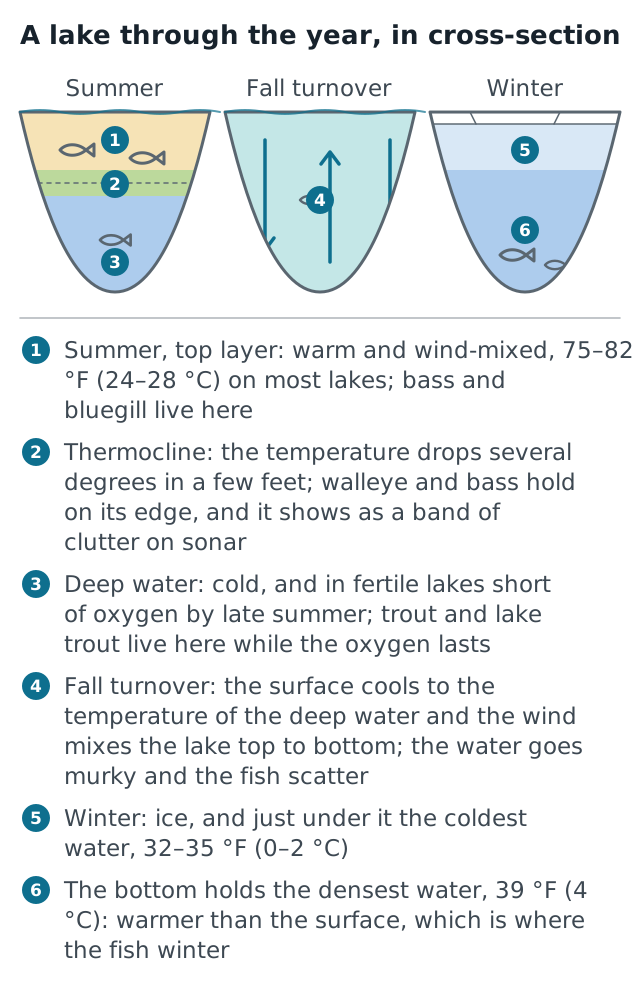
Water is densest at 39 °F (4 °C), and that one fact runs a lake’s year. Cold water sinks, warm water floats, and wherever the two meet the fish have to choose a side.
Spring. When the ice goes, the whole lake sits near the same temperature and mixes; for a few weeks fish can be at any depth. The shallow, sheltered water warms first. A dark-bottomed bay or the downwind shore runs warmer than the main lake by late afternoon, and that is where the first fish of the year feed and the first spawners move.
Summer. From late spring the sun warms the top faster than the wind can mix it down, and the lake splits into layers. A warm upper layer sits on the thermocline, where the temperature drops several degrees in a few feet, and cold water lies below. No new oxygen reaches that bottom layer until fall. In a fertile pond the water under the thermocline can hold almost none, near 0 mg/L, so the fish stay above it. Clear, infertile lakes keep oxygen deeper, which is how they hold trout through August.
Fall. The surface cools until it matches the deep water, and then nothing holds the layers apart. The final mix can happen overnight. That is the fall turnover, the murky, scattered spell every reservoir angler knows. On most lakes it lasts about a week or two, by the count of Virginia’s fisheries staff and of pro Michael Iaconelli. Around it, the cooling water brings the best feeding of the year for bass, as they chase the baitfish into the creeks. It brings the big-fish weeks for muskie, and walleye on the rock piles, reefs and rocky shorelines as the water falls through the 50s into the 40s.
Winter. The order flips. The coldest water sits just under the ice and the 39 °F water on the bottom, which is where the fish spend the winter, slow but catchable.
Does air temperature tell you the water temperature?
Only roughly, and never on the same day. A lake follows a running average of the past days, not today’s high. In hourly readings from one Polish lake, the water tracked the air most closely a full day later, and on more than half of all days it moved by 1.8 °F (1 °C) or less.
So a 60-degree afternoon is not 60-degree water. In March it sits over a lake that is still carrying winter and runs colder than the air. In October it sits over a lake that has stored a summer of heat and runs warmer. That is the honest answer to “do fish bite in 60 degree weather”: it depends on the season more than the day. A rule of thumb, not a measurement, is the mean air temperature of the past five to seven days. The lake water temperature page has that rule and the live sensors that beat it.
How do you measure water temperature where the fish are?
The water temp on the boat’s sonar is the least useful reading on the lake. The sensor sits in the transducer at the hull and reads the surface water where the boat is, nothing deeper. A fishing thermometer on a line, or a temperature probe on a cable, reads the depth you fish. Three rules make the number mean something:
- Depth. In a stratified summer lake, bass and walleye hold on the thermocline edge and trout and salmon live under it. Missouri’s biologists find the bottom layer of a summer pond at 54–59 °F (12–15 °C) even in the hottest months, while the top runs far warmer. A fish finder shows the thermocline as a band of clutter at one depth (how to read one).
- Time of day. In spring the sun builds a shallow layer of warmer water by late afternoon, on the downwind side of the lake, and the afternoon is when pre-spawn bass move up. On Chesapeake Bay, Maryland’s monitoring program sees the surface rise 3 to 4 °F during a winter day and cool as much overnight in summer. The morning reading tells you little about the afternoon bite.
- Trend beats level. Fish respond to the direction of change as much as to the number. Pro angler Davy Hite, talking to Wired2Fish, puts more weight on past and future water temperature than on today’s. His example: 55 °F in prespawn sounds great, but it fishes hard when the bass were used to 60 °F before a cold front.
Before you leave home, live USGS and NOAA sensors give a reading for some lakes and none for many. Of 20 well-known bass and walleye lakes checked against both networks in October 2026, only 2 had a live sensor on the lake itself. The lake water temperature page shows where to look and how to read a number taken somewhere else.
Is water temperature the whole story?
No, and Kevin VanDam says so plainly. He calls water temperature “still a bit overrated in terms of the emphasis anglers put on it for catching fish.” In spring, he argues, the lengthening daylight does more to move bass than the thermometer. He has caught them on a squarebill crankbait in 38-degree water.
What he watches as well are the small things that warm a fish locally. A warm wind on 40-degree water, he writes, and bass get active. When the sun beams into cold water, “any dark object on the bottom becomes a fish magnet.” On an April full moon he has seen bass cruise as if spawning in 40-degree water, “a sort of false spawn that is triggered by the full moon.” The moon phase, the time of day and the barometer add their own share.
So read the chart as the frame, not the forecast. The temperature tells you which fish, which depth and which speed; the day tells you the rest.
What to throw for bass at each temperature
Here is the band, where the bass sit and the lure that matches it, for largemouth and smallmouth in a typical northern-tier reservoir. Southern lakes run the same sequence a month or two earlier. The bass water temperature page takes each band further, with the falling-water bands of fall.
- Below 50 °F (10 °C), winter. Bass sit deep on vertical structure: bluffs, channel drops, standing timber. Suspending jerkbaits worked with long pauses, a jig or a leadhead grub crawled along the bottom, a blade bait or spoon dropped on marked fish.
- 50–60 °F (10–16 °C), pre-spawn. Bass move from wintering areas toward spawning flats and stage on the first structure next to them. A deep crawfish-pattern crankbait, a slow-rolled spinnerbait, a lipless crankbait over emerging grass.
- 60–65 °F (16–18 °C), spawn. Flat, protected, shallow structure; nests in 2–8 ft (0.6–2.4 m). A tube or floating worm in clear water, a soft jerkbait in stained water, a wacky-rigged stick bait around beds.
- 65–80 °F (18–27 °C), post-spawn to summer. Bass split: some on the first deep break, some in shallow cover. Topwater at dawn and dusk, a frog over grass, a Texas-rigged worm or a football jig on the breaks by day.
- Above 80 °F (27 °C), high summer. Bass move to deep breaks and the thickest cover; above 85 °F (29 °C) feeding windows shrink to low light. Deep crankbaits and Carolina rigs on ledges, a punch rig into the thickest mat, night fishing with a black spinnerbait.
- Cooling back through 65–55 °F (18–13 °C), fall. The best feeding of the year as bass chase shad into creeks and coves. Lipless crankbaits, spinnerbaits, walking topwaters, a swimbait when the bait balls up.
The same logic runs for every species in the chart: find where the water is in its range, and the position and the lure follow. What the weather, the barometer and the moon do to the bite is on the conditions hub; the knots and the basics are under techniques.
All articles
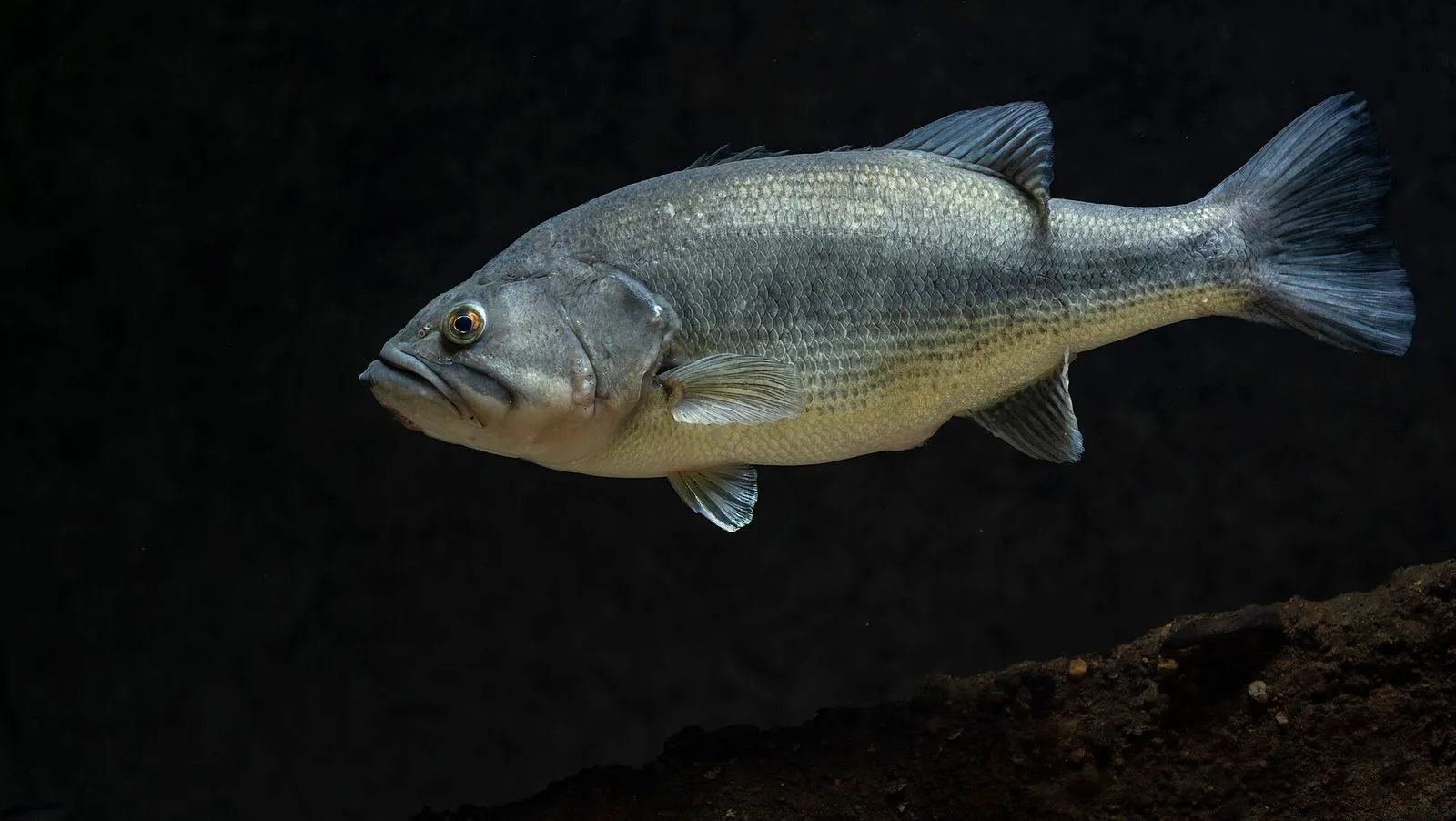 Bass Water Temperature: Spawn, Bite and What to Throw at Each Band
Bass water temperature chart, band by band: best bite at 65–80 °F, spawn near 60 °F, and when bass stop biting in heat and cold. What to throw at each.
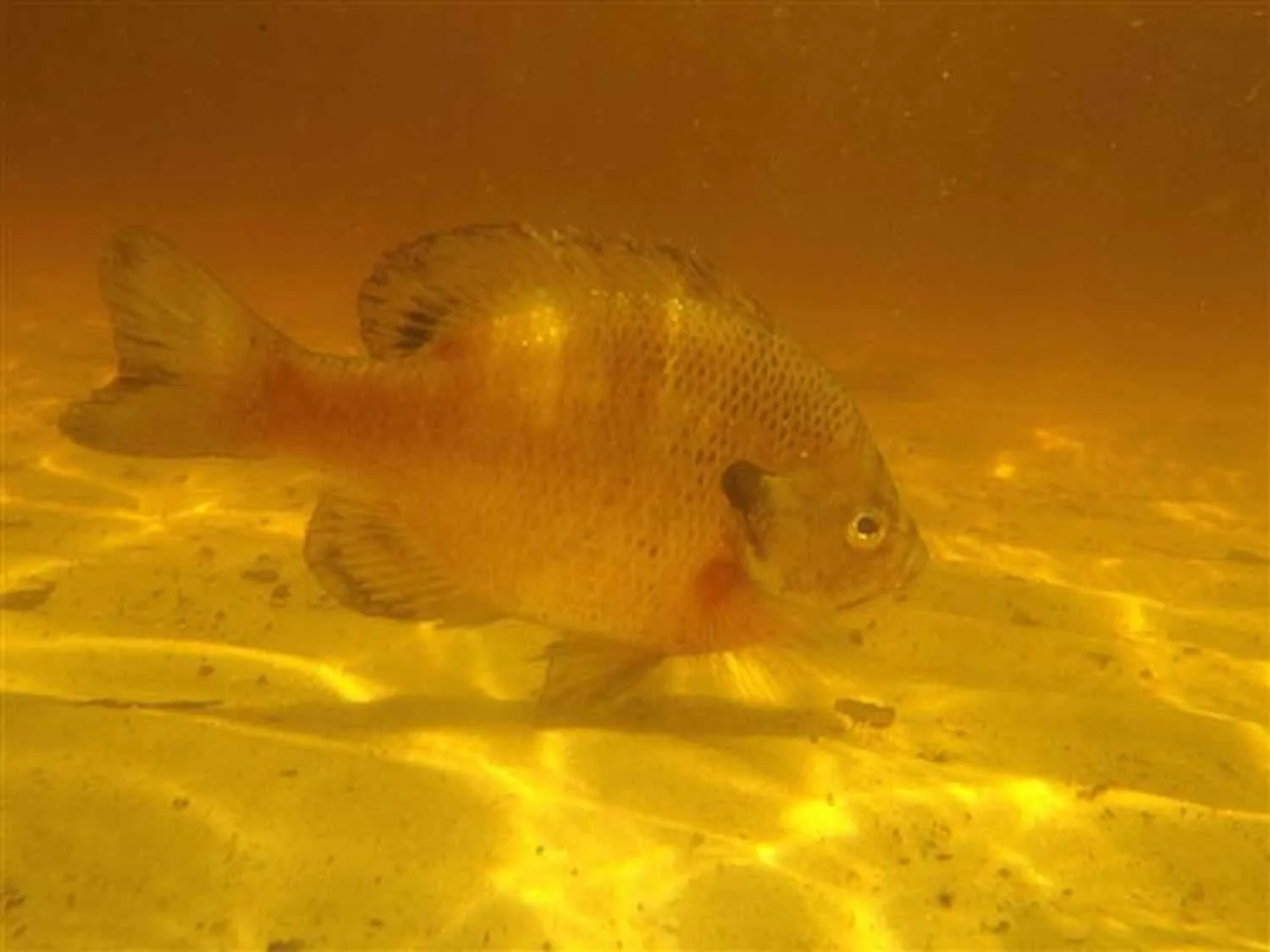 Bluegill Spawn Temperature: 67–80 °F, and How to Find the Beds
Bluegill water temperature range: spawn at 67–80 °F (19–27 °C), most comfortable at 70–80 °F, stressed above 90 °F. Spawn month by region and the beds.
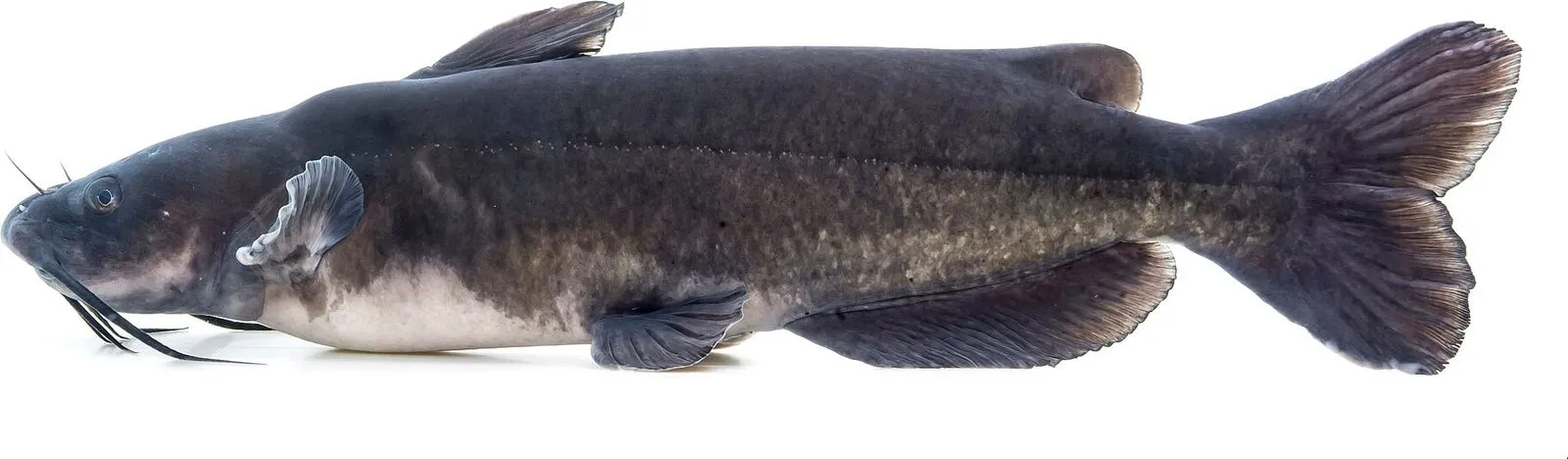 Catfish Water Temperature: When Channels, Blues and Flatheads Bite
Catfish water temperature: all three feed hardest at 75–85 °F. Channels quit near 50 °F, flatheads near 43 °F, and blue catfish bite all winter.
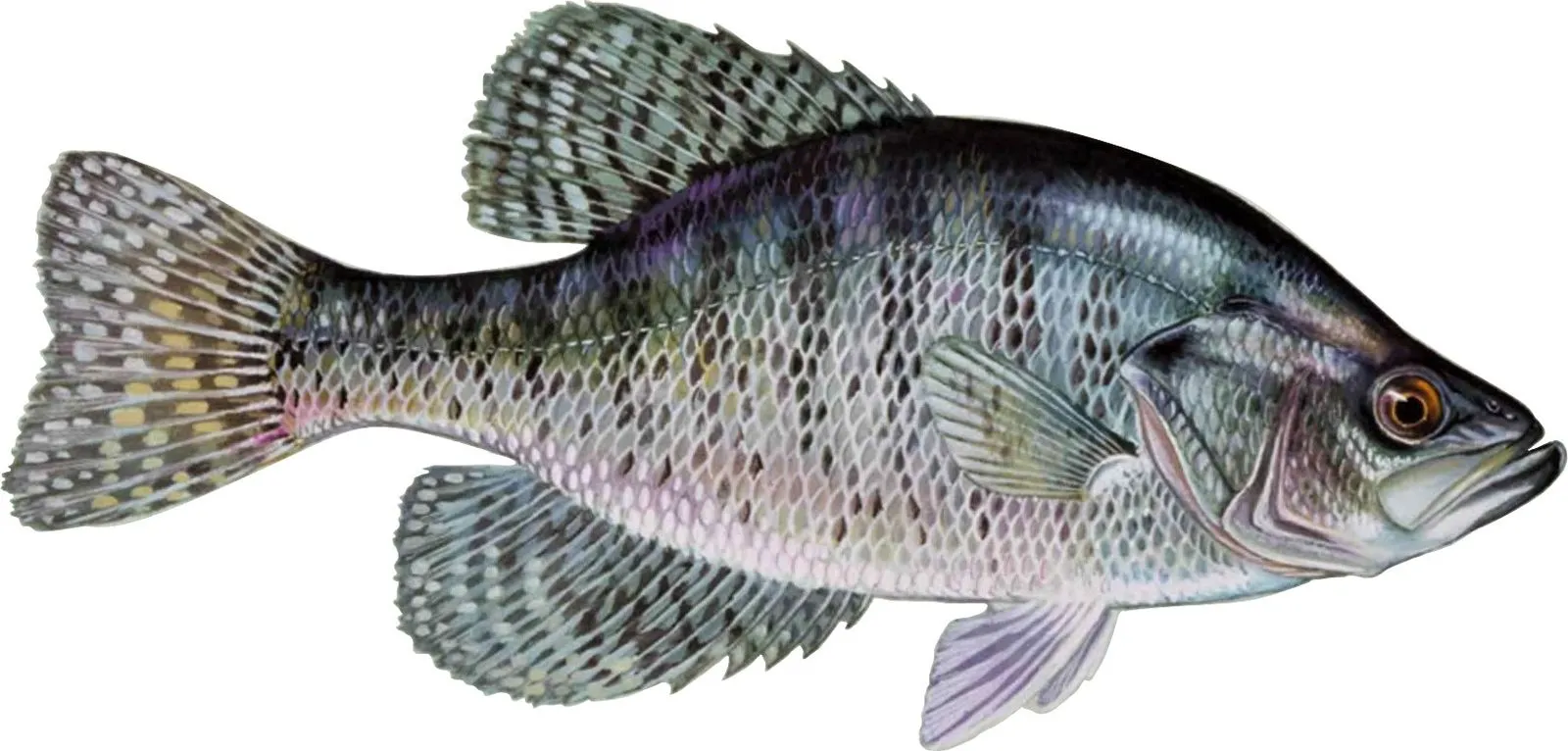 Crappie Spawn Temperature: When They Move Up, How Deep, How Long
Black crappie spawn at 58–68 °F, white crappie at 60–70 °F, once a year, not twice: when they move up, how deep by water clarity, and the fall bite.
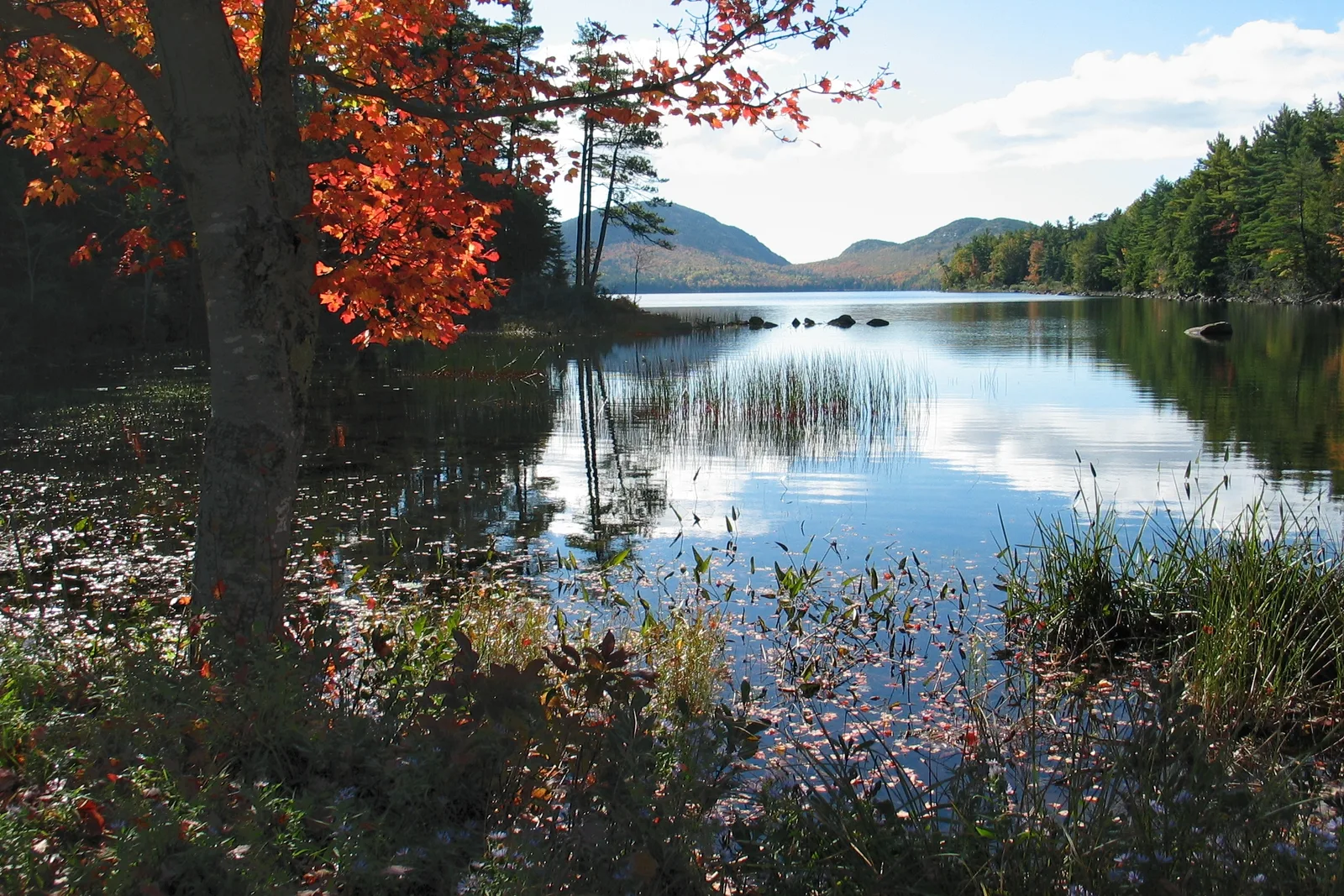 Lake Turnover: How Fall Mixing Works and Where the Fish Go
Lake turnover is the fall mixing that ends the summer thermocline: what sets it off, how long it lasts, seven signs it happened, where the fish go.
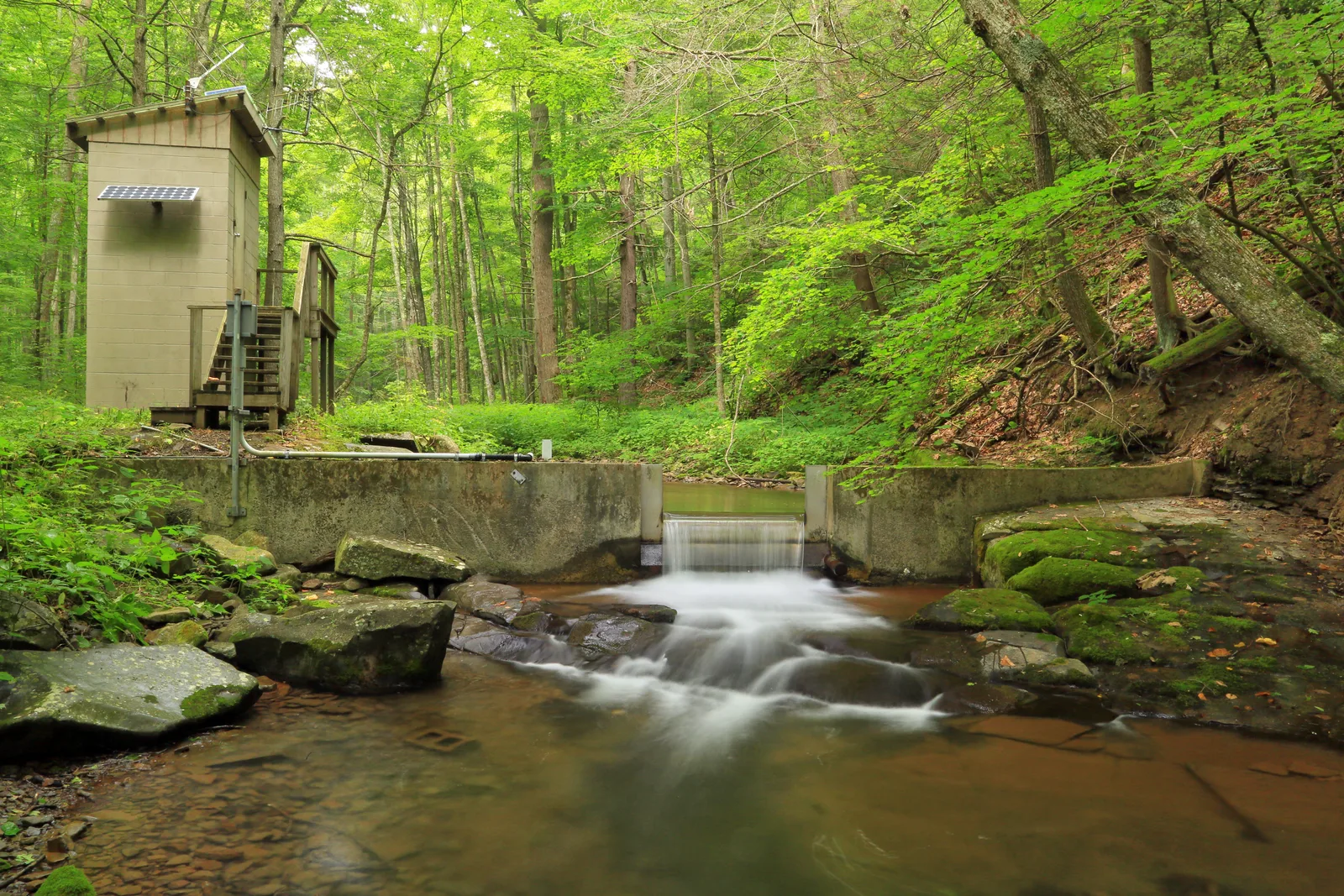 Lake Water Temperature: How to Find It Before You Go
Lake water temperature before you go, four ways: live USGS and NOAA sensors (only 2 of 20 big lakes have one), satellite maps, air temperature, a thermometer.
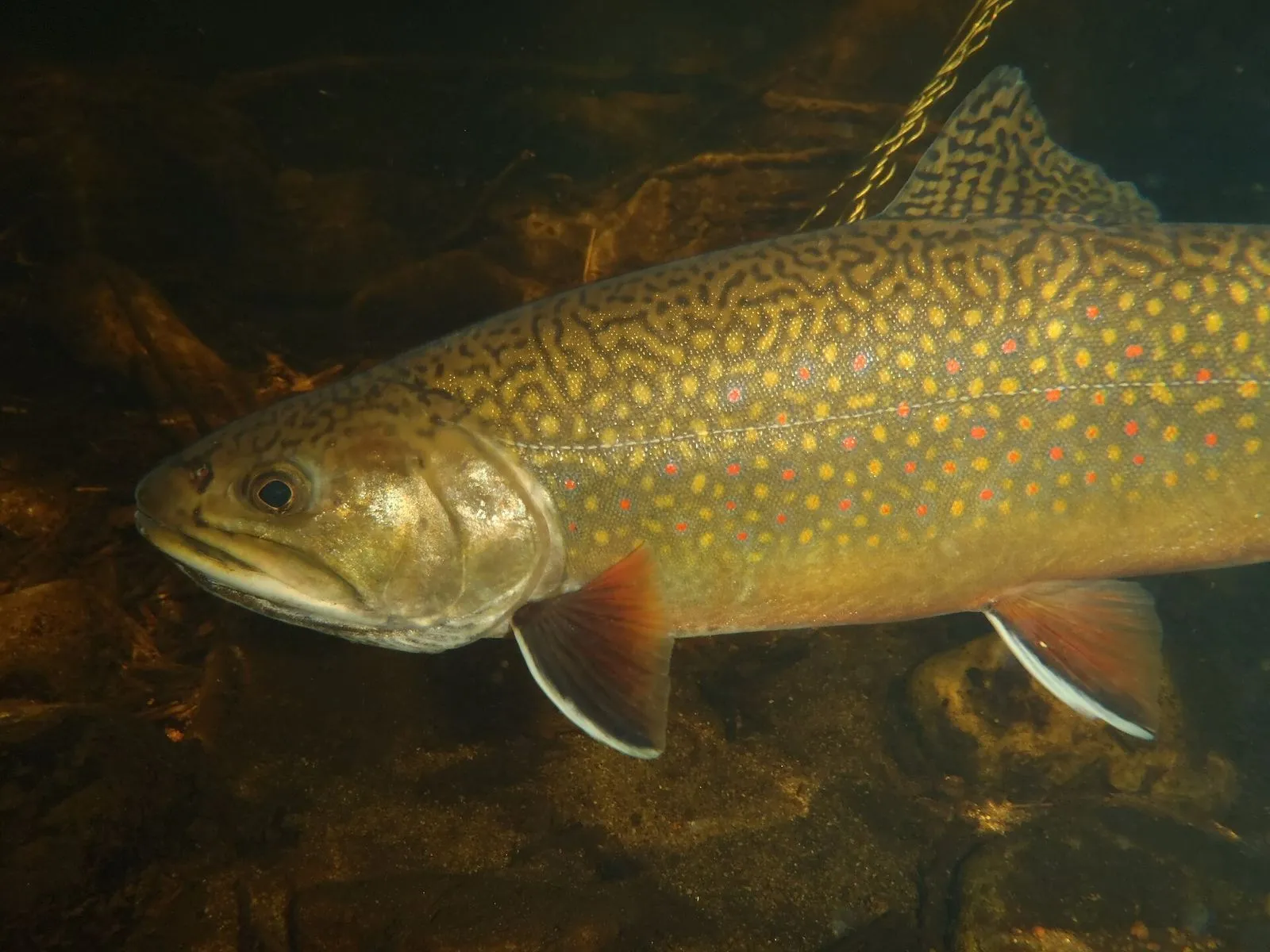 Trout Water Temperature: The 68 °F Line, Limits and Summer Refuges
Trout feed best at 55–65 °F and stress above 68 °F. The water temperature chart for five trout, why anglers stop at 68, and where trout go when rivers warm.
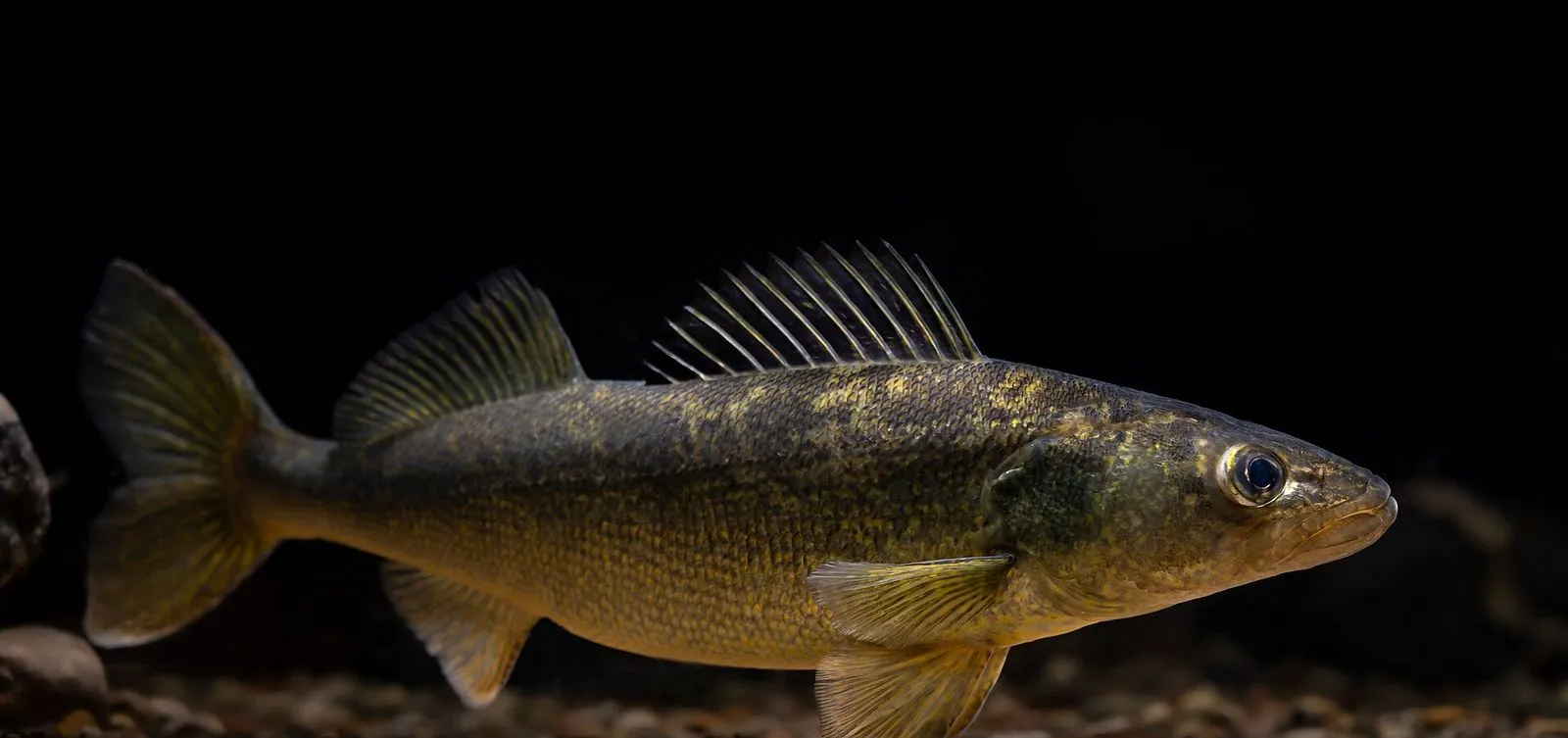 Walleye Spawn Temperature: The 42–50 °F Window and Every Band After
Walleye spawn at 42–50 °F (6–10 °C), right after ice-out. Then the 60–72 °F summer band, the 76 °F ceiling and the fall return, with depth and speed.
Free PDF · 16 pages
Know what's biting before your first cast
The Water Temperature Fishing Chart. Take one water temperature reading, find it on the chart, and you know which of 26 freshwater fish are feeding today, where they are and what to throw. For your phone and the tackle box.
- The 26-fish chart: who's spawning, feeding hard or shut down at your reading
- Where they sit and what to throw at every band: bass, crappie, bluegill, walleye, catfish and trout
- The best hours at your reading, the cold front day by day, and the spawn calendar from ice-out to midsummer
- The three thermometer mistakes that make a reading lie (the first one is the surface)
Every number from state fish and wildlife agencies and fisheries research: 61 sources, all on the site.
Enter your email, confirm it with one click, and the PDF is in your inbox. Plus one email a week on what's biting. Unsubscribe anytime. Privacy.
Sources
- Coutant, C. C. (1977), Compilation of temperature preference data, Journal of the Fisheries Research Board of Canada 34:739–745
- Hokanson, K. E. F. (1977), Temperature requirements of some percids and adaptations to the seasonal temperature cycle, Journal of the Fisheries Research Board of Canada 34:1524–1550
- Wismer, D. A. and Christie, A. E. (1987), Temperature relationships of Great Lakes fishes, Great Lakes Fishery Commission Special Publication 87-3
- Clarke, A. and Johnston, N. M. (1999), Scaling of metabolic rate with body mass and temperature in teleost fish, Journal of Animal Ecology 68:893–905
- Texas Parks and Wildlife, largemouth bass species profile
- Texas Parks and Wildlife, smallmouth bass
- Texas Parks and Wildlife, spotted bass
- Texas Parks and Wildlife, striped bass
- Virginia DWR, Striped Bass (spawning from about 55 °F)
- Oklahoma Department of Wildlife Conservation, Striped & Hybrid Striped Bass Angler Guide: Top Tips & Area Highlights (spawning 55–70 °F, peak about 65 °F)
- Texas Parks and Wildlife, white bass (brochure)
- Texas Parks and Wildlife, flathead catfish
- Texas Parks and Wildlife, black crappie
- Texas Parks and Wildlife, white crappie
- Wisconsin DNR, smallmouth bass
- Wisconsin DNR, walleye
- Wisconsin DNR, northern pike
- Wisconsin DNR, muskellunge
- Wisconsin DNR, bluegill
- Wisconsin DNR, bullheads (fact sheet)
- Wisconsin DNR (2016), Distribution, biology and management of Wisconsin's ictalurids
- Wisconsin DNR, coho salmon (fact sheet)
- Wisconsin DNR, chinook salmon (fact sheet)
- Wisconsin DNR, muskellunge fact sheet, PUBL FM-705 (2012)
- SRAC Publication 180, Channel catfish: life history and biology
- Mississippi State University Extension, biology of catfish
- Virginia Department of Wildlife Resources, blue catfish
- Minnesota DNR, northern pike species profile
- Minnesota DNR, yellow perch species profile
- Minnesota DNR, crappie biology
- Iowa DNR, white crappie (nest depth)
- Missouri Department of Conservation, Crappie: tips for fishing (shallow beds in stained water)
- New Hampshire Fish and Game, white perch
- U.S. Fish and Wildlife Service (2026), white perch ecological risk screening summary
- New York DEC, trolling for Lake Ontario trout and salmon (preferred temperatures)
- New York DEC, steelhead fishing in Lake Ontario tributaries
- EPA Region 10 (2003), Guidance for Pacific Northwest state and tribal temperature water quality standards
- North Coast Regional Water Quality Control Board, Shasta River TMDL, Appendix A: the effects of temperature on steelhead, coho and chinook salmon
- West Virginia DNR, brook trout
- Michigan DNR, lake trout
- Maine Department of Inland Fisheries and Wildlife, splake management plan
- Alaska Department of Fish and Game, burbot species profile
- Wyoming Game and Fish Department, State Wildlife Action Plan: burbot
- Outdoor Alabama, spring fishing tips (the late-day warm layer)
- The Tackle Room, striped bass fishing guide (the 55–68 °F feeding band)
- FishBase, Cyprinus carpio (common carp)
- Magnuson, J. J., Crowder, L. B. and Medvick, P. A. (1979), Temperature as an ecological resource, American Zoologist 19:331–343
- Texas A&M AgriLife Extension, Water quality in sportfish ponds (oxygen solubility by temperature, the thermocline, the daily oxygen cycle)
- U.S. Geological Survey, Water Science School: dissolved oxygen and water
- Kevin VanDam, The truth about water temperature (April 13, 2020)
- Wired2Fish, Adapting to changes in prespawn water temperature (Walker Smith, 2013: Davy Hite on 60 °F fish at 55 °F, and the trend over the reading)
- Ptak, M., Sojka, M. and Nowak, B. (2019), Characteristics of daily water temperature fluctuations in Lake Kierskie (West Poland), Quaestiones Geographicae 38(3)
- Bassmaster, Coping with the fall turnover (Michael Iaconelli, 2024)
- Virginia Department of Wildlife Resources, Five factors for fantastic fall fishing (Bednarski, 2021)
- Booth, I. T. et al. (2023), Evaluating Muskellunge catch-and-release mortality at elevated summer water temperature, Transactions of the American Fisheries Society 152:577–593 (USGS)
- Maryland DNR, Muskie biology (refrain from targeting muskie at 80 °F)
- Montana Outdoors (FWP), Giving a hoot (E. Donnall Thomas Jr., July–August 2024: hoot-owl closures at 73 °F for three days)
- Texas Parks and Wildlife, Gulf striped bass (striped bass prefer water below 75 °F)
- New York State DEC, Species status assessment: burbot (2023): spawning temperature, range, maturity
- Missouri Department of Conservation, Pond turnover (summer bottom water 54–59 °F)
- Maryland DNR, Eyes on the Bay, How-to step 4: temperature (surface swings of 3 to 4 °F)