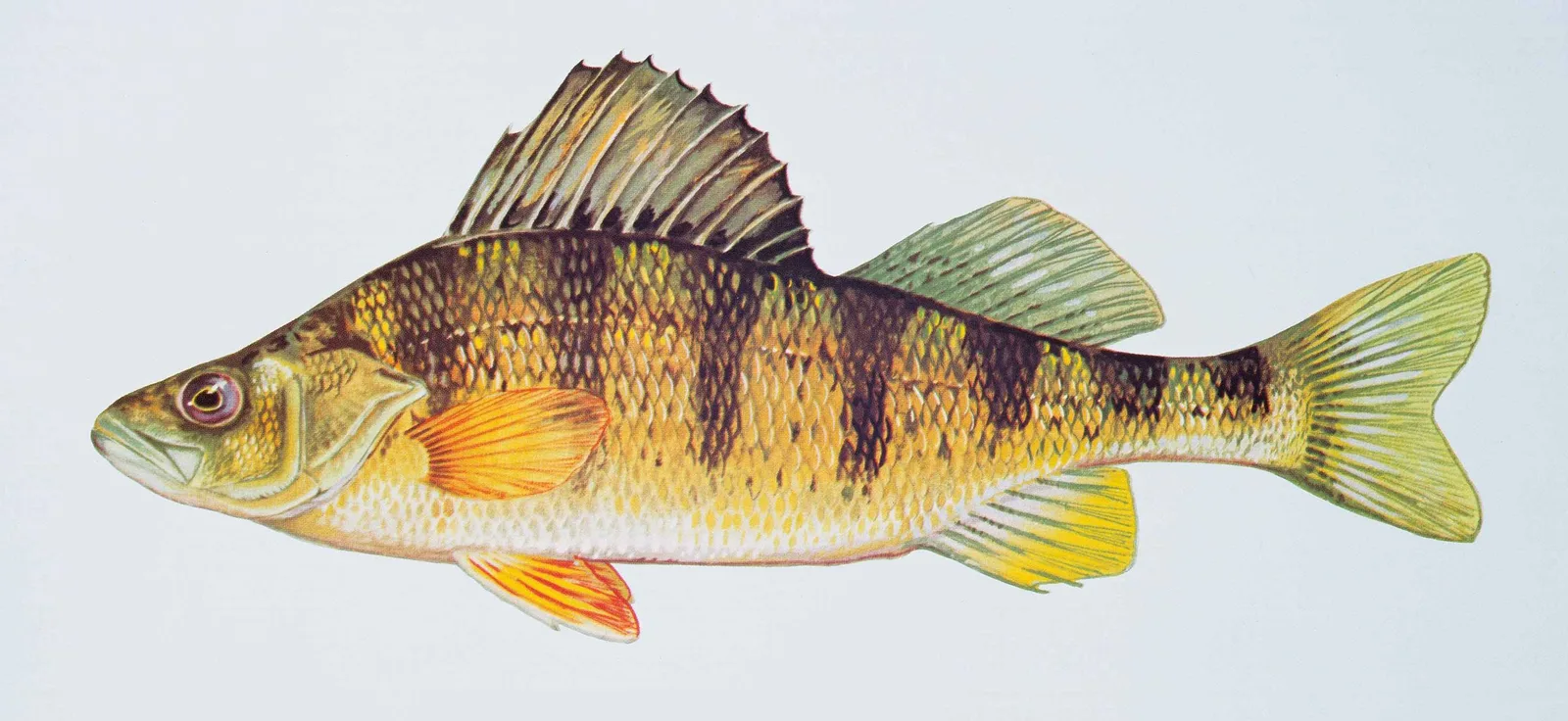
The yellow perch is Perca flavescens: Perca is Latin for “dusky” and flavescens means “becoming gold-colored,” which describes the fish exactly. It is a true perch, the small cousin of the walleye and sauger, 6–10 in (15–25 cm) long in most lakes, and the fish behind the Friday fish fries around the Great Lakes. Are perch bottom feeders? Wisconsin’s biologists call them “primarily bottom feeders with a slow deliberate bite”; Michigan’s say they take insects, crayfish and small fish “both from open water and from the bottom,” and at night rest on the bottom without feeding at all. Both are right: a perch hunts by sight in daylight, near the bottom because that is where the food lives, and it is no scavenger. After this page you will be able to tell a perch from a walleye by its teeth, guess the age of a 10 in perch, read its spring, and know why the biggest one you catch is almost certainly a female.
The world-record yellow perch, 4 lb 3 oz, was caught at Bordentown, New Jersey, on May 1, 1865. No freshwater fishing record in North America has stood longer.
Identification: no canines, six to eight bars
Depending on the lake you learn it on, the yellow perch is also the lake perch, ringed perch, striped perch, coon perch, jack perch or American perch. The white perch that shares the name is not a perch at all but a small relative of the striped bass; both are on the panfish hub.
Three marks settle a yellow perch. It is gold to brassy green with six to eight dark vertical bars that stop above a white belly. It carries two clearly separate dorsal fins, the front one all spines. And it has no canine teeth: its jaws and palate are lined with bands of brush-like teeth, about 800 of them, where a walleye from the same water has fangs. Run a thumb along the lower jaw and the question is answered.
| Mark | Yellow perch | White perch | Walleye |
|---|---|---|---|
| Color | Gold to brassy green, 6–8 dark vertical bars | Silvery green-gray, high domed back, no bars or stripes | No vertical bars |
| Dorsal fins | Two separate fins; front fin 12–14 spines, dusky at each end | Two fins joined by a deep notch | Two separate fins |
| Teeth | No canines; bands of fine brush teeth | Small mouth, no canines | Canine teeth |
| Anal fin | 2 spines, 6–8 rays | 3 spines, 9–10 rays | — |
| Scales | Rough stroked tail to head; 57–62 along the lateral line | Large, easily seen | — |
The lower fins run yellow to orange and turn red on spawning males, and a slight dip in the head above the eyes gives a big perch its hump-backed look.
Where yellow perch live
Yellow perch are native to the Atlantic, Arctic, Great Lakes and Mississippi drainages, from Nova Scotia west to Great Slave Lake and south to Ohio, Illinois and Nebraska. They went west early, California in 1873 and the Rocky Mountain states from 1880, and there the U.S. Geological Survey lists them as an invader that competes with trout for food and likely eats young trout.
The perch’s own lake is clear, cool and fertile, with moderate weed growth; it also lives in slow rivers and in the Great Lakes, where in Lake Erie’s deep eastern basin it stays mostly within 100 ft (30 m) of the surface. Michigan’s profile says perch are rarely taken from water deeper than 30 ft (9 m), while Wisconsin’s winter anglers fish them in 40–60 ft (12–18 m): both are true, in different lakes and seasons. Their preferred temperature is 66–70 °F (19–21 °C), and Michigan’s biologists note that perch follow the 68 °F water through their seasonal movements, which is the line to watch on the water temperature chart. One more thing shapes perch lakes: they tolerate low oxygen well enough to survive a winterkill that wipes out the bluegill, bass and walleye, after which, in Wisconsin’s words, “a lake will often provide an excellent yellow perch fishery for several years.”
What yellow perch eat
The menu is whatever is small and moving near the bottom: midge larvae, mayflies, crayfish, zooplankton, the eggs and fry of other fish, and minnows. Iowa’s biologists describe perch feeding through the day in deep water and moving into the shallows in the evening to hit schools of minnows; Michigan’s have them moving shoreward morning and evening and switching off on the bottom after dark. About a fifth of an adult’s diet is fish, and on Idaho’s Lake Cascade, In-Fisherman reports, perch turn cannibal at 8–9 in.
That is the whole bottom-feeder question. Perch feed near the bottom because the insects and crayfish are there, and a bait lying on the bottom catches them. But they feed by eye, in daylight, and the biggest perch in a lake often do not sit on the bottom at all. Ross Robertson, writing in In-Fisherman in 2024, says forward-facing sonar has taught Lake Erie anglers that “the bigger yellow perch often suspend” while the small ones crowd the bottom. A bait a foot or two up is a jumbo bait; a bait on the mud is an eater bait.
Where perch have too little to eat, they stunt: Michigan warns that crowded populations “may never exceed a length of six inches,” and a lake full of 5 in perch rarely fixes itself without walleye stocking or a drawdown.
How big, and how old: yellow perch size by age
A yellow perch grows about 2 in a year for its first three years and then slows hard. The table puts four agency surveys side by side. Iowa and Pennsylvania are inland lakes; Lake St. Clair is the most likely age for a perch of that length from Michigan’s 2018–2022 netting; Lake Erie is Jobes’s 1927–1937 study, when the lake grew perch fast.
| Age | Iowa natural lakes | Pennsylvania inland | Lake St. Clair | Lake Erie (1927–37) |
|---|---|---|---|---|
| 1 | 2.7 in (7 cm) | 4–5 in (10–13 cm) | 2–3 in (5–8 cm) | — |
| 2 | 5.6 in (14 cm) | 5.5–6 in (14–15 cm) | 3–5 in (8–13 cm) | — |
| 3 | 7.7 in (20 cm) | 7 in (18 cm) | 5–6 in (13–15 cm) | 8.5 in (22 cm), 4.2 oz |
| 4 | 8.9 in (23 cm) | 8 in (20 cm) | 6–8 in (15–20 cm) | — |
| 5 | 9.8 in (25 cm) | 9 in (23 cm) | 8–9 in (20–23 cm) | 10.7 in (27 cm) females, 10.1 in (26 cm) males |
| 6 | 10.5 in (27 cm) | 10 in (25 cm) | 9–10 in (23–25 cm) | 9.8 oz (280 g) average |
| 7 | 10.6 in (27 cm) | 10.5 in (27 cm) | 10–11 in (25–28 cm) | — |
Pennsylvania’s curve keeps going: a 12 in (30 cm) perch is about ten years old and weighs 0.8 lb (0.4 kg), a 13 in fish is nearer fourteen, and a 14 in (36 cm) fish at 1.3 lb (0.6 kg) is older than the curve can say. Set that against Pennsylvania’s annual mortality of 61% and the arithmetic of a jumbo is plain: of every hundred perch alive at age one, about one is still swimming at age six.
Females grow faster and larger than males, and the gap widens with age. In Lake St. Clair, 87.8% of perch over 8 in were female; in Jobes’s Lake Erie sample the longest male was 11.3 in (29 cm) against 12.9 in (33 cm) for the longest female, and the heaviest fish of all, 19¾ oz (560 g), was a female full of eggs. A jumbo perch is a female, nearly every time, carrying next spring’s egg ribbon.
There is no official definition of a jumbo. Anglers use 12 in (30 cm) and up; Ohio’s Fish Ohio award starts at 13 in (33 cm), and a 13 in perch over a pound is a trophy anywhere. Most yellow perch live seven to ten years.
Spawning: an egg ribbon at 44–52 °F
Yellow perch spawn shortly after ice-out, in April or early May across the North, at 44–52 °F (7–11 °C), right after the walleye and alongside the suckers. There is no nest and no guarding. The female moves into 2–25 ft (0.5–8 m) of water and drapes a single gelatinous, accordion-folded ribbon of eggs over weeds, brush, roots or a fallen tree; in the Great Lakes it usually lands on sand. The ribbon swells to 7–8 ft (2.1–2.4 m) long and 2–3 in (5–8 cm) wide and holds about 23,000 eggs on average, with Wisconsin recording 210,000 in one fish. Fifteen to twenty-five males follow each female and fertilize the ribbon as it is laid. The eggs hatch in 8–10 days in warm water and up to three weeks in cold. Males mature at three, females at four.
Pennsylvania’s management plan makes the angling point: perch concentrate close to shore to spawn and “can be quite vulnerable to anglers fishing from shore.” A break wall or weedy bay at 48 °F in April is the easiest perch fishing of the year, and the big fish in it are the females.
Season by season, and how to catch them
The pattern is Ohio’s for Lake Erie, and it transfers to any big perch lake.
- Spring (March–May): perch move in to spawn, on the bottom in shallow water near break walls, docks and rocky points; on Erie that is the western islands and the shoreline from Huron to Ashtabula. Field & Stream’s Jeff Dean fishes the move shallow “when water temperatures approach 50 degrees,” on a slope next to deep water.
- Summer: deeper, and on the bottom, off the islands and the Toledo water intake or offshore from Huron to Conneaut. Inland, Pennsylvania’s creel data put the best river perch fishing in summer.
- Fall (September–November): “some of the best yellow perch fishing on Lake Erie,” in Ohio’s words, around West Sister Island, the Toledo shipping channel and the islands, with the big fish on the deep mud basins a few feet off the bottom.
- Winter: harbor fish take light jigs tipped with minnows or wax worms near the bottom around Catawba and Sandusky Bay. Through the ice, Minnesota’s DNR fishes the last green weeds at first ice, drop-offs as winter deepens, and shallow water again before ice-out; Wisconsin’s anglers go deep, 40–60 ft, with teardrop jigs and wax worms. On Idaho’s Lake Cascade the largest perch come in February and March, just before the ice goes.
The standard Lake Erie rig is Ohio’s own description: a spreader with multiple hooks and a 3/4–1 oz sinker holding shiners just off the bottom. The bite is a soft tap, so the rod stays in the hand. When a school of big perch is found, the guide’s advice is to switch to a small twister-tail or hair jig, which “can produce great catches of jumbo perch while skipping the undersized fish.” The best bait, in every agency’s list, is a live minnow, with worms, wax worms and small jigs behind it; Minnesota adds one rule for the ice that applies everywhere: “you can over-jig.” A full page on perch fishing by season and water is in preparation.
The 1865 record, and the records since
The all-tackle world record is a 4 lb 3 oz (1.9 kg) yellow perch caught by Dr. Charles Conrad Abbott at Bordentown, New Jersey, on May 1, 1865; Iowa’s DNR places it in Crosswicks Creek, which meets the Delaware there. Abbott was a New Jersey naturalist, not a tournament angler, and his fish predates the IGFA itself by 74 years. Nothing has beaten it in more than 160 years, and the state records show why: the best modern perch top out around 3 lb. Wisconsin’s is 3 lb 4 oz (1.5 kg) from Lake Winnebago in 1954; Idaho’s 3.22 lb (1.5 kg) from Lake Cascade, through the ice in March 2021; Ohio’s 2.86 lb (1.3 kg) from the Grand River in April 2016, “so close to spawning it was spilling eggs”; Pennsylvania’s 2 lb 14 oz (1.3 kg) from Presque Isle Bay in March 2016. Every modern record fell between February and April, to a female heavy with eggs. Idaho’s Lake Cascade is the one water that produces them on purpose: Fish and Game removed “literally tons” of northern pikeminnow and transplanted about 850,000 adult perch, and the lake has set the state record twice in five years and shares the IGFA length record, 39 cm (15.4 in), from May 2024.
Lake Erie’s quota, and Ohio’s three zones
Lake Erie is the biggest perch fishery on the continent, and its quota is shrinking in public. Five jurisdictions set a lakewide total allowable catch each March: 6.554 million lb in 2024, 5.866 million lb in 2025 (a 10% cut, 20% in the west and east-central units), and a further cut for 2026 after the task group reported the east-central unit “at its lowest level in the time series” and dropped its population models as unreliable in favor of a traffic-light rule. The 2025 harvest was 3.158 million lb, 70% of it by Ontario’s commercial gill-net fleet and 26% by Ohio; in the east-central unit, Ohio and Pennsylvania anglers’ catch rate fell to 0.0 fish per hour. Ohio answers with zone limits, in force from May 1, 2026 to April 30, 2027: 30 perch a day in the west zone (Toledo to Huron), 10 in the central zone (Huron to Fairport Harbor) and 20 in the east zone (Fairport Harbor to Conneaut), with a hard cap of 30 from the whole lake in one calendar day. Pennsylvania’s Erie limit is 30. Limits change every spring, so check the state’s current regulations before the first trip.
Are yellow perch good to eat?
Yes, and the lower Great Lakes built a tradition on it: small, white, flaky fillets that fry in minutes. Wisconsin’s Lake Michigan and Green Bay commercial harvest has averaged over 2 million lb a year since the late 1800s, and in 2016 a Wheatley, Ontario, processor was selling perch at CA$15 a pound as the quota tightened. Perch carry under 1% body fat, so the PCB worry that hangs over fat predators is smaller, but they do accumulate mercury. The one advisory to know is the Hudson River’s: from Catskill down to the Battery, yellow perch is four meals a month for most people and one for women under 50 and children; from Troy to Catskill it is one a month, and none for that sensitive group. Anywhere else, a limit of perch is the cleanest fish dinner a lake offers.
Related
The panfish hub covers every fish that ends up in the same bucket, and the white perch page settles the perch that is really a bass. For the temperatures that move them, the water temperature chart sets the perch beside the walleye and the crappie.
Sources
- Wisconsin DNR, Fishes of Wisconsin: yellow perch (name, spawning, feeding)
- Wisconsin DNR, Yellow Perch (PUB-FM-711): identification, growth, spawning, ice tactics, records
- Michigan DNR, yellow perch species profile
- Michigan DNR, Lake St. Clair Yellow Perch Fact Sheet 2018–2022 (age, length, sex ratio)
- Iowa DNR, Fish Iowa: yellow perch (length at age, spawning, feeding, state record)
- Pennsylvania Fish & Boat Commission, Yellow Perch Management and Fishing in Pennsylvania (2018)
- Jobes (1952), Age, growth and production of yellow perch in Lake Erie, Fishery Bulletin 52
- IGFA world records, yellow perch
- USGS Nonindigenous Aquatic Species, yellow perch (native range, western introductions)
- Lake Erie Yellow Perch Task Group, report to the Lake Erie Committee, March 2026
- Ohio DNR Division of Wildlife, Yellow Perch Fishing Zone Boundaries on Lake Erie (May 2026–April 2027 limits)
- Ohio DNR, Lake Erie Fishing Guide (seasonal perch tactics, spreader rig, Fish Ohio length)
- Idaho Fish and Game, Lake Cascade produces another state record perch (2021)
- New York State Department of Health, Hudson River fish advisories
- Minnesota DNR, ice fishing for perch
- Yellow perch (teeth count, spawning envelope, commercial value)