Lake turnover is the fall mixing of a lake: the warm surface water cools until it is as dense as the cold water underneath, sinks, and wind stirs the whole lake until it reads the same temperature from top to bottom. It happens on lakes deeper than about 20 ft (6 m), it takes a week or two on most of them, and for those days it scatters the fish and slows the bite. Once you can read the signs, you will know which lake to drive to, which end of it to fish, and where the bass, walleye, crappie, trout and catfish have gone.
Water is heaviest at 39.2 °F (4 °C), not at freezing. That single quirk is why a lake turns over in fall, why ice floats, and why a lake freezes from the top down instead of into a solid block.
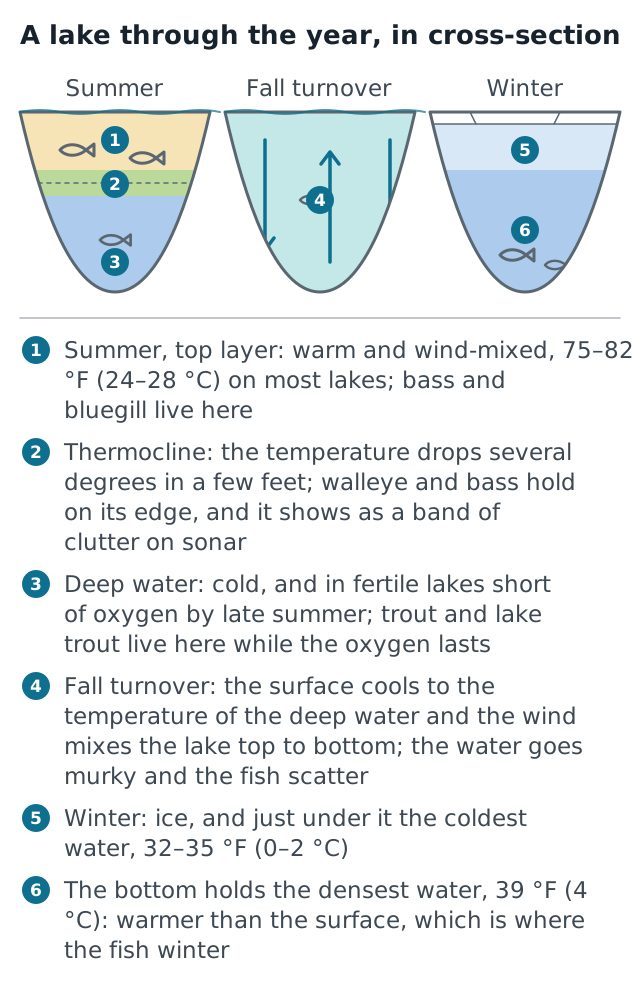
The summer lake: three layers and a lid
From late spring the sun warms the top of a lake faster than wind can mix the heat down, and by early summer any lake deeper than roughly 20 ft (6 m) has split into three layers. The Missouri Department of Conservation names them: the epilimnion on top, warm and light, stirred by wind and fed oxygen by the air and by plants; the thermocline under it, a band where the temperature falls fast with depth; and the hypolimnion at the bottom, the coldest, densest water in the lake, sealed off from the air by the two layers above.
The thermocline is thin: most of the drop happens within about 3 ft (1 m). It sits about 6–8 ft (2–2.5 m) down in a dingy lake and 30 ft (9 m) or more in a clear one; a Michigan DNR survey of Lost Lake in the Upper Peninsula found it at 20–21 ft (6–6.4 m) in two surveys a quarter century apart. The 25-species chart and the thermometer tool on the water temperature hub give the band each fish wants; in July, the thermocline is where you find it.
Why the deep water runs out of oxygen
No light reaches the hypolimnion, so no plant makes oxygen there, and the lid above keeps the air out. Everything that dies in the lake sinks into it and rots, and the bacteria doing the rotting burn oxygen. Missouri’s biologists put it bluntly: by mid-July the bottom layer of a fertile pond may be completely without oxygen, and there is little point fishing the bottom in summer.
Michigan DNR’s lake reports put the limit for cool- and warmwater fish below 3.0 mg/L of oxygen and the lethal line below 0.5 mg/L; in Lost Lake the 2021 profile fell under 3.0 mg/L at about 18 ft (5.5 m), right at the thermocline. So in August the usable lake is the top layer plus the first few feet of the thermocline; Minnesota DNR research scientist Andy Carlson describes the fish as crowded into the surface waters. Clear, infertile lakes are the exception: light reaches deep enough for plants to make oxygen below the thermocline, which is how a clear trout lake keeps breathable water well below it all summer.
Fishing the thermocline before it breaks
In July and August the thermocline edge is the best structure in the lake: the coolest water that still has oxygen, and the food knows it. Largemouth hold in a 3–4 ft (1 m) zone just above it. Crappie school 2–3 ft (0.6–0.9 m) above the low-oxygen floor, often in 22–24 ft (6.7–7.3 m). Walleye feed in their 60–72 °F (16–22 °C) band where it touches humps, points and deep weedlines; trout and salmon live in or under it wherever the oxygen holds. Find the band on the sonar, where the density change draws a line of clutter at one depth (the fish finder guide shows it), and fish the structure that cuts through that depth with a jig or drop-shot counted down to it. The bands and lures per species are on the bass, crappie, walleye and trout pages.
What sets turnover off, and at what temperature
In September the surface loses more heat at night than it gains by day. Cooled water is denser, so it sinks and warmer water rises; the upper layer cools and deepens, eating the thermocline from above, with the fall wind stirring it along. When the surface matches the bottom temperature nothing holds the layers apart, and Missouri’s biologists say the final mix can happen literally overnight. Wind gets more credit than it earns: on a small Canadian Shield lake monitored for ten years, wind shear mixed only the top 35% of the surface layer and sinking cold water did the rest.
There is no single turnover temperature, and that is the fact to remember. A lake turns when its surface reaches the temperature of its bottom water, and the bottom water is whatever the lake went into summer with. In a deep northern lake the hypolimnion sits near 39–45 °F (4–7 °C), so the surface has to drop into the 40s; Gord Pyzer puts complete turnover at about 40 °F (4 °C) on Ontario lakes. In a Missouri pond or a Virginia reservoir the deep water warmed into the 50s and 60s, so turnover arrives “as temperatures drop toward 50 °F” in Missouri’s words and “as waters fall into the low 60s and upper 50s” in the Virginia Department of Wildlife Resources’ account. The floor is 39.2 °F (4 °C), where the USGS puts fresh water’s maximum density; colder water is lighter again, which is why winter’s coldest water floats on top.
Warm spells stall it. Lake Mendota in Madison, Wisconsin usually turns in late October, but in September 2017 the UW Center for Limnology measured a lake that had begun mixing and then re-warmed under a heat wave: 71 °F (22 °C) on top, 64 °F (18 °C) in the middle, 57 °F (14 °C) at the bottom, three layers instead of two.
How long it lasts
Missouri’s rule of thumb: a small pond circulates for a few days, a lake for several weeks or longer. Virginia’s fisheries chief says turnover resolves in about a week or two, and Michael Iaconelli says the same from the tournament boat. The measured fall mix on the Canadian Shield lake took about 13 days, from the day the column came within 0.4 °C of uniform to the start of winter layering. Minnesota’s Carlson gives the honest range: days to months, depending on shape, depth and weather.
Two things follow. A deeper lake has colder bottom water, so its surface has to cool further, and it turns later than the shallow lake next door. And a big reservoir turns in sections, the shallow upper end first and the deep water by the dam last, which is why Iaconelli runs to whichever end has not turned. Lakes shallower than about 20 ft (6 m), rivers and ponds in open, windy country never build a thermocline to begin with; they have no turnover to wait out.
How to tell your lake has turned
- Take two temperatures. Surface, then bottom, with a thermometer on a line or a fish finder that reads temperature at depth. Minnesota DNR’s test: within a few degrees, the lake has turned; 10 °F (5 °C) or more apart, it has not.
- The water went murky. The Ausable River Association calls a murky, tea-colored or gray-green lake the telltale sign: bottom sediment and nutrients hang in the whole column for days.
- It smells. Rotting matter on the bottom produced sulfur gases all summer, and turnover brings them up. Fisheries biologist Gene Gilliland describes the peculiar stink of a turning lake; Kentucky’s extension names the gas, hydrogen sulfide, the rotten-egg smell.
- Lines of debris on the surface. Decayed weed and leaf fragments float up and the wind rafts them into streaks that look like grass clippings. Iaconelli first spotted a turnover from the launch ramp by the debris alone.
- The thermocline band on the sonar is gone. The clutter line that sat at one depth all summer disappears, because there is no longer a density change to reflect sound.
- The fish moved. Summer spots are empty, arches show at odd depths, catches crash. At one youth tournament Iaconelli watched, one team in 30 to 40 boats weighed a limit.
- In a small pond, fish at the surface at sunrise. Mississippi State Extension lists gasping fish at dawn as the first sign of an oxygen crash; in a big lake it almost never happens.
Three phases, one table
| Phase | What the water does | What the fish do | Where to fish |
|---|---|---|---|
| Stratified summer (July to September) | Warm top layer, thermocline at 6–30 ft (2–9 m), bottom layer cold and nearly without oxygen | Crowded into the top layer and the first feet above the thermocline; cold-water fish in the coolest water that still has oxygen | The thermocline edge: humps, points and weedlines that cut through it; shallow at dawn and dusk |
| Turnover (a week or two, September to November) | Surface cools to the bottom’s temperature, the column mixes, water goes murky and smells, one temperature top to bottom | Scatter, with no layer to hold them; stressed in fertile water | Water under 6 ft (2 m), creek arms with inflow, windy banks, a single dock or laydown that runs shallow to deep; the end of the lake that has not turned |
| Mixed fall (after turnover to ice) | Same temperature and oxygen at every depth, cooling week by week through the 50s and 40s (10–4 °C), clearing | The whole lake is open; walleye, pike and crappie go deeper; bass follow bait into creeks; trout and salmon roam the shallows | Deep structure for walleye and crappie, creek mouths and coves for bass, shoreline rock and inlets for trout at first light |
Where each fish goes
Bass. In summer, Gilliland writes, bass seldom cross the thermocline into the oxygen-poor depths. During turnover they scatter, and Iaconelli’s answer is water 5 ft (1.5 m) or shallower, where there was never a layer to mix: feeder creeks and causeways with current, wind-hit banks, and isolated “ladder” cover such as one dock or fallen tree running from 2 ft at the bank to 20 ft at the end. Afterward bass follow the bait into adjacent coves and creeks. The bass temperature bands take it from there.
Walleye. Before turnover, walleye hold on the thermocline edge in their 60–72 °F (16–22 °C) band. After it, Minnesota DNR’s depth-sensor tagging studies show walleye, northern pike, muskellunge and cisco all using deeper water than they could in summer. As the mixed lake cools through the 50s the bite comes back on deep structure after dark; the walleye page has the fall bands and speeds.
Crappie. In September the schools hang 2–3 ft (0.6–0.9 m) above the low-oxygen band on the basin floor. Once the lake mixes, crappie pro Dan Dannenmueller tells In-Fisherman, they seek the depth closest to 68 °F (20 °C), which late in fall is the deepest, slowest-cooling water in the basin, 28 ft (8.5 m) or more, where barotrauma becomes a risk for released fish. Fish the deep weed edge beside the basin first, then the basin; the crappie page has the depths by water clarity.
Trout and salmon. Lake trout, rainbows, browns and salmon spend the open-water season confined to the cold layers, and turnover opens the shallows to them just as the fall spawners head for shallow rock and tributaries. Shoreline rock and inlet mouths at dawn now fish as well as any downrigger did in July; the trout page carries the temperature lines.
Catfish. Channel catfish feed hardest at 75–85 °F (24–29 °C) and keep eating down to about 50 °F (10 °C), where SRAC’s life-history work says feeding largely stops. Turnover reopens the deep holes and channels that had no oxygen in August; through the 60s and 50s cats work flats and creek channels near the bait, then settle into the deepest holes near 50 °F. The catfish page separates channel, blue and flathead.
Bluegill. The deep weed edge and dock shade pattern breaks with the thermocline; after turnover bluegill group on the deepest weedline and the basins beside it, where they will winter. The bluegill page has the bands.
Spring turnover, and the winter in between
Once the surface drops below 39.2 °F (4 °C) it is lighter than the water beneath, so the coldest water floats on top, ice forms at the surface, and the bottom holds about 39 °F all winter; Pyzer notes that fish gather in that stable bottom layer. Missouri adds the winter risk: decay uses up the bottom oxygen as in summer, and heavy snow on the ice that blocks the light can winterkill a pond. Spring turnover runs the film backward: the ice melts, sun and breeze warm the top layer to 39 °F, the lake mixes, and for a few weeks fish can be at any depth. It ends when the surface warms past the bottom and the summer layers form again.
When turnover kills fish, and when it does not
The fish kills that make the news are pond kills, and most happen in summer, not fall. A cold rain or a thunderstorm’s wind mixes a fertile pond whose bottom water has been without oxygen for weeks; Mississippi State Extension warns that a severe mixing event can kill nearly every fish larger than an inch or two in one night, and Kentucky’s extension adds that the bottom water can carry hydrogen sulfide, which is toxic on its own.
The fall turnover of a real lake is different. Gilliland’s summary stands: most of the time turnover does not kill fish, but it does stress them. The bite falls off for a week or two, the fish scatter, and then the lake is more open than it has been since June. A September cold front gets blamed for the same slow days because it does two things at once: it starts the cooling that leads to turnover, and it drops the bite for a day or two on its own.
The words that come with all this, thermocline, turnover, structure and the walleye chop, are defined under water, structure and weather in the fishing terms.
Sources
- Missouri Department of Conservation, Pond turnover (summer stratification, fall turnover, winter stratification, spring turnover)
- USGS Water Science School, Water density
- Michigan DNR, Status of the Fishery Resource Report 2022-332, Lost Lake (Bauman, 2022): dissolved oxygen limits and thermocline depth
- Minnesota DNR fisheries research scientist Andy Carlson, Ask the DNR: fall turnover, Grand Forks Herald (2014)
- Virginia Department of Wildlife Resources, Five factors for fantastic fall fishing (Bednarski, 2021)
- University of Nebraska–Lincoln Extension, Fall turnover: a physical look at lakes (Pekarek, 2021)
- Ausable River Association, What happens to lakes in the fall?
- UW–Madison Center for Limnology, Lake is a rainbow: weird, warm fall makes three-layer lake cake (Loken, 2017)
- Ghane, A. (2022), Phosphorus and oxygen dynamics between fall and spring turnover events in a small Canadian Shield lake, PhD thesis, Queen's University
- Mississippi State University Extension, Fish kills (pond turnover after cold rain or wind)
- University of Kentucky Extension, Pond turnover could be why the fish in your pond are dying (Wynne, 2020)
- Bassmaster, Changing seasons: stratification and the turnover (Gene Gilliland, 2020)
- Bassmaster, Coping with the fall turnover (Michael Iaconelli, 2024)
- BassResource, The thermocline (2000): thermocline depth by clarity and the bass zone above it
- In-Fisherman, When crappies slide deep (Gord Pyzer, 2022)
- Outdoor Canada, What you need to know about fall turnover when fishing (Gord Pyzer, 2013)
- SRAC Publication 180, Channel catfish: life history and biology