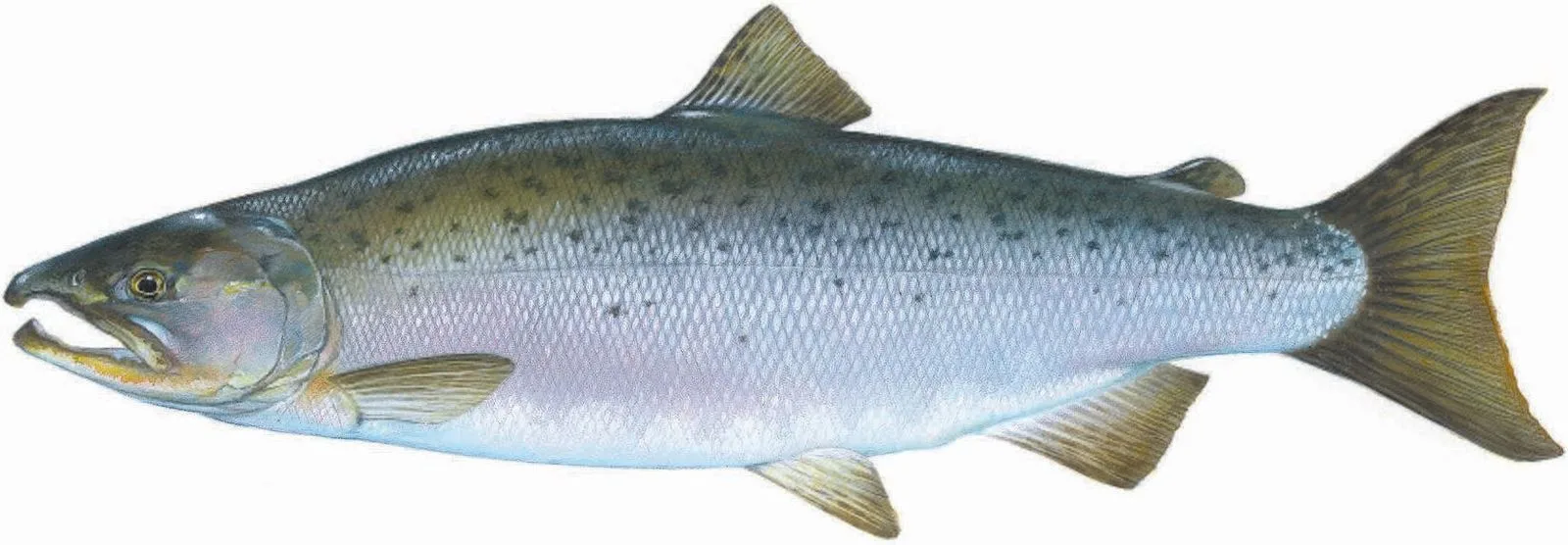
The coho salmon, also known as the silver salmon in Alaska and the Pacific Northwest, is a 24 to 30 in (61–76 cm) fish of 8 to 12 lb (3.6–5.4 kg). It spends half its three-year life in a small stream and the other half at sea. It is also the fish that started the Great Lakes salmon fishery in 1966. A white gum line tells it from a king at a glance.
The world-record coho did not come from the Pacific. Jerry Lifton’s 33 lb 4 oz fish was caught in the Salmon River at Pulaski, New York, in 1989, and New York’s own state record, from Lake Ontario, is three ounces heavier.
Coho or chinook: check the gum line
Two marks settle it. A coho has a white gum line at the base of its lower teeth, and spots usually only on the upper half of its tail. A chinook has a black gum line and spots on both halves. Oregon’s fish and wildlife department adds that enforcement officers go by the lower jaw, and that size settles nothing.
| Mark | Coho | Chinook (king) | Steelhead | Atlantic salmon |
|---|---|---|---|---|
| Gum line, lower jaw | White | Black | White, like the whole mouth | Not the mark to use |
| Tail spots | Usually upper half only, a few | Both halves | All over, in rows | None; tail forked |
| Back spots | Small, few | Large | Many, small | Black, no red spots |
| Anal fin rays | 13 or more | 15 to 17 | 10 to 12 | 9 or 10 |
| Wrist of the tail | Wide; slips the hand | Wide | Wide | Narrow; easy to grip |
Ignore the tongue: Alaska’s chart draws a coho’s tongue black and Washington’s card says it may be. The gum line is the part every identification card agrees on.
Fresh from the ocean or the lake a coho is bright silver, which is where “silvers” comes from. On the spawning run both sexes turn dark maroon with a dark back, and the male grows a hooked snout, the kype. Against the other three Pacific salmon, look at the spots. A pink is the small one, 3.5–5 lb (2 kg), with a black gum line and large oval spots on both halves of the tail. A sockeye salmon carries only fine speckles, never large spots. A chum, second only to the chinook in size, is speckled too; on the spawning run it turns calico and the males grow fangs. The salmon hub sets all five Pacific salmon and the Atlantic salmon side by side. The steelhead page covers the sea-run rainbow trout that shares the coho’s rivers.
Where coho live, and how they got to the Great Lakes
The native range circles the North Pacific Ocean: from Japan and eastern Russia across the Bering Sea, through Alaska, and down the coast to Monterey Bay in California.
The Great Lakes fish are immigrants with a known history. In fall 1964 the Oregon Fish Commission shipped Columbia River coho eggs to a Michigan hatchery. Howard Tanner, the state’s fisheries chief, wanted a predator for the alewives that were washing up dead on Lake Michigan’s beaches. In spring 1966 the first smolts, young coho ready for open water, went into two Lake Michigan tributaries, the Platte River and Bear Creek. By 1970 anglers took 576,000 coho from Lake Michigan in a single year. Tanner died in August 2026, aged 102.
Coho now swim in all five Great Lakes, and nearly all of them are stocked. Michigan plants most of its fish in the Platte River, and New York stocks about 250,000 a year into Lake Ontario. In 2024 coho was the fish Wisconsin’s Lake Michigan anglers kept most: 210,891 of the 743,492 fish harvested, a record for the species.
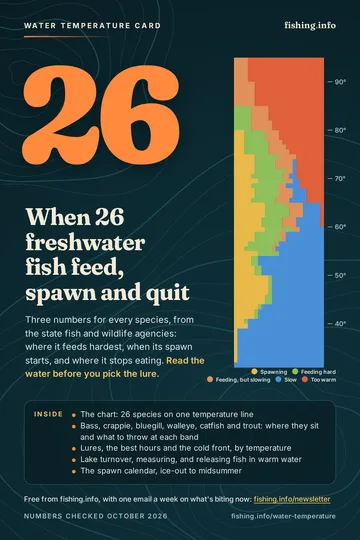
Free card: what 26 species do at your water temperature
Plus one email a week on what's biting now. No sales pitches. Privacy.
When coho run
| Region | Open water | Rivers |
|---|---|---|
| Alaska | July to September | July to November, on high water |
| Oregon coast | Not given | Mid-September to November; spawning from late November |
| Southern Lake Michigan | February to May; best late March and April | September and October |
| Wisconsin, Lake Michigan | Not given | September through December |
| Lake Ontario | Staging off river mouths from mid-August | Early September to early November; peak in early October |
Lake Michigan’s coho follow the warmth. In spring nearly the whole population gathers in the southern end of the lake, then spreads north along both shores from mid-April to mid-May. In summer they roam offshore in water below 60 °F (16 °C). Their preferred range is 53 to 58 °F (12–14 °C); the temperature chart gives coho and chinook together a band of 50 to 60 °F, beside 24 other species.
How to catch coho
Coho bite. Oregon’s agency puts it bluntly: colors catch anglers, not fish, and a coho will take almost any color of lure. Alaska calls them the most acrobatic of the Pacific salmon.
- Troll high. On Lake Michigan, Indiana DNR says to fish the top 15 ft (4.6 m) even over deep water. Oregon gives the same 15 ft for the ocean, at 3 to 5 mph, with a spoon or plastic squid, often behind a dodger.
- Run a dodger and fly. Once the lake passes 40 °F (4 °C), Indiana’s pick is an orange 6 in dodger with a small “peanut” fly 14 to 18 in (36–46 cm) behind it. Troll it at 1.8 to 2.5 mph. Wisconsin DNR credits trolling with about 90% of the coho anglers keep.
- From a pier or beach, use bait. Indiana DNR’s first choice from shore is spawn sacs, skein or a nightcrawler 4 to 6 ft (1.2–1.8 m) under a bobber on 6 to 10 lb line. Half-ounce spoons and spinners take the rest.
- In rivers, swing a spinner slowly. Oregon suggests a No. 3 in clear water and a No. 5 when it is murky. Terry Wiest of Salmon Trout Steelheader wants the blade turning as slowly as it can and still turn, in deep holes near wood.
- Or twitch a jig. Cast a ⅜ to ½ oz (11–14 g) jig into slow, deep water, let it sink and lift it with short snaps of the rod. Jason Brooks, in the same magazine, notes that coho take it on the drop.
A coho in a river has stopped feeding. New York’s biologists say river fish strike out of aggression, which is why a lure that annoys them works.
How big do coho salmon get?
By Alaska’s figures a coho runs 24 to 30 in and 8 to 12 lb; Washington says 6 to 12 lb. Oregon says they rarely pass 15 lb (6.8 kg). The U.S. Fish and Wildlife Service gives the extreme as 42.5 in (108 cm) and 36 lb (16.3 kg).
Great Lakes coho are smaller on average. Michigan DNR puts the typical adult at 5 lb (2.3 kg); Wisconsin’s range for Lake Michigan is 5 to 12 lb. Lake Ontario is the exception, and its fish hold the top of the record book.
What is the record coho?
| Record | Weight | Where and when |
|---|---|---|
| World (IGFA) | 33 lb 4 oz (15.08 kg) | Jerry Lifton, Salmon River, Pulaski, New York, September 27, 1989 |
| New York | 33 lb 7 oz (15.17 kg) | Stephen Sheets Jr., Lake Ontario off Oswego, August 13, 1998 |
| Michigan | 30.56 lb (13.86 kg) | Platte River, 1976 |
| Alaska | 26 lb 11 oz (12.1 kg) | Steve Atkinson, Icy Strait, August 2011 |
| Wisconsin | 26 lb 1.9 oz (11.85 kg) | Lake Michigan off Milwaukee, August 1999 |
| Washington | 25.34 lb (11.49 kg) | Martin Cooper, Sekiu, 2001 |
The New York fish outweighs the world record but is not in the IGFA book, which lists only Lifton’s. Michigan’s record came from the Platte, the river that received the first smolts ten years earlier. Alaska’s stood for 35 years until 2011, when the angler’s party chartered a plane to get the fish to a certified scale in Juneau.
Protected runs, and the tire chemical
On the Pacific coast four coho populations are listed under the Endangered Species Act. Central California Coast coho are endangered; the Southern Oregon and Northern California, Lower Columbia River and Oregon Coast populations are threatened. California closed its coho fisheries in the early 1990s, so a coho caught there goes back. Washington marks its hatchery coho by clipping the small adipose fin. In a mark-selective fishery only a clipped fish may be kept; an unclipped one goes back unharmed. Read the rules for the river before you fish it.
Coho are also unusually easy to poison. In Seattle’s Longfellow Creek, 60 to 100% of the adults returning between 2002 and 2009 died before they could spawn, within hours of falling ill. In 2021 a team writing in Science traced the deaths to 6PPD-quinone, a breakdown product of a chemical used in almost every car tire. About one millionth of a gram in a liter of water kills an adult coho.
Are coho good to eat?
Yes. NOAA describes the flesh as mild, more delicate in smaller fish, and a good source of omega-3 fats. Great Lakes coho carry advisories for PCBs that differ by lake, so check your state’s current guide. Wisconsin DNR’s trimming advice applies anywhere: remove the skin, the strip of fat along the back, the belly flap and the dark flesh along the lateral line.
How long do coho live?
A coho hatches in stream gravel and spends about its first year and a half in fresh water. Then it goes to sea, or out into the lake, for another year and a half. It comes back in its third fall, spawns once and dies. Some males return a year early at about 12 in (30 cm); those are the jacks.
Juvenile coho need slow water and sunken wood: ponds, side pools and log jams out of the current. Adults favor small water too. In Washington they turn up in nearly every small coastal stream with a year-round flow, waiting at the mouth until rain lifts the level. A coho can clear more than 6 ft (1.8 m) in one leap.
A female lays 2,400 to 4,500 eggs in a gravel nest called a redd. Coho spawn in water of 40 to 55 °F (4–13 °C) and prefer 40 to 49 °F (4–9 °C). For every other fish, start at the species guides.
Free download
The water temperature card
Read your water temperature and the card tells you who is spawning, who is feeding and what to throw. 26 species, 16 pages, for your phone and the tackle box.
Plus one email a week on what's biting now. No sales pitches. Privacy.
Related
Section guide
Types of Salmon: The Five Pacific Species and the Atlantic, Told ApartThe six types of salmon a North American angler meets: chinook, coho, sockeye, pink, chum and Atlantic, by gum line, tail spots, size and record.
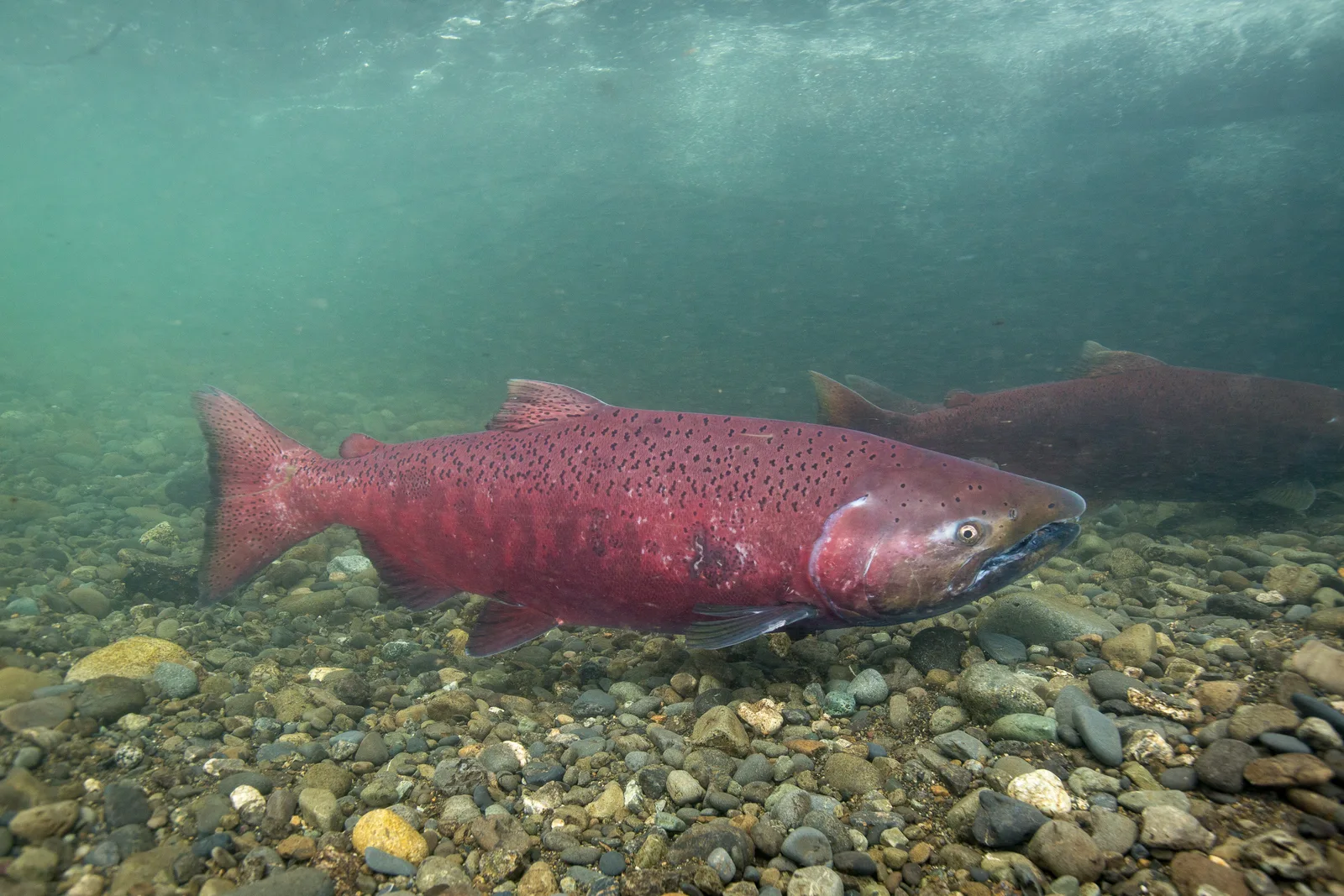 King Salmon (Chinook): Black Gums, Size, Runs and the 97-Pound Record
King salmon, or chinook: the black gums that mark a king, how big they get from Alaska to the Great Lakes, when each run starts, and the 97 lb 4 oz record.
 Kokanee Salmon: The Landlocked Sockeye, Season by Season
Kokanee salmon are sockeye that never reach the sea. How to tell one, the 50 °F depth they hold at each season, how to troll for them, and the record.
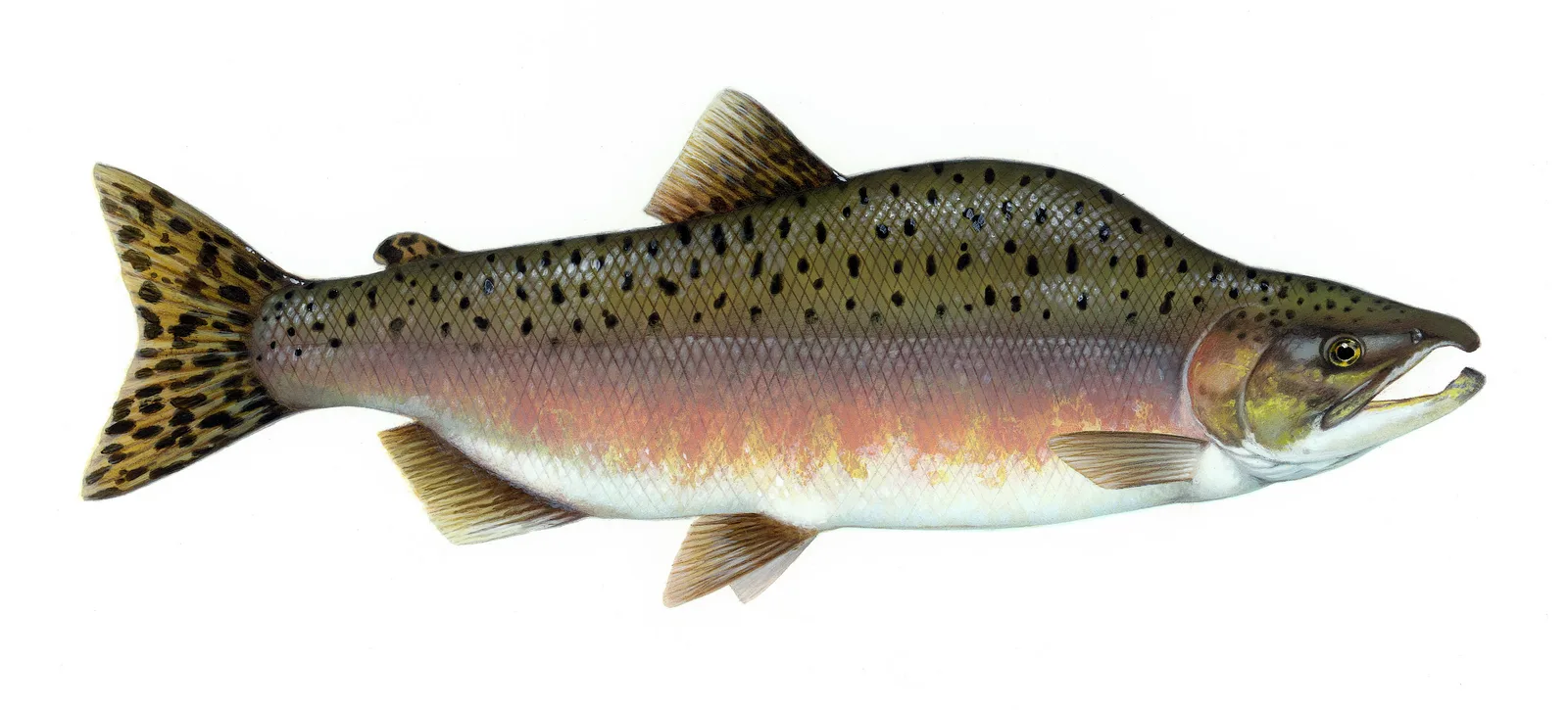 Pink Salmon: Odd-Year Runs, How to Tell a Humpy, Size and Records
Pink salmon live two years, so Puget Sound gets humpies only in odd years. When they run, how to tell one from a king, how to catch it and the record.
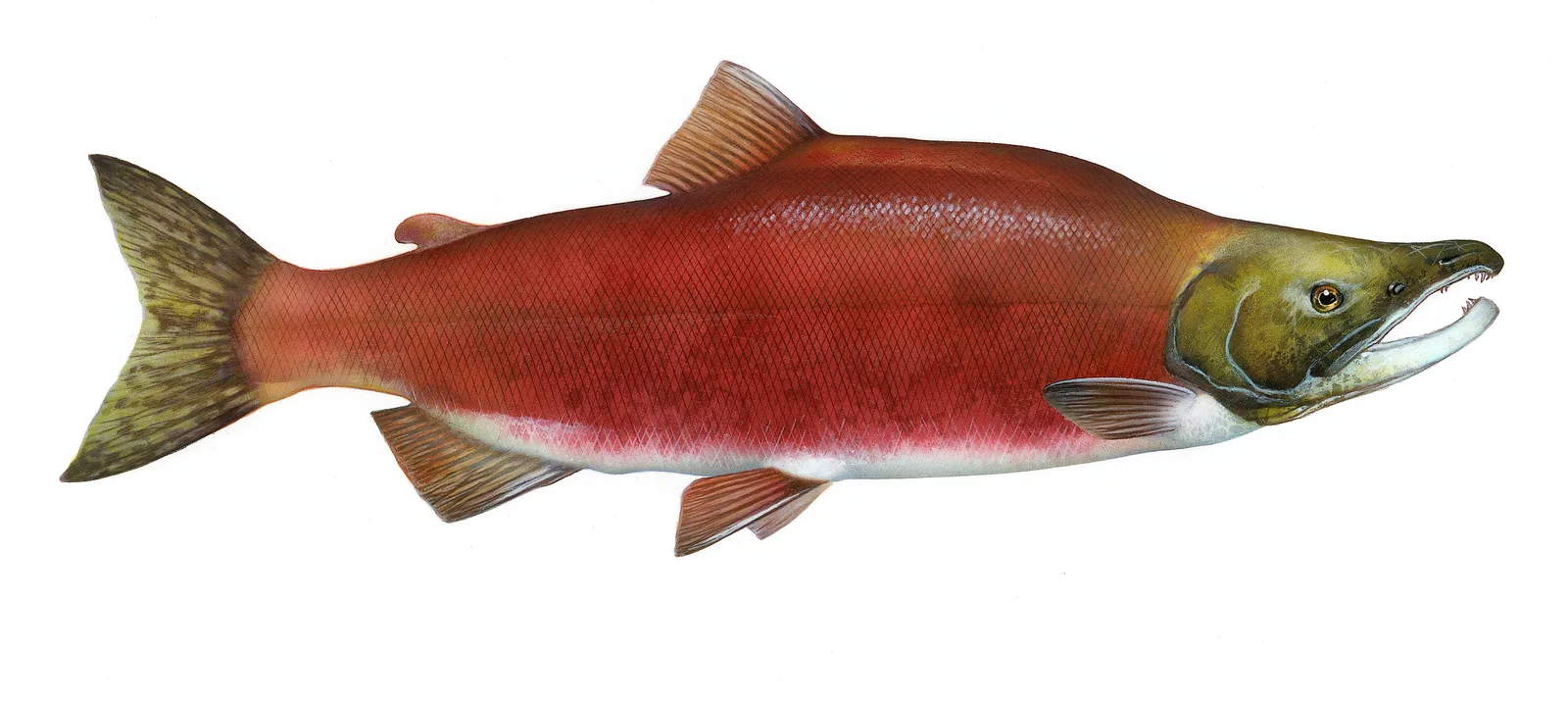 Sockeye Salmon: How to Tell a Red, Where They Run, and the Record
Sockeye salmon: a 4–15 lb red salmon that needs a lake. Tell it from a chum, find the runs from Bristol Bay to Lake Washington, hook one, and the record.
Sources
- Wisconsin DNR, hook-and-line record fish
- North Coast Regional Water Quality Control Board, Shasta River TMDL, Appendix A: the effects of temperature on steelhead, coho and chinook salmon
- Alaska Department of Fish and Game, Coho salmon species profile: size, life cycle, eggs, jacks
- Alaska Department of Fish and Game, Alaska salmon fishing guide: methods, state record
- NOAA Fisheries, Coho salmon: range, life cycle, diet, seafood profile
- NOAA Fisheries, Coho salmon (protected): the four listed populations
- U.S. Fish and Wildlife Service, Coho salmon (Oncorhynchus kisutch): life cycle, maximum size
- Washington Department of Fish and Wildlife, Coho salmon: habitat, size, state records
- Alaska Department of Fish and Game, Pink salmon species profile
- Alaska Department of Fish and Game, Sockeye salmon species profile
- NOAA Fisheries, Chum salmon
- Washington Department of Fish and Wildlife, Pacific salmon ID card (2024)
- Oregon Department of Fish and Wildlife, Is it a coho or Chinook?
- Oregon Department of Fish and Wildlife, 10 tips for catching coho
- ODFW, Coho salmon species page: size, ocean trolling depth and speed
- ODFW, Coastal rivers and lakes wild coho fisheries: 2024 report and 2025 proposal
- ODFW, See salmon spawn: coho timing by river
- WDFW, Puget Sound coho mark-selective and non-selective fisheries, 2024 post-season report
- Great Lakes Sea Grant Network, Salmon and Trout of the Great Lakes: a visual identification guide
- Wisconsin DNR, Coho salmon, PUBL-FM-107 (2008): names, temperature, trolling, run timing, state record
- Wisconsin DNR, Wisconsin's 2024 open water sportfishing effort and harvest, Lake Michigan
- Michigan DNR, Coho salmon: identification, average size, the 1966 stocking
- Michigan DNR, Chinook salmon: identification, anal fin rays
- Michigan DNR, Steelhead: identification, anal fin rays
- Michigan DNR, Atlantic salmon: identification, spots, tail, anal fin rays
- Michigan DNR, State record fish
- Michigan DNR (2026), DNR remembers the legacy of Dr. Howard Tanner
- Peck, Michigan DNR Fisheries Research Report 1755: the 1964 eggs and the 1966 Lake Superior release
- Parsons (1973), History of salmon in the Great Lakes, 1850–1970, abstract (USGS)
- Indiana DNR, Spring trolling for coho salmon in Indiana: movements, depth, dodger and fly, speed
- Indiana DNR, Shore fishing for coho salmon in Indiana
- New York State DEC, Pacific salmon fishing in Lake Ontario tributaries
- New York State DEC, Freshwater fishing records (the 1998 coho state record)
- Leonhardt et al. (2020), Diet complexity of Lake Michigan salmonines 2015–2016, Journal of Great Lakes Research 46
- Scholz et al. (2011), Recurrent die-offs of adult coho salmon returning to spawn in Puget Sound lowland urban streams, PLoS ONE 6(12)
- Tian et al. (2021), A ubiquitous tire rubber-derived chemical induces acute mortality in coho salmon, Science 371:185–189
- California Department of Fish and Wildlife, Coho salmon: listings and the fishery closure
- Oswego County Tourism, World and state records (Lifton and the 1998 state record)
- The Fisherman, Coho chaos: the other salmon of Salmon River (the world record)
- Anchorage Daily News (2011), Record silver salmon landed in Southeast Alaska
- Terry J. Wiest, Coho: finicky fish alternatives, Salmon Trout Steelheader (2022)
- Jason Brooks, Advanced twitching jigs, Salmon Trout Steelheader (2019)