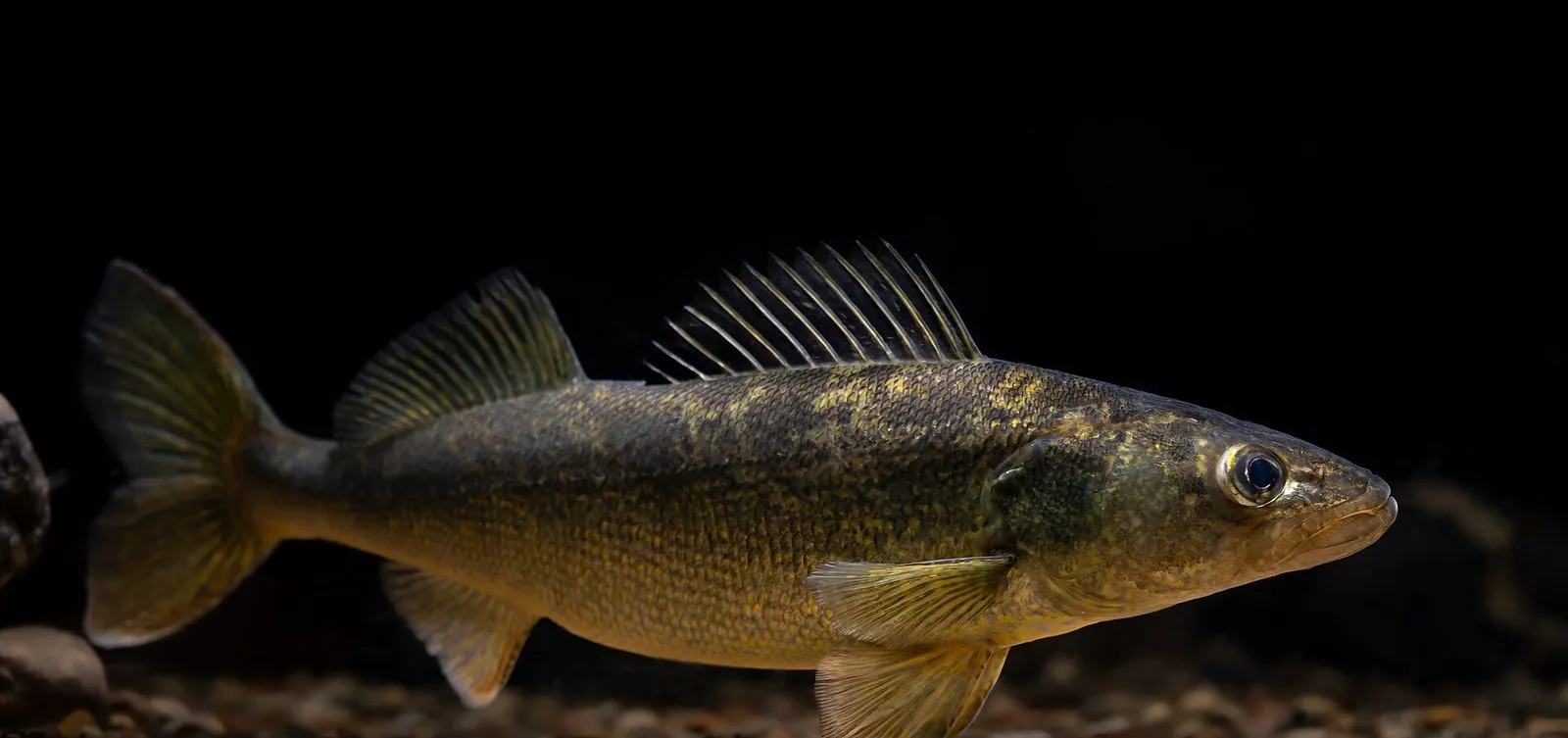
Walleye spawn when the water reaches 42–50 °F (6–10 °C), usually in the first two or three weeks after ice-out. The run starts a little colder: at 38–44 °F (3–7 °C) the fish are already heading for the spawning rock. That window sets the rest of the year, from the post-spawn scatter to the summer band of 60–72 °F (16–22 °C), the 76 °F (24 °C) ceiling and the fall return through the 50s. Know the temperature and you know where the walleye hold, how fast to fish, and whether live bait or a crankbait wins.
Walleye spawn colder than almost any game fish that is not a trout. At 42–50 °F (6–10 °C) they are done before the same lake’s largemouth, which spawn at about 60 °F (16 °C), have even started to move up.
When and where do walleye spawn?
The move begins under the last of the ice. At 38–44 °F (3–7 °C) walleye leave their wintering basins. Some run up rivers, some stack below dams, some slide along rocky, wind-swept shorelines. They spawn at night, over rock, gravel and rubble, where current or waves keep the eggs clean. There is no nest and no guarding: the eggs are broadcast over the rock and the adults leave.
The order of the early spawners is worth remembering. Northern pike go first, at 40–50 °F (4–10 °C), into flooded grass. Walleye follow at 42–50 °F on the rock. Yellow perch come next at 45–52 °F (7–11 °C), over brush and weeds. On one lake all three can spawn inside two weeks.
Can you fish the spawn?
Fishing the run is a regulations question first. Many states close the inland walleye season through the spawn. Some rivers carry their own closures or sanctuary stretches, so check the current rules for the water you fish.
Where the season is open, fish the pre-spawn bite. Go in the last hour of light and after dark, on current seams and the rock below dams. A 1/4–3/8 oz jig and a minnow is the bait, lifted and dropped as slowly as the current allows. The jig heads guide covers head weights for current, and the jigs guides cover the other rigs named here.
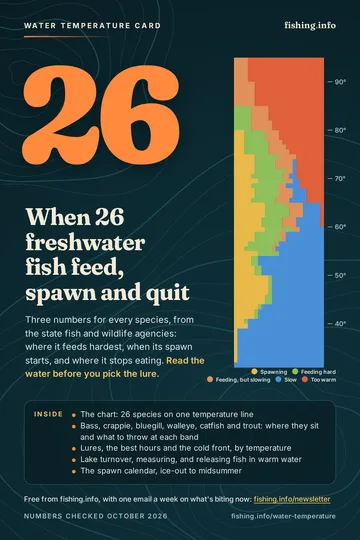
Free card: what 26 species do at your water temperature
Plus one email a week on what's biting now. No sales pitches. Privacy.
Why does the date move when the temperature does not?
Walleye from northern lakes spawn and feed at cooler temperatures than the same species farther south; a 1977 study of the percids showed it. That is why the agencies’ figures differ by a few degrees. Wisconsin’s DNR puts the peak at 42–50 °F, with the move starting at 38–44 °F. Minnesota’s says spawning begins as the water approaches 45 °F (7 °C).
It is also why the calendar is useless across the range. A southern reservoir can be at 45 °F while a northern lake is still iced over. Both hit the same spawn window on the thermometer, weeks apart on the calendar.
So watch the water, not the month. Two readings matter most. The first is the trend: a three-day warm-up from 40 to 44 °F (4 to 7 °C) moves fish harder than a stable 47 °F (8 °C) after a cold front. The second is the evening reading. A spring bay warms 5–8 °F (3–4 °C) between dawn and mid-afternoon, and walleye spawn after dark, so the temperature at dusk is the one that counts.
Where are walleye at each temperature?
The table runs the whole year, from ice to ice, for a typical natural lake or reservoir with a river feeding it. Depths are the usual starting points, not rules; the fish finder overrides them.
| Water temperature | Stage | Where walleye hold | Presentation and speed |
|---|---|---|---|
| Below 38 °F (3 °C) | Ice and late winter | Deep basin edges, main-lake points, river holes | Jigging spoon or minnow under a tip-up; vertical, slow |
| 38–44 °F (3–7 °C) | Pre-spawn run | Below dams, river mouths, rocky shorelines in current | Jig and minnow, lift-drop; under 0.5 mph (0.8 km/h) |
| 42–50 °F (6–10 °C) | Spawn | Shallow rock and gravel in current or wind, at night | Season often closed; where open, jig and minnow at dusk |
| 50–60 °F (10–16 °C) | Post-spawn scatter | Males linger on the rock, females drop to the first break, 8–15 ft (2.4–4.6 m) | Slip bobber and leech; jig and minnow; crawler harness at about 1 mph (1.6 km/h) |
| 60–72 °F (16–22 °C) | Summer band | Thermocline edge, deep weedlines, humps and points, 15–30 ft (4.6–9 m); dawn, dusk, night | Crankbaits at 1.5–2.5 mph (2.4–4 km/h); bottom bouncer and harness at 1–1.5 mph (1.6–2.4 km/h) |
| Above 76 °F (24 °C) | Heat ceiling | Deepest cool water with oxygen, current, shade; night | Slow live bait on marked fish; low light only |
| Falling through the 50s (10–15 °C) | Fall feed | Back on shallower rock, points and river current; feeding hard | Big minnow on a jig; stickbaits trolled or cast shallow after dark |
How do you fish summer walleye?
Once the water passes 60 °F (16 °C) the walleye’s year settles into its long middle. Growth peaks at 72 °F (22 °C), and the range walleye choose in the wild is 69–74 °F (21–23 °C). Above 76 °F the fish are under stress, and 89 °F (32 °C) kills an adult.
Read those numbers next to a rule that holds for all fish: metabolism roughly doubles with every 18 °F (10 °C) of warming. A 1999 study found it across 69 species. A walleye at 70 °F (21 °C) needs about twice the food of one at 52 °F (11 °C), and it eats where the water sits in its band.
In a stratified lake that band is a layer, not a spot. From late June the surface can read 82 °F (28 °C) while 15 ft (4.6 m) down it is 60 °F. The walleye’s 60–72 °F water is the edge of the thermocline, the layer where temperature falls fast with depth. Look for the structure that touches it: deep weedlines, humps, the sides of points, the lip where a flat breaks into the basin. A fish finder that shows the thermocline and a temperature at depth turns this into a depth to fish; the fish finder guides explain how to read one.
Speed and bait follow the temperature inside the band:
- Read the surface, then find the band. Under 65 °F (18 °C) on top, the fish may be anywhere on the structure. Over 70 °F, start where the depth reads 60–72 °F and work the structure that crosses it.
- Cold end, 60–65 °F (16–18 °C): live bait, slow. A jig and minnow, or a slip bobber with a leech, on top of the structure. Under 1 mph (1.6 km/h), long pauses.
- Warm end, 66–72 °F (19–22 °C): crankbaits and speed. The fish are eating hardest, so cover water. Troll crankbaits at 1.5–2.5 mph along the break at the depth the finder marks. Add weight or lead-core line when the fish sit deeper than the lure dives, or pull a bottom bouncer and nightcrawler harness at 1–1.5 mph.
- Fish the low light. Walleye have the light-gathering eye that gives them their name. In clear lakes the summer bite is dawn, dusk and after dark, when they move up the structure. Trolling shallow stickbaits along a rock shoreline at night is a summer pattern of its own.
- Above 76 °F (24 °C), slow down and go deep. The fish are past their ceiling. Find the deepest water that still holds oxygen, or current from a river arm or a dam, and fish live bait vertically on the marks. Expect short windows.
Where do walleye go in fall?
As the surface cools back through the 50s (10–15 °C), the layers mix in the fall turnover and the walleye’s whole band is open from top to bottom. The fish move back onto shallower rock, points and river current and feed hard against the coming winter. In many lakes this is when the biggest walleye of the year are caught. Work a big minnow slowly under a 3/8–1/2 oz jig, or troll and cast stickbaits shallow after dark along the same rock the fish spawned on in spring. Near 40 °F (4 °C) the fish are back on the basin edges where the year began.
The same three numbers, feeding band, spawn and stress point, are in the water temperature chart for 26 freshwater species. There a walleye day can be read against the perch, pike and bass in the same lake; the species section has their profiles. Bass run the sequence 10–18 degrees warmer, band by band on the bass water temperature page.
Free download
The water temperature card
Read your water temperature and the card tells you who is spawning, who is feeding and what to throw. 26 species, 16 pages, for your phone and the tackle box.
Plus one email a week on what's biting now. No sales pitches. Privacy.
Related
Section guide
Ideal Water Temperature for Fish: The Chart for 26 Freshwater SpeciesMost freshwater fish bite best at 65–75 °F, trout at 50–65 °F, catfish at 75–85 °F. One chart for 26 species: feeding range, spawn and shutdown.
 Lake Water Temperature: How to Find It Before You Go
Four ways to know your lake's water temperature before you go: live USGS and NOAA sensors, satellite maps, your own thermometer, and the air-temperature rule.
 Lake Turnover: How Fall Mixing Works and Where the Fish Go
Lake turnover is the fall mixing that ends the summer thermocline: what sets it off, how long it lasts, seven signs it happened, where the fish go.
 Bass Water Temperature: Spawn, Bite and What to Throw at Each Band
Bass bite best at 65–80 °F and spawn at about 60 °F. A band-by-band table of where bass sit, what to throw and how fast, from 40-degree water to summer heat.
 Bluegill Spawn Temperature: 67–80 °F, and How to Find the Beds
Bluegill spawn at 67–80 °F (19–27 °C), in waves from late May into August in the north and longer in the south. Where the beds are and how to fish them.
 Catfish Water Temperature: When Channels, Blues and Flatheads Bite
Catfish feed hardest at 75–85 °F. The water temperatures where channel, blue and flathead catfish start biting, spawn and quit, and how to fish each band.
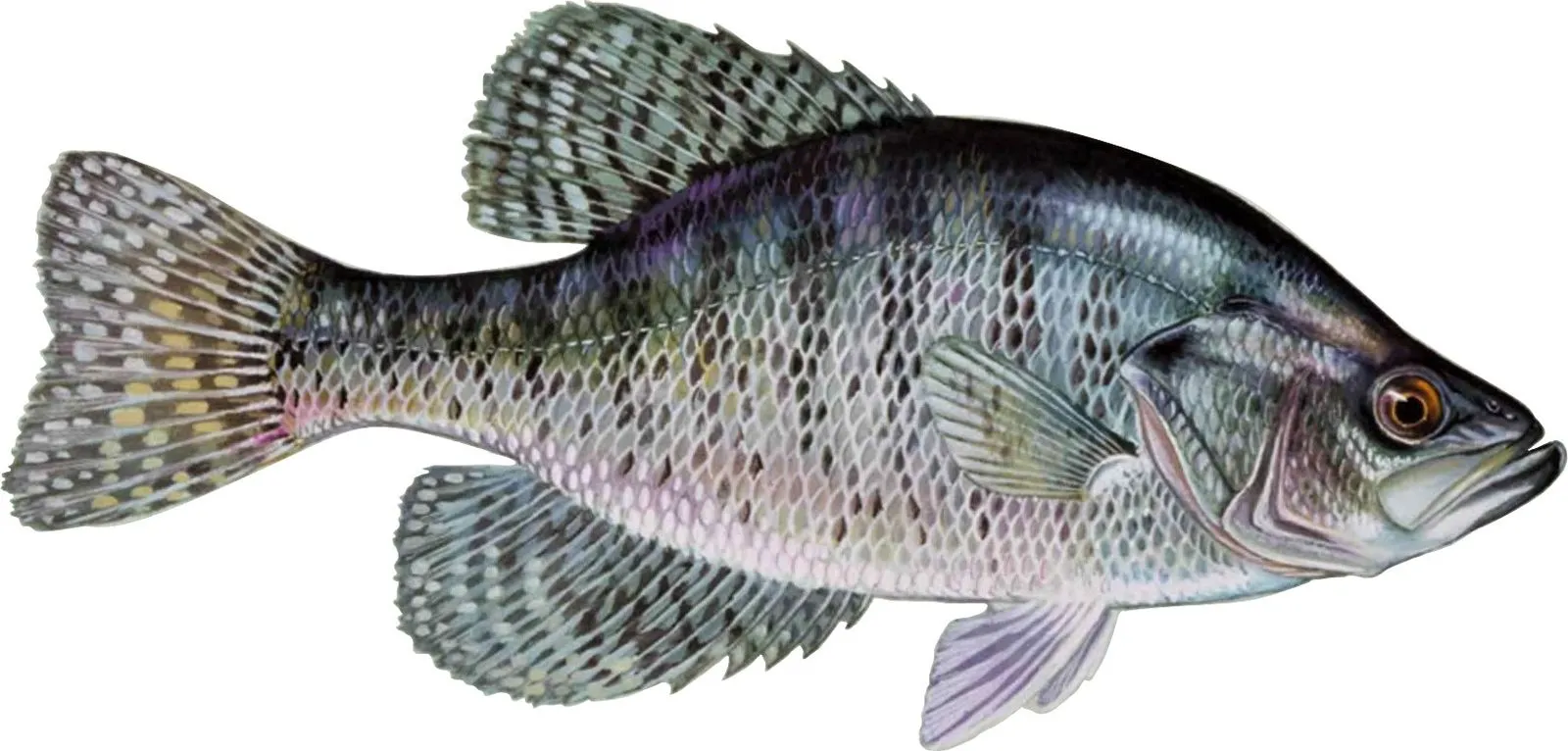 Crappie Spawn Temperature: When They Move Up, How Deep, How Long
Black crappie spawn at 58–68 °F, white crappie at 60–70 °F: when they move up, how deep by water clarity, one spawn a year, and the fall bite.
Sources
- Wisconsin DNR, walleye
- Minnesota DNR, walleye
- Hokanson, K. E. F. (1977), Temperature requirements of some percids and adaptations to the seasonal temperature cycle, Journal of the Fisheries Research Board of Canada 34:1524–1550
- Clarke, A. and Johnston, N. M. (1999), Scaling of metabolic rate with body mass and temperature in teleost fish, Journal of Animal Ecology 68:893–905
- Minnesota DNR, northern pike species profile
- Minnesota DNR, yellow perch species profile