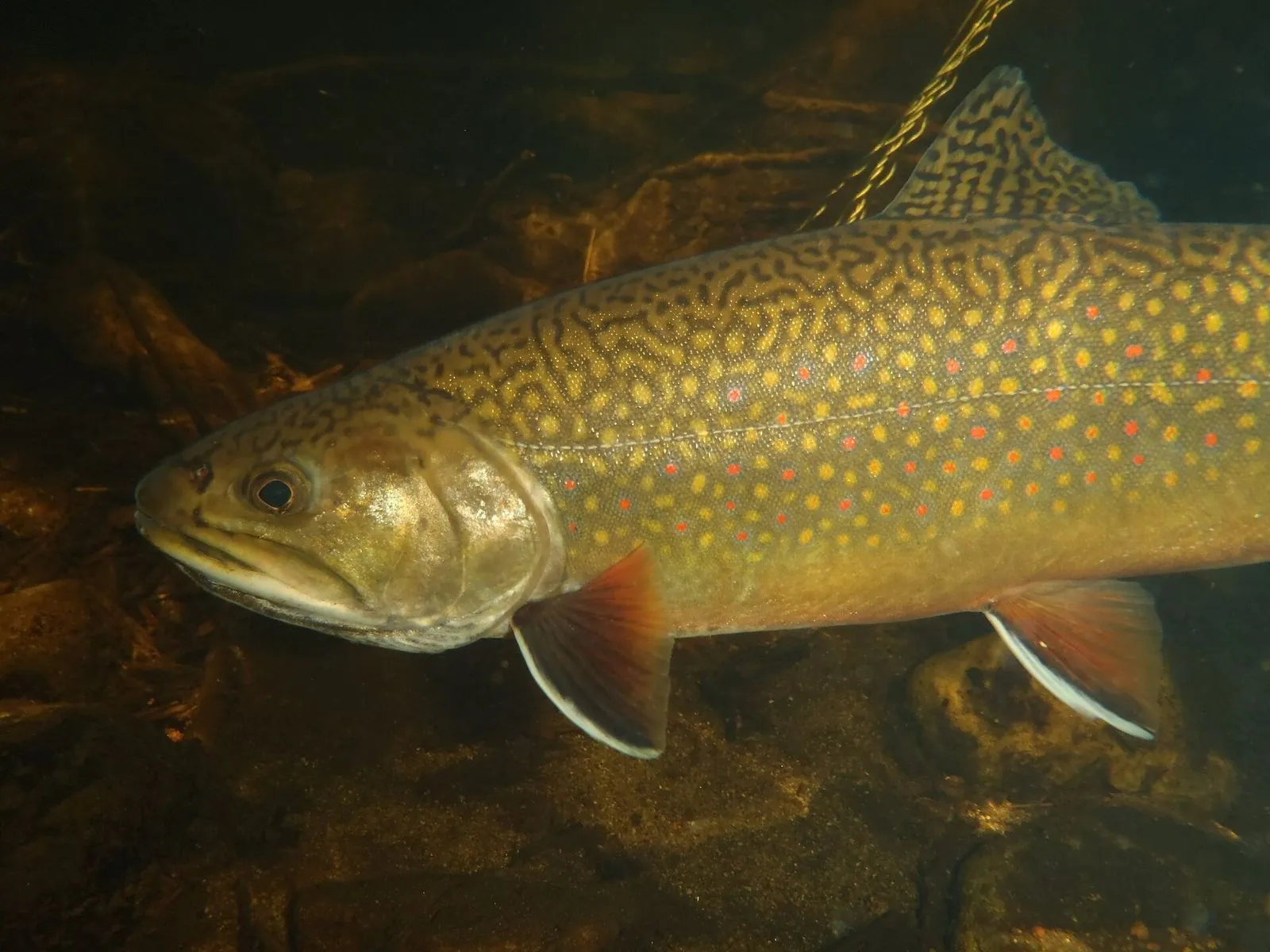
Trout feed best in water of 55–65 °F (13–18 °C), and the day to stop fishing for them begins at 68 °F (20 °C). Brook trout stress sooner, at 65 °F (18 °C), and brown trout hold on to 70 °F (21 °C). Lake trout want it colder than any of them, 48–55 °F (9–13 °C). The upper 70s kill.
A rainbow trout grows fastest at 63 °F (17 °C) and dies at 77–79 °F (25–26 °C). Fourteen degrees separate its best day from its last one, which is why trout anglers carry a thermometer.
What temperature does each trout need?
Each trout gets four numbers. Comfort is the feeding band, and spawn is the temperature that starts the spawn. Stress is where the fish must find colder water. The stop line is where a caught trout starts paying for the fight with its life.
| Species | Comfort | Spawn begins | Stress | Stop fishing at |
|---|---|---|---|---|
| Rainbow trout | 55–65 °F (13–18 °C) | 42–50 °F (6–10 °C), spring | above 68 °F (20 °C) | 68 °F (20 °C) |
| Brown trout | 55–65 °F (13–18 °C) | 42–48 °F (6–9 °C), fall | above 70 °F (21 °C) | 68 °F (20 °C) |
| Brook trout | 55–64 °F (13–18 °C) | 40–50 °F (4–10 °C), fall | above 65 °F (18 °C) | 65 °F (18 °C) |
| Lake trout | 48–55 °F (9–13 °C) | 45–55 °F (7–13 °C), fall | above 60 °F (16 °C) | 60 °F (16 °C) at the depth you fish |
| Steelhead | 45–58 °F (7–14 °C) | upper 40s °F (8–10 °C), spring | above 68 °F (20 °C) | 68 °F (20 °C) |
Brook trout are the tightest: West Virginia DNR calls anything above 65 °F a stress factor. Brown trout are the toughest, with a growth ceiling of 66–70 °F (19–21 °C). That is why browns survive in rivers that lost their brookies. Lake trout die at 74 °F (23 °C), a temperature a bass finds pleasant.
The wider water temperature chart puts these five next to twenty other species, from walleye and crappie to catfish and bluegill.
Can trout survive in warm water?
Briefly, yes; for a season, no. The lethal readings sit in the upper 70s. Rainbows die at 77–79 °F, brook trout at about 77 °F (25 °C), browns at 79–81 °F (26–27 °C). A stocked pond that reads 78 °F (26 °C) in July has no trout left to protect. Between 68 and 77 °F a trout lives, but it stops growing and holds in whatever cold seam it can find.
The reason is arithmetic. A fish’s metabolism roughly doubles with every 18 °F (10 °C) of warming, and a 1999 study across 69 species found much the same rule. A trout at 68 °F needs about twice the oxygen it needed at 50 °F (10 °C), while warm water carries less of it.
Add a fight and the fish runs an oxygen debt it may not repay. It can swim off and die hours later under a cut bank. That is why the catch and release numbers turn on the thermometer as much as on the hook.
The EPA’s Region 10 guidance draws the same line for Pacific salmon and steelhead. It sets a maximum of 64 °F (18 °C) where they migrate and rear, and 43–50 °F (6–10 °C) for water holding eggs.
Free card: what 26 species do at your water temperature
Plus one email a week on what's biting now. No sales pitches. Privacy.
Why do anglers stop at 68 °F?
Montana Fish, Wildlife and Parks turns the line into law. Under its drought policy, a river whose daily high stays above the department’s trigger for several days running gets a “hoot-owl” restriction. Fishing then closes from 2 p.m. to midnight, and the cool hours when the owls still call stay open.
Full closures follow when flows drop as well. The list changes weekly through July and August, so check FWP’s closures page before any summer trip in the state.
The rest of the country runs on the honor system, and the 68 °F line is the system. It is not a legal limit. It is the point where a trout you release stops being a trout you will catch again.
How do you take a stream temperature that means something?
A number from the wrong place or the wrong hour is worse than no number.
- In the current, not at the edge. The margin where you wade in runs warmer than the run the trout hold in. Drop the thermometer in knee-deep moving water, at the depth of the fish, for a full minute.
- Mid-afternoon, not dawn. A stream peaks in mid-to-late afternoon and bottoms out just after sunrise. A shallow bay warms 5–8 °F (3–4 °C) between dawn and mid-afternoon in spring, and a small open stream in July moves nearly as much.
- Trend beats level. A river falling from 70 to 66 °F (21 to 19 °C) after a storm fishes. One climbing from 62 to 66 °F under a heat dome is about to close.
- Move the thermometer. A tributary mouth, a spring seep or a shaded canyon reach can read several degrees below the main river a hundred yards (90 m) away. That difference is where the trout are.
Where do trout go in summer?
Trout do not tolerate heat; they leave it. Four places hold them when the main river reads 70 °F.
Tailwaters. A dam draws from the cold bottom of a stratified reservoir. That water can read 60 °F at 15 ft (4.6 m) while the surface is 82 °F (28 °C). The first miles below the dam stay in the comfort band all summer.
Springs. Groundwater comes out close to the region’s year-round average air temperature, far below a July afternoon. A seep the size of a bathtub can hold a pod of brook trout through August.
Tributary mouths. A small, shaded, fast tributary runs colder than the river it feeds. Trout stack in the plume where the two meet, often within a rod length of the seam.
Depth, in lakes. From late June a lake stratifies and trout live under the thermocline, the layer where the temperature falls fast with depth. New York DEC’s trolling table gives the same bands as the chart’s comfort column for steelhead, lake trout, browns and rainbows. Find the depth that matches it and fish there.
The summer decision, step by step
This is for a trout stream from late June through early September, on any day the forecast air high passes 85 °F (29 °C).
- Check the closures page the night before. A hoot-owl restriction or a full closure makes the decision for you.
- Read the water in the current where you will fish, and know the afternoon high from yesterday’s 3 p.m. reading.
- Below 65 °F all day: fish normally. For brook trout, 65 °F is also the day’s ceiling.
- Afternoon high of 65–68 °F: fish, but shorten everything. Barbless hooks, the fish kept in the water, no photograph in the air. Use a tippet heavy enough to end the fight in a minute: 4X fluorocarbon lands a 16 in (40 cm) trout, on a knot that holds.
- Afternoon high above 68 °F: fish dawn only. Start in the gray light, keep the thermometer clipped to your vest, and quit the moment the water touches 68 °F.
- Morning reading already at 70 °F: leave the trout alone. Drive to a tailwater, a spring creek or a lake you can fish deep. Or fish for bass and carp, which feed hardest at 65–85 °F (18–29 °C).
- Write down the reading, the hour and the result. A notebook of afternoon highs tells you when your home water closes next July.
When does the fishing turn back on?
Fall is the trout’s reward for surviving summer. As the water falls back through 65 to 55 °F, browns and rainbows feed hard in daylight again.
The spawn follows the falling thermometer. Brown trout start as the water drops into 42–48 °F, brook trout at 40–50 °F. Lake trout spawn on rocky shoals at 45–55 °F. Walk around cleaned, light-colored patches of gravel in the tailouts from October on: those are redds, and the eggs in them are next year’s fish.
Steelhead run on the same falling thermometer. New York DEC calls them most active at 45–58 °F and says the run slows below 40 °F (4 °C).
Winter is the metabolism rule run backward. Every 18 °F of cooling halves what a trout needs to eat, so a rainbow at 40 °F feeds about half as often as one at 58 °F (14 °C). Fish the warmest hours of early afternoon and the slowest water.
The trout hub tells the five trout apart, and the species pages carry each fish’s biology.
Free download
The water temperature card
Read your water temperature and the card tells you who is spawning, who is feeding and what to throw. 26 species, 16 pages, for your phone and the tackle box.
Plus one email a week on what's biting now. No sales pitches. Privacy.
Related
Section guide
Ideal Water Temperature for Fish: The Chart for 26 Freshwater SpeciesMost freshwater fish bite best at 65–75 °F, trout at 50–65 °F, catfish at 75–85 °F. One chart for 26 species: feeding range, spawn and shutdown.
 Lake Water Temperature: How to Find It Before You Go
Four ways to know your lake's water temperature before you go: live USGS and NOAA sensors, satellite maps, your own thermometer, and the air-temperature rule.
 Lake Turnover: How Fall Mixing Works and Where the Fish Go
Lake turnover is the fall mixing that ends the summer thermocline: what sets it off, how long it lasts, seven signs it happened, where the fish go.
 Bass Water Temperature: Spawn, Bite and What to Throw at Each Band
Bass bite best at 65–80 °F and spawn at about 60 °F. A band-by-band table of where bass sit, what to throw and how fast, from 40-degree water to summer heat.
 Bluegill Spawn Temperature: 67–80 °F, and How to Find the Beds
Bluegill spawn at 67–80 °F (19–27 °C), in waves from late May into August in the north and longer in the south. Where the beds are and how to fish them.
 Catfish Water Temperature: When Channels, Blues and Flatheads Bite
Catfish feed hardest at 75–85 °F. The water temperatures where channel, blue and flathead catfish start biting, spawn and quit, and how to fish each band.
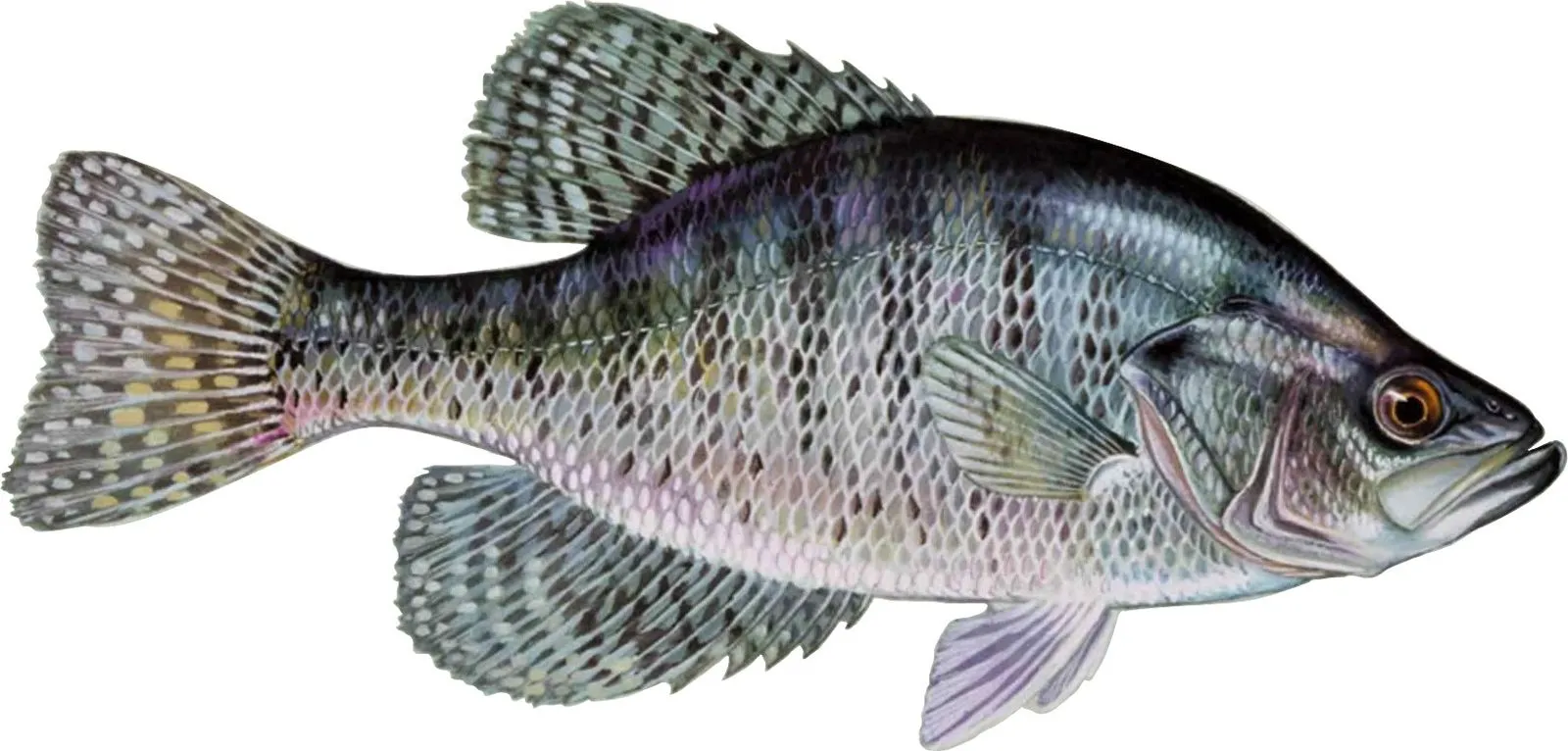 Crappie Spawn Temperature: When They Move Up, How Deep, How Long
Black crappie spawn at 58–68 °F, white crappie at 60–70 °F: when they move up, how deep by water clarity, one spawn a year, and the fall bite.
Sources
- New York DEC, trolling for Lake Ontario trout and salmon (preferred temperatures)
- New York DEC, steelhead fishing in Lake Ontario tributaries
- EPA Region 10 (2003), Guidance for Pacific Northwest state and tribal temperature water quality standards
- West Virginia DNR, brook trout
- Michigan DNR, brown trout
- Michigan DNR, lake trout
- Wismer, D. A. and Christie, A. E. (1987), Temperature relationships of Great Lakes fishes, Great Lakes Fishery Commission Special Publication 87-3
- Coutant, C. C. (1977), Compilation of temperature preference data, Journal of the Fisheries Research Board of Canada 34:739–745
- Clarke, A. and Johnston, N. M. (1999), Scaling of metabolic rate with body mass and temperature in teleost fish, Journal of Animal Ecology 68:893–905