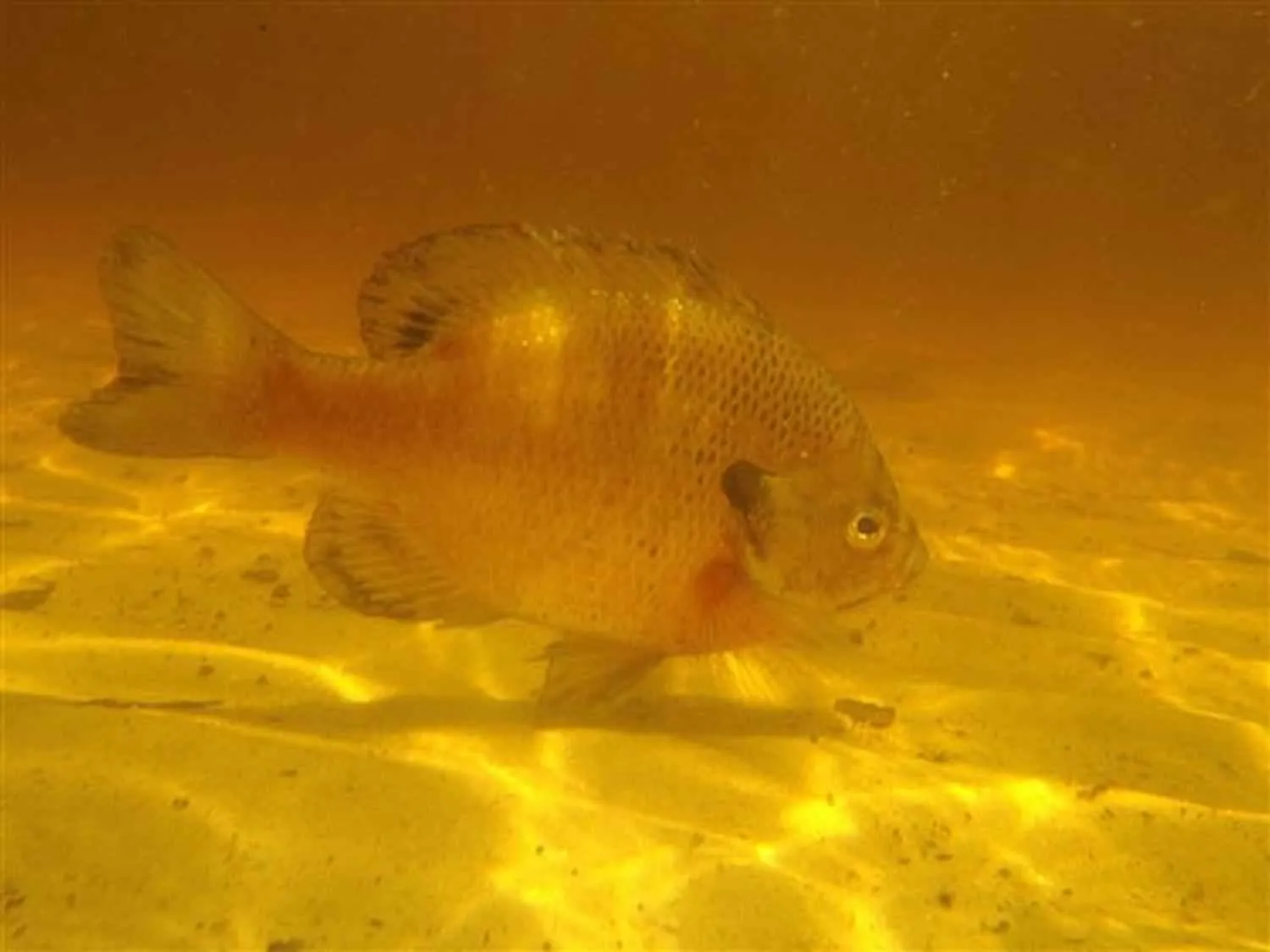
Bluegill spawn when the water reaches 67–80 °F (19–27 °C), and Texas Parks and Wildlife puts the first beds at about 70 °F (21 °C). It is the warmest spawning window of any common freshwater game fish, and the widest. So the spawn comes in waves through early summer rather than on one weekend. The male guards the nest and attacks anything that comes near it, a bait included.
Bass finish spawning at about 60 °F (16 °C) before bluegill start at 67 °F (19 °C), and channel catfish begin at 75 °F (24 °C) while the bluegill beds peak. One thermometer tells you what all three are doing.
When do bluegill spawn?
Bluegill are the last of the spring spawners. Crappie nest at 58–68 °F (14–20 °C) and largemouth bass at about 60 °F. Bluegill wait until a protected bay holds 67 °F for a few days. In the northern states that is late May at the earliest. The season runs to early August, and June is the peak. In the South the same temperatures arrive weeks earlier and stay longer, so the beds start in spring and keep going into late summer.
The band is 13 °F (7 °C) wide, and that width makes the season. Not every female is ready at once. As long as the water sits between 67 and 80 °F, new groups move onto the beds, and anglers count a fresh wave roughly every few weeks. Many time their trips to the days around each full moon, and the “June full moon” is the classic date in the north. Treat the moon as angler convention: the agencies tie the spawn to temperature, not the calendar. When a colony goes quiet, check the temperature and wait for the next wave before you give up on the bay.
Latitude matters too. Hokanson showed that northern perch and walleye spawn cooler than southern ones, and bluegill follow the same logic: a Michigan fish and a Florida fish run on slightly different thermometers. Start from the band and let the beds you see confirm it.
When does the spawn reach your water?
The table gives a typical year for three latitude bands. The South is the Gulf states, Texas and Florida. The Mid-South is Tennessee, the Carolinas, Missouri and Kansas. The North is the Great Lakes states, New England and the northern plains. A cold spring shifts everything a month later; the thermometer decides, not the month.
| Month | South | Mid-South | North |
|---|---|---|---|
| April | Bays pass 67 °F (19 °C); first beds | Staging, water 58–66 °F (14–19 °C) | Ice just out; no beds |
| May | First big wave at 70–78 °F (21–26 °C) | First beds late in the month | Staging; first beds the last week |
| June | Second wave | Peak | Peak, around the full moon |
| July | Waves continue while bays stay under 80 °F (27 °C) | Late waves | Second wave |
| August | Shallows above 80 °F (27 °C) push fish deep; spawn ends | Last beds | Last beds early in the month |
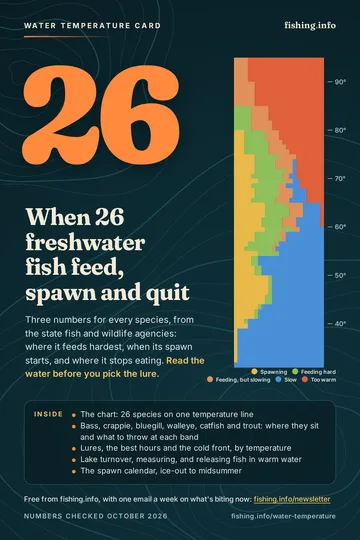
Free card: what 26 species do at your water temperature
Plus one email a week on what's biting now. No sales pitches. Privacy.
What does a bluegill bed look like?
A bluegill bed is not one nest but a colony. Each male fans a saucer-shaped depression into sand, gravel or packed clay. The saucers sit side by side, sometimes dozens of them, so the bottom looks like a sheet of pale dinner plates on a dark background. The nests are in 1–6 ft (0.3–1.8 m) of water in bays and coves out of the wind, on the banks that catch the most sun and warm first. Soft mud does not hold a nest. If the bottom is silt, move down the shore until it turns hard.
The male does the work. He builds the nest and courts the female, and after she leaves he guards the eggs and then the fry, chasing off anything that comes near, a bait included. That aggression is why bed fishing is easy, and why the fish you catch on a bed are mostly males.
How do you find and fish a bed?
- Take the temperature in the bay, in mid-afternoon. A shallow bay warms 5–8 °F (3–4 °C) between dawn and mid-afternoon in spring, and the afternoon reading is the one the fish act on. Beds start when the bay holds 67–70 °F for a few days.
- Pick the bank. A protected cove on the north or northwest shore gets the most sun and warms first. Look for hard bottom in 1–6 ft, near a weed edge or a dock.
- Look before you cast. Polarized glasses and a high sun show the pale circles from the bank or a drifting boat. Stand tall, move slowly, and scan a cast-length out.
- Trust your nose, a little. Anglers describe a musky, fishy smell hanging over an active colony on a still, warm day. It is lore, not biology, but it costs nothing to check the bank it leads you to.
- Stay back and cast past the colony. Bedding bluegill spook from a shadow. Use 4–6 lb monofilament and a #8 or #10 hook; the hook size chart has the panfish sizes. Add a small split shot and a cricket, a piece of worm or a 1/32 oz jig. Drop the bait into a saucer and let it sit; the male takes it within seconds.
- Work the colony from the outside in. Hooking the near fish first keeps a fighting bluegill from towing through the other beds and putting them down.
- Sort as you go. Keep the 6–8 in (15–20 cm) eaters and release the big males straight back over the beds. Many states have no bag limit on panfish or a 25-fish limit; either one is a ceiling, not a target.
What do bluegill do at other temperatures?
Bluegill feed hardest at 70–80 °F (21–27 °C), the same band they spawn in, and they bite at every temperature a lake produces. Fish are cold-blooded, and their metabolism roughly halves for every 18 °F (10 °C) of cooling. A bluegill under the ice at 39 °F (4 °C) needs about a quarter of the food it needs at 75 °F (24 °C). So it still eats, but in short windows and small bites.
At the warm end, a laboratory compilation has bluegill choosing 86–90 °F (30–32 °C) in a tank and avoiding water above 90–95 °F. In a lake, 90 °F is where feeding falls off and the fish go looking for shade, depth and oxygen. The water temperature chart shows where that puts bluegill next to every other species.
| Water temperature | What bluegill do | Where to look | Bait |
|---|---|---|---|
| Under ice, 32–39 °F (0–4 °C) | Short feeding windows | Deep weed edges and soft basins | Tiny jig with a waxworm, #10–#12 |
| 40–55 °F (4–13 °C) | Move up on sunny afternoons | Dark-bottom bays, canals, the sunny shore | Small jig under a float, red worm |
| 55–67 °F (13–19 °C) | Pre-spawn, feeding hard | The first drop outside the spawning bays | Cricket or worm on a #8 under a slip float |
| 67–80 °F (19–27 °C) | Spawning in waves | Sand and gravel in 1–6 ft (0.3–1.8 m) | Anything small dropped into the saucer |
| 80–90 °F (27–32 °C) | Feed at dawn and dusk; big fish deep | Deep weed edge, dock shade, the thermocline | Slip float at the weed edge; small popper at dusk |
| Above 90 °F (32 °C) | Stressed, feeding falls off | Deepest oxygenated water, springs, current | First light only |
Summer is where the thermometer earns its keep. A stratified lake in July can read 82 °F (28 °C) at the surface and 60 °F (16 °C) at 15 ft (4.6 m). The big bluegill sit on the edge between those numbers, on the deep weedline or the first break. A slip float set to that depth catches fish the shoreline anglers never see.
Why release the big males?
A colony is only as good as its males. The biggest ones fan the best nests, hold the best spots and guard the eggs and fry against everything that comes to eat them. Take a male off a nest and the nest is unguarded. Take a bucket of them off one colony and the bay’s best spawners are gone in an afternoon. The fish that make a lake famous for big bluegill are exactly the fish that are easiest to catch there.
The fix costs nothing. Keep the 6–8 in (15–20 cm) fish, which eat best anyway, and put the hand-sized males back over the beds within seconds. Bluegill are tough and shallow-hooked on a #8, so a quick release works. The bluegill page covers the rest of the fish, and the species section runs the same temperature logic for every other one.
Free download
The water temperature card
Read your water temperature and the card tells you who is spawning, who is feeding and what to throw. 26 species, 16 pages, for your phone and the tackle box.
Plus one email a week on what's biting now. No sales pitches. Privacy.
Related
Section guide
Ideal Water Temperature for Fish: The Chart for 26 Freshwater SpeciesMost freshwater fish bite best at 65–75 °F, trout at 50–65 °F, catfish at 75–85 °F. One chart for 26 species: feeding range, spawn and shutdown.
 Lake Water Temperature: How to Find It Before You Go
Four ways to know your lake's water temperature before you go: live USGS and NOAA sensors, satellite maps, your own thermometer, and the air-temperature rule.
 Lake Turnover: How Fall Mixing Works and Where the Fish Go
Lake turnover is the fall mixing that ends the summer thermocline: what sets it off, how long it lasts, seven signs it happened, where the fish go.
 Bass Water Temperature: Spawn, Bite and What to Throw at Each Band
Bass bite best at 65–80 °F and spawn at about 60 °F. A band-by-band table of where bass sit, what to throw and how fast, from 40-degree water to summer heat.
 Catfish Water Temperature: When Channels, Blues and Flatheads Bite
Catfish feed hardest at 75–85 °F. The water temperatures where channel, blue and flathead catfish start biting, spawn and quit, and how to fish each band.
 Crappie Spawn Temperature: When They Move Up, How Deep, How Long
Black crappie spawn at 58–68 °F, white crappie at 60–70 °F: when they move up, how deep by water clarity, one spawn a year, and the fall bite.
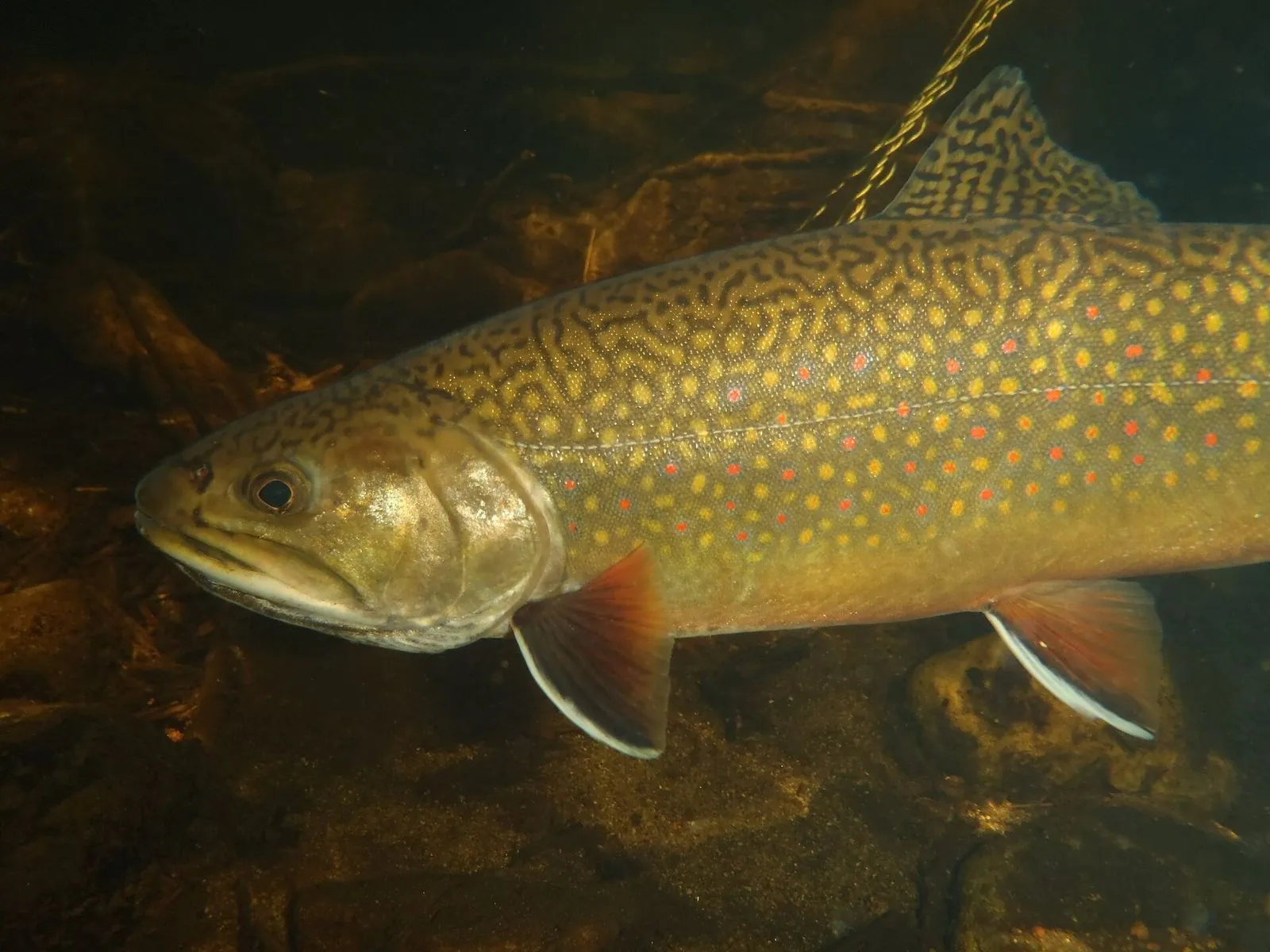 Trout Water Temperature: The 68 °F Line, Limits and Summer Refuges
Trout feed best at 55–65 °F and stress above 68 °F. The chart for five trout species, why anglers stop at 68, and where trout go when rivers warm.
Sources
- Wisconsin DNR, bluegill
- Minnesota DNR, sunfish biology
- Coutant, C. C. (1977), Compilation of temperature preference data, Journal of the Fisheries Research Board of Canada 34:739–745
- Hokanson, K. E. F. (1977), Temperature requirements of some percids and adaptations to the seasonal temperature cycle, Journal of the Fisheries Research Board of Canada 34:1524–1550
- Clarke, A. and Johnston, N. M. (1999), Scaling of metabolic rate with body mass and temperature in teleost fish, Journal of Animal Ecology 68:893–905
- Minnesota DNR, crappie biology