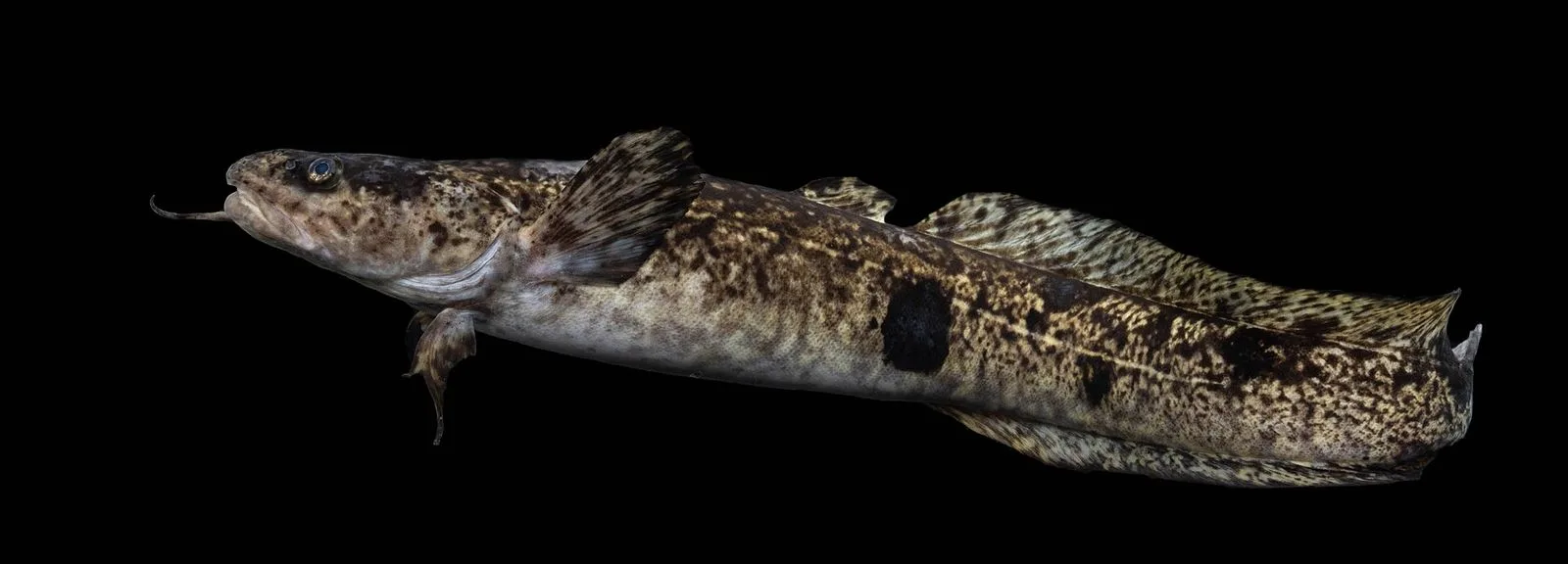
The burbot (Lota lota) is a cod that never sees the sea: the only member of the cod order that lives its whole life in fresh water. Most are 15 to 28 in (38–71 cm) and 1.5 to 5 lb (0.7–2.3 kg), mottled brown, slimy, with one whisker on the chin. Minnesota calls it eelpout, Wisconsin and Michigan call it lawyer, the West calls it ling and New England calls it cusk. Below: how to be sure what you caught, how big burbot get, why they bite best on the coldest nights of the year, and what they taste like.
Burbot spawn in midwinter, at night, under the ice, in a writhing ball of 20 to 50 fish. A 20 in female can carry about 800,000 eggs.
What is a burbot? One chin whisker, two back fins
Three marks identify a burbot, and the first is enough on most days.
- One barbel on the chin. A single soft whisker in the middle of the lower jaw. Catfish have several pairs around the mouth; a bowfin has none on the chin.
- Two dorsal fins. The first is short, the second runs half the length of the body, and the anal fin underneath is nearly as long.
- A rounded tail and skin that looks scaleless. The scales are there, but almost microscopic and buried in slime.
The fish it gets confused with are warm-water fish with one long back fin. In the Midwest “dogfish” means bowfin, so burbot against dogfish is the same question as burbot against bowfin.
| Mark | Burbot | Bowfin (dogfish) | Northern snakehead | Catfish |
|---|---|---|---|---|
| Chin barbel | One | None | None | Several pairs |
| Dorsal fin | Two: short, then very long | One long fin | One long fin | One short fin with a spine |
| Anal fin | Long | Short | Long | Short to medium |
| Scales | Tiny, hidden in slime | Obvious; none on the head | On body and head | None |
| Water | Cold and deep | Warm, weedy | Warm, shallow | Warm to cool |
The burbot, bowfin and snakehead columns follow Wisconsin DNR’s snakehead key and Michigan State University Extension. It matters beyond curiosity: snakeheads are invaders that agencies want killed and reported, and burbot and bowfin are natives that get killed by mistake.
As for “lawyer”, no agency offers an origin. Wisconsin Sea Grant notes the burbot’s habit of wrapping its slimy tail around the arm of whoever is holding it, and leaves the rest to the reader.
How big do burbot get?
| Where | Typical | Largest on record there |
|---|---|---|
| Alaska | 3–5 lb (1.4–2.3 kg) | 24 lb 12 oz (11.2 kg), Lake Louise, 1976 |
| Minnesota | Under 8 lb and 28 in (3.6 kg, 71 cm) | 19 lb 10 oz (8.9 kg), Lake of the Woods, 2016 |
| Lake Michigan (Illinois) | 15–22 in, 1–3 lb (0.5–1.4 kg) | About 12 lb (5.4 kg) |
| New Hampshire | 1.5–3 lb (0.7–1.4 kg) | About 12 lb (5.4 kg) |
| Kootenai River, Idaho | 16–20 in (41–51 cm) | 13.5 lb (6.1 kg), 33–35 in |
| Wyoming | Not given | 19.25 lb (8.7 kg), 44 in, 1965 |
| World (IGFA) | — | 25 lb 2 oz (11.4 kg), Saskatchewan, 2010 |
They get there slowly. In a Lake Superior study of 1,285 fish, a burbot was 16.1 in and 1.1 lb at age five and 23.4 in and 3.2 lb at age ten. Fish of 8 to 15 years are normal in the lower states, and Alaska reports that burbot older than 20 are not uncommon. Lake fish outgrow river fish.
Minnesota’s record came to a man fishing for walleye. He thought he had a monster; his friends filmed the fight and, according to the DNR, stopped filming when they saw it was “just a pout”.
Where burbot live
The burbot is one of only two freshwater fish found all the way around the top of the world. The other is the northern pike. In North America it lives from Alaska to New Brunswick and south to about the 40th parallel: Pennsylvania, Kentucky, Missouri, Wyoming and Oregon mark the edge, and along that edge it is disappearing.
It wants cold. Burbot avoid water warmer than about 55 °F (13 °C), spend summer below the thermocline of deep lakes alongside the lake trout, and are close to dormant until the water cools. In Bad Medicine Lake, Minnesota, tagged burbot sat in 30 to 40 ft (9–12 m) by day in winter and climbed into the shallows after dark.
Spawning under the ice
Burbot spawn between January and March, in water of 33 to 35 °F (0.5–1.7 °C), which in most of their range means under the ice. They gather at night over sand, gravel or rock and form what Alaska’s biologists call a large writhing ball; the Bad Medicine Lake study counted 20 to 50 fish in each. Eggs and milt go into open water, with no nest and no guarding.
The egg counts are enormous for the size of the fish. Eight Lake Superior females between 14.7 and 21.3 in held 268,800 to 1,154,000 eggs each. The fish also make noise: the U.S. Fish and Wildlife Service describes burbot drumming with muscles on the swim bladder during the spawn.
How to catch burbot
Late winter, after dark, on the bottom. Every source agrees on those three.
- When. Idaho Fish and Game finds the most adult burbot on the Kootenai from mid-February to mid-March, when they bunch up to spawn. Alaska adds an early window from just before freeze-up to late December. On Bad Medicine Lake the bite runs past midnight, and many anglers do not start until 7 p.m.
- Where. In-Fisherman’s Steve Hoffman describes rocky humps that top out at 15 to 20 ft (5–6 m) beside deep water: fish the deep edge in the afternoon, the base of the reef toward sunset, and the top of it from sunset to midnight. New Hampshire’s agency points to cobble bottoms and sand bars in 30 ft (9 m) or less, near islands and brook mouths.
- What. Heavy and bright: a ¾ to 1 oz (21–28 g) jig or jigging spoon, glow-painted, tipped with a minnow or a strip of cut fish. Lift it 6 to 10 in (15–25 cm) and let it fall back to the bottom. Stirring up the bottom helps, because a burbot hunts by feeling along it with that chin barbel.
- Bait. Fresh, never spoiled. Alaska lists whitefish, herring, smelt and squid, and notes that burbot will not feed on rotten food.
- Line. 10 to 14 lb abrasion-resistant line; rows of small teeth wear through anything lighter.
Alaska and New Hampshire also allow unattended set lines for burbot on listed waters, each with its own rules on hooks, labels and how often the line must be checked.
For forty winters the fish had its own party. The International Eelpout Festival on Leech Lake at Walker, Minnesota, began in January 1980 with about 800 people and drew some 15,000 a year at its height. The 40th, in February 2019, is the last on record.
What does burbot taste like?
Like a firm, mild white fish, and good enough that Montana’s field guide says anglers rate it tops for the table. The famous preparation gives it the name poor man’s lobster: chunks of fillet boiled, then dipped in melted butter. Cook it fresh: a Minnesota DNR biologist calls it worthy table fare when cooked fresh, not frozen.
The liver is the strange part. In Baudette, Minnesota, a pharmacist named Ted Rowell noticed that the foxes on his father’s fur farm grew beautiful coats on a diet of burbot, tested the liver oil and found it eight times as rich in vitamins A and D as cod liver oil. He founded the Burbot Liver Products Company in 1933. It became Rowell Laboratories.
Wisconsin advises up to one meal a week of Great Lakes burbot. Check your own state’s guide.
One fish, three legal lives
- Minnesota treated the eelpout as a rough fish until a law of 2020 made it a game fish. Its first limit, four fish, took effect on March 1, 2025.
- Idaho closed the Kootenai River burbot fishery in 1992. In 2004 biologists estimated about 50 fish were left. After a long recovery effort the river held 40,000 to 50,000, and the season reopened on January 1, 2019, at six fish a day.
- Utah and Wyoming have the opposite problem. Burbot were put illegally into the Green River system and reached Flaming Gorge. There is no limit, and in Utah an angler who catches one must kill it.
The records
The IGFA all-tackle record is 25 lb 2 oz (11.4 kg), caught by Sean Konrad in Lake Diefenbaker, Saskatchewan, on March 27, 2010, on herring. He was beating his own 19 lb 1 oz record from the same lake two years earlier.
The fish in the news in 2026 was not a world record. Mason Magee, 14, pulled a 23.04 lb (10.45 kg), 40 in burbot through 18 in of ice on Lake Nipigon, Ontario, on January 31. It is the Ontario record, about two pounds short of Konrad’s. “When I was fighting it,” he told a reporter, “I thought it might have been a lake trout.”
Related
- Other freshwater fish: sturgeon, gar, bowfin, drum and the rest of the fish outside the big families.
- Northern pike and muskie: the pike family; the northern pike is the other fish that circles the pole.
- Fish species: every species guide in one place.
Sources
- Alaska Department of Fish and Game, Burbot species profile: names, identification, size, age, diet, spawning
- Alaska Department of Fish and Game, What is a burbot? Ice-fishing handout: seasons, bait, set lines
- U.S. Fish and Wildlife Service, Burbot: the singsong gadoid
- USGS Nonindigenous Aquatic Species, burbot: native and introduced range
- Minnesota DNR, MinnAqua species profile: burbot
- New York State DEC, Species status assessment: burbot (2023): spawning temperature, range, maturity
- Wyoming Game and Fish Department, State Wildlife Action Plan: burbot
- Wyoming Game and Fish, Bye-bye burbot, Wyoming Wildlife (2025): the Green River introduction
- Montana Field Guide, burbot
- New Hampshire Fish and Game, Burbot/freshwater cusk
- New Hampshire Fish and Game, Cusk fishing in NH: locations, jigs, bait, line
- Wisconsin DNR, Did I catch a snakehead? Burbot, bowfin and snakehead compared
- Michigan State University Extension, Bowfin or faux-fin? The look-alike fish
- Illinois DNR, Family Gadidae: burbot
- Idaho Fish and Game (2018), New Kootenai River burbot fishery opens for anglers on Jan. 1
- Idaho Fish and Game (2020), Burbot fishing ramps up with peak spawning season in the Kootenai River
- Bailey (1972), Age, growth, reproduction and food of the burbot in southwestern Lake Superior, Transactions of the American Fisheries Society 101(4)
- Tony Kennedy, Harvest season possible for eelpout, a fish on the rise, Star Tribune (2021): the Bad Medicine Lake study
- Brainerd Dispatch (2017), Shout-out for pout: new Minnesota state burbot record
- Steve Hoffman, How to catch burbot, In-Fisherman (2024)
- MNopedia, Minnesota Historical Society: International Eelpout Festival, Walker
- Historical Marker Database, Theodore H. Rowell marker, Baudette, Minnesota
- Wisconsin Sea Grant, Eat Wisconsin Fish: burbot
- Grand View Outdoors, IGFA hot catches for June 2010 (the world record)
- SNNewsWatch (2026), Giant Lake Nipigon burbot smashes provincial record
- Utah Division of Wildlife Resources, 2026 Utah fishing guidebook: burbot must be killed