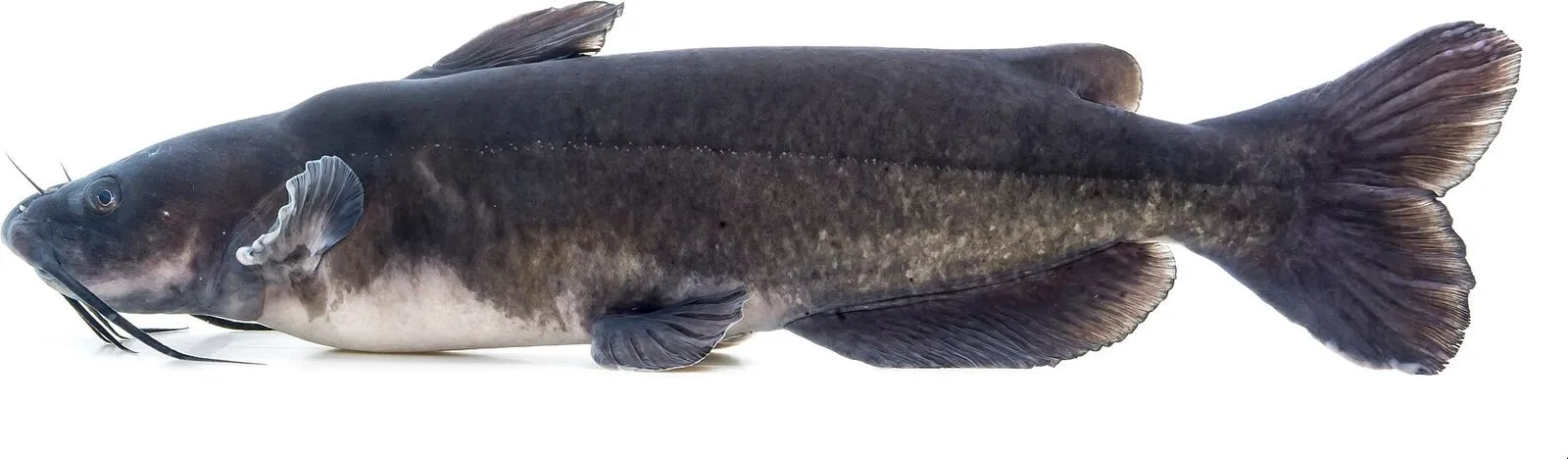
Catfish feed hardest in water of 75–85 °F (24–29 °C), and that one range covers channel, blue and flathead catfish alike. The three species part ways at the cold end and in the spawn. A channel catfish quits eating near 50 °F (10 °C), a flathead barely eats below 43 °F (6 °C), and a blue catfish keeps biting through the coldest month of the year. The full chart for 26 species is on the water temperature chart.
Channel catfish stop feeding near 50 °F (10 °C), flatheads shut down at 43 °F (6 °C), and blue catfish bite all winter. Winter catfishing is a blue-cat game.
Where is each catfish at your water temperature?
The bands in the table are water temperature, taken where the bait will sit, not the air and not the surface. Southern reservoirs run through the sequence a month or two ahead of northern rivers.
| Water | Channel catfish | Blue catfish | Flathead catfish | How to fish it |
|---|---|---|---|---|
| Below 43 °F (6 °C) | Off the feed, in the deepest holes | Slow but catchable; the biggest fish of the year | Dormant in deep holes | Anchor cut shad on deep outside bends; afternoons; give a spot an hour |
| 43–50 °F (6–10 °C) | A rare fish, nearly always in a river | Feeding on cut bait in deep water | Little feeding | Slip-sinker rig, fresh cut bait, warmest hours of the day |
| 50–70 °F (10–21 °C) | Feeding builds; good from about 65 °F (18 °C) | Feeding, moving shallower as it warms | Active above 50 °F; pre-spawn feed from the 60s | Cut bait on flats and channel edges that warm first; evenings lengthen |
| 70–75 °F (21–24 °C) | Pre-spawn peak, the easiest fishing of the year | Spawn begins; fish move to rock and wood in shallow water | Pre-spawn peak; spawn starts near 72 °F (22 °C) | Slip float over rocky banks; live shad for blues this month only |
| 75–85 °F (24–29 °C) | Spawn at 75–80 °F, then a post-spawn feed; night bite all summer | Post-spawn feed; comfort range | Spawn at 75–80 °F; hunts at night | Night fishing; punch bait for channel numbers, cut bait for size, live bluegill for flatheads |
| Above 85 °F (29 °C) | Still grows fastest here; feeds in low light | Feeds under bait schools and in current | Feeds at night in current | Dawn, dusk and dark; current and wind-blown banks where the oxygen is |
When do catfish start biting in spring?
The spring question has three answers, one per species. Blue catfish never stopped. Channel catfish show as the water climbs through the 50s and become reliable once it holds above 65 °F (18 °C). The pre-spawn weeks at 70–75 °F (21–24 °C) are the easiest channel-cat fishing of the year. Flatheads join from 50 °F (10 °C) and feed hardest in the 60s and low 70s before the spawn.
“Do catfish bite in 50-degree weather” is a question about air, and catfish live in water. Water lags air by days to weeks. A week of 50-degree afternoons in March leaves most water in the 40s: blue-cat water, and channel water only in a river where the fish stack in the deep holes. The same 50-degree afternoon in October sits over water still in the 60s, and every catfish in the lake is eating. Read the water, not the forecast.
Two more rules. A warming trend beats a stable higher reading: three warming days at 52 °F (11 °C) fish better than a flat 58 °F (14 °C) after a cold front. And take the reading at the fish. A shallow spring bay warms 5–8 °F (3–4 °C) between dawn and mid-afternoon, and a summer lake can be 82 °F (28 °C) on top and 60 °F (16 °C) at 15 ft (4.6 m).
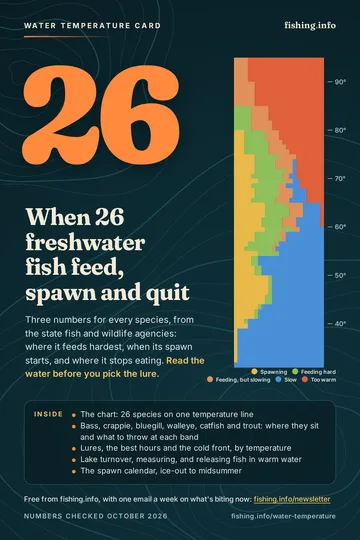
Free card: what 26 species do at your water temperature
Plus one email a week on what's biting now. No sales pitches. Privacy.
Why does the bite die in early summer?
It is the spawn. Channel catfish spawn when the water reaches about 75 °F (24 °C), late May into July, in a cavity the male guards. The eggs hatch in about a week and the fry stay in the nest another week. A nesting male is off the feed for two weeks or more, and the anchored bait in the usual hole goes quiet. That is the lull, and it is temperature, not weather or moon.
The fix is to fish the fish that are not in the nest. A slip float holding a bait just off the bottom along a rocky bank in 2–6 ft (0.6–1.8 m) finds the males between nests and the females that have finished. Blue catfish spawn a few degrees earlier, at 70–75 °F, and the spawn month is the one time the guides switch from cut bait to live shad. Flatheads follow at 72–80 °F (22–27 °C). A flathead guarding a hollow log is the fish the noodlers pull out by hand.
When do catfish stop biting, and where are they in winter?
Channel catfish feeding ends near 50 °F (10 °C), and the fall bite fades as the water falls through the 50s in October and November. Flatheads go earlier: below 50 °F they feed little, below 43 °F (6 °C) hardly at all. The September and October feed before that is the best flathead fishing of the year. Blue catfish slow below 55 °F (13 °C) but never stop. The month-by-month calendar on the blue catfish page, from a Tennessee River guide, starts in January at 36–38 °F (2–3 °C).
So a winter catfish trip is a blue-cat trip, and it can be fished from the bank. Look for the deepest water reachable from shore: the outside of a river bend where the bank drops steeply, the tailrace below a dam, a bridge hole, a creek mouth in high water. Fish the afternoon after two or three sunny days. Anchor a slip-sinker rig with the lightest sinker that holds bottom, keep the leader short, and give a spot an hour. A river beats a lake in winter, because current keeps the fish in predictable holes.
The cold-water bait is the one that runs all year for blues: fresh cut shad or skipjack herring, the oilier the better, hooked once through the skin with the point clear. Stink and punch baits are channel-cat baits for warm water; they sort for small fish and go stiff in the cold. For the few channel cats a cold river gives up, cut bait wins too, and a dip bait beats a punch bait. The best catfish bait page ranks them.
Reading the thermometer for catfish, step by step
- Take the temperature where the bait will sit. A thermometer on a cord, lowered to the bottom of the hole, not the surface reading on the sonar. The two can differ by 20 °F (11 °C) in July.
- Find the band in the table. Below 50 °F (10 °C) is blue-cat water; 50–70 °F (10–21 °C) is cut-bait water for all three as the feed builds; 70–85 °F (21–29 °C) is the spawn and the summer night bite.
- Pick the species the band favors. In the 40s do not waste a night on flatheads; in the 70s the pre-spawn channel cats are the sure thing.
- Pick the bait for the band. Cut shad below 60 °F (16 °C) and for every blue; punch or dip bait for channel numbers from 65 °F (18 °C) up; live bluegill for flatheads once the water passes 60 °F.
- Pick the depth from the water, not the calendar. Cold water sends catfish to the deepest holes and mud bottoms; warming water pulls them onto the first flats that heat up; summer puts them deep by day and shallow at night.
- Check the trend. Three warming days beat one warm one. After a cold front, fish deeper and slower for two days, whatever the reading says.
- Time it. Afternoons in cold water, evenings in the 60s, full dark once the water is above 75 °F (24 °C).
Why do the three catfish differ?
A catfish is cold-blooded, so its appetite tracks the water. Metabolic rate roughly doubles with every 18 °F (10 °C) of warming and halves with every 18 °F of cooling. A channel cat at 60 °F (16 °C) needs about half the food it needs at 78 °F (26 °C).
The aquaculture research on the channel catfish is the most precise. Growth is best at about 85 °F (29 °C), slow below 65 °F (18 °C), and feeding stops below about 50 °F (10 °C). Channel cats survive from just above freezing to nearly 100 °F (38 °C), so the fish are there in winter; they just do not eat. Texas Parks and Wildlife puts the spawn at 75 °F (24 °C); the aquaculture literature gives 75–85 °F (24–29 °C), optimum near 80 °F (27 °C).
The blue catfish spawns cooler. Virginia’s wildlife agency records blues moving to spawning areas at 70–75 °F (21–24 °C); Oklahoma says 75 °F (24 °C). No agency publishes a cold cutoff for blues, because there is not much of one. The anglers’ rule of thumb is that they slow below 55 °F (13 °C), and the guides catch the biggest fish of the year from November to March.
The flathead catfish is the true warm-water fish of the three. Texas puts its spawn at 75–80 °F (24–27 °C), Minnesota at 72–75 °F (22–24 °C). Flatheads feed most actively above 50 °F (10 °C) and little or not at all below 43 °F (6 °C), and they tolerate water in the low 90s. Bullheads sit with the flathead: comfort at 75–85 °F, spawn at 70–77 °F (21–25 °C), stress above 90 °F (32 °C).
The species profiles behind these numbers are on the catfish hub. The water temperature chart sets catfish beside the other species, 10 °F (6 °C) above the bass and 20 °F (11 °C) above the trout.
Free download
The water temperature card
Read your water temperature and the card tells you who is spawning, who is feeding and what to throw. 26 species, 16 pages, for your phone and the tackle box.
Plus one email a week on what's biting now. No sales pitches. Privacy.
Related
Section guide
Ideal Water Temperature for Fish: The Chart for 26 Freshwater SpeciesMost freshwater fish bite best at 65–75 °F, trout at 50–65 °F, catfish at 75–85 °F. One chart for 26 species: feeding range, spawn and shutdown.
 Lake Water Temperature: How to Find It Before You Go
Four ways to know your lake's water temperature before you go: live USGS and NOAA sensors, satellite maps, your own thermometer, and the air-temperature rule.
 Lake Turnover: How Fall Mixing Works and Where the Fish Go
Lake turnover is the fall mixing that ends the summer thermocline: what sets it off, how long it lasts, seven signs it happened, where the fish go.
 Bass Water Temperature: Spawn, Bite and What to Throw at Each Band
Bass bite best at 65–80 °F and spawn at about 60 °F. A band-by-band table of where bass sit, what to throw and how fast, from 40-degree water to summer heat.
 Bluegill Spawn Temperature: 67–80 °F, and How to Find the Beds
Bluegill spawn at 67–80 °F (19–27 °C), in waves from late May into August in the north and longer in the south. Where the beds are and how to fish them.
 Crappie Spawn Temperature: When They Move Up, How Deep, How Long
Black crappie spawn at 58–68 °F, white crappie at 60–70 °F: when they move up, how deep by water clarity, one spawn a year, and the fall bite.
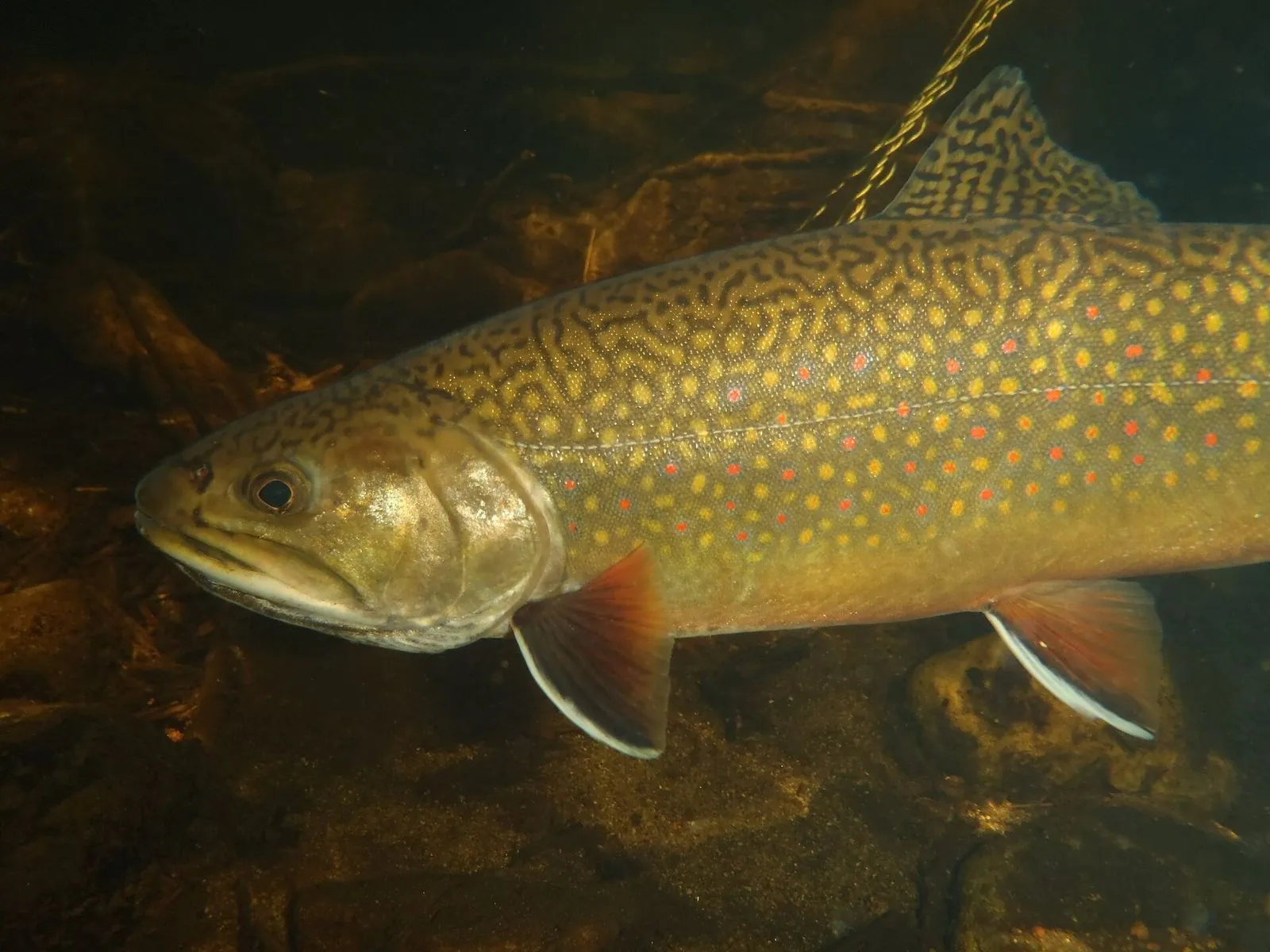 Trout Water Temperature: The 68 °F Line, Limits and Summer Refuges
Trout feed best at 55–65 °F and stress above 68 °F. The chart for five trout species, why anglers stop at 68, and where trout go when rivers warm.
Sources
- Texas Parks and Wildlife, channel catfish species profile
- Texas Parks and Wildlife, flathead catfish
- SRAC Publication 180, Channel catfish: life history and biology
- Mississippi State University Extension, biology of catfish
- Virginia Department of Wildlife Resources, blue catfish
- Oklahoma Department of Wildlife Conservation, blue catfish
- Wisconsin DNR (2016), Distribution, biology and management of Wisconsin's ictalurids
- Wisconsin DNR, bullheads (fact sheet)
- Clarke, A. and Johnston, N. M. (1999), Scaling of metabolic rate with body mass and temperature in teleost fish, Journal of Animal Ecology 68:893–905