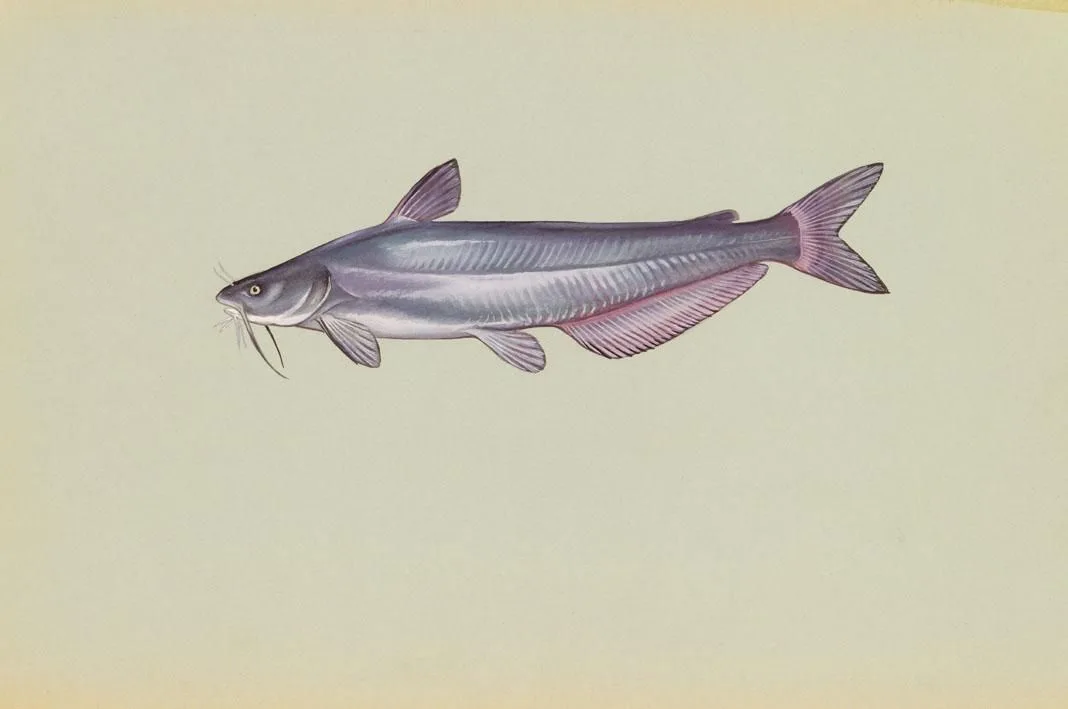
The blue catfish, Ictalurus furcatus, is the largest catfish in North America and the one that produces the fish anglers travel for: the 143 lb world record came from a Virginia reservoir in 2011, and fish over 100 lb are weighed most years from the Mississippi, the Tennessee and the tidal rivers of the Chesapeake. It is a river fish by nature, a fish of current, sand and gravel, that grows faster than the channel catfish and lives to 25. It is also, east of the Appalachians, one of the most consequential invasive species in American water. Below: the identification rule, the habitat and the Chesapeake story, the spawning and growth numbers, a month-by-month season from the guide who wrote the standard calendar, and the records, each with its source.
The world record blue catfish weighed 143 lb and came from Kerr Lake, Virginia, in 2011. Fish over 100 lb are weighed most years from the Mississippi, the Tennessee and the tidal rivers of the Chesapeake.
Identification
Big channel catfish lose their spots and small blue catfish are not blue, so the color rule fails at both ends. The anal fin settles it. A blue catfish has 30–35 rays on a fin whose outer edge is straight, so the fin looks squared; a channel catfish has 24–29 rays on a rounded fin. Texas puts it as simply as it can be put: the blue “always has 30 or more”. The other marks support that one: a back that is “steeply sloping and straight” from the dorsal fin to the head, giving the fish a wedge-shaped profile, a pale bluish-silver color above and silvery white below, and no dark spots at any age. The tail is deeply forked, as on a channel; the flathead’s square tail rules it out at a glance.
| Mark | Blue catfish | Channel catfish | Flathead catfish |
|---|---|---|---|
| Anal fin rays | 30–35 | 24–29 | 14–17 |
| Anal fin edge | Straight | Rounded | Short and rounded |
| Spots | None | Scattered dark spots on most fish | None; mottled |
| Back profile | Steep, straight, wedge-shaped | Gently curved | Flat head, long body |
| Tail | Deeply forked | Deeply forked | Squared, slight notch |
| Common size | 20–44 in (51–112 cm), 3–40 lb (1.4–18 kg) | 12–32 in (30–81 cm), 1–15 lb (0.5–6.8 kg) | 15–45 in (38–114 cm), 1–45 lb (0.5–20 kg) |
Where they live
The native range is the Mississippi, Missouri, Ohio and Rio Grande basins, from Pennsylvania to South Dakota and south to the Gulf. Missouri’s field guide describes the water they choose: “swift chutes, pools with noticeable current, and silt-free substrates of sand, gravel, and rubble”, and the species prefers depths beyond about 20 ft (6 m) where it can find them. Big rivers and the reservoirs on them are the classic water; the fish also tolerates brackish water to about 15 parts per thousand, which is the reason it thrives in tidal estuaries.
That tolerance is the Chesapeake story. Virginia stocked blue catfish in the James and Rappahannock rivers in 1974 and the York in 1985 for sport, and NOAA counts nearly twenty states that have stocked them. By 2023 they were in every Virginia tributary of the Chesapeake Bay and spreading through Maryland’s. The University of Maryland’s fact sheet puts blue catfish at up to three quarters of the fish biomass in the James, Rappahannock and York, a James River study estimated 1.6 million fish in a 12 km (7.5 mile) stretch, and electrofishing crews have taken “upwards of 6,000 fish in an hour” where the native-range peak is about 700. The fish eat 8–9% of their body weight a day, including menhaden, river herring and, by one estimate, some 400 tonnes of blue crab a year. The response is harvest: watermen landed more than 5 million lb (2.3 million kg) in 2017, Virginia’s wildlife agency “encourages the harvest of small Blue Catfish, following consumption advisories”, and Maryland has no limit at all. For an angler in those states the rule is the reverse of everywhere else: keep them.
Season and behavior
Blue catfish spawn in late spring and early summer, in Virginia’s data when the water reaches 70–75 °F (21–24 °C), late May into June; a female produces 2,000 to 4,000 eggs per pound of body weight, so a 10 lb (4.5 kg) fish lays more than 20,000, in a cavity nest 6–14 in (15–36 cm) across guarded by the male. Eggs hatch in six to ten days.
The calendar below is Jim Moyer’s, a Tennessee River guide, as published in In-Fisherman, and is quoted as his. It is the most detailed temperature-keyed blue catfish calendar in print and it explains the pattern that every blue-cat angler learns: the biggest fish bite in the cold.
| Month | Water temperature | Where | How |
|---|---|---|---|
| January | 36–38 °F (2–3 °C) | Outside channel bends with mud bottom, 30–45 ft (9–14 m); “mud holds heat better than rocks” | Carolina rig, 3–5 oz (85–142 g) sinker, cut skipjack |
| February | Upper 30s to low 40s °F (3–6 °C) | Fast-sloping banks with wood; 15–25 ft (5–8 m) in warm snaps | Bottom rigs, afternoons |
| March | 45–48 °F (7–9 °C) | Outer edges of rocky channel banks; creek mouths in high water | Cut bait 15–30 ft (5–9 m), up to 8 oz (227 g) in current |
| April | About 50 °F (10 °C) | Rocky channel banks 10–15 ft (3–5 m) | Jugs with live shad; smaller fish |
| May | Mid-60s to low 70s °F (18–22 °C), spawn at 70–73 °F | 1–5 ft (0.3–1.5 m) around rock and wood | Cork rigs, live shad or crawlers |
| June | Mid-70s °F (24 °C) | Steep rocky and woody banks 20–30 ft (6–9 m) | Live 6–8 in (15–20 cm) gizzard shad at night |
| July | 80–85 °F (27–29 °C) | Under schools of white bass | Slip-cork rig 10–14 ft (3–4 m), live shad |
| August | 80–90 °F (27–32 °C) | Backs of big bays | Jugs with shrimp; “real bad month” |
| September | Mid to high 70s °F (24–26 °C) | Steep banks, tributary junctions 10–12 ft (3–4 m) | Drifted cork rigs and jugs |
| October | About 60 °F (16 °C) | Outside bends with timber 20–30 ft (6–9 m) | Heavy bottom gear, cut bait |
| November | Mid to low 50s °F (10–13 °C) | Outside bends, snaggy wood 20–40 ft (6–12 m) | Cut bait; “when I start catching multiple heavyweight blues on each trip” |
| December | Low 50s to 40s °F (4–11 °C) | Mud-bottom ledges with cover 20–40 ft (6–12 m) | Anchored cut bait, 60–90 minutes per spot |
How to catch them
The bait rule for blue catfish is fresh cut fish, and the guides are unanimous: shad and skipjack herring first, “the oilier the fish the better”, with cut carp, drum, buffalo and bluegill behind; fresh beats frozen every time, and live bait offers no advantage over fresh dead bait except in the spawning month. The rig is a slip-sinker rig or its drifting cousin the Santee Cooper rig, with a peg float on the leader to lift the bait off the bottom; in tidal rivers Virginia’s agency suggests ¾–1½ oz (21–43 g) of lead, in the big reservoirs and rivers of the Moyer calendar 3–8 oz (85–227 g). Hooks are 5/0–8/0 circle hooks for chunks and up to 10/0 for heads, on a 7–10 ft rod with a strong butt and a soft tip and 30–65 lb line; the catfish hub has the rig table and the hooks hub the sizes. Anchor on the structure the calendar names, give a spot an hour, and move.
Size, age and records
Blue catfish grow fast for a catfish and live long. The James River data in the Animal Diversity Web account puts a fish at 3 lb (1.4 kg) at eight years and 20 lb (9 kg) at eleven; Virginia’s agency gives an average lifespan of nine to ten years and a maximum of 25, and the 2018 study of four Virginia tidal rivers found a maximum observed age of 25. A 100 lb fish is therefore an old one, most likely twenty years or more, and the fisheries agencies’ point about releasing the biggest fish rests on that arithmetic.
| Fish | Weight | Age or note | Source |
|---|---|---|---|
| Maturity | 5 lb (2.3 kg) | 4–7 years, 14–26 in (36–66 cm) | Animal Diversity Web |
| James River growth | 3 lb (1.4 kg); 20 lb (9 kg) | 8 years; 11 years | Animal Diversity Web |
| Common adult | 3–40 lb (1.4–18 kg) | – | Missouri Department of Conservation |
| Lifespan | – | 9–10 years average, maximum 25 | Virginia DWR; SEAFWA 2018 |
| Maryland record | 84 lb (38 kg) | Potomac River, 2012 | Chesapeake Bay Program |
| Virginia record before 2011 | 102 lb (46 kg) | James River, 2009 | Chesapeake Bay Program |
| World record | 143 lb (64.9 kg), 57 in (145 cm), girth 44–47 in (112–119 cm) | Kerr Lake (Buggs Island), Virginia, 18 June 2011 | IGFA via Outdoor Life |
The record fish was caught by Richard Nicholas Anderson, drifting a piece of chicken on 30 lb line and a spincast reel; it beat a 124 lb fish from the Mississippi River caught in 2005, and Anderson tried to keep it alive in a 250-gallon tank, where it died the next day. Missouri’s guide notes 19th-century reports of blue catfish “over 300 pounds”; treat those as reports, not records. Regulations vary by state: Texas allows 25 blue and channel catfish a day combined with only 10 over 20 in on most water and tighter trophy rules on a dozen reservoirs, while Virginia and Maryland ask anglers to keep what they catch. The state pages carry the current rules.
Related
The catfish hub covers all the species, the baits and the rigs; the channel catfish page is the comparison most readers need and the flathead catfish page the other giant; the rods hub covers the heavy tackle.
Sources
- Missouri Department of Conservation, blue catfish field guide
- Virginia DWR, blue catfish
- NOAA Fisheries, blue catfish
- University of Maryland Extension FS-1142, Chesapeake Bay blue catfish
- SEAFWA Journal 2018, Natural mortality and size structure of introduced blue catfish in Virginia tidal rivers
- In-Fisherman, Blue catfish seasons (Jim Moyer)
- Outdoor Life, the biggest North American catfish of all time