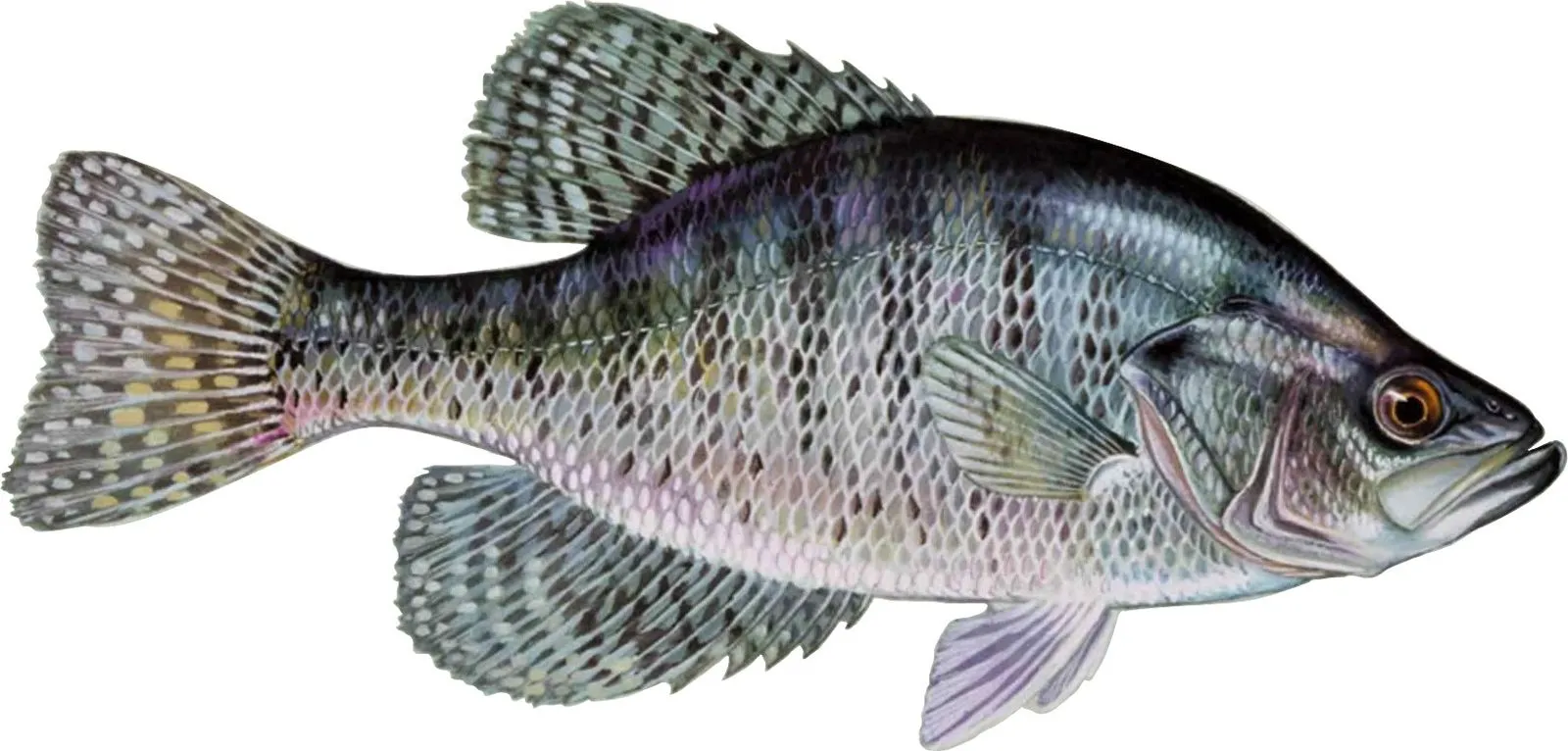
Crappie spawn when the water reaches 58–68 °F (14–20 °C) for black crappie and 60–70 °F (16–21 °C) for white crappie. In Texas, black crappie start at about 60 °F (16 °C) and white crappie at 65–70 °F (18–21 °C), and white crappie there have been recorded spawning at 56 °F (13 °C). In Minnesota both species spawn in the mid-60s, in May and June. The nests usually sit in 3–10 ft (0.9–3 m) of water, shallower in stained water and deeper in clear.
A large female crappie carries well over 100,000 eggs, and the males build and guard their nests in colonies. Find one bed and you have found dozens.
Black or white: which spawns first?
The two species are often caught from the same brush pile, but they do not spawn on the same day. Black crappie start first, at about 60 °F (16 °C). White crappie generally wait for 65–70 °F (18–21 °C), though the 56 °F (13 °C) observation shows how ragged the edge of that band is. One more detail finds the beds: black crappie prefer deeper, cooler, clearer water than white crappie do.
So a lake with both species runs two spawns a week or two apart, black crappie first and slightly deeper, white crappie later and shallower. An angler who sees beds on the same bank for three weeks has usually watched two species take turns.
Where are the crappie at each temperature?
The bands combine the agency spawn figures with the feeding range and stress point from the water temperature chart. Crappie feed hardest at 65–75 °F (18–24 °C).
| Water temperature | Stage | Where the crappie are | Presentation |
|---|---|---|---|
| Below 50 °F (10 °C) | Winter | Suspended in schools over creek channels and the deep basin, often near the bottom | A small jig held still on marked fish; slow vertical drops |
| 50–55 °F (10–13 °C) | Pre-spawn staging | The first drop outside a spawning cove: channel bends, points, deep brush | A jig or minnow under a float, moved slowly along the drop |
| 56–60 °F (13–16 °C) | First movers | Black crappie on shallow cover in the warmest, most stained coves; white crappie still staging | Cast a light jig to visible cover; work stained water first |
| 60–70 °F (16–21 °C) | Spawn peak | Beds in 3–10 ft (0.9–3 m), as shallow as 1–2 ft (0.3–0.6 m) in muddy coves, on brush, reeds, stumps and dock posts; males on the nests | A jig under a float set to bed depth; a minnow on a light hook |
| 70–80 °F (21–27 °C) | Post-spawn to summer | Back on the first drop, then deep brush piles and suspended along channel edges | Vertical jigging over cover; spider rigging; low-light fishing |
| Above 80 °F (27 °C) | Summer stress | Deep and suspended, near the thermocline, feeding at night, dawn and dusk | Fish the low-light hours; count the jig down to the school |
| Cooling through the 60s (16–21 °C) | Fall feeding | Moving back up creek arms, chasing shad, holding on mid-depth cover | Cast and swim a jig or small plastic; cover water until the school shows |
The 50–55 °F (10–13 °C) row is where the season is won: staged fish are grouped and hungry, and nobody is fishing for them yet. And the fall row is not a second spawn. It is the same fish coming back through their comfort band on the way down.
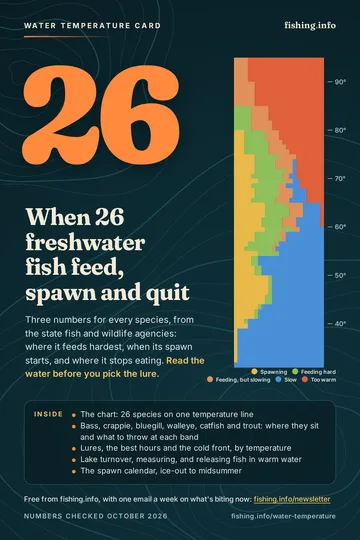
Free card: what 26 species do at your water temperature
Plus one email a week on what's biting now. No sales pitches. Privacy.
When do crappie spawn? The month, state by state
The month depends on how far north the lake is. Three state agencies put dates on it, and together they cover the country from the mid-South to the Canadian border.
| State | When crappie spawn | Water temperature the agency names |
|---|---|---|
| Missouri, south | From mid-March | About 55 °F (13 °C) |
| Oklahoma | Early to mid April through mid-May | 55–65 °F (13–18 °C) |
| Missouri, north | Until the end of May | About 55 °F (13 °C) |
| Minnesota | May and June | Mid-60s (about 18 °C) |
Missouri alone spans ten weeks from its southern lakes to its northern ones. So treat the calendar as the week to start checking, and let the thermometer make the call: once the cove you fish holds 58 °F (14 °C) or more, start looking for beds.
Do crappie spawn twice a year?
No. Crappie spawn once a year, in spring, when the water warms into their band. It looks long, and sometimes looks like two spawns, for three reasons.
First, depth and shoreline. A shallow, stained bay hits 60 °F (16 °C) weeks before the main lake does. Crappie in that bay spawn while fish on the clear main-lake points are still staging. Fish the whole lake and you see beds for six weeks; each bed lasted a fraction of that.
Second, cold fronts. A front that knocks a cove from 62 °F (17 °C) to 55 °F (13 °C) pushes the crappie back to the first drop for a few days. When the water warms they move up again, and the angler who missed the first push sees a “second spawn.”
Third, latitude. Hokanson showed that northern populations of perch and walleye spawn at lower temperatures than southern ones. The crappie agencies do not agree on the degree: Texas says 60 °F (16 °C), Minnesota the mid-60s. The calendar is what matters. Texas and the Gulf states reach those water temperatures in March, the mid-South in April, the northern tier in May. An angler who fishes across states meets the spawn three or four times a spring, always once per lake.
The fall bite is the other half of the myth. From September the surface cools back through 75 °F (24 °C) and into the 60s, and crappie that spent summer deep move into the creek arms to feed on shad. Same depth as spring, similar temperature, same aggression, but no beds, no colonies of males, no eggs.
How deep do crappie spawn?
Crappie nests usually sit in 3–10 ft (0.9–3 m) of water, built and guarded by males in colonies. Iowa’s DNR finds them anywhere from 1 to 20 ft (0.3–6 m) deep. Where inside that range depends on how far light reaches, which is a question of water clarity.
In stained or muddy water the beds are shallowest, as shallow as 1–2 ft (0.3–0.6 m) by Missouri’s account, often right against the bank on the first reed stem or laydown. In clear water the same fish push to the deep end of the range, 20 ft (6 m) or more in exceptionally clear lakes, and black crappie, the clearer-water species of the two, sit deepest of all. The practical rule: the farther down you can see your jig, the deeper the beds.
Cover matters as much as depth. Crappie nest on or beside something: flooded brush, reeds, stumps, dock posts, laydowns. A bare gravel bank that bluegill would use often holds no crappie beds at all.
How to find the spawn, step by step
- Read the water temperature in the afternoon, not at dawn. A spring bay warms 5–8 °F (3–4 °C) between sunrise and mid-afternoon, and the afternoon number is the one the crappie answer to. Start on the north shore, which takes the most sun.
- At 50–55 °F (10–13 °C), fish the doors, not the rooms. Staged fish sit on the first drop outside a spawning cove: a channel bend, a point, a brush pile. A 1/16 oz jig head with a small soft plastic under a float, moved slowly along the drop, is the crappie default; the crappie jigs guide matches the head weight to the depth.
- At 56–60 °F (13–16 °C), check the warmest stained cove for black crappie. They are the first up. Cast to visible cover in 2–4 ft (0.6–1.2 m) in the dirtiest water you can find.
- At 60–70 °F (16–21 °C), fish cover at the depth the clarity dictates. Shallow and tight to the bank in muddy water; out to 8–10 ft (2.4–3 m) in clear water, and deeper still in exceptionally clear lakes. Set the float so the jig hangs just above the bed; males on nests hit anything that hovers over the eggs. The crappie rigs page shows the slip float that sets that depth exactly.
- After a cold front, go back to step two. The fish that were on beds are on the first drop again. They return when the water warms; you return with them.
- When the beds empty above 70 °F (21 °C), follow the fish to the first drop, then deeper. Post-spawn crappie stack on the staging cover they used on the way in, then slide out to summer brush and channel edges as the water passes 75 °F (24 °C).
- Fish light line. Crappie inhale a jig and spit it in a second; 4–6 lb monofilament shows the bite and lets a 1/16 oz jig fall naturally.
Where do crappie go in summer, and when does the fall bite start?
Crappie are a 65–75 °F (18–24 °C) fish, and once the surface passes 80 °F (27 °C) they leave it. Coutant’s compilation lists the black crappie’s upper avoidance at 79–86 °F (26–30 °C) and the white crappie’s at about 81 °F (27 °C). In a stratified summer lake the schools drop to the thermocline and to deep brush. Crappie travel open water in schools and feed at night, dawn and dusk, which is why the summer bite belongs to the low-light hours and the lit dock.
The fall bite starts when that ceiling lifts. As the surface cools back below 75 °F (24 °C) the fish move up, and every degree lower through the 60s puts more of them on mid-depth cover in the creek arms. A fish’s metabolic rate roughly doubles for every 18 °F (10 °C) of warming, so crappie at 68 °F (20 °C) eat far more often than crappie at 50 °F (10 °C). That makes the fall run through the comfort band the last big feeding window before the water drops out of it. Below 50 °F (10 °C) the schools settle back over the channels, and the year is back at the first row of the table.
For the other species, the water temperature chart gives the spawn, comfort and stress numbers side by side, and the species pages carry the rest.
Free download
The water temperature card
Read your water temperature and the card tells you who is spawning, who is feeding and what to throw. 26 species, 16 pages, for your phone and the tackle box.
Plus one email a week on what's biting now. No sales pitches. Privacy.
Related
Section guide
Ideal Water Temperature for Fish: The Chart for 26 Freshwater SpeciesMost freshwater fish bite best at 65–75 °F, trout at 50–65 °F, catfish at 75–85 °F. One chart for 26 species: feeding range, spawn and shutdown.
 Lake Water Temperature: How to Find It Before You Go
Four ways to know your lake's water temperature before you go: live USGS and NOAA sensors, satellite maps, your own thermometer, and the air-temperature rule.
 Lake Turnover: How Fall Mixing Works and Where the Fish Go
Lake turnover is the fall mixing that ends the summer thermocline: what sets it off, how long it lasts, seven signs it happened, where the fish go.
 Bass Water Temperature: Spawn, Bite and What to Throw at Each Band
Bass bite best at 65–80 °F and spawn at about 60 °F. A band-by-band table of where bass sit, what to throw and how fast, from 40-degree water to summer heat.
 Bluegill Spawn Temperature: 67–80 °F, and How to Find the Beds
Bluegill spawn at 67–80 °F (19–27 °C), in waves from late May into August in the north and longer in the south. Where the beds are and how to fish them.
 Catfish Water Temperature: When Channels, Blues and Flatheads Bite
Catfish feed hardest at 75–85 °F. The water temperatures where channel, blue and flathead catfish start biting, spawn and quit, and how to fish each band.
 Trout Water Temperature: The 68 °F Line, Limits and Summer Refuges
Trout feed best at 55–65 °F and stress above 68 °F. The chart for five trout species, why anglers stop at 68, and where trout go when rivers warm.
Sources
- Texas Parks and Wildlife, black crappie
- Texas Parks and Wildlife, white crappie
- Iowa DNR, white crappie (nest depth)
- Minnesota DNR, crappie biology and identification
- Coutant, C. C. (1977), Compilation of temperature preference data, Journal of the Fisheries Research Board of Canada 34:739–745
- Hokanson, K. E. F. (1977), Temperature requirements of some percids and adaptations to the seasonal temperature cycle, Journal of the Fisheries Research Board of Canada 34:1524–1550
- Clarke, A. and Johnston, N. M. (1999), Scaling of metabolic rate with body mass and temperature in teleost fish, Journal of Animal Ecology 68:893–905
- Missouri Department of Conservation, Crappie: tips for fishing
- Oklahoma Department of Wildlife Conservation, Crappie angler guide