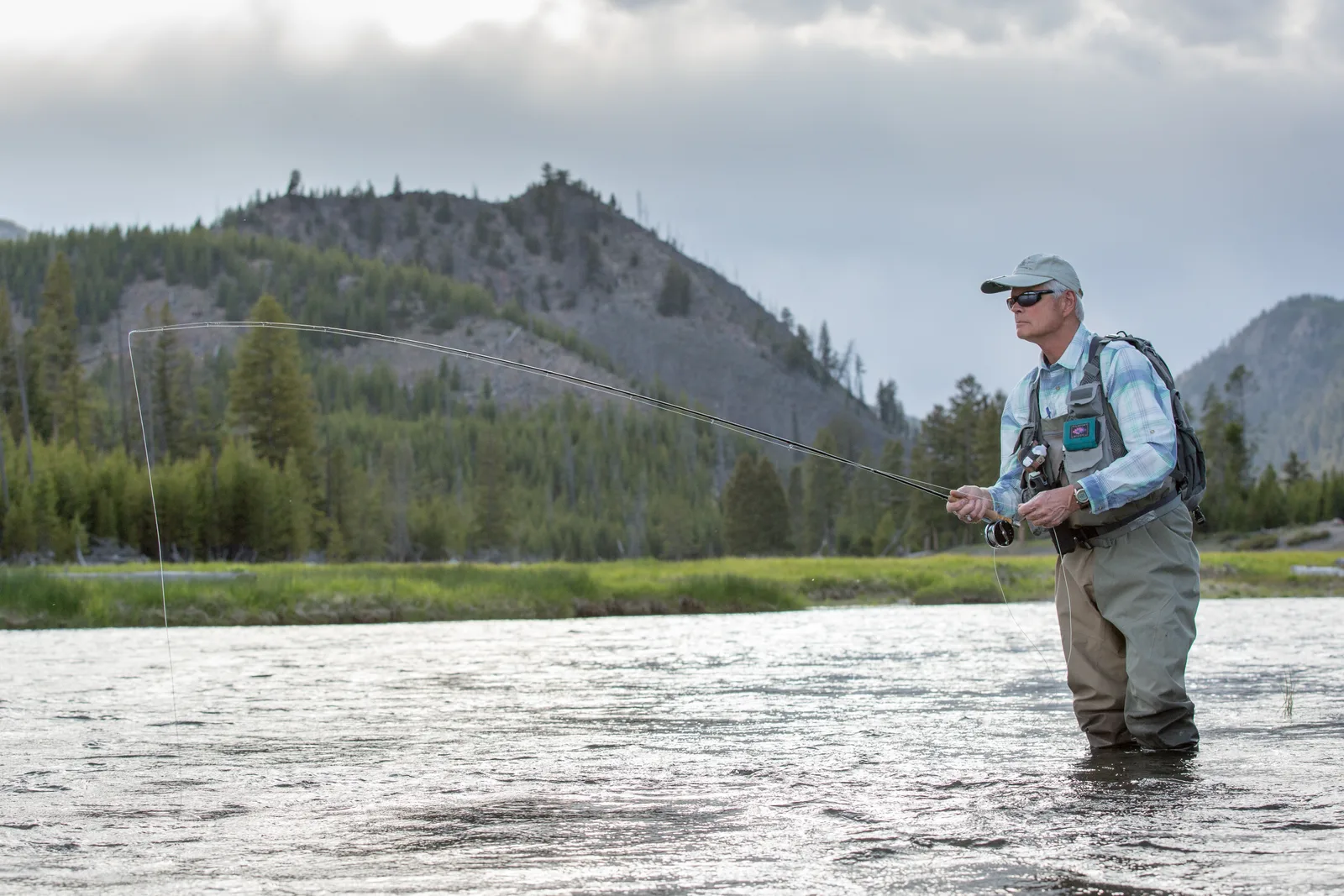
A $14 encased stream thermometer does the job for most anglers, and the one on most trout guides’ vests is exactly that: the Orvis Encased, 4.5 in (11 cm) of glass in a plastic tube, no battery. Spend more only for something it cannot give you: a number you can read without squinting (the $34.95 Fishpond Riverkeeper), or a reading from 20 ft (6 m) down, where the bass and walleye are in August (a $10 Vexilar Deptherm on a line, or the Fish Hawk TD and its $249.99 successor, the TD Connect). The picks come from the makers’ specifications and the owner reviews on their pages; none of them has been tested by this site. Below: the five kinds compared, the pick for each fishing, and how to take a reading that means something.
A pocket thermometer reads the top foot of water. In August the bass and walleye are 20 ft below that, at the thermocline, and the only thermometer that reads there is one that goes down on a line.
How we chose
Four things decide a fishing thermometer, and price is the fourth. Where it reads: the surface, or the depth you fish. Whether it can fail on the water: a dead battery or a flooded case ends the day’s readings, and a glass tube has nothing to fail but the glass. Whether you can read it: a scale with 2 °F marks is hard in low light and harder at fifty, and a number you cannot read stops getting taken. Weight and the clip come after those.
The numbers are the makers’ own, checked on the product pages under Sources. Where owners have reviewed a product there the count is given, and the counts are small: four on the Fishpond page, sixteen on the TD Connect page, one on Overton’s listing of the original TD. MidCurrent’s guide to stream thermometers, the one serious piece on the subject, supplied the case for analog over digital and the way to take a reading.
The five kinds compared
| Type | What it reads | Best for | Price | Weakness |
|---|---|---|---|---|
| Encased analog pocket (Orvis Encased) | Surface, or as deep as your arm; 1–3 minutes to settle | Trout on streams, wading, kayak | $12–14 | Small scale, slow; the glass column can separate |
| Digital pocket (Fishpond Riverkeeper) | Surface, probe on a lanyard; seconds | Stream anglers who want a fast, legible number | $30–35 | A battery (CR2025) and ±2 °F (±1 °C) tolerance |
| Stick-on tape (Cling) | Air or surface, on a net or rod | A fallback for a vest with no room | $7 | Reads the net, not the river; 1–2 degrees at best |
| Depth-and-temperature probe (Fish Hawk TD, Vexilar Deptherm) | Temperature at every depth on the way down, to 300 ft (90 m) | Trolling for walleye, salmon and trout; bass at the thermocline | $10 (Deptherm), $250 (TD Connect) | Needs a line or a downrigger ball; a drop takes minutes |
| Sonar transducer (any fish finder) | The top inch or two, at the hull | A boat angler who wants the number on the screen | Included | Surface only; the hull warms it on a hot day |
The picks in detail
Orvis Encased Stream Thermometer: best for streams
A glass thermometer inside a 4.5 in (11 cm) plastic tube with a key ring at the top, $13.95 on Orvis’s page, 35–120 °F (2–49 °C) on the scale by MidCurrent’s reading. It clips to a zinger or a vest D-ring. MidCurrent calls an analog model like this “the best stream thermometer for fly fishing,” and the case is mechanical: no battery, it goes as deep as your arm, and you can check it in a cup of ice water, where it should read 32 °F. The costs are a glass tube’s: one to three minutes to settle, a small scale, and a hard knock can separate the column. Buy it for trout on streams and for any wading angler, and hang it on the vest, not in a pocket, so the reading gets taken.
Fishpond Riverkeeper Digital Thermometer: best digital for streams
A 0.8 oz (23 g) digital with an aluminum probe, a recycled polycarbonate body in a silicone case, a UV-filtered screen and a carabiner, $34.95 on Fishpond’s page. The specifications that matter: ±2 °F (±1 °C), −30 to 130 °F (−34 to 54 °C), IPX7 submersion and a replaceable CR2025 cell. The four owners who have reviewed it on Fishpond’s page all give it five stars. Buy it if an analog scale is a struggle to read or you want the number in seconds; know that ±2 °F is the width of the call at 66–68 °F, which is why MidCurrent keeps an analog for the decision.
Fish Hawk TD and TD Connect: best at depth
The Fish Hawk TD is the pocket probe trollers have carried for years: clip it to the line or a downrigger ball, drop it, and it logs the water temperature every 5 ft (1.5 m) on the way down to 300 ft (90 m), shows the maximum depth to the nearest foot and reads in feet or meters, 2.72 oz (77 g) with the lithium battery molded in. One drop at the start of the day shows where the warm surface layer ends, and the lead-core lines go to that depth. The catch, as of October 2026: the original TD has gone from Tackle Warehouse and FishUSA (both product pages are dead), Overton’s lists it at $142.49 but out of stock, and Fish Hawk’s own site sells only the TD Connect at $249.99. The TD Connect is the same idea with a phone: 1.7 oz (48 g), the same 300 ft, it switches on when it hits the water, records temperature and depth as it descends and draws the profile in a free app, with a Target Temp mode that highlights the band you set. It needs iOS 18 or Android 12, the app works only in North America, and sixteen owner reviews are listed on the maker’s page. Buy it for trolling walleye, salmon and lake trout; a bass angler on one lake can get the same number for $10.
Vexilar Deptherm: budget probe
A 5 in (13 cm) tube, about $10 (Thorne Bros lists it at $10.99), no battery, no electronics. Drop it on a line and water pressure forces water into the tube; the trapped column reads depth in feet on one side, and the thermometer on the other side gives the temperature if you leave it down about 30 seconds. Shake the water out before the next drop. Vexilar also says to clip it to a downrigger ball, with one warning: the temperature lags one to two minutes when the ball is raised, so read it at depth, not on the way up. The right tool for a bass or crappie angler who wants to know where the thermocline sits on his lake this week, and for a kayak angler with no downrigger.
Cling Temperature Tape: the fallback
A stick-on strip, $6.99, 40–82 °F (4–28 °C), that fastens to a landing net or any smooth surface and shows the temperature in color: green for safe, yellow for warning, red for danger. The maker claims a reading within 1–2 degrees. It reads whatever it is stuck to, and a net lifted out of the river warms in the sun, so it is a check on the net in the water, never the number that decides whether to keep fishing. It beats nothing; a $14 Orvis beats it.
What to know before buying
Analog or digital. MidCurrent’s answer for most anglers is analog, and the reasons are mechanical: no battery, nothing to flood, no drift. Cheap digital units, the guide says, are known to drift out of calibration over a season, and the good one is specified at ±2 °F. On a stream in July, two degrees is the difference between 66 and 68, and that is the call. Choose digital for speed or for eyes that cannot read a 2 °F scale; check either kind in ice water once a season.
Surface or depth. A pocket thermometer and the transducer on a fish finder read the top foot. From June to September a lake stratifies into a warm top layer, a cold bottom layer and a thin band between them where the temperature drops fast, the thermocline; the lake turnover page explains why the bass and walleye hold on that band and why the water below it runs out of oxygen. A surface reading tells a summer boat angler almost nothing; a probe on a line tells him in one drop. The fish finder often shows the thermocline as a faint band at high sensitivity, but cannot put a number on it.
How to take a reading that means something. Submerge the thermometer a foot down, in moving water, in shade, never in a sun-warmed shallow; MidCurrent’s line is that in a stream one mid-current reading represents the whole column. Leave it 60 seconds for a digital and up to three minutes for a glass tube. On a lake, read at the depth you fish. Take it at the same spot and hour each trip and write it down: three weeks of numbers from one riffle beat any chart, and the water temperature hub turns the number into what each species is doing. Before the trip, the lake water temperature page shows how to find the lake’s reading from your desk.
Why stream anglers carry one at all. Trout stress at 68 °F (20 °C), and that line is the reason a thermometer hangs on nearly every trout vest; the trout water temperature page has the chart for five species and where the fish go when a river warms. Montana shows how seriously the agencies take it: FWP’s drought policy brings in hoot-owl restrictions, no fishing from 2 p.m. to midnight, once the maximum daily water temperature reaches 73 °F (23 °C) for three consecutive days, and FWP notes that 77 °F can be lethal to trout. The thermometer on the vest is how you make the call before the state makes it for you: at 65 °F fish on, at 68 °F fish the dawn and quit, at 70 °F find a tailwater.
Related
Pliers, nets, scales and the rest of the small gear sit in the accessories hub. The water temperature hub has the thermometer tool: set your reading and it sorts 25 species into spawning, feeding, slow and too warm. For the lake, lake turnover covers the thermocline and lake water temperature how to find the number before you go; for the stream, the trout page and its 68 °F line. How to read a fish finder shows the thermocline on the screen, and thermocline, turnover and the other terms used here are defined on the fishing terms page.
Related
Section guide
Fishing Accessories: The Small Gear That Decides the DayThe fishing accessories worth carrying: net, pliers, scale, thermometer, tackle box and the rest, with the one spec that matters on each and what it is for.
Sources
- Fishpond, Riverkeeper Digital Thermometer (specifications and owner reviews)
- Orvis, Encased Stream Thermometer
- Fish Hawk Electronics, TD Connect water temperature and depth sensor
- Overton's, Fish Hawk TD digital at-depth water temperature gauge (original model, specifications)
- Thorne Bros, Vexilar Deptherm model 104
- Yellow Dog Flyfishing, Cling Temperature Tape
- MidCurrent, The best stream thermometer for fly fishing and why you need one in summer
- NBC Montana, FWP announces hoot-owl restrictions (Montana FWP drought policy: 73 °F for three days, fishing closed 2 p.m. to midnight), July 9, 2024