The best bass bait is whatever the bass in your water already eat: shad, shiners, crawfish, bluegill or worms. Live golden shiners and crawfish are the proven live baits. Among artificials, plastic worms took 41% of the first 100 Florida bass of 13 pounds or more in a state survey. For lure picks by season, go to the best bass lures; this page matches each food to its live bait and its lure.
Of the 168 Florida bass of 13 pounds and up logged by TrophyCatch, 53% fell to lures and 47% to natural bait. At trophy size, the argument is close to a coin toss.
What is the best bait for bass?
Match the forage, the food a bass is already hunting in that water. A lake full of shad calls for a shad or a shad-shaped lure; a rocky river with crawfish calls for a crawfish or a jig. The table puts each food beside its live bait, its lure and the law.
| What bass eat | Live bait | Lure that imitates it | Best when | What the law says |
|---|---|---|---|---|
| Shad (23% of diet by weight) | threadfin or gizzard shad | swimbait, lipless crankbait | fall creeks; winter, as cold shad slow down | Texas: legal nongame bait |
| Shiners and minnows | golden shiner, fathead | swimbait, jerkbait | trophy largemouth in grass | Florida: shiners any size; New York: Green List |
| Crawfish (38% by weight; about 75% for smallmouth) | live crawfish | jig, Texas-rigged craw | fall, rock, smallmouth and spotted bass | Texas: legal; Wisconsin: banned on inland waters |
| Bluegill and sunfish | small bluegill | bluegill swimbait, squarebill | ponds; bass on spring nests | Florida: only the angler who caught them |
| Worms | nightcrawler | plastic worm, stick bait | rivers and ponds, any season | none of the six states below restricts worms |
| Frogs and salamanders | frog, where legal | hollow-body frog, lizard | summer pads; lizard at the spawn | California: no salamanders |
What do bass eat most?
Fish first, crawfish second. In DeGray Reservoir, Arkansas, federal biologists opened 748 largemouth bass stomachs from April to November. Fish made up 59% of the diet by weight and crawfish nearly 38%. Sunfish came to 28% and shad to 23%.
The split shifts with size and season. Crawfish were 42% of the food of bass 8 in (200 mm) and longer and 12% for smaller ones, and they peaked in fall. That is why a crawfish or a jig earns its place on a fall reservoir.
Texas Parks & Wildlife magazine, reporting biologist Craig Bonds’s stomach-content study, lays the largemouth menu out as a pyramid. Bluegill and other sunfish form the base, threadfin and gizzard shad sit above them, and crawfish top it. In Bonds’s thesis lake, Virginia’s Claytor Lake, smallmouth and spotted bass ate about 75% crawfish against about 20% for largemouth. His lure advice follows the calendar. In summer and early fall, small prey is everywhere, so downsize. In spring only intermediate and large forage is around, so go bigger. In winter, cold-stressed threadfin shad turn into easy meals. The magazine’s winter tip: a shad imitation fished very slowly in deep water.
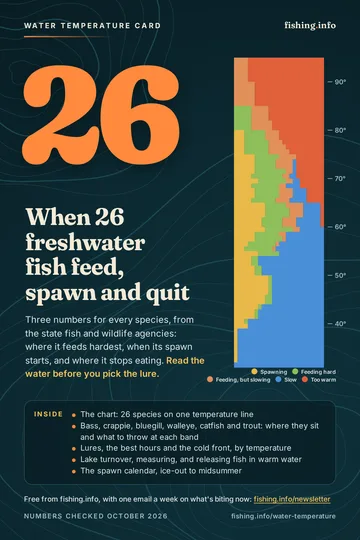
Free card: what 26 species do at your water temperature
Plus one email a week on what's biting now. No sales pitches. Privacy.
Lures or live bait: which catches more bass?
Neither wins outright. Florida’s TrophyCatch program has approved 16,615 bass of 8 pounds or more. Of the 168 of 13 pounds and up, 53% came on artificial lures and 47% on natural bait. In FWC’s survey of the first 100 of those giants, plastic worms took 41% and soft plastics as a group 71%.
So the choice is about the day, not about which is better. Lures cover water fast and let you search. Live bait sits in front of a bass that will not chase, and it is the only option that swims and smells like food on its own.
Pressure matters too. Illinois Natural History Survey researchers found that largemouth do not learn to avoid lures by watching other bass get caught; they learn from their own capture. A new lure color caught more fish at first, then the catch fell over 12 sessions as those fish learned it. On a hard-fished lake, something the bass have not seen, a live shiner included, is a fair bet.
Which live bait works best for bass?
Golden shiners
The trophy bait of Florida. FWC lets you take golden shiners of any size for bait with a cast net, dip net, seine or minnow trap within its gear limits. Wild shiners caught on the lake you fish are the classic choice, hooked by the rules further down.
Crawfish
The natural bait for smallmouth and spotted bass, and for largemouth on rock in the fall. Check your state first. Rusty crayfish are thought to have reached new states in anglers’ bait buckets, so several states restrict crawfish as bait. Wisconsin bans live crayfish as bait on all inland waters except the Mississippi River. Carrying live crayfish and fishing tackle together on those waters counts as evidence of a violation.
Nightcrawlers
The easiest live bait to buy, and the one no state in the rule table restricts. Michigan’s state-record smallmouth, 9.98 pounds and 23.1 in (59 cm), was caught on nightcrawlers in the Indian River in 2016. Worms get swallowed deep, so watch the line and set the hook soon.
Shad
A main prey fish in southern reservoirs such as West Point Lake. Threadfin shad grow to only 4 to 5 in (10–13 cm), which suits mid-size bass; trophy fish eat larger gizzard shad. Fish them on the water you net them in.
Bluegill and other sunfish
The base of the pond food chain, and the bait with the most legal strings attached. Florida allows bluegill, redear and other panfish as bait only for the angler who caught them, on rod and reel or pole and line. Farm-raised panfish under 4 in (10 cm) may be bought for bait there. Texas does not list sunfish as game fish, so they count as legal nongame bait.
Frogs and salamanders
Bonds found adult bass eating frogs, salamanders, snakes and mice. Anglers after bedding bass use a soft-plastic lizard or a live waterdog, a salamander. The law decides here. California allows amphibians as bait except salamanders, which no one may use.
How big a bait can a bass swallow?
About half its own length for a shad, and 40% for a bluegill. In Auburn’s West Point Lake study, the largest gizzard and threadfin shad found in largemouth stomachs reached 0.5 times the bass’s length. The largest bluegill reached 0.4 times, because the deep body of a sunfish fills the mouth sooner.
| Bass length | Largest bluegill (0.40×) | Largest shad (0.50×) |
|---|---|---|
| 10 in (25 cm) | 4 in (10 cm) | 5 in (13 cm) |
| 12 in (30 cm) | 4.8 in (12 cm) | 6 in (15 cm) |
| 15 in (38 cm) | 6 in (15 cm) | 7.5 in (19 cm) |
| 18 in (46 cm) | 7.2 in (18 cm) | 9 in (23 cm) |
| 20 in (51 cm) | 8 in (20 cm) | 10 in (25 cm) |
The study measured shad, not shiners. A golden shiner is built more like a shad than a bluegill, so the shad column is the closer guide for shiners.
These are ceilings, not preferences, and the ratios hold for bass of 4 to 20 in (10–50 cm). In bass of 19 and 27 in (48 and 68 cm), the largest shad reached only 38% and 34% of their length. Young bass switching to fish took prey about 35% of their length. A bait at the top of the table is a trophy bait: fewer bites, bigger fish. Bonds once found a 16-inch bass with a 9.5-inch shad inside, so the ceiling can be beaten.
How do you hook live bait for bass?
Florida Sportsman’s Terry Lacoss sets out the standard ways to hook a wild shiner:
- Hook through the upper lip for drifting and slow trolling. Never run the hook from the bottom lip up through the top: it limits how much water the shiner can draw over its gills.
- Add a small float a few feet above the hook to keep the bait near the surface and the cover. A slip bobber lets you fish deeper and still cast.
- For heavy cover, hook under the body just behind the anal fin with a weedless hook, cast tight to the cover and let the shiner swim in under it.
- Size the hook to the bait. A kahle hook from 2/0 to 4/0 covers it, and a 2/0 suits most wild shiners. A 2/0 to 5/0 circle hook under the body also swims freely in grass.
Crawfish and worms fish on the bottom: a Carolina rig drags them along, and a worm can go on weedless the way a soft plastic does on a Texas rig. The hook size chart shows how a 2/0 compares with a 4/0.
Does live bait kill more bass?
Not in the one controlled test. Texas Parks and Wildlife caught 240 largemouth at Lake Umphrey on treble-hook lures, Carolina-rigged plastic worms and live carp. Overall 72-hour mortality was 22% and was not related to bait type. What killed bass was where they were hooked: throat-hooked fish died at 48%. Plastic worms produced the most throat-hooked fish, at 18%.
The lesson is timing. Set the hook early with any bait a bass can swallow. A circle hook hooks fewer bass in the gullet: on fathead minnows it cut gullet hooking from 9.7% to 4.8% in an Illinois study. But it landed only half as many bass, and survival was the same for both hooks. When a bass is gut-hooked, cut the line rather than dig for the hook.
Is live bait legal where you fish?
Bait law is state law, and it differs more than most anglers expect. Six states, from the current rule text:
| State | Allowed | Banned or limited | Moving bait |
|---|---|---|---|
| Florida | golden shiners and freshwater shrimp of any size; other nongame fish under 8 in (20 cm) | black bass and peacock bass as bait; live goldfish and carp; panfish only by the angler who caught them | no live nonnative fish moved between waters, except fathead minnows and variable platys |
| Texas | goldfish, common carp, Gulf shrimp, crabs, crawfish, nongame fish | any game fish or part of one | bait that touched lake water stays on that lake; store bait elsewhere needs a dated receipt |
| New York | the 20 Green List species, golden shiner and fathead minnow among them | carp, goldfish, round goby, European rudd, lamprey larvae | uncertified or self-caught bait only on its own water; certified receipt good for 10 days |
| Minnesota | bait from inside the state | releasing bait into any water; bringing in live minnows or leeches from another state | drain the bait bucket and refill it with bottled or dechlorinated tap water before you leave |
| Wisconsin | minnows from a Wisconsin bait dealer | live crayfish as bait on inland waters (Mississippi River excepted) | dealer minnows to another water only if no lake water was added; up to 2 gal (7.6 L) of water |
| California | invertebrates, crustaceans, amphibians except salamanders | any salamander; finfish in the Sierra and North Coast districts, with a few lake exceptions | district bait lists apply |
Three rules hold almost everywhere. Never dump leftover bait in the water; Minnesota says to put it in the trash. Buy bait from a licensed dealer when you plan to move it. And read your state’s current regulations before each season, because bait rules are rewritten as new diseases and invasive species turn up.
Which lure stands in for each bait?
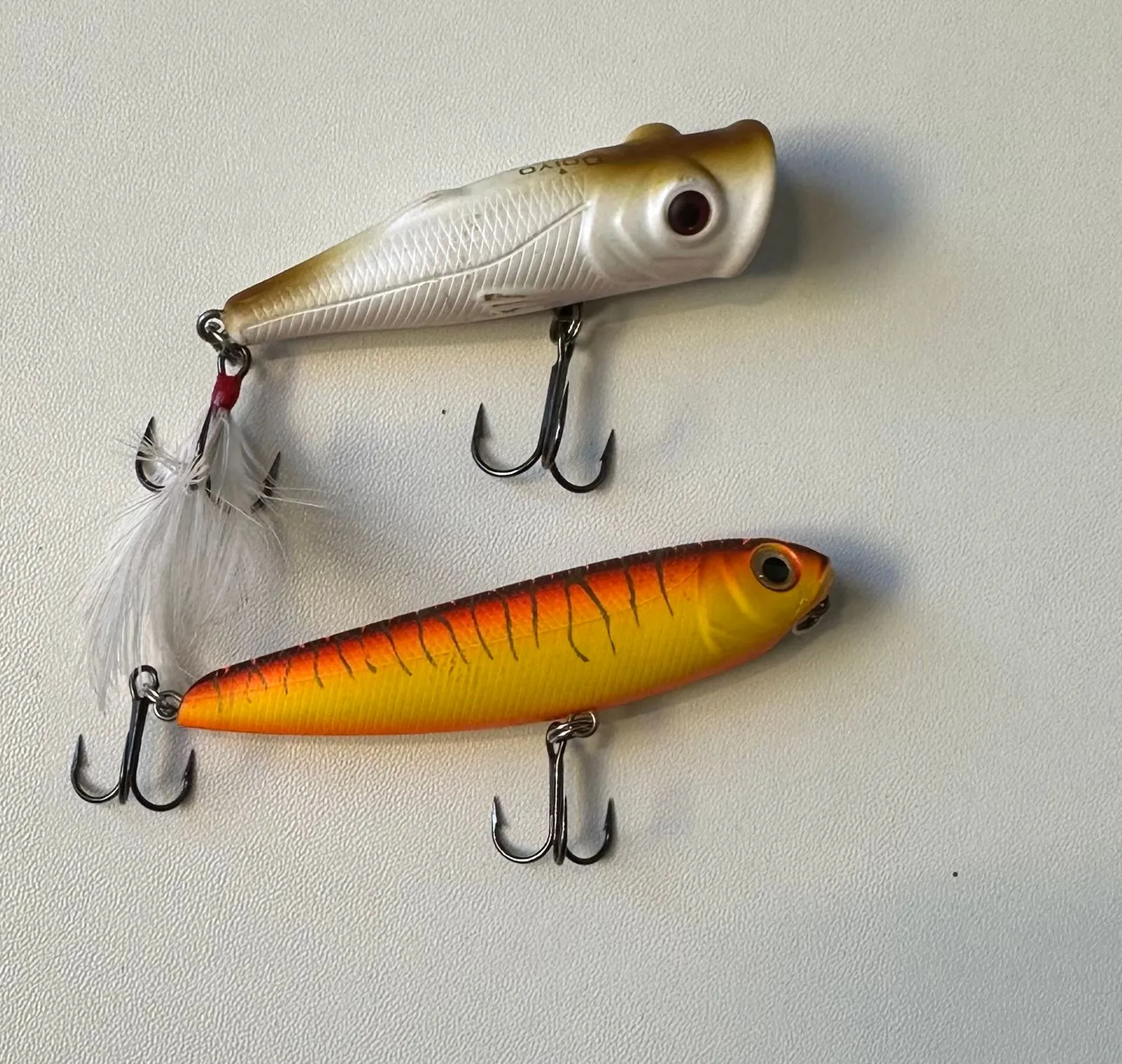
The lure column of the first table does the matching: a swimbait or lipless crankbait for shad and shiners, a jig or a Texas-rigged craw for crawfish, a stick bait like the Senko for worms, a hollow-body frog for frogs. Virginia’s fisheries chief, Mike Bednarski, names the jig-and-pig, a crawfish imitation, as the bait behind more of his 6-pound bass than any other.
When live bait is not an option or not allowed, those lures carry the same forage logic. For what to throw this month, the best time to fish for bass works through the seasons, and the bass hub covers the rest.
Gear for bass
Gear guide
Best Bass Lures: What Won the 2025 and 2026 Elite Series, Season by SeasonBest bass lures from two seasons of Elite Series winning baits: a lure for each water color, depth, cover and season, with smallmouth and spotted bass picks.
Free download
The water temperature card
Read your water temperature and the card tells you who is spawning, who is feeding and what to throw. 26 species, 16 pages, for your phone and the tackle box.
Plus one email a week on what's biting now. No sales pitches. Privacy.
Related
Section guide
Bass Fishing: Where the Bass Are, What to Throw, and the Three Bass You Will MeetBass fishing from the angler's side: where largemouth, smallmouth and spotted bass are at each water temperature, what to throw first, how to tell them apart.
 Black Bass: What the Name Means, and All 19 Species
Black bass are the genus Micropterus: 19 species, from largemouth to Bartram's bass. What the name means in science, law and the record book.
 Best Time to Fish for Bass: Season, Time of Day and Weather
The best time to fish for bass is the pre-spawn at 48–55 °F and the fall feed, at dawn and dusk. Season table, hours, night and weather.
 When Do Bass Spawn? Water Temperature and Timing by Region
Bass spawn when the water holds about 60 °F: February in Florida, June in Minnesota. The temperature bands, a calendar by region and how to fish each stage.
 Smallmouth vs Largemouth Bass: How to Tell Them Apart
Smallmouth vs largemouth bass: the jaw, the stripe and the dorsal fin settle the identification in seconds. Then habitat, size, records and how each one fights.
 How to Fish for Bass: A Beginner's Season-by-Season Guide
How to fish for bass from the first cast: one rod and reel, five lures, where bass are at each water temperature, and a numbered method for a day on the water.
- Best Bass Lures: What Won the 2025 and 2026 Elite Series, Season by Season
Best bass lures from two seasons of Elite Series winning baits: a lure for each water color, depth, cover and season, with smallmouth and spotted bass picks.
Sources
- Lindelien, S. and Cimbaro, J. (FWC) (2026), Want fishing tips? Consult the data, The Florida Specifier, Jan. 19, 2026
- Bryant, H. E. and Moen, T. E. (1980), Food of largemouth bass in DeGray Reservoir, Arkansas, 1976, Journal of the Arkansas Academy of Science 34
- Hodge, L. D. (2007), Bass Buffet, Texas Parks & Wildlife magazine, January 2007
- Bonds, C. C. (2000), Assessment of the response of piscivorous sportfishes to the establishment of gizzard shad in Claytor Lake, Virginia, M.S. thesis, Virginia Tech
- Timmons, T. J. and Pawaputanon, O. (1980), Relative size relationship in prey selection by largemouth bass in West Point Lake, Alabama-Georgia, Proc. SEAFWA 34:248-252
- Goldstein, R. M. (1993), Size selection of prey by young largemouth bass, Proc. SEAFWA 47:596-604
- Myers, R. A. and Poarch, S. M. (2000), Effects of bait type and hooking location on post-release mortality of largemouth bass, Proc. SEAFWA 54:39-45
- Cooke, S. J. et al. (2003), Injury rates, hooking efficiency and mortality potential of largemouth bass captured on circle hooks and octopus hooks, Fisheries Research 61:135-144
- Lacoss, T., Best ways to hook a live shiner in every situation, Florida Sportsman
- Michigan DNR (2016), Smallmouth bass state record broken by catch from Indian River
- Illinois Natural History Survey (2019), Bass learn from experience not to take the bait
- Virginia DWR, Bednarski, M. (2023), Three go-to baits for targeting bigger bass this summer
- Florida FWC, Methods of taking bait and use of fish for bait
- Texas Parks and Wildlife, General fishing regulations: bait regulations
- New York DEC, Baitfish regulations
- Minnesota DNR, Aquatic invasive species: anglers
- Wisconsin DNR, How VHS rules affect anglers
- Wisconsin DNR, Rusty crayfish
- Wisconsin Administrative Code, NR 19.27, Seasons, limits, restrictions on taking crayfish
- California Code of Regulations, Title 14, § 4.00, Bait: general
- California Code of Regulations, Title 14, § 4.30, Bait fish use in the Sierra and North Coast districts