 By
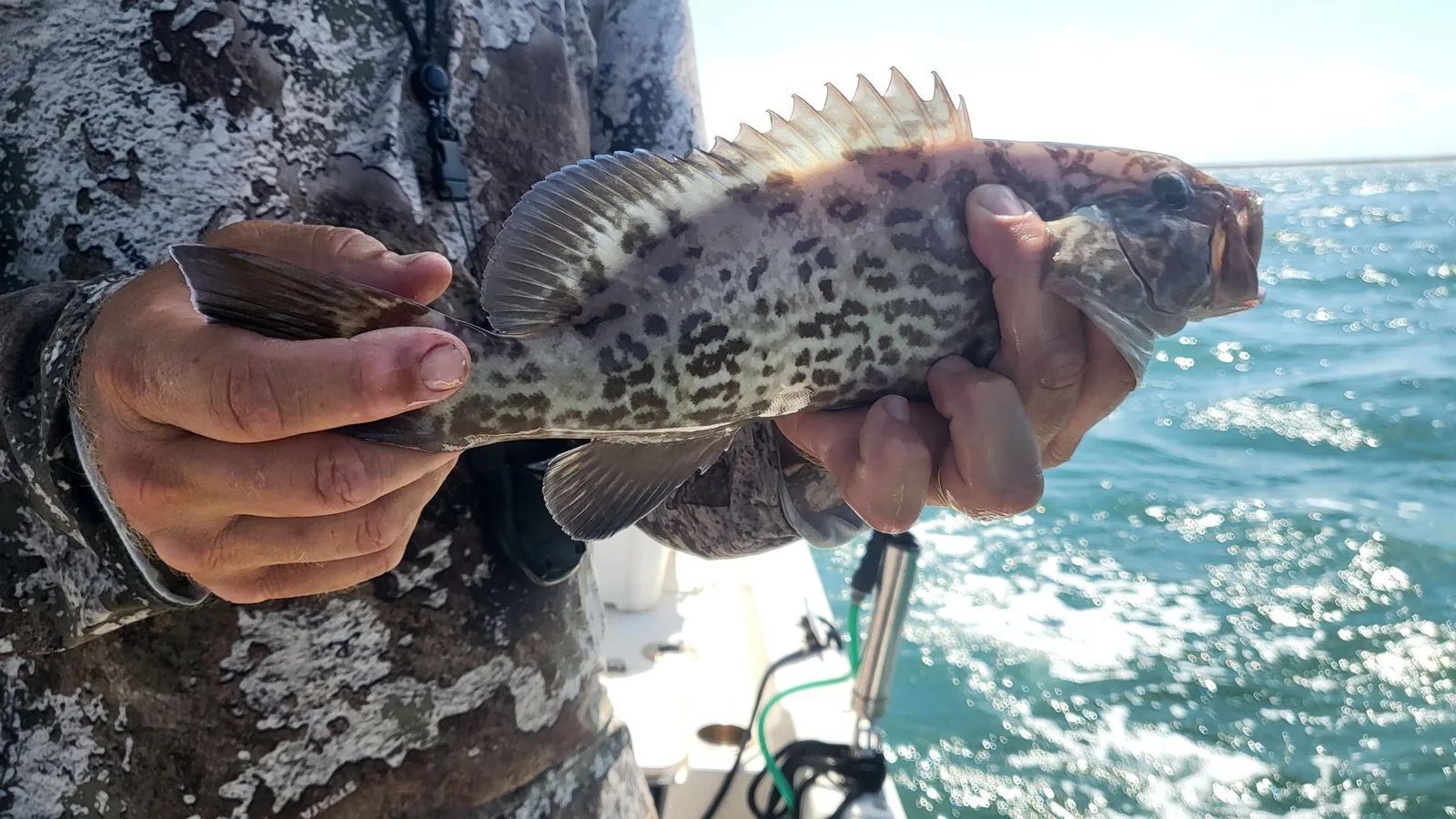
Grouper are heavy, big-mouthed reef fish from North Carolina around Florida into the Gulf. You catch them on the bottom with live bait and heavy tackle. Seven matter to US anglers: gag, red, black, scamp, Warsaw, Nassau and goliath. Red and gag are the two anglers land most, by NOAA’s 2024 numbers. The rules change by fish, by coast and by month, so the first job is knowing which one you just pulled up.
In 2026 you could keep a gag in federal Gulf waters for 30 days, September 1 to 30. A Nassau grouper you can never keep, and you cut the line without lifting it out of the water.
What is a grouper?
A grouper is a thick-bodied fish with a huge mouth that waits near cover and inhales its food whole. A red grouper opens its mouth, flares its gill covers and sucks the prey in with a rush of water, NOAA says. It eats fish, octopus, shrimp and lobster, whatever comes close.
Most groupers start life as females and some turn male later. A gag matures around age 4 and changes to male around age 8. In red grouper the share of males climbs with age, so the males tend to be the older, bigger fish.
They grow slowly and live a long time. A gag can live 30 years. The oldest red grouper on record was 29, from the Gulf. That slow pace is why the rules below are so tight.
Which grouper did you catch?
Look at three things: the color pattern, the edge of the cheek and the fins. The marks and sizes come from Florida’s wildlife agency, FWC, and from NOAA for the Nassau. The records are the IGFA’s.
| Fish | How to tell it | Grows to | IGFA world record |
|---|---|---|---|
| Gag | Brownish-gray with dark, worm-like marks; small fish carry charcoal “kiss-like” marks; strong serrated spur on the bottom edge of the cheek | 36 in (91 cm), 50 lb (23 kg) | 80 lb 6 oz (36.46 kg), Destin, Florida, 1993 |
| Black | Olive or gray with rectangular black blotches and brassy spots; cheek edge gently rounded | 48 in (122 cm), 180 lb (82 kg) | 124 lb (56.24 kg), Gulf off Texas, 2003 |
| Red | Brownish-red with irregular white blotches; mouth lined scarlet-orange; no black spot at the base of the tail | 42 in (107 cm), 50 lb (23 kg) | 42 lb 4 oz (19.16 kg), St. Augustine, Florida, 1997 |
| Scamp | Light gray or brown with spots grouped in rosettes; top and bottom tail rays drawn out long in adults | 42 in (107 cm) | 32 lb (14.51 kg), Atlantic Beach, North Carolina, 2016 |
| Warsaw | Plain dark reddish-brown or gray, no markings; second dorsal spine very tall; square tail | 90 in (229 cm), 580 lb (263 kg) | 436 lb 12 oz (198.10 kg), Gulf off Florida, 1985 |
| Nassau | Light beige with five dark bars, a big black saddle on top of the tail base, black spots behind the eye | 4 ft (1.2 m), 55 lb (25 kg) | 38 lb 8 oz (17.46 kg), Bimini, Bahamas, 1994 |
| Goliath | Tiny dark spots on head and fins, dark bars, small eyes, rounded tail; dorsal spines low and all nearly the same height | 8 ft (2.4 m), 800 lb (363 kg) | 680 lb (308.44 kg), Fernandina Beach, Florida, 1961 |
Three mix-ups cause most of the trouble, and two of them can cost you a ticket.
Gag or black grouper? Feel the bottom edge of the cheek, just in front of the gill cover. FWC’s key is simple: a gag has a strong serrated spur there, and a black grouper’s edge is gently rounded. Even fish markets mix these two up. NOAA says gag is sometimes sold as black grouper.
Red or Nassau? FWC names the Nassau as the red grouper’s look-alike. Look at the top of the tail base. A large black saddle spot there means Nassau, and a Nassau goes back.
Goliath or Warsaw? Both get huge. Look at the spiny part of the dorsal fin. On a goliath the spines are low and nearly even. On a Warsaw the second spine stands much taller than the rest. A Warsaw also has a squared-off tail, where the goliath’s is rounded.
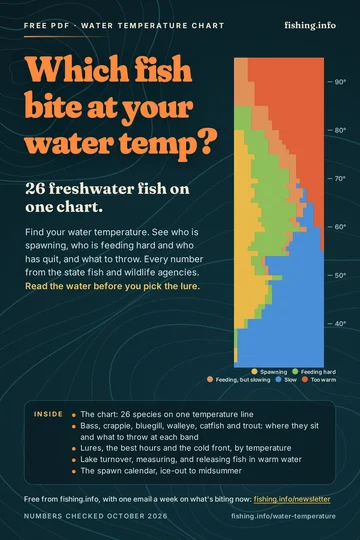
Free PDF · Water temperature chart Which fish are biting at today's water temperature?
One reading, and the 16-page chart shows which of 26 fish are spawning, feeding hard or slowing down; for bass, crappie, bluegill and walleye, where they sit and what to throw. Every number sourced.
No card, nothing to buy, and the PDF is yours to keep. Confirm with one click and it's on its way. Then a few short emails and one a week on what's biting. Unsubscribe anytime. Privacy.
Where do grouper live, and how deep?
Every grouper wants hard bottom: a ledge, a rock pile, a wreck, a reef. Find that and you’re in grouper water. How deep you fish depends on the fish.
- Gag: adults on reefs, wrecks and drop-off walls in water over 60 ft (18 m), FWC says. The young grow up in estuaries, in seagrass and on oyster reefs. The Tackle Room says gags move inshore in the colder months, close enough to reach from nearshore reefs and even docks.
- Red grouper: NOAA calls them shallow-water grouper because they’re common in 10 to 60 ft (3–18 m) of water. They dig pits on flat bottom, and spiny lobster and other fish move into them. FWC puts their preferred water at 66 to 77 °F (19–25 °C).
- Black grouper: the US stock is mostly in the Florida Keys, on rocky bottom, reef and drop-off walls. They move deeper as they age.
- Scamp: nearshore and offshore reefs, ledges and rocky bottom.
- Warsaw: rocky bottom in water over 200 ft (61 m). The young come inshore.
- Nassau: mostly absent from the continental US except Florida, where larger young fish and adults have been seen.
- Goliath: shallow structure. The young live around mangroves, bridges, docks and artificial reefs, and FWC says they’re more common in south Florida than in the north.
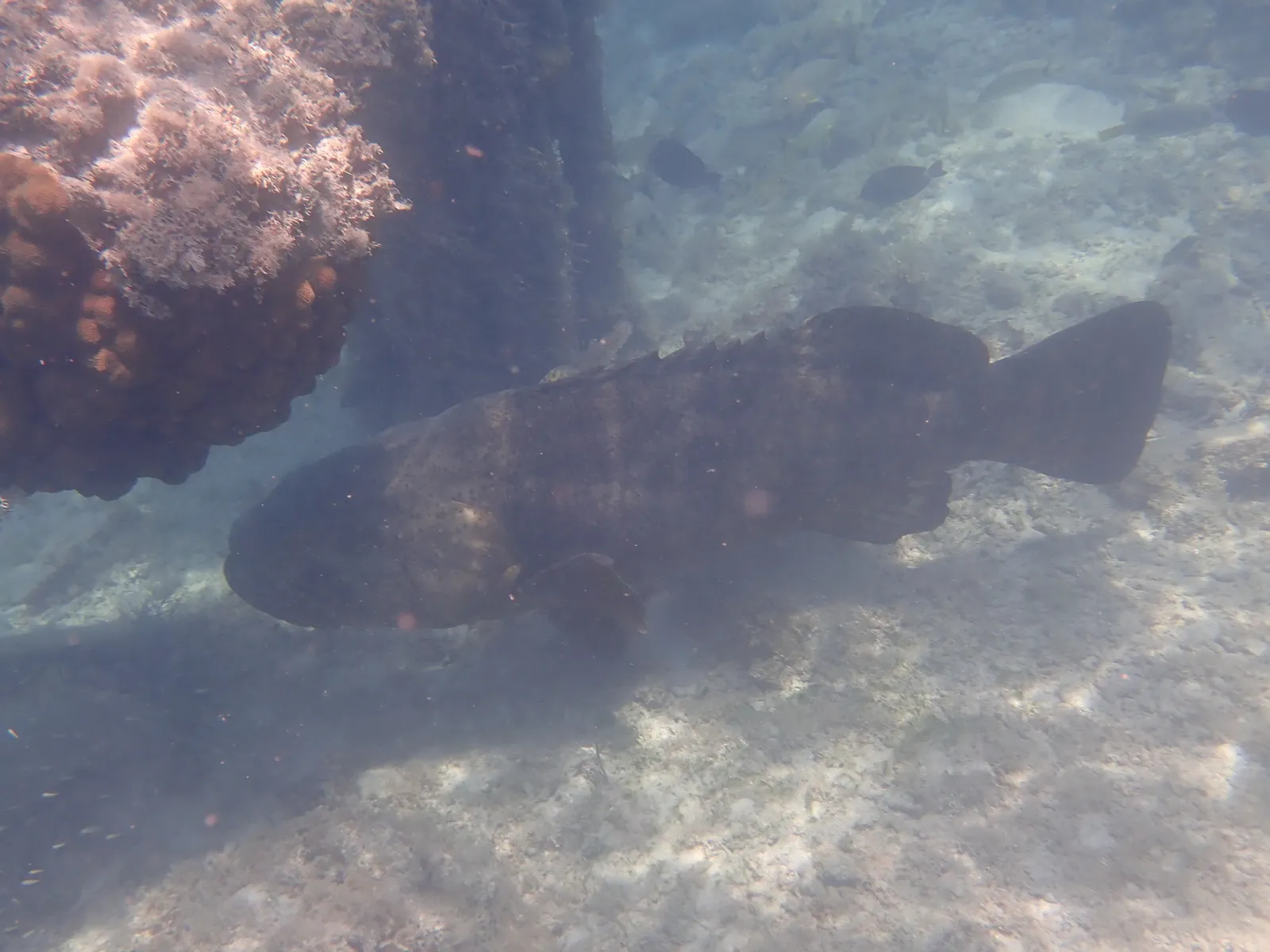
A goliath grouper beside a piling in shallow water. Photo: Michael A. Alcorn, iNaturalist observation 376837349 (CC BY 4.0)
The best spots are often small. So don’t skip a bump on your sonar. Captain Kevin McMillen of Tarpon Springs told Salt Water Sportsman that big grouper hold on “a foot or so of relief that hardly shows on the machines.” He also reads the other fish. Grunts of 14 in or bigger and sea bass of 16 in or bigger mean big grouper are near. Grouper eat the small ones and leave those alone, he believes.
How do you catch grouper?
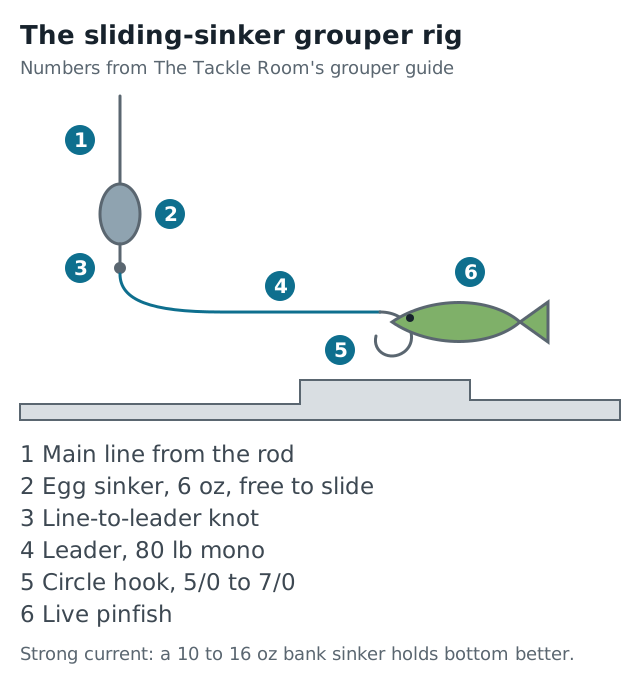
Start with a live pinfish on a sliding-sinker rig, on the bottom, right on the structure. That’s the bait The Tackle Room calls the top live bait for grouper in the Gulf. Threadfin herring, grunts and small blue runners work too. FWC adds that dead cut bait or whole dead bait catches them as well.
The rig. Tie a Carolina-style rig, The Tackle Room’s standard. You need a 6 oz egg sinker sliding above an 80 lb mono leader, and a 5/0 to 7/0 circle hook. Offshore, The Tackle Room steps up to a 7/0 to 9/0. Keep the sinker sliding, never fixed. If a grouper rocks you with a fixed weight on, your rig is stuck there. In strong current, the same shop swaps the egg for a 10 to 16 oz bank sinker, which holds bottom better. For most offshore grouper it runs 100 lb fluorocarbon leader, since grouper aren’t leader-shy. Our hook size chart runs bigger for grouper, 8/0 to 12/0, the range for the heaviest fish. Sizes differ by maker, so match the hook to your bait.
Use a circle hook. With natural bait it’s the law in the Gulf, federal and Florida state waters, and in the Atlantic north of 28° N. The circle hook finds the corner of the jaw on its own. Don’t swing hard. Reel until the rod loads.
The first seconds. This is where grouper are won or lost. The Tackle Room says to get the fish moving away from the rocks before it can turn and dive. Keep the boat in gear, then reel fast and don’t stop. McMillen does it the other way. He lets the fish take the bait without a hookset, so it doesn’t panic and swims farther out. Once the line comes tight, he reels up the slack and has the jump on it. With a circle hook, his way fits better, since you don’t set a circle hook anyway.
When it locks into a hole. Don’t break it off yet. Put the reel in free spool and let the line go slack, so the fish thinks it’s safe and swims out. Watch the slack line for any move. Then wind tight fast and pull hard to get it coming your way. “Sometimes you wait 15 minutes or more,” Keys light-tackle angler Daniel Delph told Salt Water Sportsman. If slack doesn’t work, come tight and strum the braid like a guitar string. The writer of that story landed a 55 lb black grouper after about 45 minutes and four tries.
Trolling. Capt. Charlie Ellis trolls lipped diving plugs near reefs in 25 to 40 ft of water at 5 to 7 knots, The Tackle Room reports. Deep-diving crankbaits of 6 to 8 in work best, bumping bottom near the structure.
Jigs. Heavy jigs worked with sharp lifts near bottom catch grouper, gags most of all. Be ready on the drop: grouper often hit a jig as it falls.
When is the best time to fish for grouper?
The best time is when your fish is open. The law decides that before the fish do. In 2026, Gulf gag in federal waters had one month, September. Atlantic gag ran from May 1 to August 1. Red grouper are the steady one. The Tackle Room calls them a year-round target in the Gulf and the South Atlantic. In Florida’s Gulf state waters you can keep them all year.
Inside the open season, the cold months bring gags closer. The Tackle Room says gags move inshore as the water cools, within reach of nearshore reefs and even docks. Off Tarpon Springs, Salt Water Sportsman names two prime spells for gags on McMillen’s water, with red grouper in the mix. Spring runs March through June, and fall into early winter September through December. Line that up with the calendar below before you book a trip.
Calm days help too. McMillen fishes 50 ft or so, never deeper than 65 ft, so the fish he lets go have a good chance. He likes no wind and no current, because then you can feel the bite.
Grouper rules in 2026: size, bag limits and seasons
Grouper rules are set by fish, by coast and by water. Federal waters start past 9 miles off Florida’s Gulf coast and past 3 miles off its Atlantic coast, FWC says. All lengths are total length, mouth closed and tail squeezed. These are the federal recreational rules as they stood on November 13, 2026.
Gulf federal waters
| Fish | Minimum size | Bag limit | 2026 season |
|---|---|---|---|
| Gag | 24 in (61 cm) | 2 per person, inside the 4-grouper total | September 1–30, closed October 1 through December 31 |
| Red | 20 in (51 cm) | 2 per person, inside the 4-grouper total | Open; the February–March closure past 20 fathoms (120 ft) ended October 2, 2026 |
| Black | 24 in (61 cm) | Inside the 4-grouper total | Open (same February–March closure as red until October 2, 2026); from 2027, closed January 1 to June 30 |
| Scamp | 16 in (41 cm) | Inside the 4-grouper total | Open (same February–March closure as red until October 2, 2026); from 2027, closed January 1 to June 30 |
| Warsaw | None | 1 per boat per day | Open |
| Nassau, goliath | — | None: no harvest | Closed |
The Gulf bag is 4 grouper per person per day in all, goliath excluded. The captain and crew of a charter boat or headboat (a party boat) keep zero.
South Atlantic federal waters
| Fish | Minimum size | Bag limit | 2026 season |
|---|---|---|---|
| Gag | 24 in (61 cm) | 1 gag or black per person; 2 per private boat per day | May 1 to August 1, closed from August 2 |
| Black | 24 in (61 cm) | Same as gag | May 1 to December 31 |
| Red | 20 in (51 cm) | Inside the 3-fish grouper and tilefish total | May 1 to December 31; closed in May off North and South Carolina |
| Scamp | 20 in (51 cm) | 1 scamp or yellowmouth | May 1 to December 31 |
| Warsaw, Nassau, goliath | — | None: no harvest | Closed |
In the South Atlantic every shallow-water grouper is closed January through April, every year. That covers gag, black, red, scamp and six other kinds. The combined limit of two gag or black per private boat per day took effect October 28, 2026. On a charter or headboat it’s two per trip, and the captain and crew keep none. The next Atlantic gag season opens May 1, 2027.
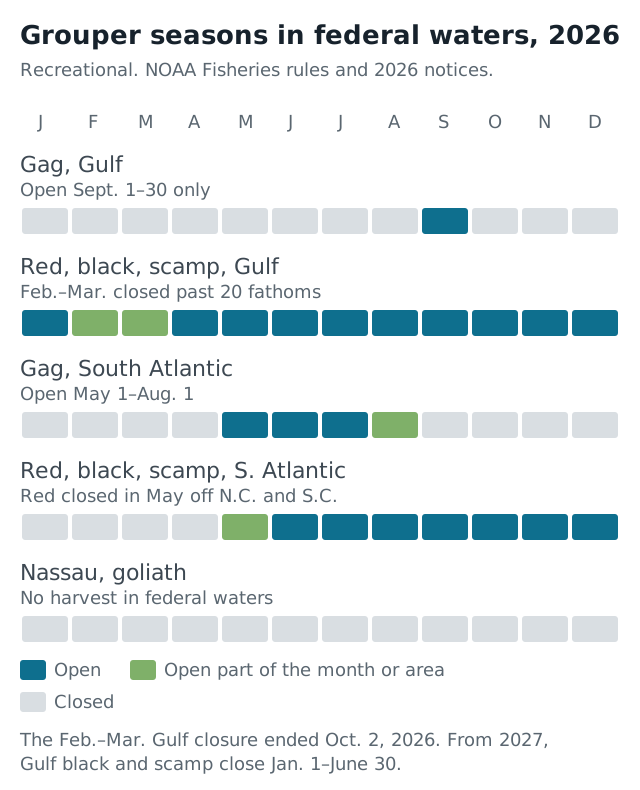
Florida state waters. In Gulf state waters, gag was open September 1–30, 2026, matching the federal season, except in Monroe County. Red, black and scamp are open all year in Florida’s Gulf state waters. Monroe County’s state waters, on the Gulf side too, follow the Atlantic: red, black and scamp close there January 1 to April 30. To fish for grouper from a private boat anywhere in Florida, you must sign up for the State Reef Fish Survey first. On a charter or headboat you don’t. FWC’s grouper page still lists the old February–March federal closure for Gulf red, black and scamp, which ended October 2, 2026. Its Atlantic table also still shows 3 scamp. The federal limit has been 1 scamp or yellowmouth since July 6, 2026.
Goliath. Florida runs a small harvest lottery with 200 permits a year. Each permit is one fish of 24 to 36 in, March 1 to May 31, hook and line only. You can’t keep one in federal waters or in Dry Tortugas National Park. State waters from Martin County south along the Atlantic side of the Keys are closed too. Applications run October 1–15. The fee is $10 to apply, then $150 for a Florida resident or $500 for a nonresident. Everywhere else, a goliath goes back.
Gear you must carry. In Gulf federal waters, use non-stainless steel circle hooks with natural bait and carry a dehooking tool. In the South Atlantic, carry a dehooking tool and a descending device rigged with at least a 16 oz weight and 60 ft of line. North of 28° N, circle hooks with natural bait must be non-offset (the point in line with the shank) and non-stainless. South of it, any hook with natural bait must be non-stainless. Florida goes further in its state waters, on both coasts. A boat harvesting or trying to harvest reef fish there needs a descending device or venting tool rigged and ready for use. In Gulf state waters the circle hooks must be non-offset too. The federal Gulf rule for a descending device ran out on January 14, 2026, but FWC’s gear page still lists one for Gulf federal waters. Carry one. The J-hook page has the full list of where a J is and isn’t legal.
Other Gulf and Atlantic states set their own rules for their state waters. Check yours before you go.
The reason it’s this tight. Both gag stocks are overfished, Gulf and South Atlantic, on the 2021 assessments, and the Atlantic rebuilding plan runs to 2033. South Atlantic red grouper is overfished too (2017). The Gulf red grouper stock is not (2025). The Nassau has been listed as threatened since July 29, 2016. Goliath harvest has been closed in federal waters since 1990.
How do you release a grouper caught deep?
A grouper pulled up from deep water swells with gas, called barotrauma: a bloated belly, bulging eyes, the stomach pushed out of the mouth. It has a hard time getting back down. Send it down with a descending device, a weighted clip that releases the fish at depth.
A goliath stays in the water. FWC says a big goliath’s skeleton can’t carry its weight out of the water, and lifting one into a boat can kill it. FWC asks you to keep small goliaths in the water to unhook them too. In federal waters, cut the line on a Nassau, and on a goliath in the Atlantic. The fish stays in the water. Our catch and release guide covers the rest of handling a fish you’re putting back.
How big do grouper get?
The goliath is the giant: up to 8 ft and 800 lb, the largest grouper in the western Atlantic. The IGFA all-tackle record goliath weighed 680 lb, caught at Fernandina Beach, Florida, in 1961. It’s still Florida’s state record too, and it sits among the biggest fish ever caught on rod and reel.
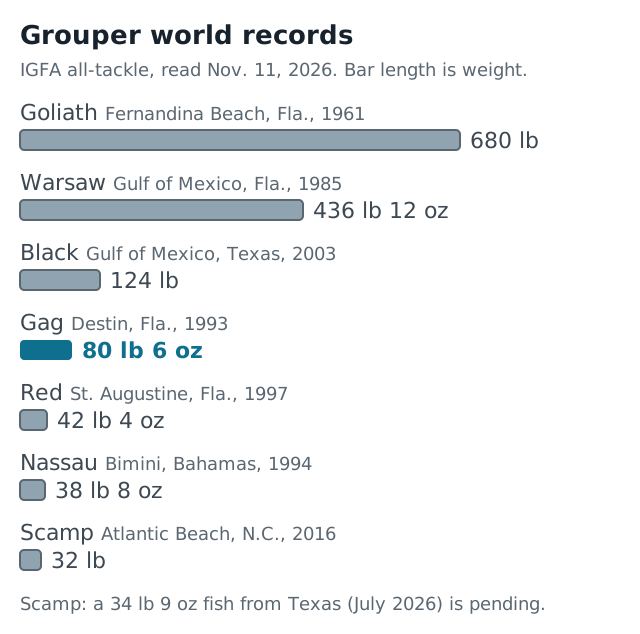
Records run past what agencies call normal. NOAA says a gag can weigh up to 50 lb, and FWC calls 25 lb common. The record gag from Destin weighed 80 lb 6 oz. The black grouper record, 124 lb, came from the Gulf off Texas in 2003. Florida’s own best black is 113 lb 6 oz, from the Dry Tortugas. For red grouper, FWC calls 20 in and 15 lb common.
A big one is old. NOAA gives a gag up to 30 years, a black grouper up to 30 and a Nassau up to 29. FWC thinks a goliath lives 30 to 50 years on average.
Is grouper good to eat?
Yes. NOAA describes gag as mild but distinct, somewhere between bass and halibut, with firm, moist, white meat. It calls red grouper sweeter and milder than black, and says many people like red grouper best of the two. For the cleaning table, Danco puts grouper on its 9 in fillet knives.
Know one warning that belongs to the fish. The CDC names grouper among the reef fish you may want to avoid because of ciguatera, a poison made by tiny algae around coral reefs. You can’t see, smell or taste it, and “cooking does not destroy the toxins,” the CDC says. Don’t eat the liver, guts, eggs or head, where the toxin collects most. Check your state’s fish advisory for the water you fish.
Why is grouper so expensive at the counter? NOAA doesn’t give a reason for the price, but it does count the catch. Commercial boats landed 240,000 lb of gag in 2024, worth $1.7 million, against 2.8 million lb of red grouper, worth $16 million. Recreational anglers landed more gag than the commercial boats did, 1.2 million lb, and 2.8 million lb of red.
When do grouper spawn?
Gag and red grouper spawn in late winter and spring, and the closed seasons you fish around follow the spawn. The Nassau spawns in winter and the goliath in summer.
- Gag spawn from mid-January to early May in the South Atlantic and from late January to mid-April in the Gulf. They gather in big groups on the continental shelf. A female can release 60,000 to 1.7 million eggs each time she spawns. The January–April Atlantic closure exists to protect this.
- Red grouper spawn from February through June in shallow water, close to 26 times a year.
- Nassau gather from November through February around the full moon, when the water is around 79 °F (26 °C). The gatherings run from hundreds of fish to tens of thousands.
- Goliath spawn from June through October, peaking July through September.
The names, if you want them
Groupers are their own family now. For a long time they counted as a branch of the sea bass family, and NOAA still files them there. That’s why black sea bass shows up as a grouper relative on our types of bass page. Most fish called grouper belong to two big groups of species. The word comes from the Portuguese garoupa. The goliath had an older name too: NOAA’s records call it “previously known as jewfish.” For every other fish we cover, start at fish species.

Free PDF · 16 pages
Stop guessing. Know what's biting before your first cast
A whole Saturday on the water with nothing to show for it. One reading tells you who's feeding.
The Water Temperature Fishing Chart. Take one water temperature reading, find it on the chart, and see which of 26 freshwater fish are spawning, feeding hard or slowing down.
- Where bass, crappie, bluegill and walleye sit, and what to throw. Trout: the reading where you stop.
- Why a 3 ft drop beats a cold front, and what to throw each day of the front
- The three thermometer mistakes that make a reading lie
The chart's numbers come from state fish and wildlife agencies and fisheries research: 61 sources, each listed on the site.
No card, nothing to buy. Confirm with one click and the PDF is on its way, one version for your phone and one to print, yours to keep. Then a few short emails and one a week on what's biting, with an unsubscribe link in every one. Privacy.
Sources (33)
- eCFR, 50 CFR 622.37 and 622.38, Gulf reef fish size and bag limits (current to November 10, 2026)
- eCFR, 50 CFR 622.34, seasonal closures for Gulf reef fish (gag closed January 1 through August 31)
- eCFR, 50 CFR 622.185 and 622.187, South Atlantic snapper-grouper size and bag limits
- eCFR, 50 CFR 622.183, South Atlantic area and seasonal closures (shallow-water grouper closed January through April)
- eCFR, 50 CFR 622.181, South Atlantic prohibited species (goliath, Nassau, Warsaw, speckled hind)
Show all 33 sourcesShow fewer sources
- eCFR, 50 CFR 622.30 and 622.188, required gear for Gulf reef fish and South Atlantic snapper-grouper
- Federal Register 91 FR 29920 (May 21, 2026), 2026 recreational season announcement and harvest closure for Gulf gag
- Federal Register 91 FR 21389 (April 22, 2026), 2026 recreational accountability measure and closure for gag in the South Atlantic
- Federal Register 91 FR 63502 (October 6, 2026), Reef Fish Fishery of the Gulf of America, Amendment 62
- Federal Register 91 FR 36545 (June 17, 2026), Reef Fish Fishery of the Gulf of America, Shallow-Water Grouper Management Measures
- Federal Register 91 FR 61160 (September 28, 2026), Snapper-Grouper Fishery of the South Atlantic, Regulatory Amendment 36
- Federal Register 91 FR 33661 (June 4, 2026), Snapper-Grouper Fishery of the South Atlantic, Amendment 55 (scamp and yellowmouth grouper)
- Florida Fish and Wildlife Conservation Commission, Groupers (recreational regulations)
- Florida Fish and Wildlife Conservation Commission, Goliath grouper (catch and release, Goliath Harvest Program)
- Florida Fish and Wildlife Conservation Commission, Reef Fish Gear Rules
- Florida Fish and Wildlife Conservation Commission, State Reef Fish Survey
- FWC species profile, Gag grouper
- FWC species profile, Black grouper
- FWC species profile, Red grouper
- FWC species profile, Scamp
- FWC species profile, Warsaw grouper
- FWC species profile, Goliath grouper
- NOAA Fisheries, Gag Grouper
- NOAA Fisheries, Red Grouper
- NOAA Fisheries, Black Grouper
- NOAA Fisheries, Nassau Grouper
- NOAA Fisheries, Atlantic Goliath Grouper
- IGFA World Record Search: Grouper, goliath; Grouper, Warsaw; Grouper, black; Grouper, gag; Grouper, red; Grouper, Nassau; Scamp
- The Tackle Room, Grouper Fishing Guide: How to Catch Gag, Red and Black Grouper
- Salt Water Sportsman (Dave Lear), Game Plan: Grouper (2007)
- Salt Water Sportsman, Bottomfish Tactics
- CDC Travelers' Health, Food Poisoning from Seafood (ciguatera and scombroid)
- Wikipedia, Grouper