 By
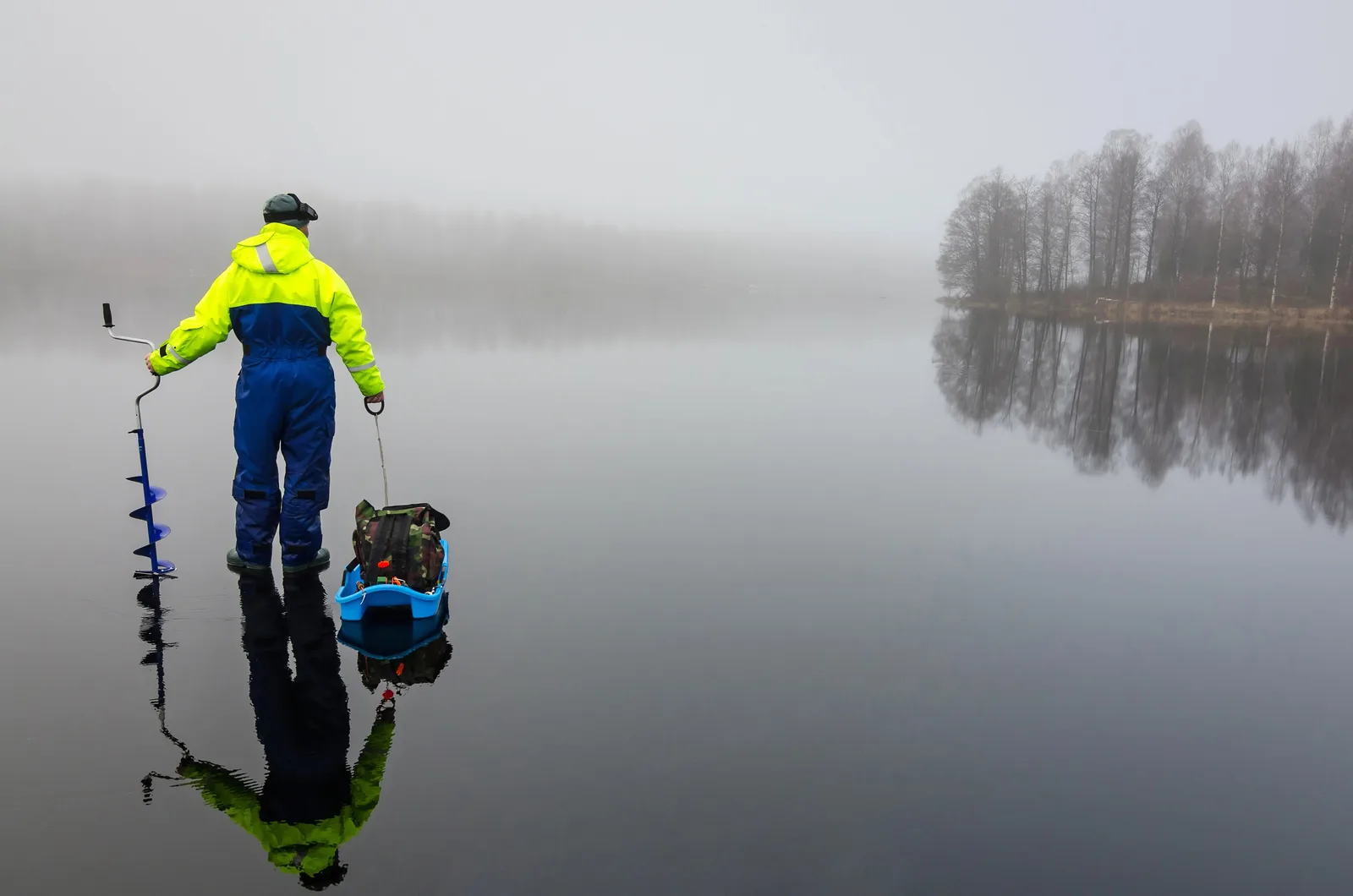
To ice fish, wait for 4 in (10 cm) of new, clear ice, drill a hole, and fish two lines: one jigged, one still. That’s how Minnesota DNR tells you to fish for perch, crappie and bluegill through the ice. You need a hole, a skimmer, a short rod and a bucket. Ice picks and a life jacket come before any of it.
Jig the bait a few times, then stop. New York DEC says fish generally hit the bait during the pause.
Start here
- Ice thickness chart: how thick the ice must be to walk, ride and drive, white ice doubled.
- Ice fishing gear: the checklist, from the bare minimum up.
- What to wear ice fishing: layers, boots and float suits.
- Ice fishing bait: wax worms, spikes and minnows, and how to keep them alive in the cold.
- Ice fishing lures: the small jigs and spoons that catch fish under the ice.
How do you ice fish, step by step?
Here’s a first trip, in the order you do it.
- Go with someone, or rent. Minnesota DNR says it’s best to learn from an experienced ice angler. The ice, the travel and heater fumes are the reasons.
- Check the ice. Wait for 4 in of new, clear ice before you walk out. Stab the ice ahead of you with a spud bar at every step.
- Pick a spot. Fish where you would in summer: weed lines, humps, points and drop-offs. A cluster of fish houses tells you where fish have been biting.
- Drill all your holes at once. Minnesota says to drill them in one session, not drill, fish, drill. The noise spooks fish for a while.
- Clear the hole. Scoop out the slush and ice chips with a skimmer.
- Fish two lines. On one, jig a small spoon or jig with bait on the hook. On the other, hang a bait that doesn’t move.
- Move. Treat each hole like a cast, Minnesota says. Give it 5 to 10 minutes, then go to the next one.
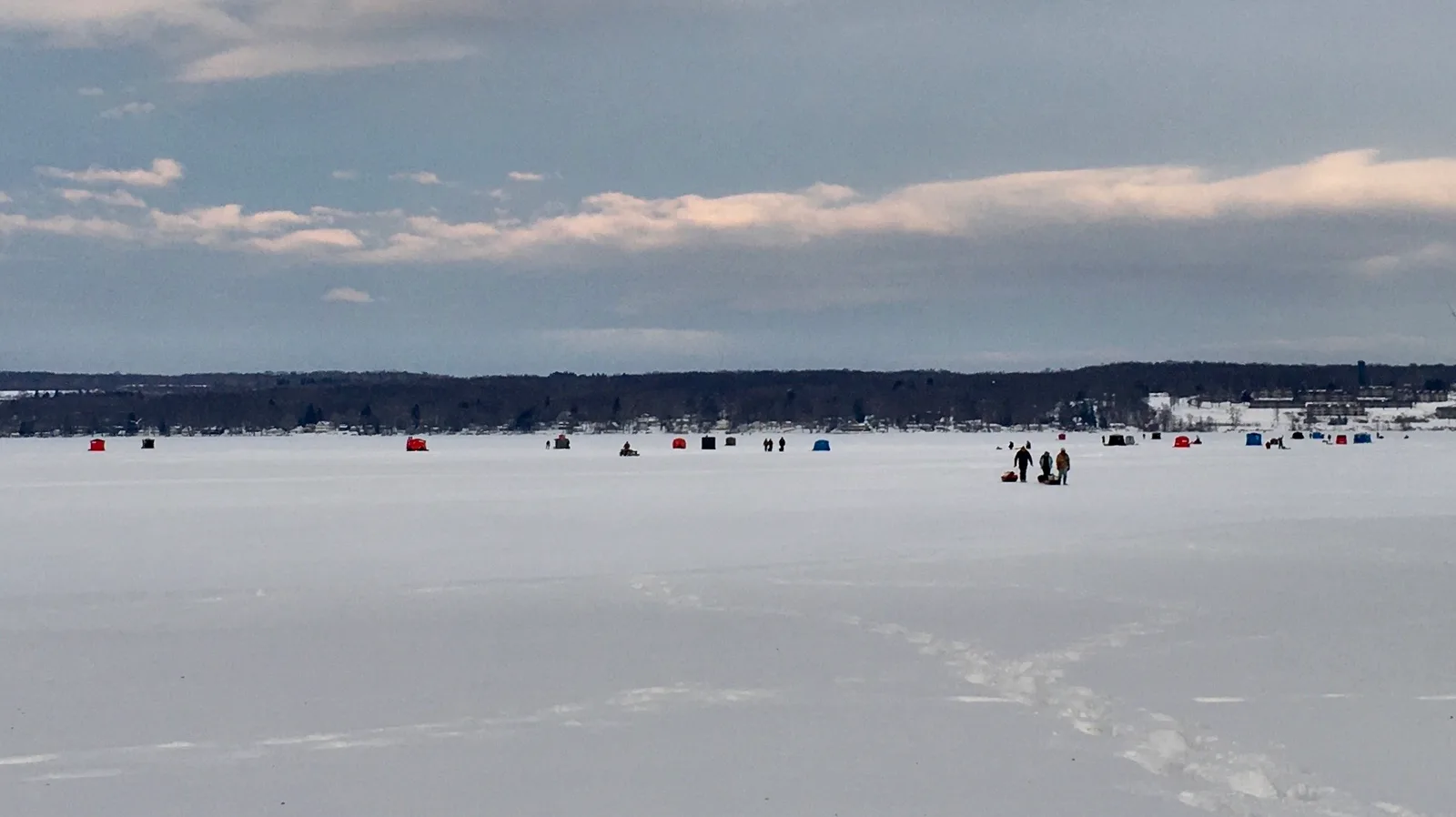
Anglers walking out to the shelters on Chautauqua Lake, New York, on a January evening. Photo: Andre Carrotflower (CC BY-SA 4.0).
That’s the method. Everything else is doing each step a bit better.
Your first time out
Start small. New York DEC says the best way in is a half-day trip with a friend or neighbor. A half day is enough to learn the routine and find out if ice fishing is for you. That’s the point where Minnesota says to start buying gear.
Renting is the other easy start. Minnesota DNR says a rental house comes with the holes already drilled, a heater and other comforts that take the work out of it. Bring a rod and bait.
You don’t need the big gear before then. Minnesota DNR names an auger, a shelter and a sonar unit as the big-ticket items. It says you can hold off on all three if you fish with someone who has them. And when you do buy, you don’t have to buy new.
No one to go with? New York’s next best idea is a tackle or bait shop in a busy ice fishing area. On some big Minnesota walleye lakes, you drive out on a road a local resort plows, and pay the resort an access fee. Wherever you go, Minnesota says to have the fishing regulations with you.
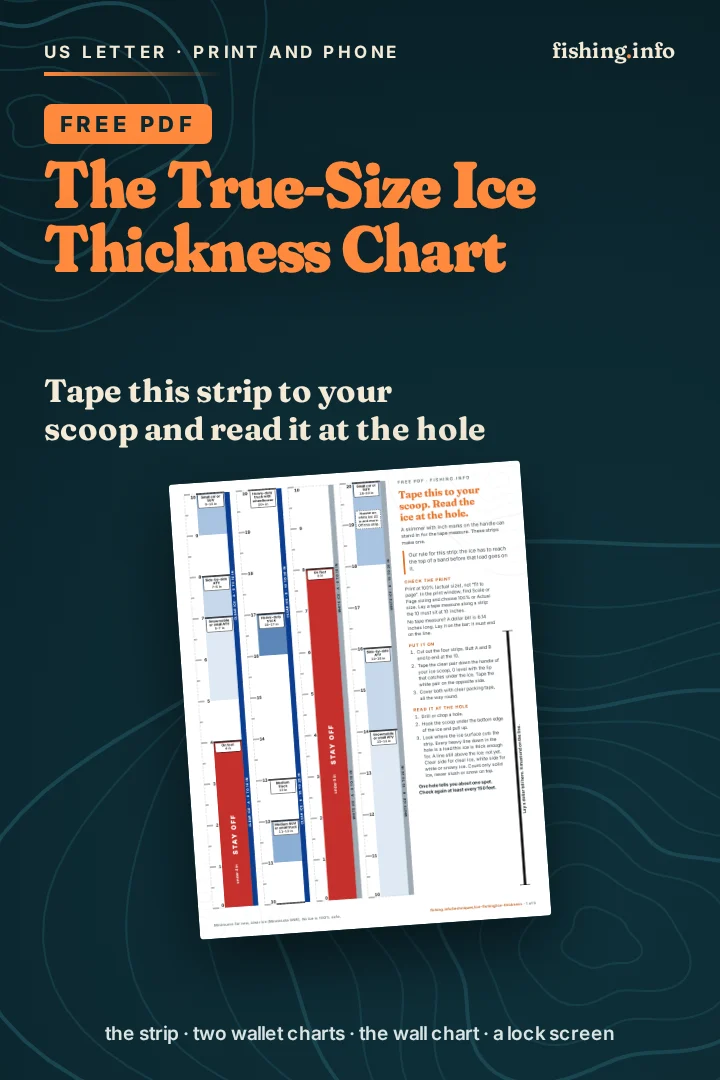
Free PDF · Ice thickness chart How thick is the ice? Read it at the hole.
Print the free chart, tape the strip to your scoop and hook it under the ice. It shows what that ice is thick enough for, clear or white. Two wallet charts and a wall chart come with it.
No card, nothing to buy, and the PDF is yours to keep. Confirm with one click and it's on its way. Then a few short emails and one a week on what's biting. Unsubscribe anytime. Privacy.
When does ice fishing start, and how thick must the ice be?
Ice fishing is fishing with hook and line through a hole in the ice. That’s close to how Vermont’s rule puts it, whether the line is on a rod, a tip-up or in your hand. The season starts when the ice will hold you. That’s a measurement, not a date.
Minnesota DNR says to wait for at least 4 in of new, clear ice before you walk out. Most state charts use the same number for one person on foot. On white ice, double it.
How safe is 7 inches of ice? On Minnesota’s ice thickness chart, 7 in of new, clear ice is past the 4 in for walking. It’s the top of the 5 to 7 in row for a snowmobile or small ATV. A small car or SUV wants 9 to 10 in. And no number is a promise. Minnesota says there’s no such thing as 100 percent safe ice. Ice can be two feet thick in one place and one inch thick a few yards away.
So check as you go. Drill a test hole near shore first, then stop and check often as you walk out, Minnesota says. A spud bar lets you test the ice ahead of you with every step.
Remember: 4 in of new, clear ice to walk on. Double it when the ice is white.
What if you go through the ice?
Dress to float. Most people who fall through the ice drown, Minnesota DNR says. They don’t die of the cold. That’s why it calls a foam life jacket or float suit the No. 1 item, and why it doesn’t recommend inflatable vests in cold water. Ice picks are the second most important item. Wear them around your neck, Iowa DNR says. Climbing onto smooth, wet ice with numb fingers is very hard without them.
If you go in, turn back toward the way you came. That’s probably the strongest ice, Minnesota says. Put your arms on the ice, kick your feet and dig in the picks. Once you’re out, lie flat and roll away from the hole. And don’t go alone. In Canada, half of the people who died on the ice were by themselves, the Lifesaving Society says.
What gear do you need for a first trip?
Less than you’d think, and most of it is cheap. Minnesota DNR says the open-face spinning reel you already own works on the ice. Add a short rod, since you aren’t casting. An entry-level ice rod and reel runs about $25, Minnesota says. Dress in layers and skip cotton, New York DEC says.
| Item | What it’s for | First trip? |
|---|---|---|
| Life jacket or float suit | Keeps you up if you go through | Must have. Foam, not inflatable |
| Ice picks | Pulling yourself back onto the ice | Must have |
| Ice cleats | Help prevent falls | Bring them |
| Ice auger or spud bar | Makes the hole | Must have, or borrow. A 6 in (15 cm) hand auger is plenty unless you want pike or lake trout |
| Skimmer | Clears slush and ice from the hole | Must have |
| Ice rod and reel | Jigging and the still line | Must have. Rods run 2 to 3 ft (0.6–0.9 m) |
| Bucket | A seat on the ice | Must have |
| Sled | Hauls it all | Handy |
| Shelter | Out of the wind | Can wait |
| Flasher or sonar | Shows depth and fish | Can wait |
At the makers’ own prices in November 2026, a bare-minimum ice fishing gear kit came to about $320, safety gear included. The fishing half is about $170: a 7 in hand auger, a skimmer, a rod and reel, a box of jigs and a bucket. The safety half is about $150: a foam life jacket, a kit with picks, a whistle and cleats, a spud bar and a throw rope. Use the open-water reel you already own and the total drops to about $285.
A heater comes later, and a carbon monoxide detector comes with it. Minnesota DNR says every ice shelter should have one. If you buy one thing early, make it flotation: a foam life jacket, or a float suit you can fish in.
Where do fish hold under the ice?
Mostly where they held the rest of the year. New York DEC says to fish weed lines, humps, depth changes, points and other structure, the same as any season. A lake map shows you those spots before you leave home. Minnesota’s LakeFinder covers more than 4,500 fishing lakes.
Then use the crowd. Minnesota DNR says a cluster of fish houses, or a spot where others drove out and drilled, shows where fish have been biting. Give people room, though. Take Me Fishing says to stay at least five to six feet from other anglers’ holes and shelters.
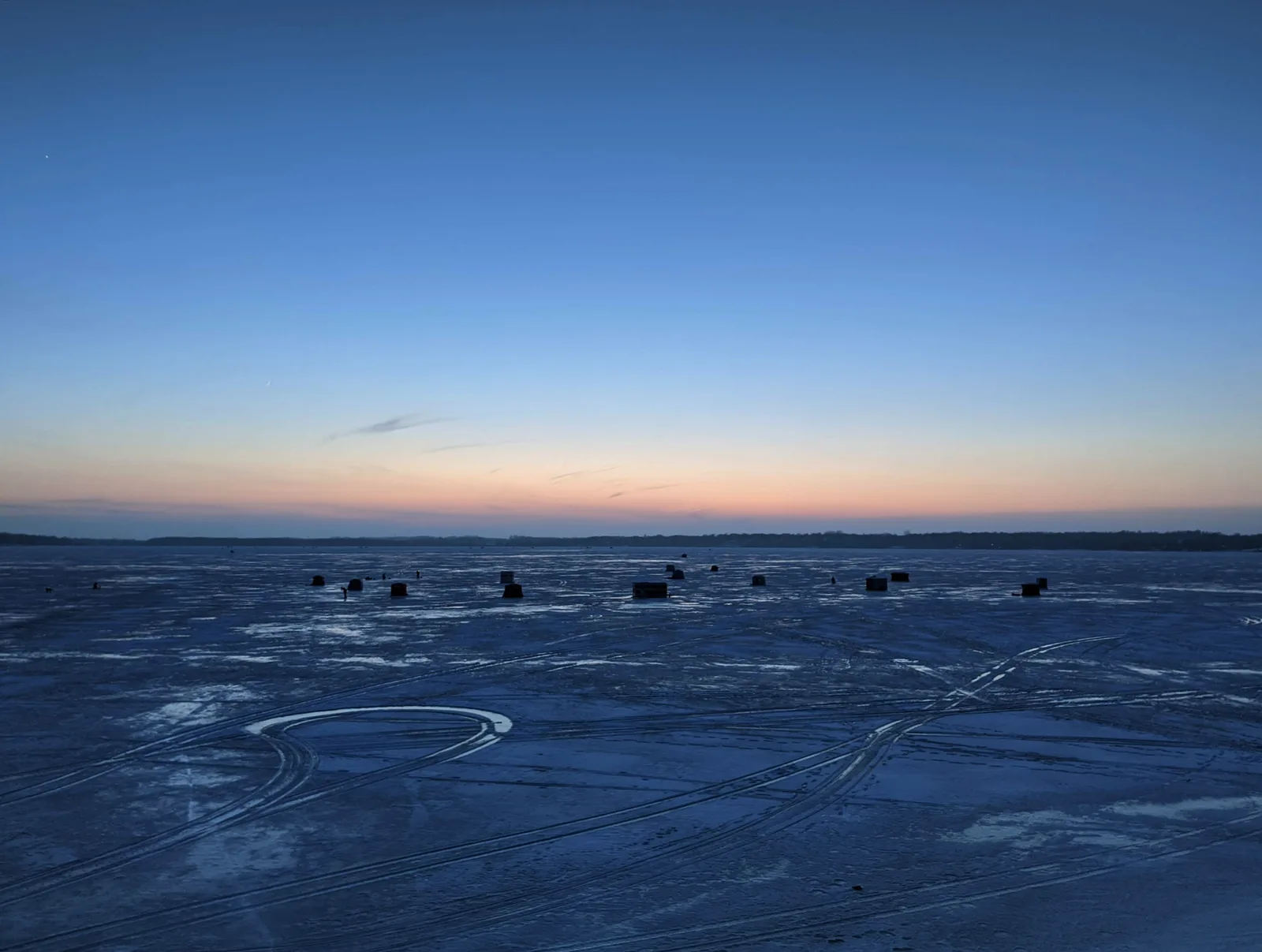
Ice houses on Buffalo Lake. A cluster like this is a clue to where the fish have been. Photo: Courtney Celley, U.S. Fish and Wildlife Service (public domain).
No electronics? Drill a hole or two. If they come up empty, keep drilling holes at even spacing until the bottom drops away sharply. That’s the old Wisconsin Sea Grant method. Start your bait near the bottom, then try higher, until you find fish or decide to move.
Why the bottom? In winter the water near the bottom is warmer than at the top, Minnesota DNR says. Many fish and baitfish move there to save energy.
Most ice anglers now use some kind of fish finder, Minnesota says. New York DEC says you don’t need one to catch fish, but it shows depth, structure and fish moving under you. A flasher is the ice version: a sonar that shows what’s under the hole right now, not a scrolling history.
Keep the noise down. Minnesota says vehicles and the roar of a gas auger can scare fish away for a while. That’s one more reason to drill every hole at the start.
What is the trick to ice fishing?
Fish two lines and let the fish pick. Minnesota DNR says sometimes the rod you jig catches most of the fish. Sometimes the one hanging still with a motionless bait catches more. If the still one wins, you’re jigging too hard. As Minnesota puts it, you can over-jig.
Rule of thumb: If the still line catches more fish than the one you jig, jig less.
On the jigging rod, fish a small spoon or jig, often “sweetened” with a piece of bait, as New York DEC puts it. Jig a few times, then stop for a few seconds. That pause is when fish generally hit. Big hops call fish in from a distance, Minnesota says. Small twitches tempt the ones already near your lure.
The still line is the dead stick: a second rod with a live minnow, left alone. For crappie, Minnesota calls the jigging rod a “calling rod.” It draws fish to the hole, and they eat the minnow on the second line.
Watch the line, not just the rod. Some perch anglers fish with no bobber, Minnesota says. They drop the lure to the bottom, wait for the line to go slack, then lift it a few feet. They set the hook when the rod tip twitches, the line goes slack or it moves in an odd way. A spring bobber, a thin piece of metal on the rod tip, shows bites you’d never feel. Crappie rise up to a bait and inhale it, which anglers call an up bite.
What hook and line? New York DEC prints a simple table, and it’s a good start.
| Fish | Hook size | Line | Auger | Rod |
|---|---|---|---|---|
| Sunfish, perch, crappie | 6–8 | 4–6 lb | 4–6 in (10–15 cm) | Ultra-light |
| Trout, walleye, pickerel | 4–6 | 6–10 lb | 6–8 in (15–20 cm) | Medium |
| Lake trout | 4–6 | 8–12 lb | 8 in (20 cm) or more | Medium-heavy |
| Northern pike | 1–2 | 10–17 lb | 8 in (20 cm) or more | Medium-heavy |
Minnesota goes lighter for perch and crappie: 2- to 4-pound line. New York’s jigging rods are usually 2 to 3 feet long. Iowa’s run 18 to 24 inches.
How do tip-ups work?
A tip-up is a spool on a stick that holds a baited line down the hole. When a fish takes the bait, usually a minnow, the pull on the line releases a signal, usually a red flag. That’s New York DEC’s description, and it’s the whole idea.
Tip-ups let you cover water while you jig. Take Me Fishing says most ice anglers set tip-ups around an area first. Once a spot gets several bites, they pull the tip-ups and fish it with a rod.
To set one, the way New York DEC teaches it:
- Clip a weight, called a depth sounder, to the hook and lower it to the bottom.
- Raise it off the bottom as far as you want the bait.
- Mark the line at the water line with a small bobber or a button.
- Take the weight off, bait the hook and lower it to your mark.
- Set the flag.
Tip-ups usually come without line, Minnesota says, so spool one before you go.
When the flag flies, walk. Minnesota says not to run toward it: the ice is slippery. Then the advice splits on when to set the hook. For pike, Minnesota says to wait until 15 seconds or more have passed and the fish is swimming slowly, or you feel dead weight. Wisconsin’s Sea Grant guide says a walleye may stop and take four or five minutes with the bait. Maine’s guide says a short, quick tug sets the hook.
Check the bait every half hour or so, Minnesota says. Maine says every hour. Clear the ice and slush from the hole when you do. How far you may walk away from a tip-up is a state rule, and it ranges from in sight to 200 feet.
Is it better to ice fish deep or shallow?
Neither. It depends on the fish and the light. Walleye come shallow at dawn and dusk, crappie hang in the middle, and perch slide deeper as the winter goes on. Start here.
| Fish | Where to start | How deep |
|---|---|---|
| Walleye | Points, humps, narrows, drop-offs, saddles | 10 ft (3 m) or less at dawn and dusk, deeper in bright light |
| Yellow perch | Green weeds early, drop-offs midwinter, shallow at the end | Near the bottom, from weeds under 10 ft (3 m) to flats at 40 ft (12 m) |
| Crappie | Mouths of shallow bays that lead to deeper water | Suspended, a few feet under the ice to inches off the bottom |
| Bluegill | Over or on the edge of weed beds | 15 ft (4.6 m) or less |
| Northern pike | Points, narrows, weedlines | 6–15 ft (1.8–4.6 m), bait from near the bottom to a few feet under the ice |
| Lake trout | Over open basins | Start at 30–40 ft (9–12 m), out to 90–100 ft (27–30 m) |
Walleye
Ice fishing for walleye is mostly drilling holes where walleye feed and jigging near the bottom. Use a lure tipped with a minnow or a minnow head, Minnesota DNR says. Its usual outfit is a 2- to 3-foot semi-stiff rod and 6-pound line. Most anglers fish without a bobber and set the hook the moment the fish hits.
The winter spots are the ones you fished in summer and fall. The walleye fishing basics carry over too: near the bottom, and in low light. On stained lakes, Skip Sommerfeldt of Wisconsin DNR finds tip-ups with live bait often catch more walleye than a jig rod. On clear lakes, jigging may do better.
Crappie
Crappie fishing through the ice is a hunt for a suspended school. Crappie typically aren’t near the surface or the bottom, Minnesota says. Find one and drill a few more holes in slightly deeper and shallower water nearby. Fish 2- to 4-pound line and set the hook gently, because their soft mouths tear.
One ethics rule from Minnesota: crappie caught deeper than 20 ft (6 m) are likely to die if you put them back down the hole. Keep those. Ice fishing for crappie on clear lakes is often best at dawn and dusk, Minnesota says. Murky lakes can have a good day bite.
Northern pike
Pike are where the tip-up beats the rod. Minnesota DNR calls a tip-up rig the best way to catch northern pike in winter. Use a sucker minnow or a larger shiner under 12 inches, big enough that perch leave it alone. Minnesota pairs braid of 45 to 70 lb with a 2- or 3-foot wire or fluorocarbon leader. In open water you cast for pike. Through the ice you wait for the flag, and pike ice fishing is a game of where you spread the tip-ups.
Yellow perch
Perch move through the winter, and perch fishing through the ice follows them. Minnesota says they sit in shallow green weeds early, move to deeper drop-offs as winter goes on, and return shallow to spawn at the end. On some Wisconsin lakes anglers fish 40 to 60 ft (12–18 m) down. Many Wisconsin ice anglers choose a small, colorful teardrop jig with a wax worm or mousie.
Perch through the ice have a long history. On Wisconsin’s Madison chain, Lake Mendota was a perch lake a century ago.
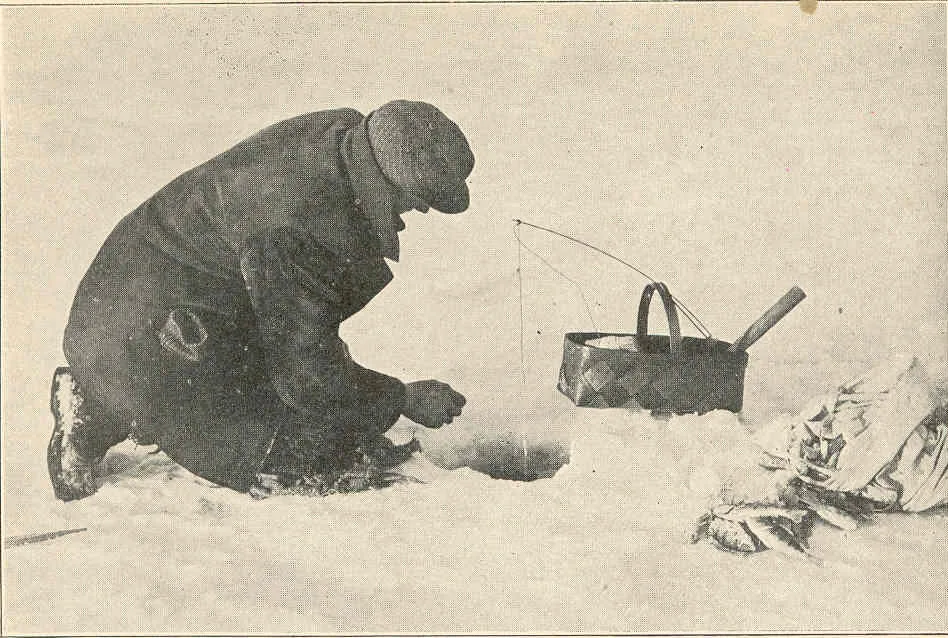
A perch fisherman on Lake Mendota in 1921, from the Bureau of Fisheries bulletin that put the winter catch at about 282,960 perch. Photograph by L. W. Brown, public domain.
Perch ice fishing is mostly bottom fishing. New York DEC says they’re close to the bottom anywhere from shallow weed beds to flats in 40 feet of water.
Bluegill and lake trout
Bluegill are the easy winter fish. Iowa DNR says most Iowa lakes are full of them, and they’re the easiest and most often caught in winter. Fish small jigs tipped with spikes over the weeds, from a few feet under the ice to just off the bottom, New York says. Their mouths are small, so Minnesota says to start with smaller jigs.
Lake trout are the opposite: deep, open-water cruisers. Minnesota anglers often start at 30 or 40 feet and move out as deep as 90 or 100. They often hit a bait as it drops. They have hard mouths, so set the hook hard. In Minnesota, designated trout lakes allow only one line, so it’s a rod or a tip-up there, not both.
What’s the best bait for ice fishing?
For panfish, start with wax worms. Take Me Fishing calls them generally one of the best natural ice fishing bait choices for panfish. Spikes and mousies are fly larvae, New York DEC says, and they work the same way. For bigger fish, use minnows.
| Fish | Live bait | On the line |
|---|---|---|
| Bluegill, crappie | Wax worms or wigglers | A small teardrop |
| Crappie | Crappie minnows, which are small, sorted fathead minnows | Jigs of 1/16, 1/32 or 1/64 oz |
| Perch | Wax worms or mousies | A small, colorful teardrop jig |
| Walleye | 3–4 in (8–10 cm) minnows | A tip-up, or a jigging spoon tipped with a minnow |
| Northern pike | Suckers or shiners, 4–7 in (10–18 cm), under 12 in (30 cm) | A tip-up |
| Lake trout | Heads or chunks of suckers, chubs or large minnows | A jig or jigging spoon, often silver or white |
Watch the word “wigglers.” Iowa uses it for mayfly larvae. Minnesota writes “wigglers/Eurolarvae,” and Eurolarvae are European blowfly maggots fed dyed food to color them. Ask the bait shop what you’re getting. Keep larvae in an insulated container next to your body so they don’t freeze, Iowa says. Minnows go in an insulated bucket, with a dipper so your hands stay dry.
Never dump leftover minnows or bait water into the lake, New York says. Moving minnows between lakes is where bait rules get strict, so read your state’s. Minnesota makes you swap your bucket water for tap or bottled water before you leave a lake with bait. Fishing through the ice is the exception, except on Lake Superior.
For ice fishing lures, go small. Most of it is small jigs and spoons with a bit of bait. Tungsten jigs are denser than lead, Minnesota says, so they fall faster.
When is the best time to ice fish?
Early and late in the day. New York DEC says early morning and late afternoon tend to be best. For walleye, Minnesota calls the 90 minutes before sunset and the time just after it prime time, though murky lakes can bite all day. Crappie often feed after sunset, Iowa says. Pike are the exception: they feed by sight and bite best in daylight, Wisconsin DNR says.
Across the winter, Minnesota says the early and late weeks of the ice are productive, because oxygen is highest then. In the same breath it says no ice is ever safe. Early and late ice is thinner than midwinter ice, which is when a spud bar earns its place.
Check the season too. In Minnesota, walleye and pike close the last Sunday in February, while perch and crappie stay open. Maine keeps its waters closed to ice fishing except those opened by rule. And watch the weather. Minnesota says to pack a compass in case a snow squall hides the shore.
How many lines can you fish through the ice?
From 2 to 8 in most of these twelve states’ general rules. Lines, tip-ups and hooks count differently from state to state, and so does “attended.” Rules change, so check this season’s regulations before you go.
| State | Lines through the ice | When is a line attended? |
|---|---|---|
| Minnesota | 2. Only 1 on designated trout lakes and streams | In sight of the line, or within 200 ft (61 m) of a tip-up. A phone alert doesn’t count |
| Iowa | 2, tip-ups count. A 3rd with a third-line permit | You can’t be out of sight of your lines |
| Wisconsin | 3 hooks, baits or lures | Not responding at once to a bite is evidence the line is unattended |
| Michigan | 3 lines, tip-ups included, and 6 hooks or lures in all | All lines under immediate control |
| Ohio | 3 rods or hand lines. No more than 6 tip-ups | Not set in Ohio’s line rule. The 3-line cap counts lines in hand or under control |
| North Dakota | 4 poles. Each tip-up counts as one | Easily visible, within 150 ft (46 m). Not checked for over an hour is an illegal set line |
| South Dakota (2023 handbook) | 4. Only 2 on the Minnesota border waters | Under your direct supervision, in your unaided sight |
| Pennsylvania | 5 devices, one line each | Not set in the ice-fishing rule |
| Maine | 5 | Under your immediate supervision |
| New Hampshire | 6 on most waters. 2 on designated lake trout and salmon lakes | Not set on the state’s ice-fishing page |
| New York | 7, in any mix of devices | Immediate attendance |
| Vermont | 8. Up to 15 on Lake Champlain | You must be able to see them. A line showing a fish is tended within 30 minutes |
Minnesota announced two changes on November 17, 2025, for the 2025-26 ice season. Hook-setting devices that work by a spring or a bent rod are now legal on the ice, as long as they can’t reel in line. And one line may carry up to three hooks within 18 in (46 cm), up from 9 in.
Three of these states also limit the hole. Wisconsin and Ohio allow up to 12 in (30 cm) across, Pennsylvania 10 in (25 cm). North Dakota sets no limit, but a hole over 10 in must be marked when you leave it.
You’ll need a license too. Wisconsin and North Dakota want one from age 16. Minnesota residents under 16 fish free, and Maine kids under 16 can ice fish without one. Michigan’s age is 17.
A fish house left on the ice needs your name and address on the outside. The letters must be at least 2 in high in Minnesota, 3 in in New York. It comes off the ice by a set date, March 15 in New York. A portable shelter you take home each day doesn’t count as a shanty there.
All articles
 Crappie Ice Fishing: Where They Suspend and What to Drop
Ice fishing for crappie: where they hang under the ice in each kind of lake, the dusk and night bite, tiny jigs, two lines, and the 20 ft rule.
 Ice Fishing for Pike: Tip-Ups, Bait, Depth and When to Set the Hook
Ice fishing for pike: where they sit under the ice, the tip-up spread, live or dead bait, how far off bottom, when to set the hook, and the state rules.
 Ice Thickness Chart: How Thick Ice Must Be to Walk, Ride or Drive
Ice thickness chart for walking, snowmobiles, cars and trucks, with white ice doubled, what each inch holds in pounds, and how to measure it yourself.
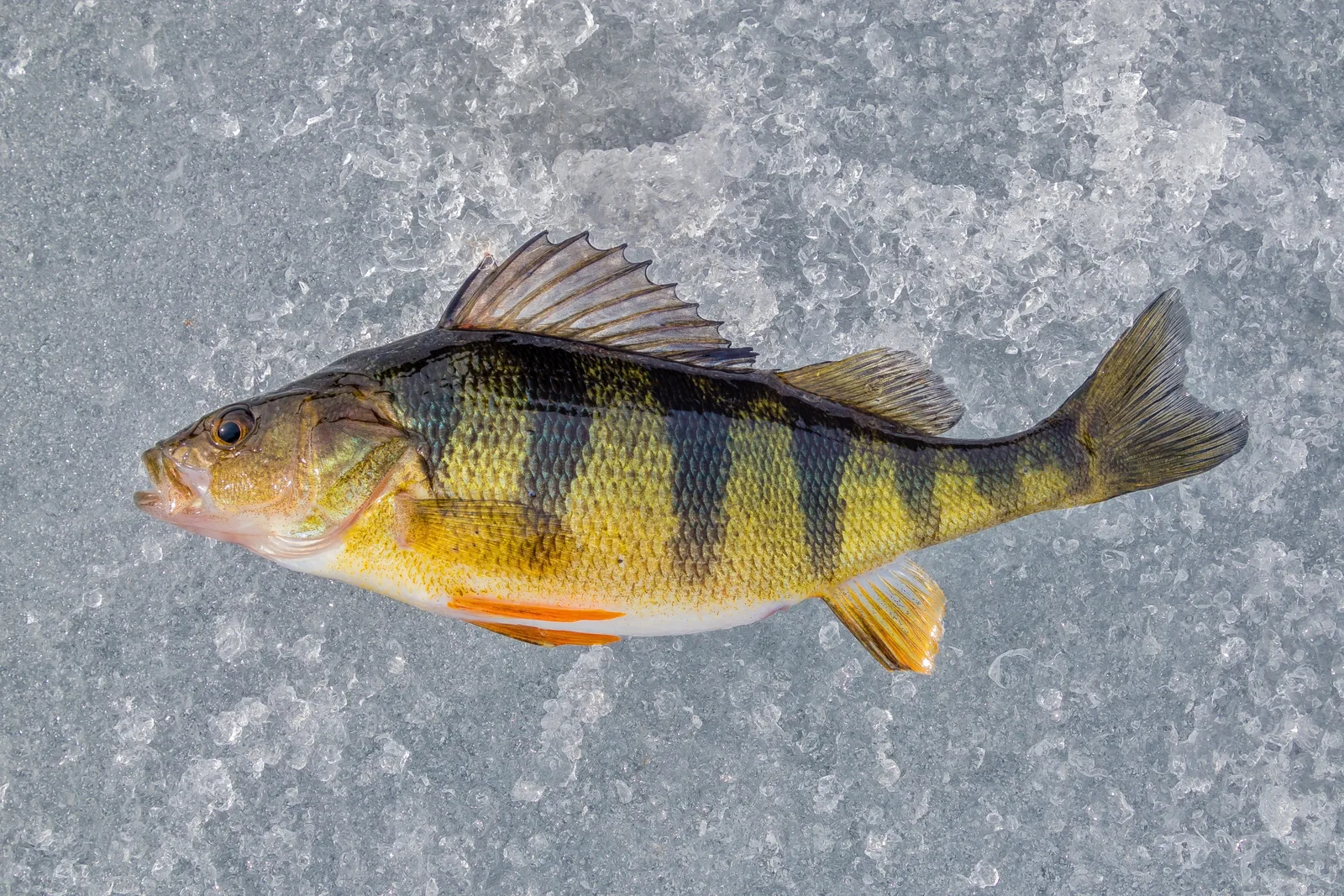 Perch Ice Fishing: Where Perch Sit Under the Ice and How to Catch Them
Perch ice fishing: fish near the bottom, from weeds under 10 ft to flats at 40 ft, with 1/64 to 1/16 oz jigs and spikes. Plus 8 steps to stay on a school.
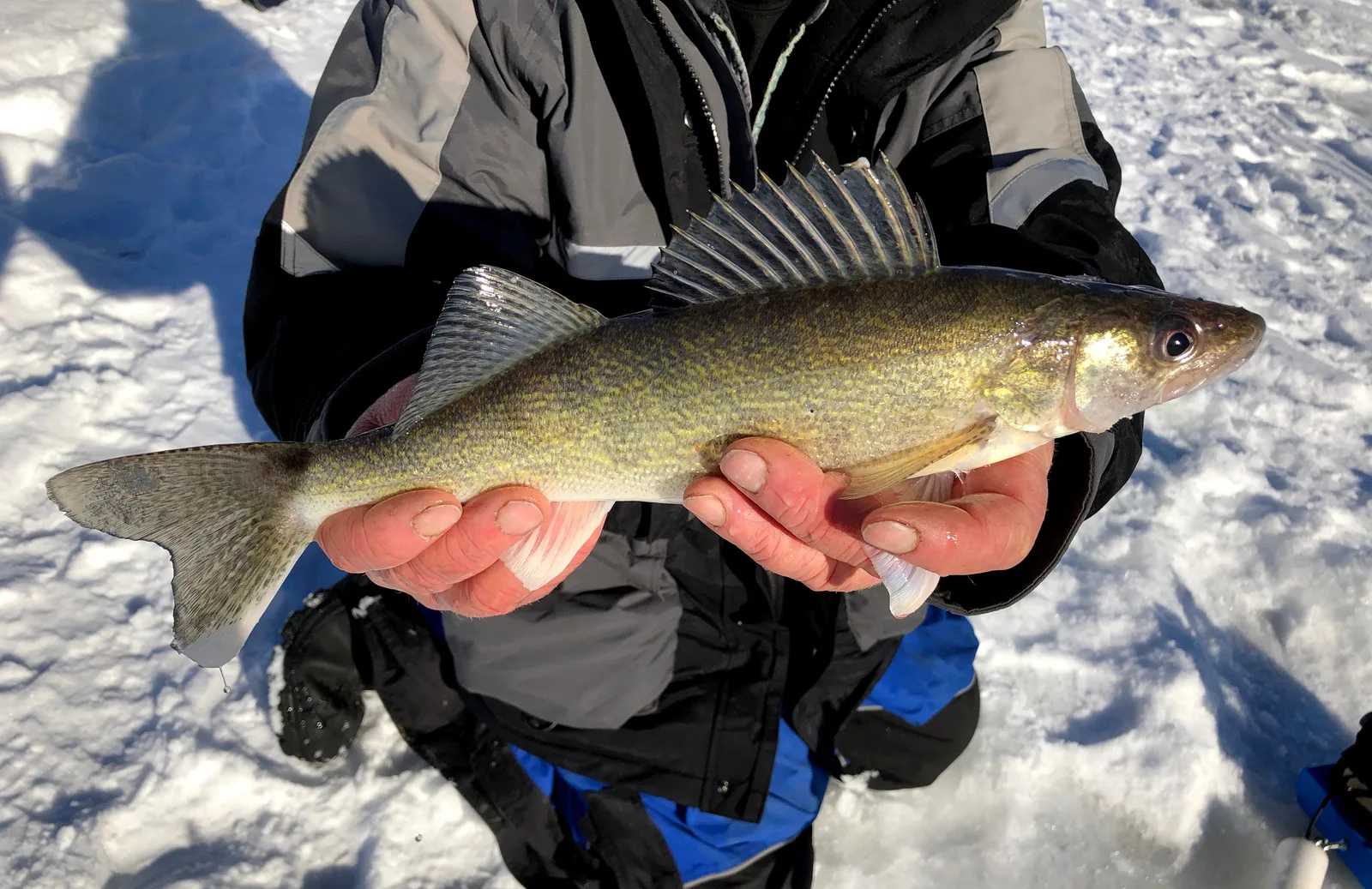 Walleye Ice Fishing: Where, When and How to Catch Them
Walleye ice fishing peaks in the 90 minutes before and just after sunset. Where they sit, how deep by lake, spoon or Jigging Rap, tip-ups and line rules.

Free PDF · 5 pages
Stop guessing the ice. Tape this strip to your scoop and read it at the hole
Ice that is 6 or 7 inches thick in one spot can be 2 inches close by. You can't tell by looking.
The True-Size Ice Thickness Chart. Print it, tape the strip to your ice scoop, hook it under the ice and read the band at the surface: on foot, sled or truck. One side for clear ice, one for white.
- A true-size strip for your scoop handle, marked from "stay off" to a truck with a wheelhouse
- Two wallet charts, one for your buddy, with five moves that get you out if you go through
- Why 8 inches of white ice counts as 4, and the ice to stay off at any thickness
Every clear-ice number is the Minnesota DNR's, set beside the 29 sources on the page, the Army Corps of Engineers among them.
No card, nothing to buy. Confirm with one click and the PDF is on its way, one version for your phone and one to print, yours to keep. Then a few short emails and one a week on what's biting, with an unsubscribe link in every one. Privacy.
Sources (53)
- Minnesota DNR, Learn to ice fish
- Minnesota DNR, Ice fishing for walleye
- Minnesota DNR, Ice fishing for crappie
- Minnesota DNR, Ice fishing for northern pike
- Minnesota DNR, Ice fishing for perch
Show all 53 sourcesShow fewer sources
- Minnesota DNR, Ice fishing for bluegill
- Minnesota DNR, Ice fishing for lake trout
- Minnesota DNR, General ice thickness guidelines
- Minnesota DNR, How to check ice thickness
- Minnesota DNR, Ice Safety Gear
- Minnesota DNR, Ice safety
- Minnesota DNR, Carbon monoxide poisoning in ice shelters
- Minnesota DNR, What if you fall in?
- Minnesota DNR, News release: Hook-setting devices allowed starting with the 2025-26 ice fishing season (Nov 17, 2025)
- Minnesota DNR regulations, General Regulations (eRegulations)
- Minnesota DNR regulations, Fishing Licenses & Fees (eRegulations)
- Minnesota Revisor of Statutes, 97C.321 Restrictions on unattended lines
- Minnesota Revisor of Statutes, 97C.355 Shelters on ice; dark houses and fish houses
- New York State DEC, How to Ice Fish
- New York State DEC, Guide to Ice Fishing (I FISH NY)
- New York State DEC, Ice Fishing
- New York State DEC, General Freshwater Fishing Regulations
- Iowa DNR, Ice Fishing
- Iowa DNR, General Fishing Regulations (eRegulations)
- Wisconsin DNR, Guide to Wisconsin Hook and Line Fishing Regulations 2026-2027
- Wisconsin DNR, Fishing walleye through the ice (Skip Sommerfeldt)
- Wisconsin DNR, Yellow Perch (PUBL-FM-710 08)
- Wisconsin DNR, Northern Pike (PUBL-FM-707)
- University of Wisconsin Sea Grant Institute, Ice Fishing (Warren Downs, revised 2005)
- Michigan DNR Fishing Guide, Lawful Fishing Methods (eRegulations)
- Michigan DNR Fishing Guide, Fishing License Information (eRegulations)
- North Dakota Game and Fish, Fishing regulations
- North Dakota Game and Fish, Ice Fishing Information and Tips
- South Dakota GFP, 2023 South Dakota Fishing Handbook
- Ohio Administrative Code, Rule 1501:31-13-01
- 58 Pa. Code § 63.10, Ice fishing (Cornell LII)
- Maine Revised Statutes, Title 12, §12659-A: Ice fishing regulations
- Maine IFW, Ice Fishing Guide (Jake Scoville)
- Maine IFW, General Fishing Laws and Definitions
- Vermont Code of Rules 12-010-035, Fish Management, Section 4.0 Ice Fishing (Cornell LII)
- New Hampshire Fish and Game, Ice Fishing (freshwater regulations, eRegulations)
- Lifesaving Society, Cold Water and Ice
- Take Me Fishing (RBFF), Ice Fishing Basics: 5 Guidelines to Get You Started (Debbie Hanson, December 2022)
- Vexilar, FLX-12 instruction manual
- Iowa DNR, Stay safe on the ice this winter (December 10, 2024)
- Outdoor Life, Icefishing Tips: Guide to Live Bait (Dick Sternberg, 2013)
- StrikeMaster, Mora hand auger (maker price, November 2026)
- Eagle Claw online store (skimmer, CRYO ice rod, Ice Safety Kit, jig kit; maker prices, November 2026)
- Clam Outdoors online store (Straight Drop reel, bucket; maker prices, November 2026)
- Onyx Outdoor, Adult General Purpose Life Jacket
- Eskimo online store (Economy Chisel)
- Mustang Survival, Bailer Throw Bag, 50 ft
- Pearse and Achtenberg, Habits of Yellow Perch in Wisconsin Lakes, Bulletin of the U.S. Bureau of Fisheries vol. 36, 1921 (photograph by L. W. Brown)