 By

Fishing boats run from $1,495 for a bare 10 ft aluminum jon boat to $77,595 for a rigged 21 ft fiberglass bass boat. The water you fish picks the type for you. A pond or a slow river wants a flat-bottomed jon boat. A bass lake wants a bass boat, a big windy lake a deep-V, and a saltwater flat a skiff. Buy for the water you fish most weekends, not the water you dream about.
Nearly four of every five boats sold in the US in 2024 were used: 858,798 pre-owned against 238,117 new, NMMA counts.
Start here
- Jon boat: the cheapest way onto the water. Sizes from 10 to 17 ft, welded or riveted, and the horsepower math behind the plate on the transom.
- Bass boat: aluminum or fiberglass, what the speed costs, and what new ones sell for.
- Trolling motor: the quiet electric motor that holds you on the fish. Nearly every fishing boat ends up with one.
- Trolling motor battery: lead-acid or lithium, and how long a charge lasts.
- Fish finders: the screen that shows depth, bottom and fish under the boat.
What are the types of fishing boats?
Freshwater fishing boats come in three hull shapes. A flat bottom rides on top of the water and floats in inches of it. A modified-V has a shallow V at the bow that softens the ride. A deep-V has a sharp V that cuts through waves. The shape is the trade: the flatter the hull, the shallower it goes and the harder it slaps in chop. If a boat word is new, the boat terms list explains it.
| Freshwater type | Length | Hull | Where it fits |
|---|---|---|---|
| Jon boat | 8–24 ft (2.4–7.3 m) | Flat bottom, usually aluminum | Ponds, creeks, rivers, protected water |
| Bass boat | 16–25 ft (4.9–7.6 m) | Aluminum mod-V or fiberglass | Lakes and rivers, two anglers |
| Deep-V (multi-species) | 16 ft 4 in–22 ft 2 in (5–6.8 m) in Alumacraft’s line | Aluminum V-hull | Big lakes |
Canoes, 12 to 16 ft, and kayaks, 8 to 16 ft, fish the same protected water as a small jon boat, on paddle power. The salt side splits by how far from shore you go. Flats skiffs and bay boats work the shallows. Center consoles go wherever their size and rigging allow.
| Saltwater type | Length | Hull | Where it fits |
|---|---|---|---|
| Flats skiff | 16–20 ft (4.9–6.1 m) | Shallow-draft fiberglass or composite | The skinniest flats, poled |
| Bay boat | 20–26 ft (6.1–7.9 m) | Fiberglass or composite mod-V | Open bays; bigger ones go offshore |
| Center console | 14–50+ ft (4.3–15+ m) | Usually fiberglass, deep-V or mod-V | Any water, by size and rigging |
The length ranges come from Salt Water Sportsman’s field guide to fishing boats. It also covers the dual console (16 to 30 ft) and the cabin boats built for offshore trips: walkaround, express and convertible.
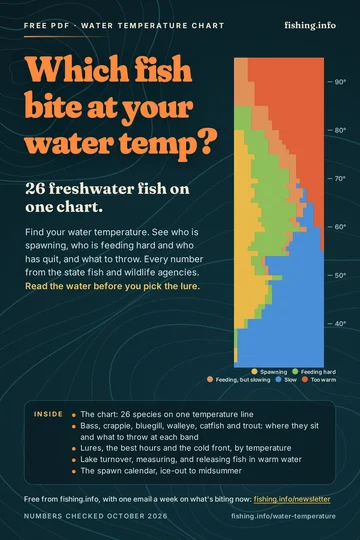
Free PDF · Water temperature chart Which fish are biting at today's water temperature?
One reading, and the 16-page chart shows which of 26 fish are spawning, feeding hard or slowing down; for bass, crappie, bluegill and walleye, where they sit and what to throw. Every number sourced.
No card, nothing to buy, and the PDF is yours to keep. It's in your inbox a minute later. Then a few short emails and one a week on what's biting. Unsubscribe anytime. Privacy.
Which fishing boat is best for you?
The best fishing boat is the one that fits the water you fish, the people you bring, and what you can tow. Start with the water.
Ponds, creeks and slow rivers: a jon boat
A jon boat is a flat-bottomed boat with a square bow and stern and one or more bench seats. Most are aluminum. It runs on oars, a small outboard or an electric trolling motor, and it’s built for protected water. Tracker’s 14 ft Grizzly weighs 165 lb and draws just over 5 in. The flat hull rides over waves instead of cutting through them, which keeps it on calm water. Duck hunters and bowfishermen use the same boat. Most jon boats are rated for small motors: 15 hp on that 14 ft Grizzly.
Bass lakes: a bass boat
A bass boat is built for two anglers: a casting deck up front, another in back, and seats in between. Discover Boating, the boat industry’s own site, puts them at 16 to 25 ft and says they are “usually only two-person occupancy”. They carry big motors for their weight, so they’re fast and they burn fuel. Fuel is the number-one running cost, the same site says. For family cruising, look elsewhere. The low sides and big decks that make a bass boat good at bass make it a poor fit for most other jobs. Bass boats come in aluminum or fiberglass.
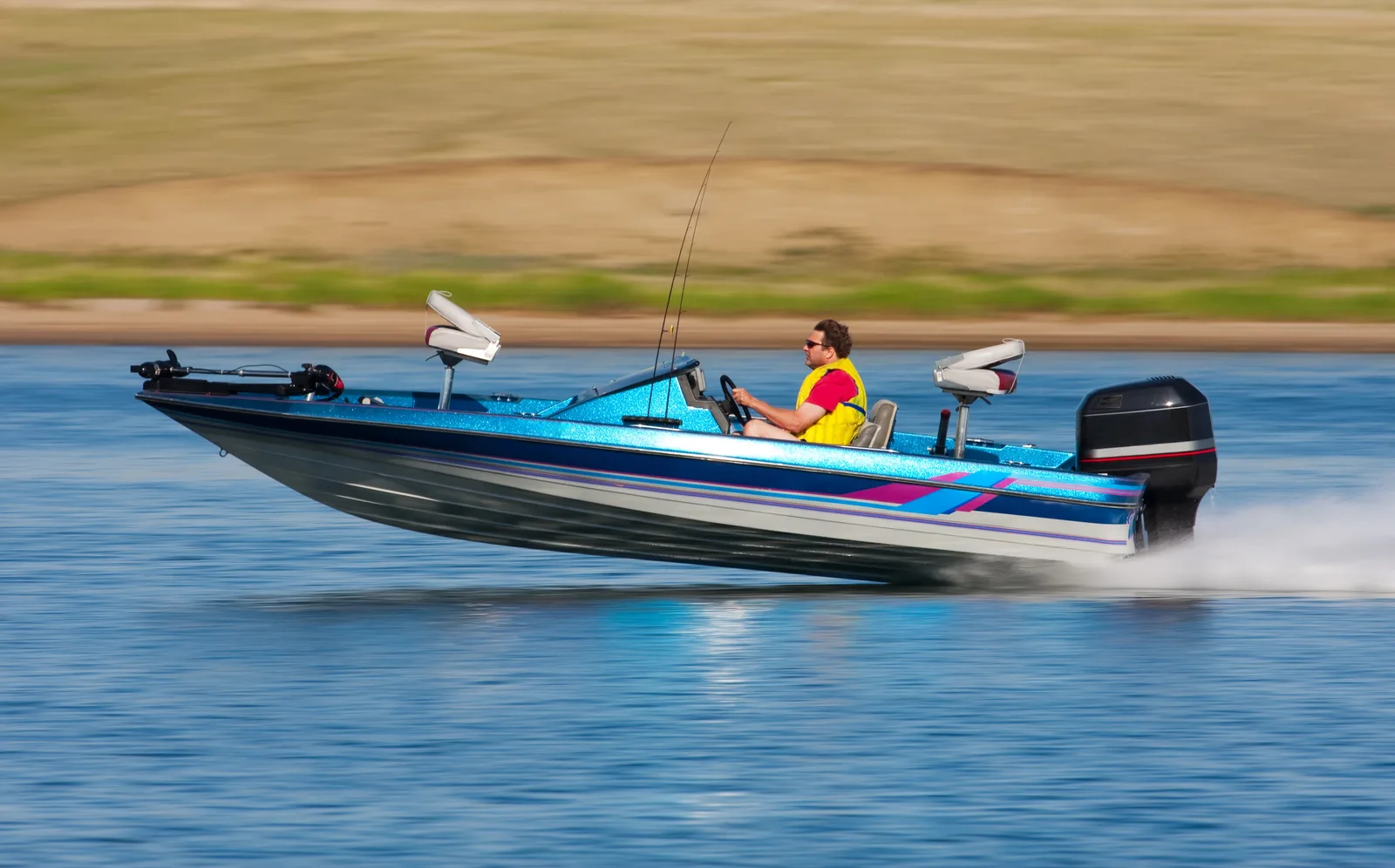
A bass boat at speed: a casting deck with a pedestal seat at each end, the trolling motor stowed on the bow. Photo: songbird839 / Depositphotos.
Big lakes: a deep-V
On big water, a V hull cuts the waves a flat bottom would slap. The multi-species boat is that V hull in aluminum, with a tiller or a console. It has room to troll or cast for walleye, pike or bass. Alumacraft’s Voyageur 175 Tiller is a typical one: 17 ft 10 in, rated for 75 hp and six people.
Salt flats and bays: a flats skiff or bay boat
A flats skiff is 16 to 20 ft with a shallow-draft hull and usually a platform over the engine. You stand on it and push the boat with a long pole, quietly, across the shallowest flats. A bay boat is bigger, 20 to 26 ft, a beamy center console with low sides and big livewells. It was made for open bays, and the bigger ones go offshore. Both are fiberglass or composite.
Offshore: a center console
The center console is the “open fisherman” of salt water. The wheel sits on a console in the middle, so you can fish all the way around the boat. They run from 14 to over 50 ft. Size and rigging decide how far out you go.
Fishing with the family: a pontoon or dual console
If the boat has to fish on Saturday and carry the whole family on Sunday, a pontoon or a dual console earns its keep. Multi-purpose boats, led by pontoons, sold 56,280 new in 2024, NMMA counts. A pontoon gives you lots of deck space. Discover Boating calls pontoons “amazingly stable” and puts them at 16 to 30 ft, for up to 15 passengers. A dual console has two consoles, one on each side, with a walkway to the bow between them. It fishes “all waters, depending on size”.
Eight real fishing boats, side by side
What a fishing boat costs depends on the type, the size and whether the motor and trailer come with it. Here are eight real boats from three makers’ own spec sheets, from the smallest jon boat to a tournament bass boat. “Max hp” is the most horsepower the maker rates the hull for.
| Boat (model year) | Length | Max hp | People | Price as listed |
|---|---|---|---|---|
| Tracker Grizzly 10 Jon (2027) | 9 ft 10 in (3.0 m) | 3.5 | 2 | $1,495, boat only |
| Tracker Grizzly 14 Jon (2027) | 13 ft 10 in (4.2 m) | 15 | 3 | $1,995, boat only |
| Tracker Grizzly 1648 SC (2027) | 16 ft 1 in (4.9 m) | 50 | 4 | $15,995 with 20 hp and trailer |
| Bass Tracker Classic XL (2027) | 16 ft 8 in (5.1 m) | 50 | 3 | $17,995 with 40 hp and trailer |
| Tracker Pro Team 175 (2027) | 17 ft 7 in (5.4 m) | 75 | 4 | $24,995 with 60 hp and trailer |
| Alumacraft Voyageur 175 Tiller (2027) | 17 ft 10 in (5.4 m) | 75 | 6 | Dealer quote |
| Nitro Z17 (2027) | 17 ft 4 in (5.3 m) | 115 | 3 | $32,995 with 115 hp and trailer |
| Nitro Z21 XL Pro (2027) | 21 ft 2 in (6.5 m) | 300 | 4 | $77,595 with 250 hp and trailer |
All eight are freshwater boats, and Tracker and Nitro are sister brands. Read the price column carefully. The two small jon boats are priced as a bare hull. Add a motor, and a trailer if it won’t ride in a truck bed. Tracker lists a 12 ft 6 in single-axle trailer for them at $1,295. The others are priced as a package with a motor and trailer. Dealer prep and freight come on top of all of them.
How shallow, and how heavy?
Draft is how deep the hull sits in the water. It decides where you can go. Dry weight decides what you can launch by hand.
| Boat | Draft | Dry weight |
|---|---|---|
| Tracker Grizzly 10 Jon | 5.75 in (15 cm) | 115 lb (52 kg) |
| Tracker Grizzly 14 Jon | 5.12 in (13 cm) | 165 lb (75 kg) |
| Tracker Pro Team 175 | 12 in (30 cm) | 1,050 lb (476 kg) |
| Nitro Z17 | 15 in (38 cm) | 1,450 lb (658 kg) |
| Nitro Z21 XL Pro | 16 in (41 cm) | 2,150 lb (975 kg) |
The 14 ft jon draws less than half of what the aluminum bass boat does. The Z21 weighs 13 times as much as the 14 ft jon.
How much is a decent fishing boat?
A decent new fishing boat costs about $2,000 for a bare 14 ft jon hull. A rigged 16 to 18 ft aluminum boat runs $16,000 to $25,000, and fiberglass starts around $33,000 in Nitro’s line. Those are the list prices in the table above. Three price bands cover most of what you’ll see:
- Under $2,500: a jon hull. Tracker’s Grizzly jons list at $1,495 (10 ft), $1,795 (12 ft), $1,995 (14 ft) and $2,495 (15 ft) for the boat alone.
- $15,000 to $25,000: a rigged aluminum boat. A 16 to 18 ft hull, a 20 to 60 hp outboard and a trailer.
- $30,000 and up: fiberglass. Nitro’s line runs from $32,995 for the Z17 to $77,595 for the Z21 XL Pro, each with motor and trailer.
Bass boats tend to cost more than many other boats of the same size, Discover Boating says. The biggest upkeep cost is the engine’s regular maintenance. The sticker isn’t the whole bill. Budget for the trailer if it isn’t in the package, plus dealer prep and freight. Then come insurance, fuel and the registration fee, which varies by state and boat size.
Aluminum or fiberglass?
Aluminum is lighter and cheaper. Fiberglass is heavier, carries bigger motors and costs more. Tracker’s aluminum Pro Team 175 and Nitro’s fiberglass Z17 are close in length. The fiberglass boat weighs 400 lb more and is rated for 40 more horsepower.
| Tracker Pro Team 175 | Nitro Z17 | |
|---|---|---|
| Hull | 0.100 in welded aluminum | Fiberglass |
| Length | 17 ft 7 in (5.4 m) | 17 ft 4 in (5.3 m) |
| Dry weight | 1,050 lb (476 kg) | 1,450 lb (658 kg) |
| Max hp | 75 | 115 |
| Package price | $24,995 (2027) | $32,995 (2027) |
Aluminum hulls are either welded or riveted, and each side argues its case. Tracker, which welds, says riveted hulls “may develop vulnerabilities over time”. The riveted side’s answer, as boats.com heard it on a Lund plant tour in 2011: rivets “are easy to replace and in a pinch you can plug leaking rivets with epoxy.” Neither method wins on paper. Look at the sheet thickness on the spec sheet, and at the hull in front of you. On a small jon boat, Tracker’s sheet runs 0.063 to 0.080 in.
What is a good starter fishing boat?
For most people, a good starter fishing boat is a 12 to 14 ft aluminum jon boat, new or used. It’s cheap to buy, and a small outboard or a trolling motor runs it. Tracker’s 14 ft Grizzly lists at $1,995 for the hull, carries three people, and takes up to a 15 hp motor. The smallest jon boats ride in a pickup bed, and most go on a small trailer.
Step up to a 16 to 17 ft aluminum boat with a console when you fish bigger lakes or want to run farther. That’s where the $15,995 to $24,995 packages in the table sit. Fiberglass comes after that, when you know you want more horsepower.
A used boat is where most buyers land: pre-owned sales were 78.3 percent of all boat sales in 2024, NMMA says. On a used aluminum hull, press on the seams, the transom and around the rivets for soft spots. If you can’t put it in the water, run a few inches of water into the hull and look for leaks.
Can your vehicle tow it?
Check the package weight against your vehicle’s tow rating in its owner’s manual, and the towing length against your garage and the ramp. Here is what the makers list for their boat, motor and trailer packages:
| Package | Package weight | Towing length |
|---|---|---|
| Tracker Grizzly 1648 SC | 1,395 lb (633 kg) | 20 ft 4 in (6.2 m) |
| Bass Tracker Classic XL | 1,705 lb (773 kg) | 23 ft 2 in (7.1 m) |
| Tracker Pro Team 175 | 2,235 lb (1,014 kg) | 22 ft 8 in (6.9 m) |
| Nitro Z17 | 2,650 lb (1,202 kg) | 23 ft 8 in (7.2 m) |
| Nitro Z21 XL Pro | 4,050 lb (1,837 kg) | 27 ft 11 in (8.5 m) |
The 21 ft fiberglass rig weighs almost three times the 16 ft aluminum one. Add fuel and gear on top of these figures. Before a used rig goes on the road, check the trailer’s lights, tires and wheel bearings.
What does the capacity plate tell you?
Every boat under 20 ft with one hull carries a capacity plate, except sailboats, canoes, kayaks and inflatables. It lists three limits, set by federal rules. Stay under all three.
- People. The most persons, as a head count and in pounds. The head count is capped by the pound figure: the rule adds 32, divides by 141 and rounds. The maker may plate lower.
- Weight. The most total weight: people, motor and gear together.
- Horsepower. The biggest motor the hull is rated for, or “This Boat Not Rated for Propulsion by a Motor”.
The head count is the number people get wrong. Tracker’s 14 ft jon is plated for three people but only 345 lb of them. Three adults of 180 lb are 540 lb, way over, and even two of them come to 360 lb. On that boat, three people really means one adult and two kids. People, motor, fuel and gear together count against the second limit, 580 lb on the same plate. On a tiller jon boat, a federal formula keeps the horsepower low. A 12 ft hull with a 4 ft transom gets about 10 hp.
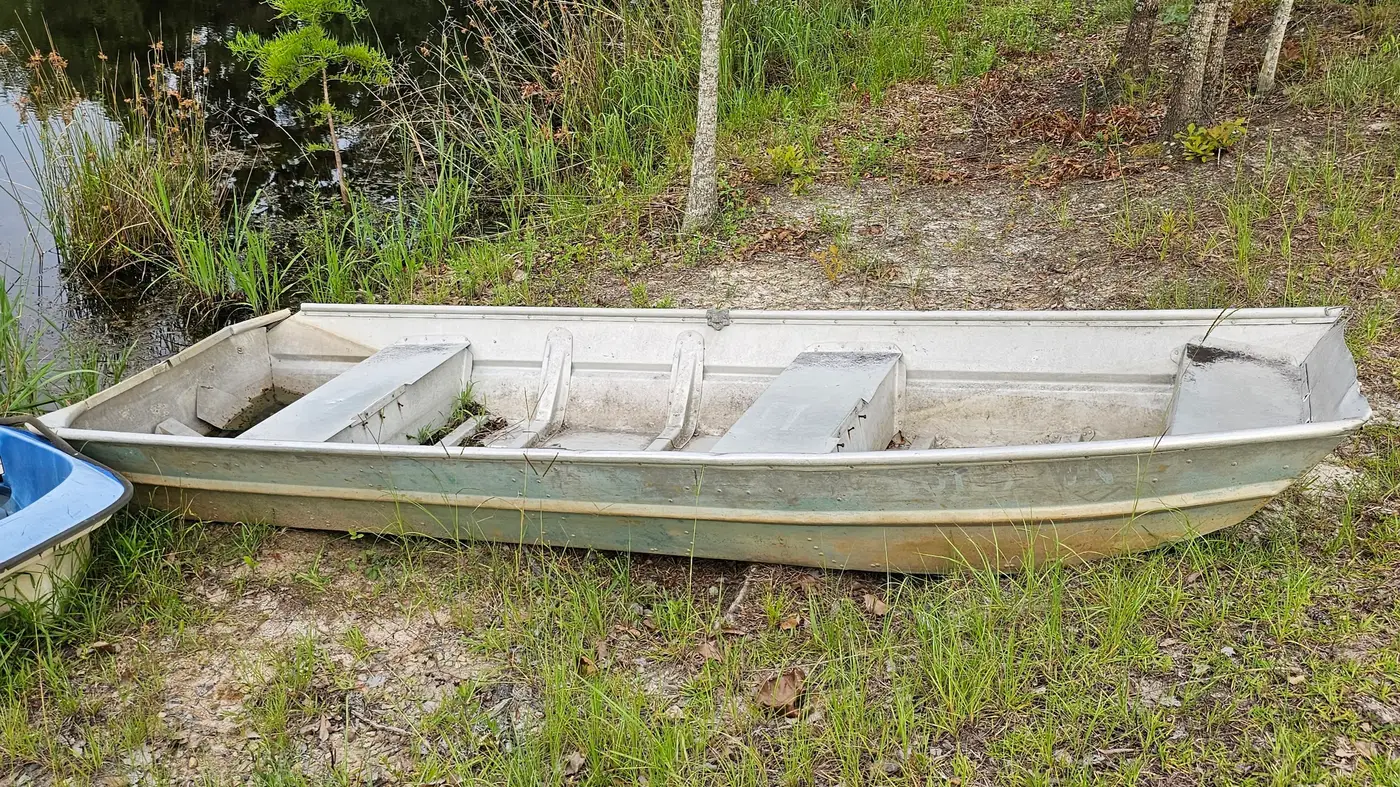
A small aluminum jon boat on a pond bank. Tracker plates its 10 to 14 ft jons for two or three people. Photo: JJonahJackalope, Wikimedia Commons (CC BY-SA 4.0).
What do you need before you launch?
The federal rules below cover every recreational boat. Your state adds its own, so check its boating pages before the first trip.
- Registration. Generally, a boat with a gas, diesel or electric motor must be registered in its state, “including a trolling motor”, Discover Boating says. Texas puts it plainly: adding a trolling motor to a canoe or rowboat “negates the exemption”. A registration lasts one to three years, depending on the state. The number goes on both sides of the front half of the boat, federal rules say. Use plain block letters at least 3 in high, in a color that stands out from the hull.
- Life jackets. One wearable life jacket for each person aboard. On a boat 16 ft or longer, add one throwable, such as a cushion or ring. Children under 13 must wear theirs while the boat is under way, unless they are below decks or in an enclosed cabin.
- Fire extinguisher. An outboard boat under 26 ft needs none if its build can’t trap fuel vapor. A closed compartment where a portable tank is stored, or a built-in fuel tank, changes that. An open jon boat with a portable tank usually needs none. A bass boat with a built-in tank needs one.
- Distress signals. On coastal waters, a boat 16 ft or longer must carry visual distress signals, such as flares. A boat under 16 ft needs night signals only between sunset and sunrise.
How big a trolling motor does your boat need?
A trolling motor is the electric motor that holds you on a spot and moves you along a bank without a sound. Minn Kota’s rule: at least 2 lb of thrust for every 100 lb of fully loaded boat, people and gear included. Each 12 volts of motor takes one 12-volt trolling motor battery. Worked on two boats from the table (our arithmetic):
| Boat | Loaded weight | Thrust by the rule | Minn Kota chart |
|---|---|---|---|
| Tracker Grizzly 14 Jon | 745 lb (338 kg) | 15 lb | 30 lb, 1 battery (12 V) |
| Tracker Grizzly 1648 SC | 1,785 lb (810 kg) | 36 lb | 40–45 lb, 1 battery (12 V) |
The loaded weight is the dry weight plus the plate’s full load. Minn Kota’s chart starts at 30 lb of thrust, so any 30 lb motor covers a 14 ft jon. The 1648 SC comes wired for a trolling motor but without one, so buy a 40 to 45 lb motor for it.
What else goes on a fishing boat?
Next comes a fish finder: it shows depth, bottom and fish under the boat. The depth finder guide covers the simplest way to see the bottom from a small boat. On a jon boat, a small unit on the transom or the trolling motor is all you need to start.
Five questions before you buy a fishing boat
- Where will you fish most? A pond or river points to a jon boat and a bass lake to a bass boat. Big water wants a deep-V, the flats a skiff. One boat rarely does all four well.
- How many people come along? Read the plate, not the brochure. The pound figure decides, and three adults can be more than a small boat may carry.
- What will you tow it with? Compare the package weight with your vehicle’s tow rating, and leave room for fuel and gear.
- Where will it live? A 14 ft jon fits on a short trailer beside the house. A 21 ft fiberglass rig is almost 28 ft long on its trailer.
- Count the whole budget. Add the motor and trailer if they aren’t in the price, plus prep, freight, registration, insurance, fuel and a trolling motor with its batteries.
The boat words you’ll hear
- Beam: the boat’s width at its widest point.
- Draft: how deep the hull sits in the water.
- Deadrise: how steep the V of the hull is, in degrees. A flat-bottomed jon is close to 0, Tracker’s 16 ft Grizzly 1648 SC has 7, and the Nitro Z21 XL Pro has 16.
- Freeboard: how high the sides stand above the water.
- Transom: the flat back of the boat, where the outboard hangs.
- Tiller: steering by a handle on the outboard itself, with no wheel.
- Livewell: a tank of fresh water that keeps the catch alive.
The cheapest boat in the lineup is the jon boat, so that’s the place to start.
All articles
- Bass Boat: What It Is, What It Costs and How Fast It Goes
A bass boat is a low, fast lake boat for two anglers. What a new one costs with motor and trailer, aluminum vs fiberglass, top speed and the rules.
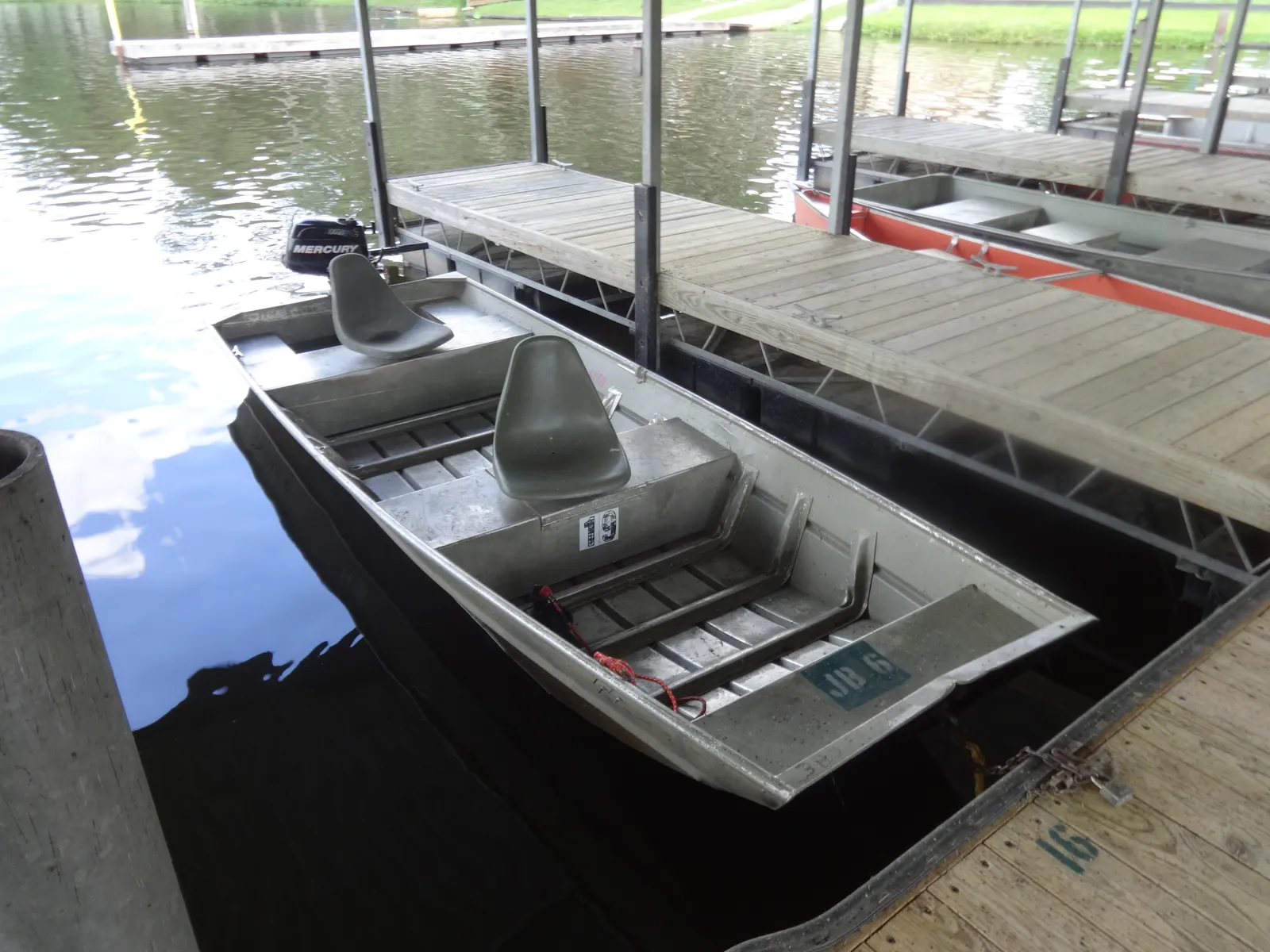 Jon Boat: Sizes, Prices, and How Much Motor Each One Can Take
A jon boat is a flat-bottomed aluminum fishing boat for calm, shallow water. Sizes from 10 to 17 ft, prices from $1,495, and the federal horsepower math.
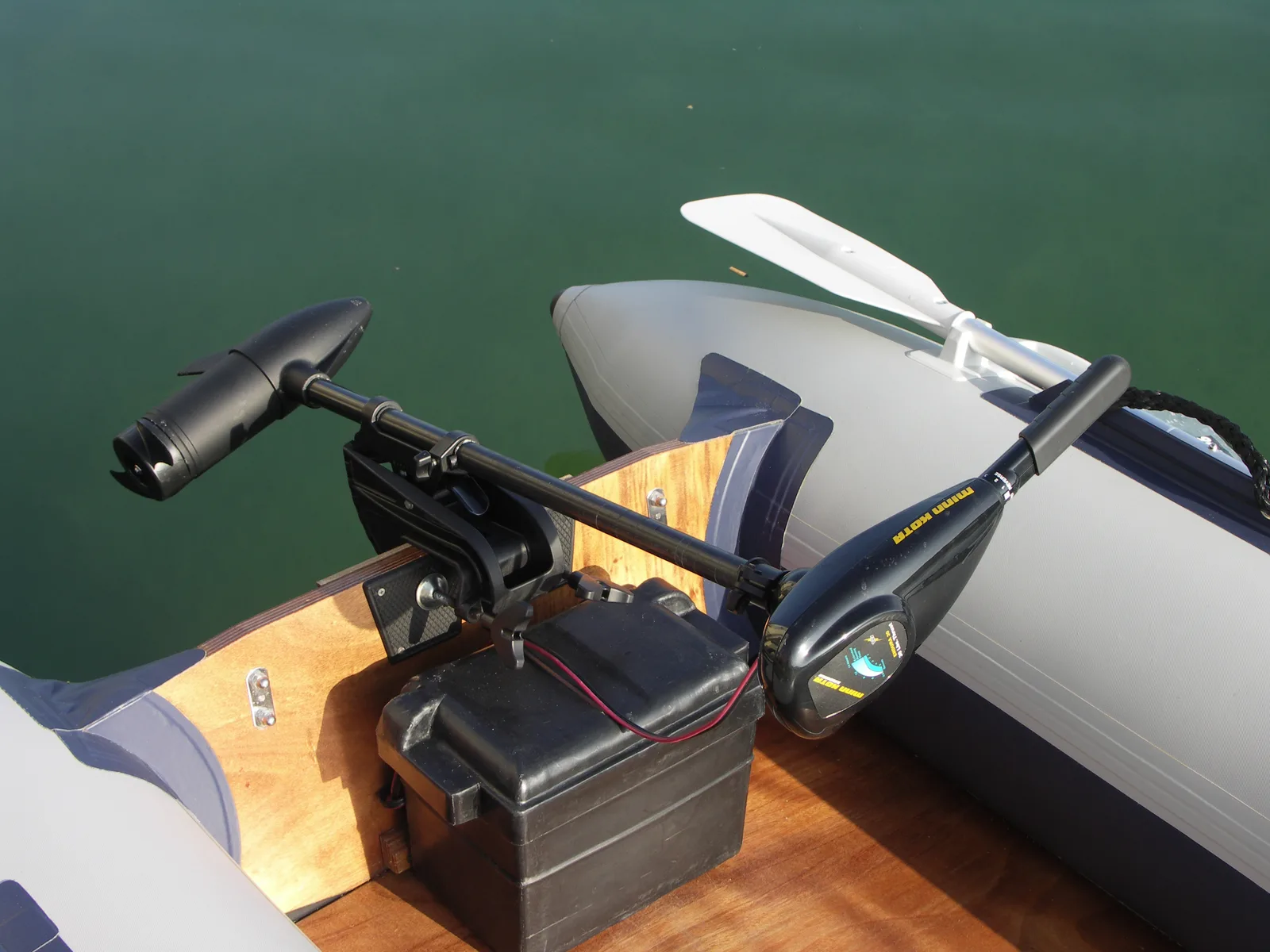 Trolling Motor: How Much Thrust, Which Shaft, Bow or Transom
Trolling motor guide: 2 lb of thrust per 100 lb of loaded boat, 12, 24 or 36 volts, the shaft length chart, bow or transom, and prices from $169.99.

Free PDF · 16 pages
Stop guessing. Know what's biting before your first cast
A whole Saturday on the water with nothing to show for it. One reading tells you who's feeding.
The Water Temperature Fishing Chart. Take one water temperature reading, find it on the chart, and see which of 26 freshwater fish are spawning, feeding hard or slowing down.
- Where bass, crappie, bluegill and walleye sit, and what to throw. Trout: the reading where you stop.
- Why a 3 ft drop beats a cold front, and what to throw each day of the front
- The three thermometer mistakes that make a reading lie
The chart's numbers come from state fish and wildlife agencies and fisheries research: 64 sources, each listed on the site.
No card, nothing to buy. The PDF is in your inbox a minute later, one version for your phone and one to print, yours to keep. Then a few short emails and one a week on what's biting, with an unsubscribe link in every one. Privacy.
Sources (25)
- NMMA, 2024 report on cruisers, watersports, fishing boats and trailers (Sep 8, 2025)
- NMMA, 2024 Industry Sales by Category and State Report (Sep 23, 2025)
- Salt Water Sportsman (Alex Suescun), Field Guide to Fishing Boats (updated Jul 13, 2022)
- Discover Boating (NMMA), Bass Boats
- Tracker Boats, Grizzly 10 Jon (2027) specifications
Show all 25 sourcesShow fewer sources
- Tracker Boats, Grizzly 14 Jon (2027) specifications
- Tracker Boats, Grizzly 1648 SC (2027) specifications
- Tracker Boats, Bass Tracker Classic XL (2027) specifications
- Tracker Boats, Pro Team 175 (2027) specifications
- Alumacraft, Voyageur 175 Tiller (2027) specifications
- Nitro, Z17 (2027) specifications
- Nitro, Z21 XL Pro (2027) specifications
- Minn Kota, Motor Size selection guide (Rev. 8.21.2020)
- 33 CFR 183.21 and 183.23, capacity information and marking
- 33 CFR 183.41, persons capacity, outboard boats
- 33 CFR 175.15, personal flotation devices required
- 33 CFR 175.101 and 175.110, visual distress signals
- 33 CFR 175.320, fire extinguishing equipment required, recreational vessels (Cornell LII)
- 33 CFR 173.27, numbers: display, size, color
- Discover Boating, Boat Registration Guide (updated Mar 10, 2026)
- Texas Parks and Wildlife, boat registration requirements
- boats.com (Charles Plueddeman), Lund vs Crestliner (Apr 9, 2011)
- Discover Boating (NMMA), Pontoon Boats
- Outdoor Life, Best Jon Boats of 2026
- Wikipedia, Johnboat