 By
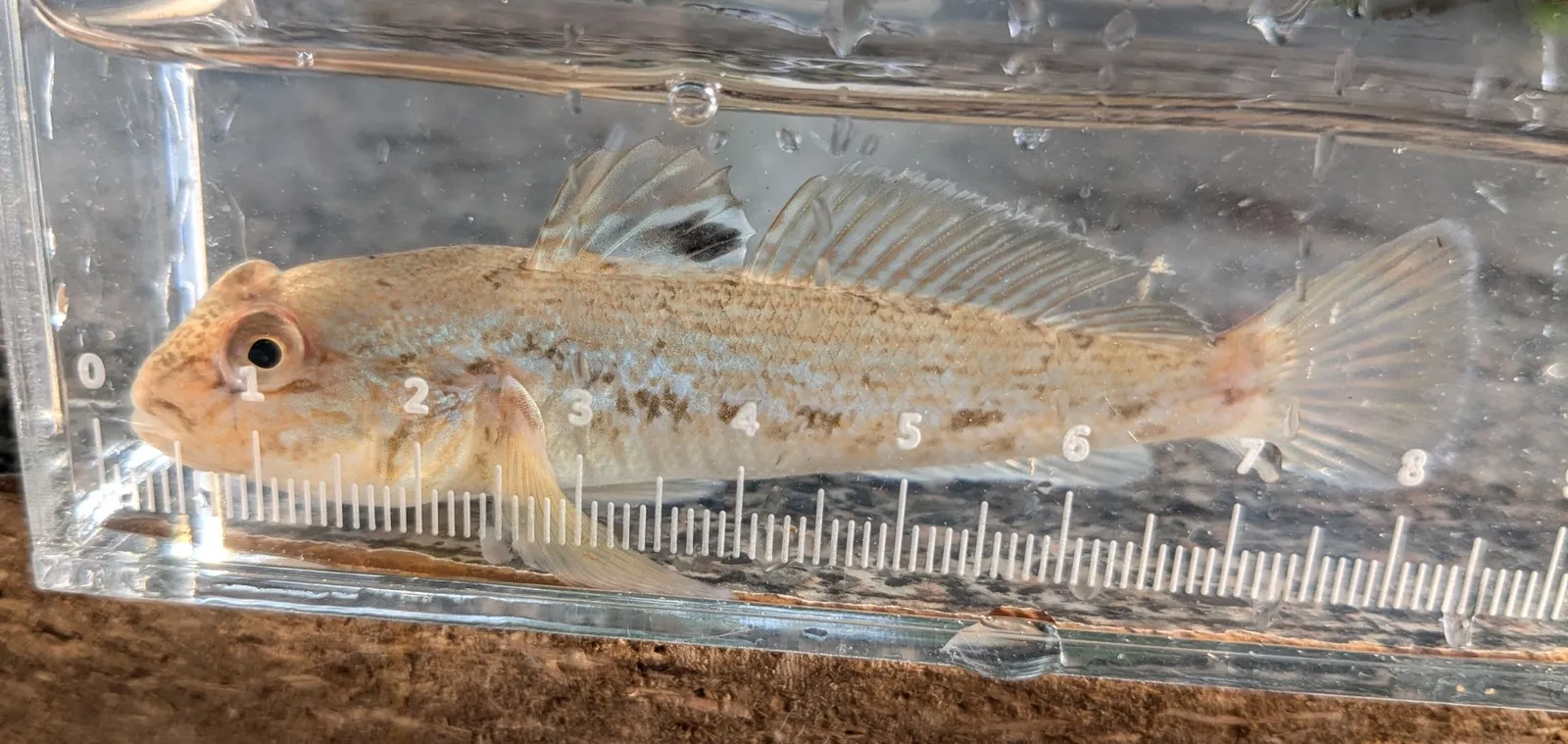
The round goby is a small, aggressive bottom fish from the Black and Caspian Seas that took over the Great Lakes after 1990. It usually runs 3 to 6 in (8 to 15 cm). You’ll know it by the single suction-cup fin on its belly. For you it’s three things. It steals your bait. You mostly can’t use it as bait. And it’s the food that makes Lake Erie smallmouth so fat.
Take a male smallmouth off his nest, and gobies move in and can eat up to 4,000 eggs in 15 minutes.
How do you identify a round goby?
Turn it over and look at the belly. A round goby has one scallop-shaped pelvic fin, fused into a single cup, where the native sculpin has two. Minnesota’s DNR says no native Great Lakes fish has a fused pelvic fin, so that one check settles it. The goby uses that fin like a suction cup to hold onto rocks in current.
Then check the back. There’s a black spot at the rear of the first dorsal fin, the front fin on its back. USGS notes that some Lake Erie fish don’t have it, so the belly fin is the surer test.
The rest of the look: a big round head, thick lips and raised, frog-like eyes on a soft, torpedo-shaped body. Young ones are solid slate gray. Adults are gray with black and brown blotches, and a male ready to spawn turns almost solid black.
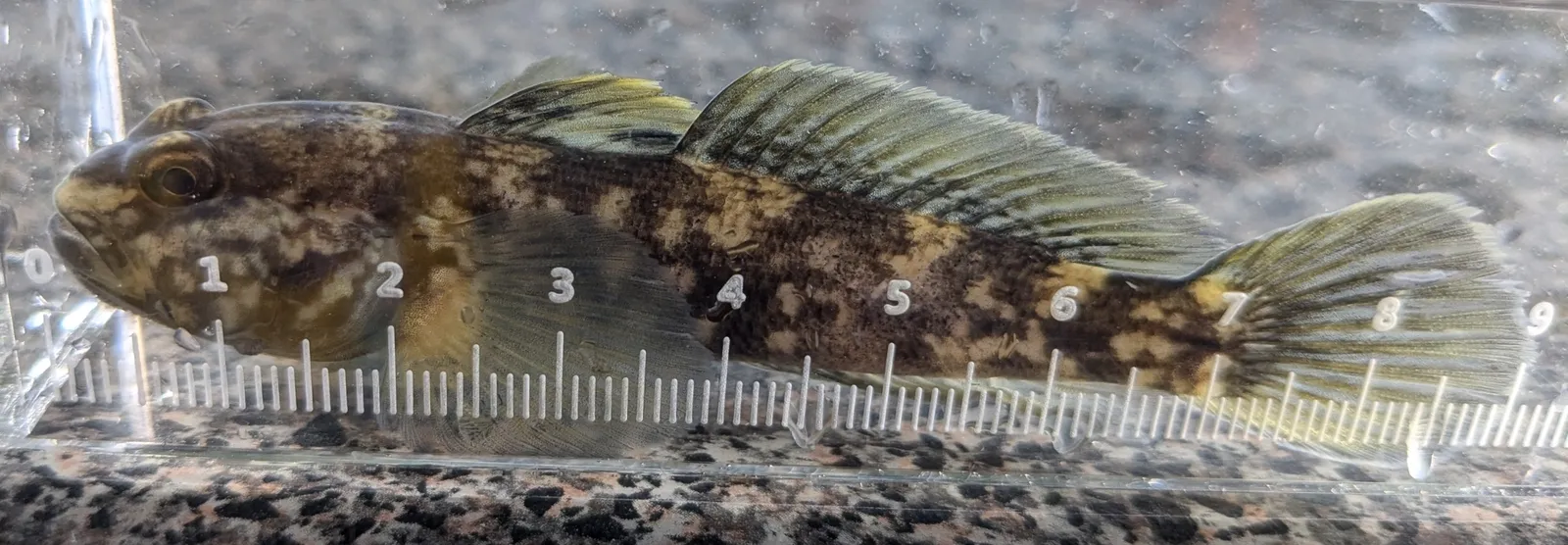
A blotchy adult from the St. Clair River, where the first U.S. gobies were found in 1990. Photo: Quinn (qfc79), via iNaturalist (CC BY 4.0)
Round goby or sculpin: how do you tell them apart?
The fish people mix it up with is the native mottled sculpin, another bottom-hugger with a big head. Get this right before you kill anything. The sculpin is a native and belongs back in the water.
| Check | Round goby (invasive) | Mottled sculpin (native) |
|---|---|---|
| Belly (pelvic) fins | One fused, scallop-shaped fin | Two separate fins |
| First dorsal fin | Black spot at the rear | No big black spot |
| What you do | Follow your state’s rule below | Let it go |
Michigan State University Extension also names the tubenose goby, another non-native, as a look-alike. You’re less likely to meet one: USGS calls it low in numbers and local. Michigan and Indiana cover it with the same live-goby rules.
Free PDF · Water temperature chart Which fish are biting at today's water temperature?
One reading, and the 16-page chart shows which of 26 fish are spawning, feeding hard or slowing down; for bass, crappie, bluegill and walleye, where they sit and what to throw. Every number sourced.
No card, nothing to buy, and the PDF is yours to keep. Confirm with one click and it's on its way. Then a few short emails and one a week on what's biting. Unsubscribe anytime. Privacy.
Can you use round goby as bait?
In most places, no, at least not alive. This is the part that trips anglers up. Gobies are everywhere, bass eat them, and it’s tempting to toss a few in the bucket. Pennsylvania Sea Grant says anglers often do. It also says that’s illegal in Pennsylvania and other states. People moving bait is the main way gobies reach new water, Minnesota says.
Here’s what each state’s own rules say. These are their words, not a summary of them.
| State | What the rule says |
|---|---|
| New York | “Carp, goldfish, lamprey larvae, round goby, European rudd … may not be used for bait.” If you catch one, DEC says “DO NOT RELEASE IT.” |
| Pennsylvania | Unlawful to “possess, introduce or import, transport, sell, purchase, offer for sale or barter” a live round goby. Pennsylvania Sea Grant goes further: “living or dead,” and “Round Goby should never be used as bait.” Officers “regularly check bait buckets for Round Goby.” |
| Michigan | Unlawful to “possess or transport … any live specimen” of round goby. “To do so may result in civil fines up to $10,000.” |
| Minnesota | A prohibited invasive species: “unlawful (a misdemeanor) to possess, import, purchase, transport, or introduce” it without a permit. |
| Wisconsin | A restricted species. From Nov. 1, 2026, gobies “can be kept without limit, however, they must be immediately eviscerated or decapitated or have their gills removed.” DNR also tells anglers “to never use round gobies as bait.” |
| Indiana | No one may possess a live round goby, but you don’t break the rule “if the fish … is killed immediately upon capture.” |
| Illinois | Round goby is a listed injurious species. “The use of live injurious species … as bait is prohibited. Possession of live specimens … is prohibited.” |
| Ohio | A listed injurious invasive species. Unlawful to “possess, import, release into the wild, or sell live individuals.” A dead one must be “headless, preserved in ethanol or formaldehyde, or eviscerated.” The bait rule doesn’t name the goby, so ask the Division of Wildlife before you put a dead one on a hook. |
Two more rules of thumb. Never dump leftover bait in the water: Minnesota and Michigan both say it goes in the trash. And never move a goby, alive, to a new lake. The Menasha Lock was closed to keep them out of Lake Winnebago. An angler still reported the first one there on June 2, 2025.
The live bait and minnows pages cover what you can use instead. Rules change, so check your state’s regulations each season.
What should you do if you catch a round goby?
Don’t throw it back. That’s New York’s advice in capital letters. Michigan, Indiana, Illinois, Ohio and Pennsylvania all bar a live one in your possession, and Minnesota bars one, period. So the safe move is this:
- Check the belly fin against the table above, so you don’t kill a sculpin.
- Kill it right away if you keep it. Wisconsin wants it gutted or headed, or the gills taken out. Ohio wants it headless or gutted. Indiana says a fish killed at once doesn’t break its rule. In Minnesota, don’t keep one at all.
- Don’t take one home in Pennsylvania. The state’s rule book bans a live one, and Pennsylvania Sea Grant says a dead one is illegal too. Leave it out of the bucket.
- Take pictures from several angles, including the underside, as New York asks. Then freeze it, and throw it in the trash once it’s been identified.
- Report it if the water is new. Minnesota wants new sightings reported at once. In Wisconsin you don’t need to report one from Green Bay or Lake Michigan. One from the Winnebago System, you should.
Where do round gobies live?
They’re in all five Great Lakes. The first U.S. fish turned up in Michigan’s St. Clair River in 1990, probably dumped from a ship’s ballast water. By the late 1990s they had reached Duluth Harbor on Lake Superior. They keep spreading up and down the rivers: down the Illinois River, and in New York through the Erie Canal and the Mohawk to the Hudson. New York says they haven’t reached Lake Champlain. USGS has records from nine states:
| State | First record | Latest record |
|---|---|---|
| Michigan | 1990 | 2026 |
| Illinois | 1993 | 2026 |
| Indiana | 1993 | 2025 |
| Ohio | 1993 | 2025 |
| New York | 1995 | 2026 |
| Wisconsin | 1995 | 2025 |
| Minnesota | 1996 | 2025 |
| Pennsylvania | 1996 | 2026 |
| Missouri | 2023 | 2025 |
Missouri is the newest. USGS notes a record doesn’t always mean a population is still there.
In Pennsylvania you’ll find them in Lake Erie and its lower tributaries, Fairview Gravel Pits Pond, Lake LeBoeuf and French Creek.
Look for them in shallow water over rock and sand. They sit on top of rocks and hide in the cracks, and in streams they tuck under big wood. The thickest numbers are from about 3 to 164 ft (1 to 50 m) deep, and they slide deeper offshore in winter. Where they’re thick, they’re really thick: Minnesota has counted up to 20 a square yard.
How do gobies help smallmouth fishing?
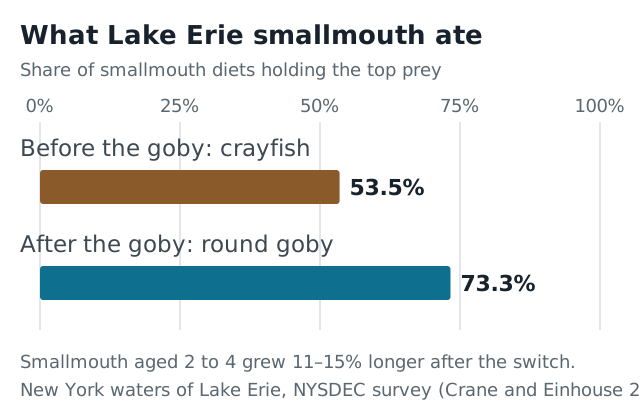
The smallmouth switched to gobies, and they grew. In New York’s waters of Lake Erie, crayfish were the bass’s top prey before the goby, found in 53.5% of diets. Shortly after the invasion, round goby took over, found in 73.3%. Smallmouth aged 2 to 4 ran 11 to 15% longer than before.
Why gobies? They’re “packed with protein and are a heck of a lot easier for a smallie to catch than a shad or shiner,” Bassmaster wrote. They have no swim bladder, so they just hop from rock to rock. Walleye, yellow perch, largemouth, lake trout and lake sturgeon eat them too. The what do bass eat page has the full menu.
There’s a catch. Gobies eat the eggs and fry of smallmouth. A male bass guarding the nest keeps them off. Pull him off it, and gobies pour in and can eat up to 4,000 eggs in 15 minutes, USGS says. That’s why Ohio shut Lake Erie’s smallmouth fishery in May and June starting in 2004. Today the spring rule is one bass a day of 18 in (46 cm) or more, from May 1 to June 26 in 2026.
How do you fish a goby imitation?
Drag it on the bottom over rock, with a short hop now and then. That’s how a real goby moves, sitting on its front fins and darting from one perch to the next. Make a long cast and let it settle. Then work it back in short hops with twitches of your rod tip.
Rig it one of two ways. Put a goby-shaped soft plastic on a jig head for dragging, or hang it on a drop shot rig. Great Lakes smallmouth pro Joe Balog said his Drop Shot Goby bait “revolutionized the drop shot world up here because the forage base is nearly 100 percent gobies.” Both paddle-tail and curly-tail versions are sold. Balog says he made the first commercial goby bait in 2003, and tackle shops around the lakes are full of them now.
Balog’s details for a big goby bait, from Bassmaster:
| Detail | Balog’s pick |
|---|---|
| Color on sand | The lightest color, for gobies on a sandy bottom like Lake St. Clair |
| Color to match a spawner | A dark, purple one, like a spawning male |
| Season | Spring and fall, and on beds |
| Line | 17 or 20 lb fluorocarbon on casting gear |
| Retrieve | Drop it on the bottom and drag it, not a cast-and-reel swimbait |
The bite tells you why the bottom matters. “When a bass hits a goby, they sort of pin it to the rocks by the head and then slurp it up,” Balog says.
Why do gobies steal your bait?
Because they’re all over the bottom and they attack bait eagerly. Minnesota says gobies “may attack and take anglers’ bait, making it nearly impossible to land other preferred fish species.” Walleye anglers in Detroit have reported days when gobies were all they could catch. If that’s your day, you’re in good company.
They feed in complete darkness too, using a sense that picks up water movement, and that gives them an edge over other fish. You’ll catch them on hook and line, and they show up in a minnow trap set for bait. Both are why anglers are often the first to find gobies in a new lake, Pennsylvania Sea Grant says. If that’s your lake, report it.
Why are round gobies a problem?
They push out native fish. Adults defend spawning sites hard and take the best spots, and they eat the eggs and fry of native fish. They can spawn as often as every 20 days from April to September, so their numbers climb fast. Once they’re in your lake, there’s no known way to get rid of them, Minnesota says. Wisconsin calls them nearly impossible to wipe out.
They also move pollution up the chain. Gobies eat a lot of zebra and quagga mussels, which filter the water and can build up heavy metals, PCBs and toxins. Bass, perch and walleye eat the gobies, and that has led to tighter fish consumption advisories, Pennsylvania Sea Grant says. Gobies have also been tied to Type E botulism, which has killed fish and birds on the Great Lakes.
Watch out: Gobies eat mussels that build up heavy metals, PCBs and toxins. Bass, perch and walleye eat the gobies, and that has led to tighter fish consumption advisories.
Not all of it is bad. Lake Erie water snakes now eat mostly gobies, and the snake came off the federal endangered list in 2011.
Can you eat a round goby?
Yes, it’s edible. It’s a common food fish around the Black Sea. The meat is very lean, about 1 to 2% fat. In Baltic taste trials, fried goby scored best. The catch is size: they’re small with strong bones, so they’re hard to fillet. Keep the contaminant point above in mind for Great Lakes fish, and check your state’s advisory for that water first. And in states that bar possession, eating one doesn’t make keeping it legal.
The biology behind the bait thief
A female matures at 1 to 2 years and lays 100 to 4,000 eggs, more in a bigger fish. Females spawn in several males’ nests, and the males guard them fiercely. The most a round goby lives is about 4 years. USGS puts the species at up to 12 in (30.5 cm), but the largest seen in the U.S. is 7 in (17.8 cm).
The bigger ones live mostly on zebra mussels, which no other Great Lakes fish eats so heavily. They also eat insects, snails, small native mussels, fish eggs and small fish.
For the other odd fish in the same water, the other freshwater fish hub has the rest of the lineup.

Free PDF · 16 pages
Stop guessing. Know what's biting before your first cast
A whole Saturday on the water with nothing to show for it. One reading tells you who's feeding.
The Water Temperature Fishing Chart. Take one water temperature reading, find it on the chart, and see which of 26 freshwater fish are spawning, feeding hard or slowing down.
- Where bass, crappie, bluegill and walleye sit, and what to throw. Trout: the reading where you stop.
- Why a 3 ft drop beats a cold front, and what to throw each day of the front
- The three thermometer mistakes that make a reading lie
The chart's numbers come from state fish and wildlife agencies and fisheries research: 61 sources, each listed on the site.
No card, nothing to buy. Confirm with one click and the PDF is on its way, one version for your phone and one to print, yours to keep. Then a few short emails and one a week on what's biting, with an unsubscribe link in every one. Privacy.
Related
Section guide
Freshwater Fish Species Outside the Big Families: Sturgeon, Gar, Bowfin, BurbotThe freshwater fish species outside the bass, trout, catfish and pike families: sturgeon, gar, bowfin, burbot, drum, eel and paddlefish, with records.
 Pacu Fish: Human-Like Teeth, and How to Tell One From a Piranha
A pacu fish is a piranha cousin with flat teeth like human molars. How to tell it from a piranha, how big it gets, and what to do if you catch one.
 Mooneye and Goldeye: How to Tell Them Apart and Catch Them
A mooneye is a silvery, big-eyed river fish with teeth on its tongue. How to tell it from a goldeye, where both live, how to catch them, and how they eat.
 Alewife: How to Identify It, Where It Runs and Why Anglers Care
The alewife is a small silver herring: sea-run on the Atlantic, landlocked in the Great Lakes. How to ID one, where it runs, and where you can keep it.
 Candiru: The Amazon's Vampire Catfish and the Urethra Myth
The candiru is a tiny see-through Amazon catfish that drinks blood from fish gills. What it really does, its size, and the urethra story checked.
 Fathead Minnows: ID, Bait, Pond Stocking and Rosy Reds
Fathead minnows are tough 2 to 3 in baitfish. How to identify them, keep them alive in a bucket, stock a pond by the pound, and spot a rosy red.
 Golden Shiner: How to ID, Catch and Fish This Trophy Bait
Golden shiners are deep-bodied minnows and Florida's top live bait for big bass. How to tell one from a rudd, catch your own, and hook it right.
Sources (26)
- Minnesota DNR, Round goby (Neogobius melanostomus)
- Pennsylvania Sea Grant, Round Goby Fact Sheet
- U.S. Geological Survey, Nonindigenous Aquatic Species: Round Goby (Neogobius melanostomus)
- Michigan Invasive Species Program, Round goby
- Michigan Fishing Regulations, Unlawful Activities
Show all 26 sourcesShow fewer sources
- Michigan Invasive Species Program, Bait and fish release laws
- New York Fishing Regulations Guide, Baitfish Regulations
- New York State DEC, Round Goby
- Wisconsin DNR (2026), DNR Announces New Statewide Detrimental Species Possession And Bag Limit
- Wisconsin DNR (2026), New Round Goby Emergency Rule In Effect On The Winnebago System
- Indiana DNR, Addition of AIS Fish to Illegal Possession List
- Ill. Admin. Code tit. 17, § 810.50 - Bait Fishing, via Cornell LII
- Illinois Administrative Code, 17 Ill. Adm. Code 805.20 (listing of injurious species), via Cornell LII
- Ohio Administrative Code, Rule 1501:31-13-04 | Bait and bait dealers
- Ohio Administrative Code, Rule 1501:31-19-01 | Wild animal importing, exporting, selling and possession regulations
- Ohio Administrative Code, Rule 1501:31-1-02 | Definition of terms
- Ohio DNR, Ohio Fishing Regulations 2026–27 (Lake Erie black bass, 1 May–26 June 2026)
- Pennsylvania General Fishing Regulations (official summary, hosted by eRegulations)
- 58 Pa. Code § 63.46. Sale, purchase or barter of injurious species.
- Minnesota DNR, Minnesota invasive species laws
- IAGLR, Smallmouth bass growth increased following invasion of Lake Erie by the round goby (Crane and Einhouse 2016)
- Bassmaster, This goby's got it
- Dan Armitage, Fooling bronzebacks with fake gobies, Great Lakes Scuttlebutt
- Michigan State University Extension, National Invasive Species Awareness Week: Round goby
- European Commission, Oceans and fisheries (2025), Dealing with the invasive round goby species in the Baltic Sea region: if you can't beat them, eat them
- Eurofish, If you can't beat them, eat them